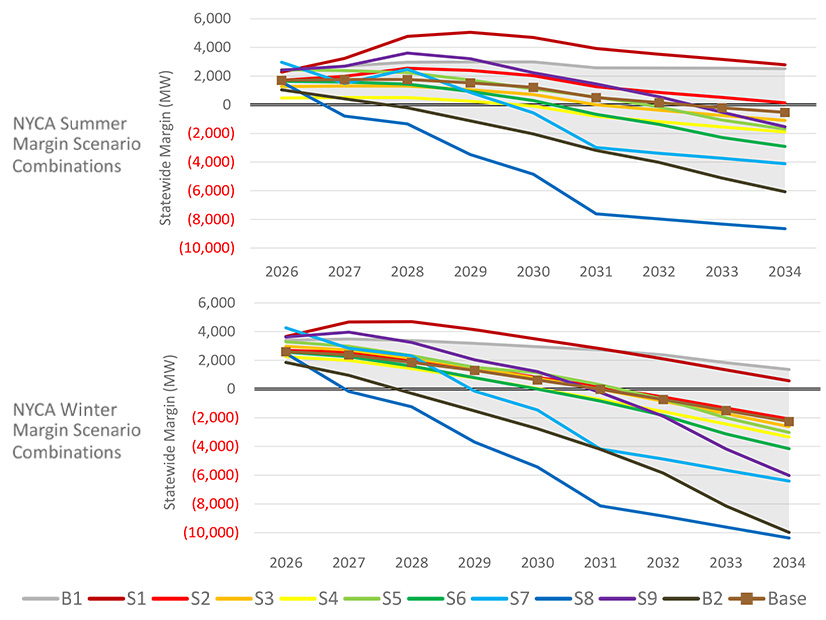
NYISO’s draft 2025-2034 Comprehensive Reliability Plan, released Sept. 25, shows a wide range of possible scenarios for resource adequacy in New York, with the most negative outlook showing a deficit of up to 10 GW by 2034.
The ISO is contending with aging generation, climate change causing heightened weather variability, generator and transmission project delays, and large load additions.
“While each of these factors presents its own set of risks, their combined effects can be far more consequential,” the draft says. “A single uncertainty may reduce reliability margins, but multiple uncertainties occurring together — such as higher demand coinciding with delayed transmission projects or overreliance on aging generation — can result in critical supply shortfalls.”
“The one thing I hope you take away from this presentation is that ‘uncertainty’ is the key theme of the CRP,” Ross Altman, NYISO senior manager of reliability planning, told the Transmission Planning Advisory Subcommittee. “It’s quite critical in how we view reliability with such shrinking margins that we are seeing.”
To illustrate this, Altman pointed to the 2024 Reliability Needs Assessment that identified a reliability need in New York City for about 97 MW by 2033 because of transmission security problems. A change in the demand forecast modeling eliminated the need. (See NYISO Cancels 2033 Reliability Need for NYC.)
“That’s not a very comfortable place to be, but it did resolve the reliability violation,” Altman said.
The draft evaluates each identified risk’s impact on the statewide reliability margin before examining several combinations of the best- and worst-case scenarios from each. It includes 11 scenarios forecasting different system conditions and combinations of demand, new generation, retirement, transmission upgrades and weather conditions.
Of these scenarios, only two saw summer and winter sufficiency by 2034. One of them is a lower-boundary scenario where load growth follows the Lower Demand forecast in the 2025 Gold Book. The other is a scenario in which all generation in the queue is constructed on schedule, and all battery storage is able to be discharged at maximum during peak hours.
“Most of the combinations of scenarios show decreasing margins through 2034, with the range of future margins growing over time. The most optimistic scenario combinations show positive margins by 2034 that are roughly equivalent to today’s margins in the positive 2,000-MW range,” the draft says. “On the other hand, the most pessimistic scenario combinations show deficiencies of up to 10,000 MW by 2034.
“While a negative statewide system margin is not, on its own, a violation of a reliability criterion, it is a leading indicator of the inability to securely meet system load under applicable normal system conditions.”
“We’re really concerned about this whole analysis,” responded Kevin Lang, a lawyer from Couch White representing New York City. He said the margins that determined reliability needs were extremely small. While he said he appreciated the various scenarios and sensitivities included in the draft, he argued that NYISO had a responsibility to explain all of it to the public. The tight margins and differences in outcomes because of different assumptions made “material differences” to whether action had to be taken now.
“This idea that we look at one baseline and say, ‘There’s no reliability need, no need to do anything’ — I think we need to reconsider that,” Lang said. “Because many of your scenarios suggest that there is something.”
Altman agreed and said the ISO should not focus on a single determination or set of assumptions when there is a wide range of possibilities for how the system could evolve. The final CRP’s recommendations would make that clear, he said.
One stakeholder said he hoped the ISO would emphasize that the uncertainties go in both directions so the public would not view forecasting uncertainties in “an overly negative light.”
The draft shows several blank pages and notes about what will be included in the final report.
“There’s no way we’re voting on this in October,” said Doreen Saia, chair of the environmental law practice at Greenberg Traurig. “We cannot rush this. We just got this information. It’s a lot of information. It’s going to be critical to formulate it correctly and responsibly.”
She pointed out that the draft did not include an executive summary, conclusion or recommendations yet.