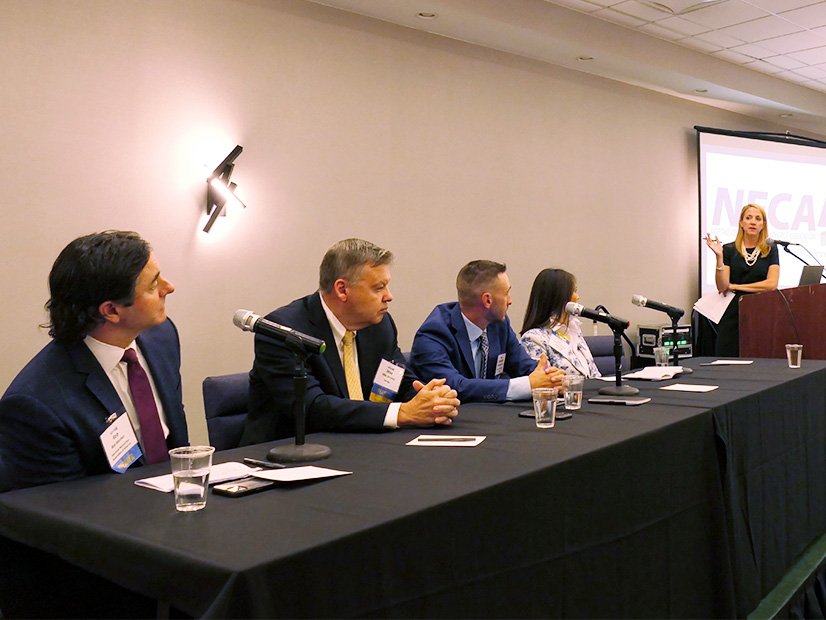
MARLBOROUGH, Mass. — Speaking at an industry conference Sept. 30, representatives of major gas pipeline companies said they are optimistic that political shifts at the federal and state levels will create opportunities for gas infrastructure expansion in New England.
Panelists at the Northeast Energy and Commerce Association’s annual Fuels Conference emphasized the importance of reducing the region’s gas constraints to alleviate affordability and reliability concerns, while downplaying climate concerns about long-term reliance on natural gas.
“After decades of disagreement, a lot of key states are coming around, and a lot of it centers around the need for electric generation,” said Rick Smead, managing director at RBN Energy. He added that data center demand growth in the Boston area has increased the urgency to address gas constraints.
Brooke Thomson, CEO of the Associated Industries of Massachusetts (AIM), the largest business association in the state, said she has “seen a shift” in the political acceptance of natural gas.
“A lot of the change that has come out of the shift in federal administration is trickling down to the local level,” Thomson said, adding that Massachusetts Gov. Maura Healey (D) has emphasized that “everything’s on the table, including natural gas.”
She said the conversation around gas in the state has shifted significantly since the Biden administration, when Massachusetts lawmakers sought to ban new natural gas hookups and succeeded in passing a pilot program allowing 10 municipalities to ban gas connections for most new buildings.
Bill Ryan, chairman of Pilgrim Strategies, a lobbying firm whose largest client is Enbridge, said Healey “has almost gone out of her way to talk about the reality of natural gas in the current energy mix and the future energy mix.”
While the industry was on the defensive in Massachusetts under the Biden administration, “I think we’re in a different arc right now,” with political leaders in the state “singing a different tune,” Ryan said.
Speakers at the event stressed that the gas industry should double down on their efforts to drive the narrative around gas in the state.
“We’ve really made some gains in having people better understand the impact of natural gas,” said Mike Dirrane, director of Northeast marketing at Enbridge. “We’ve seen a change in the narrative, even in the media.”
“I think we need to be even more aggressive in pointing out the benefits of the natural gas industry,” he added.
Earlier in September, Enbridge announced a $300 million project to expand the capacity of its Algonquin pipeline into Massachusetts by about 75,000 Dth/d. Dirrane said the company has reached agreements with seven utilities in New England to support the expansion, which Enbridge expects to be completed in 2029. The project would not require any new compression, he added.
The project would be a relatively small expansion of the pipeline, which has a peak day capacity of over 3 million Dth. It appears to be a significantly scaled-back version of Enbridge’s 2023 proposal to increase Algonquin’s capacity to Massachusetts by 250,000 Dth/d. (See Enbridge Announces Project to Increase Northeast Pipeline Capacity.)
Dirrane said the project will meet “some of the critical needs right now” but speculated that a subsequent project may be necessary “to meet additional needs further down the road.” He said Enbridge has met with “all of the administration officials in New England” and has “had some great dialog and really good education on the benefits of natural gas and its impact on affordability.”
The project will likely be met with significant resistance from climate organizations in the state, which have opposed all efforts to expand gas capacity into the region. Environmentalists argue that increasing the long-term reliance on natural gas is not compatible with reaching net-zero emissions by 2050; methane is a potent near-term greenhouse gas and a key contributor to manmade climate change.
Smead applauded the effort to increase pipeline capacity to the Northeast. While the Algonquin expansion is “not a huge project,” he expressed his hope that “there’s going to be more of these that keep ramping up capacity, rather than a big monster that gets in all the papers.”
He stressed that, despite changing political attitudes around gas expansion, key barriers to addressing New England’s gas constraints remain.
He highlighted a pair of large pipeline projects to the region that were shelved during President Donald Trump’s first term: Kinder Morgan’s Northeast Energy Direct project and Enbridge’s Access Northeast project.
“The reason stuff didn’t get built in New England was because people didn’t want to pay for it, not because environmentalists lay down in the right of way,” Smead said.
The financing challenges for new pipelines in New England are often attributed to the fact that gas utilities have been reluctant to sign long-term contracts to support major projects; electric utilities are not allowed to use ratepayer funds for pipeline contracts; and gas generators typically do not sign long-term firm supply contracts. (See New Pipelines Unlikely for New England, Experts Say.)
While New England generators often struggle to access pipeline gas during the coldest days of the year, gas generation in ISO-NE has increased steadily in recent years, hitting its all-time high in 2024 amid reduced electricity imports from Canada. (See New England Gas Generation Hit a Record High in 2024.)
“It’s not necessarily in the interest of the generators to pay for it if they make their money off of volatility,” Smead added.
The Role of LNG
Multiple speakers emphasized the importance of the Everett LNG import terminal to the region and said there may not be a single solution to replace the facility when its contracts with Massachusetts gas utilities expire in 2030.
When approving the contracts, the Massachusetts Department of Public Utilities directed the utilities to develop a plan to reduce their reliance on the import terminal. (See Massachusetts DPU Approves Everett LNG Contracts.)
Everett, which is north of Boston, supports direct injection into the gas network and the dispatch of LNG trucks to other points on the system.
Jeff Tounge, development lead at Cashman Preload Cryogenics, outlined the company’s proposal to build an LNG storage tank in Northern New England that could supply 200,000 Dth of gas for winter reliability and inject enough gas to supply a 1,300-MW gas plant for 10 days during peak demand.
He said the project would provide reliability benefits during cold winter periods and that Cashman is seeking long-term utility contracts for the project.
Charlie Riedl, executive director for the Center for Liquefied Natural Gas, said he sees an important role for both LNG infrastructure and additional pipeline capacity.
“What the Northeast really needs is additional pipeline capacity to complement LNG,” Riedl said, adding that “pipelines are the most cost-effective way to meet growing demand.”
Emissions Limits
Also at the meeting, several speakers said they hope Massachusetts will re-evaluate its legally binding decarbonization targets, which require the state to cut its emissions by 50% by 2030 and at least 85% by 2050, relative to 1990 levels.
“There should be a real hard look at going back and providing some flexibility there” to account for “what’s potentially feasible right now,” AIM’s Thomson said.
“I think it’s possible that the House does this,” she added. “Do I think the Senate would do this? I don’t think they would, but I hope they consider it.”