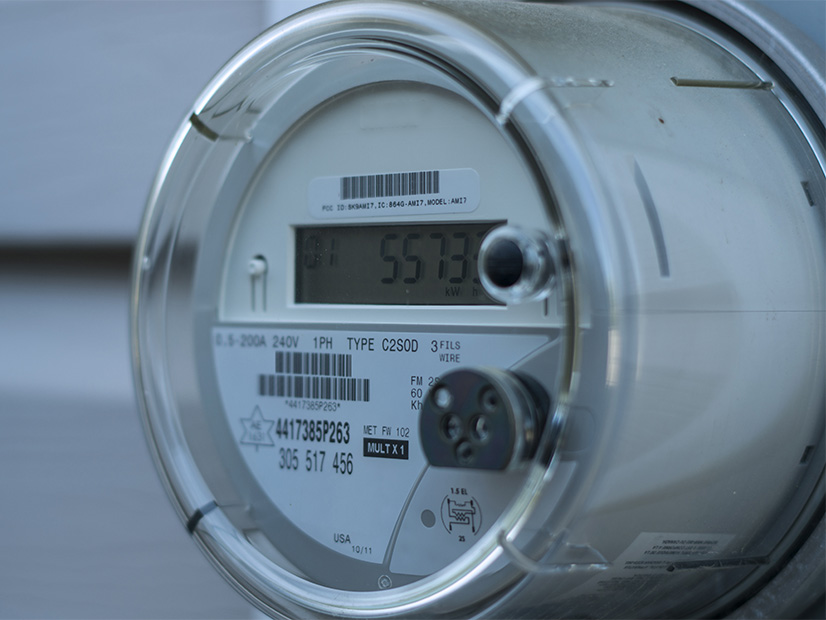
Curtailment service providers Voltus and Mission:data have filed a complaint with FERC against PJM, alleging its rules are unjust because they require the companies and other demand response providers to submit load-reduction meter data for their customers when they have little to no meaningful access to them (EL26-4).
Utilities have access to those data because of their investments in smart meters, the companies argued in their complaint filed Oct. 8. The companies requested that PJM be required to change its rules so that CSPs can use the RTO’s statistical sampling method (used when smart meters are not available) if they submit a sworn declaration, with appropriate notice to the relevant state regulator, certifying that interval meter data are not available from the utility.
State regulators would be notified of the issue and then could require changes from their utilities to allow the use of actual meter data, the companies argued.
The issue already has come before FERC, when CPower filed a complaint in 2023 asking to use statistical sampling to measure its customers’ DR. FERC denied the complaint, finding that the DR aggregator had not offered enough support that it and other CSPs were unable to procure the data.
Before CPower’s complaint, it tried to get changes through PJM’s stakeholder process, but it said it was thwarted by entities that benefit from the status quo. (See “Stakeholders Narrowly Reject Demand Response Problem Statement and Issue Charge,” PJM MRC Briefs: Oct. 24, 2022.)
Part of the issue is that the RTO’s rules were developed for large commercial and industrial customers, Voltus and Mission argued, but CSPs work with residential customers by aggregating home automation systems and devices like smart thermostats to build DR aggregations and bid them into PJM’s capacity markets.
“For meaningful participation in the PJM market to occur for residential customers, CSPs must have scalable, efficient and meaningful access to differentiated interval meter data that will accommodate concurrent registration of thousands of residential customers if there is to be effective participation by these classes of customers,” the companies said in the complaint.
Getting those data from utilities is either not possible, or it comes with impractical requirements that make it infeasible, they argued. Voltus also prepared a position paper, filed with the complaint, that purports to show the validity and accuracy of aggregated load data are as accurate as high-quality individual meter data.
“Accordingly, requiring the submission of hourly interval meter data when access to that data is not readily available and when statistical sampling or aggregation is sufficiently accurate is unjust and unreasonable,” the complaint said. “The requirement is also discriminatory when utilities do not have the same barriers to accessing hourly meter data and under the PJM tariffs can and do participate as direct competitors to competitive aggregators acting [as] CSPs.”
Voltus said it reached out to some major utilities in the RTO about using the Green Button Connect or Electronic Data Interchange, or otherwise getting 18 months of interval data, peak load contributions, and capacity and energy loss factor values when customers authorize it to get their data.

Commonwealth Edison offers online tools for retail suppliers to access customer data, but it limits the requests to 10 accounts at a time. The use of third-party tools to access larger numbers of accounts does not work because of an irreversible two-factor authentication process, Voltus found.
“In other words, every time any party needs to access the data, the customer him- or herself must complete the two-factor authentication, and if a customer initially chooses two-step verification when establishing online registration with ComEd, the customer cannot reverse it or disable it on a go-forward basis to permit third-party access and would have to reauthenticate a dozen or more times a year,” the companies said in the complaint.
A successful lawsuit required changes to how ComEd shares customer data, but so far, the utility has yet to implement any changes. Voltus signed up 20,000 customers in the utility’s territory, but it got only enough data for 4% of them to bid into PJM, meaning 23 GW of new capacity were unavailable to the RTO.
The complaint explains similar experiences with other utilities and lays out the basic findings in a table.
Access to utility data on residential customers could be accomplished by changes to state rules, but the complaint argues numerous proceedings at that level “will not result in a uniform, efficient and effective approach to a regionwide issue applicable to the entire PJM market and will deprive PJM of needed and beneficial resources during a time of unprecedented load growth, increasing capacity constraints and concern for reliability.”
Allowing statistical sampling when the retail customer is not practically available does not infringe on state jurisdiction and would give the market a uniform and efficient approach to the issue, the companies argued. The statistical method becomes more accurate the more meters are included in an aggregation and with enough of them, it “can far exceed the effective accuracy of existing standards,” they said.
The companies noted that FERC has recognized that with enough evidence, it could be proved that lack of access to meter data is a barrier to meaningful participation in wholesale markets, citing a concurrence in the CPower complaint by Commissioner Judy Chang.
“Voltus has now provided such evidence above,” the companies said. “FERC precedent has consistently emphasized the removal of unnecessary barriers to demand response and distributed resource participation in wholesale markets, particularly noting the benefits of removing barriers that prevent smaller resources from providing services to the grid when larger resources can more easily meet certain requirements.”