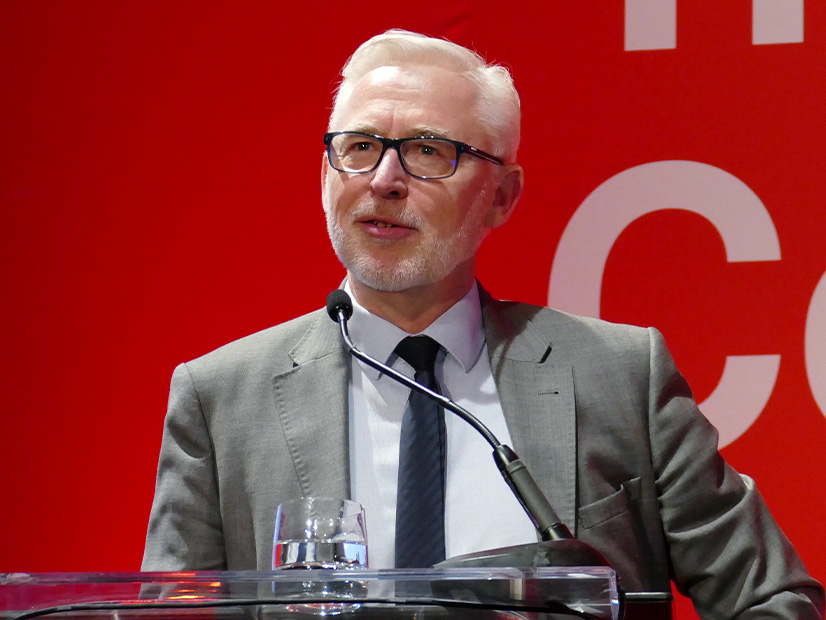
WASHINGTON — In ISO-NE CEO Gordon van Welie’s time running the grid operator, it has seen natural gas come to dominate generation in the region. An even bigger shift is under way now as state policies demand a grid increasingly powered by renewables.
The shift to natural gas led to cleaner generation than the mix 25 years ago, but it also has come with unexpected developments, van Welie said Oct. 23 at the S&P Global Nodal Trader Conference. “One of the big assumptions at the start of the market was that fuel will always be available,” he added. “And of course, the fuel is not always available.”
While natural gas generation is cheap enough most of the time to push other resources off the system, during winter cold snaps, the region struggles to attract enough of the fuel. Gas and electricity prices then skyrocket. With state policy shifting more heating and transportation demand onto the grid, winters promise to become more volatile.
“So, the big point, from a trading point of view, is much higher volatility than we’ve ever seen in the winter,” van Welie said. “The second point is that emissions reduction will be seasonal. We will decarbonize the spring and the fall way before we decarbonize the winter, if ever.”
ISO-NE sees negative prices in the shoulder seasons because of the proliferation of renewables. And van Welie said he expects that trend will grow. But serving a rising share of winter demand with 100% renewables would be costly because the reliability value of wind and solar declines as more resources are added to the grid.
Solar has a massive impact in New England, which van Welie described as a 42-GW system with 10 to 12 GW sitting behind the meter.
“If you can have firm, dispatchable, zero-carbon generation, the mythical ‘DEFR’ as New York invented this resource in their capacity expansion models — dispatchable emissions-free resource — you can really not only support reliability, you can dramatically reduce all that cost,” van Welie said. “The problem is that resource doesn’t exist today. Maybe SMRs will fulfill that role in the future, but for now, the balancing resource is natural gas.”
Another economical answer is price-responsive demand because reductions can happen during winter peaks when producing power is most expensive. On top of price volatility issues, getting the last 15 to 20% of decarbonization will be the most expensive. The grid needs to expand to handle more renewables, which cuts energy market revenues for balancing resources needed to meet winter peaks.
“You need balancing resources to keep the lights on,” van Welie said. “That money has got to come from somewhere, so that’s the resource adequacy construct, and those constructs are under a lot of pressure right now.”
ISO-NE expects the role of natural gas to grow in coming years as demand growth is outpacing the addition of renewable resources, which eventually will bring down emissions, though doing so all on their own could prove too costly for the region’s future policymakers.
“Taking the last bit of carbon out of the system becomes increasingly expensive,” van Welie said.
With affordability an ever present issue, policymakers might decide that 80% of the way to net-zero emissions is enough, he added.
The queue in New England today is dominated by renewables and batteries because that is what investors think can get built and what state policies are pushing. A significant resource the region was counting on was offshore wind, which has 15 GW under development.
“That’s got a big question mark against it. It’s been disrupted,” van Welie said. “My guess is offshore wind has been knocked back at least a decade, and so does raise the question for the region, which is, where’s the supply coming from in order to meet this demand that’s projected?”
The questions around offshore wind have New England policymakers thinking about gas again, but that must be weighed against long-term decarbonization goals that could risk stranded costs. While the markets did well to bring investment onto the grid and shield customers from the risk of bad investments, ISO-NE is making major changes to its capacity construct to better deal with winter reliability issues.
“We need to move to a prompt, seasonal market with marginal accreditation and modeling of the gas constraints,” van Welie said. “We’ll be the first region to actively clear the capacity market by modeling a gas constraint.”
If the markets are going to succeed at guiding New England through an affordable, reliable transition to a net-zero grid, as they did to a system dominated by natural gas, states must embrace the markets,” van Welie said.
“Ultimately, the markets are a means to an end,” van Welie said. “The states are the ones that created the markets. The states are the ones that can undo the markets. So, they need to have ownership and support for the market construct.”
If states support a capacity market it could work. If they do not, they will find a way around it and meet their policy goals some other way, he added.