
BOSTON — An increasing political anxiety around energy affordability permeated debates about wholesale market changes, federal policy and demand growth at the annual New England Energy Summit on Dec. 2.
Speakers at the event, hosted by the New England Power Generators Association (NEPGA) and the Dupont Group, grappled with how to lower consumer costs while simultaneously supporting the development of new generation and transmission infrastructure needed to keep pace with accelerating demand growth.
Panelists also expressed differing views on how prepared the ISO-NE markets are for a rapid increase in demand.
NEPGA President Dan Dolan stressed that wholesale markets have not been the cause of rising retail energy costs in New England, noting that capacity prices have remained low in recent auctions.
These low prices have contributed to “a four-year major retirement cycle with over 3,000 MW going away,” Dolan said.
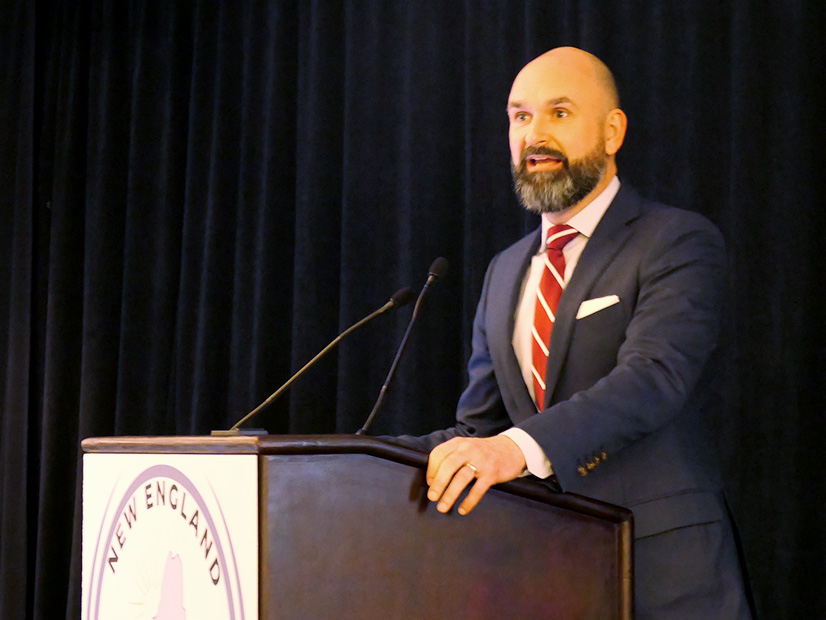
He emphasized the need to first ensure the markets are sending the right signals, and then let them operate, even if that leads to periods of high prices. To allow the market to respond to high prices, state and federal policymakers must focus on lowering barriers to development, he said.
He acknowledged that this is “easy to say, but extraordinarily politically challenging to implement.”
‘Massive Stress’
ISO-NE CEO Gordon van Welie said the transition to wholesale markets has brought major cost savings to the region over the past 25 years, in part by helping to shield consumers from poor investments. But there is still work to do, he said.
“There was a moment in 2019 when we seriously considered abandoning the capacity market,” he said, pointing to problems in the RTO’s Forward Capacity Market related to forecasting, phantom entry and accreditation. Its ongoing Capacity Auction Reform project is intended to address these issues for the 2028/29 capacity commitment period (CCP).
Van Welie added that the region would benefit from a more robust bilateral trading regime, which could help reduce volatility for consumers. He expressed hope that the RTO’s proposed transition to a prompt capacity auction — in which auctions would be held about one month prior to each CCP — would “push people more into bilateral contracting.”
While ISO-NE’s prompt market proposal has garnered strong stakeholder support, some NEPOOL members have voiced concern that the shift to a prompt market could increase inter-annual price volatility, while adopting a seasonal market would introduce intra-annual volatility. Some stakeholders have asked the RTO to look at ways to encourage bilateral trading to hedge the volatility risks.
Van Welie, who is retiring from the RTO at the end of the year, said market volatility increases the likelihood of political intervention — such as price caps — in the markets.
He added that politicization around energy has already increased in recent years, creating “massive stress” within ISO-NE, with various groups often blaming the RTO for issues outside of its control and politicians using the RTO “as a piñata.”
“It’s escalated to the point of bomb threats and death threats, and I think that’s really not a good place to be,” he said.
Yin and Yang
Referring to the political blowback that occurred in PJM following skyrocketing capacity prices, Anthony Crowdell, senior analyst for Mizuho Americas, expressed pessimism about the future of wholesale markets in a world of rapidly growing demand.
“I think that politicians will end up blowing up the markets,” Crowdell said.
Regarding offshore wind development, he said the Trump administration’s efforts to undermine the industry appear to have done irreparable damage.
“Unless it is a state entity or a federal entity building it, offshore wind is done in the United States,” Crowdell said.
Justin Trudell, CEO of FirstLight Power, said changes in federal policy have caused the company to shift some investments to Canada.
“The next hundreds of millions of dollars that we invest through FirstLight are going to be in Ontario and, likely, in Quebec,” Trudell said.
“What we’re seeing in Canada is when you do have alignment with the provincial and federal governments, you’re seeing explosive growth,” he added.
Other speakers downplayed the Trump administration’s long-term effects on energy development.
“I think there’s a lot of noise in the current administration, but I don’t see a lot of tangible things,” said Curt Morgan, CEO of Alpha Generation. He added that, beyond the offshore wind industry, “I don’t think they’ve moved the needle that much.”
Sherman Knight, CEO of Competitive Power Ventures, echoed Morgan’s comments and said the federal policy changes have not shifted the company’s priorities in the 2030-2035 time frame.
“I think we have to think about it from a more fundamental standpoint of what’s going to work,” he said. “There’s so much uncertainty over that long period of time, and you just can’t develop and build even within an administrative cycle.”
With significant demand growth on the horizon, Morgan stressed the need to stop the cycle of generator retirements. He criticized ISO-NE’s Pay-for-Performance (PFP) rules, which have led to significant penalties for slow-start thermal generators during capacity deficiency events.
“I have some real concerns about how we’re treating existing generation. But I tell you, over time, that generation is going to become as valuable as gold,” he said.
He also criticized the frequency of rule changes in the ISO-NE capacity market.
“Almost every year, we’re making a tweak or a change to the capacity market,” Morgan said. “People don’t believe the markets are going to be allowed to work, and frankly they haven’t been allowed to work.”
ISO-NE board Chair Cheryl LaFleur said that hints at an “age-old dilemma” that frequently came up during her time at FERC.
“People say ‘stop making changes, do not make any changes … except fix [PFP], fix ancillary services — just make my change, then stop making changes.’ It just seems to be the constant yin and yang.”
“I didn’t say it was easy,” responded Morgan.