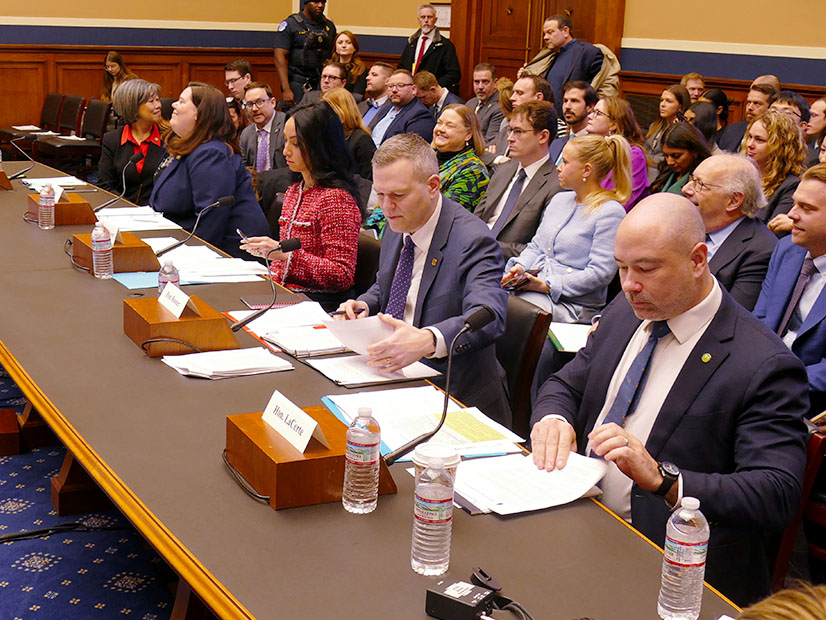
WASHINGTON — All five FERC commissioners faced questions from the House Energy and Commerce Subcommittee on Energy on how to balance reliability and affordability as demand grows.
“FERC stands at a critical juncture in history, domestically and in the world,” FERC Chair Laura Swett told the subcommittee during an oversight hearing Feb. 3. “We’re in a global energy arms race created by the rise of technology, its tremendous load growth, and our push to onshore manufacturing and jobs. I want the United States to lead that race.”
FERC is working to streamline its processes, cut connection times and ensure efficient, durable infrastructure development, she added.
The commission’s main job is to deliver affordable and reliable energy for Americans while upholding Congress’ vision for a bipartisan, independent and resource-neutral regulator, Commissioner David Rosner said. That is easier said than done, especially with all the changes the industries it regulates are facing, he said.
“Our energy systems face these pressures at a time when families and small businesses have been struggling with high prices, including their utility bills,” Rosner said. “While meeting this moment presents challenges, it also creates opportunities for us to modernize America’s energy infrastructure.”
To submit a commentary on this topic, email forum@rtoinsider.com.
While the demand growth, largely from data centers, does present the opportunity to modernize the grid in a way that increases reliability and efficiency, FERC has work to do to make that a reality, Commissioner Judy Chang said.
“To date, the system buildout has contributed to high prices for customers, whose utility rates have already increased in recent years due to other factors,” she said. “Thus, as regulators, the commission has a responsibility to guide the industry’s efforts towards cost-effective and durable solutions that address these pressing challenges while protecting customers from adverse reliability and cost impacts.”
The hearing was held as the district is still digging out from the late January winter storm, and many members of Congress noted it took out power to more than 1 million customers. Ranking Member Kathy Castor (D-Fla.) noted that the storm knocked out some transmission lines owned by the Tennessee Valley Authority. But the bulk power system largely held throughout the winter weather, FERC Commissioner Lindsay See said.
“Though information is still coming in, I’m encouraged to see good results from better winterization and prep work, and coordinating across the gas and electric industries,” See said. “We have more to do in these areas, but the progress so far is real.”
Subcommittee Chair Bob Latta (R-Ohio) asked his standard question of whether the U.S. needs more power — to which all five commissioners answered “yes” — before asking Swett how FERC is working to ensure regulatory certainty to help that happen.
“We are taking a hard, holistic look at the open items at FERC,” Swett answered. “First of all, I shut down quite a few lingering dockets at my first meeting with the help of my colleagues here. That is one way to eliminate uncertainty that has come from previous administrations. Another way is to end the flip-flopping of FERC’s regulatory paradigm and the uncertainty that’s created by increasing regulation that has built up over the years that far exceeds what FERC’s mission is under the law.”
Castor asked what FERC was doing to speed up the interconnection of new power plants on the grid.
Chang answered that the commission has been working on that for years, with Order 2023 requiring a first-ready, first-served approach with cluster studies for interconnecting projects. Progress is being made to speed up the queues, she said.
“No matter how fast we can study the projects in the generation interconnection process, one of the bottlenecks I talked about in my opening statement is the transmission system,” Chang said. “So, if the transmission system is not ready, or if it’s inadequate for interconnecting the generator and the load, that becomes the bottleneck.”
Affordability was the focus of many questions, with Swett noting that the aspects of the power system that FERC regulates are responsible for about one-third of the average customer’s bill.
“Increasingly Americans are struggling in paying those utility bills,” Rep. Alexandria Ocasio-Cortez (D-N.Y.) said. “In 2024, more than a third of households skipped out on necessities to pay an energy bill, and close to a quarter of households kept their homes at hazardous temperatures to avoid the cost of heating or cooling. Yet the energy utilities charging Americans are among some of the most powerful and profitable companies on earth.”
She then started asking Swett questions about the average return on equity FERC approves for utilities engaged in interstate commerce. She ran short of time for questions, but later Rep. Greg Landsman (D-Ohio) picked up where she left off.
“Most Americans don’t know how much power you all have in terms of adjusting down the profit margin in order to adjust down some of these utility bills,” Landsman said.
He asked Swett what kind of debates FERC is having about lowering power bills for consumers considering their ability to trim utility profits.
“The heated debate we are having is a contest to see who can save ratepayers more money,” Swett said. “Every time we have a docket come before us, every single one of them has raised, ‘Well could we lower this, or can we lower that? How is this going to pass through to consumers?’”
Landsman then asked how quickly FERC could act to lower utility profits by trimming their rates.
“Every single rate that comes before us, we do look at what rate of return the utility has,” Swett said. “And that can help Americans, but like I said, that’s only one-third of the bill that they pay every month.”