Electricity markets increasingly are in the political spotlight, and that includes attention from the biggest figure in politics over the past decade.
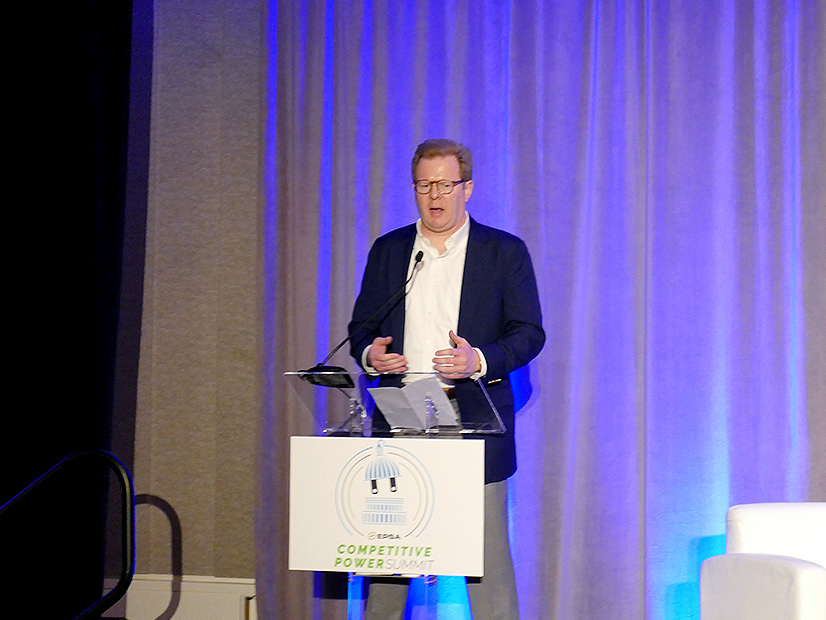
“I’m frequently reminded about how consistently the president talks about co-location,” White House National Energy Dominance Council’s (NEDC) Peter Lake said on March 3. “He’ll mention co-location twice a week, which means I hear about it twice a day.”
Sometimes Lake will get a call from the West Wing on a day without any NEDC events because President Donald Trump brought up the concept at a speech on healthcare, Lake told the crowd at EPSA’s Competitive Power Summit. The president’s focus on co-locating generation with large loads shows how focused he is on meeting the data center demand driven by artificial intelligence, a technology he says the United States needs to dominate.
“Power is the big constraint on unleashing this generational technology,” Lake said. “And just like the combustion engine or the microprocessor, this is one of those technologies where America cannot afford not to be No. 1.”
With leading tech firms planning to spend hundreds of billions of dollars a year on data centers, AI has brought demand growth. Higher power prices, especially in PJM where the capacity market cleared short again, have attracted Trump’s attention. That led the White House and 13 governors of PJM states to jointly call for a backstop procurement auction to get more supply online for large load customers. (See White House and PJM Governors Call for Backstop Capacity Auction.)
“As a stakeholder group, we would ask you all, sincerely and enthusiastically, to please work with PJM to help reform the regular capacity market and the regular energy market,” Lake said. “The focus, rightly so, is a lot of time on the reliability backstop auction, but we very much intend for that to be one time only.”
Ideally, PJM will hold the backstop auction and two previously scheduled Base Residual Auctions in 2026, and then in 2027 the markets can get back to normal — where existing generation is maintained, new units are incentivized and prices are reasonable, he added.
Lake spoke a day before Trump gathered tech executives to sign a pledge where they promised to pay for any power costs their data centers cause. (See Trump Gets Tech Execs to Sign ‘Ratepayer Protection Pledge.’)
“We can build enough power supply to meet the demand of AI and maintain affordability,” Lake said. “And this is where the president’s leadership has been truly extraordinary, in cutting the deal with the PJM governors to set up a framework in which we have a clear line of sight on how to build the new baseload and build big power in America again.”
The 13 governors represent PJM states across the political spectrum, but they agreed on the basic framework to address the issues the RTO faces, he added.
“My assumption when I took this job was that if the White House figures out what FERC is, you may not be in this role anymore, and that the White House knows what PJM is — oh my gosh, you know — what happened?” FERC Commissioner David Rosner said earlier in the day. “And both are true, and we’re OK.”
The stakeholder process in PJM is messy and complicated. Hearing views from some new parties and the resulting political attention has been fine, Rosner said.
“I think that, at a high level, this is very positive, because it wasn’t so prescriptive,” Rosner said. “They didn’t know all the answers, but they brought people together on some concepts, and … we have to work with everybody in this room to make sure those concepts turn into steel in the ground.”
The only way rising demand can be met is if “the force of capitalism” is unleashed to meet it, which means getting the market design right.
“I know a lot of people like to talk about PJM as a problem, but my sort of opening statement is, PJM, as it currently exists, saves people billions of dollars,” Rosner said. “And we should work on the problems and make it better to meet the moment.”
Political attention on markets can lead to changes. Now that politicians are increasingly focused on affordability, that could lead to some knee-jerk reforms, said Wolfe Research Senior Analyst Steve Fleishman.
“Obviously, they do need to get elected, and they’re focused on that, but it does require a lot of us in the market seeing through a lot of noise, which is not easy,” he added. “It’s hard, hard for our investors, particularly the ones that aren’t in weeds on everything to assess.”
So far much of the posturing on affordability has been more bark than bite, said Fleishman.
“Now we’re in the middle of everything, and AI and data center focus is the No. 1 thematic,” Fleishman said. “So, this is a real change for us, and I think it puts everybody at a higher level of alert.”
The demand comes at a time when the costs are growing; a new natural gas plant that recently cost $800 million to build now costs $2 billion, he added.
Affordability is a Concern Outside of ISO/RTOs
While PJM dominated the discussion at EPSA given its membership and the RTO’s recent attention from the White House, the entire country is dealing with affordability. NARUC President Anne Rendahl of the Washington Utilities and Transportation Commission said communication helps deal with the issue.
“We talk to the governor’s office,” Rendahl said. “We talk to the legislators. We have a good relationship and try to explain what we do and how we do it. But we need to do a better job with our utilities’ customers.”

Regulators need to explain that utilities not only have fair rates, she said, but rates that are enough to maintain a reliable system. “We can’t just cut the ROE [return on equity], cut the CEO pay — that’s not what we do,” Rendahl said.
If regulators can explain how they balance those sometimes-competing issues to lawmakers and consumers alike, that can help, she said. It also would help if utilities and the broader industry did the same, she added.
In North Carolina, Chris Ayers feels the same political pressure. Ayers is the public staff executive director of the utilities commission.
“I can tell you that I’ve taken more calls from legislators over the last six months than I have probably in the last several years combined in terms of why are rates going up, and are they going to continue to go up?” Ayers said. “What’s driving it, and why? You know, why can’t we do something about this?”
Most of North Carolina is served by Duke Energy with its own balancing authority, but part of the northeast is served by PJM member Dominion Energy.
How will the Market and Policymakers Respond?
Affordability has been a major issue in PJM, but the capacity market started reflecting the data center boom only about 18 months ago. Suppliers need more time to fully respond to that price signal, said Stacy Doré, Vistra Energy’s chief strategy and sustainability officer. Still, some 11 GW of new supply is at various stages of development.
“You do need to see sustained and durable price signals to do merchant generation,” Doré said. “And the minute that we had a high capacity clear, after years of having capacity clears of $30, the government put in price caps. So, I think we have to understand how the market was designed to work and let it work that way.”
While Doré pushed back on some of the most bullish forecasts for load growth due to data centers, the White House NEDC’s Senior Policy Adviser Nick Elliot said PJM has the most bullish case for data center growth in the world. And while, as his colleague Lake pointed out, the White House is focused on meeting that demand — affordability has taken center stage.
“I cannot understate how many times we get questions from the West Wing on affordability,” Elliot said. “It is the single biggest thing that’s flowing through the administration right now on power and on energy generally. I think that is universal. It is across blue states. It’s across red states. You know, it is a really big deal. I don’t think it’s going away.”
The hyperscalers have an “insatiable demand” for power, and Elliot said he was unsure where the new capacity to quench that would come from.
“Something has to give to fix the supply side,” Elliot said. “Otherwise, this is my impression, it’s going to become a re-regulated market, because universally, you got a whole bunch of Democratic governors and some Republican governors to sit down with Donald Trump to agree that we need to add more supply. If you want more of a signal that there’s unified political opinion — maybe that should be it.”
Van Welie: Keep Political Interventions Temporary
New England has comparatively anemic demand for data centers, but it has its own issues with reliability. Recently retired ISO-NE CEO Gordon van Welie said he thinks states need to reassert themselves in resource adequacy to ensure reliability going forward.
“I think that will drive lots of good behaviors,” van Welie said. “The market, I think, has worked really well to attract hundreds of billions of dollars’ worth of private investment. But if you look at what’s happened in recent years, there’s lots of frictions in the system that are impeding the ability of the market to respond.”
It makes sense for load to be responsible for resource adequacy, he said, and the states represent mass market customers (with restructured jurisdictions having large customers served by retail marketers).
“Whether you achieve that through bilateral arrangements, or setting up power authorities, or asking your utility to build stuff — in the end, accountability has to rest with the states,” van Welie said. “And I think then that drives positive behaviors around siting and permitting, because once you feel accountable, you’ll do something about it.”
While states need to take some ownership of resource adequacy, eliminating the markets and the “enormous” efficiencies they have unlocked through centralized dispatch would be foolish, he added.
“There’s an imperative to try to contain pricing — that is going to require a whole bunch of workarounds … outside of the market in order to get the result,” van Welie said. “And my point here would be, ‘OK, that’s what we’ve got to do for a while — let’s make sure that it’s temporary.’ And so, the thing that most heartened me earlier today was Peter Lake saying, this is temporary.”