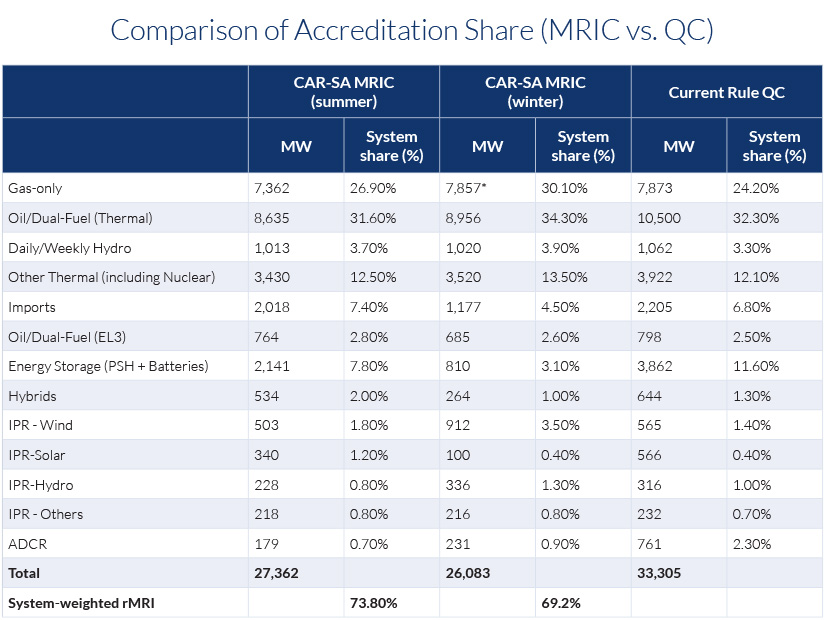
ISO-NE has published initial data on how its proposed capacity market overhaul will affect resource accreditation, providing an indication of how the changes would affect capacity market revenues for different resource types.
The RTO presented the long-awaited impact analysis results to the NEPOOL Markets Committee on March 12. Reacting to the findings, several stakeholders expressed concern about the expected negative effects on storage, solar and demand response resources.
ISO-NE cautioned it has yet to finalize the proposed market changes and stressed the results do not reflect the effects of winter gas system constraints, which could significantly affect market outcomes in the winter season. The region should get a clearer picture of the potential effects when the RTO presents additional analysis in the coming months.
The Capacity Auction Reforms (CAR) project, intended to take effect in time for the 2028/29 capacity commitment period (CCP), would establish a new capacity accreditation framework; split annual commitment periods into six-month seasons; and cut the time between auctions and CCPs from more than three years to about one month.
The accreditation and seasonal changes would directly affect how much capacity each resource can sell in the market.
The RTO currently accredits resources based on a “qualified capacity” framework that does not account for factors including intermittency, fuel limitations and resource outage rates. Under the CAR proposal, ISO-NE would accredit resources based on their modeled ability to reduce energy shortfall. Accreditation values would be subject to change on an annual and seasonal basis depending on shifts in the characteristics of energy supply and demand in the region.
The timing and length of modeled shortall events would be significant factors in determining accreditation values. For example, short-duration storage would be more valuable for preventing short-duration shortfall events, while intermittent resources would be better at mitigating shortfalls that coincide with their production profile. Because of the dynamic nature of the modeling, adding large amounts of intermittent resources with similar production profiles would reduce the accreditation values of all like resources by reducing the chances of shortfall occurring while they are expected to be performing.
For the 2028/29 CCP, ISO-NE’s modeling estimated the median summer shortfall duration to be about three hours and the median winter duration to be about five hours.
ISO-NE plans to calculate accreditation values based on performance during marginal reliability impact (MRI) hours, which it defines as “hours where additional available capacity would reduce unserved energy in that hour or in a subsequent hour.”
MRI hours include periods of energy shortfall; when storage would be dispatched to avoid unserved energy; and when storage would be unable to charge. Enabling storage conservation or charging can reduce expected shortfall in subsequent hours, ISO-NE noted.
“While summer EUE [expected unserved energy] events last about three hours on average, incorporating the associated dispatch and charging hours shows that total MRI events are considerably longer — averaging roughly nine hours,” said Chris Geissler, director of economic analysis at ISO-NE. “Similar to summer, MRI event duration during winter is also longer than EUE events, with an average of 21 hours.”
The impact analysis shows a reduction in total systemwide capacity under the proposed rule changes. ISO-NE has not forecast how the changes would affect revenues but did estimate how the proposal would affect each resource type’s share of total system capacity.
The near-term results indicate an increase in capacity share for nuclear, non-intermittent hydro, wind, storage-limited oil and dual-fuel resources, and passive DR including energy efficiency.
In contrast, ISO-NE projected significant declines in capacity share for storage, solar and active DR resources.
For storage resources, duration would have a significant effect on capacity value. ISO-NE estimated the reliability value of a four-hour battery to be about twice the value of a two-hour battery in the summer and winter. For wind and solar, offshore wind performed better than onshore in both seasons, and sun-tracking solar outperformed fixed.
Accreditation values varied significantly by season for many resource types. Hydro, wind and oil resources with large storage capacity performed better in the winter, while imports, energy storage and solar performed better in the summer.
ISO-NE forecasts an increased capacity share for gas-only resources in both seasons, with a higher share in the winter because of higher maximum capabilities amid low temperatures.
However, the gas-only results may be misleading, as they do not account for winter pipeline constraints, which can be a major limiting factor for these resources. ISO-NE plans to account for these limitations through a separate “gas capacity demand curve,” which would reduce the winter capacity clearing price for gas-only resources that lack firm fuel arrangements. (See ISO-NE Introduces Approach to Modeling Gas Constraints.)
ISO-NE’s longer-term analysis indicated that adding significant amounts of solar and wind would decrease the per-megawatt reliability value of incremental additions of these resources. For wind resources, the addition of 2,000 MW of capacity in 2035 reduced the reliability benefit of additional wind by about 20% in the winter and more than 40% in the summer.
Several participants expressed concern that ISO-NE is overestimating winter risks — including the duration of winter events — causing accreditation reductions for batteries and solar.
“As the accreditation results currently stand, the design will fail to send investment signals for renewables, demand response and energy storage to participate in New England’s capacity market,” said Alex Lawton, director at Advanced Energy United. “That will deter new supply from entering the market and put upward pressure on electricity prices as demand continues to grow.”
He said the impacts of the new gas demand curve remain a “major unknown,” but this “won’t solve the core problem of severely undervaluing advanced energy technologies.”
Lawton added that he remains “optimistic that the ISO will consider stakeholder feedback, run other scenarios in their model, and make changes that reflect realistic conditions and market behavior so that real system risk drives accreditation, not modeling choices.”
ISO-NE plans to present the results of two additional longer-term modeling cases in April. In May, the RTO plans to discuss the results of an analysis focused on the effects on market clearing outcomes. Outputs of this analysis will include estimates of clearing prices, consumer costs and capacity revenues by resource type.