States and environmentalists argue the U.S. Department of Energy is trying to usurp planning authority over generation through its use of the Federal Power Act’s Section 202(c).
DOE has used the “emergency” authority to force numerous coal-fired plants to continue operating past their planned retirement dates.
“Emergency powers, the Supreme Court recently warned, ‘tend to kindle emergencies,’” the states of Illinois, Michigan and Minnesota said in a joint brief. “This case proves the point. DOE’s emergency power has kindled a wildfire of purported emergencies spreading nationwide from Michigan to Indiana, Pennsylvania, Colorado, Washington and beyond. In the past year, DOE issued more 202(c) orders than in its entire history and shows no sign of stopping.”
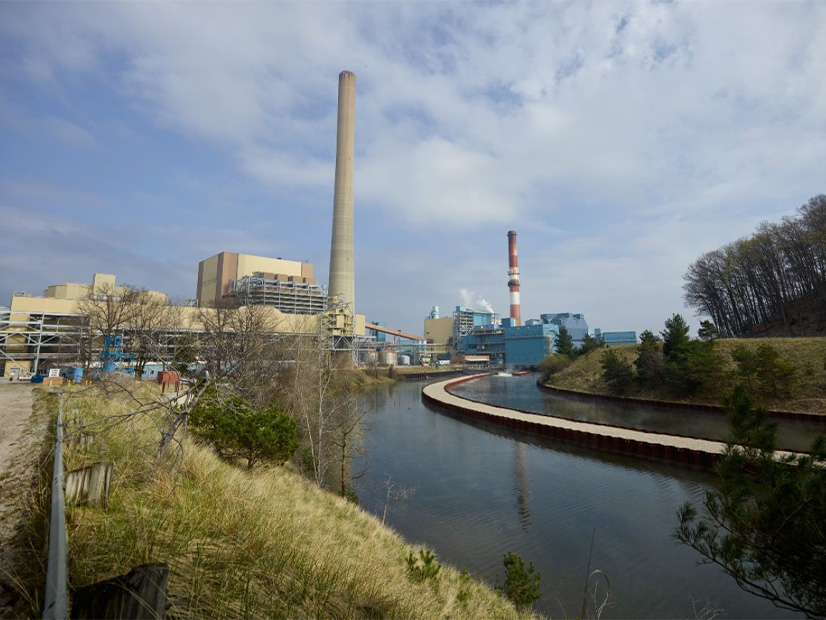
The three states and a group of environmentalists, who filed another brief with the U.S. Court of Appeals for the District of Columbia, were responding to DOE’s first brief in the appeal of the order stopping the J.H. Campbell coal plant in Michigan from retiring in May 2025. The 90-day order has been renewed repeatedly since. The case is furthest along among all the appeals of 202(c) orders, with oral arguments scheduled for May 15. (See DOE Defends Use of Emergency Orders in Court Filing.)
DOE has clear authority over emergency responses, but it lacks authority over long-term resource adequacy planning. The FPA reserves that for the states, and in some cases the ISOs and RTOs regulated by FERC, the three states said. Long-term resource adequacy is handled through processes where rates are set prospectively and conform to the requirements of environmental law.
“DOE now attempts to bypass that robust process,” the states said. “Acting under its emergency power, DOE is unconstrained by the normal guardrails of utility law. Public process is unnecessary. Cost is no object. Rates are set retroactively. Environmental laws may be ignored.”
The orders rest on DOE’s legal effort to strip the word “emergency” of any independent meaning. The term is the lynchpin to DOE’s authority under 202(c) — allowing it to overrule environmental laws and renew the order after 90 days when needed “to meet the emergency.” Without a fixed meaning for emergency, 202(c) has no fixed limits, they said.
“DOE claims that its emergency authority is triggered the moment any future risk presents a need for long-term planning, without regard to its imminence or the availability of routine interventions to address that risk,” the states said. “And it claims authority to supersede state and RTO decisions about what units may retire and, based on its own unsubstantiated claims of years-away regional ‘needs,’ keep those plants running indefinitely through an endless cycle of 90-day orders.”
While the order suffers from numerous fatal legal flaws, the states said the court needs to hold that DOE is held only to a plain text reading of “emergency,” or DOE’s own regulatory definition of the term. Both compel the same conclusion: an emergency is something exigent, imminent and unexpected, the states said.
Environmental Defense Fund, Earthjustice, Natural Resources Defense Council, Sierra Club and other environmental groups filed another joint brief that made many of the same points.
“The department’s brief confirms that it is seeking to transform Section 202(c)’s rarely invoked emergency provision into a sweeping authority to address any potential electricity shortage, no matter how far off,” the environmentalists said. “This unprecedented power grab has supplanted the entities responsible for long-term grid planning under the Federal Power Act — states, utilities, grid operators and FERC.”
The order at issue in this case has torpedoed years of planning around Campbell’s retirement by Michigan regulators and MISO, which already had procured replacement generation. DOE claimed its order saved lives during a cold snap this past winter, but the environmentalists said it just racked up costs while exposing neighbors of the plant to more pollution.
“The department cannot square its secretary-knows-best approach with Section 202(c)’s limits,” the environmentalists said.
DOE can issue generation to stay online only where an emergency exists due to a “shortage of electric energy or of facilities for the generation or transmission of electric energy.”
DOE’s brief argued that 202(c) is not limited to “imminent shortages of electricity” because it reaches any shortages of electric power, even if a “blackout might not materialize for years.”
“The department’s contrary reading rests on its showing that an ‘emergency’ can be long-lasting, but it cites nothing to establish that an ‘emergency’ can encompass a crisis that may not emerge for years,” the environmentalists said. “The department’s desire to address such longer-term generation and reliability challenges cannot override the Federal Power Act’s clear assignment of that authority to others.”
If Congress had wanted 202(c) to be as expansive as DOE claims, it would have omitted the word emergency and allowed it to be used whenever a shortfall of electricity was anticipated, they said.
“The department’s fallback is that ‘emergency’ cannot require imminence because one dictionary and some courts have recognized that emergencies can be long-lasting,” the environmentalists said. “That is a non-sequitur. Whether an emergency can be long-lasting is a separate question from whether an emergency is defined by a need for immediate action.”
The structure of the FPA confirms that 202(c) is a stopgap to address exigencies, not a tool by which the federal government can fix longer-term problems.
“Other provisions of the Federal Power Act — including Sections 202(a), 202(b), and 215 — speak directly to the federal government’s limited authority over long-term resource adequacy and reliability planning, reflecting Congress’ intent to preserve primary responsibility for utility regulation with the states,” the environmentalists said. “This ‘backdrop of clear and limited delegations’ illustrates that Congress did not intend for the department to ignore these constraints and ‘unlock … extraordinary power’ based on a ‘declaration of emergency.’”