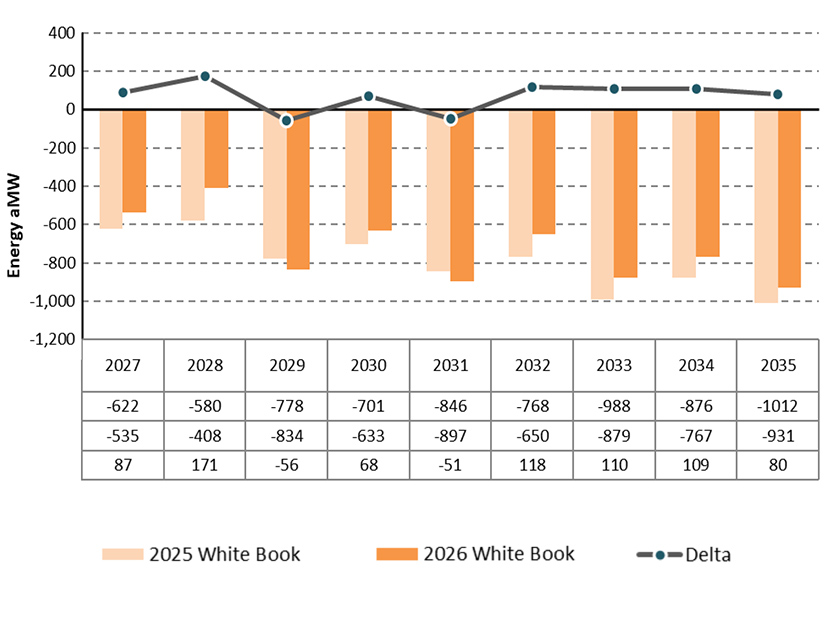
The Bonneville Power Administration said it continues to face steep energy deficits under “firm” water conditions over the next 10 years, but the outlook is slightly better than what the agency foresaw a year ago.
The finding comes out of BPA’s most recent Pacific Northwest Loads and Resources Study, also known as the “White Book,” which offers a 10-year outlook on the agency’s ability to serve its load obligations with its own federal resources.
The study provides predictions for BPA’s own load and resources, as well as the entire region’s retail loads, power supply obligations and resources. The findings are used in long-term planning for BPA and the Columbia River Treaty, and they provide a record of information for customers and other regional planning entities.
“Firm” water conditions represent the agency’s lowest estimate for flows in the Federal Columbia River Power System, a conservative planning scenario intended to ensure the agency maintains system reliability and avoids overextending its contract obligations. BPA noted that under “median” conditions, which reflect historical flows, it would remain in surplus for the entire study period.
The 2026 White Book, released April 13, projects annual energy deficits across the 10-year span under firm conditions, ranging from 535 average megawatts (aMW) in operating year (OY) 2027 to 834 aMW in 2036 — with a peak deficit of 937 aMW in 2036. In comparison, the 2025 White Book showed deficits ranging from 426 aMW in 2026 to a peak of 1,012 aMW in 2036. (See BPA Predicts Energy Deficits Over Next 10 Years.)
“The 2026 White Book shows a slight improvement in deficits annually in seven of the 10 years,” BPA noted in the report, attributing that change to a decrease in federal load obligations during the first half of the study period and the impact of a planned uprate of the Columbia Generating Station nuclear plant during the latter half. (See BPA Approves $700M Plan to Boost Columbia Generating Station Output.)
The outlook is more volatile for the entire Pacific Northwest, which under firm conditions could see a surplus of 337 aMW in OY 2027 but decline steeply to a deficit of 3,514 aMW in 2035. The first deficit appears in 2029 (747 aMW) then begins accelerating in 2031 (2,135 aMW).
“This result was mainly driven by the increasing PNW retail loads,” Rachel Dibble, BPA vice president of generation asset management, said in a letter accompanying the White Book.
Dibble noted also the Pacific Northwest analysis consisted of a “forecast of regional firm loads and resources, based on expected retail loads and different levels of generating resources that vary by water conditions.”
“The scheduled decommissioning of existing resources, the extent of forecasted load growth, the availability of uncommitted PNW independent power producer generation to meet regional load, and new resource additions are key variables in the results of this analysis,” she wrote.
BPA said the total retail load, contracts and generation forecasts used in the White Book were up to date as of February.
“While [BPA] Provider of Choice contracts were signed in December 2025, Bonneville will not have a full understanding of its Provider of Choice load obligations until Tier 2 elections are made in summer 2026. Thus, Provider of Choice updates are not included in this issue of White Book,” the agency wrote. (See BPA Signs New Multiyear Contracts with over 130 Customers.)