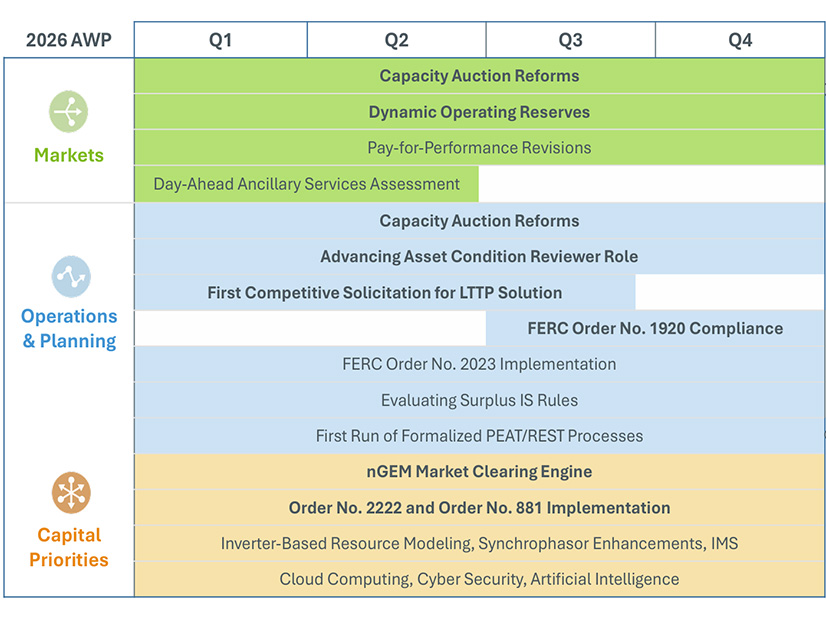
Capacity auction alterations, a new asset condition reviewer role, parallel transmission planning efforts, new reserve products, Pay-for-Performance changes and interconnection modifications are likely to be on the docket for ISO-NE in 2026.
The RTO’s draft 2026 annual work plan, published in advance of the NEPOOL Participants Committee’s meeting Oct. 9, includes continued work on several major ongoing projects and outlines potential new initiatives related to dynamic operating reserves, PFP adjustments and surplus interconnection service.
The Capacity Auction Reform (CAR) project will continue to be the RTO’s main market development focus. The second phase of CAR, which is scheduled to run throughout 2026, will focus on overhauling the RTO’s capacity accreditation methodology and splitting annual capacity commitment periods into distinct summer and winter seasons. (See ISO-NE Kicks off Talks on Accreditation, Seasonal Capacity Changes.)
ISO-NE plans to seek technical committee votes in November on the first phase of the project, centered around the transition to a prompt market, followed by a PC vote in December. (See Stakeholders Mixed on ISO-NE Prompt Capacity Market Proposal.)
Other projects for 2026 include ISO-NE’s effort to stand up a new “asset condition reviewer” role. The role is intended to provide increased transparency around pooled costs associated with upgrades to aging and degrading transmission infrastructure, which have ballooned in recent years. (See ISO-NE Open to Asset Condition Review Role amid Rising Costs.)
As ISO-NE works to develop its in-house review capabilities over the next year, “the ISO plans to use a consultant to begin reviewing some [asset condition] proposals in an interim phase and facilitate stakeholder review and discussion of the consultant’s feedback,” the RTO wrote in its work plan.
Transmission Planning
Also in 2026, ISO-NE plans to evaluate and select a preferred transmission solution for the first Longer-Term Transmission Planning (LTTP) solicitation, which is intended to increase transmission capacity in Maine and help interconnect new onshore wind generation in the state. (See ISO-NE Releases Longer-term Transmission Planning RFP.)
According to ISO-NE spokesperson Randy Burlingame, the RTO received six qualified responses prior to the Sept. 30 deadline. Burlingame declined to comment which companies submitted proposals, but said ISO-NE will publish summaries of the proposals within 60 days.
ISO-NE wrote in the work plan that it plans to select a preferred solution “as early as September 2026.”
“Upon completing, reviewing and adjusting for any lessons learned from the 2025 cycle, the LTTP process could then proceed with a subsequent cycle, which would seek stakeholder input,” the RTO added.
In the third quarter of 2026, ISO-NE plans to begin work to comply with FERC Order 1920, which establishes long-term planning requirements for grid operators. In February, FERC accepted ISO-NE’s request to push back the compliance deadline for the order by two years, extending it to June 2027. The RTO has said the delay will enable it to “implement and gain experience from conducting the first LTTP” request for proposals.
“While New England’s new LTTP framework accepted by FERC in July 2024 went far in complying with [Order 1920], notable differences must be addressed,” ISO-NE noted.
The RTO said Order 1920 compliance discussions likely will include a focus on “further including [grid-enhancing technologies] into transmission planning assessments,” along with the development of a process for right-sizing asset condition upgrades “as a way to address long-term needs.”
Dynamic Operating Reserves
To prepare the system for increasing variability in generation and demand, ISO-NE “is assessing and commencing development of dynamic, operating reserve demand curves for incremental quantities of existing real-time reserve products (10- and 30-minute reserves), in amounts that vary during the operating day based on the system’s near-term potential ramping needs,” it wrote.
The RTO is considering adding a 60- or 90-minute reserve product, which could include “dynamically determined demand quantities,” to prepare the system for “unanticipated supply and demand changes.”
In a memo published in March, ISO-NE wrote that, to address increasing uncertainty and ramping requirements, it plans to develop “a dynamic, real-time probabilistic forecast of the system’s energy ramping needs,” which could inform these new reserve products. (See “Flexible Response Services,” ISO-NE Gives Updates on Prompt, Seasonal Capacity Market Changes.)
The RTO plans to begin stakeholder discussions on these potential changes in the fourth quarter of 2026.
Pay-for-Performance
ISO-NE also wrote that changes may be needed to its PFP rules following a recent New England Power Generators Association (NEPGA) complaint to FERC about “serious flaws” in the construct’s design.
In response to the complaint, ISO-NE has said it is open to capping the PFP balancing ratio but opposed NEPGA’s proposed changes to the stop-loss mechanism. (See ISO-NE Open to PFP Changes Following NEPGA Complaint.)
“The ISO may assess and discuss with stakeholders possible cost-allocation related revisions to the stop-loss mechanism and balancing ratio, depending on FERC action on NEPGA’s filing,” ISO-NE wrote in its work plan.
Surplus Interconnection Service
Prior to the publication of the work plan, some stakeholders pushed ISO-NE to pursue updates to surplus interconnection service rules, arguing that the RTO should allow increased flexibility for interconnecting resources that are willing to accept limitations based on the existing capacity resources at an interconnection point. (See Stakeholder Forum: Surplus Interconnection Can Maximize Capacity in ISO-NE.)
ISO-NE wrote that it plans to initiate discussions with stakeholders in the first quarter of 2026 “to identify the objectives, issues and scenarios driving stakeholders’ inquiries around existing and future access and use of assigned interconnection service rules.”
Following initial discussions, the RTO plans to “conduct a gap analysis of the use cases against the existing interconnection rules to determine the scope of potential solutions,” which would inform additional stakeholder discussions on potential rule changes.
ISO-NE is scheduled to complete its first cluster interconnection study under transitional Order 2023 rules in August 2026. The next cluster study will begin in October 2026.
Other Initiatives
The work plan includes initiatives intended to improve ISO-NE’s modeling of inverter-based resources, boost cybersecurity and deploy a new market clearing platform. The RTO also plans to publish a report on the performance of its new day-ahead ancillary services market that will include “any potential recommendations for enhancements.” The ISO will discuss the draft work plan with NEPOOL members at the PC meeting in West Hartford, Conn., on Oct. 9.