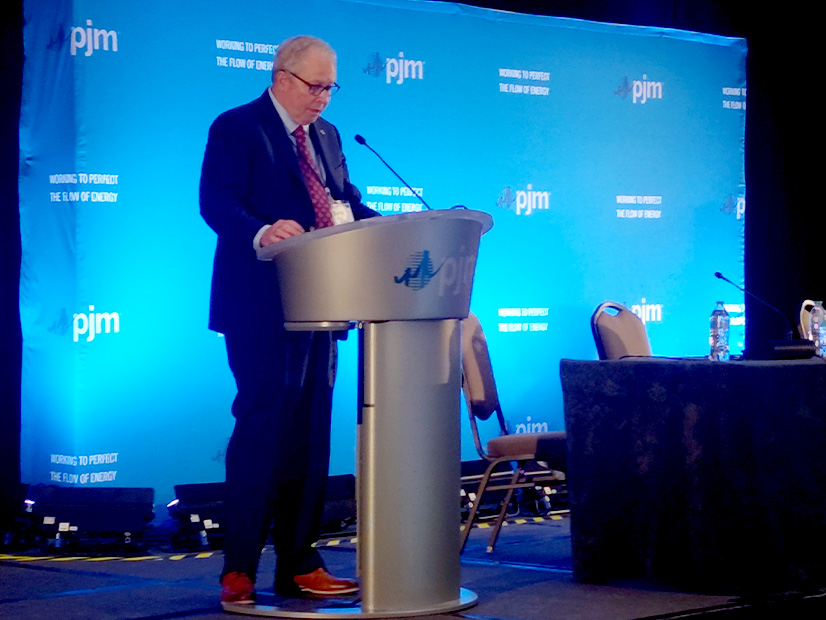
LANDSDOWNE, Va. — PJM’s Public Interest and Environmental Organization User Group voiced mixed views on the RTO’s policy trajectory, praising advances in generation interconnection over the past year while raising concerns about rising costs and transparency.
Speaking at PJM’s Annual Meeting on May 14, representatives of the consumer advocate wing of the group largely focused on how rising capacity and transmission costs are affecting ratepayers and long-term reliability, while raising questions about whether the RTO is overly influenced by large transmission and generation owners.
Environmentalists worried that improvements to the interconnection study process, which could speed renewable development, could be outweighed by decisions to allow more resources into the queue and the effects of PJM’s long-term transmission planning proposal under FERC Order 1920.
Brian Lipman, director of the New Jersey Division of Rate Counsel, said consumer advocates for the first time are growing concerned about how the PJM capacity market can manage both sides of the objective of delivering reliability at the least cost. While advocates have long focused on impacts to consumers’ rates, reliability has become a growing issue as industry participants discuss the increasing risks of brownouts and rolling blackouts.
Lipman used the concept of a Venn diagram to describe the decreasing overlap between the prices consumers are willing to pay and the revenues generation owners report they need to earn to maintain and develop resources. Legislators, governors and voters trying to understand how PJM decisions will affect rates and should impact policy also are frustrated by the lack of cost-impact analysis around the RTO’s proposals and market outcomes, he said.
“The anger at PJM outside this room is probably at an all-time high … I think you saw that over the last few days,” Lipman said, referring to a May 12 Members Committee (MC) vote to oust two members of the RTO’s Board of Managers who were up for reelection. (See related story, PJM Stakeholders Reaffirm Board Election Results.)
Lipman expressed surprise that PJM didn’t anticipate the outcome, given the amount of dissatisfaction that some stakeholders have expressed to the RTO.
He argued that PJM should conduct more outreach to understand where member states stand and to establish more avenues for them to learn about changes being contemplated by the RTO or its members. Too often, he said, key decisions already have been made when proposals are brought to stakeholders. He pointed to the proposal to shift filing rights over the Regional Transmission Expansion Plan from the RTO membership to the Board of Managers, which was filed at FERC after stakeholders voted in opposition, as well as the settlement with Pennsylvania Gov. Josh Shapiro to set a minimum capacity price and lower the maximum, which was not voted on by the membership.
“PJM must work on its transparency; much of its work is shrouded in secrecy,” Lipman said.
Maryland People’s Counsel David Lapp said PJM has argued that the considerable increase in clearing prices seen in the 2025/26 Base Residual Auction (BRA) was the result of tightening supply and demand, which he said misses the impact of RTO market design decisions that have limited supply.
Lapp noted that, while some of those have been changed for subsequent auctions, such as modeling the output of generation operating on reliability-must-run agreements as capacity, leaving them in place for the 2025/26 auction will cost consumers more than $5 billion. (See Maryland Report Details PJM Cost Increases for Ratepayers.)
Lapp also said that including intermittent and storage resources in the requirement that resources holding capacity interconnection rights (CIRs) must offer into BRAs was another step forward, but an exception remains for demand response resources.
“There’s a lot PJM can do to move those circles together if not overlap; those are the assumptions and parameters that PJM controls,” Lapp said, referring to Lipman’s Venn diagram concept.
Lipman said PJM market design decisions often undermine states’ clean energy policies and efforts to build offshore wind in the footprint. That has created an impression the RTO is more political than previously realized.
PJM CEO Manu Asthana strongly pushed back on that assertion, saying one of his proudest efforts was the use of the State Agreement Approach to facilitate the transmission planning necessary for meeting New Jersey’s offshore wind targets. He noted that other projects are proceeding in Virginia and said the high accreditation offshore wind carries makes it an ideal resource for meeting PJM’s capacity needs.
“It’s not fair to come to us and say, ‘PJM, you’re against offshore wind.’ We did everything we could to get it, and we need it now,” Asthana said. “I can’t be accountable for a supplier in Denmark who walked away.”
Asthana said one of his core goals before stepping down from his role at the end of the year is to rebuild the bridge with consumer advocates, who have an important voice in the stakeholder process. He said consumers ultimately must pay these costs, and he is sensitive to that hardship, so PJM and advocates will have to work together to figure out how to serve consumers at a price they can afford. (See PJM CEO Manu Asthana Announces Year-end Resignation.)
Asthana said each of the major capacity market changes the RTO has filed at FERC since December is expected to reduce clearing prices. While prices in the last auction were very high, he disagreed with the position that they were unreasonably high from an economics perspective. He said several different principles are conflicting with each other around sending price signals that attract needed generation while remaining cost-effective. PJM’s modeling shows more generation is needed, Asthana said, and much of the generation that can be built in the region comes out to about $650 MW/day to build.
Board of Managers member David Mills said he plans to propose adding a standing agenda item to future MC meetings stipulating that attending board members would commit to staying for the full day so they can discuss items of importance with stakeholders, including possible FERC filings the board is contemplating.
Environmental Orgs Promote Streamlining Interconnection, Planning
The explosion of data center load growth has caught PJM on the back foot as it works to transition to a new mode of studying generation interconnection requests that aims to break through its application backlog by the end of 2026, said Claire Lang-Ree, an advocate with the Natural Resources Defense Council’s Sustainable FERC Project. While the new cluster-based approach carries the potential to speed renewable development, she said other decisions PJM has made recently would undermine that progress.
In particular, she faulted the Reliability Resource Initiative (RRI), which added 51 projects to Transition Cycle 2, with the aim of allowing more generation to get built by the end of the decade to address a possible capacity deficiency PJM has identified.
Rather than advancing the development of more fossil fuel generation, which was the big winner in the RRI, PJM should focus on throwing its weight behind existing queue projects while improving queue processing timelines, Lang-Ree said. She cited PJM’s surplus interconnection service and generation replacement processes as two major improvements the RTO has made over the past year.
Lang-Ree said the RRI showed PJM is capable of moving quickly and effectively on priorities it has identified, a capability she thinks should be leveraged to position itself as a partner to states advancing their own energy policies.
Mike Jacobs, of the Union of Concerned Scientists, said one such area for collaboration is meeting the battery and renewable portfolio targets several PJM states have set. PJM has taken steps to improve the process for installing batteries at underutilized points of interconnection and transferring CIRs from deactivating generation to storage on the same site, but the market rules remain murky for combining renewable and storage resources as a hybrid seen as a single unit. He argued PJM should meet with those states to make constructive contributions to their goals and how they can be achieved.
Asthana said he was glad to see 2.3 GW of storage projects selected for expedited interconnection studies through the RRI and added that another 20 or 40 GW of batteries would make resource adequacy planning a lot easier. Studies conducted by The Brattle Group found that battery installations remain very expensive, a factor that has been overcome in other regions by the resources’ ability to arbitrage fluctuations in energy prices caused by higher intermittent penetration — a development that has yet to materialize in PJM.
Earthjustice attorney Nick Lawton said a long-term, regional planning model that complies with FERC’s Order 1920 will reduce risk and conflict for PJM. Enhancing backbone transmission can facilitate new entry, advance state clean energy policies and lower rates for consumers, while the RTO’s continued reliance on building local projects will raise interconnection costs for new generation and add up to higher rates once the multitude of smaller, inefficient projects are added up.
He argued that PJM’s proposal to comply with Order 1920 would continue to rely on supplemental and generation interconnection projects by splitting the benefits it considers when evaluating regional projects into core and additional needs. He said that would miss out on projects that would better prepare the grid for generators deactivating for economic reasons and new resources entering the market to support state renewable portfolio standards. Inserting PJM in the position of determining which state policies would be planned for would also be an inappropriate usurpation of state authority, he said.