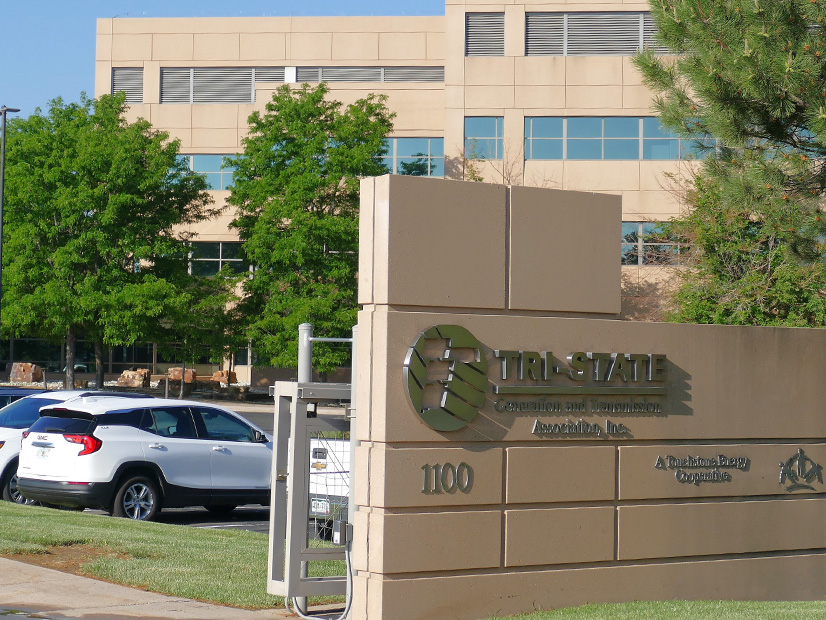
FERC approved Tri-State Generation and Transmission’s request to update a program designed to allow its member utilities more flexibility in how they procure power, finding the proposed revisions will help members tackle large new loads from data centers.
Specifically, FERC approved revisions to Tri-State’s Bring Your Own Resource (BYOR) program in an Oct. 6 order (ER25-3109).
The company launched the BYOR program in 2024 to provide members with increased flexibility to build or contract their own energy projects, according to a news release.
The initial BYOR tariff allowed utilities to procure up to 40% of their power from sources other than Tri-State based on the wholesale power supplier’s 2022 system peak period.
However, the company argued in the FERC filing that “relying on a single year historical test period had the potential consequence of relying on low outlier data, because utility member peak demand fluctuates over time; and therefore, using a single historical year test period risks BYOR allocations being set at unfairly low levels.”
Under the new tariff, the amount of power utilities may procure from other sources than Tri-State remains at 40% but is now based on the utility member’s highest monthly Tri-State Peak Period/Member Coincident Peak value over a three-year historical period, rather than Tri-State’s 2022 system peak, according to the order.
“We find that the revised BYOR tariff is just and reasonable and not unduly discriminatory or preferential,” FERC’s order stated. “We agree with Tri-State and its utility members that the proposed revisions to the BYOR tariff will provide Tri-State’s utility members with additional flexibility in procuring power resources for their retail ratepayers and provide them with the benefits the BYOR tariff was originally developed to provide.”
FERC also approved increased flexibility to BYOR funding mechanisms and cost savings associated with DERs as well as other “minor improvements,” according to the order.
The tariff revisions also provide members with energy project development rights related to new large loads — specifically those exceeding 45 MW — being developed in their service territories, “in direct response to the forecasted proliferation of large data center and industrial [high-impact loads] across the country,” according to the order.
“[W]e find that the proposed revisions to expand the BYOR tariff to allow utility members to contract for, or build, their own generation resources to serve specific HILs will help Tri-State’s utility members serve HILs being developed in their service areas, and we agree with Tri-State that tying Tri-State’s obligation to procure power for its utility members from a HIL BYOR project to the operation of the HIL that the HIL BYOR project was designated to serve mitigates risks related to over-procurement of power,” FERC wrote.
The FERC order comes shortly after Tri-State filed an application for approval of a new tariff designed to manage the heavy volume of data center load expected to materialize in its member utilities’ service territories over the next decade. (See Tri-State Seeks FERC Approval for Data Center Load Tariff.)