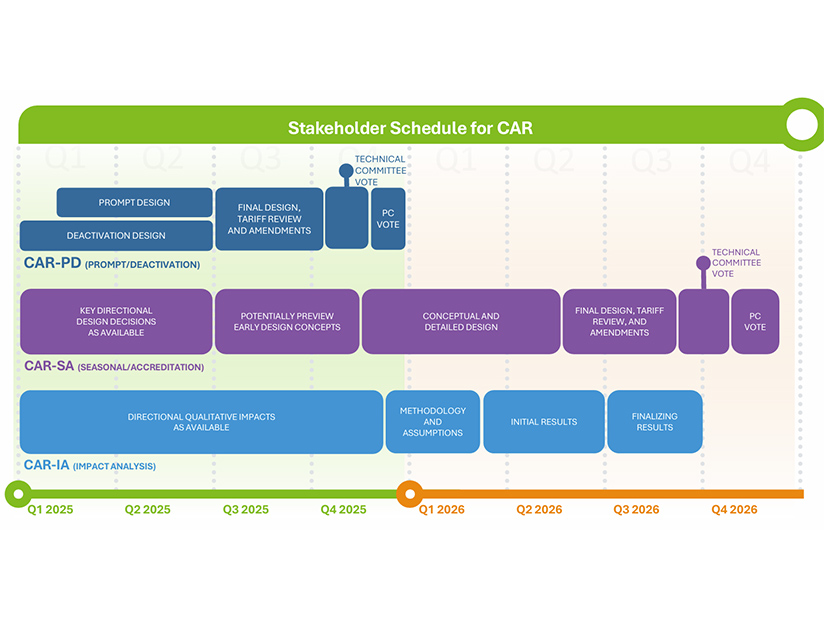
NEPOOL members have proposed several amendments to the first phase of ISO-NE’s capacity market overhaul prior to the scheduled Markets Committee vote on the RTO’s proposal in November.
The amendments presented to the committee Oct. 16 include proposals to allow generators to submit capacity offers reflecting physical limitations during hot weather; adjust the methodology for calculating the capacity offer price threshold (COPT); and extend the length of time resources can hold onto interconnection rights while undergoing major repairs.
The first phase of ISO-NE’s Capacity Auction Reform (CAR) project is centered around shifting the Forward Capacity Market to a prompt design and updating the resource retirement process. The second phase is focused on accreditation changes and instituting a seasonal market. Both phases are intended to take effect in the 2028/29 capacity commitment period. (See ISO-NE Kicks off Talks on Accreditation, Seasonal Capacity Changes.)
Ambient Air De-list Bids
Bruce Anderson of the New England Power Generators Association (NEPGA) argued that ISO-NE should extend existing rules and practices allowing generators to submit capacity offers reflecting reduced generating capabilities at temperatures above 90 degrees Fahrenheit.
The RTO’s current proposal requires all qualified resources to offer all available capacity in annual auctions and would not maintain the option for generators to de-list capacity during periods of high temperatures.
“Without carrying forward the exemption, a resource will unnecessarily be required to submit a cost workbook for megawatts it is physically unable to produce at those high ambient temperatures,” Anderson told the committee.
To address the issue, NEPGA has proposed adding language allowing participants to “identify and submit a price-quantity pair(s) in a capacity offer specifically attributable to and up to the megawatt amount that the lead market participant expects will not be physically available due to ambient temperature effects.”
Several members of the generation sector expressed support for the amendment, while some stakeholders said it ultimately will be important to address temperature effects in the accreditation phase of the CAR project.
Chris Geissler, director of economic analysis at ISO-NE, said the RTO does not yet have a firm position on the amendment and still is considering the proposal. He added that ISO-NE’s existing proposal to not carry forward ambient air exemptions was motivated by a desire for more consistency across different segments of capacity.
Capacity Offer Price Threshold
Ben Griffiths of LS Power proposed a transitional methodology for calculating the COPT for the 2028/29 commitment period that he said would help address issues related to outdated price inputs.
The price threshold is intended to protect against market power; participants offering above the threshold price are required to submit a cost workbook to the Internal Market Monitor.
ISO-NE plans to maintain its methodology for calculating the threshold as it transitions to a prompt auction. Under the existing methodology, the 2028/29 threshold would be based in part on the prices from the last Forward Capacity Auction, which will have been held about four years prior to the first prompt auction.
Griffiths said he’s concerned this will lead to an outdated threshold value, especially after capacity shortfall events over the past two summers caused some generators to accrue costly performance penalties, which has caused some participants to speculate that capacity costs will increase in the future to account for these risks.
He proposed that ISO-NE set the threshold for the 2028/2029 commitment period at “at a fixed price of $4.984/kWm,” which “represents the simple average of observed clearing prices in the summer 2025 ARAs [annual reconfiguration auctions] and theoretical common value component estimates derived from the same auctions.”
The common value component equals “the expected value of scarcity revenues under [Pay-for-Performance],” Griffiths noted in a memo published prior to the meeting.
He said the close alignment of the ARA and common value component prices “supports a strong case for using this value.”
Responding to the proposal, Geissler said the RTO’s current proposal is to extend the existing methodology for the threshold. However, he said ISO-NE is amenable to considering transitional changes to address a time lag in the data, especially if there is broad stakeholder support.
Geissler said ISO-NE plans to consider changes to the threshold during the accreditation phase of CAR. However, if the RTO cannot finish the accreditation phase in time for the 2028/29 commitment period, and it identifies issues related to stale data used in the COPT, the RTO would look to address the issue prior to the auction, he said.
Also at the meeting, Andy Gillespie of Calpine reiterated his proposal for ISO-NE to base the threshold strictly on the common value component. He acknowledged that this could lead to a threshold value significantly higher than the clearing price of past FCAs but stressed that the threshold should be a forward-looking metric.
“This method is based on ISO-based, forward-looking, objective data” and is “often cited by ISO as the basis for calculating PFP opportunity cost,” Gillespie said, adding that the methodology could “be used regardless of auction format or accreditation methodology.”
Geissler said ISO-NE is not supportive of a broader change to the COPT methodology, which it considers to be outside the scope of work for the first phase of the CAR project.
3-year Rule
Griffiths also advocated for a change to ISO-NE rules that automatically deactivate resources that do not run for three straight calendar years. He expressed concern that recently proposed changes to the RTO’s repowering rules could cause resources facing extended repairs to lose their interconnection service.
Three- to seven-year wait times for turbines and transformers “make compliance with the strict three-year clock unrealistic for facilities facing catastrophic outages,” Griffiths said.
While resources could seek a waiver from FERC to ISO-NE’s three-year rule, “FERC’s waiver process is uncertain and ill-suited to this situation,” he argued.
Griffiths proposed introducing “a bounded extension” of up to six years for resources making “good-faith restoration efforts.”
To be eligible for such an extension, resources should have to demonstrate “due diligence, including at-risk expenditures, in pursuit of permitting, licensing and construction necessary to restore the resource to commercial operation,” he proposed.
Several stakeholders said they are open to the change but would want to ensure there is language to prevent resources from using the extension simply to hold onto interconnection rights and prevent other resources from entering the market.
ISO-NE agreed the issue warrants additional discussion but said it should be done outside of the CAR process.
Griffiths also offered an amendment to clarify ISO-NE’s authority over the interconnection rights of state-jurisdictional resources that have been inactive for more than three years. He advocated for new tariff language “to protect jurisdictional integrity” and to “enable equal treatment for state resources under the proposed deactivation language.” ISO-NE, however, said that is outside the scope of the CAR project.
Accreditation Updates
Also at the meeting, ISO-NE outlined its plans to calculate seasonal forced outage rates in the new accreditation framework.
Equivalent forced outage rate on demand (EFORd) is intended to quantify resources’ likelihood of having an outage when called upon and is a key input into resources’ overall accreditation value, noted Steven Otto, manager of economic analysis at ISO-NE.
The RTO plans to calculate EFORd values based on data from the previous five years. For resources that lack enough data, it plans to use class averages from the New England generation fleet to fill in any gaps, Otto said.
“Conceptually, the mechanics of seasonal EFORd calculations will be identical to the existing mechanics for annual EFORd calculations, except that the calculation will be done for a given season with historical data only from that season,” Otto said.
He added that “for most resources, the differences between their annual and estimated seasonal EFORd values are small.”
Maximum Capability
ISO-NE also discussed its methodology for calculating resources’ maximum capability, which “represents a resource’s physical supply capability and reflects changes in a resource’s capability due to changes in its physical attributes.”
To generate accreditation values for each resource, ISO-NE plans to multiply resources’ maximum capability by their marginal reliability impact ratio, which compares the reliability benefits of the resource to a hypothetical “perfect” capacity resource.
Maximum capability would be calculated seasonally in the summer and winter. In the summer, it would equal each resource’s maximum recorded hourly net output from the past three years when temperatures are over 80 F. Winter maximum capability values would be based on maximum hourly output when temperatures are below 32 F.
ISO-NE also plans to allow resources to schedule an audit to determine their maximum output.
For active demand resources, the maximum capability will be based on maximum hourly performance in the winter and summer from the previous three years. The temperature constraints would not apply to these resources, as they do not self-schedule, and are not guaranteed to run at their full capacity at a certain temperature in any given season, ISO-NE said.
The maximum capability for energy efficiency resources would be based on performance estimates from ISO-NE’s efficiency database.
ISO-NE said the three-year lookback period for maximum capability values should give resources that run infrequently enough time to demonstrate their full performance capabilities while also capturing recent performance trends.