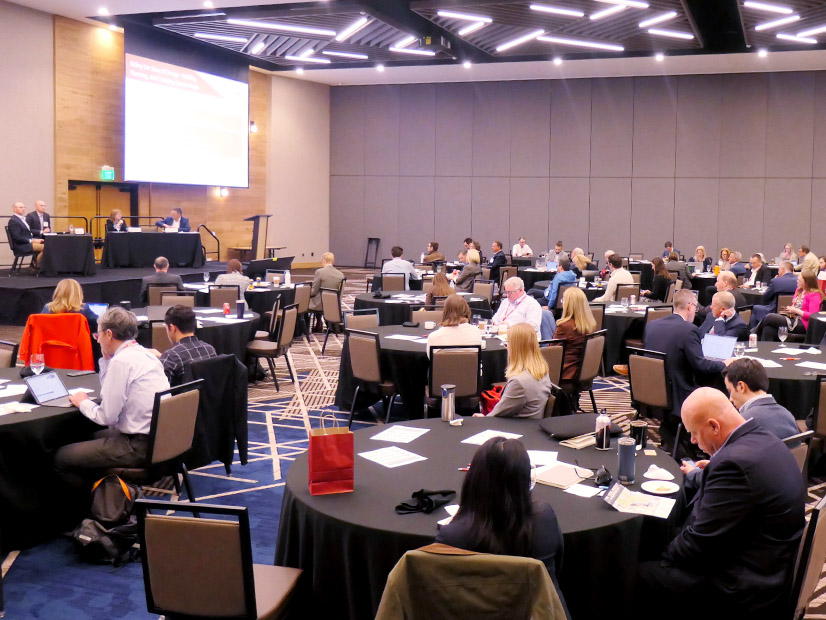
SIOUX FALLS, S.D. — At a time when MISO’s long-term planning is under fire, the Organization of MISO States’ annual meeting featured speakers who vouched for the power of planning.
MISO Vice President of System Planning Aubrey Johnson said exploding load growth makes the RTO’s long-range transmission planning even more relevant. He also said the rigor MISO applies to its scenario-based transmission planning makes ensuing projects a “least-regrets” route.
Speaking at the Oct. 21 event, Johnson said a single data center can “sign on the dotted line” and alter a load-serving entity’s integrated resource plan. He cautioned the industry against making “knee-jerk reactions” to policy changes and new reliability assessments.
“It doesn’t mean that when those decisions were made three years ago, they were wrong,” he said of grid planning. “I would encourage us to have a little more patience and see this as a signal.”
Johnson said when MISO refashioned its 20-year transmission planning futures in 2019, growing load was a concern. By 2022, flat load estimates influenced an update of the RTO’s futures.
“Both of those cases have prepared us for the generation coming online,” Johnson said of the latest upswing in load forecasts, which are set to shape more long-term transmission planning from the RTO.
Johnson said MISO’s work to install a 765-kV backbone through its long-term planning apparently has inspired neighbors PJM and SPP to draw up their own plans.
But MISO’s second, $22 billion long-range transmission portfolio has attracted criticism in the latter half of 2025.

FERC Commissioner Lindsay See used a recent FERC docket to warn MISO it should present a more complete picture of the needs behind its transmission planning. That’s in addition to the pending North Dakota-led complaint doubting the value of the portfolio. (See FERC Orders MISO to Describe Merchant HVDC Planning Considerations and MISO States Split on FERC Complaint to Unwind $22B Long-range Tx Plan.)
Terry Wolf, COO of Missouri River Energy Services, said he worries his territory — which exists at the MISO-SPP seam in Iowa, Minnesota, North Dakota and South Dakota — risks being left behind between the RTOs’ separate 765-kV plans. He asked that the RTOs pay attention to the burgeoning chasm at their boundaries and plan interregional links.
“Two regions that are tightly intertwined, in my opinion, must do that,” Wolf said.
Clint Savoy, SPP manager of interregional strategy and engagement, said his RTO’s burgeoning 765-kV portfolio likely eventually would lead to both grid operators examining how to best connect their high-voltage networks.
“I think we’ll have an opportunity to do that over the next few years,” Savoy said.
Outgoing OMS President Joseph Sullivan, a member of the Minnesota Public Utilities Commission, said he’s excited about the prospect of MISO tapping into the West through interregional transmission. He said new transmission routes could deliver more reliability benefits, more diverse resources and economic advantages.
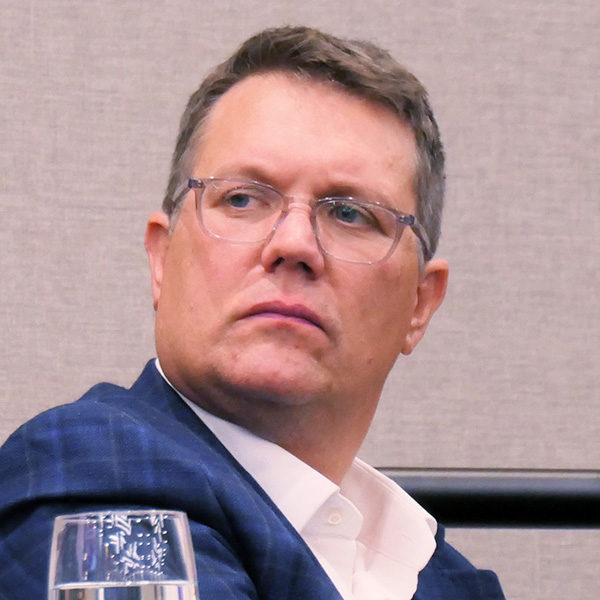
“From my perspective, it’s absolutely worth a deep conservation: How do we look further West?” Sullivan said.
OMS spent much of 2025 in “reactive mode” responding to others’ decisions, Sullivan continued. He referred to MISO’s multibillion-dollar transmission planning, the RTO’s interconnection queue fast lane, explosive load growth and federal policy whiplash.
“The agenda was often set for us,” Sullivan said. He urged OMS in 2026 to “carve out space to truly set our own active agenda” in the face of immense change. “This coming year will test our cohesion,” he told his fellow state regulators.
Christina Drake, MISO’s director of economic, interregional and policy planning, said the RTO’s 765-kV plans can support about 100 GW of generation and provide a foundation for interregional planning.
Drake added that stakeholder meetings can get “spicy” when RTOs start debating the benefits of transmission investment. But she said stakeholders who aren’t motivated by the prospect of expanded transfer capability alone might be persuaded by a “confluence” of increased transfers plus reliability benefits plus congestion-saving benefits. She said outlining the multiple benefits of transmission solutions is paramount after engineering analyses are completed.
However, Drake argued, affordability matters more to MISO South members, regulators and ratepayers than in the RTO’s northern regions.
“The best transmission [projects] are the ones folks are willing to pay for and can be sited. That’s a tall order,” she said.
Wisconsin Public Service Commissioner Marcus Hawkins said the best case for transmission could be the “undeniable value” it provides during widespread extreme weather events.
Savoy said it’s important to figure out how to quantify the resilience benefits, noting that as more time passes between lived events, the more the perceived value of transmission solutions fades. As an example, he said the premium that civilians and utilities placed on continued supply and power restorations during February 2021’s Winter Storm Uri changed dramatically just a few years later.

Ryan Fedie, founder of consulting firm Axelergy, said the “whipsawing” between presidential administrations makes grid investments a tough call. He said that instead of “speed to market,” the Trump administration is fomenting “speed to mistrust.”
Fedie said he wants to make sure the system is expanded adequately and includes distributed energy resources and demand-side options to avoid overbuilding. He said the existing system “was built on a different model in a different era.”
Chelsea Loomis, the Western Power Pool’s regional transmission planning services manager, said there’s much to tackle regarding coordination on load and generation projections. She said when she worked at Northwestern Energy, the utility fielded about 10 separate interconnection requests from a single customer concerning the same load. Data centers, Loomis warned, can utility shop and “FUBAR” load projections and generation plans.
Loomis joked that she was grateful she was not that close to the audience before saying regulators should be doing more to demand more standardized growth information. She said there’s a lot of flexibility in commissions’ reporting requirements.
Johnson said meeting the moment of load growth paired with the energy transition is not “one quantum shift, but a series of incremental shifts.” He said MISO’s work on load projections, resource adequacy assessments and transmission planning often produces a “tension” between it and its members that shapes solutions. He told regulators to expect more work from the RTO on interconnection queue to speed up interconnections to the expanding system.
“Nobody’s talking about how bored they are,” Johnson joked of the zeitgeist in the energy industry.