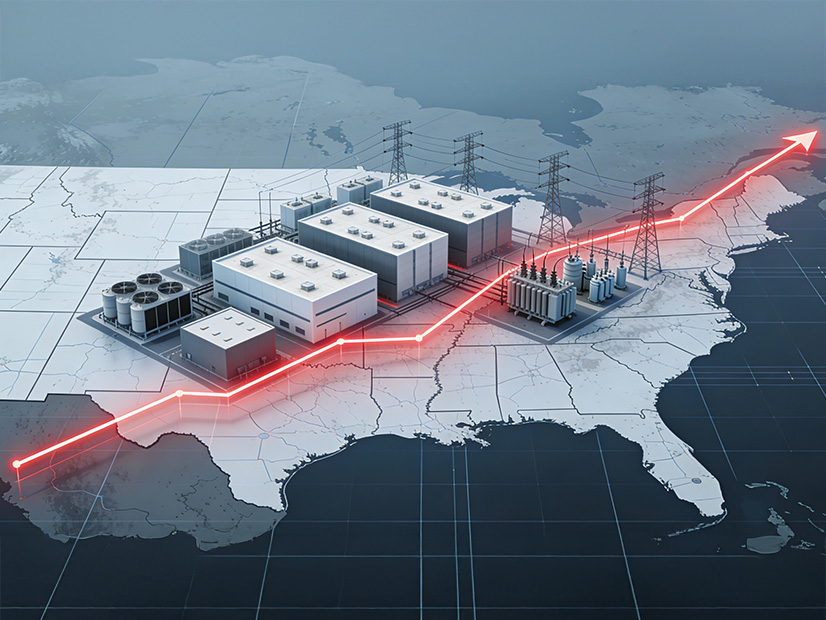
As we turn the page from 2025 to 2026, the trends of the past year are not just continuing, they are accelerating. The defining story of the coming year will be the widening chasm between electricity supply and demand, a dynamic driven by a slow-moving supply side, coupled with the explosive growth of energy-hungry data centers.
Physical bottlenecks: Access to hardware, whether for generation or transmission, is becoming a big problem. Transformers, switchgears and turbines are in short supply and increasingly expensive. Even when equipment is available and developers can put steel in the ground, the existing interconnection process is far too sluggish to meet projected demand. While some grids are working to fast-track these issues, and even employing AI to assist with the process, it’s not fast enough.
Even if we could access equipment and resolve the interconnection issue, there’s simply not enough existing transmission to accommodate new supply. That barrier exists largely because the permitting process is agonizingly slow — where transmission facilities traverse multiple states. The SunZia and Grain Belt Express projects are strong examples: Each took well over a decade to get approvals lined up.

Software and applied intelligence augment the existing system’s capabilities to do more, with applications such as dynamic line rating, topology optimization and power flow management. They, as well as reconductoring of existing transmission lines, can provide some relief but cannot meet the magnitude of the challenge.
These infrastructure timelines are simply incompatible with the “I-want-it-yesterday” urgency of the data center industry — the modern-day equivalent of Rumpelstiltskin that no longer spins straw into gold, but rather converts data, silicon chips and power into enormous digital wealth.
Financial and National Security: There’s also a pressing national security imperative. Those countries that dominate the data also will dominate the future economy and military battlefields. The Russia-Ukraine conflict, rapidly shifting from a people-centered struggle to one driven by software, fiber optics and lethal drones, clearly demonstrates how swiftly AI is transforming modern warfare and how urgently the global AI race must be won.
The Astonishing Accelerating Pace of Change: Three short years ago, AI had a relatively minimal profile. The launch of ChatGPT 3.0 catalyzed a rapid shift in that industry, and a race to feed chips and machines with power. Here, though, the virtual world collides with the physical reality and complexity of the electric grid. That collision creates significant uncertainties because of the speed and the magnitude of the projected growth in demand.
In this new world, billions of dollars now seem trivial, AI companies make circular investments in each other, and chip technologies and AI modeling approaches constantly evolve. It’s also a world in which few AI companies are demonstrating profitability. We may well look back at 2026 as the start of a golden age, or as a repeat of the dotcom bubble — leaving behind enormous, stranded assets if the promised returns fail to materialize.
The Federal vs. States’ Rights Collision: In 2026, the electron will sit square in the middle of the centuries-old tug-of-war between state sovereignty and federal oversight. This is epitomized by the Department of Energy-mandated FERC rulemaking to standardize large load interconnection processes.
The related debate is contentious. By the recent comment deadline, approximately 150 comments had been filed. State entities such as the National Association of Regulatory Commissioners (NARUC) and the National Conference of State Legislatures pushed back, with NARUC commenting: “The commission should avoid any action that would circumvent or negate state decisions governing the provision of retail service.” Similarly, the NCSL stated: “This new proposed rule would bring under federal jurisdiction an issue that is currently handled by the states and has been for decades. … Such actions should also not remove decision-making powers that have historically been left to the states.”
FERC must publish its determination by April 2026. Given the size of the prize at stake, it’s likely to be controversial and spark ongoing debate regarding states’ rights.
As big as that issue is, it may be eclipsed by legislation related to permitting of new energy infrastructure. Construction of such infrastructure inevitably raises questions about states’ rights, eminent domain and property rights. States have been quite successful in either delaying or terminating many infrastructure projects proposed over recent decades. That’s one critical reason so little energy infrastructure has been built recently. But it’s also not a sustainable model for the future, given the pressures on today’s fragile grid that are further exacerbated by data loads.
When Elephants Fight, Grass Gets Trampled: With obvious shortfalls in capacity to meet new large loads, we already are seeing the impacts on other customers’ wallets. The past three capacity auctions in PJM have resulted in punishingly high prices for load. In the first two auctions, the revenues associated with existing and forecast data center load were estimated to exceed $16.6 billion, representing more than half of the entire revenues paid to capacity. The second auction, for 2026/27, would have gone higher had a negotiated cap not been in place.
The most recent auction in mid-December for 2027/28 saw prices hit the cap again, clearing at $333.44 per MW-day, and likely adding an additional $8 billion of data-related costs to the data center-related tab. Worse yet, when PJM ran a simulated auction absent the cap, prices catapulted to $529.80.
This burden falls squarely on other ratepayers, with capacity costs now representing well over 25% of the wholesale power bill. Absent political or regulatory intervention, the effects may get much worse, since the June 2026 auction for 2028/29 no longer is capped.
The Rise of Flexible Load: To mitigate these effects, many PJM members insist that new large loads must bring their own capacity or agree to be interrupted. They maintain this is the only way to ensure that other ratepayers are not affected. Clarity is hard to come by: A dozen proposals related to large load interconnections recently were considered by PJM stakeholders, but none were approved, leaving lack of clarity as to what to do next.
Meanwhile, a FERC ruling told PJM to develop a clear set of rules (and report back by Jan. 19, 2026) for co-located data centers siting next to generation to speed access to power, and their associated impacts on transmission.
Meanwhile, in Texas, Senate Bill 6 was signed into law in 2025, authorizing ERCOT to use the so-called “kill switch” to cut power to data centers during grid emergencies. Details as to how that will work in practice are being resolved. Just to the West, SPP has approved an expedited interconnection process of just 90 days if data loads commit to being interrupted when necessary.
2026 a Volatile Mix: With electricity bills rising, data-related loads have become a lightning rod. The coming year promises a heated political environment. Already House Democrats have floated the “Protecting Families from AI Data Center Energy Costs Act,” urging FERC to examine ways to manage rising power costs associated with data centers.
Add to that President Trump’s Dec. 11 executive order “Ensuring a National Policy Framework for Artificial Intelligence.” Between massive AI loads and the infrastructure permitting debate, the stage is set for a collision between the fast-moving culture of Silicon Valley and the regulated and risk-averse power sector. Then throw in the centuries-old tension between states and federal power just to spice up the mix. In 2026, electricity no longer will be just a commodity; it will become a political flashpoint.