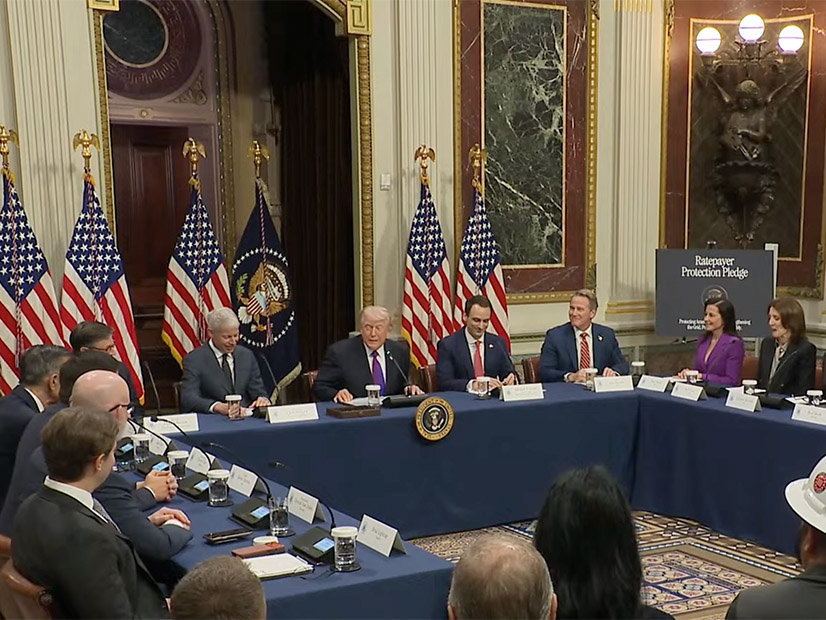
President Donald Trump gathered seven tech leaders at the White House to sign a ratepayer protection pledge holding that they will pay all the costs associated with the boom in construction of data centers.
“We follow through on an announcement I made in my State of the Union address last week, as America’s largest tech companies officially signed the ratepayer protection pledge,” Trump said. “It’s a big deal and going to have a tremendous impact on electricity costs. We’re bringing down all of the costs.”
The event included other administration officials, including Energy Secretary Chris Wright and most members of FERC. While Wright was talking about how FERC needed to speed up its processes, Trump asked the commissioners to stand.
“Because, you know, they’re the most powerful people in the country,” Trump said as they stood. “I have had more people say, ‘Do you know FERC?’ I said, ‘Do I know FERC? What about FERC?’ And I learned so much about you, and you are the most powerful people in the country, so we want to be very nice to you. Please get us approvals. Please get us those approvals. Okay?”
The pledge was signed by senior executives from Google, Meta, Microsoft, OpenAI, Amazon Web Services, Oracle and xAI.
“Data center infrastructure is the foundation of the internet, cloud computing and artificial intelligence (AI), and supports our economic and national security,” the pledge says. “As that infrastructure grows and the related electricity demand increases, the American people should not be footing the bill for the benefit of private companies. Instead, the data center boom should be leveraged to address affordability and benefit all American households and businesses.”
Trump called on hyperscalers and AI companies to “build, bring or buy all of the energy needed for building and operating data centers, paying the full cost of their energy and infrastructure, no matter what.”
That includes paying for the full cost of power plants and any required delivery infrastructure upgrades, whether the data centers wind up using the power or not. The pledge calls on data centers to make a more resilient grid by making their backup generation resources available at times of scarcity to prevent blackouts and power shortages in their communities.
“Basically, we’re building massive amounts of electricity, and you’re not paying for it at all,” Trump said. “And the companies want to do it because … otherwise they couldn’t build. I mean, the option really was not about cost, it was about there’s no way of possibly taking the old grid and doubling it in a matter of months or years.”
Wright said that, during one of his first meetings at the White House, the president told him the country must lead in AI.
“And the old energy policies that were going on would not lead in AI,” Wright said. “We need to lead in AI. Number two, the government’s a bureaucracy. It’s always in the way of things. It’s been in the way of AI. We’ve got to run the government like a business.”
‘Durable’ Solution Needed
Electric industry trade groups said they were ready to work with the Trump administration and hyperscalers to make the pledge a reality.
“We appreciate President Trump’s focus on ensuring that our nation can drive innovation while also protecting Americans who need affordable, reliable energy,” Edison Electric Institute CEO Drew Maloney said. “Our industry has built a strong record of working with the tech community on responsible agreements that benefit local communities and help strengthen the grid for the future. We are excited for the next phase of American innovation that will support jobs, help families and drive economic growth.”
EEI also released a snapshot of publicly announced data center and other large load projects being developed with investor-owned utilities.
“America has an opportunity to lead the world in artificial intelligence and the digital economy, and that leadership will require reliable, abundant, cost-effective electricity,” Electric Power Supply Association CEO Todd Snitchler said in a statement. “Competitive power generators are ready to deliver the energy needed to power that growth while ensuring that the costs associated with new data centers and rising power demand are borne by investors and private capital, not ratepayers. EPSA is confident that the competitive generation industry will meet this pivotal moment.”
EPSA members have announced their own agreements to power data centers without shifting investment risk to consumers. They have announced also more than 12 GW of additional generation capacity in PJM, where, according to the RTO’s Independent Market Monitor, data center demand has pushed up capacity prices by $23 billion in recent auctions.
Speaking at EPSA’s Competitive Power Summit a day before the White House event, Virginia State Corporation Commissioner Kelsey Bagot said the coming announcement, and others like it from the White House on the grid, are a helpful use of the bully pulpit.
“But I think at some point, all the smart people in this room and the states and at FERC need to really be the ones to solve the problem in a way that’s durable and isn’t going to change in three, four, five years’ time,” she said.