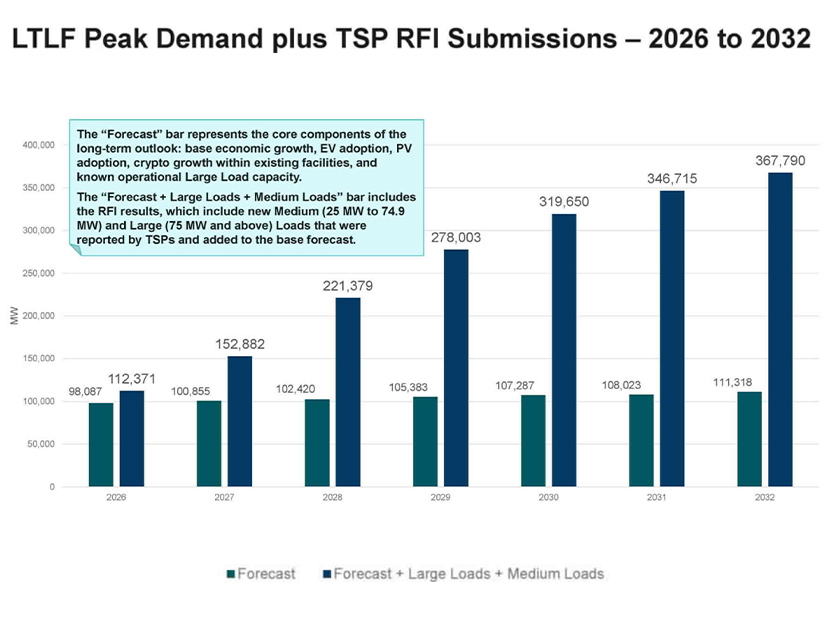
ERCOT has filed a preliminary long-term load forecast for discussion at the April 17 Texas Public Utility Commission open meeting that predicts 367 GW of demand by 2032, a staggering 430% increase over its current peak demand of 85.5 GW.
The grid operator attributed much of the forecast to large loads identified by transmission and/or distribution service providers’ (TDSPs) submissions based on criteria established in ERCOT’s 2026 Regional Transmission Plan, as required by state law.
Staff expressed concern in the filing about using the preliminary forecast values as a modeling input for its 2026 reliability assessment or other transmission and resource adequacy analysis. They want to consult with PUC staff to evaluate whether it is appropriate to adjust the forecast, noting state law allows it “if the adjustment is supported by actual historical realization rates or other objective, credible, independent information.”
ERCOT projects 2026’s summer peak load will fall between 90.5 GW and 98 GW. The preliminary forecast projects demand to hit 112 GW this summer.
The grid operator cautioned the forecast is not a prediction of what will be built, but a preliminary snapshot to inform its transmission planning and resource adequacy reporting, and that adjustments should be expected as the data is further studied, reviewed and finalized for use in the planning process.
“Texas is experiencing exceptional growth and development, which is reshaping how large load demand is identified, verified and incorporated into long-term planning,” ERCOT CEO Pablo Vegas said in a statement. “As a result of a changing landscape, we believe this forecast to be higher than expected future load growth.”
The forecast was developed from data that included ERCOT’s base economic forecast and information provided by TDSPs that work directly with large load customers (75 MW and above) and others.
Data centers, cryptocurrency mining and industrial and oil and gas processes comprise the bulk of the large loads. Data centers alone account for 228 GW of the TDSP’s 243 GW submissions for 2032. Oncor, with a North Texas footprint that is ground zero for large loads, has submitted 109 GW of the large loads.
ERCOT said in March that its queue of interconnection requests from large load customers has hit 410 GW. (See ERCOT Large Load Interconnection Queue Hits 410 GW.)
That has led to the grid operator’s proposed batch process, in which it will study clusters of interconnection requests rather than individually. ERCOT staff are working on a transitional batch study, called Batch Zero, that will streamline the interconnection process and set the stage for subsequent batches. They plan to bring their proposal to the Board of Directors for its consideration in June. (See ERCOT Batch Process Rules Headed to Stakeholders.)
Assuming board and PUC approval, the transitional Batch Zero study would begin July 10 and run into 2027. Loads that had validated studies as of March 4 will be eligible for Batch Zero. Loads without validated studies will have to wait until March 1, 2027, when Batch 1 is scheduled to begin.
A first cut filed with the PUC April 10 indicates 14 GW of requests meet the requirements to be included as base load in Batch Zero. An additional 9.2 GW still could qualify as base load when their studies are checked for validity. And 18.5 GW more requests could be included as studied load in Batch Zero but face a July 10 deadline to be deemed as base load should their studies be valid.
ERCOT said in its 2025 State of the Grid report that average annual electric consumption in its region is increasing by 5% over multiple years. The market has added 62 GW of new generation, primarily renewables and batteries, since 2021. An additional 450 GW of active requests sit in ERCOT’s generator-interconnection queue, as of January 2026.