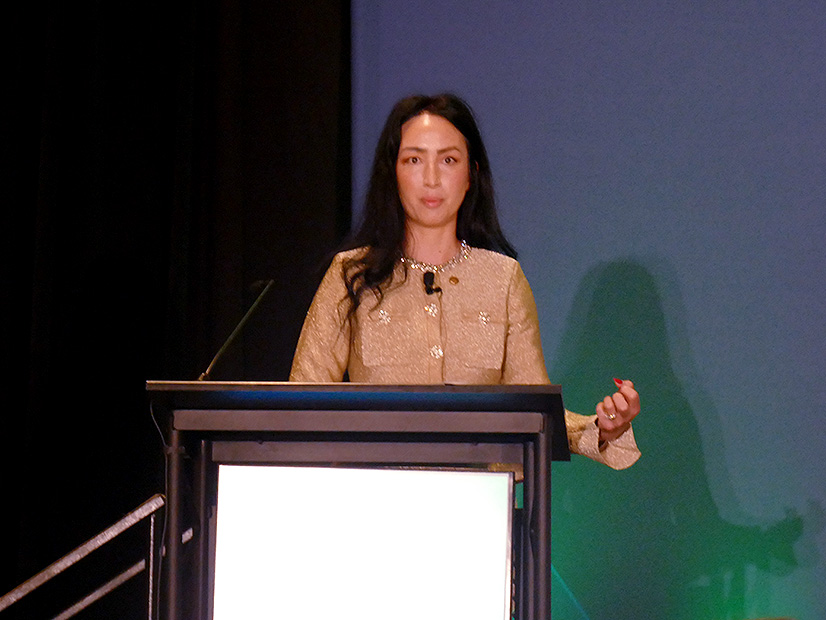
WASHINGTON — FERC Chair Laura Swett told the Energy Bar Association that she wants to push the commission’s authority as far as she can.
“I know very well from litigating where the absolute edge of precedent is on many topics in our jurisdiction, and I have an appetite to push right up to that edge, if it may secure effective results,” Swett said April 15. “But the other side of that coin is my borderline obsession — it’s not borderline; it’s a full-blown obsession. I’m obsessed with legal durability.”
Swett said her personal goal was to “be one of the most impactful chairmen in FERC history,” especially given the issues facing the regulator now.
“We are at a historic crossroads of some of the biggest issues of our lifetimes when it comes to energy,” Swett said. “And so, I recognize the great responsibility that the commission has right now, over the next few years. Everything has to be very thoughtful and very grounded in the law. I can only accomplish my personal goal if our orders stand the test of time and appeal.”
Working in a democracy means that FERC could have a very different composition in a few years with very different priorities.
“The only thing that I can do is help ensure that the orders that go out under my tenure are as tight and excellent as possible, and that means less susceptible to reversal on appeal,” Swett said. “When we leave out orders; if we don’t address arguments that are raised; if we don’t analyze the evidence, then we are vulnerable.”
Swett did not bring up any specific case regarding maximizing FERC authority, but the concept is at issue in Energy Secretary Chris Wright’s Advance Notice of Proposed Rulemaking, which directed the commission to consider assuming jurisdiction over large loads that connect to the transmission system by April 30. (See Energy Secretary Asks FERC to Assert Jurisdiction over Large Load Interconnections.)
While still fairly new to her current job, Swett has been working in and around FERC for 15 years, beginning as a law clerk at the Office of Enforcement while at Georgetown Law School, then becoming an investigator in the office and eventually an adviser to Chair Kevin McIntyre. In between stints at the agency, she worked in private practice representing all kinds of the entities the commission regulates.
“In the past 15 years, I kept a running list of observations about how FERC is run, how the industry is run and what we can all do better,” she said.
Swett is running FERC at a time when reliability is being challenged by the rapid integration of large loads, most notably — but not exclusively — data centers.
“Confronting the problem of large loads is, in my view, the most important and pressing problem in contemporary American public policy,” Swett said. “We have to ensure that these loads can connect quickly and efficiently, but at the same time, we have to ensure that the costs are allocated fairly.”
The authors of the Federal Power Act in 1935 did not anticipate artificial intelligence and the hyperscale data centers it needs, so now regulators and the industry need to evolve, she said.
“We have to use the precedent that we have and solve a problem that the law never anticipated,” Swett said. “However, the authors of the act did anticipate and understand the paramount importance of reliability.”
Reliability remains core to FERC’s mission, and it does not have to be in tension with integrating large loads, she said.
“There’s a lot of creativity that we’ve seen even in the past six months of my tenure, and stakeholders are committing to confront this problem head on, as are our partners at all levels of the government,” Swett said. “And the developers of organized markets have already proposed a number of creative solutions that FERC has approved.”