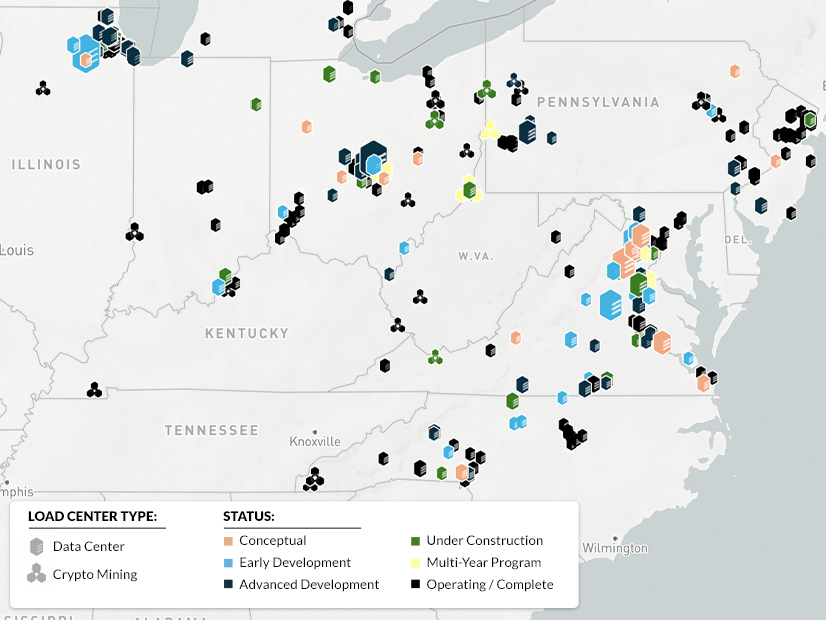
Concerns about PJM and the growth of data center demand dominated the comments received by FERC after its recent technical conference on resource adequacy (AD25-7).
The two-day technical conference in June focused on all of the organized markets under FERC jurisdiction, but PJM took up the most time. (See FERC Dives into Thorny Resource Adequacy Issues at Technical Conference.) Post-conference comments were made available July 7.
PJM’s Independent Market Monitor said continuing with the status quo will mean “a massive wealth transfer” from other consumers as market prices spike almost entirely due to the needs of data centers. The IMM offered a way to avoid that.
“That solution is to require large data center loads to bring their own generation,” the IMM said. “It is essential to have a pragmatic market solution that is consistent with and sustains efficient and competitive PJM markets rather than to create the conditions for a return to cost-of-service regulation.”
That “bring your own generation” would have to have locational and temporal characteristics that meet the data center’s load profile.
Some states are considering withdrawing from PJM’s markets or returning to cost-of-service regulation to address the gap between growing demand and new supplies being too slow to materialize. (See N.J. Mulls PJM Withdrawal amid Energy Shortfall Predictions.)
Data center demand was responsible for $9.3 billion, or a 174.3% increase in the 2025/26 base residual auction (BRA). Absent reforms, those high prices will continue despite their political unsustainability.
“Data center load growth is the core reliability issue facing PJM markets at present,” the IMM said. “There is still time to address the issue, but failure to do so will result in very high costs for other PJM customers and could also result in a switch from competitive markets to cost-of-service regulation.”
Regardless of what the states do, PJM has a rule that has never been deployed, as its BRAs have always met the target reserve margin. If it were to fall short three delivery years in a row, it would start offering generators 15-year cost-of-service contracts. The idea of shortening that trigger from three years has been suggested by some stakeholders, the IMM said.
“Implementation of such long-term cost-of-service contracts would undermine competitive markets and suppress prices for competitive entrants because the backstop capacity is required to be offered in the capacity auctions at zero price,” the IMM said.
Constellation Energy, an independent power producer and competitive retailer that is competing to serve data center load, pushed back on the “BYOG” proposal, arguing it would discriminate against large consumers.
“Any suggestion that some load growth should be addressed efficiently through PJM’s capacity market, but large load should be subject to a bring-your-own-generation requirement makes little sense; it is unclear why the existing capacity market is the efficient vehicle to incentivize needed investment for some types of load but not others,” Constellation said. “Further, this requirement will distort competitive capacity market prices and result in inefficient long-run price signals. This outcome will likely result in less efficient investment decisions and higher overall costs for wholesale electric customers.”
The Federal Power Act says FERC must avoid “undue discrimination,” and the IMM argued the BYOG proposal falls short of that.
“It is not unduly discriminatory to identify the class of large data centers and impose requirements on that class that match the impact of that class on all other customers,” the IMM said. “It would be unduly discriminatory to all other customers, from the smallest residential customer to the largest industrial customer, to allow large data centers to add massive amounts of load to the system with resulting price impacts and reliability impacts on those other customers. Preventing undue discrimination requires that data center loads bring their own new generation.”
Constellation argued the proposal would affect existing generation because those deals are not likely to be reflected in the capacity market price, and that will distort its signals. For that reason, however, the firm agrees with the IMM on utility-owned generation.
“Likewise, requiring utility ownership of new generation in market regions will negatively impact market performance and impose unnecessary costs and risks on wholesale electric market consumers,” Constellation said.
Constellation wants to see more facilitation of long-term bilateral contracting to hedge resource adequacy risk. It also argued for improved load forecasting and improvements to energy market price formation so markets can be as effective as possible.
Dominion Energy Resources owns one of the largest vertically integrated utilities in PJM. Its zone includes rural cooperatives and also is home to the largest concentration of data centers in the world. Winter and summer peaks are expected to grow at 4.7% and 4.9%, respectively, on an annual, compound basis in the coming years.
The capacity market is at risk of falling short of meeting the demand from load-serving entities (LSEs).
“LSEs are forecasting the interconnection of significantly large amounts of new load while expecting the BRA to bring on sufficient new capacity in time to serve that load,” Dominion said. “The current rules simply do not require such LSEs to themselves do anything to ensure that most of the capacity will ‘be there.’ This deviation from the original intent of the market design is stressing the system.”
Dominion wants FERC to establish obligations for LSEs to provide a certain amount of generation or other capacity supply to serve their load — making the BRA a true residual market. It also suggested strengthening the fixed resource requirement self-supply alternative and moving to more seasonal auctions.
The Edison Electric Institute made the point that the load growth, which has grown to levels unseen for decades and has disrupted resource adequacy plans around the country, has its good side.
“This load growth is a positive development for the United States and holds the potential to create economic benefits for all customers over the long term,” the investor-owned utility trade group said. “The electric grid provides an extraordinary platform to deliver resilient, reliable power to address customer needs on a large scale. To accommodate current and future growth, as well as maximize benefits, new and proactively planned energy infrastructure of all types will be required.”
FERC has its role in getting the wholesale market design correct, but it must work with states, LSEs and others to deal with the issue.
“States’ authority includes control over in-state facilities used for the generation of electric energy, whereas the commission has exclusive jurisdiction over wholesale sales of electricity in the interstate market,” EEI said. “Given their jurisdictional authority with respect to generation resources, states will have a central role in identifying and implementing needed changes.
“However, the commission must recognize that state commissions have elected to exercise their jurisdiction over generation resource adequacy differently — some state commissions directly exercise authority over generation resource adequacy issues, while others rely primarily on regional reliability councils or RTOs/ISOs.”
Advanced Energy United, the American Clean Power Association, the American Council on Renewable Energy and the Solar Energy Industries Association agreed that states are important to solving the issue.
“When allowed to function as designed, and when coordinated with state policies and resource planning processes, competitive markets remain an effective and efficient tool to ensure resource adequacy,” the clean energy trade groups said. “Across the RTOs/ISOs, there are multiple approaches to meeting resource adequacy needs — from centralized and hybrid markets to non-market approaches — any of which can help ensure sufficient resources for a reliable grid. It is not market failure, but the failure to let markets function that threatens resource adequacy.”
Existing resource adequacy constructs can be improved incrementally to increase their transparency, accuracy, granularity and durability. Those changes will improve the chance for more bilateral contracting to take pressure off the centralized markets, they said.
“Bilateral contracts are an essential tool for resource adequacy: they offer longer-term certainty to new resources than a three-year forward or prompt auction for a single delivery year can, and are therefore important for facilitating investment in the new resources needed to support resource adequacy,” the clean energy trade groups said. “States can play a key role in enabling and encouraging more bilateral contracting, but stable, predictable, transparent markets are a critical foundation without which more robust, efficient contracting cannot occur.”
While incremental reforms are needed, the trade groups urged caution against rushing the process and relying too heavily on quick fixes.
“Urgency constrains optionality and accurate analyses, which as a result often leads to sub-optimal solutions,” the four groups said. “For example, short-term fixes imposed in a rush to mitigate the effects of market prices will only deepen uncertainty and cause further harm by negating the role that market prices can play in stimulating entrance of new capacity.”