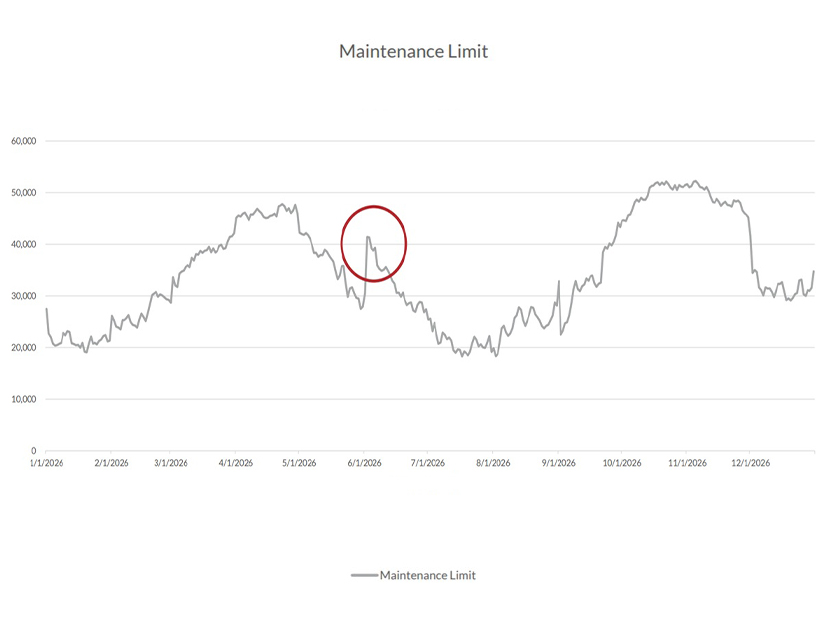
MISO said it will pay attention to its maintenance margin while it considers changes to its 31-day limit on outages for capacity resources.
MISO staff said the RTO’s maintenance margin — used to schedule planned generation outages and grant capacity accreditation exemptions — is at times off-base in its risk-to-supply adequacy judgment when owners request downtime for maintenance.
MISO has been toying with the idea of altering its 31-day outage rule, which has been in effect since FERC approval in August 2022. (See MISO Re-examining Monthlong Outage Limit for Capacity Resources.) Now, MISO said its maintenance margin could use some work to maintain reliability.
“We will be evaluating it and making sure it’s accurate. Our goal is to make sure it’s completely accurate,” MISO Market Design Engineer James Curtis said during an April 14 Reliability Subcommittee teleconference.
Curtis said the maintenance margin shows too much wiggle room for outages in high-risk months in summer and winter. He said the maintenance limit allows 40 GW of planned, urgent and emergency outages for June 2026.
“I think we can all agree that 40 GW of outages in the summer is totally inappropriate,” MISO Market Design Manager Davey Lopez said. “That’s why we’re having this discussion.”
Curtis said when MISO’s maintenance margin is set too high, resources can take outages that put reliability at risk while still getting accreditation and non-compliance penalty exemptions.
MISO’s maintenance margin was introduced in 2013 and uses the average of the past 30 years of load data to calculate available reserves. MISO said the 30-year amalgamation results in only typical operating days, when it also should represent days with choppier operations. MISO said the 5 GW of import capability it assumes from neighboring regions when calculating the margin is too optimistic. It said a more realistic average ranging from 1.4 GW to 2.5 GW depending on the season is in order.
“It is critical that the maintenance margin is accurately representing the number of megawatts that can go on outage without causing reliability risk to the grid,” Curtis said.
MISO said it observed an average 20 GW in unplanned outages over summer 2025, a 42% spike over previous years, which contributed to tighter operating margins and ultimately four maximum generation emergencies.
Curtis said generation owners are planning outages “intentionally to avoid” MISO’s capacity replacement non-compliance charge by “straddling seasons” so the outage can occur in a month of one season and continue into another month of the next season, exceeding the monthlong limit without technically violating the limit.
Curtis said while MISO anticipated some of that type of behavior, it didn’t expect it to be at the scale generation owners are using it.
MISO expects capacity resource owners to either procure replacement capacity or pay penalties if they are offline for more than 31 days in a single season. They must notify the RTO 120 days in advance of planned outages to be exempt from capacity accreditation reductions. If MISO’s maintenance margin is above zero for a given period, resources can get planned outage exemptions for their accreditation.
MISO imposes a capacity replacement non-compliance charge when resource owners conduct outages longer than 31 days and fail to replace the zonal resource credits they signed up for. The charge is calculated by multiplying the capacity shortfall by the sum of auction clearing prices and the area’s cost of new entry.
Minnesota Power’s Tom Butz said he didn’t see how a more exacting maintenance margin would allow generation owners to take proper, long-term maintenance outages when necessary. Butz said MISO might consider allowing longer outages in spring and fall.
Butz previously asked for a better understanding of MISO’s maintenance margin and what calculations are used to determine when the system is tight.
“It just seems like it’s a post card that comes in the mail,” Butz said, adding that the maintenance margin seems like the “black box of black boxes.”
Curtis said MISO wants make sure generation owners have the necessary time for planned outages “so they’re not taking forced outages when something breaks.” He said MISO plans to discuss outage limits and monetary penalties further in upcoming meetings of the Resource Adequacy Subcommittee.
MISO will continue discussions on how its maintenance margin could change at subsequent Reliability Subcommittee meetings.