FERC Approves ISO-NE Prompt Capacity Market

FERC has approved ISO-NE’s proposal to replace its Forward Capacity Market with a prompt market, cutting the time between auctions and commitment periods from more than three years to about one month (ER26-925).

The new rules will take effect for the 2028/29 capacity commitment period (CCP), which begins June 1, 2028. ISO-NE held its last Forward Capacity Auction, FCA 18, in February 2024 for the 2027/28 CCP.

FERC’s March 30 approval marks the end of the first phase of ISO-NE’s Capacity Market Reforms (CAR) project. The RTO is amid stakeholder discussions on the second phase of the project, which centers around capacity accreditation changes and the division of annual CCPs into winter and summer seasons.

Under the new design, only resources that have achieved commercial operations will be allowed to participate in the Annual Capacity Auctions. A key motivation driving the prompt market proposal was ISO-NE’s desire to eliminate “phantom entry,” which occurred in the FCM when non-commercial resources obtained capacity supply obligations (CSOs) but failed to come online in time for the commitment period.

ISO-NE has also argued that the new auction format will help protect the region against increasing uncertainty in load forecasts. While New England states have set ambitious electrification goals, the RTO has scaled back its electrification forecasts in recent years because of slower-than-expected electrification adoption. And while the data center boom has yet to hit New England, the potential for new large loads adds additional uncertainty to the forecasts.

“The combination of forecasted demand growth into the next decade, and the uncertainty over the extent of such growth, underscores the value in transitioning from the three-year forward market construct to the proposed prompt market construct,” ISO-NE wrote in its filing.

Accurate demand forecasting “will be especially important when accounting for data centers and other large load proposals, which are often highly uncertain in terms of proposal attrition rates, relative construction time and electric demand characteristics,” it added.

The approved changes also include provisions affecting resource deactivations, resource qualification and the auction clearing mechanism, and will eliminate the need for annual capacity reconfiguration auctions.

In the prompt market, the resource retirement process will be decoupled from the auction qualification process. Retiring resources must submit deactivation notices a year prior to the applicable commitment period. In the forward market, ISO-NE processed retirements about four years prior to each CCP.

The RTO has said the reduced notification period will enable resources to make retirement decisions with more up-to-date market information, while still giving the region some time to respond to deactivations. In the NEPOOL discussions of the changes, some stakeholders expressed concern that reducing the notification timeline will increase the likelihood and duration of reliability-must-run agreements.

All commercially available capacity resources that do not deactivate will be required to participate in the auction.

The new qualification process includes a February deadline for data submission and an April deadline for new resources to demonstrate they have achieved commercial operations. Each auction will be held in early May prior to the June 1 start of each CCP.

The move to a prompt auction will affect which costs that participants are allowed to incorporate into capacity offers. Bids are supposed to reflect the incremental cost of assuming a CSO, and costs associated with investments made in resources prior to the auction cannot be included in bids.

But ISO-NE argued that this will “not necessarily lower capacity offer prices,” as it impacts just one factor affecting offer prices in the auction. The RTO told FERC that the transition to a prompt market will allow for more efficient market outcomes but will not systematically influence the trajectory of clearing prices.

“The change in the timing of the capacity auction does not change the fundamental pricing dynamics within the capacity market,” Chris Geissler, director of economic analysis at ISO-NE, wrote in testimony supporting the RTO’s proposal.

The prompt market proposal received near-universal support from the NEPOOL Participants Committee, and a range of commenters expressed general support for the RTO’s filing with FERC. (See NEPOOL Supports First Phase of ISO-NE Capacity Market Reform.)

The New England Power Generators Association (NEPGA) expressed concern about how the RTO would calculate the competitive price offer threshold, which determines whether an offer will be subject to review by the ISO-NE Internal Market Monitor. While NEPGA has argued that ISO-NE’s proposal to maintain its existing methodology would make it reliant on stale data, ISO-NE has committed to evaluating potential issues prior to the 2028/29 CCP.

FERC said the new design will reduce both supply and demand uncertainty. It agreed the retirement changes “will allow market participants to make their retirement decisions based on better information about market conditions, revenues, costs and the remaining economic life of the resource.”

“We’re pleased to receive the commission’s approval on the first phase of capacity market reforms, which enjoyed broad support from stakeholders and the New England states,” ISO-NE said in a statement. “We look forward to this collaboration continuing as we develop the second phase of reforms ahead of a filing with the commission later this year.”

While the prompt market changes are intended to be able to stand on their own, ISO-NE hopes to implement both phases of the CAR project for the 2028/29 CCP. But the second phase is widely considered to be the more controversial component, and there is no guarantee ISO-NE will obtain approval of these additional changes in time for the commitment period.

SEPA Tracks 77 Large Load Tariffs Nationally with DELTa Database

The Smart Electric Power Alliance’s update to its Database of Emerging Large-Load Tariffs (DELTa) shows how much the concept is spreading for utilities as state regulators grapple with a surge in load growth driven by new large customers.

SEPA created DELTa in partnership with the North Carolina Clean Energy Technology Center to track the proliferation of utility tariffs for large load customers after hearing interest from its members that include utilities, regulators and tech companies, SEPA’s Anne Collier said during a March 30 interview with RTO Insider.

“Everyone would like to know what are the solutions and strategies they have to meet load growth in a way that not only protects existing customers from some of the cost or reliability risks that we’ve seen come out in other papers, but also, to look proactively at this as a moment to do something good for the grid and to improve service to everyone,” Collier said.

The database, which anyone can download, shows 77 large load tariffs either in place or being considered at utilities around the country. Only 12 states neither have adopted nor are considering such a tariff.

Users can break down the data by whether the tariff has been approved and what kind of customers it applies to, by types like data centers or general commercial and industrial customers, and by how big a customer needs to be to qualify.

To submit a commentary on this topic, email forum@rtoinsider.com.

While hyperscalers have dominated headlines, just five states have large load tariffs that kick in at 100 MW or greater: Georgia, Kentucky, Michigan, Missouri and West Virginia. Florida, Minnesota, Virginia and Wisconsin are considering specific rules for customers at or above 100 MW.

Some states have found that the standard way of dealing with larger commercial and industrial customers with conventional tariffs and electric service agreements continues to work for them, Collier said.

“Of the states that are in DELTa, we see interest really accelerating,” Collier said. “It’s this hockey stick inflection point for the regulatory industry right now where we have 77 tariffs and service rules in DELTa right now with this quarterly update, and 29 of those were approved last year alone.”

The tariffs blend longtime principles used in traditional utility ratemaking with new contractual mechanisms that are seen as helpful for large customers participating in emerging industries, she added.

Before 2025, most tariffs SEPA was tracking were for smaller customers — applying to facilities with demand of 5-10 MW.

“Now we’re seeing that load threshold increase sort of in parallel with the emergence of hyperscale and frontier data centers,” Collier said. “So, thinking around what is large and what requires this new way of contracting for service is starting to change.”

Most of the tariffs characterize large loads by their size and load factor, but some get more specific and are aimed at specific types of customers, such as data centers or crypto miners. Other changes are designed to require data center projects to provide upfront interconnection deposits meant to weed out speculative projects shopping for the best, cheapest connections to the grid.

“We’re also seeing provisions that are meant to provide increased certainty to the utility over the long term,” Collier said. “So, contractual timelines and take-or-pay contracts terms where they’re used, they tend to settle in that 75-to-85% range.”

Other terms include different financial security provisions meant to limit the risks of stranded costs in the event of an economic downturn, or whatever causes a large customer to shut down before completion of the useful life of infrastructure built to serve it.

“The process of utility ratemaking is an art and a science,” Collier said. “And it’s not for me to really say how precise the science is going to be able to get here. But I know from broad conversations with utilities, with those in the regulatory community, and with those at data centers and large customers, that there is shared interest in figuring this out so that the degree of error is minimized. So, we’re looking for a risk-minimization approach here.”

Entergy Louisiana Says 7 More Gas Plants Necessary for Meta Data Center

Entergy announced a massive addition to Meta’s Hyperion AI data center project in northeastern Louisiana and said it plans to add seven additional natural gas plants to deliver more than 5 GW to power the site.

The expansion involves a second hyperscale data center, called “Project Evest,” adjacent to the Hyperion data center in Richland Parish and would further entrench Meta’s dependence on gas for its data centers.

Entergy Louisiana filed an application for an electric service agreement March 26, again asking the Louisiana Public Service Commission to approve a 20-year contract for the seven plants on a fast-tracked basis (U-37882).

Combined, the data centers would be supplied by 10 natural gas plants at nearly 7.5 GW. Entergy Louisiana already is building a trio of plants at 2.26 GW for the Richland Parish project: two in the parish and a third near Baton Rouge.

All told, the planned gas plants for the Meta facility would total more than half of Entergy Louisiana’s 12-GW load.

Meta’s investment in the Hyperion facility has grown from the initial $10 billion announced in 2024 to about $27 billion, with Blue Owl Capital fronting most of the funds. (See Earthjustice Says Change to Louisiana Meta Data Center Funding Fishy, Asks PSC to Investigate.)

Entergy Louisiana CEO Phillip May promised the data center campus and its needs would be funded solely by Meta. Entergy claimed that Meta’s expansion would save customers a total of $2.67 billion through 2046.

May and other Entergy officials met with Louisiana Public Service Commissioner Foster Campbell, who represents the district, in his office March 27 to discuss the ballooning plans. Campbell told a USA TODAY affiliate that he supports the project “1,000%” and is confident the expansion will benefit ratepayers.

The Richland Parish data center “serves as a symbol of the ambition and scale of next-generation AI infrastructure,” Meta Vice President Rachel Peterson said in Entergy Louisiana’s news release.

Peterson said Meta has been “working closely with Entergy since early on-site planning to ensure our power needs are met and, importantly, so that Entergy’s other consumers aren’t paying our costs.”

In early March, Meta was one of seven major technology companies to sign on to the White House’s “Ratepayer Protection Pledge” to ensure data centers don’t raise electricity costs for American households.

Entergy’s plants would feature technological capabilities for future carbon capture and hydrogen co-firing. The utility said the generation would require about 240 miles of new 500-kV transmission lines connecting southern Louisiana to northern Louisiana and Arkansas.

Entergy also said Meta would fund up to 2.5 GW of new renewable energy, an unspecified amount of battery storage in three locations and power uprates in the utility’s existing fleet. Per Entergy, the agreement includes a “memorandum of understanding to explore the future development and use of nuclear power.”

Entergy said Meta would contribute $260 million to programs for low-income residential customers.

Louisiana’s primary consumer advocate group for utility customers met the news with unease.

Logan Burke, executive director of the Alliance for Affordable Energy, called the expansion “an unprecedented ask.”

“We’re talking about 10 new gas power plants and over $16 billion in new fossil fuel infrastructure. That’s a nearly 70% increase in Entergy Louisiana’s total gas capacity, adding to the already heavy dependence on the fuel, at a time when market analysts expect price volatility to continue,” Burke said in a March 31 press release.

Alaina DiLaura, a policy coordinator for the alliance, questioned the more than $2 billion benefit claim. She said it’s not clear how the PSC, should it act on an expedited basis, can “allow for the scrutiny necessary to verify those benefits and the supposed ratepayer protections.”

The alliance said the fleet of gas plants would drive a “huge increase in CO2 emissions,” at almost 26 million metric tons/year. The nonprofit drew attention to local reporting that Richland Parish residents already have been subjected to power outages and brown water coming out of taps while the Hyperion facility and first round of gas plants are built.

Meta aims to achieve net-zero emissions across its entire “value chain” within the next four years.

“Meta’s proposed expansion and Entergy Louisiana’s new application demands a full transparent review and an opportunity for the community to weigh in,” the Alliance for Affordable Energy said.

Competition, Industrial Groups Contest MISO Plan for Long-range Tx Stretching into PJM

The Electricity Transmission Competition Coalition and the Industrial Energy Consumers of America have mounted a challenge to MISO’s proposed method for building portions of long-range transmission projects that cross into PJM.

The competition and consumer groups entered a protest with FERC on MISO’s plan to implement “agreements with external transmission owners to fund, construct, own and operate new transmission facilities serving MISO needs but located outside the MISO region” (ER26-1538).

In question: about $1.95 billion worth of mostly greenfield transmission projects in Illinois and Indiana that stretch into PJM but are considered part of MISO’s second, $22 billion long-range transmission portfolio. MISO said “certain PJM-based tie-line transmission and substation facilities were included in several” of the long-range transmission projects.

MISO wants to create new tariff provisions to assign projects directly to PJM transmission owners, bypassing competitive solicitations. The RTO plans to call them “Do No Harm” projects and use PJM’s “supplemental project” designation. MISO said it cannot apply its competitive bidding process to the select group of projects because they are outside of MISO.

MISO reasoned that its “authority as the transmission provider extends to the MISO transmission system only.” It said it plans to execute several proposed “Cost Recovery and Funding Agreements” with PJM transmission owners.

But the Electricity Transmission Competition Coalition and the Industrial Energy Consumers of America said MISO-planned long-range transmission projects outside of MISO don’t exist in a regulatory no-man’s land that requires a departure from the MISO tariff. They called MISO’s filing an “unsupported request for waiver and authority to bypass” FERC’s core transmission planning.

“MISO must follow its tariff, not institute a policy choice to circumvent transmission competition contrary to its tariff and Order No. 1000, and then seek approval from FERC to codify that policy choice,” the groups said in a March 30 protest.

The groups said MISO’s plan “rests on a false premise” that MISO can assert that FERC-mandated practices are “inapplicable” based on where a project is located.

They argued that if MISO can plan the transmission under the long-range framework pursuant to its tariff, then it’s subject to the tariff and MISO’s competitive developer selection process. They pointed out that MISO’s transmission expansion planning protocol “contains no geographic or topological restriction to transmission projects.”

“MISO’s filing, even if it could be considered just and reasonable on a prospective basis, cannot cure MISO’s violation of its existing tariff,” the two groups argued.

The duo said “neither MISO’s border nor the facilities under MISO’s operational control are static or geographically fixed” and that MISO’s borders constantly change as transmission owners add facilities, or join or leave MISO.

“MISO’s assertion that the [long-range] projects are located ‘in the PJM region’ is nothing more than a self-fulfilling policy choice by MISO to avoid competition,” they contended.

The groups argued there’s a better name for long-range projects outside of MISO: interregional projects.

They said even if FERC accepts MISO’s explanation that its projects can be in PJM, then MISO and PJM’s interregional planning process and joint operating agreement should take effect.

They said MISO attempted to “skirt” the interregional issue by disclosing it and PJM “discussed the MISO requested facilities as part of their Interregional Planning Stakeholder Advisory Committee.” But the two said that doesn’t answer the question as to whether MISO and PJM met the requirements of FERC’s Order 1000 and evaluated them as interregional projects.

Furthermore, the two argued PJM’s supplemental project category is a poor fit. The PJM category is meant for projects to meet transmission owners’ local planning criteria.

MISO-planned long-range transmission projects “have nothing to do with PJM transmission owner planning standards and criteria,” they told FERC.

Finally, the competition and industrial consumer organizations argued that MISO didn’t put forth a narrow or limited plan. They said MISO didn’t attempt to limit the number of projects eligible for direct, outside assignments; didn’t limit aggregate costs of projects put through the process; did not restrict use of the new treatment to projects named in its filing; and didn’t propose that FERC review or approve a determination method for projects that could circumvent competition or interregional planning.

“In effect, MISO asks the commission to grant it plenary discretion to determine when Order No. 1000 no longer applies. If accepted, there would be no limiting principle preventing MISO from applying this waiver approach repeatedly, including to projects of great scale and cost, thereby routing substantial volumes of regionally cost-allocated transmission investment outside FERC’s competitive and interregional safeguards,” the groups told FERC.

They said the filing “would establish a regime” that FERC’s Order 1000 was designed to protect against.

Mich. PSC Won’t Reopen DTE’s Stargate Data Center Supply Deal over AG’s Concerns

The Michigan Public Service Commission unanimously rejected requests from Attorney General Dana Nessel to reassess DTE Energy’s arrangement to provide 1.4 GW to an Oracle and OpenAI’s Stargate data center south of Ann Arbor.

Nessel, a Democrat, criticized a lack of discussion around the PSC’s March 27 vote that leaves DTE Energy’s agreement in place (U-21990). The attorney general filed a motion to reopen DTE’s application and a petition for rehearing in the docket, condemning “a secret review of the heavily redacted contracts with significant consequences for Michigan utility customers.”

The PSC also rejected Nessel’s request for a contested case proceeding to review six “heavily redacted contracts proposed by DTE for three battery storage facilities throughout the state meant to support the data center project.”

Oracle and OpenAI partnered with the newly formed Related Digital to propose a $7 billion Stargate AI data center in Saline Township in October 2025. It took the PSC less than two months to grant DTE Energy’s redacted large load supply agreement for the project.

Nessel has been challenging the accelerated approval and pushing to review the special contracts in full and verify DTE’s claims of customer affordability under the deal. (See Michigan PSC OKs DTE Energy’s 1.4 GW Data Center Contract, AG Pans Process; DTE Treads Carefully as Michigan Becomes Flashpoint in Data Center Debate.)

“The Michigan Public Service Commission continues to perform a grave disservice to the state of Michigan and the utility customers of this state, to the only apparent benefit of the utility corporations and their new billion-dollar AI customers,” Nessel said in a statement. “Since these secret contracts were first filed in October, I have requested and demanded that my office and other consumer advocates be able to review these contracts and ensure adequate protections for existing utility customers. At every opportunity, the commissioners have shut out everybody, choosing instead to keep DTE’s contract terms top secret, fast track their approval and play fast and loose with the meager terms they claim to put in place.”

Nessel added she has never observed “a process so secretive, rushed and ripe for disaster as what the commission rammed through here.” She vowed her office will continue to explore remaining options to get insight into the agreements’ ratepayer ramifications.

Nessel said the PSC failed to address her contention that DTE wrote in weaker protections for its existing customers than the commission ordered in December.

According to Nessel, the commission instructed DTE to make representations that “payments made by Green Chile Ventures LLC under Rate Schedule D11 and the special contracts will cover the costs to serve Green Chile Ventures LLC such that the costs of serving Green Chile Ventures LLC (including generation, transmission, distribution, or other costs) are not covered by other customers.”

Green Chile Ventures is a subsidiary of Oracle and serves as a development vehicle for Stargate data centers.

Nessel said DTE altered the PSC’s ordered language and wrote that “aggregate revenues generated by the customer [Green Chile Ventures LLC] will cover the costs to serve them.”

Nessel said the rewrite didn’t offer a clear enough guarantee that DTE won’t place the near-term costs of the data center on existing customers. She said DTE dodged accepting the conditions ordered by the PSC.

The AG’s office said, “DTE has only represented that by the end of the 19-year contract that it expects the aggregate payments from the data center to have eventually risen to a sum greater than the company’s own costs to serve the data center.”

In shooting down a reopening of the case, the PSC said it “finds that the reference to aggregate revenues in the acceptance letter does not change or somehow endanger the cost allocations that were placed on the approval.”

The PSC authorized a $242.4 million annual rate increase for DTE in February 2026, which took effect in early March (U-21860). DTE originally requested a $574 million increase.

Five days after the approval, DTE said it would move to raise electric rates again, with a formal filing expected sometime in April and new increases to take effect in March 2027.

Nessel has said she plans to involve herself in the case.

“It’s astonishing that our current system allows DTE to announce their next rate hike case less than one week after locking in a $242 million rate hike, all while the utility projects record profits,” Nessel said. “How many times are Michigan families expected to reach deeper into their pockets to bankroll record profits and shareholder dividends for DTE and Consumers Energy’s Wall Street investors, while reliability and affordability remain out of reach?”

The AG’s office said since 2020, state regulators have greenlit more than $1 billion in annual revenue increases for DTE, “despite continued reliability and affordability concerns.”

“DTE’s special contracts for the Saline Township data center, which the Michigan Public Service Commission  approved in December, protect our customers — including ensuring that there will be no stranded assets and our customers will not subsidize data center rates,” DTE Director of Communications Jill Wilmot said in a statement to RTO Insider. “DTE Energy has an obligation to serve any customer, including data centers, that come into our electric service territory in southeast Michigan. That’s why we’ve been so focused on including these customer protections in these agreements.”

State Briefs

CALIFORNIA

Kern County Approves State’s Largest Solar Project

The Kern County Board of Supervisors unanimously approved the 2-GW Buttonbush Solar and Storage project.

The project required 17 individual conditional use permits and 79 mitigation measures intended to reduce the development’s environmental impact.

Developer Avantus hopes to open as much of the project as possible by the end of 2029.

More: Bakersfield.com

FLORIDA

Port Canaveral Denies Natural Gas Plant Proposal

Port Canaveral commissioners voted unanimously not to sell land to Berkshire Hathaway and Chesapeake Utilities to build an LNG plant.

A 50-acre barge canal property on Merritt Island, part of the port authority’s property, was the target of an unsolicited offer by Berkshire, which wanted to purchase the land for an LNG liquefaction plant to help supply both the cruise and space industry.

Commissioners cited the land’s potential value and not having control of the land for 50 years as reasons for their rejection.

More: Tampa Bay Times

INDIANA

DOE Orders Another Extension of Coal Plants

DOE issued another emergency order to keep the coal-fired Schahfer Generating Station and Culley Generating Station operating until June 21.

DOE cited MISO’s response to Winter Storm Fern as a reason to maintain the plants.

Synapse Energy Economics estimates keeping the plants open costs NIPSCO and CenterPoint Energy a total of $229,000/day.

More: Indianapolis Star

KENTUCKY

Kentucky Power Looks to Update Coal Plant

Kentucky Power filed an application with the Public Service Commission to build a new cooling tower at the Mitchell Generating Station.

The project would cost $191 million and comes after the PSC warned any additional investments at the facility would require separate review. The utility asked for a Certificate of Public Necessity to start work on building the new cooling tower, saying the project is necessary to preserve a significant source of electricity.

More: The Mountain Eagle

MAINE

Gov. Mills Signs Bill to Prioritize Affordable Electric Rates

Gov. Janet Mills signed a bill that directs the Public Utilities Commission to consider the affordability of electricity for residential customers when setting new rates.

The PUC will develop an affordability metric to determine the impact of electric bills on the overall burden for households. It also will disclose the credit and collection activities of Central Maine Power and Versant Power.

More: Maine Public Radio

Lawmakers Back off from Creating Climate Superfund

The Legislature has decided not to create a climate superfund program and instead wait for similar court battles in New York and Vermont to play out.

Instead of starting a program, the bill now directs the Department of Environmental Protection to calculate the dollar value of costs to Maine from greenhouse emissions over the past 20 years. The original bill would have set up a program to assess costs of climate harms and charged big oil companies for those damages, with the funds helping to prepare communities for sea level rise and extreme weather.

Sen. Stacy Brenner (D-Scarborough) told the Environmental and Natural Resources Committee that avoiding a potential lawsuit was the motivation for backing off from a full superfund program for now, but she said the new version of the bill is a step forward in the process.

More: Maine Public Radio

MARYLAND

Supreme Court Strikes down Climate Lawsuits

The Maryland Supreme Court ruled against reviving climate lawsuits brought by Baltimore, Annapolis and Anne Arundel County that were struck down by lower courts.

The governments had sued 26 multinational oil and gas companies to recover damages caused by the effects of greenhouse gas emissions, accusing them of deceiving the public about the dangers of using their products. The Supreme Court ruled that federal law overrides state law on air pollution that crosses state lines, blocked such lawsuits from proceeding and accused the plaintiffs of trying to use litigation to regulate greenhouse gas emissions.

Two lower courts had dismissed the cases, which were filed in 2018 and 2021.

More: The New York Times

MICHIGAN

PSC Approves Largest Consumers Rate Increase in Decades

The Public Service Commission approved a $276.6 million rate increase for Consumers Energy – the largest rate hike approved in more than 20 years.

The PSC said it shaved more than $100 million off the original request since it was filed in June 2025. Regulators also said the increase will allow Consumers to continue reducing outages and improving historically bottom-tier reliability.

The increase, which will go into effect May 1, will add $6.46 to the average residential bill.

More: MLive

NEW HAMPSHIRE

Gov. Ayotte Issues Order for ‘Nuclear Roadmap’

Gov. Kelly Ayotte issued an executive order directing the state Department of Energy to create a “nuclear roadmap.”

The order tasks the DOE with identifying a path toward implementing “advanced nuclear electric generation” and studying ways to insulate ratepayers from delays and cost overruns.

A preliminary roadmap is due within six months and a final report within two years.

More: New Hampshire Bulletin

OHIO

Siting Board Recommends Denial of Solar Facility

Power Siting Board staff recommended the denial of the 180-MW Sloopy Solar facility in Clark County.

The project is partially grandfathered in, according to the PSB, because it received a system impact study and fees before October 2021. It already was in motion before the passage of Senate Bill 52, which allows a county board to prohibit the construction of utility-scale wind or solar facilities altogether or in certain designated zones in unincorporated areas.

Although the staff recommended denial, the board is not bound by the report and could still approve it.

More: Springfield News-Sun

SOUTH DAKOTA

Data Center Restrictions Signed into Law

Gov. Larry Rhoden signed a bill that will place new limits on large loads and data centers.

The law will apply to data centers 10 MW or greater. It requires data center companies to ensure their water use does not overburden local resources and to pay for electrical infrastructure costs. It also prohibits the state from overriding local ordinances limiting, prohibiting or regulating data centers.

Another bill will allow the Public Utilities Commission to assess data center companies the costs of regulatory reviews related to their projects.

More: South Dakota Searchlight

TEXAS

EPE to Build Meta Data Center Power Plant

El Paso Electric plans to have a $500 million, 366-MW natural gas plant built in 10 months to meet part of the power needs of Meta’s data center complex under construction in El Paso.

Meta announced the data center project is expanding to a $10 billion, 11-building complex. Meta will pay the costs of the plant, and it won’t affect EPE rates during the first five years of operation. The PUC still must approve the project.

Construction of the plant is scheduled to begin in August with an expected completion date of May 2027.

More: El Paso Times

Federal Briefs

Study: U.S. has Caused $10T Worth of Climate Damage Since 1990

The U.S. has caused $10 trillion in global damages between 1990 and 2020 through its greenhouse emissions, with a quarter of the damages inflicted upon itself, according to a study published in Nature.

The study attempts to attach dollar amounts to “loss and damage” — a term used to account for the harm suffered by societies from rising temperatures. By being the largest carbon emitter in history, the U.S. ($10.18 trillion) has caused greater harm to worldwide economic growth than any other country, ahead of China ($8.7 trillion), according to the findings of the paper.

More: The Guardian

NRC Seeks Comments on Project Matador Environmental Review

Fermi America is working with the Nuclear Regulatory Commission on a pilot program to develop applicant-prepared Environmental Impact Statement documentation, an approach the NRC says will help improve regulatory efficiency.

This new approach — enabled by recent amendments to the National Environmental Policy Act — allows applicants, under NRC oversight, to develop a draft EIS. The change is expected to reduce review time by about 50%. Fermi America is the first private company to participate in the pilot.

Fermi America is planning what it calls the world’s largest energy-driven artificial intelligence complex, located in Amarillo, Texas. The HyperGrid campus aims to integrate large-scale nuclear power plants, small modular reactors and other power sources.

More: World Nuclear News

Oil Prices Jump Again

On March 30, Brent crude oil was trading at about $114/barrel, up significantly from the prior week, when prices were around $100 or $105/barrel.

Gasoline prices have risen along with oil and are averaging about $3.99/gallon in the U.S.

More: The Hill

Company Briefs

Microsoft, EDP Ink Solar PPA

Microsoft and EDP Renewables North America have inked a power purchase agreement for the entire output of the 150-MW Pleasantville Solar project.

EDP has developed 1.6 GW of clean energy projects in Illinois.

More: Solar Power World

Swift Current Energy Names New CEO

Swift Current Energy announced it has appointed Michael Arndt as its new CEO.

Arndt will replace Eric Lammers, effective April 6.

Arndt moves to Swift Current from Canadian Solar subsidiary Recurrent Energy, where he served as president and general manager.

More: Taiyang News

Entergy: Revised Meta Data Center Deal to Deliver Higher Savings

Entergy said Meta Platforms will pay its full cost of service for ​a planned hyperscale data center in ‌northeast Louisiana under a revised agreement.

The agreement is expected to deliver ​nearly $2 billion in customer savings over 20 years, the company said, in addition ​to the $650 million announced in 2025.

More: Reuters

SERC Members/Board Meeting Briefs: March 25, 2026

FPL Urges Other Members to Start Using AI

Representatives of Florida Power & Light urged fellow SERC Reliability members to start using artificial intelligence tools, even in their own personal lives, warning that its use on the grid is spreading too rapidly to not understand how it works.

To that end, Robert Wargo, senior director of the utility’s Critical Infrastructure Protection program, and Robert Adams, senior director of compliance and regulatory affairs, briefed members at SERC’s annual meetings March 25 in Jupiter, Fla. on the many ways their utility is using AI to monitor its distribution grid, reduce outage times and avoid outages entirely.

Like virtually every state in the country, Florida is experiencing surging load growth that is expected to accelerate, driven primarily by the proliferation of data centers, and the Sunshine State is hurriedly building solar resources to meet it. “Think of a dispatcher in the future with all this volatile load out there,” Adams said. In the past, “generation was pretty stable. You had a defined number of generating plants, and nothing moved horribly quickly on the transmission grid.”

But “transmission is actually becoming a lot more distribution-like with that volatility, and that system operator is going to get absolutely overwhelmed with data inputs. … You go from roughly 20 generation plants to hundreds of generating plants and batteries. The number of contingencies that’s going to generate for a system operator is infinite.”

Wargo talked about NextEra Energy’s new NERC Information Command Center, which includes an Advanced Virtual Auditing (AVA) tool that constantly monitors compliance with the ERO’s Critical Infrastructure Protection. “Ava,” which Wargo referred to with she/her pronouns, can recognize voice commands and speak. “She is constantly in the background, checking our compliance. No longer do we have to say, ‘OK, we’re going spend six months with three people doing spot checks to see if we’re compliant.’ We have instant awareness of whether we are compliant.”

In between detailing AI’s uses for grid reliability, however, Wargo and Adams acknowledged a general hesitancy to use AI. They urged attendees to simply try using it in their personal lives first.

“We have to lead our teams through this transition,” Adams said. “All of the employees are afraid of AI, and if you’re not an AI user today, I strongly encourage you: Go plan a date with your significant other. Start with that. … ‘My wife does not like fish, but I want to take her out to dinner. Give me five recommendations for a great date night.’ I’m not kidding. Works like a champ.”

One attendee asked about the best way for smaller utilities to start using AI. After encouraging him to partner with larger entities, Adams noted that Microsoft’s programs — “some of the stuff that you use every day” — now have AI software embedded in them.

“AI is being integrated into all of our systems. … Every one of the Microsoft products you use has AI enabled in it, and it is transforming Word and Excel, especially. PowerPoint hasn’t quite caught up yet; I keep praying.

“Keep the human in the center,” he urged. “It is a very scary process for all of us. Embrace it.”

Dragos Warns About Iranian Cyber Group

Ben Miller, chief information security officer for Dragos, warned that one of the newly identified threat groups in its 2025 Year in Review report has shifted from cyber espionage and theft to actively seeking to disrupt operational technology.

Most of Miller’s presentation at the meeting reviewed the report, which was released in February, and the cyberattack on Poland’s grid, believed to be committed by a Russian-backed hacking group. (See Dragos: Cyber Threats Rose Worldwide in 2025.)

The report, however, was released before the U.S. and Israel began bombing Iran and assassinating its top leaders. With the start of the war, a group named by Dragos as “Pyroxene” has changed its modus operandi.

In 2025, Dragos observed that the group was using social media to trick users into giving up their credentials; for example, the hackers created fake LinkedIn profiles and posed as recruiters in the aerospace industry, sending potential “hires” to fake websites that infected their computers with malware. But aside from during the Twelve-Day War of June 2025 — in which Iran conducted cyberattacks against Israel after the latter bombed its nuclear facilities — the group has refrained from disruptive attacks.

But on March 11, hackers attacked Michigan-based medical device and equipment manufacturer Stryker, wiping 200,000 workstations; the company was still recovering, Miller said.

A group that claims to be made up of pro-Palestinian “hacktivists,” widely believed to be backed by the Iranian government, said it was responsible for the attack. Miller said the attack bore a strong resemblance to Shamoon, the attack on Saudi Aramco in 2012. The group also claimed responsibility for hacking FBI Director Kash Patel’s email March 27.

Board Nominees and Draft 2027 Budget Approved

SERC members approved without discussion the nominees to the Board of Directors for two-year terms to begin June 1.

Roger Clark of Associated Electric Cooperative Inc. (cooperative sector); Greg Henrich of the Tennessee Valley Authority (federal-state); Shawn Schukar of Ameren Services and Nelson Peeler of Duke Energy (investor-owned utilities); and Kent Cochran of Nashville Electric Service (municipal) were confirmed to replace Directors Denver York, Vicky Budreau, Lee Xanthakos and Beth McFarland, and Doug Lego, respectively. Directors Eric Laverty (marketer), Venona Greaff (merchant) and Lonni Dieck (independent) were re-elected.

The board and members also approved the regional entity’s draft budget of $40.5 million for 2027, a 7.9% increase over 2026, for posting and submission to NERC.

CFO George Krogstie said much of the increase comes from the addition of three full-time-equivalent employees, along with increases in merit pay and benefits.

“The accuracy of our work and the timeliness of our work is critical. We have to keep pace and remain a credible and trusted expert, not just for our entities, but also to be there for NERC, and to ensure that these studies of reliability and resource adequacy are done in an accurate methodology,” Krogstie said.

“We intentionally did not add FTEs in 2026. We wanted to allow our programs to mature and then see where the greatest needs would be in terms of the impacts from” the addition of inverter-based resources. “We’re confident in the efficiencies that we have gained over the last few years and have a clear picture … of what our resource needs are in the immediate future.”

The approval of the draft begins a lengthy process to gain approval from the NERC Board of Trustees and FERC, which should conclude in October.

Stakeholders Question IESO Changes for Non-quick-start Units

IESO’s plan to change the initialization logic for non-quick-start (NQS) resources left some stakeholders wondering why during an engagement March 24.

NQS generators require a formal commitment through the day-ahead market (DAM) or pre-dispatch (PD) to manage their longer startup times — at least one hour — and multihour run requirements.

IESO says the DAM needs to know the physical status of NQS resources at the end of the previous operating day to ensure the transition from real-time operation at hour ending 24 to the next day’s DAM “reflect a realistic and physically accurate operating state.”

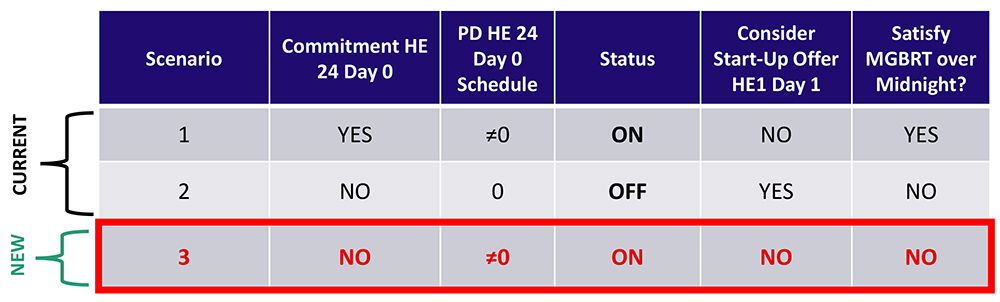
Currently, the initialization logic assumes that an NQS unit is “ON” only if it has a “commitment” in HE24 of the PD run. NQS resources without a commitment in HE24 of PD are assumed to have an online status of “OFF,” regardless of whether the resource has a PD “schedule” for HE24. A commitment is an instruction to come online and provides greater certainty than a schedule.

When an NQS resource has a schedule in HE24 of the PD initialization run, it is online about 95% of the time when HE24 arrives in real time, said Garth Nash, an adviser in the market development unit. As a result, relying solely on the PD HE24 commitment flag causes many NQS resources to be improperly initialized as “OFF” in the DA engine.

Starting in June, IESO will set the initialization status to “ON” if a non-quick-start resource has a schedule in Day 0 HE24, regardless of whether it has a commitment in the hour. | IESO

Starting in June, IESO says, it will set the initialization status to “ON” if a resource has a schedule in Day 0 HE24, regardless of whether it has a commitment in the hour. NQS generators will receive no additional start-up costs for HE1.

What’s the Problem?

IESO officials did not cite any financial impact of the current assumptions or the proposed change.

“Can we … clarify what you’re trying to solve here?” asked Jennifer Jayapalan, of Workbench Energy.

“It’s just trying to better align what the status of a unit is and what is assumed to be,” Nash responded. “It’s just trying to have that alignment between what the DAM is assuming and what the physical reality is.”

“I just want to make sure that there has been significant … analysis that these hours aren’t going to be isolated, because the market participants are going to be financially bound to hours that potentially … they can’t operationally meet,” Jayapalan said.

“The problem I’m seeing here is now you have a DAM schedule that, in theory, you’re supposed to continue through,” she continued. “We know there’s an issue here right now, where, if the PD no longer wants a resource, it takes it offline even though it’s scheduled all day, and then it brings it back up. We already are not paying startup costs [for] the second start of the day if the PD does not want it.”

Karen Backman, supervisor of market development, said NQS operators who do not want a day-ahead schedule for the following day must “make sure that the 9 a.m. pre-dispatch does not show them in the hour ending 24 as being scheduled.”

Jayapalan acknowledged that IESO’s new market has seen “some extreme conditions where NQS resources have been scheduled day after day.”

“I understand that it probably is a high probability so far. But there’s going to be these cases in there where [NQS units] have isolated hours that … they operationally can’t meet. And there are going to be cases where the PD is going to change significantly,” she added. “It happens all the time now.”

Sean Vincent, of Greenfield South Power, echoed Jayapalan’s concerns over the ISO’s reliability and cost benefit analysis. “In the future, it would be really beneficial if these points were … something that you were able to provide for in these meetings — the actual benefit that’s being provided here, and the amount of people … or runs that are being impacted; how much this is actually changing things,” he said. “I think this is all extremely great information that should be publicly available here in these meetings.”