DOE Loans $26.5B to Southern Co. for Infrastructure Upgrades

The U.S. Department of Energy announced Feb. 25 it will provide a loan package totaling $26.5 billion to Southern Co. that it said will deliver savings for ratepayers while enhancing grid reliability in Georgia and Alabama.

According to a statement, DOE will provide the loans under the Office of Energy Dominance Financing, the new name for the Loan Programs Office, to Southern utilities Georgia Power and Alabama Power. The 30-year package is the largest loan in the department’s history, it said.

The loans will support the building or upgrading of projects representing over 16 GW, including 5.3 GW of new gas generation and nearly 500 MW of capacity upgrades at existing gas plants; upgrades and license renewals for nuclear facilities totaling 6.3 GW; and modernization and enhancement projects at hydropower facilities representing 1 GW.

Battery energy storage system projects are also part of the funding package, along with about 1,300 miles of transmission and grid enhancement projects. DOE said in a fact sheet that the loans will “provide $7.3 billion in estimated customer savings” and reduce Southern’s interest expenses by $300 million/year, while Southern CEO Chris Womack said in a separate statement that the financing “will help lower the cost of investments in our grid that will enhance reliability and resilience for the benefit of our customers.”

“The Energy Department is lowering energy costs and ensuring the American people have access to affordable, reliable and secure energy for decades to come,” Energy Secretary Chris Wright said. “These loans will not only lower energy costs but also create thousands of jobs and increase grid reliability for the people of Georgia and Alabama.”

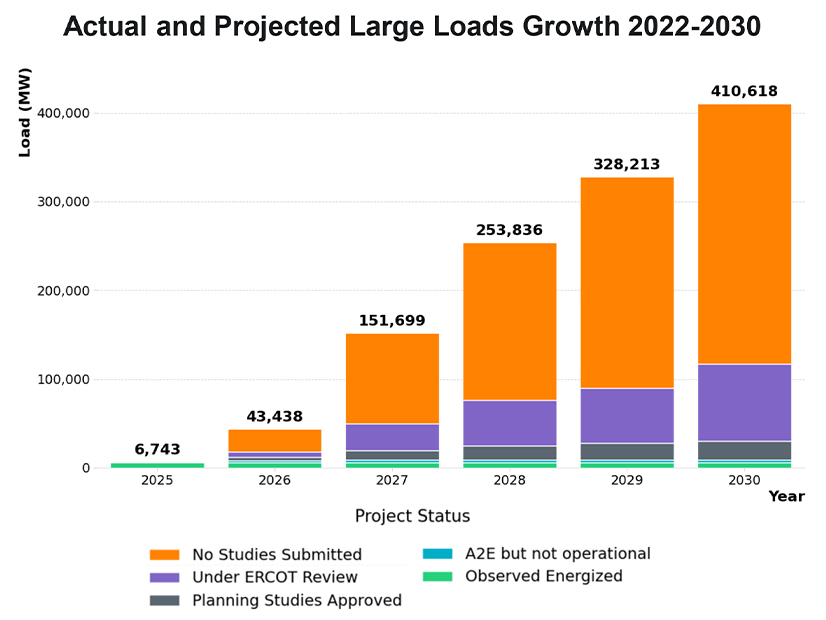
The financing announcement came the week after Southern released its fourth-quarter earnings, reporting net income of $4.3 billion for the year 2025, down from $4.4 billion the previous year. (See Southern Forecasts Continued Large Loads Growth.) The company announced plans to invest $81 billion across its subsidiaries through 2030, an expansion of the previously planned $63 billion; the main driver is new generation facilities, including five combined cycle plants, three combustion turbines, two combined solar and battery plants and 17 BESS facilities.

Both Georgia Power and Alabama Power have received permission from their state regulators to freeze base rates for several years. Georgia’s Public Service Commission in July 2025 approved Georgia Power’s plan to freeze rates through the end of 2028, and the Alabama Public Service Commission in December accepted a two-year halt on increases to Alabama Power’s rates. The PSCs’ decisions did not apply to storm recovery costs.

The loans to Southern follow $4.1 billion in financing provided to Constellation Energy to restart the Three Mile Island nuclear plant; an American Electric Power subsidiary to strengthen its transmission system; and Wabash Valley Resources to use a coal plant to produce fertilizer. The Office of Energy Dominance Financing has more than $289 billion in available loan authority and plans to prioritize projects in 2026 that it says contribute to energy security, grid reliability and affordability.

Stakeholders Urge Changes to ISO-NE Surplus Interconnection Rules

Clean energy groups are calling for changes to ISO-NE’s surplus interconnection service (SIS) rules to use capacity headroom and help some resources avoid lengthy cluster study processes.

The RTO’s existing SIS rules stem from FERC Order 845, which required transmission providers to allow new resources to access unused capability behind existing interconnection points.

ISO-NE’s surplus process enables interconnection customers “to use any unused capability of interconnection service established in an interconnection agreement for a generating facility” while requiring the consent of the original customer and maintaining the original customer’s priority use of its interconnection rights.

The attractiveness of the surplus process lies in the ability for developers to avoid the interconnection cluster process, potentially enabling them to bring resources online more quickly.

But concerns about capacity revenue sharing, the extent of surplus studies and the lack of permanence of surplus interconnections appear to have limited the use of ISO-NE’s SIS pathway. To date, there is only one surplus interconnection agreement in the region.

ISO-NE has noted that surplus requests can still need extended studies when the resource has different performance characteristics from the original customer, including thermal analysis when adding charging capabilities to a site.

Surplus interconnection also does not equal permanent interconnection rights. If the original interconnection customer retired, the surplus customer would not retain its interconnection rights beyond a one-year grace period. It would need to proceed though the RTO’s general interconnection process to continue operations.

At the NEPOOL Transmission Committee meeting Feb. 24, several stakeholders emphasized the need for more clarity around the surplus application and study processes to help induce greater participation in the pathway.

ISO-NE “should focus on setting and meeting accelerated timelines in order to give developers confidence to proceed with projects,” said Bill Fowler, speaking on behalf of JERA Americas. JERA owns a fleet of large fossil generators in the region and has expressed interest in using SIS at its existing sites.

Fowler advocated for a nonbinding “target timeline” for ISO-NE approval of surplus requests set at “no more than six to nine months from filing an application.”

He said ISO-NE should consider changes to surplus accreditation in coordination with its ongoing capacity accreditation overhaul, and he recommended that the RTO “give SIS market participants flexibility in how the resources participate in the market, similar to how co-located facilities can choose to function as separate resources or as a single resource.”

Claire Lang-Ree, of the Natural Resources Defense Council, said ISO-NE “should recognize that surplus resources may improve the overall capacity value of the arrangement.”

She said ISO-NE’s proposed accreditation methodology for co-located storage and generation resources “could be a good fit for surplus arrangements.”

Speaking on behalf of RENEW Northeast, Carter Scott said changes would likely be needed to ISO-NE’s definition of unused capacity to account for the RTO’s proposed new accreditation framework, which would make resource accreditation values subject to change on a yearly and seasonal basis.

To reflect the new accreditation process, Scott said ISO-NE should allow both original and surplus resources to share capacity rights on a “more flexible, periodic basis.”

Multiple speakers noted that the proposed accreditation changes in the RTO’s Capacity Auction Reforms (CAR) project also likely will reduce the amount to accredited capacity in the region, potentially opening up headroom on the system.

Alex Lawton, director at Advanced Energy United, stressed that lowering barriers to surplus interconnection could help bring resources online more quickly and efficiently, helping prevent future resource adequacy issues.

“The current barriers that have prevented participants from using SIS to date stem primarily from difficulty participating in the capacity market, and the lack of permanent capacity interconnection rights,” Advanced Energy United wrote in a memo published prior to the TC meeting.

Lawton advocated for the creation of a process for capacity surplus customers to obtain permanent rights upon the retirement of the original customer without having to proceed through the interconnection cluster study process.

“If a [surplus interconnection customer] is required to go through a cluster study and potentially be responsible for network upgrade costs after it has already become operational, and if those upgrade costs are not supportable, this could lead to an unwanted market exit,” he said.

Responding to the stakeholder feedback, Alex Rost, director of transmission services at ISO-NE, detailed the RTO’s plans for a “gap analysis” intended to evaluate potential improvements to the surplus process and the potential “development of a comparable surplus interconnection service-like process” for co-location or resource repowering.

He committed to fully evaluating stakeholder proposals in the gap analysis, but he emphasized the subordinate nature of surplus interconnection customers. He noted that surplus customers can submit an interconnection request for permanent interconnection rights at any time.

He added that ISO-NE plans to evaluate surplus process timelines, surplus study scope and resource requirements in the gap analysis. He said the implementation of the CAR project would require an update to the definition of unused capability but added that this will depend on the outcome of the project.

ISO-NE plans to complete the analysis by early in the third quarter of the year, Rost said.

Stakeholders generally responded favorably to ISO-NE’s proposal for the gas analysis but expressed interest in expediting the timeline of the analysis and related discussions.

FERC Declines to Suggest Interregional Transmission Requirements

FERC declined to suggest any minimum transfer capability requirements to Congress in a legally required report released Feb. 25.

The report was a required follow-up from the commission on NERC’s Interregional Transfer Capability Study, which found shipping power between some regions produces significant benefits. (See NERC Releases Final ITCS Draft Installments.)

“Increasing interregional transfer capability can be a potent tool in addressing reliability issues and warrants further examination,” FERC Chair Laura Swett said in a statement. “However, it is crucial to recognize that this measure is not a cure-all solution and should be considered in conjunction with potential economic impacts and other reliability strategies.”

FERC staff declined to make any suggestions for changes to the law in response to the study. The report notes that while transfer capacity has benefits, they come about only if the region on the other end of the line has excess generation.

“If neighboring regions lack resources, additional transfer capability will provide limited help because there is not enough surplus energy to share,” the paper says. “These results suggest that using a heuristic approach to establish interregional transfer capability requirements — such as setting a target to achieve interregional transfer capability to match a fixed percent of peak load or historical outages — can inaccurately value interregional transfer capability compared to an approach that accounts for the complexity of the transmission system. As is true with setting a planning reserve margin, an intuitive or informal approach is unlikely to set the right target compared to a more systematic approach that includes thorough analysis to support decision-making.”

The study analyzed how electricity moves across regions and identified opportunities to improve links between regions. It found ERCOT would benefit from plugging into the rest of the bulk power system, with up to 14,100 MW of interconnection suggested, and it also found increasing links between many regions in the Eastern Interconnection could produce significant benefits.

But the report also notes that forecasted deficiencies could be fixed with local generation development, demand response or simply by accepting more reliability risk during extreme weather events.

Many commenters on the study were not opposed to the idea of increasing interregional transfer capability, but another common theme was that the study is not a transmission planning document.

“According to the Niskanen Center, although the ITC Study combines historical and synthetic load to capture hourly variability, the United States is no longer experiencing a steady load growth as it did in the past decade, but rather accelerating load growth, and as a result the ITC Study results are already outdated,” FERC’s report says.

NERC’s initial study said that 35,000 MW of additional interregional transfer capacity would cut projected energy deficiencies and improve reliability, said Christina Hayes, executive director of Americans for a Clean Energy Grid.

“FERC’s staff report to Congress today stops short of translating those findings into meaningful statutory recommendations — despite mounting reliability pressures and accelerating electricity demand since the study was completed,” she added.

Failing to act decisively on transmission will undermine grid reliability, Hayes said, and Congress must include transmission in any permitting reform legislation.

La. Energy Leads Say Determined Approach Lands Data Center Contracts

Louisiana utility players described their pull-out-all-the-stops, gas-propelled campaign to attract data centers as another hyperscaler announced plans for a new artificial intelligence-training facility in the state.

Amazon and Google’s fresh announcements for major data centers in Louisiana and Minnesota, respectively, grabbed attention at the Gulf Coast Power Association’s annual MISOSPP Regional Conference.

“We’re in a power first world,” Entergy Louisiana CEO Phillip May said in a Feb. 24 keynote speech.

May said the data center revolution needs more than traditional regulatory frameworks and historical infrastructure buildout can offer.

“Regions that can deliver … are becoming new hotspots for growth,” he said. “Today, we’re being asked to deliver agility and adaptability.”

Northern Louisiana is set to host another multibillion-dollar data campus, this time a $12 billion Amazon facility near Shreveport.

American Electric Power’s Southwestern Electric Power Co. said it would supply power in a Feb. 23 announcement. Amazon said it has worked with SWEPCO to ensure it would pay all costs associated with the new data center.

Amazon’s venture is in addition to Meta building its largest, $10 billion-plus AI data center to date in Richland Parish.

One audience member in an earlier panel had pointed out that SWEPCO is valued at $9 billion, just 75% of the $12 billion deal. They asked at what point hyperscalers would outright buy a utility. Panelists demurred on the question.

May said investment is “mobile” and can switch prospective points on the grid easily. He said utilities must be able to compete for the new load. He lauded the Louisiana Public Service Commission’s new expedited review process, which can cut certain projects’ regulatory approval to an eight-month turnaround.

May said natural gas right now is the technology that can meet the scale of demand.

“It’s not an ideological argument. It’s an engineering reality,” May said. He added that nuclear must also play a role in the long term.

May framed data centers’ 24/7 load as a good thing, taking the guesswork out of planning generation and transmission investments.

‘Tired of Being on the Bottom of the List’

May asserted that Entergy Louisiana’s supplier philosophy is paying dividends and that the utility has been integral in Louisiana being able to attract $90 billion in capital investment since 2024.

“This is the moment we’ve been waiting for. We get to design the next 100 years of Louisiana,” he said.

Audience members asked if the massive investments are upping Entergy’s financial risk and if the utility is pursuing non-traditional means to secure capital.

“There’s a massive capital challenge to meet that,” May acknowledged. He said Entergy does not place generation projects for hyperscalers in its capital plan until data center developers strike electric service agreements and commit to funding all infrastructure costs associated with their facilities. He also said Entergy expects help with cash flow from the start to begin planning and construction.

May said Entergy played an instrumental role in creating the state’s 2024 20-year sales tax exemption on equipment and software for qualifying data centers. Entergy lobbied Gov. Jeff Landry (R) for the law, which was tailored to attract Meta.

“This state is hungry. We’re tired of being on the bottom of the list,” May said.

Data center centers are a good fit for lower-income regions of the state that until now have been “overlooked by economic development,” he argued. He assured residential customers in Richland Parish that they would pay less for power because of Meta’s planned, $10 billion data center.

‘Guarantee is a Guarantee’

In a later panel with a trio of state regulators, who are elected officials, Louisiana PSC Commissioner Jean-Paul Coussan said his inbox is flooded with constituents angrily asking why they are helping to defray data center costs. But he said that’s not the case in the state.

“The national conversation is controlling the narrative,” Coussan said. He said the commission required Meta to “immediately pay on bills” that its data center campus is triggering.

Coussan said constituents sometimes don’t believe that a “guarantee is a guarantee.”

From left: Sarah Freeman of the Regulatory Assistance Project, Missouri Public Service Commissioner John Mitchell, Louisiana Public Service Commissioner Jean-Paul Coussan and Minnesota Public Utilities Commissioner Joe Sullivan | © RTO Insider 

Some environmental and consumer advocates worry that Meta has since fundamentally changed the financing structure of the project and could wriggle out of its promised consumer protections. (See Earthjustice Says Change to Louisiana Meta Data Center Funding Fishy, Asks PSC to Investigate.)

In January, Earthjustice, on behalf of the Alliance for Affordable Energy and the Union of Concerned Scientists, filed a motion to request the PSC probe the new arrangement and its potential effect on ratepayer protections. The PSC on Feb. 25 declined to investigate the new financial setup.

Coussan said he has not reviewed the Google data center deal yet, and he is interested in seeing which consumer protections Google and SWEPCO intend to establish.

Google Stakes Claim in Southeastern Minn.

During the same panel, Missouri Public Service Commissioner John Mitchell said the “lightning pace” of demand and infrastructure additions causes him anxiety.

Minnesota Public Utilities Commissioner Joe Sullivan said that among other things, the impact of higher rates on those who can least afford them weighs on him.

Xcel Energy followed Louisiana’s Amazon announcement a day later on Feb. 24 with notice that it plans to power a new Google data center in southeastern Minnesota. Google similarly said it would pay all the costs accompanying the new campus and fund 1,400 MW of wind, 200 MW of solar and 300 MW of Form Energy’s long-duration, iron-air battery storage.

“We’re going to see. The rubber is going to hit the road very soon here,” Sullivan said of Xcel’s impending docket before the commission. He said Xcel will propose a large load rate in the coming months.

“We’re going to take one step in front of the next and work through it,” Sullivan promised.

Regulatory Assistance Project principal Sarah Freeman, herself a former Indiana commissioner, asked how regulators deal with the “trilemma” of achieving affordability and consumer protections, reliability and meeting demand.

Mitchell said although it is almost impossible to achieve all three, state commissioners must try.

Freeman said commissions can help create a “pathway” for data centers to be better neighbors to the communities they’re situated in.

In a conference where nearly every speaker stressed speed, Sullivan insisted his commission has time to make decisions. He said Minnesota’s integrated resource planning process affords it time to weigh projects.

“If you’re landing the 747, you can’t land it on a runway built for a Cessna. Fortunately, we have a runway for a 747,” Sullivan said of the commission, adding he has “tremendous faith in our process.”

LaCerte: FERC Focused on Winning AI Race

FERC Commissioner David LaCerte was back before the Senate Energy and Natural Resources Committee on Feb. 25, just four months after being sworn in, for a hearing on his nomination for a full five-year term.

LaCerte was confirmed by the Senate in October to complete former Chair Willie Phillips’ term, which ends June 30. (See Senate Confirms Swett, LaCerte to Open Seats on FERC.)

The commissioner once again told the committee he supports expanding LNG and related onshore infrastructure to make natural gas exports possible. Speaking of his experience on FERC, he said the commission is focused on ensuring the U.S. wins the artificial intelligence race.

“This may be the defining competitive challenge of our generation,” LaCerte said. “If we are not the world’s leader in AI, our adversaries surely will be. We need to meet this moment, and we will do so without sacrificing affordability.”

So far, the biggest action FERC has taken on the issue has been to approve new transmission service options for data centers that want to co-locate with generators on PJM’s system. (See FERC Approves Transmission Deals Between ComEd and Data Centers.)

“I recognize this represents a first step in a very long road, but I’m proud of the decisive action the commission took at a time when energy demand is rising and reliability challenges are mounting,” LaCerte said.

He also said his personal focus is on ratepayers, reiterating what he said at his first open meeting of the commission in November.

“There are always people looking to curry favor for one project or one industry,” LaCerte said. “And I meant what I said: None of those people represent the ratepayers; I do. My commitment to the ratepayer has not wavered.” He emphasized that FERC has a duty to ensure that ordinary consumers do not face undue costs as the country deals with the demand growth from data centers and reindustrialization.

Sen. Alex Padilla (D-Calif.) asked LaCerte whether FERC needed to ensure that regions were doing adequate long-term transmission planning.

“In the past, I think we probably could have tightened some screws with some of the some of the plannings that have been done, both regionally, interregionally and at the state level themselves,” LaCerte said. “I think that it’s important that we squeeze every possible lot out of the existing grid that we have, and that means more diligent, more proper planning and taking a harder look at all the decisions before us.”

Sen. Angus King (I-Maine) said the power grid is designed to meet peak demand, which leads to inefficiencies. He asked whether LaCerte supports grid-enhancing technologies to make it more efficient.

“I think we need to squeeze every megawatt of the existing grid that we can — whether that’s dynamic line ratings, whether that’s grid-enhancing technologies of any type — but I can’t endorse one over another,” LaCerte said. “I think we need to do a much better job of being efficient with the grid that we have, in addition to building new transmission.”

The hearing was just on LaCerte’s nomination; the committee also heard from Kyle Haustveit, nominated to be undersecretary of energy, and former Rep. Steve Pearce (R-N.M.), who is up for director of the Bureau of Land Management. Haustveit is currently assistant secretary for fossil energy and carbon management at the Department of Energy.

The committee is well stocked with Westerners, several of whom noted how much land BLM controls in their states, but Pearce was also asked about the power sector. King noted that the bureau’s parent agency, the Department of the Interior, has not been processing renewable projects on federal lands under normal orders, requiring the secretary to sign off on individual projects.

“We’re facing a 2%-a-year increase in demand, which is unprecedented; compounded in 10 years, that’s a 30% increase in demand,” King said. “How are we going to get there by eliminating a significant source of energy from consideration?”

King, an independent who caucuses with the Democrats, asked what Pearce and Republicans will think if a future Democratic administration uses the same tactics to stymie fossil fuel development on federal lands.

Pearce did not answer the questions directly, saying he did not have the information to comment on the policy.

“It’s a conversation I’m more than willing to have with you and with the administration, but I don’t know the rationale,” he said.

CAISO Unveils Principles for Western Seams Coordination

CAISO has released a set of guiding principles for upcoming discussions about seams between the ISO, SPP and other entities as the Extended Day-Ahead Market nears its opening in May.

In November, FERC staff urged Western electricity industry stakeholders to get ahead of seams issues before EDAM and Markets+ begin. (See FERC Report Urges West to Address Looming Market Seams Issues.)

CAISO’s eight principles focus on how to ensure the continued strength of the Western Energy Imbalance Market, which has provided significant reliability and financial benefits to its participants and their customers, CEO Elliot Mainzer said in a blog post Feb. 23.

“We hope all WEIM participants will carefully consider the unprecedented and fortuitous combination of physics, economics and fully independent governance of WEIM and EDAM before leaving the seamless real-time market we have worked so hard to build together,” Mainzer said.

WEIM currently includes 22 balancing authorities from 11 states that account for 80% of electricity demand in the Western Interconnection. The market has proven that balancing areas can function seamlessly in a real-time market, providing reliability benefits and economic value to participants and customers across the West, CAISO’s document says.

“Breaking up the WEIM footprint risks unwinding these benefits,” CAISO says. “Market-to-market seams arrangements are a poor substitute for seamless real-time operation of the grid and can only limit the loss of efficiency and reliability that results from fragmented footprints.”

One principle is that the seams issue is not a venue for market design advocacy.

“Market-to-market seams discussions are not a forum to relitigate transmission service [and] transmission rights, or a vehicle to redesign market rules,” CAISO says. “Seams discussions are predicated on sufficiently defined market protocol[s], transmission tariffs and market boundaries.”

Another principle is ensuring seams protocols minimize the risk of gaming or manipulation. Instead, protocols should support market power monitoring at interfaces to maintain competition.

CAISO’s EDAM will open in May, and SPP’s Markets+ is scheduled to begin in 2027. These markets could cause issues at their borders because of their different policies and dispatch processes. (See CAISO, SPP Explore Using Existing Tools to Manage DAM Seams.) The grid operators had made “significant progress” on adapting existing tools to tackle seams between their respective day-ahead markets, a CAISO representative said in December.

Seams negotiations are not solely between CAISO and SPP, Mainzer said. Instead, these discussions include balancing authorities, transmission providers, transmission operators, reliability coordinators, market operators and others when scoping procedures, agreements, discussions and solutions.

DOE Extends Eddystone Emergency Order Through May

The U.S. Department of Energy has ordered PJM and Constellation Energy to keep the 760-MW Eddystone Generating Station online through May 24, extending an emergency order that has been in place since the plant’s final two gas-fired units were to deactivate May 31, 2025.

In an announcement of the Federal Power Act Section 202(c) order, Energy Secretary Chris Wright said the units helped PJM keep the grid reliable during the late January 2026 winter storm — dubbed Fern by The Weather Channel — during which Eddystone ran for 124 hours. The order states the generator, which is outside Philadelphia, must remain online because of “a shortage of facilities for the generation of electric energy and other causes.”

“The energy sources that perform when you need them most are inherently the most valuable — that’s why natural gas and oil were valuable during recent winter storms,” Wright said. “Hundreds of American lives have likely been saved because of President Trump’s actions keeping critical generation online, including this Pennsylvania generating station which ran during Winter Storm Fern. This emergency order will mitigate the risk of blackouts and maintain affordable, reliable and secure electricity access across the region.”

The order is the third 90-day mandate for PJM and Constellation, which owns Eddystone, to keep Units 3 and 4 online. DOE has also ordered Consumers Energy to keep its 1.45-GW J.H. Campbell coal generator in western Michigan to stay online until May 18 under a similar order. (See DOE Reups Campbell Coal Plant Emergency Ops; Losses Top $135M.)

The department wrote that the need for additional generation has continued to grow in PJM, pointing to the RTO’s Reliability Resource Initiative, which is expediting the interconnection studies for 51 projects. (See PJM Selects 51 Projects for Expedited Interconnection Studies.)

The order states Eddystone is needed for both near- and long-term emergency conditions, the latter of which would be hard to address if the units were allowed to deactivate.

“Practical issues, such as employment, contracts and permits, may greatly increase the timeline for resumption of operations during the period they are needed,” DOE wrote. “If Constellation Energy were to begin disassembling the units or other related facilities, the associated challenges would be greatly exacerbated. Thus, continued operation is required in such cases so long as the secretary determines that an emergency exists.”

Constellation Stock Jumps off Reported $2.32B in 2025 Profit

Constellation Energy on Feb. 24 reported net income of $2.32 billion ($7.40/share) in 2025, down from the $3.75 billion ($11.89/share) it made in 2024 despite a $1.96 billion increase in operating revenue.

While GAAP earnings were 38% lower in 2025 than in 2024, they were 8.3% higher after adjustments. This was attributed in part to the $26.6 billion acquisition of Calpine, completed on Jan. 7. The deal brought together the largest nuclear power operator and largest gas generation owner in the U.S. to form a 55-GW behemoth that now calls itself the world’s largest private-sector power producer. (See FERC Denies Rehearing Requests on Constellation-Calpine Merger.)

Other major developments in 2025 included license renewals for the Clinton and Dresden nuclear plants; a 1,121-MW power purchase agreement with Meta at its Clinton nuclear plant; and a $1 billion federal loan guarantee for the effort to restart Unit 1 of the Crane nuclear plant. (See Constellation, Meta Sign 20-year Nuclear PPA.) In early 2026, Constellation announced a 380-MW agreement for a new CyrusOne data center adjacent to the Freestone gas-fired plant.

Constellation did not deliver a 2026 business outlook with the results — that has been pushed back to March 31, a common corporate move after a major acquisition or merger — but the newly enlarged company is faced with a U.S. electricity landscape in which demand projections are rising quickly while policymakers are taking steps to slow price increases.

Data centers are one of the drivers of the expected increase in U.S. power demand, and Constellation CEO Joe Dominguez said the company is ready to meet the moment.

“We’re pairing the grid’s most reliable power with flexible resources to meet accelerating demand driven by electrification and the data economy,” Dominguez said in a statement. “Our long-term agreements with Microsoft, Meta and most recently CyrusOne demonstrate how we’re putting that expanded portfolio to work while maintaining reliability for customers and keeping costs stable.”

Positive factors in the company’s full-year earnings included favorable market and portfolio conditions, higher banked zero-emissions credit revenues and favorable nuclear outages; counterbalancing these were unfavorable nuclear production tax credit portfolio results.

Constellation’s stock price jumped more than 6% on the release of the earnings report, closing at $312.58 on Feb. 24. The stock, however, is still down nearly 13% in 2026 and about 23.5% from its peak of $404 in October 2025.

Crane Clean Energy Center

Microsoft has contracted to buy 835 MW for 20 years from Constellation’s Crane Clean Energy Center to power some of its data centers.

Work is progressing on the $1.6 billion restart of the facility formerly known as Three Mile Island planned for mid-2027, a team of Constellation managers said at a community meeting Feb. 19.

Inspections so far have revealed minimal to no impact on the major systems of Unit 1 resulting from its 2019 shutdown for economic reasons, they said. Some systems do need to be upgraded or hardened; replacements for two transformers, for example, were ordered and are expected to be delivered later in 2026.

Thirteen of 88 system restorations have been completed at the facility, which started construction in 1968 and began commercial operation in 1974.

Constellation is not worried about obsolescence or availability of replacement components for the aged facility: The size of the company’s nuclear fleet gives it relationships with many suppliers and the ability, if needed, to reverse-engineer solutions.

The company has hired 600 permanent staff for the facility, about 350 of them experienced nuclear workers and about 150 of them former Three Mile Island employees.

The control room simulator has been fully restored, and two operator classes are underway with a combined 57 students, most of them having previous nuclear experience.

House Hearing Examines Ways to Cut Wildfire Risk on Federal Lands

Permitting delays can exacerbate risks for electric transmission lines to spark wildfires, experts told the House Natural Resources Subcommittee on Water, Wildlife and Fisheries.

Midstate Electric Cooperative CEO Jim Anderson opened his testimony by stating a previous CEO of the Oregon co-op had testified at the same committee 30 years ago on the same subject.

“In that case, Midstate Electric requested permission to trim hazard trees along our rights of way on U.S. forest land,” Anderson said. “The Forest Service denied the request. Predictably, a tree fell into the powerline, sparking a wildfire for which Midstate was held strictly liable for a cost of $327,000.”

Decades later, the co-op was facing the same issues: bureaucratic delays and regulations that slow down wildfire mitigation work, said Anderson, who was speaking on behalf of the National Rural Electric Cooperative Association.

Nearly 70% of the land in Midstate’s territory is federally managed. Anderson argued that vegetation management is one of the most cost-effective ways to address risks.

“Our members pay the equivalent of two months [of] power bills just to fund wildfire mitigation,” Anderson said.

NV Energy inspects 14,000 poles a year, trims 15,000 trees annually and clears 2,000 miles of lines in its efforts to cut wildfire risk, said Jesse Murray, senior vice president of energy delivery. “This year, NV Energy will invest $500 million in the program.

“Ultimately, our customers do pay this cost; we must invest that money as efficiently as possible to reduce the risk. The process to permit work on federal lands is a noteworthy cost driver that can have an impact on customers’ bills depending on what requirements actions and timelines the utilities must follow.”

NV Energy’s territory covers multiple federal forests, and each can apply the rules differently, adding additional work for little benefit, he said.

“I think these divergent requirements result from local staff having to interpret risks and considerations based on unclear, complex rules that translate into an approach that cover ‘all the bases,’” Murray said. “Combining these complex requirements with limited resources, timelines get extended that generate more risk due to the inability to complete the work.”

House Natural Resources Committee Chair Bruce Westerman (R-Ark.) and other Republicans urged the Senate to pass his Fix Our Forests Act (H.R. 471), which cleared the House of the Representatives early in 2025.

“FOFA would allow utilities to remove hazardous trees within 150 feet of the right of way,” Westerman said. “The legislation also included a new categorical exclusion for approval of vegetation management plans and activities carried out consistent with those plans. This new categorical exclusion would significantly reduce wildfire risk and keep electricity reliable and affordable in the West.”

Vegetation management can be improved if companies start developing stable, native habitats with their transmission lines that can discourage tree growth, said Pennsylvania State University professor Carolyn Mahan.

“Integrated vegetation management is something that is recognized and approved by U.S. Forest Service, EPA and U.S. Fish and Wildlife Service,” she added. “It’s written as a recommended practice, but it really hasn’t been put into policy yet.”

The Sacramento Municipal Utility District has used the technique on federal land in its territory, using low-growing vegetation dominated by native species. For example, it has planted native loop pines that are too small to interfere with its power lines but provide good habitats for native species, Mahan said.

Permitting reform would help deal with wildfire risk, which has raised costs for utilities with major impacts on their credit risks, said Christina Hayes, executive director of Americans for a Clean Energy Grid. But permitting laws need to change to get new, major interstate transmission lines that offer major reliability benefits during extreme weather events.

“High-capacity, multistate transmission lines — the lines most critical to achieving reliability and affordability, particularly during extreme events — should have a one-stop shop for siting and permitting just like natural gas pipelines do,” Hayes said. “Streamlining multiple rounds of permitting for infrastructure that is in the national interest will ensure that it is built faster and cheaper.”

State Briefs

GEORGIA

Pridemore Won’t Seek PSC Re-election

Public Service Commissioner Tricia Pridemore announced she will not run for re-election in the fall.

Pridemore said her decision came after “deep reflection” and “thoughtful conversations with my family, colleagues and trusted advisers.”

Pridemore was originally slated to run for re-election in 2024, but her term was extended by the General Assembly after a legal challenge delayed elections.

More: The Atlanta Journal-Constitution

ILLINOIS

Pritzker Signs Order to Accelerate Nuclear Development

Gov. JB Pritzker signed an executive order directing agencies to begin identifying sites and crafting regulatory framework for the first new nuclear reactors in the state in nearly 40 years.

Pritzker cast the decision as part of a broader effort to lower utility costs and protect families, saying “producing even more energy is vital to keep up with increasing demand and bring down prices.”

Illinois is the nation’s largest producer of nuclear energy with 11 reactors across six sites.

More: WTVO

MICHIGAN

PSC Approves DTE Rate Hike

The Public Service Commission approved a $242.4 million electric rate hike for DTE Energy.

The hike, which was less than half of the $574.1 million originally requested by the utility, represents a 4.1% increase for the average residential bill.

The increase follows a $217 million rate hike approved by the PSC in January 2025.  

More: Planet Detroit

NORTH CAROLINA

Stein Appoints Gajda to Utilities Commission

Gov. Josh Stein appointed John Gajda, a professor at North Carolina State University, to the Utilities Commission.

Gajda teaches courses on power systems engineering and previously led transmission planning efforts for the DOE’s Grid Deployment Office.

More: WFAE

NORTH DAKOTA

PSC Approves Battery Storage Sites

The Public Service Commission unanimously approved two large battery storage sites.

The 140-MW Emmons-Logan Energy Storage project will cost $181 million, while the 100-MW Northern Divide Energy Storage project will cost $128.6 million. Both projects will be connected to NextEra wind farms.

More: North Dakota Monitor

RHODE ISLAND

Judge Reverses Storage Facility Permit Denial

Superior Court Judge Jeffrey A. Lanphear vacated the Smithfield Zoning Board’s rejection of a special use permit application to construct a battery storage facility, finding the board’s decision was founded on an incorrect interpretation of the state’s vesting statute.

In 2024, the board rejected the application, saying Smithfield’s zoning ordinances had been amended to prohibit energy storage systems in all districts so no special use permit could be issued, and the company should file for a use variance or zoning amendment.

“The Master Plan Application is unmistakably an application for development, was submitted to the appropriate review agency and was deemed certifiably complete. This entitled the project to the protections of §45-24-44, not merely the Master Plan Application,” Lanphear said.

More: Rhode Island Lawyers Weekly

SOUTH DAKOTA

PUC Approves State’s Largest Wind Farm

The Public Utilities Commission approved a permit for a $750 million, 333-MW wind farm.

The wind farm, developed by Philip Wind Partners, will include up to 87 turbines and 5.5 miles of transmission line.

More: South Dakota Searchlight

TEXAS

State Sues Company for Dumping Turbine Blades, Components

Attorney General Ken Paxton and the Commission on Environmental Quality sued Global Fiberglass Solutions, a fiberglass recycling company, for dumping and abandoning thousands of turbine blades and components and creating two unauthorized parts graveyards.

The state claims the company illegally accumulated and abandoned more than 3,000 blades and parts and failed to appropriately dispose of the materials. Neither Global nor its affiliates are authorized by the environmental commission to handle industrial solid waste, which is what the materials are considered, according to the state.

More: Houston Chronicle

WASHINGTON

Columbia Generating Station Back Online

Energy Northwest’s nuclear Columbia Generating Station was ramped back to full power and reconnected to the grid after being offline for six days.

The unexpected shutdown, which was done by workers after both recirculation pumps shut down, caused no power issues for consumers. Had they not shut down the plant, it would have detected the issue and automatically shut down. After repairs were made, workers performed testing and verified the performance.

More: Seattle Times

WEST VIRGINIA

Utilities Seek PSC Approval for Gas, Solar Projects

Monongahela Power and Potomac Edison are seeking Public Service Commission approval to construct a gas plant and three solar projects.

The proposed $2.48 billion, 1.2-GW gas facility would be built next to the site of the existing coal-fired Fort Martin Power Station in Monongalia County. The solar projects would be in Weirton, Davis and Albright with a combined capacity of 70 MW. The plan also calls for the continued operation of the existing coal power plant.

If approved, construction of the gas plant would begin in 2027, and it would become operational in late 2031.

More: West Virginia Public Broadcasting