ISO-NE CEO Chadalavada Talks Winter Operations, Market Reform

Just a few weeks after taking over as CEO of ISO-NE at the beginning of 2026, Vamsi Chadalavada faced a trial-by-fire introduction to the job.

Temperatures plunged Jan. 24, followed by heavy snowfall across the region the next day. With the snow suppressing behind-the-meter solar generation, ISO-NE exceeded its high-range winter peak load forecast amid the storm.

The low temperatures persisted, averaging 14 degrees F below normal over the last nine days of January and leading to significant depletion of generators’ stored fuel inventories as gas prices skyrocketed. Energy costs shot up, and ISO-NE experienced the highest monthly energy costs in its history. (See Prolonged Cold Drove Record Monthly Energy Costs in New England.)

But despite the extremely challenging conditions, ISO-NE met all reliability requirements throughout the prolonged event and officially lifted its preemptive abnormal conditions alert Feb. 11.

“I’m glad we’re through it,” Chadalavada said in a recent interview with RTO Insider. “The fact that we were able to maintain not only the energy demand, but also operate with the levels of reserve margins that indicate that we’re capable of withstanding the first or second contingency, is extraordinary.”

To submit a commentary on this topic, email forum@rtoinsider.com.

While Chadalavada is new to the job, he is far from a new face at ISO-NE: He joined the RTO in 2004 and served as COO from 2008 through the end of 2025 under longtime CEO Gordon van Welie.

“A lot of what we’re doing right now I’ve had some experience with,” he said. He credited ISO-NE’s success throughout the extended cold stretch in large part to the high levels of collaboration among the RTO, state and federal agencies, and the region’s generation fleet.

He said ISO-NE has also benefited from technology investments made in recent years, including incorporation of probabilistic modeling into its rolling 21-day energy assessments, which the RTO published daily throughout the event.

“A tool like that is invaluable in preparing us with a higher degree of confidence than we’ve ever had,” he said, adding that the analyses gave the RTO “a good sense of the worst-case outcome,” allowing it to plan effectively.

Consensus and Agility

While ISO-NE’s performance during the cold snap has drawn praise from stakeholders, the price spikes brought by the event have fueled concerns about the design of the RTO’s new day-ahead ancillary services (DAAS) market.

At the February meeting of the NEPOOL Participants Committee, Chadalavada announced ISO-NE’s support for a series of “narrowly targeted” DAAS market changes recommended by the ISO-NE Internal Market Monitor (IMM), along with plans to evaluate changes to its pay-for-performance rate and its treatment of exports during scarcity events.

“Typically, those would all be 12- to 18-month projects,” he said. “We’re challenging our organization to do all of them in six to nine months, including a stakeholder process.”

These projects come on top of an already-packed annual work plan, which includes work to establish an internal asset condition project reviewer; select a preferred solution from the first iteration of the Longer-term Transmission Planning procurement process; and complete work on the RTO’s long-running Capacity Auction Reform (CAR) project.

The DAAS market has been the subject of growing concern from the end user and supplier sectors in recent months amid mounting costs. While ISO-NE’s initial impact analysis — based on 2019-2021 data — estimated the annual incremental costs of the market to be about $140 million, the IMM calculates those costs over the market’s first 11 months reached about $921 million.

The IMM’s proposed changes are intended to induce lower-priced offers and greater market participation. While the details have yet to be refined, ISO-NE has offered high-level support for the reforms.

The recommendations have generally been well received by market participants, while some stakeholders have asked for even more urgency from the RTO, with one group pushing for a vote on the proposals at the NEPOOL Markets Committee in March.

Chadalavada has emphasized the importance of being nimble in response to market issues while also building strong consensus among stakeholders to ensure durable solutions. The proposed DAAS market changes could be an important early test of this approach.

Long project timelines have been especially apparent in ISO-NE’s resource capacity accreditation efforts. The RTO initiated the ongoing project in 2021 before expanding the scope in 2024 to include broader capacity auction changes.

If everything goes according to plan with the CAR project, ISO-NE will finally file the accreditation changes by the end of the year and implement them for the 2028/29 capacity commitment period.

“If we have long life cycles — three to five years — by the time you deploy them, you’re already behind,” Chadalavada said.

To reduce project timelines, he said ISO-NE could look to split larger projects into smaller components; deploy artificial intelligence and technological innovation; and pursue simpler solutions, which it could refine after implementation.

Managing Uncertainty

Chadalavada said he intends to focus on planning “in five- to seven-year increments, making sure that each increment fits into the future direction for New England.”

This should help ensure ISO-NE is preparing for the future in the most cost-effective manner amid great uncertainty about the region’s future load profile and resource mix, he said.

On the supply side, New England faces significant uncertainty about how it will meet demand following the Trump administration’s efforts to undermine the region’s offshore wind industry. (See Facing Rising Demand, New England has Limited Options for New Supply.)

Predicting demand over the long-term is similarly challenging. While ISO-NE forecasts substantial demand growth through 2050 due to the electrification of transportation and heating, the pace of electrification has proven hard to predict, and the RTO has scaled back its 10-year forecast of electrification demand in each of the past two years. (See ISO-NE Scales Back Vehicle, Heating Electrification Forecasts.)

The possibility of data center development adds another major source of load-side uncertainty. While New England has so far experienced relatively limited impacts from the data center boom, some utilities have reported an uptick in data center interconnection requests.

Chadalavada said ISO-NE is “actively monitoring” the potential for new data center loads.

“We’re active behind the scenes,” he said. “I think we haven’t had to mobilize in earnest because we haven’t had the volume of requests and the urgency that’s playing out in PJM and other parts of the country. But I do expect that it’ll make its way to New England, and we will be ready.”

In late January, six New England senators signed on to a letter to Chadalavada seeking information on how ISO-NE plans “to protect residential ratepayers from data center-driven price increases.” It stressed the need “to require tech companies, not American families, to foot the bill for their load.”

In his response, Chadalavada noted that “no new large data centers (or other large electrification projects) have committed to proceeding with construction at this time.”

In conversation, he echoed the importance of preventing cost shifts onto other consumers. He also expressed optimism about the role markets will play in ensuring resource adequacy in the coming decades.

He said he views markets as “the most cost-effective way to not only provide incentives for new entry, but also price retirement and deactivation of resources.”

The capacity, energy and ancillary services markets all play an important role in signaling the need for new resources while protecting consumers from investment risks, he said, adding that he expects wholesale markets will continue to work for the region over the long term.

“Will it be easy? No. Will it be controversial? Yes, because there are always different sorts of opinions and viewpoints about the effectiveness of markets,” he said. “But from an ISO standpoint, I cannot think of a better way to achieve resource adequacy for New England while having cost effectiveness as an equally important measure.”

PGE to Acquire PacifiCorp’s Wash. Operations for $1.9B

Portland General Electric has agreed to buy most of PacifiCorp’s Washington utility operations for $1.9 billion, PGE said Feb. 17.

Under the terms of the deal between the two Portland, Ore.-based utilities, PGE will acquire three generation facilities, 4,500 miles of transmission and distribution lines, and a 2,700-square-mile service territory containing about 140,000 electricity customers concentrated in Yakima, Walla Walla and nearby communities.

The generating facilities include the 477-MW gas-fired Chehalis Power Plant, as well as the Goodnoe Hills and Marengo wind farms, rated at 94 MW and 234 MW, respectively.

PGE plans to manage the Washington operation through a newly formed subsidiary regulated by the Washington Utilities and Transportation Commission. The utility is partnering on the acquisition with Manulife Investment Management, which will own 49% of the new company.

“We are excited for the opportunity to continue to grow, expanding into Washington and building upon PGE’s foundation of operational excellence and customer service,” PGE CEO Maria Pope said in a statement. “We look forward to our partnership with Manulife Investment Management, who bring a track record of investment success across the utility sector and Pacific Northwest agriculture and timberland industries.”

“We are pleased to partner with PGE to support this investment in reliable generation, transmission and distribution for Washington communities,” said Recep Kendircioglu, global head of infrastructure at Manulife Investment Management. “This partnership represents an opportunity that fits well within our infrastructure strategy and leverages our experience in utility investments.”

In a separate statement, PacifiCorp said “diverging policies” among the six states the utility serves “have created extraordinary pressure” that has affected its ability to reliably serve its customers at the lowest cost.

“These challenges have impacted the company’s financial stability, liquidity and credit ratings. The sale will be a critical step in strengthening PacifiCorp’s financial position and simplifying operations across its service area,” the company said.

“This is a targeted step toward ensuring the continued delivery of safe, reliable power to our nearly 2 million customers in the West and Intermountain West,” PacifiCorp CEO Darin Carroll said. “This will improve the company’s financial stability while simplifying our operations to support our long-term commitment to customers in each of our remaining states.”

The two utilities said the deal, which is subject to state and federal regulatory approval, should close in about 12 months.

DTE Treads Carefully as Michigan Becomes Flashpoint in Data Center Debate

DTE Energy is weeks away from finalizing an additional power agreement for a large-scale data center, even as friction continues over its deal in late 2025 to supply 1.4 GW to a $7 billion facility under construction.

The Michigan energy company provided the update with its fourth-quarter and full-year financial report Feb. 17.

DTE President Joi Harris emphasized there would be no downside for existing ratepayers as she highlighted the benefits that would accrue to the utility and its shareholders from the agreement to power the data center that Oracle and its partners recently began building on farmland south of Ann Arbor.

While the company’s 2026 financials are solid and are expected to improve with these and other data center agreements, financial analysts on the call asked about the potential negative effects of data center deals.

The Pushback

Michigan has become a flashpoint in a rapidly evolving discourse that has put Big Tech on the defensive in a matter of months.

On the same day DTE announced its results and its plans, The New Republic published an overview with a headline that concisely summed up the sentiment: “Data Centers Are the Enemy We’ve All Been Waiting For.”

The article was national in scope but made special mention of Michigan, where data center moratoria proposals are proliferating. Politicians and grassroots groups have been fighting against the Oracle-backed data center that will run on up to 1.4 GW of power supplied by DTE.

To submit a commentary on this topic, email forum@rtoinsider.com.

Bridge Michigan recently reported that all 11 of the people publicly vying to replace Gretchen Whitmer (D) as governor want to protect Michiganders from the negative effects of data center development, and some propose to do this by limiting construction.

In another example of how quickly the narrative has turned against Big Tech and its data centers, it was only in early 2025 that Michigan attempted to attract data center development by extending and expanding tax exemptions.

The Michigan Public Service Commission approved DTE’s contracts for the new Saline Township data center (Case No. U-21990) on Dec. 18 over the objections of state Attorney General Dana Nessel and consumer advocates. (See Michigan PSC OKs DTE Energy’s 1.4 GW Data Center Contract, AG Pans Process.)

Nessel is not finished. On Jan. 20, her office filed a motion to reopen the proceeding on the grounds that DTE did not accept the conditions the PSC attached to its approval.

DTE replied Feb. 6 that it had, in fact, accepted the conditions. Nessel’s motion to reopen the case does not meet legal standards for reopening, it said, adding that the attorney general and others submitting motions are not parties to the proceeding and may not seek to reopen it.

The Message

In its Feb. 17 news release, DTE celebrated its “landmark” first hyperscale data center contracts and noted their benefits to the community.

Also Feb. 17, Oracle Senior Vice President Josh Pitcock explained in a news post how the company expands its global network of data centers, which as of late 2025 numbered 147 online and 64 being built. His headline: “Designing Data Centers for the Communities and Natural Environments Where We Operate.”

Both messages are part of what now is being called a scramble to redirect the national discourse to what data centers will do FOR Americans, rather than TO Americans.

In early 2026, The New York Times, Grist, Bloomberg, POLITICO and others have declared a public relations blitz is underway by Big Tech and some of its partners in other sectors, trying to change the message.

But all the arguments for and against expanding data center infrastructure and the artificial intelligence computing revolution it will enable seem to have become secondary to one concern in the mind of Middle America and the politicians angling for its vote:

The voracious electrical appetite of these facilities could further boost retail electrical costs that already are climbing at a rate far greater than most other consumer costs and most household incomes. (See Electricity Rates are the Political Livewire Threatening the Industry.)

Boom.

The jobs that data centers might support or create someday, the competitive advantage they might provide to America, the effects they might have on water and air, the quicker or more accurate or more clever computing they might deliver — none of these seem to be as tangible as the bill that comes due each month and has become egregiously large in parts of the United States this winter. (See U.S. Utility Rate Increase Requests Topped $30B in 2025.)

The industry response has been for data centers to propose bringing their own power or for utilities to write contracts that remove financial risks from other ratepayers, as DTE stressed it is doing.

How effective either strategy is at protecting ratepayers depends heavily on the details. The Michigan PSC indicated Dec. 18 and DTE affirmed Feb. 17 that those details are all buttoned down.

But Nessel yellow-flagged an aspect of the case that other consumer watchdogs have complained about elsewhere: The proceeding moved quickly and was not fully transparent, and some details of the contract were redacted. (See Report Faults Utilities on Data Center Planning.)

The ratepaying public and its advocates, in other words, must take the parties at their word.

The Response

The Michigan PSC conditioned its Dec. 18 approval of the DTE-Oracle contracts on requirements including:

    • Boosting the minimum term of contract from the standard five years to 19 years.
    • Billing a minimum of 80% of the contracted electrical use, even if actual usage is lower, instead of the standard 50-60%.
    • Making a termination payment of up to 10 years’ worth of minimum billing.
    • Assigning to DTE responsibility for any costs it cannot recover from Green Chile Ventures, the Oracle-backed LLC behind the Saline Township data center.

Harris mentioned the ratepayer protections baked into the contract agreement during the conference call with financial analysts Feb. 17.

She also said the 3 GW of additional hyperscale data center demand in late-stage negotiations could drive the compound annual growth of DTE’s earnings/share above 8%/year in 2027-2030.

Three to 4 GW of data center load is in earlier-stage discussions.

DTE will use existing infrastructure to cover the Saline Township facility as it ramps up to 1.4 GW, and the utility will add new storage in a peak-shaving role at the data center’s expense.

Another hyperscale contract could be announced shortly, but there is not enough existing capacity to power it, Harris said: “This next data center agreement will require a combination of new generation and storage resources, providing significant capital upside to our plan.”

Harris offered other details and thoughts on data centers in DTE’s business plan and in Michigan. They are summarized here:

    • By the second or third quarter, DTE will be able to say how much capital it is putting into the plan.
    • DTE plans to propose a large load tariff for PSC approval, and it could govern future agreements with hyperscalers, but it would be too late for the second data center, now in final-stage negotiations.
    • All discussions with data center developers emphasize that no costs will be borne by existing customers.
    • The Oracle project, at full operation, should benefit existing customers to the tune of $300 million/year.
    • Details about the Oracle facility and other projects will be included in the integrated resource plan submitted to the PSC in the third quarter of 2026.
    • The areas in Michigan where data center moratoria are being proposed or imposed are not suitable for large load data centers to begin with; no moratorium is in effect in Saline Township, where construction has begun.
    • The developers DTE is talking with have been through local regulatory processes and are engaging local communities, which is a key to influencing local sentiment.
    • DTE will need a large, dispatchable 24/7 resource when it retires its 3.3-GW coal-fired Monroe Power Plant, and that means combined-cycle gas turbines with carbon-capture capability.
    • Given the lead times in meeting the expected growth, DTE has taken steps to get in the MISO queue and has placed down payments on gas turbines.

Harris tried to strike a balance on the commotion surrounding data centers like the one DTE will power in Saline Township:

“DTE is always committed to a bipartisan approach from policymaking … obviously, affordability is a top question on the campaign trail, and we take it very seriously for obvious reasons.”

She added that monthly electric bills are not the only financial metric by which to measure data centers’ impact.

“The biggest lever we have to address affordability is economic development that comes with load growth done right,” Harris said. “And case in point, the Oracle deal is going to yield $300 million worth of affordability benefits once they reach their full ramp.”

The development partners expect their 1.65-million-square-foot data center, part of the Stargate initiative, to create more than 2,500 construction jobs and more than 450 operational jobs on site, plus 1,500 jobs across the county and thousands more elsewhere.

DTE reported 2025 earnings of $1.53 billion or $7.36/share, up from $1.42 billion or $6.83/share in 2024.

FERC Commissioners: Solutions Emerging to Large Load Conundrum

WASHINGTON — Data centers’ demand and speed-to-power prerogatives continue to dominate discussions in the electric industry, but some commonsense policy answers are starting to emerge, two FERC commissioners said recently.

More state regulators are adopting large load tariffs that address the challenges brought up by the new customer classes, FERC Commissioner Judy Chang told the American Clean Power Association’s Interconnection Summit on Feb. 11.

“The states and the regulatory commissions are at the forefront of dealing with how to connect new load and how to serve them, and how to ensure that those services also protect other customers,” Chang said. “So, I think again, back to alignment: I feel like we are very much aligned in the goal of meeting the need of this growth while protecting customers.”

Utilities are starting to integrate the new large loads in a way that protects residential customers and other businesses from higher power bills, Commissioner David Rosner said.

“My perspective is, we can walk and chew gum,” Rosner said. “There are some hard questions to ask, but when you have 13 governors from PJM all getting on the same page with the White House, when you have the questions that we got from Congress, I think [that] indicates support for the kind of commonsense arrangements that we’re starting to see more and more of. I think that’s good.”

The two were speaking just after NARUC’s Winter Policy Summit had ended and about a week after FERC commissioners appeared in front of the House Energy and Commerce Subcommittee on Energy. (See FERC Oversight Hearing Focuses on Affordability and Reliability.)

When it comes to FERC’s role, both commissioners have highlighted the need to improve grid planning, with Rosner bringing up PJM’s Reliability Resource Initiative, which sought to fast-track dispatchable resources, including a natural gas plant in Ohio.

“It had an upgrade cost of $1.2 billion, which included something like over 150 miles of either new or reconductored or rebuilt 345-kV transmission,” Rosner said. “And then if you look down the list, that’s the most extreme example, but there’s, I think, about a half a dozen examples of $400 million upgrade costs for things like batteries.”

FERC has spent plenty of time implementing changes to the generator interconnection queues, but it has work left to do on the transmission side, Chang said.

“Even if we can do the studies faster — even if we can use AI and simultaneously do multiple scenarios and then filter out which resources need to connect where and how much upgrades — we still need to upgrade the system,” she said.

The example of the Ohio natural gas plant shows that the grid is not ready to integrate the new loads and the generation they require, Chang said, but Order 1920 should improve things.

“I think the 1920-style of forward-looking transmission planning — figuring out and getting the states into the room to agree on ex ante cost allocation — those are all the planning steps that are necessary, and it’s even more urgent now than it was when we just started on this commission,” Chang said. “So, I think again, this is all a package deal. You can’t just solve the interconnection issue without figuring out the transmission issue.”

SPP CEO Lanny Nickell has been in the industry for 34 years, and even before large loads took over the conversation, he said he was seeing changes unlike anything he had witnessed. Speaking on another industry panel a couple of years ago, when the focus was on the transition of the generation fleet to clean power, the moderator asked participants to be more positive.

“When they turned to me, I said, ‘Well, I’m positive, absolutely positive, that I’m more nervous now than I’ve ever been in my career,’” Nickell said.

Now with large loads exacerbating pre-existing resource adequacy issues, the industry must figure out how to serve the new customers in a way that does not deteriorate reliability even more. SPP’s answer is its High Impact Large Load (HILL) service, which was recently approved by FERC. (See FERC Approves SPP Large Load Interconnection Process.)

“If the large loads are willing to bring the generation with them, either co-located or no more than two buses away, they can be studied together in 90 days or less, so you don’t have to go through the generator interconnection queue,” Nickell said. “And I know that that could create issues in the queue.”

The requirement that paired generation be no more than two buses away means any large load customers that use the process will be less likely to impact the queue, he said. Now SPP has a pending proposal at FERC for conditional HILL service, where flexible large loads paired with generation can get connected quickly.

“We think that’s also a very innovative speed-to-power solution,” Nickell said. “You don’t have to wait for transmission, which we all know takes a long time to get built.”

The rising demand from large loads has shown its impact on the wholesale market in PJM like nowhere else, which led to the aforementioned meeting at the White House with 13 of the region’s governors. (See White House and PJM Governors Call for Backstop Capacity Auction.)

Their calls to help large loads integrate are in line with ideas endorsed by PJM’s Board of Managers, said Asim Haque, the RTO’s senior vice president of governmental and member services. When supply and demand are out of whack, either new load needs to be stopped from coming online, or more generation needs to be added. Policymakers in PJM prefer the latter, he said.

“We have to say to ourselves, ‘How do we get a lot more supply on the system to meet this incredible influx in demand?’” Haque said.

In vertically integrated states like Virginia, the integrated resource plans should keep up with demand, but the rapid growth there has left it increasingly reliant on imports, Haque said. “In our restructured jurisdictions, that is a more dynamic issue to try and solve.”

The RTO is working on a backstop capacity auction to close the gap of 8 GW from its last Base Residual Auction, but stakeholders are still working out the details. That is the short-term plan, but over the long term, PJM will take a holistic look at its markets to ensure they are aligned with the industry’s investments needs.

“We need to look at this and determine whether or not our markets are actually collectively signaling the right incentive opportunities for new supply,” Haque said.

Electricity Rates are the Political Livewire Threatening the Industry

Dej Knuckey

Families struggling with painfully high power bills are making headlines across the country. An Oakland resident racked up $1,400 of power bills while taking unpaid leave to deal with her high-risk pregnancy. A New York parent’s power was shut off for six months after her power bill tripled at the same time she lost her job. A disabled Florida senior was forced to choose between paying for his medication or his power bill.

Residential electricity bills have moved from being background noise in discussions about resource adequacy, decarbonization and transmission expansion to being the loudest political and business risk. Households do not experience the grid through integrated resource plans or RTO stakeholder processes. They experience it once a month, in a single number.

If that number rises too far, too fast, the system’s social license begins to erode.

Policy Costs Embedded in Retail Rates

Retail bills now carry policy objectives that extend well beyond the marginal cost of electricity.

Clean energy mandates, public purpose programs, low-income assistance mechanisms and legacy regulatory decisions are embedded in rate design. Many jurisdictions rely on non-bypassable charges and fixed cost recovery mechanisms that have grown as a share of total bills.

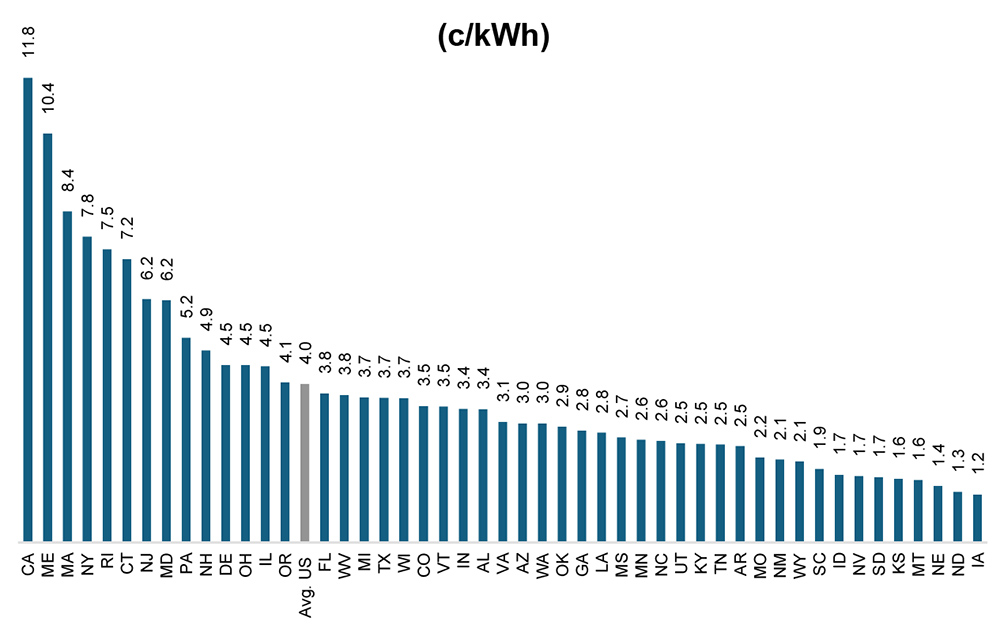
Retail rates rose in all states in the 5 years up to October 2025 | Charles River Associates

For customers, these line items are opaque. When they see an increase in their monthly bill, they do not parse which portion reflects transmission upgrades, wildfire mitigation, renewable integration or administrative overhead. They see only a cost-of-living increase.

And they react accordingly.

If the issue already is in the headlines, imagine the backlash utilities, regulators and politicians will face if prices continue to outpace inflation: ICF estimates residential electricity rates could rise 15% to 40% over the next five years and double by 2050.

National Trends Versus Regional Realities

While rates are up across the board, the realities are more subtle. For every headline-grabbing story about families struggling with power price increases, there are counter stories that never make the news.

“Prevailing narratives that there is a broad national trend of rapidly rising electricity rates are inaccurate or incomplete,” Charles River Associates warned, in its Retail Rate Trend analysis prepare for Edison Electric Institute and published in February.

In the Northeast, for example, retail rates are more susceptible to increases in wholesale electricity prices because utilities there do not own generation, whereas in California, wildfire costs and related mitigation have been the key drivers.

Electric bills have risen disproportionately in areas where power prices have risen most, or extreme weather events have forced larger-than-usual heating or cooling loads. Energy Information Administration data showed sharp increases in parts of California and New England since 2021.

What Goes Up Occasionally Comes Down

When I received a chipper email boasting that my electric rates had been cut, it was a pleasant surprise. “Dear PG&E Customer,” the email sent by Pacific Gas and Electric said, starting Jan. 1, “PG&E lowered electric prices — our fourth decrease in two years — to help make energy more affordable for the communities we serve.”

The near-term decline is counter to the national trend, as the company noted in a LinkedIn Post: “The U.S. Energy Information Administration forecasts national electric prices to increase by nearly 10% between 2024 and 2026.” Small comfort, given that California residents face the second-highest power prices in the nation.

Less than a year earlier, a study by KQED found the average PG&E bill was up 70% since 2020. The customers’ pain didn’t stop the company, along with other California utilities, from trying to increase their authorized return to shareholders to 11.3%.

The request to increase investors’ ROE — the percentage of profit utilities may earn on shareholder-funded investments — was ill timed. It wasn’t just rejected, it was delivered with a slap on the wrist: The CPUC cut the rate, restricting PG&E, Southern California Gas Co. and San Diego Gas & Electric to a little under 10%, and Southern California Edison to a little over 10%, the lowest rate in 20 years.

The returns are not guaranteed. “The utilities earn the full authorized ROE only when they effectively manage costs, maintain safe operations, and deliver projects on time and on budget,” the CPUC said. A cost of capital mechanism enables automatic ROE adjustments when bond markets change substantially in either direction.

The rising prices aren’t about corporate and shareholder greed: They are a result of an aging system that’s being asked to meet conflicting demands. We need a larger grid that’s also more resilient. And if we are to deliver on a climate future that will let future generations flourish, it needs to be cleaner too, regardless of short-term political winds.

For grid operators, utilities and regulators, affordability is the challenge that complicates all those other demands.

Climate and Modernizations Drive Capital Needs

The drivers behind higher residential bills are layered and cumulative. Capital expenditures are surging, with utilities investing heavily in wildfire mitigation, storm hardening, undergrounding, modernizing the grid and replacing aging infrastructure.

Climate stress is making those resilience investments unavoidable: NERC has repeatedly highlighted growing reliability risks tied to extreme weather and climate stress in its Long-Term Reliability Assessment.

The burden is compounded by the rising cost of money. Higher interest rates raise the cost of financing infrastructure, and those costs ultimately are reflected in rate base recovery.

Data Centers Drive Rising Demand

After nearly two decades of flat demand in many regions, load growth has returned. And of the causes — electrification, EV adoption, building heating conversion and data center expansion — one bears the bulk of the perceived blame: data centers.

Total U.S. electricity use is forecast to grow by 1% in 2026 and 3% in 2027, according to the EIA. “This increase would mark the first time since 2007 that power demand has risen for four years in a row. The driving factor behind this surge is increasing demand from large computing centers.”

Greater load can support system use and spread fixed costs. But in the near term, it often requires incremental distribution upgrades and capacity investments that raise costs before efficiency gains materialize. (See DTE Treads Carefully as Michigan Becomes Flashpoint in Data Center Debate.)

EPRI’s Win-Win Watts position paper argued the increased demand from data centers doesn’t have to increase retail rates. “Proactive planning, robust safeguards in large-load tariffs and explicit incentives for demand flexibility, including initiatives like EPRI’s DCFlex, can help turn high-load-factor growth into a tool for moderating average prices, improving asset utilization and accelerating clean energy deployment.”

Addressing the Power Price Risk

The political harm caused by rising retail prices will be addressed, whether through political means, regulatory actions or utility efforts. Legislators are scrutinizing rate cases more aggressively, and if regulators and the industry won’t act, they will step in to fill the void. Some recent examples: Maryland Gov. Wes Moore (D) recently introduced the Lower Bills and Local Power Act, and Pennsylvania Gov. Josh Shapiro (D) urged PJM to protect consumers by extending the existing price floor and ceiling, the price collar, for the 2028/29 and 2029/30 capacity auctions.

For some politicians, a commitment to addressing constituents’ concerns about electricity bills is coming at a cost. Critics accuse New York Gov. Kathy Hochul (D) of ditching the state’s climate commitments to focus on the more politically urgent issue of energy costs.

Politicians do not always have to get involved. Some utilities and regulators are limiting price increases caused by rising data center demand from filtering down to household energy bills, Charles River’s study said. “Going forward, utilities and their state regulators have committed to protecting retail customers from rate increases caused by new data centers and are approving new tariffs and ratemaking measures that embed those protections.”

The Business Risk of Doing Nothing

Failure to address escalating energy costs will strain utilities’ balance sheets if bad debt rises as customers default or disconnect. Investor earnings calls reflect growing sensitivity to bill impacts and the need to balance capital deployment with moderation strategies.

Ratings agencies increasingly factor regulatory and political stability into utility outlooks. Moody’s and S&P regularly assess regulatory environments and affordability pressures in their utility sector commentary. The Center on Budget and Policy Priorities has outlined the risks of rising utility debt and the policy implications for states.

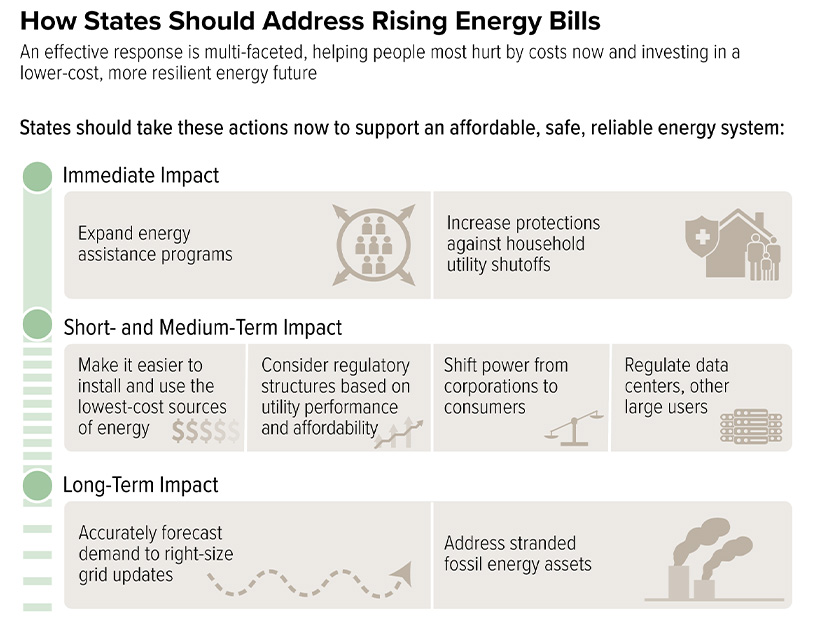
States can address rising energy bills with several levers | Center on Budget and Policy Priorities

An Integrated Approach to Managing Energy Costs

For grid operators and utilities, the risk is that affordability becomes the weak link in the energy transition, not because resiliency, decarbonization and grid growth are not technically feasible but because those upgrades are not politically durable. There are four takeaways:

    1. Treat rate design as infrastructure policy: Providing transparency into use-based charges and fixed system recovery costs could improve public understanding. However, rates that better reflect system costs must be paired with consumer protections.
    2. Make affordability an important system metric: Incorporating explicit bill impact assessments into major capital approvals may help gain buy-in. Income-based assistance mechanisms may prove more durable than broad subsidies that dilute price signals.
    3. Revisit incentive structures: Implementing performance-based models that link utility performance to outcomes rather than capital deployment will build political capital over time.
    4. Acknowledge tradeoffs honestly: Building the grid of the future carries near-term costs, and customers deserve clear communication about why investments are necessary and how costs will be managed. It may not help them pay bills in the near term — something that’s also essential — but it may stabilize public trust.

Investing in Not-too-unhappy Customers

No one loves paying their power bill, especially in strained economic times, but rising prices are a reality as the grid transforms. The nation cannot afford to slow investment in transmission expansion, decarbonization or resilience, but public tolerance is a constraint as real as engineering requirements or capital access.

For utilities, grid operators and regulators, the message is straightforward: Affordability cannot be put on the back burner. The future of the grid depends on not only what gets built but also whether monthly bills make sense to the people paying them.

Duke University Study Quantifies Benefits of Data Center Flexibility

Demand flexibility among data centers could reduce the need for new gas-fired generation needed to supply their energy consumption while driving development of additional renewables and cutting electricity prices, according to a report by Duke University’s Nicholas Institute for Energy, Environment and Sustainability.

The institute in 2025 released a major paper showing that small amounts of data center flexibility could unlock 100 GW of grid capacity to serve more of the large loads. (See US Grid Has Flexible ‘Headroom’ for Data Center Demand Growth.)

The new paper — “Data Centers and Generation Capacity over the Next Decade: Potential Benefits of Flexibility” — seeks to expand on that theme by looking at how data center flexibility could change the power system, co-author Martin Ross, a senior research economist, said.

“What I normally do is the longer-term capacity planning modeling around policy analysis,” Ross said in an interview. “And I was curious, in that longer-term context, how would flexibility sort of alter the capacity mix going forward.”

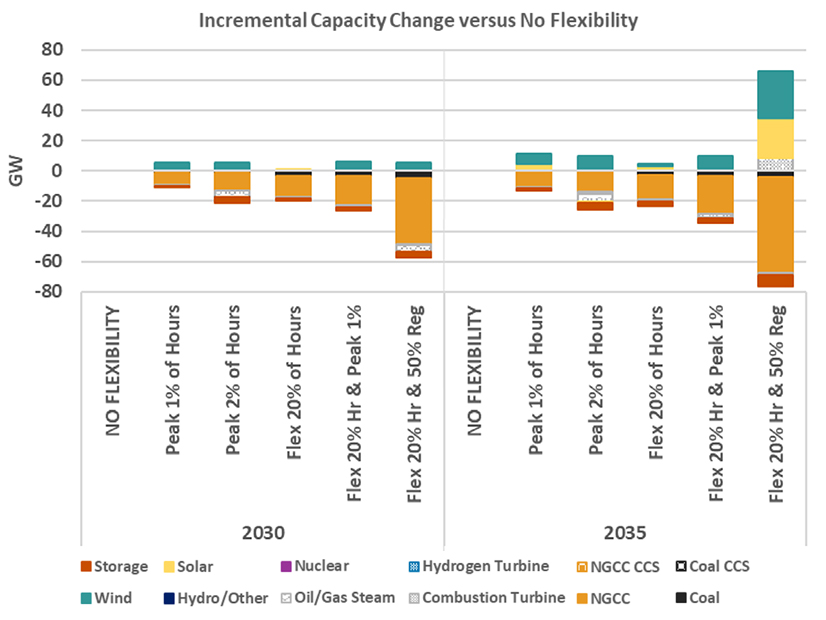
Investments in new combined cycle gas-fired plants are cut by 10-50% in the flexibility scenarios modeled, with the lower end of the range assuming data center demand flexibility that avoids consumption during just 1% of peak hours, the report finds.

The report studies both temporal and spatial flexibility (shifting compute load to other data centers in other regions) to offer the simultaneous ability to further reduce the need for new gas plants.

The flexibility scenarios include ones in which data centers curtail their entire load for 1 and 2% of net peak hours, and other scenarios assuming they can curtail by 20 or 50% during those hours. Other scenarios are combinations, modeling 20 and 50% demand flexibility with the ability, but not the requirement, to completely avoid the system peaks of 1 or 2% of net peak hours. A final scenario uses spatial flexibility to shift 50% of the data center demand in a state to other regions.

Ross focused on combined cycle rather combustion turbine plants because the formers’ higher capacity factors are better suited for steady data center loads.

“Normally you would think if you were reducing stress on the grid, you would first be reducing the need for peaking units,” he said. “But given sort of the overall demand growth that’s being expected in the system, that leads you a bit more towards the combined cycle units and makes the gas peakers a bit less useful, since it’s not efficient to run them all the time as a base load for the data centers.”

data center

Another graph from the report showing the difference in capacity additions based on flexibility scenarios | Duke University

Projected savings in capital investment, operational spending and fuel costs over the next decade range from $40 billion to $150 billion. Data center flexibility could see average electricity prices drop by $2.50 to $8/MWh, with retail customers seeing their bills be 0.5 to 2.8% lower.

The report generally found that greater demand response translated into need for fewer gas plants, with the variable demand matching up better with renewable output.

“Combining the 20% hourly flexibility case with the ability to shift up to 50% of each region’s initial data center demands into other regions allows the national grid to avoid up to two-thirds of the new [combined cycle natural gas] units that would have been built by 2035 as data centers move to regions with both less stress on the grid and higher renewable resources,” the report said.

While flexibility offers clear benefits to the grid, it is unclear how much data centers can offer, Ross said. Customer-facing demand for cloud services is generally inflexible, though the compute load for training AI can be shifted around.

“When I think of flexibility, I normally think of flexibility driven by cost savings as the motivation for the flexibility, and I’m not sure that is a major factor in the thinking right at the moment, versus a race to beat all the other models,” Ross said.

Still, if data centers are motivated to offer flexibility for other benefits such as speed-to-market, their flexibility would benefit all customers.

“I was surprised that the flexibility was having fairly significant effects on what data centers might end up paying because you’re avoiding those high-cost hours, and that sort of not only benefits the data centers, but benefits consumers more broadly,” Ross said.

CTC Global Partners with Google to Launch GridVista System

Advanced conductor manufacturer CTC Global is working with Google Cloud and Tapestry to launch the GridVista System, which combines conductors with fiberoptic cables to offer operators visibility along the entire transmission line.

GridVista’s line awareness, paired with Google Cloud and Tapestry’s artificial intelligence-powered tools, turn line data into actionable intelligence that can optimize grid capacity, prevent outages, cut wildfire risk and lower operational costs, the companies say.

CTC’s advanced conductor technology can double the capacity of an existing transmission line, having worked on 1,400 projects with more than 300 utilities in 65 countries, CEO J.D. Sitton said in an interview.

“Now with the GridVista System, we’re adding data-grade fiber optics to the product that enables the measurement of strain and temperature and capacity and events along the entire length of the power line; not at discrete points, but literally the entire length between substations,” Sitton said. “And so, GridVista really is providing an entirely new level of detail and insight into the operating status of the transmission lines.”

Unlike traditional dynamic line rating products that add sensors at discrete points along a transmission line, the fiber optics in GridVista give utilities full knowledge of what is happening.

“It’s a much higher degree of resolution and a much faster feedback loop to the utilities about an event: a line down, a hot spot, a lightning strike, a rifle shot, a tree branch falling on the power line. These sorts of things,” Sitton said. “We know about it immediately. We know exactly where it is.”

Combining that visibility with advanced conductors puts utilities in a position to operate more cheaply, he said.

“We save them money on the capacity upgrade, and we’re saving them money from an operations perspective, because they’re much smarter about how they dispatch their operating resources and their lines,” Sitton said. “We enable them to operate with a higher degree of reliability because they no longer have these blind spots in their operation between the substations where they’re guessing what’s going on or not going on with their power line.”

The growing demand from data centers that want to connect to the grid much faster than the industry has historically been able to add new power plants or transmission is leading to more demand for products like GridVista.

“I think probably for the first time, we’re seeing utilities in the United States and Western Europe realize that they are, in fact, capital constrained, and so they need to get more out of their existing systems faster than historically they’ve had to,” Sitton said. “So, all of these things are, I would say, accelerated by the dramatic pickup of demand from the data centers that’s creating an environment where the utilities are very open to much more capital and operating cost-efficient solutions.”

Utility customers increasingly have higher expectations for a safe and reliable grid, which can benefit from the awareness the new product unlocks, he added.

CTC had a pre-existing relationship with Google around speed-to-power for its data centers. With GridVista, Google Cloud helped with the user-interface system, and Tapestry is working on reforming grid operations.

“Google is using GridVista as the source for what they call ‘ground-truth data,’ so the fundamental operating data that will feed the capabilities of their software platforms,” Sitton said. “So, it’s basically a two-way street, and it’s really quite exciting to see the early reactions of some of the utilities that we’ve been engaging with about the combined capabilities.”

AI applications are starting to transform how the grid is operated as the industry adopts the technology.

“We’re starting to see utilities rethink how they dispatch their grids, how they respond to operating challenges within their operating assets, and how they think about the kind of the planning aspects of their system,” Sitton said. “So, the next round of interconnections, and the next retirements of generators along their transmission lines and … the way they plan for these things is fundamentally changing.”

Utilities move at different speeds, but the “thought leaders” in the industry are starting to roll out AI applications that improve their operations and planning, he added.

“Utilities are utilities,” Sitton said. “They are, by definition, some of the most conservative organizations on the planet, I think, for good reason. But they’re not all cut from the kind of the absolute conservative cloth, and so we are seeing many utilities moving much more quickly.”

Federal Briefs

DOE Announces $175M to Modernize Coal Plants

DOE announced $175 million in funding for projects to modernize, retrofit and extend the life of coal-fired power plants.

The projects will update plants belonging to Appalachian Power, Buckeye Power, Duke Energy Carolinas, Kentucky Utilities, Monongahela Power and Ohio Valley Electric Corp.

More: DOE

New Mexico Demands DOE Fix for Federal Nuclear Waste Management

The New Mexico Environment Department (NMED) released a series of regulatory enforcement actions and demanded the U.S. Department of Energy expedite the cleanup of legacy nuclear and hazardous waste at the Los Alamos National Laboratory.

The state will also fine the department up to $16 million for violating groundwater safety standards. The regulators’ concerns date back decades, when Los Alamos buried nuclear and hazardous waste in unlined landfills, septic tanks and firing sites. DOE estimates roughly 500,000 cubic meters of legacy waste remains.

“The continued presence of a large volume of unremedied hazardous and radioactive waste demonstrates a longstanding lack of urgency by the U.S. Department of Energy and elevates the risk of waste storage failures,” the NMED wrote.

More: High Country News

Federal Lab Lays off More Workers

The National Laboratory of the Rockies, formerly known as the National Renewable Energy Lab, laid off 134 workers, according to lab spokesperson David Glickson.

The layoffs affected both research and operations workers. The lab had another layoff in May 2025 that affected 114 workers.

“These actions were taken to adjust to existing and projected funding levels and alignment with DOE priorities,” Glickson said.

More: Colorado Politics

State Briefs

IOWA

Lawmakers Seek to Standardize Renewable Facilities Regulations

A House subcommittee advanced a bill that would create standard language for counties to adopt pertaining to setbacks, moratoriums, property tax and other siting considerations for renewable facilities.

The bill would allow local authorities to determine things like setback standards, shadow flicker standards and sound limitations, but only within certain ranges set by the bill. The bill would still allow counties to place a single, temporary moratorium for up to six months on new wind projects, and it would not allow eminent domain to be used to acquire rights of way for construction or operation.

The bill heads to the House Commerce Committee.

More: Iowa Capital Dispatch

MAINE

House Backs Aggressive Emissions Cuts

The House voted 75-64 in favor of updating the state’s carbon allowance program, taking a more aggressive approach to cutting emissions from power plants.

Under current law, Maine is to lower its carbon emissions cap by 2.5% each year. The bill approved by the House would speed up that timeline and, starting later this decade, would sharply increase annual reductions. From 2027 to 2028, the allowable emissions would drop by 12.5%. The bill estimates the total carbon emissions allowance would decline by 90% over the next 10 years.

The bill now moves to the Senate.

More: News Center Maine

MARYLAND

Discounted Rates for Low-income Residents to Take Effect by 2027

The Public Service Commission issued an order that will allow low-income residents to receive a discounted electricity and gas rate.

The program, which will go into effect by Jan. 1, 2027, will automatically apply to most low-income customers who are signed up to receive assistance through the Office of Home Energy Programs. The program will have a tiered structure, so households with the lowest incomes would receive the most assistance. The goal, according to the PSC, is to bring households’ energy costs to 6% of their annual income. It’s not clear how the utilities will recover the costs for the program, but it would likely be spread among remaining ratepayers.

More: Maryland Matters

MISSOURI

PSC Approves Ameren Gas, Battery Plant Site

The Public Service Commission formally approved an agreement to allow Ameren to build a new natural gas plant and battery storage facility on the site of the retired Rush Island coal plant.

The Big Hollow Energy Center calls for an 800-MW natural gas plant alongside a 400-MW battery storage system.

Construction is slated to begin within the next year with operations set for 2028.

More: KTVI

NEW MEXICO

Senate Rejects Bill to Codify State’s Emissions Goals

The Senate voted 23-19 to kill a bill that would have codified emissions reduction goals into law.

Senate President Pro Tempore Mimi Stewart (D-Albuquerque) again attempted to codify the goals into state law based on a 2019 executive order by Gov. Michelle Lujan Grisham. Opponents said the bill would impact the food and fuel costs and hurt the state’s economy.

More: Source NM

OREGON

DOE Awards $12M to 24 Renewable Projects

The state Department of Energy selected 24 recipients to receive nearly $12 million in Community Renewable Energy Grant Program funds. The program supports planning and construction of renewable energy or energy resilience projects for Tribes, public bodies and consumer-owned utilities.

The DOE received 76 applications requesting over $46 million in the fourth round of grant funding. Awards were chosen on a competitive basis.

The program was created by the Legislature in 2021.

More: Solar Power World

TEXAS

Hood County Rejects Data Center Moratorium

Following more than eight hours of discussion, Hood County Commissioners voted 3-2 to reject a temporary moratorium on new industrial development, including data centers.

The failed moratorium would have paused new data center development for six months while the county studied impacts to water supplies, energy demand, air quality, wildlife and residents’ quality of life. It could have affected four projects in early planning.

Adding to the debate was a letter from state Sen. Paul Bettencourt (R-Houston), chair of the Senate Committee on Local Government, to Attorney General Ken Paxton, which warned counties had no constitutional or statutory authority to impose development moratoriums.

More: Texas Tribune

VIRGINIA

Bill Would Put More Costs on Data Centers, Slash Residential Rates

Sen. L. Louise Lucas (D-Portsmouth) introduced an amendment to a bill that would levy more energy costs on Dominion Energy data centers and save residential customers about $5.50/month. 

The amended bill would allow the State Corporation Commission to determine if it is in the public’s interest for large load customers to cover the cost of distributing power to data centers and for Dominion’s capacity auctions. If the SCC approves, those costs could shift to new and existing data centers through 2033. The SCC estimated average residential customers will see rates reduced by 3.4%, about $5.52 monthly, and the data center customers’ rate will increase by 15.8%.

The bill advanced out of the Senate Labor and Commerce Committee and heads to the Senate Finance Committee.

More: Virginia Mercury

WASHINGTON

Lawmakers Quickly Pass Bill to Penalize Coal Use

The House of Representatives voted 63-33 to pass a bill that would levy a new coal tax on TransAlta Corporation if it continues to operate its Centralia coal plant.

The bill is in response to a DOE emergency order issued to TransAlta in December, ordering the company to keep the plant available for operation for 90 days with possible extensions after that. The measure would remove tax and regulatory exemptions agreed to 15 years ago as part of the coal phaseout deal between TransAlta and the state. TransAlta idled the power plant in December to comply with a 2011 agreement to phase out coal power in the state by the end of 2025.

The bill heads to the Senate.

More: Washington State Standard

WISCONSIN

Democratic Lawmakers Propose Data Center Moratorium

A group of Democratic state lawmakers announced a proposal to enact a moratorium on data center construction.

The bill wouldn’t allow the construction of any data centers in the state until it establishes a data center planning authority and prohibits energy and water costs from being shifted to residential utility customers, among other things.

Several pieces of legislation to regulate data center construction have already been proposed in the Legislature. In January, Assembly Republicans passed a bill that would establish some regulations, but Democrats said it didn’t do enough to prevent costs from being passed on to regular consumers. 

More: Wisconsin Examiner

WYOMING

Nuclear Waste Referendum Fails House Vote

A measure to ban spent nuclear fuel waste storage failed to receive the two-thirds vote required to advance in the Legislature’s session.

The measure, which died on the House floor with a 32-30 vote, would have put a referendum on the next general election ballot to amend the state constitution to ban nuclear waste storage unless approved by voters on a case-by-case basis.

More: WyoFile

Company Briefs

Rivian Beats Q4 Expectations

Rivian Automotive beat Wall Street’s fourth-quarter expectations but cautioned it will continue losing money as it launches a next-generation vehicle.

The company was able to achieve its first annual gross profit of $144 million in 2025, including $120 million during the fourth quarter. Rivian’s full 2025 revenue, including $1.7 billion in Q4, was up 8% compared with $4.97 billion in 2024.

Rivian’s net loss in 2025 was $3.6 billion, an improvement from a loss of $4.75 billion in 2024.

More: CNBC

Anthropic to Cover Price Hikes Caused by Data Centers

Anthropic, the AI firm behind Claude, said it will cover any increases in electricity rates that result from its data centers.

The company pledged to pay for infrastructure upgrades required to connect its data centers and said it would try to bring new generation online to match data center needs.

Anthropic joins Microsoft and OpenAI in making similar commitments.

More: The Hill

Enbridge to Proceed with Renewables Projects in Wyoming, Texas

Enbridge approved two renewable projects in Wyoming and Texas, the company said during its fourth-quarter earnings call.

The projects are the $1.2 billion, 365-MW Cowboy Phase 1 project in Wyoming and the $400 million, 152-MW Easter onshore wind facility in Texas. Both are expected to be operational by the end of 2027.

More: Renewables Now