Why 2026 will be the Year of Flexibility

The first time I heard an energy industry official mention the word “flexibility” was back in the early 2010s, when I was a fledgling energy reporter at The Desert Sun in Palm Springs, covering the permitting and construction of an 800-MW natural gas power plant to be located north of the city. The Sentinel plant and its eight, 90-foot-tall emission stacks were needed for system flexibility, a representative from CAISO told me.

As more and more variable renewables came online ─ like the hundreds of wind turbines also located north of Palm Springs and the first utility-scale solar projects on federal land east of the Coachella Valley ─ flexible power that could come online quickly was critical, the official told me. And back then, fast and flexible meant natural gas.

Sentinel was a peaker ─ ideally used only to fill gaps in power supply at times of high demand ─ and was licensed to operate only one-third of the time. It could fire up in about 10 minutes, and according to an environmental impact report that I read in detail, could put up to one million tons of carbon dioxide per year into the region’s already polluted air.

(Despite its status as a major resort area ─ and home to one of the country’s largest music festivals ─ the Coachella Valley has notoriously poor air quality, due in part to the hundreds of diesel-powered 18-wheelers rolling through it daily on the Interstate 10 highway.)

CAISO ran its first demonstration projects using energy storage for system flexibility between 2014 and 2016 ─ after I left Palm Springs ─ but the results were impressive. I was in D.C. at the Smart Electric Power Alliance by then and remember another conversation with a contact at CAISO, who told me the storage was faster and more flexible than a natural gas peaker.

Ten years on, California has 17 GW of energy storage online, allowing the state to ride out summer heat waves ─ just one sign that flexibility has gone from marginal to mainstream. It also is a core attribute of the various scenarios and solutions being discussed to meet the snowballing estimates of U.S. electric power demand that drove headlines in the industry and mainstream media in 2025.

K Kaufmann

2026 is going to be all about how to further integrate flexibility as part of a clean, reliable and affordable electric power system. The technology is available, with prices going down and advanced capabilities expanding at speed and scale, powered by artificial intelligence. The lag, as ever, is on the policy and regulatory side.

The questions will be about what kind of new or different market mechanisms and regulatory guidelines will be needed to ensure the U.S. power system can take full advantage of all the different value and revenue streams flexibility can offer.

Specifically, regulators have yet to figure out how to fully integrate and compensate distributed technologies, like storage, which do not fit into traditional categories of supply and demand ─ generation and load, charge and discharge ─ and how these different technologies are rated on the grid.

But the typically glacial pace of regulation ─ with endless pilot projects and decisions often years in the making ─ is no longer tenable. Demand growth, rising electric bills and the need for system reliability and resilience are converging to accelerate the pace of change, with big tech hyperscalers ─ companies like Google building gigawatt-scale data centers ─ pushing all the various envelopes involved.

What is ahead will be exciting, uncomfortable and unavoidable for all stakeholders, including President Donald Trump and his supporters, who, despite all evidence to the contrary, are stubbornly clinging to fossil fuels as the primary solution for all the challenges of demand growth.

The Flex Front 2025

Any discussion of grid flexibility probably should start with a working definition. In grossly oversimplified terms, we know that our electric power system is overbuilt to handle periods of high demand that may occur only a handful of times each year, which means it often is grossly underused. That excess capacity can be optimized with grid-enhancing technologies ─ like advanced conductors and dynamic line ratings ─ which in turn can allow for the flexible integration of different forms of carbon-free generation and storage.

Further, electric power can be “flexed” at all levels of the system, from residential, commercial and utility-scale to distribution and transmission.

That flexibility in and of itself framed new and innovative views of the grid in 2025, beginning with a Duke University study, released in February, suggesting that if data centers were willing to curtail their electric use even .25% of the time, it would open up space on the grid for 76 GW of new generation. A curtailment rate of 1% could mean enough headroom to add 126 GW of new power.

The study has been widely cited, and Tyler H. Norris, its lead author, quickly became a much-sought-after speaker at industry conferences and webinars. In November, Google hired Norris to lead its market innovation and advanced energy initiatives.

Other key developments on the flex front included:

    • The July 29 virtual power plant demonstration in California: More than 100,000 residential batteries simultaneously discharged for two hours, from 7 to 9 p.m., pumping out 539 MW of electricity, or the equivalent of a mid-sized power plant. An analysis of the demonstration by The Brattle Group concluded that the aggregation of behind-the-meter solar and storage “can deliver reliable, utility-scale capacity at a significantly lower cost than traditional solutions.”
    • Energy Secretary Chris Wright’s Oct. 23 directive to FERC: Wright proposed new rules for the interconnection of “large loads” ─ that is, data centers ─ which would allow expedited approvals for co-location of centers and generation if power at such facilities could be curtailed or dispatched by a grid operator. FERC received more than 200 comments on Wright’s proposed rules, with hyperscalers in particular opposing any rule that linked expedited interconnection to curtailment controlled by grid operators or utilities.
    • The Electric Power Research Institute’s DCFlex initiative: Significantly, EPRI launched this new program less than a week after Wright’s directive to FERC, with the goal of developing data centers as flexible grid assets. A heavy-hitting list of project collaborators includes Google, Meta, Microsoft, Nvidia and Schneider Electric, along with major utilities, RTOs and ISOs. An interactive map on the DCFlex website shows that utilities in 41 states already have some kind of flexible load or demand management programs.

Clearly, everyone ─ even Chris Wright ─ knows that change is coming; flexibility will be a critical must-have, and those who are not ready or willing to innovate and invest will be left behind.

Above Politics

The physics, economics and politics of the next few years are well known. Estimates of the amount of new power the United States will need by 2030 increase with almost every new report. Back in February, the Duke University study estimated that data centers alone would drive 65 GW of new demand by 2029.

An ICF report from May called for 80 GW of new power to come online per year for the next 20 years, while in November, Grid Strategies upgraded an earlier estimate of 128 GW needed by 2030 to 166 GW.

The turbines that will power new natural gas plants could take years to deliver due to material and labor shortages and leave consumers vulnerable to the turbulence of natural gas prices. Renewables are cheaper and faster to build ─ and according to interconnection.fyi, still make up about 88% of projects sitting in interconnection queues nationwide ─ but face a virtual obstacle course as the Trump administration, RTOs and some utilities prioritize natural gas and nuclear.

Natural gas and renewables also will require new transmission and streamlined, accelerated permitting, all of which, including new data centers, are likely to face local opposition.

And electric bills are going nowhere but up ─ period. The ICF report estimates that residential rates could rise 15 to 40% by 2030, depending on the region.

Flexibility redefines everything and, again, is available immediately with existing technologies, which will get cheaper and smarter with speed and scale. This is why it will be essential for system evolution at all levels in 2026.

Flexibility turns grid-edge renewables from variable or intermittent to flexible and dispatchable resources that can shave peak demand, as seen in California’s VPP demonstration. Homes, businesses and data centers all can serve as flexible grid assets, which can help cut electric bills and drive behavioral change.

Consumers increasingly will see the value of adopting technologies that combine energy efficiency with flexibility ─ like solar and storage ─ so they can participate in even more sophisticated demand management programs.

In addition, upgrades that make existing transmission and distribution systems more flexible could allow for more distributed renewables, while triggering less local NIMBYism and reducing the need for new fossil-fueled generation.

In other words, flexibility is a no-brainer. It is above politics, and it just makes sense.

Fail and Scale Fast

President Trump notwithstanding, clean energy will continue to grow ─ though at a slower rate ─ in 2026 because it is faster, cheaper, cleaner and more flexible than fossil fuels. But the more significant paradigm shift this year will be toward policies, again at all levels, that promote the adoption of flexible technologies, ensure they are valued and compensated appropriately and accelerate permitting.

While Trump and some major players in the industry frame the current crunch in demand growth as an “energy emergency,” it actually is a long overdue and extremely cool opportunity for the electric power sector to reinvent itself. It has been dragging its feet on a 21st-century makeover, while its customers increasingly move at the blistering speed of AI.

High-tech hyperscalers are setting the pace. They want power, speed and flexibility for their data centers. They have the technology, the experts and the money to invest in system change; they know how to fail and scale fast; and they do not like waiting for regulators or utilities unless they absolutely must.

Interconnection policies have become the front line of change, where expedited approvals for projects turn on their ability and willingness to flex their power. Texas pioneered this kind of “conditional interconnection,” now codified via SB6, signed into law in June. California followed suit in August with its Limited Generation Profiles policy, which limits the amount of power distributed projects can export to the grid at times of system stress.

What is particularly exciting here is the implicit acceptance of flexibility as a central attribute of the grid and how that in and of itself redefines reliability and resilience.

PJM will provide the acid test of this approach as it works to comply with FERC’s recent order requiring an overhaul of the RTO’s interconnection policies for new generation co-located with data centers. In particular, the order requires PJM to adopt rules and the associated tariffs for co-located generation that can self-curtail or flex its demand on an interim or regular basis. (See FERC Directs PJM to Issue Rules for Co-locating Generation and Load.)

Any final rules from FERC promoting flexible interconnection should send a signal to other grid operators, states and utilities. Wright’s directive called for the federal regulators to complete work on his proposed rules by April, which would be warp speed for the commission, especially given the many concerns raised by stakeholders.

Demand management also is going to move fast. With Tyler Norris on board, we can expect to see new initiatives in this area from Google, which has signed flexible demand agreements with the Tennessee Valley Authority and Indiana Michigan Power. Meanwhile, Amazon is promoting grid-enhancing technologies as a way to get more renewables online.

Building on California’s demonstration, 2026 will see a ramp in VPPs. A recent article in Energy Storage News details three new VPPs being launched by a range of developers and utilities in California, as well as in Texas, Washington, Arizona and the Tennessee Valley. One example is a new partnership between software developer Leap and independent power producer Enel North America that aims to connect commercial distributed resources to utility demand management programs.

Why is any of this important? As flexibility becomes the new normal, it makes us think about electric power differently. It redefines our relationship to how we produce it, how we use it and what we can do with it. It makes us aware that we as consumers have an active role to play here, and that we can do more than complain about rising electric bills and then pay them.

Let us also remember that when we talk about flexibility and renewables, we are talking about climate change and reducing greenhouse gas emissions, whether we use the actual words. We have shifted from an environmental to a practical, business case for climate action, which is equally if not more effective.

Coming full circle, in 2024, the Sentinel plant was approved for a 17.18-MW, 34.36-MWh battery storage system to provide black start capability, so the plant can restart itself even if it goes offline.

When peakers need extra flexibility, we are way past the point of no return; 2026 is going to be a good year.


PJM Pushing Forward on Efforts to Meet Rising Data Center Load

PJM enters 2026 amid several efforts to ward off a reliability gap attributed to accelerating data center load, sluggish development of new capacity and resource deactivations.

The risks were laid bare in December, when the 2027/28 Base Residual Auction cleared 6.6 GW short of the reliability requirement. Of the 5,250 MW of load growth included in the auction, the RTO attributed nearly 5,100 MW to data centers. (See PJM Capacity Auction Clears at Max Price, Falls Short of Reliability Requirement.)

With six months remaining before the 2028/29 BRA is to be conducted in June, PJM’s Board of Managers is considering how to proceed in the wake of a Critical Issue Fast Path (CIFP) proceeding focused on large load interconnections. Stakeholders brought forward a dozen proposals, none of which received sector-weighted support from the Members Committee on Nov. 19. During the committee’s meeting Dec. 17, board Chair David Mills pushed the target for a FERC filing to January to allow more time to go through the packages. (See PJM Stakeholders Reject All CIFP Proposals on Large Loads.)

The rejection of the proposals puts the board in a similar position when the RTO conducted a CIFP in 2023 focused on resource adequacy, when 20 packages were rejected. Because the committee’s vote is only advisory, the board could choose to proceed with any of the options, cobble together elements of them or arrive at its own solution. PJM staff’s recommendation included a request for a second phase of the CIFP to evaluate changes to the reliability backstop and incentives for load flexibility. (See PJM Stakeholders Vote Against All CIFP Proposals.)

The board is weighing its options against the backdrop of a FERC order directing PJM to revise its tariff to include at least four options for large loads co-located with wholesale generation to receive transmission service. It also directed the RTO to provide a report on the CIFP within 30 days of the Dec. 18 order. PJM has scheduled a workshop to discuss the co-location order Jan. 9. (See FERC Directs PJM to Issue Rules for Co-locating Generation and Load.)

Proponents of co-location have argued it allows for more efficient siting of load, reducing the need for transmission upgrades, while skeptics say it would push transmission and ancillary service costs, such as black start, onto other consumers. Independent Market Monitor Joe Bowring and several other stakeholders have argued that if loads are considered critical national security interests, it is unlikely that they would actually be required to curtail or accept non-firm service.

Further complicating the board’s deliberations is a complaint the Monitor has filed with FERC arguing that PJM has the authority to delay large load interconnections that would jeopardize transmission security or resource adequacy (EL26-30). It argued that the recommended CIFP proposal — and PJM’s statements throughout the process — are based on an untested theory that the jurisdictional contours that RTOs operate within do not allow them to require that a load can be served reliably before it is permitted to enter service. (See Market Monitor Files Complaint Over PJM Large Load Interconnections.)

Several Design Changes for June Auction

Several design changes are to affect the 2028/29 auction, including the elimination of a price collar established by a settlement with Pennsylvania Gov. Josh Shapiro (D); the implementation of FERC Order 2222 requiring RTOs to facilitate the participation of distributed energy resources; and the expiration of a measure allowing PJM to model some deactivating resources operating under reliability-must-run agreements as providing capacity. The 2029/30 BRA is scheduled for December 2026.

The price cap was effective for the 2026/27 and subsequent auction, limiting prices to between $175 and $325/MW-day, with adjustments before each to account for shifting accreditation values for the combustion turbine reference resource. The temporary nature of the agreement was intended to avoid high prices while several market changes are implemented. Supporters argued the RTO’s backlogged interconnection queue would prevent developers from responding to high prices.

During a press conference following the posting of the 2027/28 auction results, PJM Executive Vice President of Market Services and Strategy Stu Bresler said staff plan to proceed with the 2028/29 BRA with the auction parameters proposed in the RTO’s Quadrennial Review filing. (See PJM Board of Managers Approves Quadrennial Review Proposal.)

A joint proposal from the Data Center Coalition, Exelon and PPL, as well as the governors of Maryland, New Jersey, Pennsylvania and Virginia, would extend the collar by one year, in addition to adding financial requirements for large loads, creating a demand response product with limited annual run hour restrictions and loosening the participation requirements for the expedited interconnection track proposed by PJM. (See “Data Center Coalition, Utility and Governor Proposal,” PJM Stakeholders to Vote on Large Load CIFP Proposals.)

The governors, along with those of Delaware and Illinois, signed a letter encouraging the board to include an extension of the collar in the CIFP solution it accepts.

The commission’s approval of PJM including the 1,289-MW Brandon Shores and 397-MW H.A. Wagner in the capacity supply stack is also to end prior to the 2028/29 auction. Its temporary nature was similarly intended to allow resources that consumer advocates argued can operationally serve as capacity to be modeled as such while stakeholders pursue a more holistic approach to how RMR resources are reflected in the capacity market. PJM has said it intends to request a one-year extension of FERC’s approval. (See “PJM Plans to Request 1-year Extension of RMR Resources Participating in Capacity Market,” PJM MIC Briefs: Oct. 9, 2025.)

The Deactivation Enhancements Senior Task Force is continuing discussions on a pro forma RMR agreement that would allow the RTO to dispatch relevant resources during a capacity emergency.

PJM Files Quadrennial Review

PJM is awaiting a FERC decision on its Quadrennial Review filing, which would set the auction rules for four years starting with the 2028/29 BRA (ER26-455). (See PJM Board of Managers Approves Quadrennial Review Proposal.)

The proposal would rework the design of the variable resource requirement (VRR) curve to set the maximum price at the larger of either 20% of the gross cost of new entry, or 115% gross CONE minus 75% of the net energy and ancillary services (EAS) offset. The formula establishes a floor meant to prevent high energy market revenues from lowering the maximum capacity price to zero. The curve approved by the commission in 2023 set the maximum at the greater of gross CONE or 1.75 times net CONE, which subtracts the EAS offset from gross CONE.

PJM board Chair David Mills | © RTO Insider LLC

Jointly proposed by PJM staff and Pennsylvania Public Utility Commission Vice Chair Kimberly Barrow, it is meant to improve the stability of the VRR curve by reducing reliance on multipliers of the CONE parameter. The curve defines the clearing price to be procured in a BRA and at what cost.

The reference resource would remain a combustion turbine, though PJM’s initial proposal would have shifted to a combined cycle generator for all regions except in ComEd, where a four-hour battery electric storage system would be the reference. (See “Stakeholders Divided on Reference Technology,” PJM Stakeholders Discuss Quadrennial Review Proposals.)

The filing has been opposed by the Monitor, which took issue with PJM’s VRR curve shape, and the Maryland Office of People’s Counsel, which sought a Federal Power Act Section 206 investigation into the functioning of the RTO’s capacity market.

The Monitor disputed PJM’s calculation of gross CONE for the reference resource and argued the proposed VRR curve would inflate capacity costs by $6.7 billion, instead recommending a steeper curve.

The OPC argued that PJM’s filing would result in uncompetitive market outcomes so long as developers cannot respond to high prices because of a confluence of the compressed auction schedule, the amount of time it takes projects to clear the interconnection queue and national supply chain shortages. It argued the commission should investigate the capacity market and extend the maximum price set by the proposal until it determines “new entry imposes constraints on the potential exercise of market power.”

Transition to Cluster Cycles to Complete

PJM is about halfway through processing projects being studied in Transition Cycle 2 of its interconnection queue, which is currently in the second of three phases. Interconnection service agreements are to be negotiated between December 2026 and February 2027.

The cluster-based approach for studying the network upgrades needed for new resources and how costs are allocated is to begin with its first cycle once the April 27 application deadline expires. Reviewing the applications will take a few months, and models are to be posted in June. The total cycle is expected to continue through April 2028.

The shift is intended to allow projects to proceed through the queue more quickly and give developers more certainty about the costs they may face. The backlogged queue has often been blamed for holding back new resources, particularly renewables, contributing to the imbalance of supply and demand. Since it implemented its transitional process, PJM has said it is processing more projects than ever — including 306 interconnection requests when Transition Cycle 1 was completed in 2024. (See PJM Reaches Milestone on Clearing Interconnection Queue Backlog.)

Leadership in Flux

PJM leadership is in a moment of transition going into 2026, with two new board members appointed in September and Chair Mills assuming the interim CEO position for “several months” as the search continues for a long-term executive. (See PJM Members Confirm 2 Board Nominees; States Call for Governance Overhaul.)

Speaking during the Dec. 17 MC meeting, Mills said PJM was “incredibly fortunate” to attract outgoing CEO Manu Asthana in 2019, as the leading indicators of the challenges the RTO would face began to emerge. (See PJM Taps Ex-Direct Energy Exec as New CEO.)

Asthana recalled being gifted a firehose at his first MC meeting, which he called a fitting sign of what was to come. He said Mills is more than ready to take over and has his full confidence.

Several governors of PJM member states have pushed the RTO to rework its governance structure to provide more of a voice for the states in its decision-making. Following a multistate technical conference in September, they issued a statement of intent to form a PJM Governors’ Collaborative to “promote greater state and consumer representation in the governance and decision-making processes of PJM.” (See Governors Call for More State Authority in PJM.)

The participation of governors’ offices and state legislators in PJM’s stakeholder process deepened throughout the CIFP, and Pennsylvania separately sponsored an issue charge to explore a sub-annual capacity market design. The Analysis Group presented the preliminary results of its report on such a design to the Sub-Annual Capacity Market Senior Task Force at its Dec. 12 meeting. Monthly task force meetings are scheduled through June.

SPP will Widen Western Foothold in 2026

SPP has made it official: The operator of the sprawling Midwestern grid technically is in the Western Interconnection.

That means it has office space in downtown Denver that includes a sizeable meeting room, a break room and several offices with three workspaces. That allows SPP to boast a “physical presence” in the West, as one staffer said.

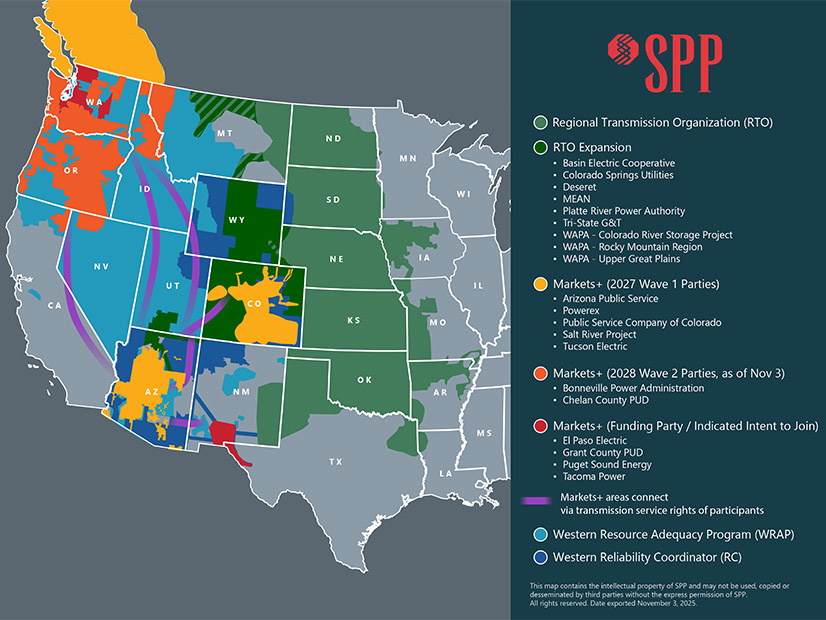
In April, it’s scheduled to become operational. That’s when the grid operator’s 14-state footprint will increase by three. Utilities from Arizona, Colorado and Utah will place their facilities under SPP’s tariff. It will make the grid operator the first to provide full market services in the U.S. system’s two major interconnections, thanks partly to three DC interties totaling 510 MW.

The expansion comes little more than a year after FERC approved an amended tariff that adds the western members to the RTO and drew praise from several commissioners. Judy Chang said the approval is “another major milestone for the market evolution in the Western part of the U.S.” (See FERC Approves Tariff for SPP RTO West.)

Work spaces inside SPP’s Denver office. | © RTO Insider LLC

All seven members of RTO Expansion — as SPP refers to its new market on the other side of the Rockies — currently participate in SPP’s Western Energy Imbalance Service (WEIS) market; four of them (Basin Electric Power Cooperative, Municipal Energy Agency of Nebraska, Tri-State Generation and Transmission Association, and the Western Area Power Administration’s Upper Great Plains-East Region) are members of the legacy RTO in the East.

A 2022 Brattle Group study for SPP determined the expansion will produce between $68 million and $81 million in annual Westside adjusted production cost benefits and wheeling revenue. Eastside members will see between $3 million and $8 million of those benefits.

SPP says it will decide Feb. 2 whether to launch the market April 1 as planned.

“Right now, everything seems to be on track,” CEO Lanny Nickell told his board in November.” We’re looking forward to working with our new members in the West.”

The RTO expansion has been somewhat overshadowed by the noise surrounding SPP’s Markets+ day-ahead offering, which is providing western utilities an alternative to CAISO’s Extended Day-ahead Market (EDAM).

The grid operator’s staff and Markets+ stakeholders are well into the initiative’s second phase, working together to build the market’s operating systems and conduct market trials and parallel operations. SPP says 41 entities have committed to covering the market’s $150 million in development expense; the costs will be recovered through future operations. (See SPP Markets+ Cruising Through Early Development.)

Interested market participants have until April 1 to register. They will have about 45 days to complete their registration workbook.

Arizona Public Service, Powerex, Public Service Company of Colorado, Salt River Project (SRP) and Tucson Electric Power are moving forward as balancing authorities. The Bonneville Power Administration will join the secondary market launch in October 2028, along with four other Pacific Northwest BAs.

SPP is targeting October 2027 as the Markets+ go-live date. When the Northwest BAs join in 2028, it will consist primarily of the Pacific Northwest, Desert Southwest and along the Rockies.

The series of complicated seams that will result have caught the attention of FERC, which has asked Western stakeholders to get ahead of seams issues before the markets launch. SPP, experienced in managing seams with MISO, ERCOT and WECC, is hosting a Western Seams Symposium open to western stakeholders at SRP’s Tempe, Ariz., headquarters Feb. 26. (See FERC Report Urges West to Address Looming Market Seams Issues.)

SPP’s western expansion effort is just one of its three overarching goals. The others are accelerating its generator and large load interconnection processes and mitigating its resource adequacy risk.

The grid operator will begin transitioning in 2026 to its Consolidated Planning Process, which combines its transmission planning and GI studies into a three-year process that aligns system modeling, planning assumptions and cost allocation across load and generation needs. The CPP’s “ready-to-go” construct replaces the current “request-then-analysis” framework by identifying system needs and costs before the generator asks to connect. (See SPP ‘Blazes Trail’ with Consolidated Planning Process.)

A transition study is underway and will result in a 20-year assessment in November 2026. The 2027 study will sunset the current process and integrate RTOE transmission needs before the first full CPP 10-year assessment in 2028.

The studies will be run in parallel with a strategic partnership announced during the summer between SPP and global tech giant Hitachi. The two organizations are collaborating to accelerate the GI process by reducing study times 80% through end-to-end industrial AI and advanced computing infrastructure. (See SPP, Hitachi Partner to Use AI in Clearing GI Queue.)

SPP’s two previous planning cycles resulted in more than $16 billion of transmission projects and included five 765-kV lines, the RTO’s first. (See SPP Board Approves $7.65B ITP, Delays Contentious Issue, SPP Board OKs Updated 2025 Transmission Plan.)

SPP’s market footprints | SPP

Several other 765-kV projects were set aside as SPP, like other grid operators, prepares for a future projected to be dominated by data centers, crypto miners and industrial electrification. A more recent Brattle Group study found the RTO will require at least $88 billion and up to $263 billion of generation investment to support load growth through 2050. (See SPP Study: $88-263B in Generation Needed by 2050.)

Naturally, affordability is a concern for regulators and other stakeholders. SPP has created the Cost Control and Allocation Review and Evaluation (CARE) Team, a cross-functional leadership body to review and recommend refinements or alternatives to the current transmission cost controls and cost-allocation methodologies. The team met once in December 2025 and took a deep dive into SPP’s various cost mechanisms; it has set a meeting schedule that lasts into November 2026.

Can Restructured Markets Meet the Challenge of Data Center Demand Growth?

The biggest issue facing FERC and the organized power markets it oversees is how they can meet rising demand reliably and affordably.

The Advance Notice of Proposed Rulemaking on large loads from Energy Secretary Chris Wright and the co-location proceeding in PJM are both undergirded by the need to build new power plants. (See FERC Directs PJM to Issue Rules for Co-locating Generation and Load.)

“As I’ve been saying now for five years, PJM is heading for a reliability crisis, and now we’re there,” former FERC Chair Mark Christie said in an interview. “It’s no longer over the horizon. It’s right on the street with us, and the latest capacity auction results just drive home how bad the crisis is, when they fall short 6 GW of meeting the reliability requirement.” (See PJM Capacity Auction Clears at Max Price, Falls Short of Reliability Requirement.)

The primary driver for that crisis is the demand from new data centers, which has so far not been met with new generation to match it, he added.

“Really the problem is financing more than anything else,” Christie said. “We’re not getting large baseload generation built. We’re not getting combined cycle gas, which is the baseload generator of choice.”

Coal plants are not feasible at this point, and nuclear is not going to be ready at scale in time to meet the demand from data centers plugging into the grid soon, Christie said. Wind and solar, which dominate the queue, add much needed electricity to the grid, but they cannot be counted on to serve demand from data centers that want 99.999% reliable power, he said.

Christie’s home state of Virginia is a major contributor to the issue because it is home to the largest data center market in the world, Data Center Alley, and has contributed to the demand growth recently by plugging in new facilities that are ultimately served by imports from elsewhere in PJM.

“The Dominion zone was a big contributor to the deficit,” he added. “And we’re going to see whether the new governor and the new legislature are going to take action to try to get large baseload generation built.”

The supplies being added to the grid are either wind and solar or combustion turbines, and Christie is skeptical that the market on its own can add new baseload plants.

“I don’t know how high prices have to go to get large baseload generation built, but politically, you’re already getting a huge backlash because we’ve hit three all-time highs in the capacity market,” Christie said. “And we’re not getting large baseload generation announced.”

Virginia is one of the vertically integrated states in PJM, which means its political establishment needs to support the construction of new baseload, Christie argued.

“When I was on the Virginia commission, we approved four combined cycle natural gas generation units for Dominion, and every one of them got built,” Christie said. “Every one of them was ratebased, but the political leadership was supportive.”

PJM sits on top of huge supplies of natural gas in the Marcellus and Utica shale fields, which could power a new wave of combined cycle units.

“In the deregulated states, where they do not allow utilities to own generation, the question becomes: Who is going to build the large new combined cycle gas?” Christie said. “Are the [independent power producers] going to build it? We haven’t seen announcements of that.”

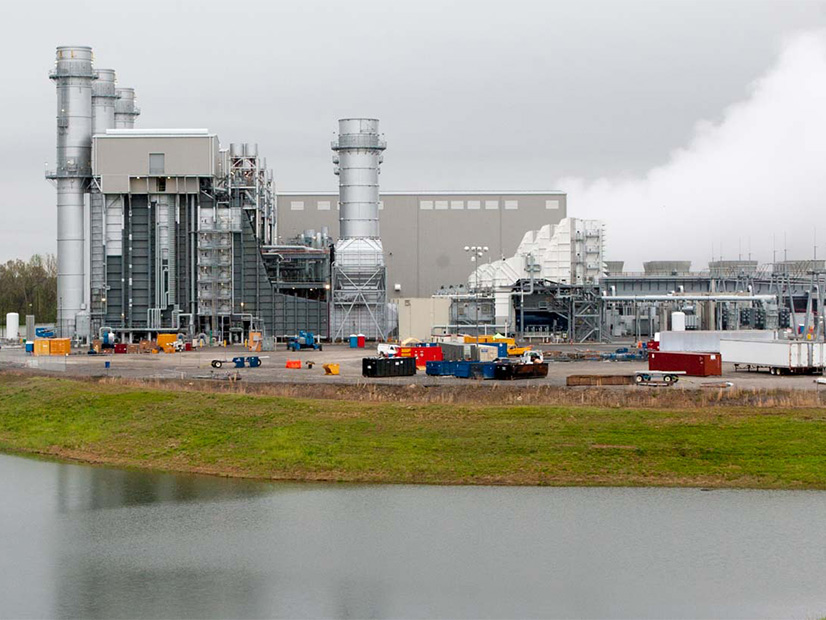
The Paradise Combined Cycle Plant in Drakesboro, Ky. | TVA

When states restructured their industries a quarter-century ago, PJM had excess supply, and the generators in those states were forced to sink or swim in the market, Christie recalled. Many sank, and it brought the reserve margins down for demand growth to return in a way no one expected.

“Now we’re in a perfect storm that, frankly, at the beginning of capacity market 20 years ago, nobody saw,” Christie said. “Nobody saw the explosion of demand coming from data centers 20 years ago.”

The capacity market was put in place at a time of wide reserve margins and slow, steady load growth. Ultimately, Christie thinks the states will have to address the issue on both sides of the supply and demand equation.

“The answer is really at the state level, not FERC,” Christie said. “The states have to deal with the demand side, with how they interconnect these large new data centers, and the states have got to deal with the supply side and getting generation built.”

Will the Market Respond?

Electric Power Supply Association CEO Todd Snitchler said the market will respond because PJM has now had three capacity auctions in the past year that have cleared at high prices.

“We’ve seen almost 12,000 MW of new generation that’s expected to be added to the PJM grid between now and roughly 2030,” he said.

EPSA and a fellow IPP trade group, the PJM Power Providers, created a chart showing all the projects, including uprates and new builds, that have been committed to serve load in the market. They argued that market participants should continue responding to the higher market prices seen in the last auctions, even though they have been muted by a cap that the RTO agreed to after a complaint from Pennsylvania Gov. Josh Shaprio (D). (See PJM, Shapiro Reach Agreement on Capacity Price Cap and Floor.)

“I think the compressed timeline of the auction has made it appear that the market is slower to respond,” Snitchler said. “But you know, you don’t drop a $2.5 [billion] or $3 billion investment in six months, or even maybe 12 months. And so, I think you’re going to see people who have had some time to digest the auction results lead to outcomes that are going to include that new generation that everyone wants to see.”

Before the July 2024 auction, the previous three cleared at low prices that were effectively signaling generators to retire just before the issue of meeting demands from new large loads like data centers started to become a reality, Snitchler said.

“As you see real load growth for the first time, really in probably 30 years, it’s triggering a response, and that response takes a little time to develop,” Snitchler said. “You’re already starting to see where there is incremental investment and new investment being made in PJM, but also in other parts of the country.”

The issue of rapidly rising demand leading to narrowing reserve margins is not unique to restructured markets, with vertically integrated states in MISO and SPP facing the same issues, he noted.

“It’s really a systemic issue that we’re all trying to address and resolve because everybody wants to make sure that we ensure, first and foremost, a reliable system that is also cost-effective and affordable,” Snitchler said. “I mean, if those two tenets aren’t met, then the rest of this is academic. We have to be sure that we’re meeting those two objectives.”

The load growth the industry is facing is different from that of the past, which was driven by economic and population growth. The new large loads are clustering in specific submarkets like Arizona, central Ohio and Loudoun County, Va.

Data centers might have plans to ultimately consume the same amount of power as a major city, but generally they do not immediately plug into the grid seeking to consume a gigawatt.

“There’s a construction ramp where they start from zero, and then you have that first tranche where you need to power it up,” Snitchler said. “Then they add the next phase until they’re finally complete.”

That gives the industry some time to respond to the load forecasts, which Snitchler argued are overstating future demand. While the power sector has limited supply chains for components like combustion turbines, the tech industry has a limited capacity to build the advanced chips needed for artificial intelligence-related data centers springing up around the world.

“If you look at the number of chips that are available from Nvidia and the fact that they’re sold out for the next couple of years, and there’s only 60 GW of new energy demand from those chips globally, [and] if you look at what is being projected in PJM and Texas, it would require every chip that Nvidia is going to sell for the next two years and more, and that’s not how that’s going to work.”

Utilities have also issued optimistic load forecasts that reflect plans for data centers that are not going to be built, Snitchler argued. When AEP Ohio put in place a new tariff for large load customers, it saw a pipeline of 30 GW of data centers cut down to 13 GW, and it’s not clear if all those will come to fruition, he said.

“They’re clearly an effective advocacy tool if you want to secure the ability to ratebase new generation, because ‘nobody’s moving as fast as a utility could.’ … I’ve never heard anyone say [that], but that’s the story that’s being told,” Snitchler said. “Then you need to have as big a number on your load forecast as possible, because that means you’re the solution to the problem that you’re creating.”

Multiple utilities have pushed for restructured states in PJM to change their laws and allow them to ratebase new generation for the first time in 30 years, which is an idea that EPSA is opposed to, arguing it would spoil the markets its members rely on.

“I understand they have a target earnings goal that they have set for Wall Street,” Snitchler said. “But that doesn’t mean that we should reverse 30 years of policy to help them achieve it when there are more cost-effective and more efficient ways to do that, and by putting the risk where it’s been for the last 30 years on shareholders and investors of competitive power suppliers.”

The Slippery Slope of Re-regulation

Ultimately if states change the laws and guarantee rates of return for new utility-owned generation, that would cut into the revenues of market generation owned by IPPs who would eventually ask for their own guaranteed rates — unwinding markets altogether, PJM Independent Market Monitor Joe Bowring said in an interview.

“If PPL builds power plants and puts them in rate base, then all customers are paying for them,” Bowring said. “There’s nothing stopping PPL from directly working out a bilateral agreement with the data center and building a power plant for them. But that’s not what they’re asking to do. They’re asking to put in rate base and charge everybody for it, and that’s just a way of making everyone else bear the costs and risks of the data center load.”

PJM’s markets have been slow to add generation in part because of overhanging issues from the interconnection queue and unstable market design in the capacity market, Bowring said.

“The developers who were caught up in all those delays had delayed getting some of their basic milestones,” Bowring said. “They’re now trying to catch up, but they’re behind, and that’s part of the reason we haven’t seen a lot of new additions.”

On top of the lingering issues from the queue, the capacity market has seen its rules change often, and Bowring is also skeptical of how the RTO has implemented effective load-carrying capability ratings for power plants.

“If data centers want to come online quickly — which is fine, we want them to come online quickly — they should figure out how to bring their own generation,” Bowring said. “That doesn’t mean you’re turning data centers into power plant operators. You sign a bilateral contract with a developer; they build the power plant. They manage all that for you, but you have power, and that’s the quickest way to get to get things going, because the data centers have a huge incentive to get power quickly.”

Some of the hyper-scalers in the data center world can build their own power plants. Google parent Alphabet announced Dec. 22 that it was buying Intersect, which develops power plants for new large loads. But not every data center developer is among the largest companies in the world by market capitalization.

“The market is going to take a little while to react, and I’m hoping that in a few years that will restore equilibrium,” Bowring said. “But at the moment, as you know, we’re something like 6,600 MW short.”

While meeting new load has always been a key part of the business, the scale of the new demands from data centers is unprecedented.

“We’re talking 30[,000] to 60,000 MW of demand,” Bowring said. “That is absolutely unprecedented,” and it’s amid “a time when PJM was getting tighter for other reasons. That confluence is, I think, absolutely unique. I mean, PJM has been long for almost forever.”

The last time the PJM region faced a major shortage was decades before it was an RTO, and the power pool was dealing with the aftereffects of the accident at Three Mile Island in 1979, he added.

The issues data centers present to the grid are unique, and they need to be handled differently than load growth was in the past, Bowring said.

“The whole notion of just plugging in is naive, almost willfully naive, in some cases,” Bowring said. “I understand why the data centers imagined a few years ago [that] they could just plug into the grid and everything would be fine, but everyone knew at least a couple years ago that that was not going to work longer-term; that it was simply overwhelming the grid. So, it has to be dealt with in special and targeted ways.”

IESO Sees 2026 Demand Cooling from ‘Trade Tensions’

IESO has reduced its 2026 demand growth projection slightly, citing “international trade tensions.”

The revised projection came in its January 2026–June 2027 Reliability Outlook, which concludes Ontario is “well prepared” to meet its reliability requirements over the 18-month period.

IESO said firm energy demand rose about 2.3% in 2025 — “stronger than anticipated” — and will grow another 1.6% in 2026 and 1.1 % in 2027, with both peak and total energy demand to “moderate … as international trade tensions impact economic activity.”

In its previous forecast on Oct. 7, IESO projected 2026 growth would be 2.23%.

The ISO says 2026 growth will be driven by numerous “large step loads” — electric arc furnaces, electric vehicle battery manufacturers and data centers — in addition to the electrification of transportation and industry.

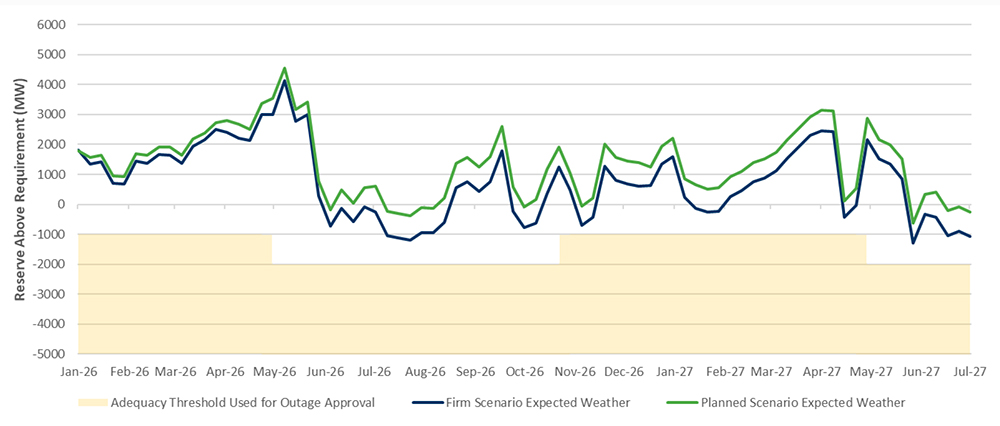
Reserve Above Requirement levels — the margin between available and required resources — are above summer and winter thresholds and expected to range as high as 4,500 MW.

The latest demand forecast, released Dec. 18, is “broadly consistent with, though lower than, the previous forecast,” IESO said. “In the longer term, the IESO continues to expect strong electricity demand growth.”

The demand models use actual demand, weather and economic data through September, with data on large step loads incorporated in mid-October. Planned generator and transmission outages reflect plans reported as of November.

Reduced Supply

IESO will lose more than 2 GW of generation when the Pickering B Nuclear Generating Station goes out of service in October 2026 for a $26.8 billion refurbishment that will extend the lives of Units 5 to 8 for up to 38 years. Work is set to begin in early 2027, with completion expected by the mid-2030s.

IESO hopes to add 185 MW in gas upgrades and 1,073 MW in battery storage and other resources from its Long-Term 1 procurements, which would leave the grid operator with a net reduction of 800 MW during the 18-month reliability horizon.

Reserve Above Requirement under expected weather and planned and firm demand scenarios | IESO

It also is counting on up to 260 MW of re-contracted capacity resources and more than 200 MW of re-contracted energy resources under its Second Medium-Term procurement.

The outlook does not include the results from the December 2025 capacity auction, which saw a record $645/MW-day (CAD) clearing price for summer 2026. “Forecast assumptions were based on capacity targets from the IESO’s 2025 Annual Planning Outlook, and incorporating the actual auction results would not materially change the outlook,” the ISO said. (See Big Jump in Ontario Capacity Prices Signals Tightening Supplies.)

The report said the refurbishment of the Bruce and Darlington nuclear plants remained on schedule, with work on Darlington Unit 4 expected to be completed in Q4 2026.

The ISO also is expecting completion of Phase 1 of Hydro One’s Waasigan Transmission Line Project — including a new double-circuit 230-kV line between Lakehead TS and Mackenzie TS — by Q4 2026.

New Format

The outlook identifies risks that can be addressed by coordinating maintenance plans for generation and transmission facilities. The Q4 outlook is the first using a “more focused and concise” format, IESO said. Details on assumptions, explanations and terminologies were moved to the Methodology to Perform the Reliability Outlook.

FERC Pulls Mich. Dam License After 15 Years of Safety Shortcomings

FERC revoked the operating license for a troubled hydroelectric dam in Michigan’s Upper Peninsula, citing a perpetual failure to address safety issues that could cost lives and the owner’s loss of land in bankruptcy proceedings.

The commission said owner UP Hydro “has discontinued good faith operation” of the Au Train Dam and decided that a license termination by implied surrender is in the public interest (P-10856).

With FERC’s Dec. 29 order, oversight of the dam shifts to the Michigan Department of Environment, Great Lakes and Energy (EGLE).

EGLE warned FERC in mid-December that the Au Train Dam was going the same route as the Edenville Dam, another Michigan dam, which collapsed in 2020 and caused $250 million in property damage. (See Michigan Dam with Prolonged Safety Issues Fails and FERC Terminates More Boyce Hydro Licenses.)

The 0.9-MW facility was built in the early 1900s to power a paper mill.

The revocation caps a tumultuous year for the dam and its old and new owners.

Since acquiring the Au Train Dam in 2010, UP Hydro has failed to remedy inadequate spillway capacity to lessen flooding risk, a condition of FERC’s transfer of the license. The company in 2020 told FERC it couldn’t finance spillway upgrades and filed for Chapter 11 bankruptcy in early 2023. At that point, FERC’s director of the Division of Dam Safety and Inspections told UP Hydro to at least lower the dam’s south levee to reduce flows through the spillway during floods. UP Hydro to date has not provided proof that it has begun that process.

Though UP Hydro sent a request to FERC in 2020 to surrender the dam, it rescinded the request in February 2025.

FERC’s regional Chicago office conducted a mid-2025 inspection and found additional neglect, including seepage through a newly discovered hole in the bottom of the vault, poor vegetation management, rodent infestations and shrubs and small trees growing in the channel downstream from the spillway.

The Au Train Dam is classified as having high hazard potential, meaning a dam failure would pose a threat to human life and cause significant property damage. The dam’s 40-year license, originally issued to the Upper Peninsula Power Co. in 1997, had about 11 more years to go.

“As a high hazard dam, the Au Train project poses a threat to public safety and UP Hydro has been unwilling and unable since 2010 to undertake required remediation,” FERC wrote.

Following UP Hydro’s bankruptcy, mortgage holder Stephenson National Bank and Trust in 2025 foreclosed 18 of the 22 parcels that the dam occupies and sold them to Green Bay, Wis.-based D. Charles Trust Investments.

The 18 parcels include those containing the powerhouse, transmission line, most of the impoundment and the surrounding project buffer. The investment company ordered UP Hydro to vacate the premises and decommission the powerhouse and said it would block access to the powerhouse Dec. 31, 2025.

“Loss of access to the powerhouse will immediately affect the licensee’s ability to comply with the terms and conditions of the license, including Article 401, which requires continuous minimum powerhouse discharge for the protection and enhancement of fish and wildlife resources in the Au Train River, or to ensure the safety of the facility,” FERC said.

FERC pointed to other failings by UP Hydro, including numerous past due dam safety submittals and audits, neglected coordination with downstream communities since 2021 and repeated failure to work with Michigan state agencies to permit and improve the dam.

DOE Blocks Retirement of Another Coal-fired Plant

The U.S. Department of Energy has ordered a non-operational 427-MW coal-fired generator in Colorado to be repaired and remain available to meet regional power needs for 90 days.

Energy Secretary Chris Wright issued Order 202-25-14 late Dec. 30, one day before the scheduled retirement of Craig Generating Station Unit 1 and 11 days after a valve failure took the 45-year-old generator offline.

The three-unit 1,285-MW station in north-central Colorado is operated by Tri-State Generation and Transmission Association, which is co-owner of Units 1 and 2 with four other utilities and sole owner of Unit 3. Units 2 and 3 are scheduled for retirement in 2028; Unit 1 was to be retired Dec. 31.

DOE said in a news release that the Section 202(c) order prioritizes minimizing electricity costs and blackout risks, and says Unit 1’s reliable supply of power is essential to keeping the region’s electric grid stable.

Tri-State said in a news release that it has a history of 100% compliance and will work toward the demands of this latest order.

That will need to begin with repairs to the valve that failed Dec. 19, but likely will entail “additional investments in operations, repairs, maintenance and, potentially, fuel supply, all factors increasing costs.”

Tri-State CEO Duane Highley said: “We are continuing to review the order to determine what this means for Craig Station employees and operations, and the financial impacts. As a not-for-profit cooperative, our membership will bear the costs of compliance with this order unless we can identify a method to share costs with those in the region. There is not a clear path for doing so, but we will continue to evaluate our options.”

Colorado Gov. Jared Polis (D) blasted the emergency order.

“This order will pass tens of millions in costs to Colorado ratepayers, in order to keep a coal plant open that is broken and not needed,” he said in a statement to Colorado Public Radio. “Ludicrously, the coal plant isn’t even operational right now, meaning repairs — to the tune of millions of dollars — just to get it running, all on the backs of rural Colorado ratepayers!”

Retirement planning for Craig Unit 1 began in 2016 and is based on economic factors as well as numerous state and federal requirements.

Tri-State said in its news release that Unit 1’s planned retirement had been analyzed and did not raise resource adequacy concerns: “The retirement of Craig Unit 1 was specified in Colorado Air Quality Control Commission Regulation No. 23 on Regional Haze Limits, and the Regional Haze State Implementation Plan put in place in 2016. Tri-State’s 2020 and 2023 Electric Resource Plan (ERP) modeling reflected the previously announced retirement date for Unit 1. The model results of the 2023 ERP showed adequate resources to maintain reliability on Tri-State’s system following the retirement of Craig Station.”

Section 202(c) of the Federal Power Act was created for use in wartime or during a sudden increase in demand or decrease in supply of electricity. Historically, it has been invoked infrequently — the Biden administration issued 11 such orders in four years, all of them weather-related.

Wright signed 19 202(c) orders from May 16 through Dec. 30, a dozen of which directed continued operation of aging fossil generation assets.

The Trump administration has been using 202(c) as a tool to support its narrative of a national energy emergency and halt the wave of fossil generation retirements seen in recent years. A surge of new-build gas generation is on the way in the next few years, but no new coal generation appears likely to be built. (See Natural Gas Generation in Demand, and Priced Accordingly and Coal’s Decline Slows Amid Demand Growth in 2026, Trump’s Support.)

Against this backdrop, the Dec. 30 order for Craig Unit 1 had been expected, so much so that the Sierra Club commissioned a December 2025 study by Grid Strategies calculating the cost of such an order: at least $20 million for 90 days on standby status and nearly twice as much on must-run status.

The 202(c) orders have been criticized for extending the operation of aging plants that are expensive and/or dirty to operate, but DOE continues to cite its July 2025 Resource Adequacy Report, which warned of a 100-fold increase in outages if the wave of retirements of firm fossil generation continues amid the buildout of intermittent renewables. (See DOE Reliability Report Argues Changes Required to Avoid Outages Past 2030.)

That report itself was criticized by clean energy advocates as an exaggeration, but DOE is standing by its conclusions.

“I hereby determine that an emergency exists within the Western Electricity Coordinating Council (WECC) Northwest assessment area due to a shortage of electric energy, a shortage of facilities for the generation of electric energy, and other causes, and that issuance of this order will meet the emergency and serve the public interest,” Wright said in the Dec. 30 order for Craig Unit 1.

“From Dec. 30, 2025, Tri-State and the co-owners, shall take all measures necessary to ensure that Craig Unit 1 is available to operate at the direction of either Western Area Power Administration (WAPA)-Rocky Mountain Region Western Area Colorado Missouri (WACM) in its role as Balancing Authority or the Southwest Power Pool (SPP) West in its role as the Reliability Coordinator, as applicable.”

The order gives Tri-State and the co-owners of Unit 1 a Jan. 20 deadline to report measures they have taken and plan to take to ensure operational availability of Unit 1.

Whither FERC?

As Yogi Berra didn’t say (at least not first): It’s tough to make predictions, especially about the future.

But I’m going to stick my neck out and predict that the dozens of independent federal agencies like FERC will survive the Supreme Court’s revisiting of Humphrey’s Executor v. United States.

The conventional wisdom is that the court will invoke something called the “unitary executive theory” to reverse 90 years of precedent, and allow the president to unilaterally fire whoever he wants from any federal agency for any reason at any time.

The unitary executive theory doesn’t make any sense because it’s premised on the notion that Congress can’t pass a law granting a federal agency some element of independence from the whims of a president. Why can’t Congress do that? It’s the first branch of our government with the power to pass laws. That’s what it’s supposed to do. And let’s remember that the president can always veto a law he or she doesn’t like, which then requires Congress to muster an overwhelming majority to override the veto. And let’s note that the veto is a “legislative” power (it’s in Article I after all), which discredits the notion that legislative and executive powers can’t mix.

But somehow the idea emerged that Congress’ legislative power to pass laws, subject to veto, is circumscribed by a president’s executive power to override such laws because, well, he’s the president.

Let’s put aside all the intricacies and nuances that have inspired countless law review articles on this subject.

Instead let’s surmise what the swing justices think of Donald Trump’s conduct. Justices don’t live in a vacuum. They see the same stuff that we do (or at least I hope so).

Prior drafts of this column listed 34 of Trump’s worst Constitutional, legal, ethical and aesthetic outrages in 2025 (actually 37 when I added the latest offshore wind, Greenland and battleship-naming outrages). But having depressed myself assembling the list I realized that I shouldn’t pass it on, at least not in the holiday season. You may have your own list. And I hope the swing justices do as well.

I am guessing, and hoping, that the cumulative effect on the swing justices will be that they just can’t stomach giving Trump more power. They won’t take this further step toward autocracy, as happened in other countries. “… centralization of head-of-state control over the executive branch of government provides a pathway to autocracy. Indeed, unilateral presidential control of the executive branch constitutes a defining characteristic of autocracy.”

But maybe this is just wishful thinking.

Speaking of wishes, I wish you and yours the best for the year ahead.

RTC Deployed, ERCOT Takes on New Challenges in 2026

AUSTIN, Texas — Having finally added real-time co-optimization to the market like every other U.S. grid operator with an effort that began in 2019, ERCOT can turn its attention to other pressing issues in 2026.

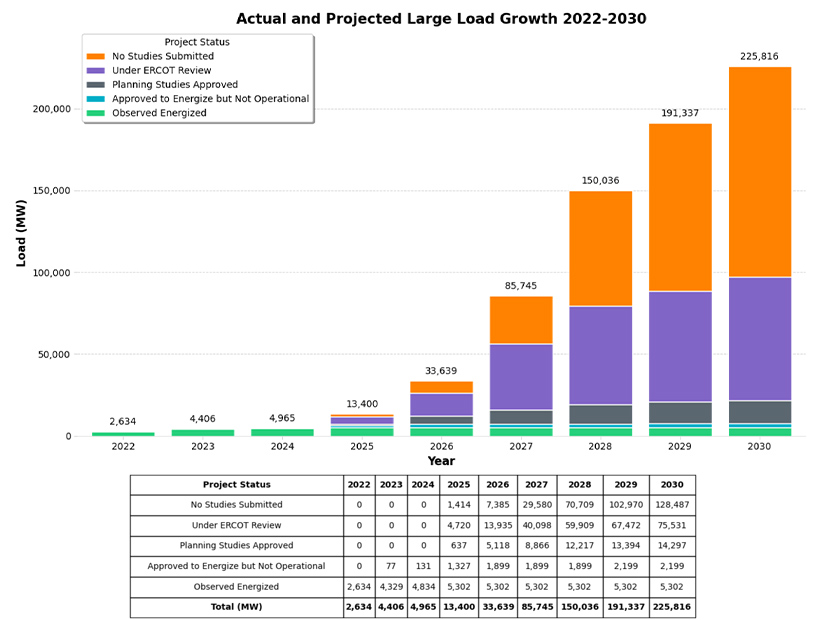
Of course, figuring out the most effective and efficient way to safely interconnect the hundreds of requests from large loads — data centers, bitcoin miners, large industrial facilities and the like — that have flocked to Texas’ welcoming arms tops the list. The grid operator began the year with 63 GW of interconnection requests in its large-load queue but enters 2026 with more than 233 GW, up 269%. Data centers account for about 77% of that load.

Then there’s ERCOT’s continuing work on a dispatchable reliability reserve service (DRRS), a product that staff call an ancillary service but that some stakeholders don’t. It is the third iteration of the product, mandated by state law in 2023 and a high priority for the Board of Directors and the Public Utility Commission.

A little less sexy initiative but equally important is the full-scale analysis that will take place in 2026 of the grid’s reliability standard. It will be the first formal evaluation of the new reliability standard the PUC established in 2024.

But wait. ERCOT isn’t finished with RTC. Nearly a dozen issues and tweaks have been identified to stabilize the market mechanism, requiring the task force that deployed RTC to stay active.

ERCOT dispatchers monitor a system that now is co-optimized in real time. | © RTO Insider 

CEO Pablo Vegas says ERCOT is going through a transition “characterized by high and very rapid growth” of intermittent and short-duration supply resources.

“It’s characterized by a rapidly changing customer base that includes price-responsive loads like crypto miners, rapidly growing large-scale data centers, and continued penetration of distributed energy resources throughout the grid,” he told his board in December. “It’s a significant shift in operational requirements, and it represents an opportunity to create a more resilient and cost-effective grid for the benefit of all Texans.”

Vegas says ERCOT’s load growth is “fairly unprecedented” and renders obsolete historical interconnection processes. As of November, the ISO had energized only a little over 5 GW of large loads in 2025. To remedy that, Vegas and other members of his leadership team proposed a new approach to interconnection called a “batch study” process. (See ERCOT Again Revising Large Load Interconnection Process.)

Projects ready to be studied will be grouped together in batches and allocated existing and planned transmission capacity. ERCOT says this will provide large-load customers with study efficiency, consistency, transparency and certainty. The first group, Batch 0, will create a foundation and baseline for subsequent batches, building on the assumptions that have changed from the previous group.

Staff will develop the batch study’s framework, taking input from market participants and regulators. ERCOT has rolled out a stakeholder engagement plan during January and February that includes six presentations to the PUC and stakeholder groups. It plans to file a proposed study process framework for discussion before the commission’s Feb. 20 open meeting.

“There’s clearly a pressure to move quickly and support the economic growth that’s coming our way,” Vegas told the PUC in December.

ERCOT Tries Again with DRRS

There’s also pressure on ERCOT to produce the DRRS product, mandated by House Bill 1500 in 2023. The law requires the grid operator to develop DRRS as an ancillary service and establish minimum requirements for the product: reducing the amount of reliability unit commitment by the amount of DRRS procured; and eligible resources being capable of running for at least four hours and be dispatchable not more than two hours after being called on for deployment.

Lawmakers followed up by directing the PUC to revise ERCOT’s original protocol change to establish DRRS as a standalone ancillary service. The new direction resulted in allowing only offline resources to participate and the change was withdrawn.

ERCOT now has filed a protocol change (NPRR1309) that meets all statutory criteria and improves the previous change by allowing online resources to also participate in DRRS. The new design enables the product to be awarded in real time and co-optimized its procurement with that of energy and other ancillary services (AS) under RTC.

An accompanying protocol change (NPRR1310) adds energy storage resources as DRRS participants and a release factor so the product can support resource adequacy. NPRR1309 has been granted urgent status and is due before the board for its June meeting. The same status has not been accorded to NPRR1310.

“We recognize there’s likely to be a lively stakeholder debate,” Keith Collins, vice president of commercial operations, told the board in December. “We are optimistic that it can move through the stakeholder process expeditiously, but we didn’t necessarily want to burden it with a timeline for that.”

ERCOT contracted Aurora Energy Research, which has a large local presence, to study future resource adequacy conditions and the effect of different market designs, including variations of DRRS. The research firm determined that DRRS’ design adds more cost-effective dispatchable capacity and provides greater resource adequacy benefits in different load and extreme weather conditions. (See ERCOT: New Ancillary Service Key to Resource Adequacy.)

ERCOT’s large-load interconnection requests as of November | ERCOT

During a December workshop to review the report, stakeholders peppered Aurora staff with questions on the study. DRRS is meant to achieve a revenue goal, not an operational goal, the firm’s representatives said as stakeholders questioned whether it is an ancillary service.

Collins said the DRRS mechanism and its eligibility requirements strengthen reliability through ancillary services, whereas ERCOT’s operating reserve demand curve, about 10 years old, uses energy to improve reliability.

“In our mind, [DRRS] is using ancillary services to achieve reliability, so it is an ancillary service plus,” he said. “I’m not aware of any other market that has a tool quite like that.”

Saying he doesn’t understand how an ancillary service could ever procure 100% of eligible capacity, energy consultant Eric Goff, who represents the consumer segment, said, “It seems like that’s a stretch to call it an ancillary service.”

The workshop signaled the conversations that will happen over the next few months. ERCOT has scheduled another workshop for the Technical Advisory Committee on Jan. 7.

“Obviously, there’ll be more discussion on 1309 and 1310 next month,” Collins said.

Strengthening the Grid

After 2021’s devastating Winter Storm Uri and the legislative session that followed, the PUC ordered ERCOT to create a reliability standard as a performance benchmark to meet consumer demand for three years into the future. The standard is composed of three criteria to gauge capacity deficiency: frequency (not more than once every 10 years), magnitude (loss of load during a single hour of an outage) and duration (less than 12 hours).

ERCOT and its Independent Market Monitor are required to evaluate the costs and benefits of any market design changes proposed to address deficiencies identified through the assessment process. The first such reliability standard assessment will be conducted in 2026 and then every three years and will include a forward review and analysis of the generation mix.

Vegas said in December that additional supply has been “helpful” in improving the grid’s reliability characteristics.

“In the long term, there is increasing risk if the load materializes and infrastructure development doesn’t keep up,” he told the board.

ERCOT has deployed what it calls its “most significant” design change since its nodal market went live in 2010. The grid operator went live with real-time co-optimization (RTC) in early December and it has been successfully procuring energy and AS in real time every five minutes ever since. (See ERCOT Successfully Deploys Real-time Co-optimization.)

“Mission accomplished. It was absolutely brilliant,” ERCOT’s Matt Mereness, who chaired the stakeholder group managing the effort, told the board in December.

The ISO says new functionality, which also improves the modeling and consideration of batteries and their state-of-charge in participating in RTC, will yield more than $1 billion in annual wholesale market savings.

However, there’s still work to be done stabilizing RTC and transitioning to normal processers. Staff and stakeholders have identified nine issues to further evaluate in 2026. Those issues run from reviewing the ancillary service demand curve to evaluating concerns with AS deliverability and will be transferred to TAC.

ERCOT has identified five likely protocol violations and mitigation plans with the PUC and has filed a protocol change (NPRR1311) to reverse language allowing ancillary service prices above the $5,000/MWh cap during emergency conditions.

Mereness said the plan is to have everything resolved by Jan. 31. The grid operator will spend the first few months of 2026 releasing updates for remaining non-critical defects.

RTC’s successful implementation is another plus for ERCOT and Vegas. He told the board during its year-end meeting that the ISO is determined to be the “most reliable and innovative grid in the world … in the world.” (See “Vegas Sets Lofty Goal,” ERCOT Board Approves $9.4B 765-kV Project.)

“We are one [of the best], if not the leading, grids globally when it comes to operational and technical complexities,” Vegas said. To be successful, we need to be a clear leader on a stage that represents the entirety of this planet.”

As part of its strategy to “advance knowledge sharing in grid innovations,” ERCOT is hosting its third annual Innovation Summit on March 26 at a resort near Round Rock, Texas, where “visionaries, thought leaders and innovators” share ideas to address “challenges and opportunities facing grid operators around the world.”

Or those thought leaders could just ask ERCOT staff, who already may be there.

NERC Navigates Turbulent Reliability Landscape in 2026

As 2025 dawned, the way ahead for NERC’s management seemed clear.

The ERO’s most recent three-year plan was set to expire in December, and NERC was set to develop a new one to begin in 2026 and carry the organization through 2028. But as the planning process got underway, ERO leaders began to realize the challenge they faced.

NERC was wrapping up the Interregional Transfer Capability Study, an unprecedented continent-wide examination of the transmission system with the potential to change how the ERO conducted reliability assessments. The second Trump administration had sowed major confusion about trade policy and other issues. The ERO’s Board of Trustees kicked off a review of the standards development process that wouldn’t be finished until February 2026. Multiple issues appeared to be in flux, a difficult environment for long-term plans.

With all this uncertainty in mind, NERC management decided that following through with the original goal would be “a fool’s mission,” as CEO Jim Robb told stakeholders in a May 21 webinar. (See 2026 to be ‘Bridge Year’ for NERC Budget.)

Instead, Robb and other executives agreed to treat 2026 as “a bridge year” in NERC’s budget and come back a year later to create a new three-year plan that would guide the ERO from 2027-2029.

Looking back on this decision near the end of 2025, Robb said he still believed it was the right call. The delay allowed NERC to get “a little bit more clarity on how we can make the most important difference possible” in the challenges facing the reliability landscape.

“We were just very early in our exploration of [large loads]. We’ve got a much clearer view now than we did a year ago,” Robb said. “Reliability assessments, same thing. … Gas-electric [coordination], I think we’re seeing a lot more progress than we would have guessed a year ago. So while there’s still a lot of uncertainty in the environment, I think a lot of it has resolved well enough for us to do a more thoughtful plan than we would have put in place [this] year.”

Cybersecurity Remains a Major Concern

In conversations with ERO Insider, Robb and other NERC managers described the organization as well-positioned to meet the year ahead, having overcome the uncertainty that characterized early 2025. One source of that ambiguity was the presidential transition, which left many crucial posts in government open — including the director of the Department of Homeland Security’s Cybersecurity and Infrastructure Security Agency.

Nearly a year after the inauguration, CISA still lacks a Senate-confirmed head. The agency has been led by Deputy Director Madhu Gottumukkala since his appointment in May 2025. President Donald Trump nominated Sean Plankey, formerly of the Department of Energy’s Office of Cybersecurity, Energy Security and Emergency Response, to head the agency shortly after taking office, but his nomination has stalled amid holds placed by multiple senators.

More disruption came during the 43-day government shutdown, accompanied by the expiration of the Cybersecurity Information Sharing Act of 2015 (CISA 2015), which set requirements for cybersecurity information sharing by the federal government and provided liability protections for voluntary information-sharing by private entities.

CISA’s operations were restored on Nov. 12 when Trump signed a continuing resolution that also renewed CISA 2015 through Jan. 30, 2026, but the episode sparked fears about the continuity of the federal government’s role in the cybersecurity ecosystem. (See Stakeholders Urge Cyber Info Sharing Act Renewal.)

Michael Ball, CEO of the Electricity Information Sharing and Analysis Center, acknowledged the turmoil of the past year and the concerns it created among stakeholders. However, he said that, despite outward appearances, the connection between the government and the ERO, including the E-ISAC, remains strong.

“There is a lot of concern about what that [relationship] looks like down the road. I can say with a lot of confidence, at least from the lens that I have, that we haven’t seen that really degrade,” Ball said. “We have great contacts within the different agencies. The changes haven’t degraded the objective and the goal.”

“Where my concern would be is the degradation over time in that [commitment], and my optimism [there] is pretty high,” he continued. “We know that when there’s administration changes, there tends to be [a shift] without stakeholders that we work through, and they tend to reconstitute and sometimes create new opportunities.”

Cybersecurity remains a critical focus for NERC and the E-ISAC in 2026. As Russia’s conflict with Ukraine continues, tensions between China and Taiwan intensify and other nation-state actors like North Korea and Iran jockey for advantage, the chance increases that those rivals will try to advance their interests by damaging U.S. infrastructure. Groups believed to be affiliated with China are known to have infiltrated U.S. telecommunications networks, and as they gain experience and confidence the threat is only expected to grow.

Risks also remain from straightforward criminal actors employing ransomware and other tactics to gain financial benefit. Ball said the growth of generative artificial intelligence is “enabling amazing capabilities, even for what would have been less sophisticated threat actors” to conduct social engineering campaigns and gain access to utilities’ computer networks. These criminals are further fueled by an industry that has grown up to market malware, information and other cybercrime tools.

“The bad guys are bad, but they’re not dumb. They’re very, very capable … well-financed and well-resourced, and persistent — you can’t let your guard down once, because they’ll [be] there to take advantage of it,” Robb said.

Standards Modernization, Large Loads Efforts to Continue

Cybersecurity is far from the ERO’s only iron in the fire; NERC has multiple efforts underway that are expected to hit milestones in 2026. One of the most prominent of these is the Modernization of Standards Processes and Procedures Task Force, which the ERO stood up following a directive from the Board of Trustees in February 2025.

NERC’s board started the MSPPTF to examine the ERO’s standards development process after trustees twice invoked their authority under Section 321 of NERC’s Rules of Procedure to break voting impasses over proposed standards that put NERC at risk of breaking a FERC deadline. Chair Suzanne Keenan urged the task force’s leaders to make sure the process remains “stakeholder-based, with reasonable notice, opportunity for public comment, due process [and] openness.” (See NERC Leaders Highlight Canada-US Collaboration.)

NERC has called the resulting work one of the biggest outreach efforts in the ERO’s history, with presentations reaching more than 5,000 stakeholders over the last year. The task force is expected to deliver its final recommendations at the board’s February meeting in Savannah, Ga. NERC will then work on updates to the ROP, which must be submitted to FERC for approval.

“We’re still quite a ways away from implementation of a new process, but the team did a great job in living up to what we asked them to do,” Robb said. “It hasn’t been a smoke-filled room; there’s been a lot of engagement, and … the task force has taken what they heard in those engagements and used it to make the process better [and] more palatable. … So [we’re] very pleased with that.”

Large loads are expected to be another major area of focus for the ERO in 2026. NERC’s Large Loads Task Force has been operating since 2024 to study the impacts of data centers, hydrogen fuel plants and other emerging large loads on grid reliability, along with multiple simultaneous other efforts.

The organization also issued a Level 2 alert in September 2025. The alert provided recommendations for registered entities to mitigate risks associated with integration of large loads into the grid while requiring responses to a series of questions on their experience with large loads, their understanding of the risks associated with large loads and their current efforts to address those risks. Responses to the alert are due Jan. 28, 2026.

Robb described the ERO’s large loads work as “doing stuff in parallel that we would normally do in sequence.” Along with the LLTF and the Level 2 alert, NERC is developing a reliability guideline on risk mitigation with emerging large loads and recently commented on an Advance Notice of Proposed Rulemaking at FERC discussing potential changes to NERC’s registry criteria and standards actions on large loads.

“We won’t get ahead of our skis, but we’re going to be prepared to move as quickly as we can on each of these initiatives,” Robb said.

Changes to LTRA Process

NERC will be carrying out its plans at a time when the ERO receives a growing amount of attention from lawmakers and the general public. As a sign of how NERC’s profile has grown, Robb observed that at a 2024 meeting of the Senate Energy and Natural Resources Committee, both Chair Joe Manchin (I-W.Va.) and ranking member John Barrasso (R-Wyo.) used maps produced for NERC’s reliability assessments. The CEO also mentioned a recent appearance on NBC’s Today to speak about risks facing the energy grid.

“The CEO of NERC’s not supposed to be on the Today show. Just think about that — that the stuff that we’re doing is reaching a mainstream audience, not just the nerds in the corner planning the electric grid,” Robb said. “People are paying attention, and they’re using our materials to inform decisions.”

The increased attention to NERC’s assessments forms part of the backdrop for the ERO’s work to update its reliability assessments, particularly the Long-Term Reliability Assessment, which is published each year. The 2025 LTRA is due in January.

John Moura, NERC’s director of reliability assessments, said ongoing changes in the electric grid — including rapid shifts from traditional generation to inverter-based resources like wind and solar, along with the growth of large loads — meant the ERO’s previous approach to the LTRA was no longer valid. He described the former approach as “very much … ground-up,” involving collecting data directly from utilities which the ERO would “piece together at the end.”

Moura said recent experiences have demonstrated that “each system is more reliant on neighbors than we ever have been in the past … and so coming together earlier on in the process to make sure assumptions and scenarios and base cases are … modeled in unison [is] essential.” NERC began a pilot program in 2025 to establish common platforms and standardized assumptions for the Eastern, Western and Texas interconnections, enabling interconnection-wide energy assessments.

That effort has been productive, Moura said, although not ready to be used in the 2025 LTRA. He explained that the Interregional Transfer Capability Study, filed with FERC in 2024 in accordance with a mandate in the Fiscal Responsibility Act of 2023, provided a “foundation” for the wide-area assessments by pushing NERC to develop tools and processes for information gathering and storage that could then be used for the LTRA.

“The ITCS gave us that step change. It kind of elevated our capability,” Moura said. “If we had not had the ITCS … we would have [eventually] said, ‘Wait, we need to understand the interregional transfer capability between the regions.’ … But the ITCS actually gave us a step change up … allowing us now to do things in a simultaneous manner.”

The most important task for NERC in the coming years, Robb said, will be to preserve its reputation for independence and fact-based analysis, and to avoid any perception of favoring one side or another in the increasingly polarized political climate.

“We’ve had as good a conversation with the current committees of jurisdiction in the House and Senate that we would have had two years ago, [and] our relationship with DOE is as strong today as it was two years ago, because we’re not partisan,” Robb said. “We’re kind of the truth tellers. And while not everybody likes what we have to say, they at least respect it and pull it into their own thinking. I think that’s really important … that we don’t let ourselves ever be turned into a tool or start telling people what they want to hear, because once we do that, we’ve lost our power.”