FERC rejected a complaint from the PJM Independent Market Monitor asking it to determine the RTO holds the authority to deny transmission service for large loads that cannot be reliably served (EL26-30).
The March 23 order found the Monitor had not demonstrated PJM would be in violation of statutory or regulatory requirements without that authority, nor would its governing documents be unjust and unreasonable. While NERC standards mandate PJM determine the amount of capacity needed to maintain reliability and identify shortfalls, the RTO to not required to solve deficiencies.
But FERC also noted that “our rejection of a procedurally inadequate complaint is unrelated to the gravity of the issues the deficient complaint raises. Though we find that the IMM failed to meet its burden under Federal Power Act Section 206, we acknowledge that the IMM and commenters raise very important issues regarding the challenges posed by large load additions to PJM’s transmission system, including ensuring reliable transmission service and resource adequacy.”
The Monitor had argued that PJM is considering changes to its capacity market that would allow data centers to come online regardless of whether there is sufficient capacity and transmission capability to cover their load. It said PJM has an obligation to ensure all customers receive reliable service and argued that allowing these large loads to come online would undermine the quality for all other consumers. (See Market Monitor Files Complaint Over PJM Large Load Interconnections.)
The Nov. 25, 2025, complaint stems from proposals brought by PJM staff and stakeholders during the Critical Issue Fast Path (CIFP) conducted last year to identify how to serve ballooning load. The Monitor sponsored the implementation of an interconnection queue for large loads, which would prevent them from coming online until the requisite capacity and transmission is in place. The PJM Board of Managers opted to go with a package of market changes that would create an expedited interconnection track for new resources; require large loads to either bring their own capacity or be subject to curtailment on PJM request; and overhaul the load forecasting process.
PJM responded that the complaint was effectively a petition for a declaratory order seeking to curb the options available to it in the CIFP process and the Advance Notice of Proposed Rulemaking focused on large load interconnection (EL25-49). (See PJM Presents 1st Look at Co-located Load Compliance Filings.)
Several generation owners, data center representatives and utilities protested the filing on the grounds that the Monitor had not shown PJM is failing to meet reliability standards. Constellation Energy, Talen Energy, FirstEnergy and the Electric Power Supply Association submitted protests, and the Data Center Coalition and PJM Power Providers Group jointly requested the commission dismiss the complaint.
The Natural Resources Defense Council and Sierra Club also objected to the Monitor’s complaint, arguing the requested relief was too vague and would impinge on state jurisdiction and PJM’s ability to prevent data center costs from being shifted to other consumers. While they agreed large load growth threatens reliability and affordability, the issue should be addressed in separate docket, such as the ANOPR, a consumer advocate complaint arguing the capacity market lacks adequate market power mitigation and a complaint from the Office of the Ohio Consumers’ Counsel regarding the growing cost of local transmission projects (EL25-18, EL23-105). (See Consumer Advocates File Wide-ranging Complaint on PJM Capacity Market.)
The commission’s order stated it is “considering and adjudicating” issues raised in the filing in other proceedings and anticipates additional filings from PJM relating to co-locating generation and large loads, a new reliability backstop mechanism and a Connect and Manage framework under which large loads would be required to curtail under strained system conditions.
Pennsylvania Gov. Josh Shapiro submitted comments agreeing with the Monitor that PJM lacks processes to modulate load growth at a time when large loads are driving high market prices and declining reliability. But he argued that “rationing” interconnection service is not the path forward and that PJM should pursue rule changes to allow new capacity to come online faster and incentivize large loads to be curtailable.
Consumer advocates in Pennsylvania, Maryland, Illinois, Delaware and Ohio jointly supported the Monitor, arguing that without the authority to reject large load interconnections, PJM’s right to review utilities’ interconnection requests is little more than a rubber stamp. A proactive process for approving new service requests would pace load growth with reliability.
“Aside from fulfilling its fundamental role and obligation of ensuring grid reliability and administering efficient energy and capacity markets, PJM serves no purpose in pursuing the policy aim of continued proliferation of data centers and AI within the region if it conflicts with PJM’s ability to meet its priority obligations,” they wrote. “PJM can and must say ‘no’ to the undisciplined interconnection of data center and AI large loads to the PJM transmission system to protect grid reliability unless and until there exists sufficient resource adequacy.”
The New Jersey Board of Public Utilities argued it would be insufficient to leave oversight of large load interconnections to the states, as the cost and reliability impacts of large loads can extend across the PJM region.
While domestic grid planning’s regional nature offers different policy examples, countries around the world offer even more diverse examples that could inform domestic transmission policy, experts said during a webinar hosted by Americans for a Clean Energy Grid.
China has a large, well-connected national grid now, but its system is regional enough that this was not some inevitable destiny. It was the result of deliberate policy choices, said Michael Davidson, associate professor at the University of California San Diego.
“When I first started studying Chinese energy systems in 2008, there were no UHV [ultra-high-voltage] lines,” Davidson said. “There were a handful of HVDC lines. But now they have over 40 UHV lines. And if you include those HVDC lines, it’s actually closer to 70.”
Building out a backbone transmission system to help grow renewable energy’s share of the grid while ensuring reliability has become a key strategic priority of the central government, he added.
“China actually has some fairly deep provincial fragmentation and a lot of autonomies granted to local governments,” Davidson said. “But during the restructuring of the power sector, which split up the grid company and the separate generation companies, you started to see some synthesis around this. And then, basically through the actions of very connected political leaders and top-down decisions, it was decided in early 2000s to go big on a national backbone.”
The Chinese Communist Party’s latest five-year plan focused on building a “new energy system,” which would be powered by renewable energy, and that means grid planners are focused on projects that help integrate renewable power, he said.
Any transmission lines 500 kV and above are planned federally, with provincial governments having to site them, but lower-voltage lines are entirely within the remit of the provinces. The planning also includes new sources of renewables, which are built on one side of new lines to bring them to serve load in a city, which means the Chinese avoid the chicken-and-egg problem often seen with generation and transmission domestically, Davidson said.
“All land is owned by the state,” Davidson said. “Even if the land has been allocated for different uses, the state always has significant power, and you don’t face the same legal bottlenecks that you would have in the United States around building new lines.”
The companies building out the grid are state-owned, with massive balance sheets, easy access to financing and much lower returns than U.S. utilities.
While the return to demand growth is a recent trend for U.S. grid planners, China has seen rapid growth for decades, and new demand from manufacturing and other more traditional loads greatly exceeds that from data centers, which Davidson pegged at 10% of incremental load.
“There’s none of the ‘bring your own generation’ kind of situation in China, because there’s just so much ample capacity on the transmission side and on the generation side,” Davidson said. “And now what they’re trying to deal with is how they power these new loads with renewables.”
One area where the U.S. industry is ahead of China is how sophisticated its planning is, with Davidson specifically pointing to CAISO’s 20-year transmission plan as more advanced than Chinese efforts. (See CAISO Sees $30B Need for Transmission Development.)
Germany’s grid is split between four transmission system operators, which is rare for Europe where one entity usually runs a national grid, said Katerina Simou, energy policy adviser at 50Hertz. Her company is partially owned by Elia Group, which runs the grid in eastern Germany and includes its two largest cities, Berlin and Hamburg.
“And in that capacity, we are responsible for optimizing, expanding and planning our extra-high-voltage grids,” Simou said. “We’re also responsible for operating them in a safe and efficient manner, for ensuring security of supply.”
Every two years there is a nationally coordinated planning process between Elia and the other three system operators to match supply and demand over the next 10 to 15 years, she added. Generally, the generation is concentrated in the north and east of Germany and has to flow south and west.
“We have a lot of renewables, particularly offshore here, and a lot of Germany’s heavy industry is located in the south and southwest of the country,” Simou said.
A federal ministry reviews the plan, and Germany’s parliament votes on the largest, most important lines, which acquire a specific legal status where they are considered necessary and urgent, she said.
CAISO’s Department of Market Monitoring urged the ISO to replace its interim congestion revenue allocation rules under its forthcoming Extended Day-Ahead Market “as soon as practicable.”
EDAM’s interim congestion revenue allocation (CRA) rules will apply initially to PacifiCorp, the market’s first participant in May. But these rules can create incentives to self-schedule resources, which can have detrimental market impacts, CAISO’s DMM said in March 9 comments to the ISO’s EDAM initiative.
In 2025, CAISO began work on new CRA rules in cases of parallel — or loop — flows, after Powerex published a paper contending the EDAM model contained a “design flaw” with potentially $1 billion in unjustifiable charges at stake. (See Powerex Paper Sparks Dispute over EDAM ‘Design Flaw’.)
The need to replace the interim CRA rules will only become “more important as additional balancing areas join EDAM and increase the potential for cross-BAA congestion impacts within the EDAM,” DMM said.
“There may be several options to replace the interim CRA [and] whichever option is chosen, the replacement allocation should not be tied to the actual schedules in the market, including schedules resulting from cleared economics offers,” DMM said.
Certain CRA designs can create incentives for market participants to submit offers not consistent with their true marginal costs, which “can undermine the purpose of the market and potentially lead to market dysfunction,” DMM said. A CRA replacement process should therefore ensure that a CRA is not tied to cleared schedules in the EDAM, DMM said.
The interim design could incent self-scheduling rather than economic bidding of generation in certain circumstances, CAISO Policy Development Manager Milos Bosanac, told RTO Insider on March 24. The extent to which market participants will exercise their transmission rights through a self-schedule to fully limit their congestion cost exposure is something that will be monitored through operational experience, Bosanac said.
The ISO is committed to transparent and frequent reporting on congestion in the EDAM footprint, bidding patterns and congestion allocation among EDAM balancing areas, he added.
CAISO is in Phase 2 of its CRA design for EDAM, which is looking at how to eliminate or reduce self-schedule incentives and ensure symmetry in allocation of parallel flow congestion revenues for CAISO balancing areas.
Phase 2 will result in a new long-term CRA design to congestion revenue allocation. CAISO plans to release this Phase 2 proposal by Q2 2027, Bosanac said.
CRA design should ensure that revenues are distributed equitably to avoid cost shifts between EDAM BAAs, CAISO staff said in a February presentation on the subject. The new design should also support transmission customers’ firm transmission rights or CRRs so they can manage and hedge congestion risk exposure, staff said.
CAISO must continue to improve its understanding and modeling of unscheduled parallel flows on its system associated with all Balancing Authority Areas (BAA) in the WECC, Justin Cockrell, assistant general counsel with DC Energy California, said in March 9 comments to the ISO.
“This improved understanding and modeling is essential both for developing more accurate CRR auction models and other related CRR enhancements in the CAISO and for developing durable approaches to congestion revenue allocation and seams issues as EDAM expands and evolves,” Cockrell said.
In a required annual update to FERC on cybersecurity incidents on the electric grid, NERC reported only a single incident occurred in 2025 that met the ERO’s reporting requirements, down from three the previous year (RM18-2).
However, NERC suggested that rather than being a vindication of the ERO’s cybersecurity policies, the lack of additional incidents may indicate that reporting requirements need to be tightened to improve awareness of cyber threats.
Reliability standard CIP-008-6 (Cybersecurity — incident reporting and response planning) requires electric utilities to report qualifying cybersecurity incidents to the Electricity Information Sharing and Analysis Center. (See FERC OKs Cyber Reporting Rule.) Reportable incidents are defined in the technical rationale for the standard as those that compromise or disrupt:
a cyber system that performs one or more reliability tasks of a functional entity;
an electronic security perimeter of a high- or medium-impact grid cyber system; or
an electronic access control or monitoring system of a high-impact grid cyber system.
Reports must include the intended effect of the cyber incident, the attack vector of the incident and the level of intrusion the attacker achieved or attempted. They may be submitted through the E-ISAC portal, the NERC EOP-004 reporting form or the Department of Energy’s DOE-417 form. NERC must submit an anonymized summary of the reports to FERC each year, according to FERC Order 848.
The ERO’s cyber incident report for 2025, released March 20, was light on details. The reporting entity was not identified beyond being in the SERC Reliability region. NERC also did not specify when the incident took place.
NERC did disclose that the incident involved a single medium-impact grid cyber system, which an unidentified intruder attempted to compromise through “connection attempts to multiple external interfaces from a single internet protocol … address.” The attacker did not gain access to the system because network perimeter controls blocked the connection requests, and the target entity activated its cyber incident response plan.
No operational impacts were reported from the intrusion. NERC reported that there was no impact to grid reliability and “the controls in place were effective in identifying and mitigating the attempt to compromise.”
The single incident report collected in 2025 was the lowest since NERC began its annual reporting in 2022. That year, the ERO reported two cyber incidents to FERC that occurred in 2021; subsequent annual reports outlined eight incidents in 2022 and three each in 2023 and 2024. (See ERO Says 2024 Cyber Incidents Showed Increased ‘Sophistication’.)
The ERO wrote in the most recent report that the number may have decreased because of “the subjective criteria to define attempts to compromise,” citing a study it undertook in 2021 to examine registered entities’ implementation of CIP-008-6. The report’s writers mentioned that Project 2022-05 (Modifications to CIP-008 reporting threshold) is underway to clarify the type of events that qualify under the standard.
“NERC is encouraged that there were no reliability impacts from the reported incident … and that the [responsible] entity reported the attempt to compromise to the E-ISAC,” NERC wrote. “However, the diminished number of reports … reinforces the importance of establishing criteria that [do] not rule out attempts to compromise from being reported simply because no harm to, or intent to harm, a [grid cyber system] was identified.”
In mid-March, Americans across the West experienced a major heat dome, with temperatures 10 to 30 degrees warmer than average and consistently over 100 degrees Fahrenheit.
It was the latest extreme weather event to challenge grid operators. A key tool during these times is the ability to import and export power via a market, as access to the largest set of resources gives operators the best chance to keep the lights on. And make no mistake. Heat waves like that are going to become a more frequent occurrence as the effects of climate change unfold.
Earlier in March, Arizona Corporation Commission Chair Nick Myers claimed that organizations like the Environmental Defense Fund (EDF) were advocating for regional electricity market choices that help California maintain control of the western power markets to benefit the state’s own policy priorities.
This is simply not the case. Groups like EDF advocate for outcomes based on which options, including regional electricity markets, provide the greatest benefits to ratepayers and the environment.
Case in point: recent analysis conducted by Aurora Energy Research and released by EDF showed that Arizona ratepayers could save more than $114 million per year between 2027 and 2040 by joining the Extended Day-Ahead Market (EDAM) as compared to joining SPP’s Markets+. None of that analysis focused on California. (See APS Would See Greater Savings in EDAM, Analysis Finds.)
Electricity market choice is complex and there are many factors that should be considered, but we believe the question of which market saves customers the most money should be at the center of any such decision.
Reliance Across the West
Events like the recent heat dome underscore why electricity markets matter. It’s not just California. States across the West are reliant on one another to keep electricity reliable and affordable. That’s why the size and configuration of day-ahead markets in the West will greatly impact electricity bills and grid reliability for decades to come.
Alex DeGolia
Since 2014, Arizona ratepayers have saved nearly $1 billion via its participation in the Western Energy Imbalance Market. As utilities and regulators weigh joining the two major day-ahead markets, Extended Day-Ahead Market (administered by the newly formed Regional Organization for Western Energy) or Markets+ (administered by SPP), they should consider the full consequences of the decision.
The configuration of Western markets — and which market individual utilities ultimately join — will have enormous consequences for customers because seams between the two markets are not trivial. While they exist currently between different balancing authorities, the implications of future seams in the West, including the seam that will surround states like Arizona, are much more significant going forward than under the status quo — with greater financial and reliability consequences. This interdependence is precisely why the conversation around regional market development, and the choice of market like that in Arizona, matters so much.
Michael Bueno
For example, during Winter Storm Fern in January, real-time prices in PJM consistently hovered in the $250-$500/MWh range, with day-ahead prices spiking to over $2,000/MWh. Meanwhile, real-time prices on the other side of the seam in MISO were negative for nearly two consecutive days, hitting as low as -$315/MWh in the Chicago area. This enormous inefficiency caused by a market seam underlines the fact that transmitting electrons between markets adds costs. Without a course correction, Arizona utilities are on a path to essentially island the state.
Households across the West, especially those in Arizona, already are struggling to pay their electric bill. Arizona Public Service (APS) has asked the Arizona Corporation Commission for a rate increase of 14% by the end of 2026, while Tucson Electric Power (TEP) has sought roughly the same increase for its customer base.
Both utilities have committed to joining Markets+. Arizona Attorney General Kris Mayes is intervening in both proceedings over concern that the requested rate increase would result in too high of a burden on consumers.
Accurate and Timely Information
APS, TEP and the Salt River Project have argued that they see substantial benefits to joining Markets+ over EDAM, but the modeling they reference is outdated and the utilities have not provided transparent information on the underlying assumptions. This decision is important and it should be driven by accurate and timely information.
The Aurora analysis contracted by EDF is one of the only independent market choice studies conducted to date that evaluates the implications of the decision on Arizona’s utilities. It’s worth emphasizing that the focus of EDF’s analysis wasn’t California, but the impact of utility market decisions on Arizona.
The topline takeaway of the analysis is straightforward: the bigger the market, the bigger the savings. The analysis also shows that distributional effects of market benefits can vary by utility (modest system cost increase for one utility, along with larger statewide savings), which is another reason why these decisions require more regulatory scrutiny.
Families across the West are grappling with high electricity bills and whether they can afford to run their AC during an extreme heat event. Coordination through a regional market can ease these pressures, but as the Aurora analysis shows, not all markets provide equal benefits.
Utilities and their regulators should consider how these benefits compare across market options, and in places like Arizona, more work is needed to show their choices are in the best interest of their customers.
Alex DeGolia is director of state legislative and regulatory affairs and Michael Bueno is senior manager of state climate policy and strategy at the Environmental Defense Fund.
AEP Names Brian Abraham President of Appalachian Power
AEP named Brian Abraham its next president and COO of Appalachian Power, effective April 13.
Abraham currently serves as the chief of staff for Sen. Jim Justice (R-W.Va.) and was appointed during Justice’s second term as governor. He will succeed Aaron Walker, who became vice president of Engineering and Quality, Nuclear Development.
Uber to Invest $1.25B in Rivian to Launch Robotaxis
Uber plans to invest up to $1.25 billion in EV maker Rivian as part of an agreement to deploy 50,000 robotaxis through 2031.
Uber will purchase 10,000 autonomous R2 EVs with the option to buy an additional 40,000 beginning in 2030. The deal includes an initial $300 million investment in Rivian, which is preparing to begin R2 sales later in spring.
The companies said the robotaxis are expected to be available in 25 cities across the U.S., Canada and Europe, with San Francisco and Miami being the first in 2028.
GM, LG Recall Workers to Retool Tennessee Battery Plant
General Motors and battery partner LG Energy Solution will recall 700 laid-off workers to transform an EV battery plant in Tennessee to make batteries for energy storage systems.
The companies, through their joint venture Ultium Cells, will recall the workers to start production of lithium-iron phosphate batteries at the plant in the second quarter. Ultium in January laid off workers at the plant and at another facility in Ohio through mid-2026 due to slow EV sales.
LG Energy Solution announced it has agreed to a $4.3 billion deal to build batteries for Tesla’s grid-scale energy storage systems at its Lansing, Mich., plant.
The plant was originally built to supply EV batteries for General Motors before the company sold its stake in the facility in 2024. LG Energy Solution has since pivoted to lithium-iron-phosphate battery cells meant to store electricity to power homes and businesses.
House Passes Bill Requiring Open PSC Rate Hearings
The House of Representatives voted 104-0 to pass a bill that would require the Public Service Commission to hold rate case hearings every three years.
Supporters said the legislation is aimed at increasing accountability and public participation in how rates are set. The hearings would be formal and under oath, with subpoena power to gather evidence.
The bill also would prohibit a return on equity greater than the regional average.
The Transportation, Energy and Utilities Committee voted unanimously to approve closure and abandonment of three rights-of-way to allow the development of a solar array facility.
The land will become one of three solar farms that will sell power to JEA. JEA, which owns the land, will buy power from Florida Renewable Partners, which will build, own and operate the facility.
The House of Representatives voted to pass the Utility RELIEF Act.
The legislation would reduce a surcharge on monthly bills that supports the EmPOWER program, which gives customers free or reduced-price smart thermostats and efficient appliances. The bill also changes the way utilities request rate increases by discontinuing the use of spending forecasts, encourages transmission upgrades instead of new lines and regulates data centers. The governor’s office estimated it would save ratepayers an average of $150/year.
Order Mandates 15-month Permitting Deadline for Renewables
Gov. Maura Healey signed an executive order mandating a 15-month limit for state and local permitting decisions on large-scale renewable infrastructure.
The mandate also will create an Energy Infrastructure Siting and Permitting Council that will oversee the regulatory framework and coordinate agencies to prevent the slowing of the state’s renewable transition. Smaller projects would face a one-year approval window.
The Healey administration aims to create 4 GW of new solar capacity by 2030.
Google announced it has reached a 20-year agreement with DTE Energy to power a 1-GW data center.
Google, which is evaluating a 280-acre site near the Detroit Wayne International Airport, said DTE will supply it with 2.7 GW of storage, renewables and grid-sourced power.
Power Siting Board Blocks Morrow County Solar Farm
The Power Siting Board denied construction of the Crossroads Solar project in Morrow County.
The decision referenced “consistent and substantial opposition to the project by the local population.” However, reporting has found that public comments claiming to be from residents do not align with voter registration records and that false email addresses were provided. The board said those comments were not considered in their decision.
PUC Fines UGI $2.6M for Chocolate Factory Explosion
The Public Utility Commission requested $2.6 million in fines from UGI in relation to a gas leak and explosion at a chocolate factory in Berks County.
The complaint filed by the Bureau of Investigation and Enforcement alleges 27 safety violations related to UGI’s natural gas system.
The explosion, which occurred on March 24, 2023, caused $42 million in property damage and killed seven people. Investigators determined natural gas leaked from a retired plastic service tee connected to a vintage plastic pipeline beneath a street near the factory. The gas migrated underground and entered the building, where it was ignited by an unknown source.
Texas installed more solar power than any other state in 2025, according to a Solar Energy Industries Association report.
The Lone Star State installed more than 11 GW of solar, more than twice as much as second-place California (4.6 GW). It is at least the third straight year the state has led the nation in solar installations.
The U.S. solar industry installed 43.2 GW overall in 2025, a 14% decrease from 2024.
The Fluvanna County Board of Supervisors approved a conditional use permit for Tenaska’s second natural gas plant in the county.
The board approved the permit of the 1,540-MW Expedition Generating Station despite a 3-1 vote from the county’s planning commission opposing the plant.
The project still needs State Corporation Commission and Department of Environmental Quality approval and to receive other permits before construction can begin.
The Public Service Commission approved We Energies’ purchase of two solar projects for $360 million.
The Good Oak and Gristmill facilities in Columbia County will generate 165 MW and will help supply data centers.
We Energies will own 80% of both facilities. The remaining power will be split between Madison Gas & Electric and the Wisconsin Public Service Corporation.
24 States, Others Sue EPA Over ‘Endangerment’ Finding Repeal
Two dozen states and more than a dozen cities and counties sued EPA, challenging its repeal of the 2009 endangerment finding that determined carbon dioxide and other greenhouse gases threaten public health and welfare.
The lawsuit seeks to reinstate the finding and to reverse a related agency move that repealed limits on greenhouse gases produced by vehicles.
Experts believe the Trump administration’s goal is to get the case before the Supreme Court and have its conservative majority reverse the 2007 Massachusetts v. EPA ruling, which was decided by a 5-4 vote. None of the justices who voted in that majority are still on the court.
Dem AGs: EV Charger Proposal Would Make NEVI Program Unusable
Attorneys general from 20 states said a Department of Transportation proposal to require 100% American-made components in EV chargers receiving federal funds would render the $5 billion NEVI program unworkable.
The attorneys general said the proposal to hike “Buy America” requirements from 55% to 100% would make it “impossible for manufacturers to achieve, frustrate congressional intent and impair the public interest by slowing or halting federally funded EV charger deployment nationwide.” The states said they support requiring Buy America rules, but the production of 100% American chargers is nonexistent, as is the demand for them.
The proposal would take effect once the changes are finalized.
President Donald Trump issued a 60-day suspension of the Jones Act on March 18.
White House Press Secretary Karoline Leavitt said the goal is to ease supply bottlenecks and lower energy prices amid the Middle East conflict. Waiving the act expands the pool of ships by allowing foreign tankers, which can bring shipping costs down.
HOUSTON — U.S. Energy Secretary Chris Wright opened the CERAWeek conference with a plenary session during which he praised fossil fuels and bashed clean energy.
He patted himself on the back for delaying the retirement of 17 GW of coal-fired power plants: “We stopped energy subtraction policies.”
“The truth is simple. Energy is life, and the world needs massively more of it,” he said, taking the stage as a cheering section led by Secretary of the Interior Doug Burgum in the front row urged him on.
“President Trump’s goal from Day 1 was to get rid of the nonsense and restore common sense,” Wright said. “That means turbo-charging American energy production, including electricity that’s been relatively stagnant for a few decades. Surging energy production will drive down costs for Americans, drive reshoring of manufacturing back to our country, and that in turn will drive up wages. Lower costs, higher wages. In short, that’s the economic agenda.”
To meet the administration’s goal of leading the world in artificial intelligence, he said the U.S. will have to build more electricity generation, preferably baseload, and do so at a rapid pace.
“We haven’t done that in a while,” Wright said, laying the blame at the feet of Democratic administrations. “No one really wanted to build a new gas or coal generation plant when some time in the near future you were going to have to capture the CO2 emissions from it, use a third of the power from the power plant to capture emissions, and then dispose them in quantity underground, which has never been done at scale. Do you really want to spend $100 for something that might give a $1 benefit? That’s not a businesslike attitude.”
He said that by “clearing out a lot of the morass that disincentivizes people from building things,” the marketplace will sort out winners and losers.
As an example, Wright said the Department of Energy is offering the national laboratories’ more than 1 million acres to companies interested in developing small nuclear reactors. The White House issued an executive order in 2025 that set a DOE goal to have three SMRs reach criticality by July 4, 2026.
“Why this year? Because it’s our 250th anniversary,” he said, acknowledging that the deadline is “an aggressive time frame.”
“As I stand here today, we look to be on track to have three next generation nuclear reactors running. They won’t be selling electricity into the grid, but all the nuclear systems will be running and generating the heat that would be used to produce electricity by July 4,” Wright said.
He said 11 SMR technologies are in the queue. At the same time, DOE is reforming permitting for nuclear reactors and trying to ramp up domestic uranium enrichment, fuel fabrication and reprocessing, and permanent waste disposal sites with a “competitive state-level opt-in process.”
With the Nuclear Regulatory Commission “at our side,” Wright said the agency is asking states to compete to host nuclear innovation campuses that will prove the worth of SMRs.
“These are small SMRs that can be built and constructed quickly. Fortunately, in America’s free market society, there’s a few dozen small modular reactor companies pursuing different technologies [and] different sizes,” he said. “We welcome it all. This will really speed up the development … nuclear has just been slow and hasn’t moved for decades. We want to get it moving quickly so it could win economically.”
Although there have been significant signs of progress for new nuclear power, nuclear analysts say it also faces a long timeline and plenty of potential obstacles. The analysts add that meaningful capacity increases are still years in the future. (See Nuclear Power Retains Great Potential in 2026.)
The return of demand growth is something new in the electricity industry, especially as it is being driven by individual consumers whose load can exceed the peak demand of a small state, and it is giving new life to an old argument in state legislatures: restructuring the industry.
The states that went forward with restructuring in the 1990s and those that opted against it are not necessarily going to switch sides completely, but longstanding rules are being challenged in both.
Utilities in PJM have been lobbying for long-restructured states like Pennsylvania and Maryland to allow them to build generation into rate base, while independent power producers with retail businesses are asking vertically integrated states to open part of their demand to the market so they can build generation to serve those new customers, as well as commercial and industrial customers generally.
Data centers are definitely driving the conversation, said Abby Foster, senior vice president of policy at the Retail Energy Advancement League (REAL), which is trying to open vertically integrated states and maintain restructured markets in others.
“But this would have been happening either way, especially in the vertically integrated states, because we’re hitting this point where you look at especially the states in MISO, there’s a ton of coal assets, and most of those are scheduled for retirement in the next 10 years,” she said in an interview with RTO Insider.
Without data centers accelerating resource adequacy concerns, it would have been more of a slow burn as utilities kept on applying for new rate cases to replace retiring power plants, with consumers facing higher prices for the first time in 20 years in states like Missouri, Indiana or Kentucky, Foster said. That buildout is coming when the costs of new generation have risen sharply in recent years.
“It’s almost like things have come full circle from the late 90s, when states were in the position that they were in, and they chose to restructure,” Foster said. “So, you have load growth; you have a ton of retirements; you have a ton of generation that needs to be built and costs that are just unsustainable and untenable for customers to pay over the long-term.”
REAL met with some West Virginia legislators on their state’s recent trend in average power prices, Foster said.
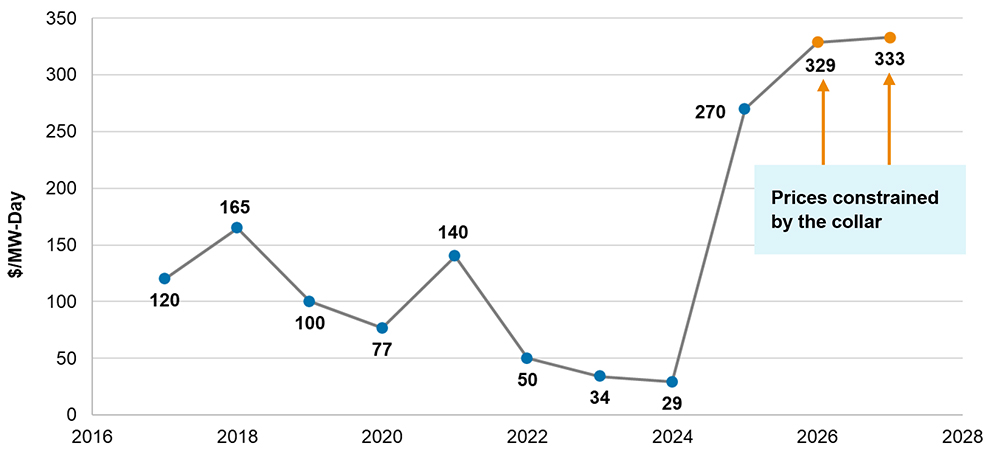
Price trends in PJM’s capacity market | Charles River Associates
“They’re still middle of the pack today, but they were like 47th two or three years ago, [and] they didn’t love the idea that West Virginia rates are increasing, second only to California,” she added.
REAL’s model legislation would open 20% of overall load to competition, and consumers would need demand of 1 MW to participate, though C&I facilities with smaller loads could use aggregation of multiple sites to get into the market, Foster said.
“That 20% makes it so that there’s still enough that needs to be built by the utilities; it’s just removing the amount that they have to build that’s new rather than placing costs on the customers who aren’t shopping,” Foster said. “And of course, the customers who are shopping still pay all of the other costs — so transmission, distribution, energy efficiency and low-income programs.” Only the generation part of their bill would go to whatever third-party company they sign up with.
Some states already have a capped level of shopping, and while their experiences varied, often they started to restructure but stopped short. Michigan put a cap of 10% on its market, and it quickly filled up, which meant the market took on the burden of supplying that demand.
“They never had to build what’s the equivalent of seven or eight natural gas plants,” Foster said. “They never had to bill the rest of the ratepayers to build those gas plants to serve those customers, plus their guaranteed rate of return.”
Michigan-headquartered General Motors would like to see a version of that state’s system extended into Missouri, where it employs 4,500 workers, via House Bill 417, the Electric Choice and Competition Law.
“We have invested more than $1.5 billion in our facilities and generated thousands of jobs for related suppliers, contributing to significant baseload demand,” GM Global Energy Strategy Director Rob Threlkeld wrote legislators in a letter in March 2025. “As electricity costs continue to rise, GM supports legislation that ensures reliable and affordable electricity for our operations. HB 417 will assist industrial customers in managing their anticipated rising energy costs.”
Utilities in PJM Want Back in Generation Game
While REAL has been pushing to crack open retail power markets in states that have never opened up, some utilities in PJM have been asking states like Maryland and Pennsylvania to let them rate-base new power plants to help close the widening gap on resource adequacy there.
Exelon hired Charles River Associates to produce a report that argues allowing it and other utilities in PJM to build generation could save consumers $9.6 billion to $20 billion in the 2028/29 delivery year.
“Customers are understandably frustrated about high energy costs, and public utility companies are ready to help bring them under control with utility-generated power such as battery storage or community solar,” Exelon Chief Legal Officer Colette Honorable said in a statement. “Utility-generated power will ensure we have enough electricity to meet skyrocketing demand, address affordability and make sure customers come first.”
Exelon said its report is especially relevant for states like Maryland, where rapid load growth and constrained supply are intensifying affordability and reliability challenges.
While the restructured states in PJM have banned their utilities from building generation in rate base since those laws went into effect in the 1990s, Exelon does not want the change to spark the unwinding of the markets, arguing that any generation it builds can work alongside them. Only some of the states in PJM have fully restructured; West Virginia is fully regulated; and Virginia has a hybrid system with utility-owned generation. Units from those states have operated in the RTO’s markets for years, competing with IPPs.
Advocates of competition argue that letting utilities into the generation business could risk an overbuild of generation, as putting the facilities in rate base guarantees cost recovery regardless, while the IPP model places such risks on the generation firm’s shareholders.
“In restructured states, IPP developers do not have an obligation to build,” Exelon Director of Federal Regulatory Affairs Jordan Kwok said. “And, because they may elect not to build for whatever reason, customers may be left with inadequate generation supply and the ensuing reduction in reliability. Put another way, in a competitive framework, IPPs bear the risk of their actions, but customers bear the risk of IPP inaction. Utility-generated power solves for this risk by fostering certainty and providing a tool for our regulators to fall back on if the market is underdelivering.”
Industry Experts Split on the Issue
Mark Christie, director of William & Mary Law School’s Center for Energy Law and Policy, said in a recent interview that there are no perfect regulatory structures, but the ultimate goal of any has to be delivering reliable power at the least cost to the consumer.
“Whether new generation is financed through rate-basing by load-serving utilities, or through capacity payments to bidders in the PJM capacity market, consumers will still be paying the bill for the new generation,” the former FERC chair said. “So, the line we have heard for 30 years that using the capacity market alone puts the burden on investors to pay for new generation, not consumers, is misleading at best. Consumers pay for capacity payments in their power bills, just as they pay for rate-based generation.”
Christie said that Virginia has a good regulatory model, with its hybrid system where utilities can rate-base power plants and IPPs can build competitive power plants. It is also one of the states that serves a model for REAL’s preferred policy with a cap on shopping that lets some C&I customers pick their supplier.
“When I was a Virginia regulator, we approved at least five combined-cycle gas generators for our utilities,” Christie said. “All were rate-based, all were built, and none of them would have been built without rate-based financing. And we approved continued rate-based financing, including life extensions, for Dominion’s nuclear units. All of these dispatchable generators have been critically important to keeping the lights on in Virginia and PJM, and without rate-based financing, we would not have gotten them built.”
The debates around which way states should go are coming back up now in PJM because its capacity market has seen prices shoot up, and in its most recent auction, it cleared short of the RTO’s reliability target.
“I think the big picture is that the PJM capacity market is simply not obtaining enough generation,” Christie said. “We know that for an absolute fact.”
Former Pennsylvania Public Utility Commissioner John Hanger served when the state passed its restructuring law. Since then he has written reports as a consultant arguing the policy is best for customers, pointing to offers in PECO Energy’s Philadelphia area territory and Duquesne Light Co.’s Pittsburgh territory that are cheaper in nominal dollars than the utility rates in 1996, when the restructuring law passed.
“It is truly stunning,” Hanger said in an interview. “That is a testament to how bad rate-based, rate-of-return regulation worked in Pennsylvania, especially in the Duquesne Light and PECO service territories, and also the success of competitive generation markets.”
While other restructured states, like Maryland and New York, have restricted the market for residential customers, Hanger said that retail competition works well for large customers, in every jurisdiction.
“If legislators in Missouri want to drive down their costs for their commercial/industrial customers, they should allow these customers to shop for electricity and introduce generation competition,” he added. “And they should do it with a sensible transition plan, but they should do it as soon as possible.”
Letting utilities back into the generation business now, even with the resource adequacy issues in PJM, would not be good, he argued.
“It’s an invitation to waste, fraud and abuse,” Hanger said. “It’s an invitation to boondoggles that the captive ratepayers would have to pay for. I cannot think of an approach to the current concerns that is more likely to blow up in the face of any legislator or any governor who supported that.”
Affordability concerns drove the initial wave of restructuring in the 1990s, Hanger recalled. Those same concerns have given the utilities an opportunity to push legislation to let them build generation again, he said.
“They use the lack of information amongst the general public on these questions and, frankly, the fact that legislators are generalists who do not specialize in electricity markets or utility regulation to try to pull the wool over the eyes of those legislators,” Hanger said. “They come in with simple stories that are simply wrong.”
The fastest rising part of the end-use customer’s bill in recent years has been what is still regulated: the payments for transmission and distribution infrastructure, Hanger said.
“We are supposed to believe that the two companies that have been shooting up transmission and distribution rates somehow or another are going to produce lower generation rates,” Hanger said. “Give me a break.”