Power plant owners plan to retire 11 GW of utility-scale generation in 2026, most of it from coal plants, according to the EIA’s Preliminary Monthly Electric Generator Inventory.
Most of the scheduled retirements are either coal-fired plants (58%) or steam turbines and simple-cycle natural gas (42%). The largest planned coal retirements planned are the 1,331-MW J.H. Campbell in Michigan and the 1,231-MW Cumberland Unit 2 in Tennessee.
Plans are subject to change due to recent policy shifts delaying retirements. Owners and operators planned to retire 12.3 GW of capacity in 2025 but retired only 4.6 GW following emergency orders from DOE to extend the operations of several coal plants.
The Commerce Department announced tariffs on solar cells and panels imported by companies in India, Indonesia and Laos.
According to the department, it calculated rates of 125.87% on imports from India, 104.38% on imports from Indonesia and 80.67% on imports from Laos. The three nations accounted for $4.5 billion in imports in 2025, about two-thirds of the overall total, according to government trade data.
The Bureau of Land Management approved expansion of the Silver Peak lithium mine in Nevada. The mine is now authorized to operate on 8,058 total acres, including 1,601 public acres.
The expansion allows for the use of new technologies that are expected to increase lithium recovery by up to 100% from the same amount of materials.
The mine has been in operation since 1965 and is currently the only producing lithium mine in the U.S.
The Central Coast Regional Water Board voted 6-0 to approve waste discharge permits for the Diablo Canyon nuclear plant.
The board also granted the plant a certification under the Clean Water Act, which was the last state regulatory hurdle the facility needed to clear before the Nuclear Regulatory Commission could renew its permit through 2045.
Pacific Gas and Electric originally planned to shut down the plant in 2025, but lawmakers extended the deadline by five years in 2022. Now it is likely to run through 2030.
House Approves Bill Preventing GHG Agricultural Lawsuits
The House of Representatives voted 66-24 to prohibit lawsuits stemming from greenhouse gas emissions linked to agricultural operations.
The bill would limit farmers’ and ranchers’ liability in cases alleging an “actual or potential” effect on the climate caused by greenhouse emissions. The House also adopted an amendment that added “petroleum source” to the list of greenhouse emissions described in the bill.
PSC Rejects Investigation into Meta’s Data Center Financing
The Public Service Commission rejected a request from environmental and consumer advocacy groups to investigate Meta’s financing of a data center in Richland Parish.
Meta’s new financial arrangement has left a separate company, Blue Owl, as the majority owner of the data center. As a result of the new structure, the nonprofits argued, various ratepayer protections guaranteed by Meta are now called into question.
The PSC noted it can investigate in the future if new information arises.
District Judge Gershwin Drain ordered DTE Energy and three of its subsidiaries to pay $100 million to the Treasury Department for Clean Air Act violations at the EES Coke Battery on Zug Island.
The facility must come into compliance with the Clean Air Act by submitting new source review permit applications within 250 days, and form a community committee within 120 days and provide it with $20 million for air quality improvement programs. The court also found that DTE saved $70 million by failing to comply with regulation.
NV Energy will reimburse more than 108,000 customers about $63 million following a settlement with the Public Utilities Commission.
Over the past 20 years, NV Energy accidentally misclassified nearly 43,000 multifamily residential customers as single-family residential customers, which overcharged them. The overcharges total around $65 million and date back as far as 2002. The utility must issue refunds within 210 days with all money coming from shareholders.
The North Carolina Court of Appeals determined the Utilities Commission made a mistake in 2024 when it allowed Duke Energy to raise rates based on unrecovered fuel costs from 2022. However, a change in state law in 2025 means customers will not see any refunds based on the error.
The court agreed the commission should not have allowed Duke to pursue the unrecovered costs when rates were set two years later. While the case proceeded through the courts, the General Assembly approved a new law in June 2025 that removed a provision limiting fuel recovery costs to a designated “test period.”
Jury Awards Victims $305M for Santiam Canyon Wildfire
A jury awarded $305 million to 16 survivors of the Santiam Canyon wildfire that burned hundreds of thousands of acres in 2020.
It is the largest jury verdict issued in relation to the James v. PacifiCorp class-action lawsuit, pushing PacifiCorp’s total liability past $1 billion. It is the 15th trial to conclude so far, with another 167 trials scheduled through 2027.
PacifiCorp has appealed the class-action lawsuit. Executives continue to deny liability and point to a 2025 state report that found no evidence connecting PacifiCorp’s equipment to the fire.
Xcel to Replace High-risk Power Poles After Settlement
A district court ordered Xcel Energy to replace damaged power poles in wildfire-prone areas following an agreement with Attorney General Ken Paxton.
Xcel is required to replace all poles with severe structural deterioration located in high wildfire risk areas within 14 days. It also is required to conduct inspections of its infrastructure in high-risk areas and inspect at least 35,000 poles annually. The company must notify the state once replacements are completed.
Paxton called the development the first step toward holding Xcel accountable for the 2024 Smokehouse Creek fire that burned through a million acres of the Panhandle.
Data Center with Gas Plant Planned for Wise County
Officials released plans for a data center complex in Wise County that would be supported by an on-site natural gas plant.
The Wise Innovation Hub would be built in phases over 10 years at the Lonesome Pine Regional Business and Technology Park. Red Post Energy would design the natural gas plant.
The complex’s first 100 MW of gas generation could come online in about three years and eventually scale up to 500 or 600 MW, Red Post CEO Lance Medlin said.
Real Estate Firm to Invest $4B in New Data Center Development
Gov. Patrick Morrisey announced a new “high-impact intelligence center” that is expected to be built in Berkeley County.
Real estate investment and development firm Penzance Management will make a $4 billion investment in the project, which will connect to the grid and is expected to produce 600 MW of “critical IT capacity.” No other information was released.
Form Energy, Xcel Strike Deal to Power Google Data Center
Form Energy has reached a deal with Xcel Energy to build an iron-air battery storage plant in Minnesota that will supply a Google data center.
Xcel will install 300 MW of Form’s batteries, which will dispatch energy for up to 100 straight hours, in Pine Island, Minn. The facility is part of a larger agreement that will see Google pay Xcel to build 1.4 GW of wind and 200 MW of solar.
Form Energy expects to deliver the batteries to Xcel in 2028.
Plug Power has officially abandoned its plans for a hydrogen plant in Genesee County, N.Y.
Instead, Plug Power will sell its property at the STAMP site to developer Stream Data Centers for between $132.5 million and $142 million. Stream Data Centers is looking to build an $11.81 billion, 2.2 million-square-foot data center campus across three buildings at the site.
According to the agreement, the sale must close no later than June 30.
U.S. renewable energy developer and operator Arevon Energy appointed COO Justin Johnson as interim CEO, effective Feb. 20.
Johnson will continue to serve as COO while assuming the additional responsibilities of interim CEO, the company said. Former CEO Kevin Smith resigned Feb. 20.
NYISO exceeded its winter baseline peak load forecast on Feb. 7 with 24,317 MW, COO Emilie Nelson told the Management Committee on Feb. 25.
The baseline forecast was 24,200 MW. From Jan. 25 to 30, load ranged from 23,417 to 24,177 MW. Demand response contributed “several hundred” megawatts of net load relief, Nelson said, with NYISO calling on its DR programs six times in January and two more times in February. “This is an unprecedented level for the winter.”
Wind performed “as expected” during the month. Roughly 2.4% of wind generation was curtailed during January. Solar always performs worse in winter but basically was unavailable for the worst of the month. Nelson pointed to Jan. 25, the start of Winter Storm Fern, when snow and heavy cloud cover began blanketing most of the state.
“Solar drops down entirely,” Nelson said. “You had a significant snowstorm and then it stayed cold, so you had snow on panels, and you did not get behind-the-meter solar generation.”
The peak of winter consumption occurs in the early evening, which she said made the issue even worse. Without solar to blunt it during the day, fuel demand remained high both on- and off-peak, straining resources.
“So much of managing a winter event is managing scarce energy,” Nelson said. “The fact that you have less solar production during the day with snow on panels makes managing those liquid fuels and scarce energy that much more important and challenging.”
She segued into a discussion of unavailable resources in the day-ahead market during the same period. Fuel shortages, inclement weather and difficult travel conditions forced many dual-fuel units offline. (See NYISO Recounts Challenges During January.) This continued into early February, Nelson said.
“You can see some pretty high numbers here, ranging from about 1,000 MW to up to 2,000 MW on a daily basis throughout,” she said.
Kevin Lang, representing New York City, asked whether this was comparable to prior winter storms. Nelson said it was about the same.
“If what we’re seeing is consistent with prior storms, that actually is good news that we’re not seeing a falloff in production or performance,” Lang said.
Aaron Markham, vice president of operations for NYISO, said that while it was broadly “good” news, it still was challenging to manage the high number of forced outages in the real-time and day-ahead markets.
Another stakeholder said that while the number of forced outages might be roughly on par with what was seen before, it is important to remember that New York had fewer resources overall to call on, which made system conditions more stressful.
“I want to highlight the extraordinary efforts that were taken this time to keep units running, things like climbing up and knocking ice off fans in sub-zero weather,” said Doreen Saia, a lawyer from the Greenberg Traurig law firm representing generation interests. “I think we need to be careful. … It was a significant test for the system.” She said she didn’t want anyone to walk away from the meeting thinking things were fine.
Another stakeholder pointed out that external control areas actually received roughly 1,000 MW of exports from NYISO.
“I think it’s time we review how generous we can be under these cold snap conditions,” they said. “It’s a mess. We can’t have all these alerts and no major emergencies. That tells me something is going on.”
Stakeholders requested the ISO identify which zones the outages were concentrated in and what the causes of the outages were. Nelson said Markham plans to cover the causes of the outages in his upcoming incident report.
Nelson said NYISO does not plan to identify where these outages occurred. Other stakeholders asked whether the ISO could present the data in an anonymous form so they could understand the outages better.
Another stakeholder asked whether the ISO could highlight which system conditions were causing wind curtailments during the periods of high demand. They said it would be helpful for identifying necessary system upgrades.
ERCOT says it plans to use a third workshop to inform the discussion with stakeholders on the Dispatchable Reliability Reserve Service, which faces a June deadline to be brought before the Board of Directors.
The DRRS product, now in its third iteration since being mandated by Texas law in 2023, requires resources providing the service to be capable of running for at least four hours at their high sustained limit (HSL); to be online and dispatchable not more than two hours after being deployed; have the flexibility to address inter-hour operational challenges; and reduce the amount of reliability unit commitment by the amount of DRRS procured.
Keith Collins, ERCOT’s vice president of commercial operations, told the Technical Advisory Committee on Feb. 25 that staff’s position is to get more information on the product’s four-hour capability at HSL during the upcoming DRRS workshop March 9. HSL is the maximum, non-curtailed, five-minute sustained energy output capacity a generator can produce, updated in real time by qualified scheduling entities.
“It’s come up a few times in the workshops related to how to consider the four-hour capability at HSL and how to consider that element,” Collins said.
ERCOT has filed two protocol changes and two related changes to the Nodal Operating Guide to make DRRS a reality. The first (NPRR1309) would meet all statutory criteria while also allowing online resources to participate. It would enable the product to be awarded in real time and would co-optimize its procurement with that of energy and other ancillary services under the new Real-Time Co-optimization market tool.
NPRR1309 has been granted urgent status and is due before the board for its June meeting.
The second protocol change (NPRR1310) has not been accorded urgent status. It would add energy storage resources as DRRS participants and a release factor so the product can support resource adequacy.
NPRR1310 “can be addressed as part of the market design elements of the reliability assessment later this year,” Collins said, referring to the biennial Grid Reliability and Resiliency Assessment, which is required by state law.
TAC members also discussed a Feb. 23 ERCOT market notice that directed transmission service providers within West Texas counties to include a no-solar scenario as part of their large load interconnection studies. ERCOT has identified an emerging reliability risk of local load shed in the region during low-wind conditions at night, especially during transmission and thermal resource outages.
ADER Pilot Expands
ERCOT staff updated TAC members on the Aggregate Distributed Energy Resource (ADER) pilot project, saying seven resources are fully participating in the program, providing 193 MW of energy and ancillary services as of February.
Staff have also accepted six additional ADERs that are in various stages of registration and qualification but cannot yet participate.
“The good news story is that the ADER pilot is growing, and it’s been growing significantly, particularly toward the second half of last year into this year,” said Ryan King, manager of market design. Existing QSEs expanding under a developed business model that meets telemetry requirements account for much of the growth, he said.
The seven ADERs offer 107.7 MW capability for energy, 35.4 MW capability for non-spinning reserve service and 49.9 MW capability for ERCOT Contingency Reserve Service. The total ADER qualified and potential capacities are 121.4 MW, 35.4 MW and 49.9 MW, respectively.
King said concerns remain within ERCOT that the pilot is moving too far and too fast on ancillary service limits. Those limits are necessary to manage system impacts and the ability of staff and resources to support the pilot, he said.
The program’s governing documents allow ERCOT to increase limits as needed. It plans to increase the registered capacity limit from 200 MW to 500 MW and the QSE limit from 20 to 90%. The AS service limits will remain the same.
King promised further updates in the second quarter on plans to move the pilot into the protocols.
Members Praise Departing Maggio
TAC members heaped praise on Dave Maggio, director of market design and analytics, who is leaving ERCOT after 19 years for a position with Energy and Environmental Economics.
Among those offering plaudits was former ERCOT COO Kenan Ögelman, now vice president of strategic projects and optimization at the Lower Colorado River Authority.
“The words that come to mind are ‘intelligence,’ ‘industriousness,’ ‘calm,’ ‘compassion’ and — the one I know for sure I don’t have in bunches — ‘structured.’ You’re so good at putting everything together and moving things along,” he said.
“I’ve always appreciated just how talented you are at taking very complex and technical matters,” Vistra’s Ned Bonskowski said. “You’ve always been very good about engaging directly on the level and helping break it down in ways that all the different stakeholders can engage with, identifying what the real concerns are and finding solutions that help make consensus happen. … That’s something that I think all of us as stakeholders will need to embody, and in the Dave Maggio spirit.”
“The way you deal with issues is unique and just a rare skill set of exceptional knowledge on subject matter. … You will be missed greatly,” Reliant Energy Retail Services’ Bill Barnes said.
Speaking remotely by phone, Maggio said he was “overwhelmed with all the kind words” and that it was an honor to work at ERCOT.
“Not just for ERCOT the company, but with ERCOT the market and ERCOT the stakeholders,” he said. “I’m very grateful to you all. I’m proud of the work we’ve done together over the last almost two decades. Perhaps I’ll have an opportunity to work with you all again in another capacity.”
Maggio’s last day at ERCOT is March 12.
LLWG Leadership Retained
Longhorn Power’s Bob Wittmeyer, chair of the Large Load Working Group, asked that TAC’s approval of the stakeholder group’s leadership be placed on the combination ballot as evidence of his “bigger idiot theory.”
“We did poll the [LLWG] for stupid volunteers, and we have the same idiots we had last time,” he cracked. “However, I would be OK if someone said this was a really bad idea and had a bigger idiot.”
Unfortunately for Wittmeyer and ERCOT’s Patrick Gravois, vice chair, there were no takers, and both retained their positions unanimously.
The combo ballot also included Pedernales Electric Cooperative staffer Eric Blakey’s nomination as vice chair of the Protocol Revision Subcommittee and singular revision requests for the protocols, the Operating (NOGRR) and Planning (PGRR) guides, and the Verifiable Cost Manual (VCMRR) that, if requiring board approval, will:
NPRR1314, PGRR139: Relocate each term and acronym from Planning Guide section 2: Definitions and Acronyms to the protocols and align related defined acronym usage. The NPRR also eliminates the abbreviations for “Current Year” and “Future Year” to avoid future confusion.
NOGRR281: Modify when an approved mitigation plan can be executed.
VCMRR047: Remove the association between the term “long-term service agreement” and the abbreviations “LTSA,” which represents “Long-term System Assessment” in the Planning Guide.
NERC and the regional entities had reduced their backlog of compliance cases by almost 50% by the end of 2025, the ERO said in the annual report of its Organization Registration and Certification Program and Compliance Monitoring and Enforcement Program.
The ERO Enterprise had 2,601 open violations at the end of 2025, according to the report, down from the 2,996 at the end of 2024, as reported in the 2024 ORCP and CMEP annual report. More than 80% of open cases were first reported within the past three years, NERC said; by contrast, 92% of the open cases at the end of 2024 were fewer than three years old.
The annual ORCP and CMEP report is intended to help NERC and the REs track their progress achieving goals across the four focus areas identified in the ERO’s long-term strategy:
Energy: Help stakeholders and policymakers address existing risks to grid reliability and prepare for emerging risks.
Security: Enhance the security posture of the industry through existing cyber and physical security programs.
Engagement: Ensure stakeholders and policymakers have access to accurate and trustworthy information from the ERO Enterprise.
Agility and sustainability: Coordinate team activities effectively while delivering value for stakeholders and capturing cost efficiencies when practical.
NERC wrote in the report that 1,054 of its open violations at the end of 2025 were reported the same year. This represents a slight decline from the previous year, when 1,162 of the open violations at year’s end were reported in 2024, but it does not include the violations that were processed the same year, which represented 38% of the total in 2025. The previous year’s report did not include this figure.
NERC’s Critical Infrastructure Protection standards once again accounted for the largest number of violations reported to the ERO in 2025. The most-reported standard was CIP-010-4 (Cybersecurity — configuration change management and vulnerability assessments), with 245 violation reports received — more than the top three most-reported operations and planning (O&P) standards combined.
CIP standards also were the top three most represented standards for moderate-risk violations, with 40 infringements reported for CIP-007-6 (Cybersecurity — system security management), 20 for CIP-010-4 and 17 for CIP-003-8 (Cybersecurity — security management controls). On the other hand, the only three serious-risk violations reported in 2025 concerned the O&P standards IRO-001-4 (Reliability coordination — responsibilities), PRC-023-6 (Transmission relay loadability) and TOP-001-6 (Transmission operations).
The report also provided an update on NERC’s processing of minimal-risk violations, which the ERO identified as a key performance metric in a June 2025 filing following up on its five-year performance assessment. (See NERC Details Performance Metrics in FERC Filing.)
NERC wrote that it and the REs have worked to improve processing efficiency by streamlining the reporting template for compliance exceptions (CEs) — which allow minimal-risk violations to be processed without penalty and without affecting future violation penalties — along with updating the registered entity self-report and mitigation plan user guide and training.
About 83% of noncompliance reports processed in 2025 were handled as CEs, NERC wrote, with another 14% disposed under the Find, Fix, Track and Report (FFT) program, another option for addressing minimal-risk violations. Like the CE program, FFT requires registered entities to mitigate the noncompliance and make the facts and circumstances of the incident available for review by NERC and appropriate governmental authorities.
Of the remaining violations processed in 2025, 35 were covered by NERC’s monthly spreadsheet notice of penalty and 23 in a notice of penalty. In all, NERC processed 1,945 violations in 2025, 281 more than the year before.
The state authority managing New York’s clean-energy transition has estimated one part of complying with the state’s landmark climate law could carry a gross impact of more than $4,000 per year per household in some cases.
The details in a memorandum provide new fuel for arguments that New York is doing too much to help save the planet or it is not doing enough and trying to justify doing less. Advocates on both sides of the debate latched onto the memo as evidence of their point.
The New York State Energy Research and Development Authority (NYSERDA) operates at the direction of Gov. Kathy Hochul, a moderate Democrat who has pivoted her focus to affordability as she seeks support for re-election from more liberal downstate and conservative upstate regions.
On Feb. 26, NYSERDA President Doreen Harris sent Hochul’s director of state operations an estimate of near-term costs of implementing a cap-and-invest system to help reach the emissions-reduction mandate of the 2019 Climate Leadership and Community Protection Act (CLCPA). It calculates that by 2031, upstate households burning oil or natural gas and operating two vehicles would see more than $4,100 a year in new costs.
After that detail, the memo notes that cap-and-invest’s affordability benefits for moderate-income New Yorkers would reduce the annual impact to about $2,500, and those who upgrade fossil fuel equipment would be expected to see an even smaller impact, or possibly a net benefit.
It calculates charges of $2.23/gallon of gasoline and comparable charges for other fossil fuels because of carbon emission allowances that would reach nearly $180/ton by 2031 under the cap-and-invest blueprint that was prepared but which Hochul has refused to implement. (See NY Defers Action on Controversial Cap-and-invest.)
The calculations in the Feb. 26 memo were not announced in a news release, but NYSERDA provided the memo to journalists who requested it.
It opened a new chapter in the long-running argument over when and how decarbonization will produce results, and at what cost — a particularly fraught debate as energy prices rise faster than inflation in a state with above-average fuel prices and some of the most expensive electricity in the nation.
Critics pounced on the memo from both sides.
State Sen. Mario Mattera, the ranking Republican on the Senate Energy and Telecommunications Committee, said March 2, “As New Yorkers continue to discover the true cost of Albany Democrats’ energy mandates, which a NYSERDA memo last week clearly outlined, it is time for New York to face reality and help its residents. [The Senate’s Republican minority] has repeatedly raised the alarm that the illogical mandates of the CLCPA are costing New York families and businesses billions.”
But New York League of Conservation Voters President Julie Tighe said the NYSERDA analysis was flawed because it factored in the most aggressive implementation of the program but not the counterbalancing cost controls and consumer rebates, or the health and societal benefits that cleaner air would provide.
She called the memo a negotiating tactic during the contentious talks shaping the state budget due March 31, and said: “Building a green economy and protecting New Yorkers’ wallets are not at odds with each other. New York has both a legal mandate and a moral responsibility to cut pollution, and that is exactly what cap-and-invest will achieve.”
In the memo, Harris said NYSERDA’s estimate is not a worst-case scenario but a conservative one, adding it may be an underestimate because it does not reflect the “hostile and disruptive” actions of the federal government. Beyond that, she said, the acceleration of clean-energy deployment needed to achieve the CLCPA’s goals is infeasible.
Despite highly supportive policy stances by Hochul and her predecessor, Andrew Cuomo (D), New York remains a slow and expensive place to develop energy generation and transmission.
After a decade of development and billions of dollars in public subsidies, New York received only 23.6% of its electricity from renewables in 2024, less than in 2014. (See N.Y. Reports Minimal Increase in Renewable Power.)
Development is expected to get more expensive as Trump administration policies begin to impact renewables. Renewable energy skeptics say it’s time for New York to step back; advocates say it is time for New York to double down; and the governor or her aides say it is time for New York to be flexible with the CLCPA’s timeline and goals.
Drafted a month before the budget deadline and released to the media, the NYSERDA memo could be viewed as what Tighe called it: a step in the bargaining process; an appeal to New Yorkers already worried about their utility bills. (See Electricity Rates are the Political Livewire Threatening the Industry.)
The memo flags several requirements of the CLCPA as expensive and/or difficult to comply with. Among them is Global Warming Potential 20 (GWP20), a mandate to consider the effect of emissions over a 20-year period. That is more stringent and expensive than GWP100, the one-century standard adopted by the Paris Agreement of 2015.
It is one more factor boosting the cost of implementing the CLCPA, which the memo reminds readers was enacted before the COVID-19 pandemic and its supply chain constraints, the return of inflation, increased geopolitical turmoil and the re-election of President Donald Trump.
Hochul unsuccessfully attempted to engineer a switch from GWP20 to GWP100 during budget talks in early 2023, when New York’s renewable pipeline was full and Washington was offering piles of money to support it.
In its December 2025 update to the State Energy Plan, a panel consisting mostly of Hochul appointees took the pragmatic path of preserving the clean energy vision of the CLCPA while also preparing for delays in achieving it. (See N.Y. Embraces All of the Above in Energy Strategy Update.)
The conversation during a five-hour meeting on changes to NYISO’s transmission planning processes became heated at times, as stakeholders challenged ISO officials on exactly how they will develop the possible scenarios they propose to use to determine reliability needs.
The joint meeting of the Installed Capacity Working Group and Transmission Planning Advisory Subcommittee on Feb. 26 originally was budgeted for only three hours, but it took up the entire morning and ran into the afternoon. More than 100 stakeholders joined the meeting by phone.
NYISO has argued that it needs multiple scenarios in its Reliability Planning Process and Short-Term Reliability Process to take uncertain future grid conditions into account. The ISO would identify needs based only on “significant and persistent” violations of reliability criteria across more than one scenario. This would avoid overbuilding the grid as well as prematurely identifying needs, NYISO argues. (See NYISO Seeks to Avoid ‘Flip-flopping’ in Revised Planning Process.)
The ISO is trying to roll out the changes before the next Reliability Needs Assessment, a timeline that requires submitting tariff revisions with FERC by summer.
Under the proposal, NYISO first would review its baseline assumptions and those for scenario development with the Electric System Planning Working Group. After conducting its analyses based on the group’s feedback, the ISO would review the recommended scenarios with the ESPWG and TPAS, initiating a 15-day comment period. The ISO then would issue a draft of the RNA for stakeholder feedback at two additional ESPWG/TPAS meetings.
The final draft RNA would need approval from the Operating and Management committees before going before the Board of Directors.
Chris Casey, an attorney representing the Natural Resources Defense Council, retorted that if the ISO had unlimited discretion to create scenarios, then they could be just as conservative, propagating similar problems across them. He said he did not see any guardrails to prevent this from occurring.
Stu Caplan, representing the New York Transmission Owners, asked about the timing of the meetings, saying he was concerned that there needed to be ample time for stakeholder feedback. He said this was particularly true for transmission owners because of their reliability obligations under state law.
“If there are multiple scenarios where elements from different scenarios contribute to common reliability, but if those elements are not correlated or likely to be coincident, then there’d be a need to provide feedback before the ISO is in a situation where it must rush to get the RNA to the Operating Committee,” Caplan said.
Zach Smith, vice president of system and resource planning, replied that the second feedback meeting was the time for stakeholders to issue support or opposition or comment on specific reliability scenarios.
“Only after weighing all that feedback would we finalize the RNA scenarios for use in the remaining analysis,” Smith said.
Mike Mager, a lawyer from Couch White representing large industrial customers, asked whether there would be a formal vote on the planning scenarios, echoing a request from earlier meetings. Smith said there is not one in the current proposal.
“We’re seeking to create a balance with the … comment period that serves to provide in a very clear and open and transparent matter the feedback everyone would have without taking that one extra step of having a formalized vote that may stand in the way of us conducting this process,” Smith said.
“This stakeholder feedback process is good; it’s absolutely what I expect from NYISO as a bare minimum,” Casey said. “I don’t consider it anywhere near sufficient. I am looking for methodological guardrails that bound scenario development and define and bound ‘significant and persistent.’”
According to its presentation, “in determining the influence of a trend or group of trends on potential scenarios, … NYISO will consider the likelihood that a trend or grouping of trends will occur in the study period; the diversity of scenarios; and the interdependence of the underlying assumptions of the scenarios.”
But multiple stakeholders had concerns about how NYISO develops plausible scenarios.
“On whether NYISO will consider the likelihood [of scenarios], I get that [the proposal] says ‘will,’ but the key word there is actually ‘consider,’” said Michael Lenoff, representing Earthjustice. “So yes, NYISO will consider, but it’s not bound by anything.”
Lenoff said any bounds on NYISO should be in the tariff because the ISO already has included what he called an implausible scenario in its Q3 2025 Short Term Assessment of Reliability report, in which the Champlain Hudson Power Express was assumed to miss its operation date.
“I think it should be that NYISO ‘shall not’ select a scenario as actionable unless it is reasonably plausible, or something like that,” Lenoff said.
A transmission planner with Consolidated Edison also noted the CHPE assumption as evidence of the need for binding rules on NYISO in the process.
Doreen Saia, a Greenberg Traurig attorney representing generation interests, said she was concerned about setting too many parameters in the tariff because it could create inflexibility. She said the current issues, such as large loads from data centers and political instability, would not have been predicted a decade ago. She urged the ISO to try to capture this in the manuals, which are easier to change than the tariff.
Saia also pointed out that the current process provides for stakeholder “discussion and action” at the MC and OC but that approval is not required. The ISO could produce a similar mechanism where stakeholders vote to indicate where they land on different scenarios. This would give the board a sense of how comfortable market participants were with the process, she said.
“It’s not perfect, but at least it provides a little more grounding on what can go forward,” Saia said. “At the end of the day, even the current tariff does not have a provision that allows market participants to stop an RNA in its tracks.”
Tony Abate, representing the New York Power Authority, said he wasn’t sure how productive it was to get so stuck on the wording of the tariff without considering whether the process actually is sufficient to meet reliability needs.
“We need some time to go through this,” Abate said. “The TOs are still thinking this through. There’s some serious technical considerations.”
“I just want to understand why there is seemingly more concern about … using conservative assumptions in the base case than using multiple scenarios,” Casey said. “I am lost by NYISO maintaining the base case as it is now and then creating as many scenarios as it wants with pretty unlimited discretion. Doesn’t that pose the exact problem you’re articulating?”
“That’s exactly the reason why we put in a lot of thought about how to build scenarios and how to take into account reliability needs,” said Yachi Lin, NYISO director of system planning.
FERC has approved NorthWestern’s acquisition of Puget Sound Energy’s shares in the coal-fired Colstrip power plant in Montana and authorized NorthWestern to sell electricity produced by the plant.
FERC issued two orders Feb. 27 related to the company’s acquisition of shares in Colstrip (ER26-129 and ER26-411). Both orders concern NorthWestern’s subsidiary NorthWestern Colstrip, which was created to hold ownership in the coal-fired generation asset, according to FERC.
In the first order, FERC accepted NorthWestern’s cost-based rate (CBR) tariff for short-term sales of electricity produced by its share of the plant. In the second order, the commission approved a power purchase and sale agreement between NorthWestern and Mercuria Energy America.
FERC said both filings were “just and reasonable and not unduly discriminatory or preferential.” The orders are effective Jan. 1, 2026.
NorthWestern reached an agreement in 2024 to acquire PSE’s 370-MW stake in two units of the Colstrip power plant effective Jan. 1, 2026. The deal came about after PSE was forced to exit the plant because of Washington state law.
NorthWestern also has acquired Avista’s 222-MW share in the plant, giving the company 55% ownership, according to NorthWestern’s website.
The transaction received backlash from Montana Public Service Commissioners and the Montana Environmental Information Center. The opponents argued in filings with FERC that NorthWestern failed to receive authorization for the agreement under Section 203 of the Federal Power Act.
The opponents said there is a risk that “generation from the Colstrip station will be contracted to a large load customer and will not benefit the people and small businesses of Montana,” according to the orders.
FERC rejected those arguments, saying the FPA requires prior authorization only for transactions valued at more than $10 million.
NorthWestern acquired PSE’s shares in the power plant “at a transaction price of $0. Therefore, this transfer is under the $10 million threshold required for commission jurisdiction under Section 203,” the orders stated.
Montana Gov. Greg Gianforte (R) supported the deal, saying the plant is “essential” to “maintaining reliability during winter conditions, stabilizing the regional grid and keeping energy affordable for Montana families, farmers and employers,” according to the orders.
According to the CBR filing, NorthWestern is negotiating various deals and made the filing to ensure it has the authority to make any short-term sales while committing to filing any long-term sale agreements with the commission.
FERC accepted NorthWestern’s proposed maximum demand charges under the CBR:
$11,920/MW-month
$2,750/MW-week
$390/MW-day
$16.30/MWh
The order states that all services agreements should be governed under the terms and conditions of the Western Systems Power Pool agreement.
Meanwhile, NorthWestern’s agreement with Mercuria Energy provides for the sale of long-term capacity and energy from the power plant. NorthWestern is responsible for all “interconnection and transmission arrangements, electric losses and necessary costs to deliver energy, capacity and ancillary services to the point of delivery,” according to the order.
FERC found the agreement’s proposed capacity and energy rates “just and reasonable” because they fall below the ceiling demand charge in the associated CBR tariff, the order stated.
BOULDER, Colo. — Conversations remained cordial despite the ongoing competition between CAISO and SPP in the West as the RTOs’ top executives took the stage at Yes Energy’s annual EMPOWER conference.
RTO Insider’s Robert Mullin moderated a panel in which Elliot Mainzer of CAISO and Lanny Nickell of SPP emphasized the importance of cooperation and friendly competition while making their pitches for their respective Western markets.
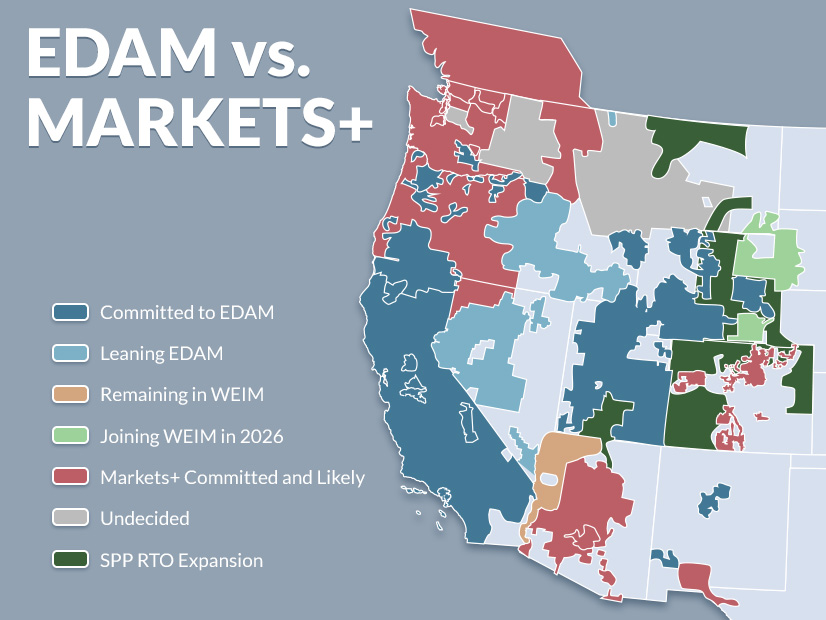
CAISO is preparing to launch its Extended Day-Ahead Market (EDAM) in May, while SPP plans to roll out Markets+ — which includes day-ahead and real-time market components — in October 2027.
Over the past few years, the competing markets have fought to sign up participants across the West. CAISO plans to go live with EDAM in May with the participation of PacifiCorp, with Portland General Electric to join in the fall. SPP also has several major commitments, headlined by the Bonneville Power Administration’s decision in May 2025 to join Markets+. (See BPA Chooses Markets+ over EDAM.)
Mainzer clearly was disappointed with BPA’s choice. He was BPA administrator and had worked there for 18 years before moving to CAISO in 2020.
Regardless of the choices of individual entities, CAISO and SPP “continue to motivate each other to get better,” Nickell said. “If one of us goes away, the motivation to improve isn’t as great.”
Mainzer and Nickell emphasized those potential cost savings associated with the adoption of day-ahead markets in the West.
Mainzer said the success of the Western Energy Imbalance Market (WEIM), launched by CAISO in 2014, gave participants confidence in the possibilities of regionwide markets.
“Now we’re seeing this second chapter,” he said, with participants realizing “we’re leaving money on the table now in the day-ahead.”
In SPP’s eastern RTO territory, Nickell said the wholesale markets provided about $10 billion in adjusted production cost savings over the past five years.
The launch of organized day-ahead markets in the West will “allow the provision of energy in a much more affordable way because we will have access to resources across a much broader region, and we’ll be able to commit those on a day-ahead basis, which will ensure a much higher degree of reliability,” he added.
The CEOs’ perspectives differed regarding potential issues associated with the seams between the market areas, reflecting ongoing debates about the benefits of the two markets.
“When you look at that map and look at the Swiss cheese that’s opening up in the West, that’s going to be challenging to deal with,” Mainzer said. While seams agreements can help mitigate issues, seamless market footprints provide the greatest reliability value, he added. (See FERC Report Urges West to Address Looming Market Seams Issues.)
As the lines between markets harden, “I don’t think any seams agreement or combination of seams agreements is going to be able to fully restore the loss of efficiency that we’re going to get from breaking apart [WEIM] and having multiple market operators,” he said. “We’ll work hard to do it, but it is a point of departure.”
Nickell expressed more optimism about the potential for productive seams agreements and said the only way to truly eliminate all seams is through the creation of a regionwide RTO.
“Seams exist all over the West today, and they’re still going to exist … there’s still going to be balancing authorities, there’s still going to be transmission owners and providers operating their own tariffs,” he said. “We’re simply operating markets.”
“Our job is to work together to try to optimize the exchange of energy, not only within the market but across the two markets,” he added. “I think we can optimize those seams in a way that assures that energy is produced, it’s accessed and it’s delivered in a much more reliable way.”
Governance Structures
Trust in SPP’s governance structure has been a key factor for entities deciding to join Markets+, Nickell said. BPA cited governance as a key qualitative factor in its decision to join Markets+.
Nickell emphasized the importance of developing long-term trust with stakeholders, saying trust is “hard to get and it’s easy to lose, and we’ll do everything we have to maintain that trust that our participants have with us.”
“We’ve operated a highly engaged stakeholder process for decades,” he said. “We’re experienced in doing that, and I think a lot of the Western participants and stakeholders saw that and found it attractive.”
Mainzer said participants joining EDAM have been motivated primarily by economic considerations.
“We’ve tried to really build on the platform of physics and economics… and continue evolving the governance,” he said.
In an effort to address concerns about the influence of California policymakers on EDAM, the state passed legislation in the fall enabling the creation of an independent regional organization to govern WEIM and EDAM. (See Newsom Signs Calif. Pathways Bill into Law.)
When he was CEO of BPA, Mainzer said he knew “as well as anybody” the governance concerns about CAISO’s markets.
“The governance structure for [CAISO] for many years was just not a sustainable structure for true multi-state participation,” he said. “That’s why we spent five years working to get that law passed last year.”
“You’ve done great work — I think it’s awesome that you were able to get those governance reforms in place,” Nickell said to Mainzer.
Asked whether the ultimate goal of Markets+ is to expand SPP’s western RTO footprint, Nickell said it’s possible SPP will continue to expand its RTO operations in the West but emphasized that “you can’t force somebody into an RTO — that’s a voluntary construct.”
“It takes time and it takes people getting comfortable with that approach,” he said.
SPP’s western RTO expansion is to take effect April 1 when it incorporates utilities in Arizona, Colorado, Utah and Wyoming.
Mainzer framed the developments in the West as a process of natural evolution that started with the implementation of real-time markets and has moved gradually toward the addition of components that can add value for the region.
“I think both our constituencies have tended to prefer this matchbox slogan of ‘evolution, not revolution,’” he said, adding that the West can benefit from best practices and lessons learned from existing markets across the country.
He emphasized the importance of maintaining local responsibility for resource adequacy planning and generation development as the markets grow.
“You are going to see a ton of change and continued evolution, but we get the chance to do it with steps and features that we think really produce value with less downside,” he said.