The Department of Energy announced it is seeking states interested in housing regional hubs that could support several parts of the nuclear fuel cycle. That includes fuel fabrication, enrichment, reprocessing used nuclear fuel and nuclear waste storage.
“Nuclear Lifecycle Innovation Campuses” are the first step toward establishing federal-state partnerships centered on building an end-to-end nuclear energy strategy for the country, the DOE said. The Trump administration wants to quadruple the production of nuclear power in the U.S. over the next 25 years, and a permanent repository for the radioactive waste will be needed to achieve that goal.
DOE Requests Input on Advancing AI for Genesis Mission Challenges
The Department of Energy announced a Request for Information to solicit public and private sector input on strategies for meeting the technical challenges of the Genesis Mission. It also seeks input on developing a workforce to advance artificial intelligence in science and engineering.
The Genesis Mission aims to mobilize DOE’s National Laboratories, industry and universities to harness the nation’s capabilities in high performance computing, next-generation quantum computers and AI to revolutionize science innovation.
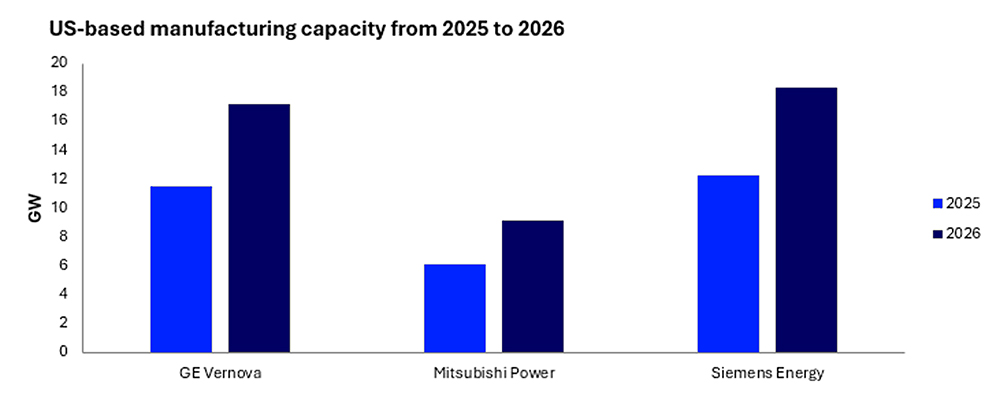
Siemens Energy to Spend $1B Expanding U.S. Turbine, Grid Factories
Siemens Energy committed $1 billion to expand its U.S. manufacturing base as the nation faces surging demand for gas turbines and power grid equipment.
Factories will be expanded in Alabama, Texas, New York and Florida, and Siemens will restart a gas turbine manufacturing plant in North Carolina. In addition, a new factory will be built in Mississippi for manufacturing switchgears.
The company will also partner with Nvidia to build an AI digital grid technologies laboratory in Orlando, Fla. It will use AI to analyze real-world grid data to use existing resources better and to aid in disaster preparation and recovery.
Dominion Energy said the cost of its Coastal Virginia Offshore Wind (CVOW) project will increase by $300 million, according to a filing with the Securities and Exchange Commission.
The company said the increase, up from $11.2 billion to $11.5 billion, is tied to additional estimated costs associated with tariffs and a December 2025 stop-work order by the Trump administration.
Dominion said CVOW will begin delivering power during the first quarter of 2026, with the entire project expected to be completed in early 2027.
Spanish renewables company Zelestra has signed a long-term power purchase agreement with Meta to deliver electricity from its 136-MW Skull Creek solar plant in Texas.
The deal expands on an existing off-take partnership between the companies, which now covers seven solar projects across the U.S. with a combined capacity of nearly 1.2 GW.
All the projects are scheduled to be operational by 2028.
The Public Service Commission approved Entergy’s request to build a new natural gas plant, called Jefferson Power Station, near the White Bluff coal plant.
The plant will cost Entergy around $1.5 billion and will produce 754 MW.
Entergy said while it looks to take the White Bluff coal plant offline by the end of 2028 due to a settlement with the Sierra Club, the new plant will help the company meet increasing demand.
The Public Service Commission released an order approving a rate hike for Southwestern Electric Power Company (SWEPCO).
The increase aims to boost the company’s revenue by $85 million – which equals a bill increase of about $24/month for the average residential customer – to recoup costs for out-of-state wind farms, infrastructure upgrades and upgrades to the Flint Creek coal plant. The upgrades could keep Flint Creek burning coal until 2038. As part of the decision, SWEPCO will also have to release a study modeling the impacts of retiring Flint Creek early in 2030 and 2035.
The Public Utilities Commission approved an expedited list of 1,700 MW of projects for Xcel Energy, hoping to get the projects started before federal tax credits expire.
The PUC approved bids for a 200-MW natural gas plant, 600 MW of wind and 300 MW of battery storage. Some of it would be owned by Xcel Energy and some purchased on long-term contracts. Xcel had proposed a project portfolio totaling 4,900 MW.
An additional 1,000 MW of solar and 700 MW of storage will be needed, PUC Chair Eric Blank said, and the final portfolio will range somewhere between 3,200 MW and 3,500 MW.
Lawmakers Push Bill to Prevent Utility Shutoffs During Extreme Weather
Lawmakers are forming a bipartisan push for a bill that would stop utilities from disconnecting customers during extreme temperatures.
The bills would stop disconnections during temperatures below 32 degrees Fahrenheit and above 95 degrees. Kentucky is one of eight states without disconnection protections.
House Caps Amount of Utility Employee Salaries that Can Come from Ratepayers
The House of Delegates voted to set new limits on the use of ratepayer dollars to pay salaries for employees of investor-owned utilities.
Under the bill, investor-owned utilities can pay their supervisory staff whatever compensation they deem fit, but only a certain amount can be recouped using money from customers. The cap is set around $250,000 annually.
The Public Service Commission approved a 10.37% rate increase for Northern States Power, a subsidiary of Xcel Energy.
Customers were already paying a higher rate in 2026 under an interim rate increase. The average residential customer was paying $11.36 more each month under the interim rate. The final rate increased that by another 58 cents — $11.94 more than before the rate increase request.
Power Siting Board Approves Natural Gas Power Plant
The Power Siting Board approved construction of a 350-MW natural gas-fired power plant in Wood County.
The facility, known as the Apollo Power Generation Facility, will be built and operated by Will-Power OH. The plant will operate “behind the meter,” meaning all electricity will serve the load of an adjacent data center and will not feed into Ohio’s grid. The project will also contain 120 MW of battery storage capacity.
The state’s Clean Heat Standard will not go into effect after the Public Utility Commission officially closed the case following the legislature’s failure to take a required vote.
The legislation would have created a credit marketplace to wean residents off fossil fuels. Lawmakers passed the legislation two years ago over Gov. Phil Scott’s veto; however, the law required another affirmative vote from the legislature before implementation, and lawmakers never voted on the measure.
The House voted 63-33 to pass a bill that would prohibit solar project bans by local communities.
The bills would prevent localities from passing ordinances that outright ban a solar project or have requirements that effectively ban them by limiting them to unsuitable areas. Local governments would have to consider and follow a set of development standards prescribed in the bills.
The Senate’s version of the bill previously passed 21-17. The bills now head to the opposite chamber for final debates.
PJM’s Market Implementation Committee passed by acclamation a PJM issue charge seeking to more thoroughly define how storage resources participate in the energy and ancillary service markets.
Much of the focus was on PJM’s obligation under FERC Order 841 to implement storage state of charge in its energy storage resource rules, as well as how lost opportunity costs (LOCs) are determined. The issue charge was revised after January’s first read spelling out that the LOC discussion should consider how the timing of PJM dispatch interacts with changing prices, emergency conditions and supply/demand balance.
The list of additional items for consideration was expanded to include cost-based energy offers, calculation of uplift, LOC rules for storage participating in energy and ancillary service markets, and whether pumped storage hydro resources should be part of the conversation. It also includes must-offer rules for storage resources with capacity commitments, intraday offers, cost-based offers and resource parameters.
The out-of-scope section includes changes to resource adequacy, performance assessment interval and effective load-carrying capability modeling for storage; surplus interconnection service; storage as a transmission asset; the pumped hydro optimizer; and peak shaving adjustments. A sixth key work activity was added for a possible second phase to explore out-of-scope topics.
The issue charge envisions governing document and manual revisions being drafted within six to nine months, which stakeholders said is an appropriate timeline given the numerous other market redesigns being considered.
Carl Johnson, representing the PJM Public Power Coalition, said it’s important that PJM’s planning and markets departments both be involved in the stakeholder discussion and remain aware of the changes being made. In particular, planning models should account for any changes to how storage resources offer into the energy market.
Constellation Proposes Dual-fuel Quick Fix
Constellation presented a quick fix proposal to revise the must-offer requirement for dual-fuel capacity resources to recognize that dual-fuel gas resources have a downtime when switching fuels. The quick fix process allows an issue charge and problem statement to be brought concurrent with a proposed solution. The proposal is set to be voted on by the MIC at its March 11 meeting.
The proposal would specify that a dual-fuel resource met its must-offer requirement so long as it submits offers including the primary and alternate fuels within “limitations or restrictions resulting from fuel switching time modeling within PJM’s software platforms.” The language would be added to the capacity resource offer rules in Manual 11: Energy & Ancillary Services Market Operations.
Stakeholders said there may be differences in how units switch fuels or in the details of that switching period. They said a broad change that applies to all dual-fuel resources could help avoid the must-offer requirement.
ARR and FTR Timeline
PJM laid out the schedule for the 2026/27 auction revenue rights (ARRs) and financial transmission rights (FTRs) markets. Stage 1A of the annual allocation begins on March 4 before moving on to stage 1B on March 10. Stage 2 begins on March 18.
Trading for ARRs begins on April 2, while the annual FTR auction starts April 8.
PJM Presents Quick Fix Proposal on Battery Dispatch Modeling
PJM’s Julia Spatafore presented a quick-fix proposal to model battery storage dispatch in Regional Transmission Expansion Plan base cases. The quick-fix process allows an issue charge and problem statement to be brought alongside a solution.
Battery units are modeled as offline under Manual 14B: PJM Region Transmission Planning Process, which would be revised to allow them to be dispatched in the block dispatch methodology. The resources are already modeled as online in generation deliverability studies, a misalignment Spatafore said would be closed by the proposal. The change would also increase the generation available when planning transmission and support state policies promoting storage.
Transmission Expansion Advisory Committee
Transmission Projects for Large Loads
Dayton Power and Light presented a $246 million transmission project to supply an 800-MW service request of load near the Darby substation in Marysville, Ohio. A 765/345-kV substation, named Patina, would be cut into the existing 765-kV Marysville-Flatlick line. Two new 5-mile 345-kV lines would connect Patina to a new 345-kV substation, named Weaver, serving the customer. The project has an in-service date of May 1, 2031, and is in the conceptual phase.
Exelon presented a $263.5 million project in the BGE zone to serve an 880-MW customer near the Calvert Cliffs nuclear plant in Maryland. A 500-kV substation, named Camp Canoy, would be constructed with a 175-MVAR, 500-kV capacitor bank. It would be cut into the 500-kV Calvert Cliffs-Waugh Chapel and Calvert Cliffs-Chalk Point lines. The customer is seeking to come online in 2028 with 190 MW before reaching full capacity in 2030. The project is in the engineering phase, with a projected in-service date of March 1, 2028.
Exelon also presented a $245 million project in the ComEd zone to serve a customer seeking to bring 504 MW to the DeKalb, Ill., area. Two 345-kV substations, Charter Grove and Gurler, would be constructed to link the customer to the 345-kV Bryon-Wayne line. Charter Grove would cut into Bryon-Wayne, and a 16-mile 345-kV line would connect it to Gurler. A 1.5-mile 345-kV line would connect Gurler to the Keslinger substation, and two 345-kV lines would link it to the customer. The load is expected to come online in 2029 at 12 MW and ramp to 504 MW in 2033.
A $269 million project in ComEd would serve a 1.8-GW customer near Joliet, Ill., by constructing a new 345-kV substation, named Rowell, featuring two 150-MVAR, 345-kV capacitor banks. It would cut into the 345-kV Elwood-Goodings Grove line and link to four customer-owned substations. The customer is expected to come online in June 2029 with 225 MW and ramp to its full consumption in 2033. The project is in the conceptual phase, with an estimated in-service date of July 1, 2028.
A $145 million ComEd project is planned for a 1,296-MW customer near Coal City, Ill., involving the construction of a 345-kV substation, named after the village, with two 150-MVAR, 345-kV capacitor banks. It would cut into the 345-kV Dresden-Pontiac Midpoint and Lasalle-Braidwood lines. The customer is seeking to bring 216 MW online in June 2029 and grow to its full load in 2034. The project is in the conceptual phase with an estimated in-service date of July 1, 2028.
A $99 million project in ComEd would serve a 1-GW customer near Joliet by constructing a new 345-kV substation, named Hiawatha, with one 150-MVAR, 345-kV capacitor bank. It would cut into the 345-kV Kendall County E.C.-Collins line and feed two customer-owned substations with two 0.7-mile radial lines. The customer is seeking to come online with 30 MW in June 2028 and reach its full load in 2032. The project is in the conceptual phase with an estimated in-service date of June 1, 2028.
PPL presented a $220 million project to serve a customer seeking to service 1 GW of load in Archibald, Pa. A new 500/230-kV Archbald Mountain Switchyard would be constructed, cutting into the 230-kV Callender Gap-Paupack and the 500-kV Lackawanna-Hopatcong lines. Archbald Mountain would be connected to Callender Gap with a new 4.6-mile double-circuit 230-kV line and to the customer substation with a 4-mile single-circuit 230-kV line. The customer is expected to come online with an initial load of 166 MW in 2027 and reach 900 MW by 2030, before reaching 1 GW the following year. The project is in the development phase, with a projected in-service date of May 30, 2028.
Dominion Energy presented three projects to serve data centers in Caroline and Spotsylvania counties and Petersburg, Va. They total $106 million and would serve at least 912 MW.
Stakeholder comments on NERC’s proposed changes to its reliability standards development process revealed widespread support for the ideas in principle, with suggested revisions to specific aspects of the plan.
The MSPPTF’s recommendations include initiating standards projects through a biannual review and prioritization process conducted by the Reliability and Security Technical Committee and creating a new subcommittee of the Reliability Issues Steering Committee to determine a plan of development. A “fast track” process that skips certain steps would be permitted for urgent projects.
Updates to the drafting process — covering the writing of proposed standards — would have NERC staff and a pool of subject matter experts create an initial draft of a new standard that can be refined through industry feedback. Stakeholders could submit comments during the process and vote on the final product. The voting process would also be streamlined by restructuring the ballot body and updating the voting rules.
Stakeholder comments were accepted through Feb. 5 and drew feedback from 18 utilities, trade associations and regulators. NERC published the responses Feb. 9 ahead of the board meeting.
Most commenters expressed appreciation for the MSPPTF’s work as a starting point while suggesting further changes. American Electric Power asked that NERC ensure the task force is not “a one-time effort” by establishing a team, selected by industry, to “continuously review and enhance the standards development process.” AEP expressed concern that the MSPPTF’s original goal “was narrowly focused on accelerating the process, rather than both accelerating it and improving the quality of the resulting standards.”
“The MSPPTF’s recommendations rest on an implicit assumption that increased engagement results in better outcomes; however, early engagement alone does not equate to higher-quality standards,” AEP continued. The company also suggested that NERC conduct a pilot using two standard initiation requests — the proposed term for the documents that would start the development process — to allow practical examination of the new process.
The MSPPTF summarized its recommendations in an informational session ahead of NERC’s Member Representatives Committee meeting. | NERC
The ISO/RTO Council (IRC) also supported a pilot project while encouraging NERC’s board to ensure sufficient resources are available to support implementation of the recommendations. The IRC further reminded the board of “the potential need for region-specific variances,” especially in Canada, and explicitly encouraged the expansion of existing procedures for developing variances on standards to allow Canadian entities to pursue variances in their territories.
Both Electricity Canada and IESO joined the IRC in urging that NERC ensure Canadian participation in the process is protected. Electricity Canada approved of the MSPPTF’s recommendation for “sufficient Canadian representation in the membership of the RISC subcommittee” and echoed IESO and the IRC in requesting additional provisions to allow both Canada-wide and “more granular provincial variances” to standards.
IESO also suggested that the proposed SME pool be solely responsible for creating initial standard drafts, rather than a combination of SMEs and NERC staff. The move “would reduce the risk of over-reliance on NERC staff, who may not always have the specific expertise required for certain standards,” IESO wrote.
Several commenters shared reservations about the proposed revisions to the registered ballot body, particularly the idea of consolidating and eliminating segments. For example, large and small end-use customers would be merged into a single group, electricity end users; electric generators would be combined with brokers, aggregators and marketers; and regional reliability organizations and regional entities would be combined with federal, state and provincial regulatory or other government entities.
Michigan Assistant Attorney General Michael Moody and Pennsylvania Consumer Advocate Darryl Lawrence — who represent small end-use customers on the Member Representatives Committee — criticized the proposal to eliminate the sector. The task force justified this move by the “lack of participation” of the sector in the existing standards process, but Moody and Lawrence wrote that this argument “elevates participation metrics over equitable and meaningful representation.”
“While industry frequently raises concerns about regulatory burden, in practice, many standards create predictable cost recovery pathways that are often welcomed rather than resisted,” Moody and Lawrence wrote. “NERC has a responsibility to ensure that the public interest has appropriate weight in a forum that is already dominated by well-resourced, profit-motivated industry interests.”
The American Clean Power Association disagreed with combining brokers, aggregators and marketers with generators, writing that the merger would “water down the existing representation spots for” independent power producers; ACP instead suggested that IPPs be given their own category “to ensure that [they] are sufficiently represented.”
Invenergy also objected to eliminating the brokers, aggregators and marketers segment, arguing that it “represents a unique function and business model among stakeholders.” The utility observed that 71% of entities represented in the load-serving entities segment are also represented in the transmission owners segment, but neither of these has been proposed for elimination.
“We urge NERC not to eliminate this stakeholder pool from its balloting process (which would also eliminate some entities’ balloting rights entirely),” Invenergy wrote. “Retaining [the brokers segment] is in keeping with NERC’s laudable goal to maximize stakeholder engagement to foster and accelerate reliability standards … by virtue of an inclusive stakeholder consensus-building process.”
PJM, Voltus and the RTO’s Independent Market Monitor presented proposals to establish penalties for demand response and price-responsive demand (PRD) resources that fail to perform during a pre-emergency load management event.
Penalties are being considered after a summer of poor performance in 2025, when six pre-emergency load management events totaling 30 hours had a weighted average performance of 67%. PJM has no penalties in place for poor performance outside a performance assessment interval (PAI). (See “PJM Proposes Performance Penalties for Non-emergency Load Management,” PJM MIC Briefs: Jan. 7, 2026.)
The PJM proposal would penalize resources with poor performance at half the rate for PAI events, which is around $2,300/MWh for the 2027/28 delivery year. That would be accomplished by mirroring the PAI penalty formula but doubling the number of expected deployments for pre-emergency events to 60.
PJM’s Pete Langbein suggested the modeled number of deployments might be worth considering further, noting there have already nearly been 60 events this delivery year. He presented the PJM solution to the Market Implementation Committee on Feb. 4.
The allocation of revenue collected through the penalties was revised since the January MIC meeting so bonuses would be evenly split between load-serving entities (LSEs) and curtailment service providers (CSPs) if overall performance were deficient. If the fleet overperformed during an event, the bonuses would be entirely allocated to CSPs.
Monitor Proposal Seeks to Withhold Market Revenues
The Independent Market Monitor proposal would withhold daily capacity payments from underperforming resources going back to the last event or test where they met their obligations to their next successful deployment. The payments would be pro-rated to scale with the shortfall.
The Monitor argued that PJM’s proposal undermines the incentive to improve performance by allowing lagging resources to continue collecting significant revenues. It gave an example of a 100-MW resource that does not curtail at all during a 12-hour deployment; it would be assessed a $1.4 million penalty under the PJM proposal, which is 12.2% of its annual capacity revenues.
For proposals including a penalty, the Monitor wrote that the associated revenues should be allocated entirely to LSEs.
The proposal would adjust the effective load-carrying capability (ELCC) rating for individual resources based on their historic performance, and PRD accreditation would be set at the lesser of a unit’s summer or winter nominated installed capacity.
Voltus Reworks Proposal
The Voltus proposal would set the penalty rate at 8.3 to 25% of the PAI rate, depending on the number of non-emergency load management hours modeled and the share of net cost of new entry (CONE) it was designed to recover. Net CONE would be reduced by a quarter to half to account for the reduced reliability risks with a pre-emergency event, and the number of events would be assumed to be two to three times greater than 30 PAI hours.
The penalty revenues would be allocated to overperforming resources with a cap 1.2 times the penalty rate; any remaining funds would go to LSEs.
Voltus proposed reducing the penalty and increasing the bonus cap should the number of non-emergency events exceed the amount modeled to reduce dispatch fatigue. The prospect of deployments becoming increasingly common as the capacity market tightens has led to alarm bells from CSPs who have argued that many participants will drop off if the financial impact of curtailments exceed their capacity market revenues.
While PJM experienced some of its highest peak loads ever during the late January winter storm, it overestimated load, with relatively high load forecasting errors, RTO officials told the Operating Committee.
PJM’s Paul Dajewski told the Operating Committee on Feb. 5 that while operations were strained during the Jan. 24-27 storm, named “Fern” by The Weather Channel, load did not quite reach the forecasted peaks and the RTO maintained reliability.
“We were able to operate through this period reliably; we did have sufficient generation reserves; we were able to serve our loads; we were able to serve our exports,” Dajewski said, adding that PJM provided emergency energy sales to neighboring regions.
PJM saw an instant peak load of 140,049 MW on Jan. 29 at 8:05 a.m. and two new top 10 hourly integrated peaks of 139,046 MW on Jan. 29 and 138,479 MW the following day. It noted that the data are preliminary.
Dajewski said there was a lot of uncertainty with preparing for the storm, owing to the duration of the freezing temperatures, pipeline flexibility, fuel storage, generators running into emission limits, load forecast accuracy, and the interplay between when gas resources are committed and when they purchase fuel from pipelines.
PJM asked that generators cut short maintenance outages between Jan. 25 and Feb. 2, reducing some transmission constraints. The RTO declared a long-duration extreme event, so fuel-limited resources were required to signal when they have 32 hours or less of fuel inventory, rather than the standard 16-hour notice.
The load forecast error was high between Jan. 26 and 29, peaking with an 8% over-forecast on Jan. 27. PJM’s Joseph Mulhern said temperatures were not quite as low as expected and that it’s possible the RTO’s modeling did not properly account for building closures. PJM said that it is difficult to predict the number of buildings that will close because of the weather, as the decisions are based on subjective, location-specific factors.
Stakeholders expressed surprise that building closures would contribute to load falling gigawatts below the forecast. Mulhern said PJM is exploring the issue further.
Transmission constraints and limited ramp capability drove $797.6 million in uplift costs, mostly in balancing operating reserve charges. There were $577.9 million in make-whole costs, $98.2 million in lost opportunity costs and $121.6 million in day-ahead operating reserve charges assigned. PJM is working on a more detailed breakdown of the make-whole costs for stakeholders.
Conservative operations were used to secure advance commitments, which PJM’s Brian Chmielewski said contributed to the make-whole costs. Pre-emergency load management was called in the BGE, Dominion and Pepco zones Jan. 25 for localized transmission constraints, and maximum generation, load management and low-voltage alerts were issued for Jan. 27.
PJM’s Brian Fitzpatrick said gas pipelines performed “very well,” with only one compressor station failing and 1,500 MW of generation interrupted. Winterization efforts on gas production appear to have led to a decrease in reduced output during winter events, with 5% production lost in Appalachia and 9% across the country. Nonetheless, spot prices were some of the highest he has seen, reaching $300/MMBtu on some interfaces.
Even with actual load coming in below forecast, Fitzpatrick said there was a lot of concern in the gas market about the duration of the storm, high loads and potential scarcity.
“That inherent fear in the market drove those prices,” he said.
PJM received Department of Energy waivers under Section 202(c) of the Federal Power Act to operate 39 units totaling 5.2 GW past environmental permit limits for 1,035 hours. The department also invoked a lesser used 202(c) provision to make backup generation available, but those units were not dispatched. (See Wright Ready to Use Emergency Powers to Dispatch Backup Generation During Winter Storm.)
PJM’s Joe Ciabattoni said the day-ahead bid period was extended on Jan. 26 and 27 because of issues running credit checks on market participants. It took longer for staff to accept bids because of the number of offers exceeding $1,000, triggering the automatic offer verification process.
A severe cold snap Jan. 16-21 preceded the storm, but it was much easier for the RTO to manage, with no emergency actions taken. The generation fleet performed well, and no emergency procedures beyond cold weather advisories or alerts were required. Load peaked at 135,121 MW on Jan. 21 at 7:40 a.m. with no load management deployed.
While all pipelines enforced the restrictions in their tariffs, there was no drop-off in production, and fuel remained available and relatively affordable for dispatched units. No advance commitments were made in preparation.
An offshore wind group has urged the California Public Utilities Commission to reject an internal proposal to use a forecast six-year delay to a Humboldt County offshore wind project to inform the state’s grid planning.
Representatives of Offshore Wind California (OWC) said the Humboldt offshore wind project’s online date in the forecast should be revised from 2041 to 2036, according to a Feb. 6 filing with the CPUC.
The projected six-year delay should be eliminated because offshore wind projects are moving ahead on the East Coast, despite Trump administration actions to attempt to hinder them, OWC said.
“Offshore wind is demonstrating its legal as well as business-case durability, even while under attack by the current administration,” OWC said in the filing. “Planning assumptions that doubt offshore wind’s ability to succeed do not reflect the prevailing legal reality. Nor do they capture the realities of steel in the water, which show eight projects are proceeding towards completion on the U.S. East Coast that will deliver more than 6 GW of clean power by 2027.”
Transmission planning often occurs over decades: The CPUC should not delay making important infrastructure decisions to react to what are likely to be short-term federal policy headwinds, OWC added.
California’s offshore wind projects will not need federal permitting for several years, so the Humboldt project could be online in 2036, the same time as the Morro Bay offshore wind project along the state’s central coast, OWC said.
The CPUC should eliminate the limited wind sensitivity case in the commission’s Jan. 14 proposed decision on the matter, OCW said. The group said the portfolio is “unreasonably conservative and unnecessary and directly conflicts” with California AB 525, which shows 25 GW of offshore wind generation by 2045, CAISO’s $4.6 billion in transmission investments to support offshore wind and the $475 million approved to upgrade port infrastructure for offshore wind.
The CPUC included the limited wind case portfolio due to recent increased difficulty of permitting wind projects and federal policy changes toward the projects, the commission said in the proposed decision.
Something strange is happening in American energy policy. U.S. Sen. Elizabeth Warren (D-Mass.) and Florida Gov. Ron DeSantis (R) are worried about the same thing: energy-guzzling data centers. Likewise, Sens. Bernie Sanders (I-Vt.) and Josh Hawley (R-Mo.) both seem to want an abrupt pause on new artificial intelligence.
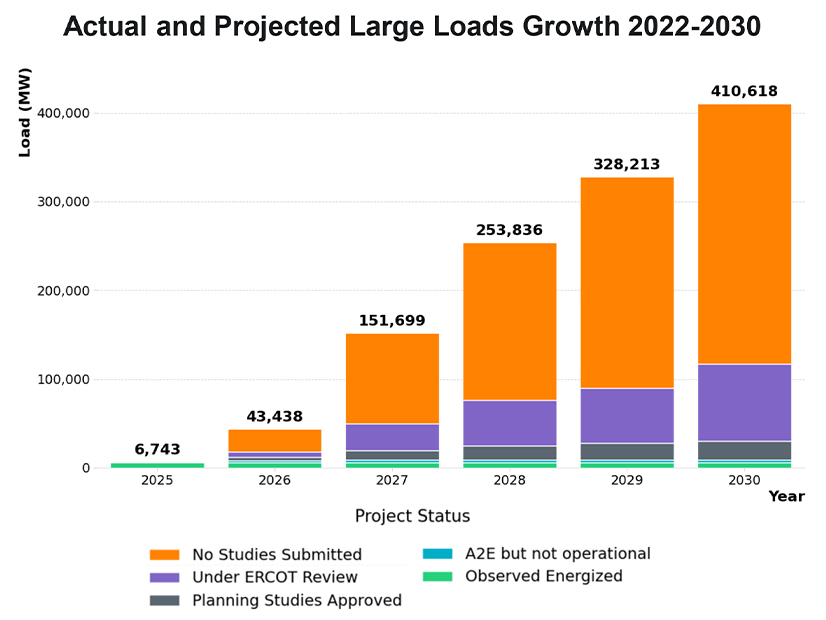
Although the Trump administration favors artificial intelligence and data centers, many of the industry’s biggest detractors are sure to run for president in two years. And some states, including New York, are considering statewide bans on new data centers. Local opposition has long been a thorn in the side of data center development and is growing.
A clear political threat to the industry is brewing within both major parties and at all levels of government. What the industry needs is a hedge against bipartisan political risk.
Major tech companies, including Microsoft, Google and Amazon, have announced huge investments in generation assets. Meta announced in January that it would expand its nuclear power purchases by 6.6 GW. For reference, that’s more than three times the output of Hoover Dam.
These tech companies’ thirst for “juice” is apparent. But what if policymakers don’t want them on the grid?
Travis Fisher
In Warren’s recent announcement of an investigation, she and fellow lawmakers alleged that “American families bankroll the electricity costs of trillion-dollar tech companies.” In Florida, DeSantis and state lawmakers are proposing a new suite of regulations on data centers.
More than 230 groups — including environmental and consumer organizations — have called for a national moratorium on new data center construction. Dramatic headlines such as “AI Is Making Your Life More Expensive” are common.
It matters little that the political alarm over data centers is misguided. In fact, Warren’s assertions may be the opposite of the truth. As Nick Myers of the Arizona Corporation Commission recently explained in RTO Insider, data centers “provide long-term, stable demand that may reduce the financial risk of utilities and lower their borrowing costs to the benefit of all customers.”
Researchers have found the “effect of sales growth on rates is highly situation-specific” and largely depends on how new costs are allocated among customer classes. At best, it’s a murky policy area that lends itself to political scapegoating.
So, what can the industry do to protect itself from a populist uprising? One alternative is to allow new industrial customers to develop or join a private, fully off-grid energy system. My colleague Glen Lyons and I call this idea Consumer-Regulated Electricity, or CRE.
Going one step further than typical “behind-the-meter” arrangements with generators, CRE would enable a new, islanded system with no physical connection to the regulated grid. A data center could join many others on an industrial campus powered by whatever resources make sense — solar, batteries, gas turbines, nuclear reactors, you name it — and operate without connection to the utility grid.
Importantly, the lack of a grid connection also means freedom from political meddling. A new proposal by Sen. Tom Cotton (R-Ark.), titled the DATA Act, would exempt large users from regulation by FERC. Operating on a separate electric grid means no risk of causing blackouts for American families and businesses. Hence, the onerous regulations that apply to the “bulk power system” need not apply to independent facilities.
Like the Trump administration, today’s FERC is supportive of data centers and their hunger for electricity. However, the industry should be prepared for a one-two punch of reduced independence at FERC and a new president who wants to cut off electricity supplies to data centers.
For example, DeSantis recently said, “We have a limited grid. You do not have enough grid capacity in the United States to do what they’re trying to do.” If efforts to expand the grid fail or move too slowly — which seems likely — then the pitchfork mob might come for data centers.
States also can help enable the CRE option and insulate households from rising costs or uncertainty created by data centers. New Hampshire has taken the leap, and Ohio and Utah have enabled private electricity systems.
More states are likely to follow suit now that the American Legislative Exchange Council has approved model legislation that would create a path for CRE in any state.
A common critique of CRE is this: “We need AI data centers to help pay for the grid.” Yes, the blackboard economics view of grid supply tells us that retail rates should fall for everyone as the total watt-hours on the grid increase and grid utilization improves. But in the real world, risks abound, and no one can guarantee the AI bubble will never burst.
Indeed, the highly uncertain risk to American families of a sharp increase in their utility bills to pay for infrastructure intended for a collapsed data center industry may be unacceptable to some policymakers.
Far from a “libertarian fantasy,” private grids already are being built, and the data center industry should view policy reforms like CRE as a practical way to hedge political risk. Even if the value seems far-fetched today, why not establish CRE reforms now in case of a future political emergency? Data centers are not the villain, but it may be impossible for them to win the debate in a hostile environment, and the industry would be wise to protect itself against political warfare.
Travis Fisher is director of Energy and Environmental Policy Studies at the Cato Institute.