BPA’s Draft Markets+ Decision Reignites Day-ahead Debate

The Bonneville Power Administration’s draft decision “solidifying” its day-ahead market choice in favor of SPP’s Markets+ has reignited a yearslong debate over the agency’s direction.

Advocacy organizations, public and investor-owned utilities, data center developers and attorneys general, among others, submitted comments before an April 3 deadline following BPA’s announcement that it is “solidifying its path” to join Markets+.

BPA’s March 12 draft decision differs from the agency’s day-ahead market policy and record of decision (ROD) it issued in 2025 in favor of Markets+ over CAISO’s Extended Day-Ahead Market, according to the agency. The earlier policies were “a direction toward participation in Markets+” when the market was still in a “conceptual stage,” BPA staff said during a March 12 workshop discussing the decision. (See BPA Releases Draft Decision Solidifying Markets+ Choice and BPA Chooses Markets+ over EDAM.)

Recent Markets+ developments have “allowed the agency to advance implementation planning efforts and further evaluate readiness requirements,” BPA Administrator John Hairston wrote in a letter accompanying the draft decision.

One key factor in BPA’s decision to opt for Markets+ over EDAM was market governance. Specifically, BPA argued Markets+ offers independent governance, whereas EDAM risked falling under the influence of stakeholders in California.

In response, EDAM proponents have pointed to the impact of the West-Wide Governance Pathways Initiative and California Assembly Bill 825 of 2025, which together allow CAISO to shift governance of EDAM and the ISO’s Western Energy Imbalance Market to a Regional Organization for Western Energy (ROWE). (See ROWE Close to Finalizing Board Selection Process.)

ROWE was incorporated in Delaware in February.

Some see the ROWE as a means to alleviate concerns among potential market participants that CAISO, whose governing board is appointed by the California governor, plays too large a role in the markets’ governance.

On April 3, Renewable Northwest (RNW), Portland General Electric and the attorneys general of Oregon and Washington said in separate comments that BPA should revisit its governance analysis in light of the establishment of ROWE.

For example, RNW asked BPA to explain how AB 825 and ROWE factored into the agency’s decision.

Those concerns were shared by data center developers in the Northwest.

In a joint letter, Google, Amazon, Microsoft, the Corporate Energy Buyers Association and Western Freedom said that “the record should reflect enacted legislation and implemented governance structures, rather than proposals that were still under development at the time.”

“Maintaining an out-of-date record while introducing this additional final proposed decision is unnecessary,” the large customers said in reference to Pathways and ROWE.
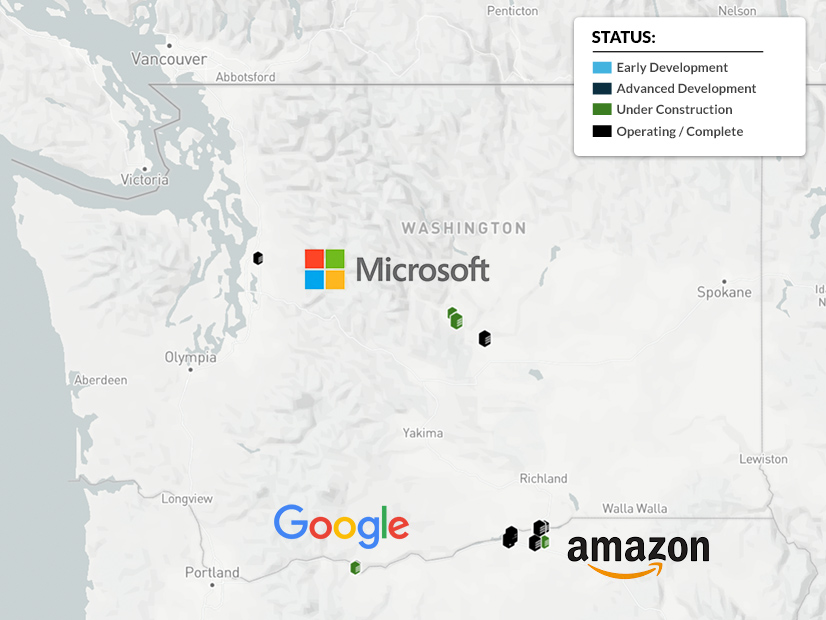
Microsoft, Amazon and Google operate data centers in Oregon and Washington. The companies, along with Western Freedom and the Corporate Energy Buyers Association, voiced concern over BPA’s draft day-ahead market decision. | Yes Energy

Western Freedom’s CEO Kathleen Staks also is co-chair of Pathways’ Launch Committee and is ROWE’s interim president.

BPA plans to exit the WEIM on Oct. 1, 2027, to prepare for its participation in Markets+ one year later. During this period, the agency has said it will trade only in bilateral markets. (See BPA’s Exit from WEIM Necessary for Markets+ Preparation, Staff Says.)

RNW contended BPA has reaped between $26 million and $36 million in benefits since 2022 from participating in the WEIM and asked for more information on how moving to bilateral trading will impact electricity prices and reliability.

RNW’s concerns were shared by the large load customers. The customers also noted that BPA has experienced recent staffing cuts under President Donald Trump. (See BPA Looks to Fill 155 Positions After Hiring Freeze.)

“Bonneville’s departure from the WEIM is a significant change in operations for the West, and it’s one that is not simple to unwind,” the customers wrote. “Any new market may face unforeseen delays pushing that further. While staffing constraints may factor into capacity to participate, stakeholders need a clearer picture of the tradeoffs and alternatives.”

No ‘New Factual Findings’

In its comments, Earthjustice, the lead plaintiff in a suit challenging BPA’s May 2025 ROD in the U.S. 9th Circuit Court of Appeals, contended that the draft decision offered nothing new of substance regarding the “policy direction” BPA outlined in the ROD. (See Nonprofits Tell 9th Circuit BPA’s Day-Ahead Market Decision Poses ‘Imminent’ Harm.)

“While titled the ‘decision to join Markets+,’ Bonneville’s [proposed] decision does not amend or otherwise change its May 9, 2025, final day-ahead market policy and ROD, nor does it affect the finality of that decision,” the organization wrote, characterizing the proposed decision as “no more than the next step on the path to implementing” the decision already made a year ago.

“Bonneville is not making any new factual findings to support its decision to participate in Markets+,” Earthjustice said. “Put simply, Bonneville is no longer considering the economic benefits and drawbacks and environmental consequences of day-ahead market participation, nor is Bonneville considering market alternatives such as participating in the EDAM.”

Earthjustice also cautioned BPA not to withdraw from the WEIM in October 2027, ahead of the winter heating season.

“While Bonneville states it needs to depart the WEIM a year prior to joining Markets+, to provide the agency the opportunity to gain experience in ‘Markets+ mechanics,’ Bonneville has not presented any data reflecting the cost to customers from this early departure,” the group wrote.

Markets+ Supporters Urge BPA to ‘Finalize’ Choice

Meanwhile, Powerex, which is set to join Markets+ on Oct. 1, 2027, added its support for BPA’s participation in SPP’s market and urged the agency to “finalize this decision.”

“BPA’s power customers need certainty to prepare for their market-related roles and responsibilities under the Provider of Choice contracts, and its transmission customers need to work with BPA on representing their BPA transmission rights in Markets+,” Powerex wrote. “BPA’s plan to align its go-live with the BP-29 rate period and initial Provider of Choice deliveries is sound, but the benefits of that alignment depend on BPA’s firm and durable commitment to Markets+, together with timely implementation.”

Snohomish County PUD, Tacoma Power, the Alliance of Western Energy Consumers (AWEC) and Northwest Requirements Utilities (NRU) argued BPA had provided sufficient justification to pursue Markets+, saying the agency should finalize its choice.

“The decision is grounded in thorough, objective analysis; it is aligned with the positions NRU has advocated for consistently throughout this process; and it provides the governance independence, economic benefits and environmental attribute protections that NRU’s members require,” NRU wrote in comments.

On the issue of WEIM, AWEC said the exit from the market is necessary “to transition to a new reliability coordinator, to amend its Provider of Choice contracts with its customers, and to engage in rate and tariff proceedings to fully implement the agency’s decision. AWEC is confident that BPA will work through these issues in lockstep with customers and stakeholders.”

Robert Mullin contributed to this article.

ERCOT Batch Process Rules Headed to Stakeholders

ERCOT staff say they are about to transfer work on the transitional batch study process to streamline the interconnection of large loads, as most of the rule is laid out in a Planning Guide revision request.

The grid operator is holding a final batch study workshop April 9. The rule’s development then will be handed off to the Reliability and Operations Subcommittee (ROS) (59142).

“That is the appropriate stakeholder body that that will vote on [the rule]” before it goes to the Technical Advisory Committee, ERCOT’s Jeff Billo, vice president of interconnection and grid analysis, told the Public Utility Commission during its April 2 open meeting.

ROS has scheduled two special meetings in April to consider the rule before sending it up to TAC. That key stakeholder body has scheduled meetings May 13 and May 19-20 so it can move the rule to the ERCOT board for its June 1-2 meeting.

ERCOT has incorporated stakeholder comments in the revision request in question (PGRR145). It establishes the transitional Batch Zero that staff will use to evaluate large loads’ reliability effects on a systemwide basis. PGRR145 transitions large load interconnections from individual studies to a cluster-based approach that allocates available transmission capacity for studied and committed large loads.

The change was created by forklifting PUC staff’s proposal establishing interconnection standards for large load customers. They commended large load customers execute an intermediate agreement that makes certain disclosures before their inclusion in an interconnection study and to post $50,000/MW in financial security (58481). (See Texas PUC Proposes Large Load Interconnection Standards.)

“We are continuing to refine this as we go, as we take feedback from the comments and through the workshops,” Billo said.

He said staff plan more filings on April 8 for controllable-load resources (CLR) and bring-your-own generation (BYOG) concepts. Billo said a load-only CLR rule change, excluding batteries for the time being, can be included with Batch Zero. It would allow loads to commit to being CLR in return for being allocated their full megawatts, even though their full request may not be available immediately.

“Stakeholders have proposed a lot of interesting ideas. I would even say ERCOT is excited about some of the ideas,” Billo said.

The BYOG concept staff are most optimistic about, he said, is self-limiting facilities. Loads bringing generation would be studied to determine how much load they can pull from the system at a time. The burden would be on the load centers not to pull more than they are allowed to.

Assuming board and PUC approval of PGRR145 and other changes, the Batch Zero study would begin July 10 and run into 2027. Loads that had validated studies as of March 4 will be eligible for Batch Zero. Loads without validated studies will have to wait until March 1, 2027, when Batch 1 is scheduled to begin.

Rule for T&Ds’ ESR Capacity

The PUC proposes a rule change that would allow transmission and distribution utilities to contract with generation companies for energy storage capacity to ensure reliability for distribution customers. The rule also would establish how T&D utilities would recover the contracts’ cost and the generation companies’ responsibilities (59523).

The commissioners asked for stakeholder feedback during the comment period on whether a utility’s cost recovery should be limited to comprehensive base-rate cases or also be permitted in interim proceedings. They also asked for input on whether contracts should satisfy relevant accounting standards for a capital lease or finance lease or whether the criteria be required only if a utility seeks recovery, plus a reasonable return under the contract.

In other proceedings, the PUC:

    • Approved in part and rejected in part El Paso Electric’s request to build and operate a 100-MW solar facility and a 100-MW storage system at its Newman Power Station. The commissioners revised an administrative law judge’s decision by adding a production guarantee for the solar facility to “help ensure ratepayers see the full benefits of that facility, given its functional limitations” (57501).
    • Remanded back to docket management a proposed order approving Texas-New Mexico Power’s acquisition of a privately owned 138-kV transmission line and an associated substation in West Texas. The commissioners asked TNMP to amend the application to include whether or not ERCOT endorses the project (58416).
    • Consented to EPE’s request for a $1.26 billion rate hike but lowering the utility’s requested 10.7% return on equity to 9.35 to 9.4% after four years (57568).

WEIM Intermountain West Exports Increase 780% in Q4 2025

The Western Energy Imbalance Market’s Intermountain West region saw its hourly exports increase by an average of 780% — or 680 MW — in Q4 2025 versus the same period a year earlier.

The region shifted from being a net importer in most hours of Q4 2024 to a net exporter in all hours of Q4 2025, DMM said in a March 30 market issues and performance report.

Wind, solar and hydropower generation increased significantly in the region, up 170 MW (30%), 740 MW (38%) and 120 MW (8%) year-over-year, respectively. Load decreased by about 1.8%. The primary resources in the Intermountain West continue to be coal and natural gas.

California experienced the opposite trend. The state imported a more significant amount of electricity in Q4 2025 compared with Q4 2024, with net imports increasing by about 32%, or 1.13 GW.

California’s imports increased during the morning hours — i.e., when solar generators are starting up and batteries are often waiting to charge. Solar generation, along with battery charging, started around 8 a.m. – leaving demand in the early morning hours to be met by imports, according to DMM’s report.

In the rest of the West, exports increased in Q4 2025 versus Q4 2024. The Desert Southwest saw its net imports decrease by about 33%, or about 350 MW. Most of this reduction happened during the evening and when battery storage discharge increased. Natural gas continued to be the largest source of generation in the Desert Southwest, but battery storage and solar generation increased significantly, DMM said.

Hydroelectric generation in the Pacific Northwest accounted for about 70% of total generation, increasing by about 1,270 MW, or 8%, in each hour from Q4 2025 to Q4 2024. Net imports and natural gas generation decreased across all hours, DMM said.

In total, net interchange after dynamic transfers increased in California by approximately 1,130 MW and decreased in the Desert Southwest by about 240 MW, Intermountain West by about 920 MW, and Pacific Northwest by about 690 MW, the report says.

DMM also found the congestion impact on price separation between WEIM areas was lower than a year earlier. Pacific Northwest balancing areas experienced more frequent price separation than other market regions, being transferred-constrained for about 18% of market intervals in the import direction and 16% of intervals in the export direction.

Mass. Gas Utilities Say Everett LNG Terminal Needed Beyond 2030

The Everett Marine Terminal (EMT) will be needed to preserve the reliability of the Boston-area gas system beyond the 2030 expiration date of the facility’s current utility contracts, gas companies told regulators in recent filings.

The LNG import facility, owned by Constellation and located just north of Boston, is strategically placed to alleviate low-pressure issues at the end of the pipeline network. It has direct injection capabilities and serves as a hub for the sendout of LNG trucks to satellite facilities.

It is under contract with Massachusetts gas utilities until the end of May 2030. The contracts took effect in 2024 following the retirement of the Mystic Generating Station, its anchor customer. In its approvals of the contracts, the Department of Public Utilities required the utilities to work to reduce their reliance on Everett and file annual reports on their efforts.

“EMT remains a critical reliability asset for Massachusetts LDCs,” Eversource wrote in its filing on April 1. “Even under aggressive assumptions regarding demand reduction and alternative infrastructure development, EMT continues to play a critical role in supporting design-winter, design-day and design-hour reliability, emergency response planning, and prolonged cold-weather operations.”

Since 2024, the Office of Energy Transformation has convened a working group intended to analyze and facilitate a transition away from Everett. The working group’s analysis indicates that “eliminating reliance on EMT for all LDCs by the end of the current contract term is not feasible,” National Grid wrote.

Another round of contracts could prove costly for ratepayers. The facility is not operating under a cost-of-service agreement, and advocates have expressed concern there is no clear limit to what Constellation could charge to keep EMT open beyond 2030. (See Conflict Brewing over Gas Transition in Massachusetts.)

In the 2024 regulatory proceedings, the Brattle Group on behalf of the Attorney General’s Office estimated the contracts would cost a combined $946 million over their lifespan. (See Everett LNG Contracts Face Skepticism in DPU Proceedings.)

The utility contracts include fixed-cost charges, LNG procurement charges and options to buy certain amounts of LNG supply. For the state’s major gas utilities, National Grid and Eversource Energy, the amount of LNG the companies are allowed to purchase increases over the span of the contracts.

The companies said a combination of supply-side and demand-side actions could help reduce reliance on Everett. These could include agreements with other LNG facilities, the addition of LNG vaporization facilities and pipeline expansion, demand reduction and electrification.

National Grid wrote the working group’s analysis “has consistently found that demand-side strategies represent the most scalable and durable pathway for achieving sustained reductions in EMT reliance.”

Demand-side solutions should be focused on providing “measurable peak-load relief in EMT-constrained areas, rather than pursuing reductions that are beneficial in aggregate but do not affect EMT-driven peaks,” the company said.

The filings also raised questions about cost shifting if one of the utilities can eliminate reliance on Everett. Eversource has signed agreements associated with an Enbridge project to expand the Algonquin gas pipeline system, which could eliminate the reliance of one of its service territories on the facility.

As Eversource cuts its reliance, “a greater share of certain of EMT’s fixed costs may be borne by the remaining contracting LDCs [local distribution companies],” National Grid wrote.

The Algonquin expansion project “may have the effect of shifting relative EMT cost responsibility rather than reducing systemwide EMT fixed costs,” it added.

It noted the working group’s analysis found “that cost mitigation for one set of LDC customers can result in increased cost exposure for others, given the absence of a regional cost-sharing mechanism for EMT and the limited jurisdiction of state and federal regulators over EMT pricing and operations.”

Nevada Regulators Approve NV Energy’s EDAM Entry

The Public Utilities Commission of Nevada voted April 3 to approve NV Energy’s application to join CAISO’s Extended Day-Ahead Market — a move some stakeholders view as a pivotal moment for Western electricity markets.

The commission approved a draft order released March 31 that allows NV Energy to join EDAM in fall 2028. (See Draft Nevada PUC Order Would Allow NV Energy to Join EDAM.)

“I do view this order as a very important step for NV Energy and our state,” Commission Tammy Cordova said.

Cordova had proposed changes to the draft order, which she described as mainly wordsmithing, but she was outvoted on the proposed amendments.

Stacey Crowley, vice president of CAISO external affairs, provided a statement acknowledging the PUCN vote.

“CAISO appreciates the careful consideration of regional collaboration and looks forward to continued coordination with NV Energy, regulators and stakeholders as EDAM implementation efforts advance,” Crowley said.

CAISO and NV Energy will now work together on an EDAM implementation agreement.

EDAM Launching May 1

EDAM is to launch May 1 with PacifiCorp as its first participant. It will be followed by Portland General Electric in October 2026; Balancing Authority of Northern California, Los Angeles Department of Water and Power, Public Service Company of New Mexico and Turlock Irrigation District in 2027; and Imperial Irrigation District in 2028.

Brian Turner, senior director with Advanced Energy United, described Nevada as “a critical hub connecting the Northwest, Southwest, and Interior West.”

“The state’s participation in EDAM will allow power to be seamlessly shared across these regions … boosting reliability, lowering costs and making the most out of the West’s naturally abundant resources,” Turner said in a statement.

The PUCN decision comes at a critical time, Turner added, as the West remains split between two competing day-ahead markets. SPP plans to launch its Markets+ day-ahead offering in October 2027.

“Nevada’s move signals strong support for EDAM as the region’s most expansive day-ahead market, and helps move the West towards the broadest footprint, supporting a reliable and affordable grid,” he said.

Idaho Power and PowerWatch (formerly BHE Montana) have said they are leaning toward EDAM. But energy officials in Idaho, as well as in Utah and Wyoming, voiced concerns in March about ROWE’s data-sharing practices, saying failure to provide full access to data and market information risks infringing on states’ rights and undermining public confidence. (See ROWE’s Bylaws Must Ensure Market Data Transparency, States Say.)

Governance Transition

NV Energy filed its request to join EDAM on Oct. 22 as an amendment to its 2025-2027 Energy Supply Plan. (See NV Energy Files Request to Join EDAM.)

In approving the request, PUCN listed factors including NV Energy’s successful participation in CAISO’s Western Energy Imbalance Market (WEIM), its transmission connectivity with other EDAM participants and diverse energy resources available through EDAM.

Some parties in the proceeding raised questions about the independence of EDAM’s governance. (See EDAM Governance Questioned During NV Energy Hearing.) Under Step 2 of the West-Wide Governance Pathways Initiative, governance of EDAM and the WEIM is expected to be transferred to a Regional Organization for Western Energy (ROWE).

“The commission anticipates that Pathways Step 2 will further increase independent oversight,” the commission said in its order.

Some of Cordova’s proposed wording changes, which the commission rejected, were related to EDAM governance.

Although the commission’s approved order lists “CAISO’s governance structure” as a factor supporting NV Energy’s EDAM entry, Cordova had proposed removing that phrase.

The approved order says, “the Pathways Initiative has begun the process to establish the ROWE board and [the commission] finds this board will provide independent regional governance of EDAM and will enhance transparency and fairness for market participants.” Cordova had proposed saying the ROWE board “has the potential to” provide independent regional governance.

Conditions of Approval

As part of the order, the commission approved a $16.15 million budget for NV Energy’s initial EDAM implementation and a $16.52 million annual participation budget. Commission approval would be needed for any costs above those amounts. The costs will be split evenly between NV Energy subsidiaries: Nevada Power Co. and Sierra Pacific Power in the southern and northern Nevada, respectively.

Under the order, NV Energy must develop a way to measure annual adjusted production cost savings from EDAM participation. The order requires the company to file reports on the progress of its stakeholder process for revisions to its Open Access Transmission Tariff.

The order also notes that if NV Energy incurs surcharges for not meeting EDAM’s daily resource sufficiency evaluation, those costs will be paid by shareholders.

Nevada requires NV Energy to receive PUC approval to join an organized energy market. Utility regulators in some other states play more of an advisory role in market decisions.

For example, the New Mexico Public Regulation Commission issued a set of “guiding principles” described as advice rather than a mandate for utilities to consider in choosing a day-ahead market. (See NM PRC Issues ‘Guiding Principles’ for Electricity Market Participation.)

Public Service Company of New Mexico ultimately decided on EDAM, while El Paso Electric, which the PRC regulates, announced it will join Markets+.

CIP Specialists Warn Compliance not Enough for Security

Speaking at the Texas Reliability Entity’s Spring Standards, Security and Reliability Workshop, NERC compliance expert Brent Castagnetto told utilities security breaches are inevitable if they do not “elevate” their focus on the ERO’s Critical Infrastructure Protection standards beyond the regular audit cycle.

Castagnetto is co-founder of NovaSync, a provider of compliance tools focused on the CIP standards, who joined the workshop to discuss what he called the “CIP drip” phenomenon. He said the name came from a conversation a year earlier with Nick Santora, NovaSync’s vice president of growth and his co-presenter at the workshop.

“We were lamenting the fact that we both own homes, and homes often come with unique sets of problems depending on where you live,” Castagnetto said. “They could be external [or] internal; they could be the fact that you bought a crappy old house like I did and then fixed it up, or you could have challenges with buying a new home and shoddy craftsmanship. Whether you rent or own, it is likely that you’ve experienced a challenging issue, or a drip or a leak with your own home.”

Castagnetto said he and his company have seen the same kind of problem in many organizations’ CIP compliance programs. These processes usually are set up with good intentions, he said, but it’s impossible to anticipate every shortcoming ahead of time, and entities must actively check to see if issues are developing that need to be addressed.

To submit a commentary on this topic, email forum@rtoinsider.com.

“If we leave [these drips] unattended, and we have a leak that’s going through our foundation, that can lead to all kinds of problems, right? If we don’t address issues with our roof, we’re likely going to see some risk exposure there,” Castagnetto said. “The same thing applies when we look at audits that happen on a periodic basis, whether you’re on a three- or six-year cycle. … Is that good enough? No, you’re likely experiencing drips along the way that you have to address in a more meaningful and practical way.”

Castagnetto and Santora discussed some of the problems they have discovered that were developing without their clients’ knowledge. These fell into several categories, the first of which was issues having to do with employees, whom Santora quipped are likely to remain “a pretty big problem to solve … until the robots take over.”

Santora observed that any registered entity contains many people involved in CIP compliance, and keeping their understanding of the standards and their responsibilities up to date is an urgent requirement. He described the best training programs as a “two-way street, a push and a pull,” in which — rather than providing training and ordering employees to complete it — leadership engages with employees to learn what they are unsure about and what processes need updating.

The discussion of CIP training prompted Castagnetto to turn to the next topic, processes, which he called “critically important” but misunderstood by utilities who design their compliance processes as “calendar events and reminders that cue to do an activity or perform something.” He said this approach is less effective than one that focuses on “connecting the dots from the technology that we’re using to the people that are working in the process.”

“If you’re stuck in this mode where you’re using Outlook and calendar reminders to ensure that the … steps [are] undertaken to accomplish a specific task, it’s not going to work long-term for you,” he said. “Heaven forbid Outlook goes down … or that [responsible] person leaves, and now we’re just moving the calendar to somebody else. We’re passing the buck. You don’t want to find yourself in that situation.”

Entities also must understand that CIP compliance by itself is not enough to ensure the organization’s safety in the face of determined security threats, Castagnetto warned. He cited the case of Christina Chapman, an Arizona woman sentenced in 2025 to 8.5 years in federal prison for helping North Korean information technology workers obtain remote positions at more than 300 U.S. companies.

Chapman operated what authorities called a “laptop farm” at her home, storing more than 90 computers from the companies she fooled, as well as shipping devices to overseas locations. The North Korean employees used the “stolen or borrowed” identities of actual U.S. individuals to fool the IRS. While authorities eventually caught up with the scheme, it still generated more than $17 million in revenue for Chapman and North Korea. Castagnetto said the story shows that utilities cannot count on CIP compliance alone to protect them.

“There’s nothing in [the CIP standards] that says you have to go and verify these people, but we have to figure out a solution to it, because it can happen to us, and we don’t want to have that,” Castagnetto said.

California Snowpack Near Record Lows as Summer Approaches

Despite a few large storms in January and February, snowpack levels in California are approaching record lows due to a heat dome that settled over the state in March.

The California Department of Water Resources (DWR) on April 1 found nothing when it measured the snowpack at Phillips Station in El Dorado County.

“We measured today, but there was actually no measurable snow … so we are calling today’s measurement 0 [inches],” Andy Reising, manager of snow surveys and water supply forecasting at DWR, said during a press conference held from the station on April 1.

In an average year, the snowpack depth at Phillips Station measures about five feet, with about three feet of snow and two feet of water below the snow. The zero-inch measurement represents the second-lowest April 1 measurement at the station in DWR’s history, Reising said, given that there was a trace amount of snow on the ground.

Snowpack levels typically peak around April 1, but the heat dome in March caused large snowmelt to start about two months early.

DWR Director Karla Nemeth called the measurements “one of the quickest snow surveys we’ve had and maybe one where people could actually use an umbrella.”

“That’s just the reality that we’re living in,” she said.

Most of the state’s precipitation in 2026 has come as rain, Nemeth said. The combination of rain, limited snow and warmer weather in March is “setting us up for what will be a challenging year for water management in the state,” she said.

Snowpack across the state is just 18% of average for April 1, DWR said in a news release. The snowpack fulfills about 30% of California’s water usage and is sometimes called the state’s “frozen reservoir,” DWR said.

However, there is fortunate news: California’s reservoirs are nearly full, Nemeth said.

“But what we have in our reservoirs is what we have. We have to manage that really for the next six months or so until we hit October,” she added.

Rivers in California are running higher than average due to the early snowmelt. Much of the snow runoff cannot be stored, however, because reservoirs are full and must keep some room to protect communities from flooding in the event of late spring rains. The state lacks the right infrastructure to convey early-season runoff into underground aquifers, DWR said.

CAISO relies on hydropower supplied by DWR’s State Water Project (SWP). The SWP has five hydroelectric generating plants and four hybrid plants, which generate about 6 billion kWh/year.

Utilities, Lawmakers Push for ‘Bold’ Leader to Guide BPA Through Tx Challenges

Utilities and lawmakers in the Northwest agree the Bonneville Power Administration’s next administrator must focus on building transmission and take risks to make that happen.

BPA is searching for its next leader after outgoing Administrator John Hairston announced he is leaving the agency to head up the Eugene Water & Electric Board. (See Hairston to Retire from BPA, Poised to Join EWEB.)

Whoever takes over would oversee an agency that controls about 75% of the Northwest’s high-voltage transmission system. And this system “faces serious challenges,” Melanie Coon, Puget Sound Energy’s spokesperson, told RTO Insider in an email.

“Years of underinvestment have left the aging system at full capacity, limiting its ability to handle power flows within the Northwest and to neighboring regions,” Coon said. “PSE believes the incoming BPA administrator must prioritize transmission development as a critical focus area and be open to innovative partnerships that can accelerate transmission development across the region.”

PSE was one of the signatories to a Feb. 18 letter that a group of investor-owned utilities sent to U.S. Secretary of Energy Chris Wright. The other utilities include Avista Corp., Idaho Power, NorthWestern Energy, PacifiCorp and Portland General Electric.

The utilities said BPA’s mission is to ensure the Federal Columbia River Power System and Federal Columbia River Transmission System benefit all the agency’s customers, not just “select parts of the region or customers of any specific classification of electric utility.”

“For the region’s IOUs, BPA’s actions to carry out that mission have been deficient for some time, and BPA’s lack of transmission development in the region is the most visible example of this deficiency,” the letter stated.

A study by Energy and Environmental Economics predicts that accelerated load growth and aging power plant retirements will create a resource gap in the Northwest starting at about 1.3 GW in 2026 and expanding to almost 9 GW by 2030. That is approximately the load of the state of Oregon.

With the region facing “unprecedented load growth,” BPA needs a “bold leader” who prioritizes transmission investments, market structures that benefit all customers and is open to new public-private partnerships to speed up transmission development, the IOUs argued.

The IOUs noted that BPA has identified critical projects to help new resources and new large load developments come online. But without “the push of a new administrator, projects will linger without timely completion,” according to the letter.

John Haarlow, Snohomish County PUD’s CEO, echoed the IOUs’ concerns.

“What we’re hoping to see in the next administrator is someone who can move the agency from planning into action on transmission, generation and the infrastructure investments the Northwest requires to keep up with growing demand and pressing resource adequacy concerns,” Haarlow told RTO Insider.

Haarlow added that the next leader should be experienced in running a “complex organization” and be able to build relationships “across a diverse set of stakeholders, including utilities, tribes, states and Congress.”

Given BPA’s importance in the region, “It will take an innovative and results-oriented leader with a clear vision to lead across all of it,” he said.

A group of seven Republican lawmakers from Washington, Oregon, Idaho, Montana and Nevada sent a separate letter to Wright on March 18. The lawmakers similarly contended the next administrator must “act much more quickly” on transmission.

Citing conversations with stakeholders, the lawmakers said the agency needs “A disrupter. A risk taker.” The agency needs someone with “the ability to recognize the need for new ideas and new approaches to long-standing problems facing the agency,” including transmission, the lawmakers argued.

Sen. Ron Wyden (D-Ore.) told RTO Insider in an email that the next administrator should strive to keep energy bills low “while also expanding responsible transmission that will allow increased renewable energy on the grid.”

‘Transmission, Transmission, Transmission’

Under Hairston, who assumed the role of administrator in January 2021, BPA has secured $773.8 million in transmission capital for 2025 with the goal of doubling transmission capital execution by 2028. It plans to issue awards to contractors that will cover a 10-year period with a maximum value of $25 billion to build and modify lines.

BPA also launched its $5 billion Grid Expansion and Reinforcement Portfolio (GERP) initiative in 2023 with the aim of building 23 new transmission lines and substation projects. (See BPA Provides More Details on $5B Tx Projects.)

Siobhan Doherty, Seattle City Light’s power supply officer, said the utility is happy BPA’s GERP initiative is moving forward. But “there’s still a lot of work to do in order to make transmission available for the region,” Doherty added.

BPA paused certain planning processes in 2025 to consider how to address nearly 61 GW of transmission service requests. The agency has presented proposals to reduce the queue and has held several stakeholder meetings on the issue. (See Northwest Lawmakers Explore Building Transmission Without BPA’s Help.)

SCL has advocated for BPA to make changes in its transmission tariff to build new lines faster and to make conditional transmission available earlier in the interconnection process, Doherty noted.

“We’ve seen multiple regional studies showing a need for resource adequacy, or that the region will not be resource adequate in the next five or 10 years,” Doherty said. “Since Bonneville is the backbone of the transmission system in the Northwest, we really think they need to focus a lot on moving transmission forward quickly.”

Transmission is not the only initiative on BPA’s agenda. For example, the agency is preparing to join SPP’s Markets+ day-ahead market. BPA also recently executed long-term wholesale electric power contracts with more than 130 public utility customers and is considering revising its rates following a court order to increase spills at eight dams on the Columbia and Snake rivers. (See BPA Releases Draft Decision Solidifying Markets+ Choice and BPA Explores Rate Alternatives Following Order to Increase Dam Spills.)

Still, “transmission, transmission, transmission,” former BPA Administrator Randy Hardy said. “Transmission construction and interconnection challenges dwarf everything else.”

Data Center Interest, Opposition on the Rise in New England

While the data center boom has yet to have a major impact on the New England grid, increased interest from data center developers is fueling concern about potential effects on energy affordability and long-term resource adequacy.

The region already faces potential supply challenges in the 2030s due to electrification-driven load growth, potential resource retirements and the struggles of building offshore wind. ISO-NE forecasts its reserve margin will decline from about 17% in 2026 to 8% in 2034.

Accurately forecasting the scale of data center development in New England is a daunting task due to the speculative nature of many interconnection inquiries and the speed-to-market sought by most developers. But multiple major utilities have reported they have gigawatts of new load under study because of a sharp uptick in interconnection requests starting in early 2024.

If the high-end outcomes for electrification and data center development materialize, New England could face a rapidly tightening balance of supply and demand. This could exacerbate energy affordability issues and threaten decarbonization efforts.

In a power system with about a 26-GW peak, the possibility of gigawatt-scale data centers means these issues could materialize quickly and with limited warning.

Forecasting Uncertainty

Prior to 2024, developers of large data centers showed very little interest in New England, in part because of the region’s high energy costs and siting limitations.

“The number literally was zero in terms of large, hyperscale data centers anywhere on Eversource’s service territory,” said Jacob Lucas, vice president of transmission planning at Eversource Energy, which owns the largest transmission footprint in New England.

Since 2024, “we’ve had anywhere between about a gigawatt-and-a-half to 7 GW simultaneously under study,” he said, noting that the total amount of demand under study can fluctuate significantly based on projects entering or dropping out of the process.

He added that “every single request we’ve ever gotten has essentially been for a 24/7/365 max load.”

The cost and duration of initial large load interconnection studies vary depending on the level of granularity sought by developers. The studies tend to last between six and 12 months and cost from $100,000 to $500,000, Lucas said. To interconnect, large loads must undergo an additional, more extensive study process, coordinated with ISO-NE, to evaluate system impacts and determine the need for interconnection upgrades.

So far, no large load projects in Eversource’s queue have reached a final interconnection agreement since interest spiked in 2024, though one recent project reached the point of negotiating a construction agreement before the developers walked away, Lucas noted.

National Grid, the third-largest transmission owner in the region, has seen a relatively steady queue of around 2.5 GW since the start of 2024. Avangrid, the region’s second-largest transmission company, declined to comment.

While New England is just starting to grapple with the potential effects of hyperscale data centers, policymakers and officials have prepared for years for load growth associated with electrification and decarbonization.

In ISO-NE’s landmark 2050 Transmission Study, published in 2023, the RTO forecast New England’s peak load to roughly double over the next 25 years, with a cost of up to $26 billion. (See ISO-NE Prices Transmission Upgrades Needed by 2050: up to $26B.)

Although electrification has proceeded at a slower pace than ISO-NE projected in 2023, the RTO still forecasts substantial electrification over the long term and expects heating electrification to shift the region from a summer- to winter-peaking system in the mid-2030s.

ISO-NE is working to incorporate large loads into its 10-year demand forecast for the first time in 2026. The RTO plans to incorporate prospective large loads that are greater than 20 MW and under formal study. It proposes to derate the proposed nameplate capacity of these projects based on their stage of development and expected utilization rate.

The RTO’s 2026 draft forecast includes only about 110 MW of additional large load demand by 2035.

“Prospective large loads in New England remain limited in number and scale,” Victoria Rojo, supervisor of load forecasting for ISO-NE, noted at a February NEPOOL meeting. “Recent data collected from TOs suggests that there are a couple hundred megawatts of large loads in the formal study phase.”

But accurately predicting data center development 10 years out is extremely challenging. Just one large-scale project could dramatically change the outlook for the region, while the fate of individual projects may depend on the ebb and flow of global economics.

According to Lucas, large load projects studied by Eversource have ranged in size from about 100 to 1,000 MW. Uncertainty around which projects actually will materialize is “one of the big issues” in planning for data center development, he said.

Significantly overestimating demand could distort the market by creating a false appearance of resource adequacy issues, he said. But if a project on the higher end of the range is among the first to commit to development, ISO-NE’s estimate could be too low by a factor of five, he added.

Ultimately, ISO-NE’s introduction of large load demand into its forecast is a step in the right direction, he said, adding that the demand is “not going to be zero.”

ISO-NE has noted it has “limited visibility into detailed project information,” and data sharing “can be sensitive and is not ubiquitous across entities.”

To help address these issues, it has developed a quarterly survey for utilities to submit information on large loads, which should help the RTO “proactively characterize and incorporate large loads into the long-term load forecast.”

ISO-NE’s ongoing capacity market overhaul also may reduce some of the risk associated with forecasting uncertainty. FERC recently approved ISO-NE’s proposal to transition to a prompt capacity auction, cutting the time between auctions and commitment periods by about three years (ER26-925). (See FERC Approves ISO-NE Prompt Capacity Market.)

Prompt auctions will be held about a month before each yearlong commitment period, enabling the RTO to rely on more up-to-date information on supply and demand.

Increased demand forecasting accuracy “will be especially important when accounting for data centers and other large load proposals, which are often highly uncertain in terms of proposal attrition rates, relative construction time and electric demand characteristics,” the RTO told FERC.

But these changes would not address the fundamental issues that could occur if new demand significantly outpaces new supply in the region.

Energy Affordability

Affordability concerns have dominated energy policy discussions in New England since consumers were hit with price spikes in the winter of 2024/25. Costs remained high over the past winter, which was the most expensive winter in the history of ISO-NE’s wholesale markets. (See 2025/26 Most Expensive Winter in History of ISO-NE Markets.)

“Everybody is acutely aware that we are already in this affordability crunch,” said Noah Berman, senior policy advocate at the Acadia Center. With the potential for data center demand on the horizon, “legislators are thinking about this … and are trying to get out ahead of it.”

In PJM, the data center boom has contributed to a rapid increase in forecast demand and skyrocketing capacity prices in recent capacity auctions. (See PJM Capacity Prices Hit $329/MW-day Price Cap.) Nationally, data center demand also drove increased coal-fired generation and overall power sector emissions in 2025.

“People are seeing what’s happening in PJM … in PJM [data centers] are absolutely causing price spikes,” Berman said.

Even without new data centers, New England could face power supply issues starting in the mid-2030s.

“We are, as a region, really struggling to build new generation,” said Lucas of Eversource. “The looming issue New England has … is capacity shortage.”

Adding a few large data centers to this equation is “just going to make that worse,” he said.

To prevent negative impacts on consumers and the climate, some advocates argue regulators must require data center developers to procure enough new carbon-free generation to meet their demand.

But the data center industry has opposed these mandates. Lucas Fykes, director of energy policy at the Data Center Coalition, said data centers should not be required to bring their own supply. He stressed the importance of developing accurate demand forecasts and said it should be up to states and utilities to figure out how best to ensure resource adequacy.

Interconnecting large data centers also could require significant upgrades to the region’s transmission system. Drew Landry, Maine deputy public advocate, said the region must work to ensure data center developers are accountable for all costs of the system upgrades required to interconnect their facilities.

He said the data center boom appears to be “a bit of a gold rush situation,” with developers scrambling to advance projects which ultimately may fail. The potential for stranded projects, he said, “raises the potential for stranded costs.”

To protect against this risk, ISO-NE and utilities should collect as much money upfront as possible to fund the upgrades, he said.

Across New England, the transmission and energy supply concerns are starting to translate into legislation.

A bill (H.5175) passed by the Massachusetts House of Representatives in late February would require data centers with load larger than 20 MW to procure at least 80% renewable energy. The bill also would direct electric utilities to establish specific data center tariffs designed to “ensure that non-data center ratepayers are protected from any increased costs that result from increased electricity demand.”

In late March, the Vermont House of Representatives passed a bill (H.727) similarly creating a separate ratepayer class for data centers over 20 MW. In the siting process, data centers would have to prove to the Vermont Public Utility Commission that development “will promote the general good of the state” and will not adversely affect other ratepayers.

Democrats in Rhode Island also have introduced legislation (S.2427) to create a new retail customer class for data centers intended to protect against cost shifts.

And in Maine, a temporary data center moratorium recently passed by the Maine House would pause development in the state until November 2027. The bill appears likely to receive support from the Senate and Gov. Janet Mills (D).

Blowback

The data center boom also has been met with growing grassroots backlash, with opponents successfully blocking or delaying projects throughout the country. New England is no exception.

For opponents, data centers can represent a physical embodiment of unconstrained capitalism, Big Tech, inequality, environmental degradation and AI slop.

“There is a real extractive relationship between data centers and local communities,” said Dana Colihan, co-executive director of Slingshot, an environmental justice nonprofit. “These facilities are primarily benefiting wealthy corporations, not everyday folks.”

At a March meeting of the ISO-NE Consumer Liaison Group — one of the region’s few forums that convenes grassroots activists, ISO-NE officials and state and industry representatives — Vermont-based activists sent a blunt message to any data center developers eyeing the state.

“If anyone tries to build data centers here, we will drive them out,” one speaker said.

Data center opponents have scored several wins in local battles in recent months.

In Lewiston, Maine, city councilors voted to kill a data center development plan after intense local opposition.

In Wiscasset, Maine, the selectboard voted to pause early-stage discussions about the development of a data center on town-owned land amid backlash from the community.

And in Lowell, Mass., the city council passed a one-year moratorium on data center development or expansion amid the Markley Group’s efforts to expand an existing data center in a residential neighborhood. Local residents have complained about noise and air pollution from the facility and have legally challenged an air permit approval allowing Markley to add eight backup diesel generators to the facility.

Public debates over the moratorium pitted union electrical workers against environmentalists and neighbors. One city councilor compared her decision on the moratorium vote to choosing a favorite child.

“I think community engagement is often key to determining if projects move forward and move forward well, and ensuring mitigation measures are put in place,” said Anxhela Mile, staff attorney for the Conservation Law Foundation.

Data center proponents argue development is essential to maintaining U.S. economic competitiveness. They point to increased tax revenue and job creation benefiting local communities.

Data centers can bring millions of dollars in tax benefits while maintaining the “small-town feel” of rural areas, Fykes said. “Many of our members are focused on being good stewards of the community.”

A 2024 economic development law passed in Massachusetts included significant sales tax exemptions for data centers. The state finalized the tax breaks on March 27, authorizing a sales tax exemption for equipment, software, electricity use and construction costs for data center facilities.

To qualify, the law requires data centers to employ at least 100 full-time workers in the state, but the regulations do not include substantial ratepayer or environmental protections.

“If you’re going to incentivize these companies to come here, make sure you’re doing it correctly,” Mile said, noting that CLF was one of a handful of groups to voice concern about the lack of consumer and environmental protections during the legislative process.

“I think a lot of groups were caught off guard with it,” she said. “It just seemed like it just kind of slipped through.”

But the political climate has shifted since the passage of the law, with energy affordability taking precedence and local groups mobilizing against data center development. Future legislation may prove to be far more controversial.

NRC Renews Diablo Canyon License for 20 Years

The U.S. Nuclear Regulatory Commission has issued a 20-year license renewal for the Diablo Canyon Power Plant, a nuclear facility seen as key to California grid reliability as the state transitions to clean energy.

The renewed licenses for Diablo Canyon Units 1 and 2 run through 2044 and 2045, respectively, though extending operations past 2030 would require action from the California Legislature. The NRC issued the renewed licenses and a record of decision April 2.

Diablo Canyon, a 2,200-MW facility owned and operated by Pacific Gas and Electric, supplied about 10% of the state’s total electricity in 2024, including 16% of its zero-carbon electricity. It is the state’s last operating nuclear power plant.

PG&E CEO Sumeet Singh called the Diablo Canyon license renewal “an important milestone for California’s energy future.”

“Diablo Canyon is the state’s largest source of clean energy and a cornerstone of reliability,” Singh said in a statement.

In 2016, PG&E agreed to retire Diablo Canyon Units 1 and 2 when their operating licenses expired in November 2024 August 2025, respectively.

But rolling blackouts in California during a 2020 heat wave and close calls in subsequent summers prompted state officials, including Gov. Gavin Newsom (D), to reassess Diablo’s future.

In September 2022, Newsom signed Senate Bill 846, authorizing a five-year extension of Diablo Canyon.

A statement from Newsom’s office following the license renewal said Diablo Canyon will provide around-the-clock, carbon-free electricity “as California navigates growing electricity demand and hotter summers, while continuing investments in grid reliability and additional clean energy resources.”

Newsom noted that Diablo Canyon’s electricity isn’t subject to the fluctuation of fossil fuel-based power resources.

SB 846 authorized a loan from the state’s general fund and directed PG&E to apply for a grant from the U.S. Department of Energy’s Civil Nuclear Credit Program. In January 2024, the DOE awarded PG&E $1.1 billion to keep Diablo Canyon running. (See Diablo Canyon Secures $1.1B DOE Award to Support Operations.)

The NRC granted an exemption to allow PG&E to keep running the units past their license expiration dates, a move that a federal appellate court upheld. (See 9th Circuit Upholds NRC Decision on Diablo Canyon.)

The California Public Utilities Commission approved a five-year extension for Diablo Canyon in December 2023. (See California PUC Votes to Extend Diablo Canyon Nuclear Plant 5 Years.) In December 2025, CPUC approved PG&E’s request to recover about $382 million from ratepayers to keep running Diablo Canyon.

PG&E said it has received approvals from the State Lands Commission, the California Coastal Commission and the Central Coast Regional Water Quality Control Board to extend Diablo Canyon operations.

Jeremy Groom, acting director of the NRC’s Office of Nuclear Reactor Regulation, said during a signing ceremony that Diablo Canyon is “a stabilizing force for California’s electric grid.” He said the license renewal is the NRC’s 100th renewed operating license for U.S. power plants.

And more renewals likely are on the way. In March, Arizona Public Service notified the NRC that it plans to seek operating license renewals for all three units at the Palo Verde Generating Station, potentially extending operations through the mid-2060s. (See APS to Seek Palo Verde Extension through 2067.)