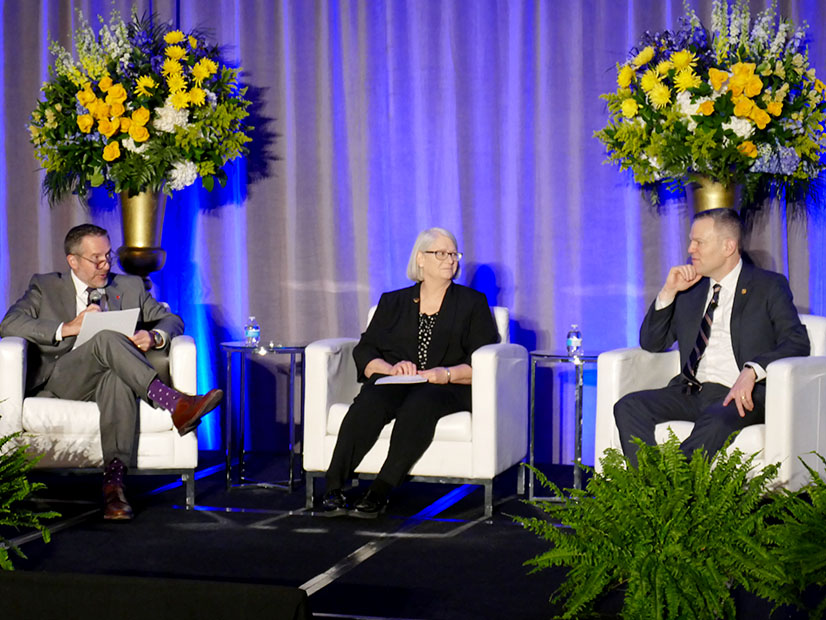
CAISO’s Western Energy Imbalance Market saw an increase in battery storage capacity and coal use in 2025 compared with 2024, although the total load across the market — which represents about 80% of the load in the West — did not increase over the year.
Battery capacity reached 25,600 MW by the end of 2025, up about 42% from the previous year, CAISO’s Department of Market Monitoring (DMM) said in memo at the joint CAISO Board of Governors and Western Energy Markets Governing Body meeting held March 4.
Most of that battery capacity exists in CAISO’s region — about 17,100 MW — with the rest of the WEIM containing about 8,500 MW.
During evening hours, batteries discharged about 2,500 MW more energy in 2025 than in 2024. This was due in part to a larger amount of solar generation on the system in 2025, which allowed the batteries to charge during the day and discharge at night, DMM said.
Coal-fired output in the WEIM increased by an average of about 800 MW during the hours between about 11 p.m. and 8 a.m. in 2025. In total, coal generated about 17,000 MW/hour in the WEIM over 2025.
The DMM specifically found that transfers out of the Intermountain West region increased during morning and evening non-solar hours in 2025 compared with 2024. This coincided with increased generation from coal resources in the region, DMM said.
Average total system load in the WEIM was the same in 2025 as in 2024 — about 78.3 GW. Load increased in the Pacific Northwest, Intermountain West and Desert Southwest regions but was down about 2% in California to 27.9 GW in 2025. Most of California’s decrease occurred during mid-day solar hours and evening peak net load hours, DMM said.
Although battery and coal usage increased in 2025, natural gas and hydropower resources continued to be WEIM’s primary resources, DMM said. Natural gas hourly generation averaged about 23,110 MW, down about 1,900 MW compared to 2024, while hydropower came in at 22,120 MW, an increase of about 920 MW in 2025.
Big Transmission Lines on Schedule
Three important transmission projects in the WEIM are progressing toward completion, CAISO CEO Elliot Mainzer said in a report at the joint board meeting.
The SunZia project, a 550-mile line across New Mexico and Arizona, began its commissioning and testing phase, Mainzer said. The line’s 3,650-MW capacity will deliver more than 3,000 MW of wind energy to the region.
The Southwest Intertie Project-North, a 285-mile line across Idaho, Nevada and California, is on track to open in June 2028, Mainzer said. Engineering and procurement are on schedule, with construction contracts signed and right-of-way requirements 99% secured.
The TransWest Express, a 732-mile line across Wyoming and nearby states, is on track to provide 3,000 MW of wind generation capacity by Q4 2031. Construction is currently happening at substations, transmission tower pads and access roads.
NERC has published a new incident review report to draw attention to the growing challenges to maintaining reliability during the “shoulder seasons” of spring and fall by highlighting multiple occasions of unplanned load shedding by two anonymous entities.
Spring and fall have been called “shoulder seasons” because they fall in between summer and winter, which are traditionally peak load periods in most regions, NERC wrote in the Load-Pocket Shoulder Season Challenges document, released March 4. Utilities tend to use these periods for planned maintenance and construction to prepare for the more demanding seasons ahead, taking advantage of the lower expected load levels to take generation and transmission facilities offline.
However, this historic approach has been complicated in recent years by changes in both the generation mix and load behavior. In many areas, once-comfortable reserve margins have shrunk to the point that grid operators must consider more carefully whether to grant equipment outage requests. NERC’s 2024-2025 Winter Reliability Assessment warned that retirements of coal- and natural gas-fired generation in multiple regions could lead to reliability challenges, which the ERO observed in the new report. (See NERC Sees ‘Reasons for Optimism’ as Winter Approaches.)
The report included four incidents of load shedding — two for each entity — out of six experienced across the ERO in shoulder seasons during an unspecified 13-month period. Each incident occurred in a load pocket — a smaller area of concentrated load within a balancing authority’s footprint that typically also contains some generation.
A load pocket will have “varying degrees of transmission lines that connect [it] to the larger grid,” through which energy must be imported to serve the load when the internal generation does not suffice. Depending on the size of the load, entities may create transmission “rings” around the pocket to provide more options for imports.
Multiple Factors in Load Shedding Incidents
The first two incidents were associated with the same entity, identified as “Entity A” in the report. Entity A reported three load-shedding incidents in 2024 and 2025, occurring in the same load pocket, of which the details for two were included in the report.
Each of Entity A’s incidents involved a combination of the following factors:
unavailable generation, either from planned or forced outages, low wind or solar generation output, or emission constraints;
differences between actual and forecast load, attributable in large part to line losses on the transmission system, resulting from increased power flow from reduced internal generation output; and
planned or forced transmission outages.
The first incident occurred in April — the year was unspecified — when a sustained fault on a 345-kV transmission line caused it to be taken out of service. A planned maintenance outage was already underway on another 345-kV line, leading to increased dependence on internal generation.
A wind facility with a nameplate capacity of 4.7 GW output only 100 MW because of low wind speeds, a separate generator failed to start and solar generation ramped down as expected at the end of the day, all as load increased to its daily peak value. With real-time contingency analysis results indicating imminent voltage instability, operators shed about 150 MW of load.
The second incident occurred in March, also in an unidentified year, when a significant unforecast reduction in wind generation led to increased transmission system flows and line losses. Multiple flexible and dispatchable generation resources were offline because of planned and unplanned outages, and a 345-kV line was out of service for maintenance as well. Operators shed 122 MW of load to return the system to stability.
Additional Incidents from 2 Entities
Two load shedding events were reported by the second entity. Both occurred in April 2025, but details were only provided for the one on April 26.
The report linked to a separate analysis by SPP that provided more details on the location of the event — northwest Louisiana — and the utility involved, American Electric Power.
On the day of the incident, about 3 GW of generation within the load pocket was unavailable because of planned maintenance outages. A 345-kV line and DC tie transmission line were also out of service, “significantly reducing the import capacity into the load pocket.” SPP ordered AEP to shed 140 MW of load, cutting power to about 30,000 customers for about six hours.
The last entity, identified in the report as Entity C, reported a single incident in May, when operators were forced to shed 600 MW of load. The load shedding was required because of planned and unplanned generation outages of about 7.6 GW — 74% of internal generation — combined with 1,732 MW of unavailable capacity on a 500-kV line. Temperatures within the pocket were also about 5 degrees Fahrenheit higher than expected, causing “a substantial increase in load.”
From the four incidents, NERC identified several considerations for entities during shoulder seasons. These include planning for a higher level of operating margin and committing additional generation in load pockets in case of variations in generation, load and weather; including demand-side management in mitigation plans for insufficient capacity; and periodically reviewing planned outages as the date approaches to determine whether conditions could warrant postponing them.
Two Arizona utilities received approval to convert coal-fired power plants to run on natural gas, projects they say will enhance grid reliability, reduce emissions and preserve jobs.
The Arizona Corporation Commission voted 5-0 on March 4 to approve an application from Tucson Electric Power to convert units 1 and 2 of Springerville Generating Station to natural gas. In a separate 5-0 vote, the commission approved Salt River Project’s application to convert two units to gas at the Coronado Generating Station. The applications sought modifications to certificates of environmental compatibility (CEC) for the facilities.
The Springerville and Coronado stations are about 30 miles apart in Apache County, Ariz.
Of the four coal-fired units at Springerville, TEP owns units 1 and 2, which have a combined capacity of about 800 MW. Unit 1 was slated for retirement in 2027, with Unit 2 to follow in 2032 “due to rising fuel costs, increasing delivery risks, anticipated mine closures, and environmental considerations and regulations,” TEP said previously.
Terry Nay, TEP’s vice president of energy resources, noted that the company did not propose repowering Springerville in its 2023 integrated resource plan (IRP) because “the prospect of a [gas] pipeline was not feasible.”
But since the IRP was filed, “we learned that a pipeline is feasible, making repowering Springerville the most economical choice for replacement gas generation,” Nay told the commission.
In August 2025, TEP and SRP were among Arizona utilities that announced commitment plans for Transwestern Pipeline’s Desert Southwest expansion project. The pipeline will transport natural gas from the Permian Basin in west Texas to Arizona. Construction is expected to be finished in late 2029.
Nay said gas conversion of the Springerville units would cost about $200 million. That would be less expensive than keeping the units running on coal at a cost of about $450 million, building a new combined cycle gas facility, or building new renewables with battery storage.
TEP expects to complete conversion of units 1 and 2 in 2030.
SRP expects the Coronado conversion to be finished in 2029. While the Coronado coal plant has provided baseload generation, SRP plans to use it as a peaking resource after the gas conversion.
“We think that converting to natural gas is a good long-term durable decision that will allow us to operate well into the 2040s, when other technologies will become available,” said Bill McClellan, SRP’s director of resource planning and development.
A new natural gas pipeline lateral is expected to serve Springerville and Coronado. An SRP spokesperson told RTO Insider that SRP has not finalized an agreement for the lateral to serve Coronado.
‘Economic Backbone’
Proponents cited multiple benefits of converting coal-fired units at Springerville and Coronado to gas fuel. The converted gas plants will emit fewer greenhouse gases and other pollutants. Many of the power plant workers will be able to keep their jobs.
“These plants are the economic backbone of our area,” said St. Johns Mayor Spence Udall, who works at the Coronado plant.
Representatives of the Sierra Club and Western Resource Advocates asked the commission to send the applications to the Arizona Power Plant and Transmission Line Siting Committee to better examine potential impacts and evaluate alternatives.
“Regulatory prudence points to the need for a new hearing for a CEC that has not been revisited since 1977,” said Alex Routhier, a senior policy adviser at WRA.
Meghan Grabel, an attorney representing TEP, said the commission is “fully authorized” to rule on the applications. She said going to the line-siting committee for an evidentiary hearing would cost ratepayers hundreds of thousands of dollars. The committee would be required to hold the hearing near Springerville.
“It’s logistically difficult, and it’s expensive,” she said.
Matt Derstine, an attorney representing SRP, said the commission has an evidentiary record in sworn declarations from the utility. The project is not a substantial change, he said, and it would provide a net environmental benefit.
Commission Support
Commission Chair Nick Myers said he saw “absolutely no reason to require another half a million dollars’ worth of studies and process just to do something that’s better than what’s currently happening.”
“This is a great opportunity for us to show the rest of the world what it’s like for government to just get out of the way,” Myers said.
Myers’ comments came before the Springerville vote, but he reiterated them before voting to approve the Coronado conversion.
Commissioner Kevin Thompson said the Coronado power plant supplies about 10% of SRP’s peak demand. The estimated cost to convert Coronado to gas and run it through 2045 would be $1.1 billion, he said, about $300 million less than replacing Coronado with a new natural gas plant for the same time frame.
“These plants are cornerstones of their local communities and, once converted to natural gas, will become a key pillar of long-term grid reliability versus being seasonally operated generating stations,” Thompson said in a statement after the meeting.
Of the remaining two units at Springerville, SRP owns Unit 4. The SRP board of directors in November approved the conversion of the unit to run on natural gas.
Springerville Unit 3 is owned by Tri-State Generation and Transmission Association. It is slated for retirement in 2031.
Electricity markets increasingly are in the political spotlight, and that includes attention from the biggest figure in politics over the past decade.
“I’m frequently reminded about how consistently the president talks about co-location,” White House National Energy Dominance Council’s (NEDC) Peter Lake said on March 3. “He’ll mention co-location twice a week, which means I hear about it twice a day.”
Sometimes Lake will get a call from the West Wing on a day without any NEDC events because President Donald Trump brought up the concept at a speech on healthcare, Lake told the crowd at EPSA’s Competitive Power Summit. The president’s focus on co-locating generation with large loads shows how focused he is on meeting the data center demand driven by artificial intelligence, a technology he says the United States needs to dominate.
“Power is the big constraint on unleashing this generational technology,” Lake said. “And just like the combustion engine or the microprocessor, this is one of those technologies where America cannot afford not to be No. 1.”
With leading tech firms planning to spend hundreds of billions of dollars a year on data centers, AI has brought demand growth. Higher power prices, especially in PJM where the capacity market cleared short again, have attracted Trump’s attention. That led the White House and 13 governors of PJM states to jointly call for a backstop procurement auction to get more supply online for large load customers. (See White House and PJM Governors Call for Backstop Capacity Auction.)
“As a stakeholder group, we would ask you all, sincerely and enthusiastically, to please work with PJM to help reform the regular capacity market and the regular energy market,” Lake said. “The focus, rightly so, is a lot of time on the reliability backstop auction, but we very much intend for that to be one time only.”
Ideally, PJM will hold the backstop auction and two previously scheduled Base Residual Auctions in 2026, and then in 2027 the markets can get back to normal — where existing generation is maintained, new units are incentivized and prices are reasonable, he added.
“We can build enough power supply to meet the demand of AI and maintain affordability,” Lake said. “And this is where the president’s leadership has been truly extraordinary, in cutting the deal with the PJM governors to set up a framework in which we have a clear line of sight on how to build the new baseload and build big power in America again.”
The 13 governors represent PJM states across the political spectrum, but they agreed on the basic framework to address the issues the RTO faces, he added.
“My assumption when I took this job was that if the White House figures out what FERC is, you may not be in this role anymore, and that the White House knows what PJM is — oh my gosh, you know — what happened?” FERC Commissioner David Rosner said earlier in the day. “And both are true, and we’re OK.”
The stakeholder process in PJM is messy and complicated. Hearing views from some new parties and the resulting political attention has been fine, Rosner said.
“I think that, at a high level, this is very positive, because it wasn’t so prescriptive,” Rosner said. “They didn’t know all the answers, but they brought people together on some concepts, and … we have to work with everybody in this room to make sure those concepts turn into steel in the ground.”
The only way rising demand can be met is if “the force of capitalism” is unleashed to meet it, which means getting the market design right.
“I know a lot of people like to talk about PJM as a problem, but my sort of opening statement is, PJM, as it currently exists, saves people billions of dollars,” Rosner said. “And we should work on the problems and make it better to meet the moment.”
Political attention on markets can lead to changes. Now that politicians are increasingly focused on affordability, that could lead to some knee-jerk reforms, said Wolfe Research Senior Analyst Steve Fleishman.
“Obviously, they do need to get elected, and they’re focused on that, but it does require a lot of us in the market seeing through a lot of noise, which is not easy,” he added. “It’s hard, hard for our investors, particularly the ones that aren’t in weeds on everything to assess.”
So far much of the posturing on affordability has been more bark than bite, said Fleishman.
“Now we’re in the middle of everything, and AI and data center focus is the No. 1 thematic,” Fleishman said. “So, this is a real change for us, and I think it puts everybody at a higher level of alert.”
The demand comes at a time when the costs are growing; a new natural gas plant that recently cost $800 million to build now costs $2 billion, he added.
Affordability is a Concern Outside of ISO/RTOs
While PJM dominated the discussion at EPSA given its membership and the RTO’s recent attention from the White House, the entire country is dealing with affordability. NARUC President Anne Rendahl of the Washington Utilities and Transportation Commission said communication helps deal with the issue.
“We talk to the governor’s office,” Rendahl said. “We talk to the legislators. We have a good relationship and try to explain what we do and how we do it. But we need to do a better job with our utilities’ customers.”
Regulators need to explain that utilities not only have fair rates, she said, but rates that are enough to maintain a reliable system. “We can’t just cut the ROE [return on equity], cut the CEO pay — that’s not what we do,” Rendahl said.
If regulators can explain how they balance those sometimes-competing issues to lawmakers and consumers alike, that can help, she said. It also would help if utilities and the broader industry did the same, she added.
In North Carolina, Chris Ayers feels the same political pressure. Ayers is the public staff executive director of the utilities commission.
“I can tell you that I’ve taken more calls from legislators over the last six months than I have probably in the last several years combined in terms of why are rates going up, and are they going to continue to go up?” Ayers said. “What’s driving it, and why? You know, why can’t we do something about this?”
Most of North Carolina is served by Duke Energy with its own balancing authority, but part of the northeast is served by PJM member Dominion Energy.
How will the Market and Policymakers Respond?
Affordability has been a major issue in PJM, but the capacity market started reflecting the data center boom only about 18 months ago. Suppliers need more time to fully respond to that price signal, said Stacy Doré, Vistra Energy’s chief strategy and sustainability officer. Still, some 11 GW of new supply is at various stages of development.
“You do need to see sustained and durable price signals to do merchant generation,” Doré said. “And the minute that we had a high capacity clear, after years of having capacity clears of $30, the government put in price caps. So, I think we have to understand how the market was designed to work and let it work that way.”
While Doré pushed back on some of the most bullish forecasts for load growth due to data centers, the White House NEDC’s Senior Policy Adviser Nick Elliot said PJM has the most bullish case for data center growth in the world. And while, as his colleague Lake pointed out, the White House is focused on meeting that demand — affordability has taken center stage.
“I cannot understate how many times we get questions from the West Wing on affordability,” Elliot said. “It is the single biggest thing that’s flowing through the administration right now on power and on energy generally. I think that is universal. It is across blue states. It’s across red states. You know, it is a really big deal. I don’t think it’s going away.”
The hyperscalers have an “insatiable demand” for power, and Elliot said he was unsure where the new capacity to quench that would come from.
“Something has to give to fix the supply side,” Elliot said. “Otherwise, this is my impression, it’s going to become a re-regulated market, because universally, you got a whole bunch of Democratic governors and some Republican governors to sit down with Donald Trump to agree that we need to add more supply. If you want more of a signal that there’s unified political opinion — maybe that should be it.”
Van Welie: Keep Political Interventions Temporary
New England has comparatively anemic demand for data centers, but it has its own issues with reliability. Recently retired ISO-NE CEO Gordon van Welie said he thinks states need to reassert themselves in resource adequacy to ensure reliability going forward.
“I think that will drive lots of good behaviors,” van Welie said. “The market, I think, has worked really well to attract hundreds of billions of dollars’ worth of private investment. But if you look at what’s happened in recent years, there’s lots of frictions in the system that are impeding the ability of the market to respond.”
It makes sense for load to be responsible for resource adequacy, he said, and the states represent mass market customers (with restructured jurisdictions having large customers served by retail marketers).
“Whether you achieve that through bilateral arrangements, or setting up power authorities, or asking your utility to build stuff — in the end, accountability has to rest with the states,” van Welie said. “And I think then that drives positive behaviors around siting and permitting, because once you feel accountable, you’ll do something about it.”
While states need to take some ownership of resource adequacy, eliminating the markets and the “enormous” efficiencies they have unlocked through centralized dispatch would be foolish, he added.
“There’s an imperative to try to contain pricing — that is going to require a whole bunch of workarounds … outside of the market in order to get the result,” van Welie said. “And my point here would be, ‘OK, that’s what we’ve got to do for a while — let’s make sure that it’s temporary.’ And so, the thing that most heartened me earlier today was Peter Lake saying, this is temporary.”
Energy officials in Idaho, Utah and Wyoming have called on the West-Wide Governance Pathways Initiative to ensure that states with members in the Regional Organization for Western Energy have full access to data and market information, saying failure to do so risks infringing on states’ rights and undermining public confidence.
The Idaho Governor’s Office of Energy and Mineral Resources, Utah Office of Energy Development and Wyoming Energy Authority submitted joint comments on the ROWE’s draft bylaws in a Feb. 10 letter to the Pathways Initiative. The letter first appeared on the Western Interstate Energy Board’s website Feb. 23.
The ROWE is the product of the Pathways Initiative’s multiyear effort to develop an independent governance structure for CAISO’s Western Energy Imbalance Market and Extended Day-Ahead Market.
In their comments, the states contended the ROWE’s bylaws must ensure members have access to data and market information “to assist states in better understanding how the existing and evolving market design would impact state energy policies and economic priorities.”
Being able to analyze market data, independent of CAISO, which will still operate the markets, is “critical” for states’ ability to assess how efficient the market is and whether it is working in favor of their constituents, the letter said.
The states noted that some data “may be commercially sensitive,” saying the bylaws should “explicitly allow state entities to enter into confidentiality agreements to responsibly access and analyze this critical information.”
“Additionally, to strengthen oversight and build state-level expertise, we strongly encourage the allowance of third-party consultants to assist states in monitoring and interpreting market activities, provided they, too, are bound by confidentiality agreements,” the states wrote. “This access is critical given the seemingly unilateral ability of the board to determine confidential information and how it is accessed.”
Ensuring fair data access would improve market engagement while also ensuring that decisions within ROWE “reflect the diversity of state interests and the shared goals of transparency and reliability across the Western Interconnection,” the states argued.
“The commitment to data transparency and access should be explicitly stated in the bylaws,” according to the letter.
ROWE has been touted as an independent organization, run by stakeholders from a variety of sectors with the goal of ensuring states still have power to control their own energy policies.
But to ensure independency and build trust among stakeholders, ROWE must build a framework for “data access, evaluation and reporting that is fully independent of the market operator, the internal market monitor and other market experts,” Idaho, Utah and Wyoming wrote in their letter to Pathways.
This, they argued, “would promote confidence that market decisions are fair, unbiased, don’t infringe on state energy policy and are aligned with the public interest.”
It will be “extremely difficult” for states to set their own energy policies without stronger commitments in the bylaws. Under the existing structure, the ROWE board would control much of its own procedures with limited oversight and no “mandatory engagement or procedural consequences,” according to the letter.
“Without strengthened provisions, there is a serious risk that market design and governance principles will infringe on state energy policy priorities, erode transparency and undermine public trust,” according to the letter. “All western states, including our three states, have unique and widely varying policy priorities and economic development goals that must be protected. We emphasize the importance of ensuring that state energy policies are on equal footing, are fully respected and equitably treated in the Western Market operated by … [CAISO].”
Kathleen Staks, ROWE’s interim president, said in an email to RTO Insider that the organization appreciates the comments. (See Pathways’ ROWE Selects Interim Leaders.)
“As we have done with all of the comments we’ve received through the Pathways Initiative process, we are evaluating how we can address those comments through the ROWE implementation work,” Staks added.
FERC has approved a settlement between ReliabilityFirst and AES Indiana carrying a $90,000 penalty for violations of NERC reliability standards, along with a separate settlement between SERC Reliability and the U.S. Army Corps of Engineers Savannah District that will not require any payment.
NERC submitted the settlements to FERC Jan. 29 in its monthly spreadsheet notice of penalty (NP26-4), along with a separate SNOP detailing violations of the ERO’s Critical Infrastructure Protection standards. Details of the CIP violations, including the utilities and regional entities involved, were not disclosed.
The ERO’s Jan. 29 filing also included two violations involving SERC and the USACE Mobile District but, in errata filed Feb. 18, NERC withdrew those infringements from the SNOP without providing a reason.
AES Indiana’s settlement with RF covers two violations of VAR-002-4.1 (Generator operation for maintaining network voltage schedules). Requirement R1 of the standard requires that generators connected to the electric grid be operated in automatic voltage control mode, with automatic voltage regulator in service and controlling voltage, unless exempted by the transmission operator. Requirement R3 mandates that generator operators notify transmission operators of any change in reactive capability within 30 minutes of becoming aware of it.
The utility informed RF of its violation via a self-report submitted July 26, 2022, in connection with its Eagle Valley generating station. AES reported that the plant’s two gas turbines had not operated in AVC mode between May 2020 and April 2021, when the generating plant entered a planned outage.
Upon investigation, AES found that the gas turbines’ operators had changed their exciter controls to volt-ampere reactive (VAR) mode without informing the TOP. In addition, the plant’s steam turbine generator had also operated in VAR mode from April 2018 — its date of commercial operation — to April 2021. When the plant re-entered operation, all three generators were set to AVC mode and the TOP was notified. AES Indiana conducted an extent of condition review and found no other instances of noncompliance at the Eagle Valley station or any other generating facilities.
RF attributed the root cause of the violation to ineffective training and deficient procedures. The RE wrote that the utility “did not effectively train its operators” on identifying when the voltage regulator was in AVC mode as opposed to any other control mode, or on the need to notify the TOP of any changes in a timely fashion. AES Indiana’s VAR-002 procedure was also not clear enough on the need to operate with the regulator in AVC mode at all times, RF wrote.
The RE assessed both violations as a moderate risk, observing that the incidents were isolated to the Eagle Valley station, which “is located in an area with heavily networked 345/138-kV substations and an adjacent generator plant, which reduces the likelihood of voltage swings or thermal issues.” Against this, RF pointed out that the misoperation continued for multiple years, and AES Indiana discovered the violation only after returning from a prolonged planned outage, rather than because of internal controls.
AES Indiana’s mitigating actions included retraining all Eagle Valley board operators and supervisors on the VAR-002 standard, plant procedures and voltage schedule; implementing quarterly review requirements; and installing conspicuous signage to remind operators of the correct operating mode and the need to remind TOPs of any changes.
No Penalty for USACE-Savannah
The settlement between USACE-Savannah and SERC concerned PRC-005-6 (Protection system, automatic reclosing and sudden pressure relaying maintenance), requirement R3 of which sets the minimum maintenance activities and maximum maintenance intervals by which generation owners and transmission owners must maintain their protection system components.
USACE-Savannah notified SERC in December 2023 that it had failed to complete required maintenance activities for 83 out of 215 protective relays at three generation stations within the required six-calendar-year cadence; at the time, the longest lapse was at the utility’s Thurmond station, where the maintenance should have been completed by December 2021. USACE-Savannah completed all required maintenance by March 14, 2025. An EOC review found no additional instances of noncompliance.
SERC assessed the cause of the violation as “ineffective preventive controls and insufficient workforce assigned to complete required activities.” The RE wrote that the noncompliance posed a moderate risk. No monetary penalty was assessed because USACE-Savannah is a federal government entity, and therefore immune from such penalties as determined in Southwestern Power Administration v. FERC.
To mitigate the infringement, USACE-Savannah implemented a new quarterly review system to verify adherence to the protection system testing and maintenance schedule, and it addressed the staffing issue by training new engineers to specialize in testing the facilities.
FERC has dismissed a complaint from two New Hampshire residents about a $385 million asset condition project on an Eversource Energy transmission line in New Hampshire, finding that the complaint failed to demonstrate any violations by the company (EL26-27).
Despite the dismissal, FERC left the door open to future challenges of the costs of the project. The commission said it is premature to challenge cost prudency before Eversource seeks cost recovery.
The project in question is a full rebuild of a 49-mile, 115-kV line owned by the Public Service Company of New Hampshire (PSNH), a subsidiary of Eversource. The company is scheduled to begin construction in early 2027, and the estimated in-service date is mid-2029.
“In Eversource’s October 2024 presentation of the project to ISO-NE stakeholders, the company said its inspections indicate 158 of the line’s 594 structures warrant immediate replacement, while additional replacements would be needed due to uplift issues caused by the new structures.”
By pursuing a full rebuild of the line, Eversource has said it will avoid additional costs and environmental impacts associated with a “piecemeal replacement of failing structures.”
Consumer advocates and the New England states have voiced strong concerns about the scope and need for the project, and some advocates say it has come to epitomize broader concerns about a lack of regulatory scrutiny on asset condition projects.
In a 2024 letter to Eversource, the New England States Committee on Electricity wrote it “is not persuaded that this investment is a reasonable use of consumer dollars,” and is “prepared to use its full resources to explore all available options to dispute the reasonableness of the investments, including but not limited to action at FERC.” (See New England States Raise Alarm on Eversource Asset Condition Project.)
In November, Kris Pastoriza, an activist who has been a vocal opponent of the project, and her mother Ruth Ward, a Republican state senator in New Hampshire, asked FERC to open an investigation into the project to ensure it is necessary and the costs are prudent.
“Eversource has avoided any scrutiny of the X-178 project,” the complainants argued. “As a result, ratepayers cannot know if the transmission charges on their monthly statements are just and reasonable as required by law.”
They also took aim at ISO-NE, arguing the RTO “failed its responsibility as the New England regional grid operator to review the X-178 to ensure that any charges to ratepayers are just and reasonable.”
They have argued the rebuild should not be exempted from ISO-NE planning procedures as an asset condition project, saying it would “more than double the line capacity,” replace existing wood structures with larger steel structures, install optical ground wire and construct permanent roads.
Responding to the complaint, Eversource argued that the complaint failed “to plead any claims upon which relief can be granted” and “grossly misrepresents the level of scrutiny” on the project.
The company added that asset condition projects undergo a “robust regional stakeholder review” at the ISO-NE Planning Advisory Committee and the NEPOOL Reliability Committee.
But for consumer advocates in the region, the existing ISO-NE review process of asset condition projects — which is not a regulatory process — is far from adequate. The transmission owners already have made several changes to the process in response to these concerns, and ISO-NE is working to establish internal capabilities to review whether the TOs have justified the need for projects and adequately evaluated alternatives. (See ISO-NE Responds to Feedback on Asset Condition Reviewer Role.)
The Maine Office of the Public Advocate (OPA) opposed Eversource’s motion to dismiss the complaint. It argued that the complaint raises “ample concerns” warranting investigation by the commission into “whether the project at issue is a system expansion and, if so, whether PSNH’s planned recovery of the cost of the X-178 project as replacement costs violates the filed rate doctrine.”
In its ruling on March 2, FERC found that the complaint “does not clearly identify or explain the action or inaction by PSNH that is alleged to violate applicable statutory or regulatory requirements.”
The commission added that, “for a complaint filed under FPA Section 206, the burden of proof is on the complainant to demonstrate that the rate is unjust and unreasonable, and we find that the broad allegations raised in the complaint are not sufficient to satisfy the complainants’ burden.”
However, FERC said interested parties will have the chance to request information and challenge project costs if Eversource seeks cost recovery for the project.
“To date PSNH has not sought to recover in rates the costs associated with the project, and until the costs of the project are proposed to be included in transmission rates, any challenges to including those costs in transmission rates are premature,” FERC wrote.
Reacting to the ruling, Andrew Landry, deputy public advocate at the Maine OPA, said he’s disappointed in FERC’s decision but is glad the commission expressed an openness to future challenges.
“We continue to believe that Eversource in particular, but some other utilities to a lesser extent, are abusing the asset condition process to move forward projects that ought to have a greater degree of review,” Landry said.
Eversource, which owns about 36% of transmission by mileage in New England, has been responsible for $3.66 billion — over 78% — of asset condition spending in the region since 2020, according to data from the TOs updated in October.
Landry said he’s hopeful the negotiations around an ISO-NE internal asset condition reviewer will lead to a more meaningful review process and greater transparency, but that he has lingering concerns about the TOs’ selection of project alternatives that are reviewed by ISO-NE.
Pastoriza noted that FERC’s dismissal does not prevent future challenges but wrote the process of allowing Eversource to build the line and then challenging costs after the fact “makes no sense, given the monumental, permanent and unnecessary environmental destruction that construction (as [Eversource] does it) would do to 50 miles of easements.”
Eversource did not respond to comment requests in time for publication. ISO-NE said TOs in the region are responsible for ensuring the prudency of their asset condition investments, and the RTO’s current authority “is only to ensure that any project placed into service does not harm the reliable operation of New England’s power system.”
President Donald Trump gathered seven tech leaders at the White House to sign a ratepayer protection pledge holding that they will pay all the costs associated with the boom in construction of data centers.
“We follow through on an announcement I made in my State of the Union address last week, as America’s largest tech companies officially signed the ratepayer protection pledge,” Trump said. “It’s a big deal and going to have a tremendous impact on electricity costs. We’re bringing down all of the costs.”
The event included other administration officials, including Energy Secretary Chris Wright and most members of FERC. While Wright was talking about how FERC needed to speed up its processes, Trump asked the commissioners to stand.
“Because, you know, they’re the most powerful people in the country,” Trump said as they stood. “I have had more people say, ‘Do you know FERC?’ I said, ‘Do I know FERC? What about FERC?’ And I learned so much about you, and you are the most powerful people in the country, so we want to be very nice to you. Please get us approvals. Please get us those approvals. Okay?”
The pledge was signed by senior executives from Google, Meta, Microsoft, OpenAI, Amazon Web Services, Oracle and xAI.
“Data center infrastructure is the foundation of the internet, cloud computing and artificial intelligence (AI), and supports our economic and national security,” the pledge says. “As that infrastructure grows and the related electricity demand increases, the American people should not be footing the bill for the benefit of private companies. Instead, the data center boom should be leveraged to address affordability and benefit all American households and businesses.”
Trump called on hyperscalers and AI companies to “build, bring or buy all of the energy needed for building and operating data centers, paying the full cost of their energy and infrastructure, no matter what.”
That includes paying for the full cost of power plants and any required delivery infrastructure upgrades, whether the data centers wind up using the power or not. The pledge calls on data centers to make a more resilient grid by making their backup generation resources available at times of scarcity to prevent blackouts and power shortages in their communities.
“Basically, we’re building massive amounts of electricity, and you’re not paying for it at all,” Trump said. “And the companies want to do it because … otherwise they couldn’t build. I mean, the option really was not about cost, it was about there’s no way of possibly taking the old grid and doubling it in a matter of months or years.”
Wright said that, during one of his first meetings at the White House, the president told him the country must lead in AI.
“And the old energy policies that were going on would not lead in AI,” Wright said. “We need to lead in AI. Number two, the government’s a bureaucracy. It’s always in the way of things. It’s been in the way of AI. We’ve got to run the government like a business.”
‘Durable’ Solution Needed
Electric industry trade groups said they were ready to work with the Trump administration and hyperscalers to make the pledge a reality.
“We appreciate President Trump’s focus on ensuring that our nation can drive innovation while also protecting Americans who need affordable, reliable energy,” Edison Electric Institute CEO Drew Maloney said. “Our industry has built a strong record of working with the tech community on responsible agreements that benefit local communities and help strengthen the grid for the future. We are excited for the next phase of American innovation that will support jobs, help families and drive economic growth.”
EEI also released a snapshot of publicly announced data center and other large load projects being developed with investor-owned utilities.
“America has an opportunity to lead the world in artificial intelligence and the digital economy, and that leadership will require reliable, abundant, cost-effective electricity,” Electric Power Supply Association CEO Todd Snitchler said in a statement. “Competitive power generators are ready to deliver the energy needed to power that growth while ensuring that the costs associated with new data centers and rising power demand are borne by investors and private capital, not ratepayers. EPSA is confident that the competitive generation industry will meet this pivotal moment.”
EPSA members have announced their own agreements to power data centers without shifting investment risk to consumers. They have announced also more than 12 GW of additional generation capacity in PJM, where, according to the RTO’s Independent Market Monitor, data center demand has pushed up capacity prices by $23 billion in recent auctions.
Speaking at EPSA’s Competitive Power Summit a day before the White House event, Virginia State Corporation Commissioner Kelsey Bagot said the coming announcement, and others like it from the White House on the grid, are a helpful use of the bully pulpit.
“But I think at some point, all the smart people in this room and the states and at FERC need to really be the ones to solve the problem in a way that’s durable and isn’t going to change in three, four, five years’ time,” she said.
Washington’s attorney general and a coalition of public interest organizations have filed separate lawsuits to overturn the U.S. Department of Energy’s order requiring TransAlta to continue operating the state’s last coal-fired plant beyond its scheduled retirement.
Both suits were filed in the 9th Circuit Court of Appeals. They come after DOE on Dec. 16 directed TransAlta to continue running Unit 2 of the Centralia Power Plant until March 16, 2026, citing an energy “emergency” in the Pacific Northwest this winter, despite the fact that neither NERC nor WECC had identified any such emergency in their winter reliability assessments. DOE issued the order based on its emergency authority under Section 202(c) of the Federal Power Act.
“Trying to force Washington to restart a defunct power plant is not only illegal, but would also jeopardize public health,” Washington Attorney General Nick Brown said in statement announcing his office’s suit. “Washington state will not be bullied.”
“Our region has moved beyond reliance on coal and this plant to meet our energy needs with cleaner sources,” Patti Goldman, the Earthjustice attorney leading the suit, said in a different statement. “This illegal DOE order does the opposite of solving problems — it forces a decrepit coal plant to produce unreliable power while worsening pollution and inevitably raising energy rates for Washington residents.”
The order was one of a handful the Trump administration’s DOE issued in 2025 to extend the life of retiring fossil fuel-fired plants, including in Michigan, Pennsylvania and Colorado.
A month after the Centralia order, Brown and a coalition of environmental groups — including Earthjustice, NW Energy Coalition, Washington Conservation Action, Climate Solutions, Sierra Club and the Environmental Defense Fund — filed separate requests to rehear the 90-day order, which DOE declined. (See Wash. AG, Environmental Groups Challenge DOE’s Centralia Coal Plant Order.)
“The groups’ legal challenge asserts the Trump administration is unlawfully using Section 202(c) of the Federal Power Act, which allows DOE to order power plants to operate for short periods of time in response to imminent and unexpected shortfalls — in other words, real emergencies,” the groups said in a press release. “This DOE order exceeds that authority and instead tries to impose the administration’s preference for coal-fired power.”
The PIOs contend that “other coal plants are experiencing extremely high costs to comply with similar DOE orders,” a statement supported by the recent revelation that, in the last seven months of 2025, Consumers Energy incurred $135 million in net costs to maintain operations at J.H. Campbell coal-fired plant in Michigan, which was to retire in May 2025. (See DOE Reups Campbell Coal Plant Emergency Ops; Losses Top $135M.)
In his suit, Brown said DOE issued the order “for reasons untethered from any actual immediate or even long-range problem with the Pacific Northwest’s grid.”
He contended the order “presents no legitimate factual basis — let alone substantial evidence — to support its claim that maintaining Centralia as a coal-fired facility is necessary to ‘meet’ any emergency,” but instead undermines “the very grid stability it purports to protect in a way that will be enormously detrimental to the Northwest’s ratepayers.”
“In doing so, DOE both misreads and misrepresents the sources it cites as support for an emergency — to the point that DOE’s order can only be explained as aimed to benefit the coal industry rather than at any true ‘emergency’ in the Northwest,” Brown wrote in the suit.
The PIOs argue along the same lines in their suit, adding that “[s]tate authorities, regional entities and utilities have been carefully planning for Centralia’s retirement for over a decade, securing replacement resources and continuously tailoring plans to evolving supply and demand conditions.”
They argue also that DOE “must abide by the limitations Congress set forth in Section 202(c). This includes limitations on what the department can require even if the department substantiated its emergency claim (which it has not).”
They add that DOE’s order must be consistent with state environmental laws to the greatest extent “practicable,” minimizing “adverse environmental impacts.”
“The department does neither,” the groups wrote.
DOE did not respond to a request for comments for this article.
When institutions are confident, they don’t rush out carefully framed messaging two days before a major regional symposium. They don’t suddenly rediscover the dangers of “fragmentation.” And they don’t rely on allied advocacy groups to circulate modeling that conveniently reinforces their preferred outcome.
Yet that’s exactly what California is doing.
Just days before a scheduled SPP Markets+ Seams Symposium, CAISO released a blog post warning about the dangers of new “seams” and market fragmentation. The timing was conspicuous. It was not accidental. It was strategic.
California Built a System that Depends on the West
California’s grid does not operate in isolation. It relies heavily on imports during evening ramping hours, leans on regional flexibility to manage renewable over-generation and depends on diversity across the West to maintain reliability at a reasonable cost.
The Western Energy Imbalance Market (WEIM) provided measurable benefits, but it also reinforced something California would prefer not to admit: Its system increasingly depends on access to resources outside its borders.
Nick Myers
As utilities and states consider anchoring their day-ahead participation in Markets+ rather than California’s Extended Day-Ahead Market (EDAM), that dependency becomes a vulnerability. If enough states choose Markets+, California’s leverage shrinks. Trade patterns shift. Institutional influence weakens. Governance becomes less California-centric.
That is what’s driving the urgency.
Seams exist everywhere. The irony of CAISO’s sudden focus on “seams” is difficult to ignore. Seams are not unique to Markets+. They exist within EDAM as well. Different balancing authorities, governance boundaries and interconnections with other markets create friction points regardless of the market that is chosen.
No market expansion eliminates seams; it simply manages them. Portraying Markets+ participation as inherently “fragmenting” the West ignores the reality that EDAM itself operates across multiple jurisdictions with inherent boundary issues. Market design always involves coordination challenges. The question is not whether seams exist. It is how they are governed and who controls the rules.
At the same time CAISO is amplifying its messaging, the Environmental Defense Fund released a study conducted by Aurora Energy Research comparing regional market outcomes. The modeling emphasizes friction costs and inefficiencies associated with certain participation pathways, while reinforcing the economic case for EDAM alignment. (See APS Would See Greater Savings in EDAM, Analysis Finds.)
Modeling assumptions drive outcomes. Inputs determine results. When an advocacy organization commissions such work during active market competition, the timing is intentional.
Environmental advocacy groups understand that California’s aggressive climate policies benefit from broad regional integration under structures California influences. A smaller footprint makes renewable balancing more difficult. This reality doesn’t invalidate the study, but its ideological perspective should be taken into account.
Governance is the Real Issue
Strip away the rhetoric about seams and fragmentation, and the core issue is governance. EDAM remains rooted in California’s regulatory structure and political environment. Markets+ offers a governance model that many Western states view as more regionally balanced and less tied to one state’s policy priorities.
That distinction matters.
California has not always played well with its neighbors. During WEIM’s rollout, governance control remained tightly anchored in California. Some states participated despite, not because of, the governance structure, largely because the operational benefits outweighed its objectionable governance. Now those same states are being invited to extend deeper into California-centered day-ahead governance. Unsurprisingly, some are reconsidering.
What Happens if California Loses Control?
If California no longer anchors the dominant Western day-ahead market, consequences follow:
Reduced ability to shape regional market rules.
Less influence over transmission prioritization.
Greater exposure to import price volatility.
Diminished leverage in balancing renewable intermittency.
California’s grid strategy has quietly assumed continued regional integration under its framework. If those assumptions do not materialize, California faces difficult tradeoffs: higher costs, tighter reserve margins and reduced flexibility. That is the backdrop behind the sudden surge in messaging in support of EDAM.
Markets should compete on their merits. If EDAM offers superior economics, governance and reliability, it should win without resorting to strategically timed blog posts and new studies. If Markets+ offers stronger regional balance and autonomy, states should be free to choose it without being accused of fragmenting the West.
The West is not fracturing. It is deciding. Perhaps the clearest signal of all is this: Institutions panic only when they fear losing something they’ve come to rely on.
California’s anxiety is not really about seams. It’s about control.
Nick Myers is chair of the Arizona Corporation Commission.