WASHINGTON, D.C. — While the AI race and speed-to-market concerns have dominated headlines, FERC Order 1920 is quietly being implemented regionally and could produce long-term benefits in a time of high uncertainty.
The landmark long-term transmission planning rule, issued in May 2024, aims to improve regional planning and cost allocation.
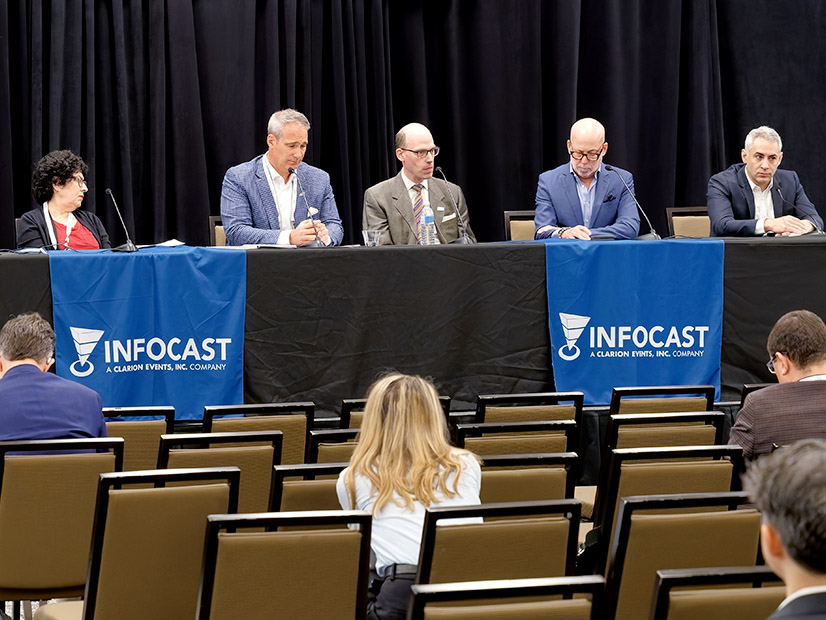
The first project approvals are not expected until 2028 and it will take another five to 10 years to get transmission built, Brattle Principal Johannes Pfeifenberger said at the Energy Bar Association’s Annual Meeting. With delays, it could be 15 years before the order has a major impact on infrastructure, he added.
With an uncertain economy, and with AI being described as either another industrial revolution or a giant bubble that could burst, Order 1920’s scenario-based planning requirements could rationalize grid expansion.
“Scenario-based planning is actually a management tool that the oil companies invented in the ’50s and ’60s and have used since then to support many billions of dollars of infrastructure investment in a highly uncertain world,” Pfeifenberger said. “It does not mean you use scenarios. It’s a process of systematically using scenarios to bracket uncertainty, to account for the future.”
It is not as simple as planning around different prices for natural gas. Planners will come up with five different versions of the future and what transmission expansion will be needed and then test those solutions across different scenarios.
“This kind of futures-based planning is the way to deal with uncertainty and plan specifically for it allows you to create flexibility,” Pfeifenberger said. “Base-case planning means flexibility has no value, because you’re only planning for the base case as if there was no uncertainty. We need to think differently about this.”
In one future, a single-circuit line is needed. In another, a dual-circuit line works best. Then it would make sense to build a single-circuit project using dual-circuit towers, he said.
“You should pick the lowest cost option that also minimizes the risk of being wrong,” Pfeifenberger said.
If the grid needs to triple over the next few decades to accommodate load growth, a third of could come from using the existing system better; another third from upsizing the grid; and a third from entirely new infrastructure. That kind of loading order is mandated in some countries, he added.
While Order 1920 is being implemented, different regions have different systems. SPP’s rules are in line with much of it, such as its regular practice of looking ahead 20 years.
SPP already gave its Regional State Committee (made up of state regulators) authority over cost allocation. And it has agreed to continue the highway/byway methodology under Order 1920, said Kimberly O’Guinn the RTO’s senior director of state regulatory policy. The RSC is considering an additional set of cost allocation rules for public policy.
SPP also is implementing its consolidated planning process (CPP) that will mitigate some of the gaps left by the status quo planning process. (See SPP’s Consolidated Planning Process a “Bold Step,” FERC Says.)
“It is a complete overhaul of how we do transmission planning, generation interconnection, and our cost allocation,” O’Guinn said. “A lot of work, a lot of energy has gone into this process.”
The CPP combines transmission planning and interconnection processes, giving generation developers more certainty over costs and sharing upgrade costs with consumers when they benefit. The hope is the system will minimize projects dropping out and the knock-on effects that often has with the queue, O’Guinn said.
Transmission planning varied widely across the regions before 1920 was passed. An earlier iteration of FERC hoped Order 1000 would lead to more universal rules around the country, but it suffered from bad timing.
“You have to think about what was going out on outside, like in the world,” NARUC Senior Director of Energy Policy Kimberly Duffley said. “Order 1000 was in 2011, and it really came on the heels of the 2009 financial crisis. And you also had the cancelation of the PATH project in Virginia, which was a large regional line. And that ended in a huge amount, millions and millions of dollars, in stranded cost.”
FERC can issue orders, but they land in the real world where the incentives for transmission expansion are not lined up well. Now with affordability and speed-to-power driving the industry, long-term planning might not look like the best tool for the moment, Duffley said.
“But it could be that it can be the tool in the toolbox for the longer term, right?” Duffley said. “Because, depending on who you talk to — it is uncertain. There’s just going to be continuing load. And so how do we meet that, as you say, least-regrets way?”