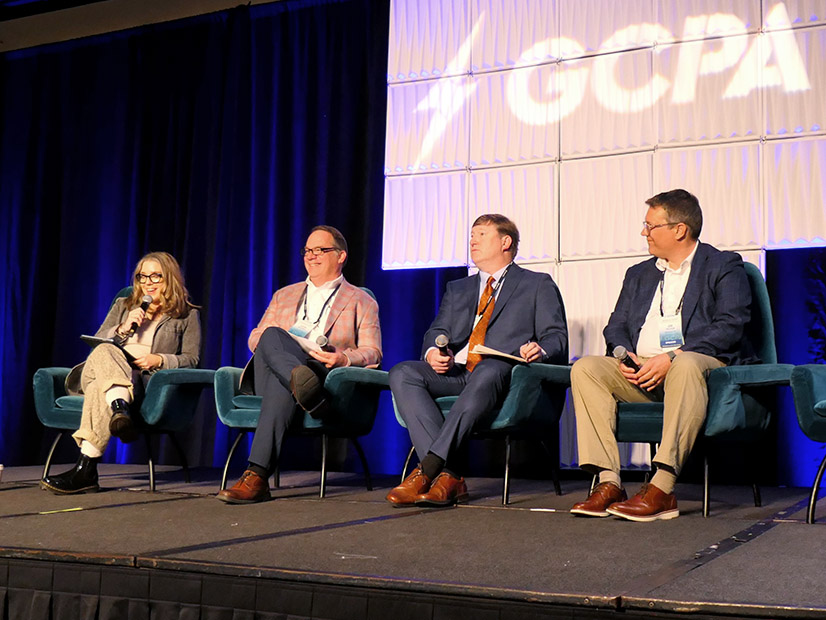
The Indiana Utility Regulatory Commission opened an investigative inquiry into the state’s major utilities in response to increasingly steep residential electric and gas bills.
IURC Chair Andy Zay, who has been on the job for six weeks, promised a “transparent and public discussion” on affordability and rising rates. He said the “environment we’re living under” is a product of rate cases that were decided three to four years ago and whose full impact is now being felt.
“I think affordability is defined every … month by Hoosiers when they receive that bill,” Zay said during a Feb. 25 press conference.
The IURC will hold a hearing March 24, with representatives of all five major utilities in the state called to appear. They are asked to present on energy affordability, bill transparency and how they could bring down mounting costs in the near term.
Zay said the IURC is going to proceed as quickly as it can. He said he plans to personally meet with ratepayers while collecting information in the field. The inquiry could morph into a formal investigation with a case number, Zay said, and could also set off a re-examination of existing law.
To submit a commentary on this topic, email forum@rtoinsider.com.
“There may be legislative concerns that come out of this inquiry,” Zay said. “As you know, we do not make policy here at the commission. We’re the implementors of policies.”
However, Zay said, he wants ratepayers to know that “we have their back” to help ensure there are enough energy resources for economic growth at the most affordable rates possible.
Including Zay, the IURC comprises three new commissioners, appointed by Gov. Mike Braun in December 2025. Zay is a former state senator.
Indiana’s major regulated investor-owned utilities include AES Indiana, CenterPoint Energy, Duke Energy Indiana, Indiana Michigan Power and Northern Indiana Public Service Co. Of those, NIPSCO has raised rates most dramatically in recent years. (See Consumer Group Says NIPSCO Affordability Crisis Direct Result of Indiana Laws.)
The IURC’s 2025 Electricity Residential Bill Survey found the average NIPSCO customer using 1,000 kWh in July shouldered an over-90% increase in their bill from 2016 to 2025. The U.S. Energy Information Administration also reported that NIPSCO in 2024 charged the second-highest residential customer rate among all electric utilities that reported data. NIPSCO’s rate is about 30% higher than Indiana’s median residential rate.
A day before the inquiry announcement, IMP announced it would file a rate decrease with the IURC this summer. The utility said it could lower base electric rates because of higher revenue from an influx of large load customers, including Google’s data center in Fort Wayne.
Zay said the press conference was unprecedented because the commission is “not typically an outward-facing agency” and it is not the agency’s “style … to get involved in these issues.”
However, he said the commission’s Consumer Affairs Division has received a “volume” of complaints, as well as correspondence from state representatives.
Zay said the commission took a few months to decide how to address fast-rising rates because it was examining what role it could play in short-term solutions. He said until now, most of the IURC’s work is reactionary based on the cases that come before it.
“It’s time for us to participate in two ways: one, be reflective of decisions we’ve made in the past and change the tone or create a tone of how we’re going to look at cases going forward, and two, [decide] what we can do in the short term,” Zay said.
He cautioned that the commission is challenged not only by affordability concerns, but also by reliability, resilience and environmental considerations.
“Those are difficult to define in a financial sense. And that’s in no way to excuse or dodge anything,” he said.
Former Commissioner Praises Probe
Regulatory Assistance Project principal Sarah Freeman, who exited the IURC in October 2025 after nine years as a commissioner, said the inquiry is an “important step in making energy regulation — and thus affordability concerns — more open, accessible and accountable to the public.”
“Energy regulation and ratemaking are getting the public attention they’ve always deserved, but the reason why is deeply unfortunate,” Freeman said in a statement to RTO Insider. “Every Hoosier deserves to be able to afford life’s necessities, and it’s unacceptable that anyone has to make impossible choices like whether to heat their home or feed their family.”
Freeman commended the IURC for hearing concerns and acting on them. She said the recent passage of Indiana’s House Bill 1002 — which would link rates to performance benchmarks like affordability and reliability — provides “an opportunity for the commission to really dig deep and figure out how to make reliable energy cheaper for Hoosiers.”
But Indiana consumer and environmental advocacy organization Citizens Action Coalition has said laws the state enacted in 2023 and 2025 have rendered the IURC powerless to do anything but endorse rate hikes.
Freeman did not comment on whether she was unable to rein in rate increases because of state law.
A Reckoning for Past Laws?
Indiana House Democrats released a joint statement welcoming the inquiry; they also said blame can be attributed to legislation passed over the past 15 years.
“The truth is, legislation passed by the Statehouse Republican supermajority is why Hoosiers are facing massive spikes in their utility bills today. An investigation without an honest assessment of these policies will be incomplete,” they said.
Democrats said the existing unaffordability crisis originated in 2013 with Senate Enrolled Act 560, which created a charge that allowed utilities to recover 80% of the costs of system improvements without having to establish a rate case. They also cited subsequent laws that ended Indiana’s energy efficiency program, terminated net metering, stuck customers with coal ash cleanup costs, allowed construction work in progress (CWIP) recovery and shut out transmission-building competition through a right of first refusal for incumbent utilities.
Nearly a month before the IURC’s announcement, a group of 16 House Republicans sent a letter to Zay detailing “a significant rise in the number of emails, phone calls and letters from our constituents regarding their NIPSCO bills.”
They said NIPSCO’s rate statistics in particular are “concerning” and requested an investigation into whether “rates have become unreasonable or unjustly discriminatory.”
The Republicans asked the IURC to get to the bottom of what investments and operational expenses of the last decade have led to the increases, compare rates among other state utilities and those in peer states and identify steps to curb rising energy rates.
“We want to thank all who have reached out to us about the hardships that they have faced due to these high NIPSCO bills, and we will continue to advocate that Indiana’s regulatory framework properly balances the five pillars of energy policy: affordability, reliability, resiliency, stability and environmental sustainability,” they wrote.
They did not address whether past laws that allowed automatic charges and trackers influenced the predicament.
Meanwhile, in neighboring Illinois, lawmakers have introduced the Utility Transparency Act (HB4781/SB3497), which could prohibit utilities from passing on certain internal costs to customers, including corporate and legal fees, advertising, trade group membership dues and insurance to protect shareholders. It represents the state’s tactic to counter its own spate of electric and gas bills that have recently doubled.