Concerned its restart of the former Three Mile Island nuclear plant could be constrained for years, Constellation Energy is asking FERC for waivers to parts of PJM’s Open Access Transmission Tariff.
Constellation’s March 31 request to FERC (ER26-2028) entails transferring capacity interconnection rights from Units 3 and 4 at its Eddystone Generating Station near Philadelphia to Unit 1 at Three Mile Island near Harrisburg, which it renamed the Crane Clean Energy Center.
As it stands, numerous regionally planned transmission projects must be completed before Crane can be fully deliverable, Constellation said.
Those projects have scheduled in-service dates as late as December 2030 but many of them already have experienced years of delays and could be delayed further, Constellation said.
Constellation has moved the expected completion date for Crane forward to the second half of 2027, and Constellation CEO Joe Dominguez said during a March 31 conference call with financial analysts that the company still expects to meet that goal despite the potential delays outlined in the FERC filing.
“I want to assure you we are working on that with PJM, and we continue to expect to start this unit in ’27,” he said.
The subject was not raised again during the call, either by Constellation officials or by analysts.
A company spokesperson elaborated April 7 via email:
“The Crane restart remains on track for the second half of 2027, and we continue to expect to be able to deliver energy to the grid at that time. While PJM projected 2031 for full deliverability of the facility based on the preliminary results of its first phase interconnection study, Constellation is actively engaged with various parties, including our utility partners, to evaluate a range of potential options to move that schedule forward.”
A PJM spokesperson said: “PJM recognizes the urgency of bringing new generation online as quickly as possible. We expect to clear up to 30 GW of projects for interconnection this year, including Crane. We are committed to connecting resources quickly and safely while maintaining the reliability of the grid and the integrity of the interconnection process.”
As of April 7, the PJM Independent Market Monitor and The New Jersey Division of Rate Counsel had motioned to intervene on the request in the FERC docket.
Constellation in its request to FERC noted the transmission projects identified as contingent facilities were planned and approved before Constellation asked PJM to include Crane in its Reliability Resource Initiative, the effort to expedite interconnection of new capacity in a market with potential capacity deficits looming. (See PJM Selects 51 Projects for Expedited Interconnection Studies.)
These contingent facilities include hundreds of miles of new 500-kV and 765-kV lines that are as far away as West Virginia and have a timeline stretching to December 2030, Constellation wrote.
Rather than wait for the work to be completed, the company is requesting a tariff waiver to remove Eddystone 3 and 4 from capacity resource status and a waiver allowing it to transfer Eddystone’s capacity interconnection rights to Crane.
Eddystone 3 and 4, each about 50 years old, had been scheduled for retirement May 31, 2025, but U.S. Department of Energy 202(c) orders have kept the two 380-MW gas/oil units online. (See DOE Extends Eddystone Emergency Order Through May.)
However, DOE specifically directed that the Eddystone units are not considered capacity resources and makes the case for transferring its capacity interconnection rights, Constellation pointed out.
Constellation added the waivers it seeks entail no known harm to third parties, no delay to PJM Transition Cycle No. 2, no effects to other projects and no market power concerns — the Independent Market Monitor already determined there were no market power concerns from deactivating Eddystone 3 and 4.
“Simply put, this is a Goldilocks opportunity,” Constellation wrote. “These circumstances present a one-time opportunity for the commission to ensure that more than 800 MW of baseload, dispatchable capacity can support customers and the grid as quickly as possible.”
New England States Commit to Exploring Nuclear Energy
The governors of Connecticut, Maine, Massachusetts, Vermont, New Hampshire and Rhode Island released a joint statement committing to exploring advanced nuclear energy technologies to meet the region’s electricity needs.
The group directed state energy offices to work together to pursue financing structures, federal funding opportunities, public-private partnerships and regulatory designs for nuclear opportunities.
Gov. Ivey Signs Bill Giving Governor More Control over PSC
Gov. Kay Ivey signed a bill that will give the governor significantly more power over the Public Service Commission.
The bill will expand the PSC to seven members, allow Ivey to appoint four new members this summer and direct the next governor to create a secretary of energy to supervise the commission. The PSC will not be able to hold a rate hearing until 2029 unless the secretary of energy or five of the seven commission members call for it.
Georgia Power Says Toxic Coal Ash Costs Increasing
Georgia Power said it will cost at least $500 million more than its previous estimates to clean up toxic coal ash ponds across the state.
In a report filed with Public Service Commission, Georgia Power said “several market factors” have driven up costs from $8 billion to $8.5 billion. The utility said it already has spent $2 billion cleaning up 29 coal ash ponds in 11 sites across the state.
PSC: NorthWestern Doesn’t Have to Release More Info in Merger Case
The Public Service Commission approved a staff recommendation to reject motions to compel NorthWestern Energy to provide details about its planned service to data centers as part of its proposed $15.4 billion merger with Black Hills Corp.
The Montana Farmers Union and 350Montana made the requests for information, saying NorthWestern couldn’t show it isn’t going to harm consumers in the merger without providing details about its plans to meet 1,400 MW of new data center load. NorthWestern argued details about data centers weren’t relevant to whether the PSC should approve the merger.
Judge Upholds BLM Approval of Rhyolite Ridge Lithium Mine
U.S. District Judge Cristina Silva upheld the approval of the Rhyolite Ridge Lithium-Boron Project.
Conservation groups argued the mine would threaten an endangered wildflower and fish native to Nevada. Silva ruled the Interior Department took a sufficiently “hard look” at the impacts of the mine on Tiehm’s buckwheat and Fish Lake Valley tui chub and “reasonably found” the project would “not result in unnecessary or undue degradation of Tiehm’s buckwheat.”
NV Energy’s Peak Demand Charge Postponed until Jan. 1
The Public Utilities Commission voted to postpone NV Energy’s new peak demand charge until Jan. 1.
The charge, which will be based on a customer’s highest 15-minute period of usage each day, was set to go into effect April 1 and would have been tested during the high-consumption summer months. NV Energy filed a request with the PUC on March 10 to delay the charge until Oct. 1, saying it was busy refunding customers who were overcharged for more than two decades and that it needed more time to educate customers about the new charge.
The utility intends to provide customers with comparisons in May and August of their bills with and without the demand charge, based on usage in April and July.
Following eight days of deliberations, Summit County Common Pleas Judge Susan Baker Ross announced the FirstEnergy bribery case centering around former CEO Chuck Jones and former Senior VP of External Affairs Mike Dowling has ended with a hung jury.
One juror said at different times for different charges, the jury was roughly 8 to 4 toward conviction. At others, it was close to 10 to 2.
The state can either retry or end the case. Attorney General Dave Yost said the state plans to retry the case.
State Proposes Oak Ridge as Nuclear Lifecycle Innovation Campus Site
Gov. Bill Lee announced the state submitted a proposal to DOE asking for Oak Ridge to be the site of a Nuclear Lifecycle Innovation Campus.
According to DOE, the proposed campus would support the creation of nuclear power through every stage of the process. In January, the agency asked state governments to submit information on potential locations. In its proposal, Tennessee said it had “the most comprehensive nuclear ecosystem in the U.S.” including “fuel fabrication, enrichment, reprocessing, advanced separations and recycling of used nuclear fuel.”
Supreme Court Ends Lawsuits Against Generators over 2021 Winter Storm
The Texas Supreme Court ended lawsuits against power generators from Texas residents and small businesses who lost electricity during the 2021 winter storm.
The Supreme Court provided no insight into why it ended the five separate appeals. Four of the nine justices did not participate in the ruling. The appeals sought to challenge a ruling from the state’s First Court of Appeals that dismissed the cases for having “no basis in law or fact.”
Regional utilities claimed the storm was to blame for the damages, not deficiencies in their own actions.
Renewables Grew to Nearly 50% of Global Capacity in 2025
Renewable power made up almost 50% of the world’s electricity capacity in 2025 following a record increase in solar installations, according to data from the International Renewable Energy Agency.
Global renewable capacity reached a record 5,149 GW at the end of 2025, up 692 GW from 2024. The growth was led by a leap in solar capacity, which grew by 511 GW in 2025 to 2,392 GW. There were 159 GW of new wind installations, taking the total installed capacity to 1,291 GW.
The data show the annual growth rate in renewable capacity in 2025 rose to 15.5% compared to 15.1% in 2024. Renewable groups in 2025 said meeting COP28’s renewables target by 2030 would require annual growth of 16.6% from 2025-2030.
U.S. LNG Exports Break Record as Middle East War Disrupts Supply
U.S. exports of LNG rose to an all‑time high in March as plants ran above nameplate capacity and new units started up, according to preliminary data from financial firm LSEG.
Exports in March climbed to 11.7 million metric tons, up from 9.94 million tons in February, and surpassed the previous monthly record of 11.5 million tons set in December 2025.
More than 1 million tons of LNG that departed in March is currently signaling for orders or idling near the entrance to the Suez Canal.
Interior Department Offering Another Round of Buyouts
The Interior Department is offering its staff another round of buyouts and early retirements.
A department press release announced it “will be offering another deferred resignation program as well as another opportunity for voluntary early retirement.” No other information was released.
GM Idles EV Plant, Temporarily Lays off 1,300 Workers
General Motors is idling its Factory ZERO EV plant in Detroit until April 13, extending downtime that began March 16, the company said.
“Factory ZERO will temporarily adjust production to align EV production with market demand,” a GM spokesperson said. The temporary layoff affects 1,300 workers.
Google, Microsoft Seek Gas Plants for Data Centers
Google and Microsoft are looking to secure natural gas resources to power data centers.
Google is partnering with Crusoe Energy to build a 933-MW gas plant in Armstrong County, Texas. The plant would be built on the site of the Goodnight campus and would operate off grid to provide energy to at least two buildings. It is the third known gas facility in Texas that Google has become involved in over the past few months.
Microsoft signed a “letter of intent” in March to secure nearly 1.4 GW from a microgrid project in Mason County, W.Va. The developer, Nscale, said it plans to deploy hundreds of gas generators by the first half of 2028. The deal marks the first time Microsoft has committed to a fully off-grid, gas-powered data center at gigawatt scale.
Pattern Energy Purchases Clean Power Producer Cordelio
Pattern Energy, a U.S. developer of renewable energy and transmission infrastructure, finalized the acquisition of Cordelio Power, a renewable independent power producer with 1.55 GW of assets.
Cordelio Power has a gigawatt-scale portfolio of operating and in-construction wind, solar and storage capacity in the U.S. and Canada. The assets, along with most of the company’s wind and storage development projects, will become part of Pattern Energy’s nearly 12-GW operating and under-construction fleet.
Tennessee Valley Authority CEO Don Moul notified the TVA Board of Directors on April 3 that he would retire July 1, 2026.
“The board appreciates Don’s service to TVA, its employees and the people of the Tennessee Valley region,” Chair Mitch Graves said in a statement. “Under his leadership, TVA has had strong operational and financial performance delivering reliable, affordable, American energy that helps communities across our seven states prosper.”
Moul joined TVA as its COO in mid-2021 and was promoted to president and CEO in April 2025. His tenure has been marked by tension with President Donald Trump, who fired three of the six sitting members of the nine-person board in spring 2025, eliminating the chance of a quorum, then nominated four new members.
Most recently, Trump had vowed to make Moul’s life “miserable” and issued a memorandum in March directing the board to set total annual individual employee compensation at a $500,000 maximum.
Trump’s dissatisfaction with the TVA spans a few issues. During his first term, he proposed a partial privatization, but Congress was not receptive to the idea. In his second term, Trump wants TVA to expedite nuclear power development and halt coal-fired power plant retirements.
Trump apparently remained unhappy with Moul, however.
When former CEO Jeff Lyash announced in early 2025 that he would retire, Tennessee’s Republican senators worried that his successor would be chosen from within and would not move nuclear development forward sufficiently quickly. The board did promote Moul from within but said an external and internal search preceded the move.
Trump sacked the board chair the day after TVA announced Moul’s appointment.
A 10-K report filed by TVA on Nov. 13, 2025, listed Moul’s 2025 salary at $1,000,923, but it indicates other streams brought his total compensation to $5,710,167.
The Tennessee Valley Authority Act of 1933 stipulates that compensation for all TVA employees “shall be based on an annual survey of the prevailing compensation for similar positions in private industry.” Trump’s memo directed the board to, “as appropriate and if consistent with its annual survey, adopt and implement policies” to cap the CEO’s salary at $500,000.
Other large utilities in the Southeast pay their CEOs base salaries in the same range as Moul’s but provide much more in total compensation:
Duke Energy CEO Harry Sideris received $13.7 million in 2025; his predecessor, Lynn Good, got $21.3 million and $20.6 million in 2024 and 2023.
Florida Power & Light CEO Brian Bolster got $9.2 million and $9.6 million in 2025 and 2024. (John Ketchum, CEO of parent company NextEra Energy, got $24.2 million and $21.6 million.)
Southern Co. CEO Chris Womack got $19.3 million, $16.7 million and $14.2 million in 2025, 2024 and 2023.
The head of the TVA typically is the highest-paid federal employee. During his first term, Trump had attacked Lyash’s multimillion-dollar compensation package.
Lyash, who became CEO of TVA in April 2019, received $10.5 million in total compensation in 2024 and 2023, his last two full years in that role. He received $6.8 million in 2025.
Eversource Energy and Avangrid have asked FERC to pause refund obligations stemming from the commission’s recent order cutting the return on equity for New England transmission owners and requiring the companies to issue extensive refunds (EL11-66, et al.).
The order on March 19 reduced the TOs’ base ROE from 10.57% to 9.57%. It set an Oct. 16, 2014, effective date, which coincides with the previous effective date for the 10.57% base ROE overturned by the D.C. Circuit Court of Appeals. FERC also required the TOs to issue refunds for a 15-month period following the date of the original 2011 petition that triggered the ongoing regulatory proceeding. (See FERC Cuts ‘Ping-ponging’ ROE for New England Transmission Owners.)
In a filing submitted April 2, Eversource and Avangrid estimated that the regionwide refund obligations would total about $1.5 billion, including interest.
“The magnitude of the required refunds is astonishing,” they wrote.
They estimated the refund obligations would total about $880 million for Eversource and about $203 million for Avangrid. The companies are the two largest TOs by mileage in the region and also own the two largest distribution networks.
They argued the refund requirements would “cause immediate and irreparable harm” to themselves, their investors and energy consumers. The obligations would hurt the companies’ financial liquidity, cost of capital and stock prices, and would lead to “operational instability, including risks to system planning and investment if funds must be diverted abruptly to pay refunds,” the companies wrote.
Eversource CFO John Moreira said the refund obligation “requires utilities to raise and carry a massive, unplanned financial liability and fundamentally disrupts liquidity, credit metrics, capital planning and investor confidence.”
“Higher borrowing costs and constrained access to capital increase the long-term cost of service and place upward pressure on customer rates,” he said.
The companies argued that processing the refunds while regulatory and legal challenges are underway would create risks of volatility on customers’ electric bills.
“Rather than providing durable customer benefits, immediate refunds followed by later recovery would subject customers to fluctuating charges that are difficult to predict, budget for or understand,” they wrote.
In contrast, state officials and consumer advocates applauded FERC’s ruling as a win for customers.
“This decision makes clear that utilities should not be allowed to make exorbitant profits on the backs of ratepayers, and that those profits should go back in people’s pockets where it belongs,” Massachusetts Gov. Maura Healey (D) said.
The state estimated the refunds would return about $900 million to New England ratepayers.
Massachusetts Attorney General Andrea Joy Campbell said the decision “reflects years of work to challenge excessive transmission profits and deliver meaningful relief.”
Tina Bennett, CEO of PowerOptions, a nonprofit energy-buying consortium, said FERC’s decision to cut the ROE “confirms what we argued all along — that regulated returns must track actual financial conditions, not outdated assumptions.”
While the utilities may appeal, “the broader outcome is clear: ratepayers are better protected,” she said.
Extension Request
In a separate filing on April 2, the New England transmission owners and ISO-NE asked FERC for an extension to the time allowed to complete the refunds.
The commission’s order included just a 30-day period to complete the refunds. The TOs and ISO-NE asked FERC to extend the refund deadline until Dec. 13, 2027, and the deadline for the refund report until Feb. 1, 2028.
They argued that the complicated nature of calculating and issuing the extensive refunds makes the 30-day timeline infeasible.
“The refunds must be processed on three tracks: regional, Schedule 12C and local rates,” they noted. “Each track involves different billing entities, sequencing requirements and reconciliation steps, further compounding the complexity of implementing refunds over such an extended historical period.”
Debbie DiFiore of ISO-NE said in an affidavit that “the proposed refund schedule represents the fastest timeline under which ISO-NE can calculate and administer the refunds, provided that the [New England TOs] submit the necessary information in a timely manner and in the agreed-upon format.”
It was one of those unexpected, revelatory moments ─ when one least expects it, the world stops and reality shifts ever so slightly, never to be quite the same again.
“Electricity is variable.”
The speaker was Romita Biswas, technical lead and adviser for Electrify DC, a home electrification advocacy group, welcoming a roomful of clean tech folks to a distributed energy resources showcase at the Healthy Homes Fair in D.C. on March 21. What she was talking about, Biswas told me during a subsequent online interview, are the essential physical characteristics of electricity.
“Electricity is just the movement of free electrons … something that relies on motion,” she said. It is not this smooth, unchanging thing flowing into our home outlets but electrons buzzing back and forth across a narrow, but still variable band of frequencies, all of which we are constantly trying to control.
The electric power industry in the U.S. has been built on the concept that reliable electricity can’t be variable; that any power ─ like solar and wind ─ that is less than 24/7 firm and dispatchable is unreliable and, therefore, less valuable.
But Biswas challenges us to imagine a different kind of electric power system, one that takes advantage of electricity’s inherent variability. “Let’s choose when we consume electricity. Let’s say we want to consume it at a lower price,” she said.
The subtext ─ at least at Healthy Homes ─ was that a system built around variability could provide flexibility and affordability in the production and consumption of electricity, and the technologies to deliver both are available.
K Kaufmann
In January, I wrote a Livewire column predicting 2026 would be the year of flexibility. Three months in, flexibility has become an industry buzz word, but I’m concerned it could be co-opted ─ assimilated into regulatory frameworks ─ amid rising panic about demand growth, high electric bills and the midterm elections.
On the plus side, President Donald Trump’s war in Iran has upended traditional arguments that fossil fuels are the most reliable, secure and cost-effective source of energy ─ for electricity and transportation. Data centers and their appetite for electrons continue to disrupt the regulatory and business frameworks of utilities.
We are past silver bullets and simple solutions. Distributed energy resources ─ especially solar, wind and storage ─ are emerging as smarter options on all counts, and flexibility is the key to optimizing their value and accelerating interconnection.
The focus so far in 2026 has been primarily on data centers and an emerging imperative pretty much everyone agrees on ─ gigawatt-guzzling large loads must pay for or bring their own power. A bit of election-year grandstanding, Trump’s Ratepayer Protection Pledge is an attempt to claim credit for innovations already emerging from data centers, states and utilities themselves.
A new report from Latitude Media notes that 25 utilities across 18 states have developed new rate structures specifically for data centers, 18 of which were filed with or approved by their respective utility commissions in 2024 and 2025.
But ensuring data centers pony up for the power they need is unlikely to provide long-term protection from residential rate increases. In addition to their data center initiatives, investor-owned utilities across the country are increasing their capital spending on new power plants, poles and wires ─ investments they can put into their rate base to justify subsequent requests for rate increases.
(On April 1, Heatmap and the Massachusetts Institute of Technology unveiled their new Electricity Price Hub, a user-friendly website where you can find how much utility bills in any part of the country, down to the ZIP codes, have changed over the past five years. The average bill for my utility, Pepco Maryland, jumped 16.5% over the past year and is up a whopping 60.5% since 2020 ─ and yes, we’re in PJM.)
Mainstreaming Flexibility
Industry efforts to mainstream flexibility within existing frameworks can be seen in the various efforts focused on quantifying large-load curtailment in ways that align with how utilities, grid operators and regulators evaluate different resources; that is, making it something they can deal with.
The Nicholas Institute for Energy, Environment & Sustainability at Duke University kicked off industry discussions on flexibility with its February 2025 report, suggesting that if data centers curtailed their energy use even .25%, they could open up space on the grid for 76 GW of new demand.
Their latest report, issued in March 2026, takes the next step, calling on state regulators to develop official definitions of flexible large loads “based on a set of enforceable curtailment commitments meeting specific technical requirements.”
As spelled out in the report, the four must-have commitments would include:
being voluntary;
being part of the interconnection process, or a condition of retail service;
being long term, to support system planning; and
guaranteeing curtailment across a set of minimum parameters, including the percent of total demand to be curtailed, response times, length of individual curtailments and total hours of availability per year.
For example, to qualify as a flexible large load, a data center might have to commit to curtailing 50% of its total demand within 5 to 10 minutes. Individual curtailments could last up to four hours and be available at least 2% of the time.
Ensuring such commitments are long term and made up front ─ as part of interconnection or retail service ─ would “ensure that [they are] relevant to the assessment of what infrastructure (distribution, transmission and capacity) is necessary,” the report says. “The avoidance of infrastructure needs is what insulates existing customers from affordability and reliability impacts.”
The Electric Power Research Institute uses much the same curtailment parameters in its FlexMOSAIC initiative, unveiled March 23 at CERAWeek in Houston, the fossil fuel industry’s premier annual conference. Aimed at cutting “time to power” for data centers ─ how quickly they can get the power they need to get online ─ EPRI describes FlexM as a “technology‑neutral way to describe and evaluate large load flexibility, based on power system requirements — such as congestion relief, peak reduction, balancing and frequency response.”
The result of cross-industry collaboration ─ with NERC, CAISO, MISO, SPP, NVIDIA, Google and Meta on board, along with a pile of utilities ─ the goal here is “a shared language and transparent performance expectations,” according to a technical overview of the initiative.
A website provides hypothetical examples of the different kinds or combinations of flexibility that might be needed to ensure timely interconnection in the face of rare or frequent “energy scarcity events,” long-duration scarcity events and any grid events requiring fast response.
Of course, quantifying flexibility is essential if it is to be properly valued and compensated. The risk is that utilities, grid operators, and state and federal regulators might appear to support flexibility but set such rigorous requirements or standards that few if any projects would be able to qualify, allowing these gatekeepers to claim flexibility isn’t feasible.
According to the Latitude Media report, none of the data center rates enacted or in the works thus far incorporate flexibility.
Super-smart Plug and Play
More to the point, Trump’s support for data centers bringing their own power assumes the power brought most likely will be large-scale and either nuclear or fossil fueled. When the Department of Energy announced $1.9 billion in funding for transmission upgrades and expansion, any projects that would benefit solar or wind energy were specifically prohibited.
But as was made abundantly clear at the Healthy Homes Fair, flexible, distributed technologies have a vital role to play in boosting grid reliability and affordability and, again, are ready and available.
The big buzz at the event was plug-and-play, smart technologies, like home energy management systems that work with existing electrical panels, so pricey upgrades are not required for installing electric vehicle chargers or induction stoves.
Jane Chen, cofounder and CEO of Stepwise Electric, sees homes and the neighborhood poles and wires that serve them as the electricity system’s “last mile” delivery network and “problem child,” driving peak demand and grid congestion.
The Stepwise Tap, a smart black box | Stepwise Electric
The Stepwise product, called Tap, literally is a black box an electrician connects to an existing electrical panel in a few hours. It monitors and manages the electricity use of appliances and can respond to utility signals at times of high demand.
For example, it can turn down or briefly turn off certain appliances ─ such as an EV charger or heat pump water heater ─ to help ease stress on the grid while keeping the rest of a house operating normally.
Elastic Energy’s ER01 is an even smaller black box that doesn’t even need to be connected to an electric panel and can turn any home or business into a grid asset, according to CEO Ben Hilborn.
The box, which is a router, connects to home equipment ─ via Wi-Fi, Ethernet or LTE-M ─ and enrolls them in any appropriate utility demand management programs so they can use electricity efficiently and cost effectively “in real time, based on real pricing signals,” Hilborn said.
Breaking down the silos between how these assets get compensated “is one of the last true remaining unlocks” to achieving an “equitable grid for everyone,” he said.
In both cases, the black boxes allow for aggregation of distributed technologies and coordination with the local distribution systems.
Adding batteries to home appliances ─ such as Copper’s plug-in induction stoves ─ is another trend aimed at shifting and managing demand. The stoves can operate off grid, storing enough electricity to cook six meals, or 76 grilled cheese sandwiches, in the event of a power outage, according to Joshua Land, the company’s founder and head of strategic partnerships.
‘Get it Done’
The message is that flexibility is itself variable and multidimensional ─ we need it top-down and bottom-up ─ and smart, distributed technologies are the enablers. The challenge ahead is to accelerate commercialization and cut upfront costs. The households that could benefit most from the cost savings that clean, distributed technologies provide are frequently those that can least afford them.
A December 2025 report from Rewiring America argues that beyond bringing their own power, hyperscalers could open up more capacity on the grid ─ enough to meet all their demand growth ─ with strategic funding for home upgrades, such as solar, storage and heat pumps.
As is often the case, Google is leading the industry. On March 20, the company announced it will power a new data center in Michigan with 2.7 GW of solar power, advanced grid technologies and demand flexibility, and will provide $10 million to fund home weatherization and energy efficiency upgrades in local communities. Another data center it is developing in Minnesota will include $50 million for smaller, distribution-level storage projects, along with 1.9 GW of utility-scale solar, wind and long-duration energy storage.
But beyond funding, we will need to make fundamental changes in utility industry regulation at the state level, said former FERC Commissioner Allison Clements, speaking at Healthy Homes.
The legacy U.S. grid, built out in the 20th century, is no longer “built for purpose” in our 21st-century digital economy, Clements said.
“If ever there was a time to take advantage of DER technology … it is right now,” she said. “We have an opportunity to make these things work, and if we don’t do it right now, we’re not going to get it done.”
Clements called for a new focus on “community power … [that] has the ability to reduce the amount of expensive power that your communities need to purchase, that your utility needs to purchase on your behalf.”
She also rejected the industry’s “technical, wonky, electricity regulatory language. … It hasn’t worked.”
Rather, like Biswas, she challenged people to “think about what it really means to make changes. Don’t accept that just because we’ve been really bad at it for 25 years, that that’s the way it has to be, because it doesn’t.”
Energy policy and regulatory news in 2026 has been all data centers, all the time. A new database shows 77 large load tariffs either in place or being considered at utilities around the United States.
As you might expect, the data center business is booming in places like Texas, Louisiana, California and Ohio. Regulators are scrambling to catch the wave.
Ken Sands
As RTO InsiderISO-NE correspondent Jon Lamson reported recently, even New England is grappling with potential data center expansion because of perceived affordability issues. New England has few data centers in the pipeline, in part because of the region’s high electricity costs. (See Data Center Interest, Opposition on the Rise in New England.)
All of this signifies a big shift in a brief period of time. RTO Insider’s James Downing recently reported that before 2025, most tariffs the Smart Electric Power Alliance tracked were for smaller customers — applying to facilities with demand of 5-10 MW.
As Downing reported: “Most of the tariffs characterize large loads by their size and load factor, but some get more specific and are aimed at specific types of customers, such as data centers or crypto miners. Other changes are designed to require data center projects to provide upfront interconnection deposits meant to weed out speculative projects shopping for the best, cheapest connections to the grid.”
Making Your Voice Heard
What do you make of all this? Are the tariffs an overreaction, an underreaction or an appropriate response? We’d like to hear from you.
We regularly publish opinion pieces in our Stakeholder Forum feature. We ask contributors for around 800 words, on a topic relevant to our RTO/ISO readership. We like to use a photo or a graphic to accompany the op-ed, as well as a mug shot of the writer(s).
Meanwhile, our data center coverage will continue, as we examine these large load tariffs and whatever emerges from stakeholder meetings in the various ISOs and RTOs. Stay tuned.
RENSSELAER, N.Y. — The results of NYISO’s 2024 transitional cluster deliverability study show that more than $1.1 billion of high-voltage transmission upgrades would be required to accommodate 48 projects in the batch of generation projects.
Hundreds of millions of dollars more would be needed to upgrade local transmission across the state’s capacity zones, according to a report presented at a special Operations Committee meeting March 31.
Whether developers will be on the hook for the upgrades is up in the air. NYISO plans to file a proposal with FERC to revise the deliverability study methodology.
This is the first round of the ISO’s ongoing move toward batched interconnection studies. Most of the projects in the batch are solar, storage, and onshore and offshore wind. Stakeholders approved the preliminary results unanimously.
The deliverability test checks to see whether the New York transmission system can accommodate the additional capacity. If necessary, the ISO will determine the cost of system upgrades to make delivery of the new resources’ capacity possible. These upgrades are broken down into “highway,” or high-voltage transmission facilities, and “byways,” lower-voltage localized transmission facilities. The cost of a highway upgrade is divided between transmission owners and developers. Byway upgrades are paid for by developers.
The test determined that projects located in the north and west of the state would all need highway upgrades to deliver their power through the Volney East and Total East interfaces. These upgrades would cost an estimated $1.107 billion, with roughly $88 million going to Volney East and the rest going to Total East.
Twenty-four projects spread across the Lower Hudson Valley, upstate, western and northern New York were determined to need byway upgrades. NYISO estimates these would cost $45 million and would cover the rebuilds of nine facilities.
Six of the 12 projects located in New York City would require byway upgrades across two local transmission facilities. NYISO estimates these upgrades would cost $619 million, of which $618 million would go to a new phased array relay control line from Fresh Kills on Staten Island to Rockaway Beach, Queens. Two new shunt reactors on Fresh Kills would also be required.
Six of the 13 projects on Long Island would require byway upgrades to be deliverable. These would be spread across three transmission facilities and cost roughly $419 million. The most expensive upgrade would be a new phased array relay between Brookhaven and Smithfield, with additional transmission upgrades in Holbrook, costing more than $334 million.
Of the more than 200 projects that initially joined the 2024 transitional cluster study, only 92 remain, and 89 are requesting energy resource interconnection service and capacity resource interconnection service (CRIS). The remaining three projects only requested CRIS.
Stakeholders questioned some of the parameters of the study, asking whether the ISO was testing for an extreme load case that “might never happen.” Zach Smith, vice president of system and resource planning for NYISO, said those requirements likely would be be changed before the end of the cluster study.
“Assuming the board approves, we’ll be filing with FERC for that revised methodology,” Smith said. He explained the changes would be in effect before the cluster study concludes, assuming FERC responds within its required 60-day window. “We have to follow the current tariff for now, and that’s the purpose of today’s presentation.”
Wenjin Yan, manager of generation integration, explained there would not be an additional draft of the deliverability study forthcoming because under the new methodology many of the upgrades were unnecessary. Those that remained “completely overlapped” with upgrades identified in this study.
Data in the appendix of NYISO’s presentation demonstrated that the new deliverability study methodology would cut dramatically the number of upgrades needed. Specific cost estimates were not provided, but the results showed far fewer violations on Central East and Volney East.
The Bonneville Power Administration’s draft decision “solidifying” its day-ahead market choice in favor of SPP’s Markets+ has reignited a yearslong debate over the agency’s direction.
Advocacy organizations, public and investor-owned utilities, data center developers and attorneys general, among others, submitted comments before an April 3 deadline following BPA’s announcement that it is “solidifying its path” to join Markets+.
BPA’s March 12 draft decision differs from the agency’s day-ahead market policy and record of decision (ROD) it issued in 2025 in favor of Markets+ over CAISO’s Extended Day-Ahead Market, according to the agency. The earlier policies were “a direction toward participation in Markets+” when the market was still in a “conceptual stage,” BPA staff said during a March 12 workshop discussing the decision. (See BPA Releases Draft Decision Solidifying Markets+ Choice and BPA Chooses Markets+ over EDAM.)
Recent Markets+ developments have “allowed the agency to advance implementation planning efforts and further evaluate readiness requirements,” BPA Administrator John Hairston wrote in a letter accompanying the draft decision.
One key factor in BPA’s decision to opt for Markets+ over EDAM was market governance. Specifically, BPA argued Markets+ offers independent governance, whereas EDAM risked falling under the influence of stakeholders in California.
In response, EDAM proponents have pointed to the impact of the West-Wide Governance Pathways Initiative and California Assembly Bill 825 of 2025, which together allow CAISO to shift governance of EDAM and the ISO’s Western Energy Imbalance Market to a Regional Organization for Western Energy (ROWE). (See ROWE Close to Finalizing Board Selection Process.)
ROWE was incorporated in Delaware in February.
Some see the ROWE as a means to alleviate concerns among potential market participants that CAISO, whose governing board is appointed by the California governor, plays too large a role in the markets’ governance.
On April 3, Renewable Northwest (RNW), Portland General Electric and the attorneys general of Oregon and Washington said in separate comments that BPA should revisit its governance analysis in light of the establishment of ROWE.
For example, RNW asked BPA to explain how AB 825 and ROWE factored into the agency’s decision.
Those concerns were shared by data center developers in the Northwest.
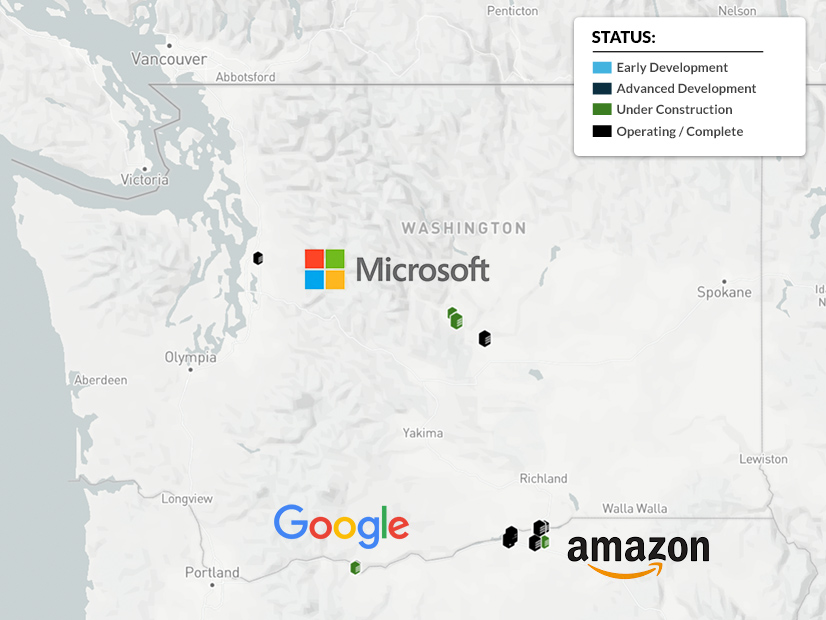
In a joint letter, Google, Amazon, Microsoft, the Corporate Energy Buyers Association and Western Freedom said that “the record should reflect enacted legislation and implemented governance structures, rather than proposals that were still under development at the time.”
“Maintaining an out-of-date record while introducing this additional final proposed decision is unnecessary,” the large customers said in reference to Pathways and ROWE.
Microsoft, Amazon and Google operate data centers in Oregon and Washington. The companies, along with Western Freedom and the Corporate Energy Buyers Association, voiced concern over BPA’s draft day-ahead market decision. | Yes Energy
Western Freedom’s CEO Kathleen Staks also is co-chair of Pathways’ Launch Committee and is ROWE’s interim president.
RNW contended BPA has reaped between $26 million and $36 million in benefits since 2022 from participating in the WEIM and asked for more information on how moving to bilateral trading will impact electricity prices and reliability.
RNW’s concerns were shared by the large load customers. The customers also noted that BPA has experienced recent staffing cuts under President Donald Trump. (See BPA Looks to Fill 155 Positions After Hiring Freeze.)
“Bonneville’s departure from the WEIM is a significant change in operations for the West, and it’s one that is not simple to unwind,” the customers wrote. “Any new market may face unforeseen delays pushing that further. While staffing constraints may factor into capacity to participate, stakeholders need a clearer picture of the tradeoffs and alternatives.”
No ‘New Factual Findings’
In its comments, Earthjustice, the lead plaintiff in a suit challenging BPA’s May 2025 ROD in the U.S. 9th Circuit Court of Appeals, contended that the draft decision offered nothing new of substance regarding the “policy direction” BPA outlined in the ROD. (See Nonprofits Tell 9th Circuit BPA’s Day-Ahead Market Decision Poses ‘Imminent’ Harm.)
“While titled the ‘decision to join Markets+,’ Bonneville’s [proposed] decision does not amend or otherwise change its May 9, 2025, final day-ahead market policy and ROD, nor does it affect the finality of that decision,” the organization wrote, characterizing the proposed decision as “no more than the next step on the path to implementing” the decision already made a year ago.
“Bonneville is not making any new factual findings to support its decision to participate in Markets+,” Earthjustice said. “Put simply, Bonneville is no longer considering the economic benefits and drawbacks and environmental consequences of day-ahead market participation, nor is Bonneville considering market alternatives such as participating in the EDAM.”
Earthjustice also cautioned BPA not to withdraw from the WEIM in October 2027, ahead of the winter heating season.
“While Bonneville states it needs to depart the WEIM a year prior to joining Markets+, to provide the agency the opportunity to gain experience in ‘Markets+ mechanics,’ Bonneville has not presented any data reflecting the cost to customers from this early departure,” the group wrote.
Markets+ Supporters Urge BPA to ‘Finalize’ Choice
In its comments, the Public Power Council said there have been no major changes since BPA issued its initial day-ahead market decision in May 2025 that would justify the agency changing course.
Markets+ has continued to develop with entities preparing to join in October 2027, PPC wrote, adding “this additional certainty created by the regional entities’ commitments to participate in Markets+ should only strengthen BPA’s decision.”
PPC noted that while EDAM has evolved “in parallel with Markets+,” CAISO’s offering “ultimately does not meet the requirements set forth by BPA and its customers.”
ROWE still is linked to CAISO and concerns remain about whether the organization will be fully “financially independent,” PPC argued.
“With no changes to CAISO statutory obligations, the relationship between CAISO and the ROWE does not meet PPC’s expectations of independence,” PPC wrote. “Thus, the creation of the ROWE does not change any of BPA’s analysis related to the governance structures of the two market offerings.”
Meanwhile, Powerex, which is set to join Markets+ on Oct. 1, 2027, added its support for BPA’s participation in SPP’s market and urged the agency to “finalize this decision.”
“BPA’s power customers need certainty to prepare for their market-related roles and responsibilities under the Provider of Choice contracts, and its transmission customers need to work with BPA on representing their BPA transmission rights in Markets+,” Powerex wrote. “BPA’s plan to align its go-live with the BP-29 rate period and initial Provider of Choice deliveries is sound, but the benefits of that alignment depend on BPA’s firm and durable commitment to Markets+, together with timely implementation.”
Snohomish County PUD, Tacoma Power, the Alliance of Western Energy Consumers (AWEC) and Northwest Requirements Utilities (NRU) argued BPA had provided sufficient justification to pursue Markets+, saying the agency should finalize its choice.
“The decision is grounded in thorough, objective analysis; it is aligned with the positions NRU has advocated for consistently throughout this process; and it provides the governance independence, economic benefits and environmental attribute protections that NRU’s members require,” NRU wrote in comments.
On the issue of WEIM, AWEC said the exit from the market is necessary “to transition to a new reliability coordinator, to amend its Provider of Choice contracts with its customers, and to engage in rate and tariff proceedings to fully implement the agency’s decision. AWEC is confident that BPA will work through these issues in lockstep with customers and stakeholders.”