MISO Debates What-ifs, Vows Improvements in Front of La. PSC After Load Shed

MISO leadership again promised to step up the RTO’s advance communication of tight system conditions following its four-hour load-shed directive for about 600 MW in Greater New Orleans on May 25.

MISO dispatched Senior Vice President Todd Hillman and MISO Executive Director of Market Operations JT Smith to the Louisiana Public Service Commission’s June 18 meeting to elucidate steps leading up to the blackouts and face censure from commissioners.

Hillman said MISO is thinking through how it can better communicate the risk it expects before “these types of rare and unfortunate events.” He said MISO is accountable as the reliability coordinator of the wholesale electric grid and that staff worked diligently on that Sunday to combat unavailable generation, transmission congestion and a tornado-damaged, unreachable Nelson-Richard 500-kV line. (See MISO Says Public Communication Needs Work After NOLA Load Shed.)

Hillman told commissioners that because the emergency ultimately can be traced to a transmission emergency instead of a capacity emergency, MISO did not sequence through its typical alerts and warnings before resorting to load shed.

MISO’s capacity advisories and maximum generation alerts and warnings are reserved for when MISO could be short on capacity, not transmission availability. Hillman said MISO doesn’t have warning protocols for transmission emergencies and is working on implementing some.

“We don’t have a lot of those. We’re not quite used to those,” he said of transmission emergencies.

Entergy CEO Phillip May said Entergy is similarly investigating how to improve the “timeliness of communication of load-shed risk.”

Commissioner Foster Campbell asked Hillman if MISO thought it owed people compensation for damages, lost revenue and adverse health outcomes during the blackouts. He said it’s “hard to swallow” that customers are obligated to not miss bills, but MISO could drop the ball without consequence.

Like he did before the New Orleans City Council, Hillman explained that MISO does not interact with retail customers and only has operational control over Entergy and Cleco’s transmission, not generation. He said MISO is a nonprofit that doesn’t have a mechanism to reimburse ratepayers, and its wholesale customers are Entergy and Cleco. (See NOLA City Council Puts Entergy, MISO in Hot Seat over Outages and MISO: New Orleans Area Outages Owed to Scant Gen, Congestion, Heat.)

Campbell said that Entergy seemed to be pointing the finger at MISO for providing roughly eight minutes of notification before the utility was forced to take load offline. Once MISO identified the risk of exceeding an interconnection reliability operating limit (IROL) on Entergy’s system on May 25, the RTO had a total of 30 minutes to offload demand and clear conditions per NERC requirements.

“That’s the nature of the conditions of this IROL,” Hillman said.

May confirmed that Entergy had less than 10 minutes to comply and dial down load.

Smith said MISO spent some of the half-hour trying to find alternatives to the last resort of blackouts. He added that MISO is trying to figure out if it met NERC’s 30-minute time limit and told commissioners MISO should have been “communicating much earlier about this risk.”

In addition to 2.65 GW of planned outages across four generating units near the southeastern Louisiana load pocket, MISO experienced eight unplanned generation outages on May 25 totaling 3.86 GW. Generation derates accounted for another lost 1.1 GW on top of that.

“That’s just a very large number to have out in a load pocket,” Hillman said.

Commissioner Davante Lewis asked if MISO would name the generators. He said that although he knew of Entergy’s two offline nuclear units, no one has identified the other generators.
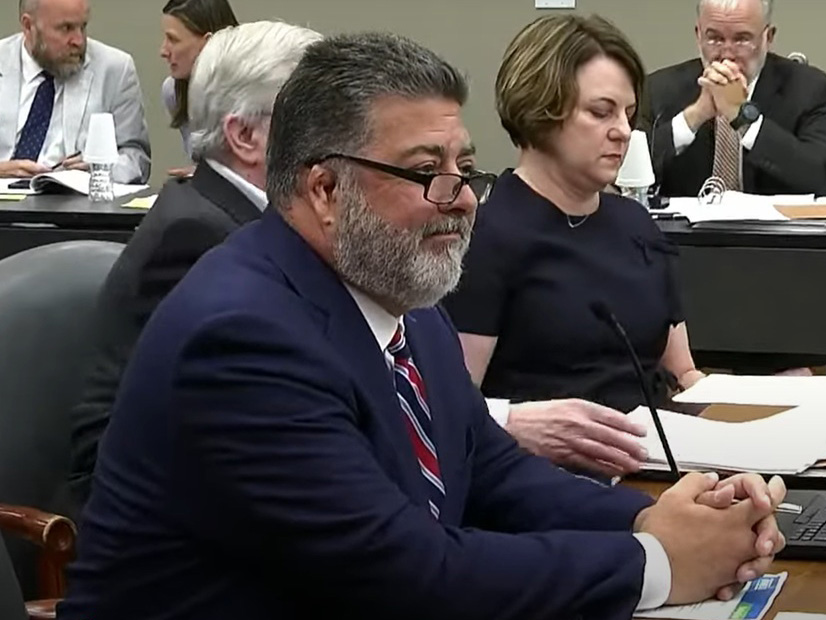
MISO’s Todd Hillman addresses the Louisiana Public Service Commission at its June 18 meeting. | La. PSC

Hillman said MISO would provide that information in data response requests and only when a utility has allowed MISO to release the information. MISO as a rule doesn’t identify units that are on outage.

However, Commissioner Eric Skrmetta said Entergy told him it has a waiver letter on file with MISO that allows the RTO to disclose utility data when asked by the commission. He said he viewed it as a “serious infraction” that MISO seemed not to follow the waiver letter and noted that commissioners must answer questions from the public and the press while MISO does not. He added that the PSC will seek data requests.

Skrmetta said he thought MISO could have “staved off” some of the load shed by turning to some of Entergy’s more than 400 MW of interruptible customers. He said some generating units that were on unplanned outage had been offline for days at that point, so they wouldn’t have shown up in the day-ahead market that morning either.

Skrmetta said the outage seemed carried out “in more of a panic” than in a “planned, methodical … activation.” He said in pre-RTO days, it seemed that companies took more pains to avoid blackouts, and the PSC could issue fines against shareholders and order rate credits for the public. He said in this case, the PSC is left with no recourse save for maybe a class-action lawsuit against MISO because it left Entergy and Cleco no choice but to “start flipping switches” or risk widespread system damage.

“I think we’ve got real problems with this,” Skrmetta said. “It’s unacceptable, and I hope people find a way to, you know, effectively get their pound of flesh out of you. We’re not going to be able to do it, but we’re going to have to find a way to make it more reliable in the future.”

Skrmetta said he did not need MISO leadership to respond to his criticisms.

Earlier, Hillman said he understood the load-shed event was “frustrating, disruptive and deeply concerning.”

Lewis asked if MISO had ever before experienced so many outages in a single local resource zone.

Smith said outside of significant storm damage, he couldn’t recall ever having “such a consolidated area of outages like that.”

Lewis noted that some unplanned outages already were in play the week prior and asked what conversations MISO had around contingencies ahead of time.

Hillman said communications were flowing between operators, with reconfiguration plans, studies and analyses performed throughout the day.

Smith said May 24 started out remarkably similar to May 25, but storms in the afternoon cooled the air and dampened demand. He said operator logs from May 24 noted that MISO was coming close to localized load shed, though they managed conditions with reconfiguration and dispatching generation down to avoid infrastructure damage.

Commissioner Jean-Paul P. Coussan asked if the load-shed judgement call was the result of automated processes or AI use.

Hillman said while a computer system runs system simulations, it’s backed up by MISO’s experienced human operators. He said the decisions that day were not dominated by technology, and control room operators tested conclusions and made phone calls to members in a plea for emergency-range output before making the order.

Smith said that on May 25, about 160 MW of Entergy’s approximately 400 MW of load-modifying resources were available with about four-hour lead times. Had MISO called them up in advance, they may have improved conditions, he said.

However, Smith said MISO’s forecasts at the time were “generally good” and its forward-view models did not reflect “the dire conditions that were eventually shown.” He said the IROL was unforeseen, and MISO is investigating the accuracy of its modeling. Hillman said in addition to modeling improvements, MISO is considering introducing drills so it can lay out what members can expect in a transmission emergency.

Lewis said the event clearly shows that Louisiana needs more transmission capacity in and around the Downstream of Gypsy load pocket. That load pocket predates Entergy’s inclusion into MISO.

May said Entergy is pursuing multiple, “significant” transmission projects that could help inject more power into the Amite South load pocket, which encompasses most of southeastern Louisiana and includes the Downstream of Gypsy load pocket. Entergy representatives said a new 41-mile, 230-kV Adams Creek-to-Robert line approved under MISO’s 2023 Transmission Expansion Plan and expected to be in service at the end of 2027 should help the area by adding 100 MW of import capability.

Asked by Lewis about Entergy’s receptiveness to long-range transmission planning from MISO, Entergy Associate General Counsel Matthew Brown said he didn’t believe long-term transmission is best suited to resolve load pockets in Louisiana. Brown said more targeted transmission that can be built quickly is an ideal solution, not big-picture, long-range projects that can take a decade to build and can assign costs to customers in states that don’t stand to benefit.

Lewis said he worried that without some intensive transmission planning, Louisiana could be in for more problems.

CAISO Approves New EDAM Congestion Revenue Allocation Design

CAISO has approved the final proposal in its highest-priority initiative in 2025.  

The CAISO Board of Governors and Western Energy Markets (WEM) Governing Body at a joint meeting June 19 approved a new method for allocating certain congestion revenues in the ISO’s Extended Day-Ahead Market (EDAM), set to launch in 2026. 

CAISO began the initiative to address a paper by Powerex that said the existing EDAM model contains a “design flaw” with potentially $1 billion in unjustifiable charges at stake. (See Powerex Paper Sparks Dispute over EDAM ‘Design Flaw’.) 

Since then, CAISO has issued multiple proposals on the subject and has held stakeholder workshops to resolve potential congestion revenue allocation issues that could arise under EDAM — some of which continue to exist in the final design, certain stakeholders contend. (See CAISO EDAM Congestion Revenue Proposal Gains Support.)  

“I think it would be an understatement to say that this initiative and proposal seem to be the most intense and engaged issue since the approval of EDAM,” Governing Body Chair Robert Kondziolka said at the June 19 meeting. “Although painful at times, the stakeholder process works.”  

“It’s clear that we are in territory that other ISOs haven’t navigated, so we are learning as we go,” CAISO board Chair Severin Borenstein added. 

The proposal is intended to address the fact that congestion revenues, or rents, will occur when a transmission constraint in one EDAM balancing area affects the locational marginal prices in neighboring balancing areas. In these cases, the market operator pays less to suppliers than to market participants. 

Under the current EDAM model, congestion revenues would be allocated to the balancing authority area that contains the transmission constraint that is causing congestion on the system. This design is in effect in the WEIM and has been approved by FERC. 

Under the new design, certain congestion revenues would be allocated to the BA where the energy is scheduled, rather than where the constraint is located. The new design applies in cases of parallel flow — or loop flow — on the system. In these parallel flow situations, congestion revenues will be allocated to an EDAM BA where congestion revenues are collected by using eligible firm Open Access Transmission Tariff transmission rights submitted and cleared as day-ahead balanced self-schedules, CAISO said in a June 12 memo on the matter. 

The purpose of the new design is to improve congestion cost protections for transmission customers exercising eligible firm transmission rights under the terms of the EDAM entity’s OATT, CAISO said in the memo. The design applies only to the day-ahead market, not congestion revenue allocations in the Western Energy Imbalance Market (WEIM). 

Most stakeholders support the final design, CAISO staff said at the meeting. However, two primary concerns remain among many stakeholders: one, that the design is ‘transitional’; and two, that the design could create economic incentives to self-schedule energy resources. 

The Unknowns

For transitional concerns, stakeholders want the ISO to “ensure there is a forum for consideration of a long-term design for congestion revenue allocation as the EDAM footprint grows,” CAISO said in its memo. CAISO therefore will hold working groups with stakeholders before EDAM begins in 2026.  

After these working groups, CASIO said it will propose a long-term design within the next two years. CAISO also will monitor the performance and impacts of this transitional change using certain metrics that will be shared with stakeholders.

The primary concern of CAISO’s Market Surveillance Committee (MSC) is about the new design’s potential to create self-scheduling incentives, which potentially reduce the benefits of coordinating unit commitment and dispatch across multiple balancing areas that EDAM is intended to provide, and potentially result in unintended cost shifts, MSC committee members said in a June 16 memo. 

“We do want to avoid those self-scheduling incentives,” consultant Scott Harvey, MSC member, said at the meeting. “On the other hand, they might be small … and there is not going to be a lot of self-scheduling in response to these incentives. But we think that is not a given and these are things CAISO needs to look at.” 

“EDAM is not an off-the-shelf product,” Harvey added. “When you’re doing something for the first time, you should never assume everything is going to work right.” 

The ISO’s Department of Market Monitor (DMM) agreed the new design is likely to create economic incentives for some inefficient self-scheduling of resources. However, while this will reduce the efficiency benefits from managing congestion over an expanded EDAM footprint relative to the currently approved design, there still would be significant benefits from an expanded market relative to the current pre-EDAM market, Eric Hildebrandt, DMM executive director, said in a June 12 memo 

The ISO has provided data showing there is reasonable hope that the potential for inefficient self-scheduling would be limited in the PacifiCorp balancing areas, Hildebrandt said. 

Tri-State Tells Colorado PUC Joining SPP RTO in Public Interest

Tri-State Generation and Transmission Association asked the Colorado Public Utilities Commission to find it would be in the public interest for the power supplier to join SPP, saying integrating with the RTO woud bring significant benefits. 

Tri-State said in a June 17 news release that it is preparing to fully integrate with SPP’s RTO West expansion in April 2026 together with six other Western utilities and that it has filed an application for a public interest determination with the commission. 

By joining the RTO, Tri-State would bring resources located in the power supplier’s Colorado, Nebraska and Wyoming Western Interconnection system, totaling more than 20 generating units, more than 3,100 miles of high voltage transmission and portions of 23 of Tri-State’s members’ loads, “representing 67% percent of gross load across the Tri-State system,” according to the release. 

Additionally, Tri-State touted the benefits of joining the RTO, saying it would bring an estimated $20 million in annual net benefits and increased ability to meet energy demand and greenhouse gas reduction targets, among other benefits. 

“The expansion of the SPP RTO is the most cost-effective pathway to organized market benefit for Tri-State’s members,” Duane Highley, Tri-State’s CEO, said in a statement. “Our participation will support our members’ goals for reliability, affordability and a cleaner energy future, with cost savings shared by all members.” 

“SPP welcomes Tri-State’s announcement about their expanded participation in the SPP RTO,” Carrie Simpson, SPP vice president of markets, told RTO Insider. “As a long-standing SPP member and key energy provider in the West, Tri-State’s deeper involvement strengthens our shared commitment to responsibly and economically keep the lights on today and in the future.”

“This announcement formalizes plans announced years ago and applies only to Tri-State’s Colorado facilities outside the Xcel system. It does not impact Tri-State’s continued participation in Markets+ for facilities within Xcel,” Simpson added.

FERC on March 20 accepted SPP’s proposed revisions to its tariff that will incorporate seven Western Interconnection entities as transmission-owning members of the RTO, making the grid operator the first to provide full market services in the grid’s two major interconnections. (See FERC Approves Tariff for SPP RTO West.) 

SPP has targeted April 2026 as when the entities, including Tri-State, will begin participating in its Integrated Marketplace, transmission planning, reliability coordination and other RTO services. They all are members of the Western Energy Imbalance Service market, which SPP has administered since 2021: 

    • Basin Electric Power Cooperative 
    • Colorado Springs Utilities 
    • Deseret Power Electric Cooperative 
    • Municipal Energy Agency of Nebraska 
    • Platte River Power Authority
    • Western Area Power Administration 

SPP has said RTO West will provide more than $200 million in annual benefits to its members, primarily through the optimization of DC ties with the Eastern Interconnection. 

In the June 17 news release, Tri-State said the RTO will reduce seams between providers in “Colorado, Wyoming, Montana and Nebraska through the consolidation of seven transmission providers’ tariffs into an SPP RTO common tariff, also reducing the costly “pancaking” of transmission rates.” 

Tri-State noted that seams will continue to exist between the Western Area Power Administration’s Colorado-Missouri balancing area and that of the Public Service Company of Colorado, which is seeking to join SPP’s Markets+ day-ahead market offering. (See PSCo Seeks to Join SPP’s Markets+.) 

Tri-State has been one of the signatories to a series of “issue alerts” touting the purported advantages of Markets+ over CAISO’s extended day-ahead market and the Western Energy Imbalance Market (WEIM). (See 7th ‘Issue Alert’ Highlights Markets+ Footprint.) 

“We greatly value the full benefits of the SPP RTO, including day-ahead, real-time and ancillary services markets, efficient regional transmission planning, reliability coordination, a common transmission tariff and a participatory governance model that help us reduce costs and advance clean energy goals,” Highley said. 

Load Growth Putting Pressure on Capacity Markets in the Northeast

BOSTON — Capacity markets have brought significant cost savings for customers in the Northeast over the past two decades but now face the critical need to evolve amid rapid load growth and a changing resource mix, according to a group of experts.

“We’re in a moment that requires a significant amount of evolution,” said Liz Delaney, vice president at New Leaf Energy, speaking at the Energy Bar Association’s annual Northeast Chapter meeting on June 18.

All three of the Northeastern RTOs have pursued significant capacity market reforms in recent years; ISO-NE and NYISO are in the midst of significant capacity market overhauls — the Capacity Market Structure Review project for NYISO and the Capacity Auction Reform project for ISO-NE — while FERC approved major resource accreditation changes for PJM in 2024. (See FERC Approves 1st PJM Proposal out of CIFP.)

Since the inception of capacity markets, grid operators frequently have made design changes to reduce volatility and improve price formation and resource accreditation, said Marc Montalvo, CEO of Daymark Energy Advisors.

“I think all of these things are evolutionary and are important, and are a sign of a dynamic learning environment, as opposed to a sign of weakness,” Montalvo said.

However, with every significant change, “there are dollars at play,” Montalvo added. “Politics is just played differently than either engineering or economics, and that’s where we find ourselves now.”

In PJM and MISO, resource retirements and new large loads — including AI data centers — have contributed to major spikes in capacity prices. (See MISO Summer Capacity Prices Shoot to $666.50 in 2025/26 Auction and PJM Capacity Prices Spike 10-fold in 2025/26 Auction.)

While New York and New England have not experienced the same level of large loads seeking to come online, both have ambitious transportation and building electrification goals, which, if successful, would drive significant load growth. The region also could see the addition of smaller-scale data centers. (See Limited Demand for Large-scale Data Centers in New England.)

Data center growth “really puts pressure on every corner of the industry,” said Samuel Newell, principal at the Brattle Group, noting that the recent spike in load growth projections appears to be “much more than our development pipeline, supply chains and transmission planning were ready for.”

There’s immense uncertainty around data center load growth, and it can be difficult to know if proposed load sources are real or speculative, Newell said.

“There’s so many uncertainties with regard to what demand will be, what computational efficiencies will be,” Newell said. “I don’t think it’s realistic to forecast it well.”

While rising capacity prices should increase the incentives for new resources, high costs also can cause political blowback for RTOs, a circumstance experienced recently in PJM.

“That’s real money in residential, commercial and industrial customers’ pockets … and it’s turning out to be a real political problem and flashpoint,” said Walter Graf, chief economist for PJM.

In New England, the capacity market has successfully signaled whether to build new resources and has helped shield customers from risks associated with generation development, said Bruce Anderson, senior vice president at the New England Power Generators Association (NEPGA).

In recent years, the region has seen “historically low clearing prices, reflective of the system at large,” Anderson said. Although ISO-NE anticipates load growth to accelerate over the next 10 years, peak loads in the region have been relatively static over the past decade, in part due to energy efficiency gains and the deployment of rooftop solar.

Anderson said he’s “very hopeful” about the capacity reforms underway at ISO-NE and is particularly interested in the capacity accreditation changes, which should allow for increased “substitutability” between different resource types in the market.

He added that ISO-NE’s proposal to cut the time between capacity auctions and the capacity commitment period (CCP), and split CCPs into summer and winter periods, should help the region cope with increasing winter reliability risks and enable better-informed investment decisions.

While ISO-NE’s CAR project creates short-term market uncertainty, Anderson said he hopes the capacity market that emerges will be able to provide a “period of stability” once finally implemented in the 2028/29 CCP.

“Getting some stability in the market, that really helps in investor confidence and investor decisions,” Anderson said.

He also said NEPGA members have discussed the potential to bring back some version of a price lock for new resources, which may help serve as an alternative to strict reliance on state contracts to bring more resources into the market.

In 2020, FERC ordered ISO-NE to eliminate its allowance of a seven-year price lock for new entrants, a move that was supported at the time by NEPGA. (See FERC Orders End to ISO-NE Capacity Price Locks.)

Other speakers spoke favorably about a seasonal market construct but expressed some skepticism about ISO-NE’s “prompt market” proposal, questioning whether the market will provide enough certainty to attract investment in new resources.

“I’m personally a bit skeptical of the benefits of New England moving from a forward to a prompt structure,” said Montalvo.

Delaney of New Leaf emphasized the importance of providing enough transparency to allow participants to model market outcomes multiple years into the future. She added that creating avenues for bilateral contracting is essential to helping new resources come online.

“We need some level of certainty over a significant portion of the revenues to make the math work,” Delaney said.

N.J. Launches Ambitious Energy Storage Incentive Program

The New Jersey Board of Public Utilities has launched a storage incentive program, aiming to develop 1,000 MW of capacity to mitigate the state’s energy shortfall. 

The first phase of the Garden State Energy Storage Program has a goal of developing 350 to 750 MW in transmission scale capacity by October. The agency aims to award the remainder of the first phase capacity by next May. 

The program will have a competitive solicitation, according to the June 18 board order explaining the plan. Financial support in the form of fixed incentives will be paid over 15 years. The program will be open to stand-alone energy storage projects as well as solar-plus-storage projects. The pre-qualification process will start June 25, and the final bid submission deadline is Aug. 20. 

“These projects are essential for mitigating the electric capacity supply crunch that is driving dramatic rate increases for New Jersey customers,” according to the order. It adds that “quantitative analysis” by the BPU staff indicates the project will “provide net savings to ratepayers within the first few years of its operation.” 

Boosting Supply

New Jersey, like other states, faces a potential energy shortfall, which PJM attributes in part to the closure of fossil fuel generators faster than new — mostly clean energy — facilities come online. Surging demand from data centers and electric vehicles exacerbates the problem. 

A BPU release said the storage project “directly addresses demand growth and limited supply.” 

“By strategically investing in energy storage now, we’re building a resilient system that can better withstand both man-made and weather-related disruptions,” BPU President Christine Guhl-Sadovy said in a release. She added that storage also can “support the critical integration of more clean energy, which is vital for New Jersey’s sustainable future and peace of mind.” 

Democratic legislators and BPU officials argue that solar and storage projects are the quickest and cheapest way to add new electricity generation. Storage can provide power overnight or when the sun is not out, and help meet spikes in demand. The BPU says storage can boost the supply of electricity, thus reducing prices.   

Guhl-Sadovy called the launch of the program a “pivotal moment for New Jersey’s energy landscape,” 

“This isn’t just about meeting our climate goals, it’s about making sure every family can afford to keep their lights on and their home comfortable,” she said. 

New Jersey’s Clean Energy Act of 2018 requires the state to deploy 2,000 MW of energy storage. The state already has missed a state target of having 600 MW of storage in place by 2021. The BPU said last year the state had just 560 MW of installed storage. 

Future Phases

The BPU in 2015 established the Renewable Electric Storage Incentive Program and also offered incentives to solar projects coupled with storage under the agency’s Successor Solar Incentive (SuSI) program, neither of which covered the large scale and sweep of the latest program.  

The BPU’s first version of the Storage Incentive Program (SIP), released in 2022, focused on how to stimulate storage. It since has been modified into the current version through a series of public hearings. (See Impact of NJ’s Storage Plan on Overburdened Communities Questioned.)  

The second phase of the new program is intended to be launched in 2026 but was not approved in the June 18 order. It would “focus on incentives for smaller energy storage systems connected to local distribution grids, including both “in front of the meter” (grid-connected) and “behind the meter” (residential or commercial) systems, according to the BPU release. 

A third phase that would offer transmission performance incentives also is under consideration, but the phase is “currently deferred” according to the order. 

Fred DeSanti, executive director of the New Jersey Solar Energy Coalition, said in an email to RTO Insider that he understands “the potential good that can come of transmission level storage in terms of helping with the capacity shortfall.” But he expressed concern that the funding would come from the Regional Greenhouse Gas Initiative (RGGI). 

DeSanti said the state, an energy importer, has reaped most of the benefits it can from participating in the RGGI program. He added that by deferring the behind-the-meter proposal to the second phase of the storage program, the state “misses an opportunity to help this important market” just as it faces the loss of crucial tax credits in the federal budget being shaped by Congress. 

Mitigating Ratepayer Pain

The BPU emphasized the way extensive storage capacity could help bring down electricity prices in the state, as the agency also backed a series of initiatives designed to mitigate the impact of the recent 20% hike on the average ratepayer bill. 

The board approved changes in the state universal service fund (USF), which provides credits to low- and moderate-income ratepayers struggling to pay gas and electricity bills. The board increased the minimum USF benefit from $5 to $20 and the maximum benefit from $180 to $200. 

The board order also requires utilities to increase ratepayer enrollment in the program to ensure that more eligible ratepayers benefit. The state’s four utilities are required to increase by 5% their enrollment in the program during the year from October 2024 to September 2025. They should increase enrollment by 3% in the second year and by 2% in the third year, according to the plan. 

The changes are expected to affect 136,000 existing customers who receive the minimum benefit and an additional 8,000 who receive the maximum benefit, according to the BPU. The utility enrollment efforts are aimed at the 80% of eligible household that are not signed up for the benefit. 

The changes will cost about $28.5 million, which will be paid with existing funds, the board said. 

DOE’s Wright Fields Senate Questions About Funded Project Reviews

Senators had a chance to ask Energy Secretary Chris Wright about project spending his department has put under review — or already cut — when he testified at the Senate Energy and Natural Resources Committee about the Trump administration’s 2026 budget request.

“It is deeply concerning how many billions of dollars were rushed out the door without proper due diligence in the final days of the Biden administration,” Wright said during his June 18 testimony. “DOE is undertaking a thorough review of financial assistance that identifies waste of taxpayer dollars, protects America’s national security and advances President Trump’s commitment to unleash American energy dominance.”

He said that led DOE to terminate 24 projects totaling $3.7 billion in spending that failed to meet the economic, national security or energy security standards needed to sustain the agency’s investment.

Ranking Member Martin Heinrich (D-N.M.) said those deals were canceled without notice or justification and that DOE crossed into “impoundment territory,” which is when the executive branch cancels congressionally approved funds, an act only legal in narrow circumstances.

“Actions like these will severely damage our country’s ability to lead in developing and commercializing next generation technologies while ceding ground to our competitors,” Heinreich said.

Sen. Steve Daines (R-Mont.) asked about the North Plains Connector transmission project, which would run through his state and connect the Eastern and Western interconnections. Last summer it was awarded funds under the Grid Resilience and Innovation Partnership (GRIP). (See DOE Announces $2.2B in Grid Resilience, Innovation Awards.)

The project would open new markets to the Colstrip power plant, which currently is linked to utilities in Oregon and Washington, Daines said.

“This project would have the potential to diversify Montana’s generation assets, unlocking billions in private investment and enhance our nation’s energy security by connecting the Eastern and Western Electric grids,” he said.

Wright said he has met with the North Plains Connector’s developer previously and called the project — and the general idea of increasing transfer capability across the two interconnectors, a good idea.

“We are committed to following this project review process where a crew of people evaluate — not political, not biased for this or that,” Wright said. “Just look at the math, look at the numbers, and is this thing viable and beneficial for America. You know, yes, no or adjustable — it’s modifiable. So, we haven’t finished that on that project yet, but I think you make a strong case for the project.”

‘Demand and Pressure’

Sen. Angus King (I-Maine) noted that GRIP funding was approved under the bipartisan Infrastructure Investment and Jobs Act, and not the Inflation Reduction Act, which is much more unpopular with Republicans. He asked whether the DOE’s review of projects will be fair.

“We’re evaluating the engineering, the science, the finance and just the viability of the projects,” Wright said. “It is just a business review. Unfortunately, it wasn’t done before when grants were given. But I would say, in the GRIP program, there’s a lot of very good projects there.”

King then asked about a major energy storage project being built north of Bangor, Maine, by Form Energy, which is under review by DOE currently. (See: Form Energy to Develop First Multiday Storage Project in New England.)

“We stood up this process a few weeks ago,” Wright said, adding that the agency expects to do at least 20 reviews a week and telling King that he’s “very interested” in storage as well. “My chief of staff here is here with me, and we’ll make sure that in the next few weeks at most, we will get on to that project.”

King additionally said he didn’t understand why the Grid Deployment Office is facing a 75% cut in funding under DOE’s budget request, given the “demand and pressure” on the grid.

Wright said he thinks DOE’s most important grid-related offices are the Office of Electricity and the Office of Cybersecurity, Energy Security and Emergency Response. The budget cuts to GDO are part of a reorganization that will refocus its work in the Office of Electricity.

King said he hoped the funds earmarked to strengthen the grid are not slashed in the face of rising demand and more expensive power bills for consumers.

“One of the things I’ve noticed just in my career in energy is it used to be that the principal part of your electric bill was the cost of energy,” King said. “Now, in many places, transmission and distribution is 50% or more, and that’s only going to increase, unless we start to think about new technologies, what are called GETs, which I’m sure you’re familiar with — grid enhancing technology, so that we’re not simply rebuilding massive facilities that could be obviated by new technologies.”

Georgia Power Calls Largest-ever 50-50 Hydrogen Test a Success

A natural gas-fired plant outside Atlanta has completed what is described as the largest 50% hydrogen-gas blending test of its kind in the world. 

The trial was the latest in a series by Georgia Power and Mitsubishi Power at Plant McDonough-Atkinson in Smyrna, Ga., a former coal facility that was converted to natural gas in 2012. 

In 2022, the two companies and the Electric Power Research Institute carried out a similar test that also was the world’s largest up to that point, producing 265 MW at full load from an M501G advanced gas turbine with fuel that was 20% hydrogen by volume. 

In May and June, a series of tests at full and partial load culminated in 283 MW output with 50% hydrogen from an M501GAC turbine that had been converted from steam-cooled to air-cooled. 

The 20% hydrogen test achieved a 7% reduction in carbon emissions compared to 100% natural gas; the 50% hydrogen test achieved a 22% reduction. 

Georgia Power said in a June 16 news release that it entered the collaboration with Mitsubishi as part of its research and development efforts toward affordability, reliability and carbon reduction. 

But it did not specify what it would do with the results. A spokesperson told NetZero Insider that the utility and its partners would study the results of the trials to better assess the future potential of hydrogen. 

What to do with hydrogen is a common question these days. 

Clean hydrogen was a priority of the Biden administration as a clean, or less dirty, alternative to fossil fuels, but the rollout was delayed amid extensive debate over how to define “clean hydrogen” and how to subsidize its development. Many of the potential investments in hydrogen industrialization contemplated by the private sector were held back until these critical details were finalized. 

Final rules for the key 45V Clean Hydrogen Production Tax Credit were not issued until January 2025 — more than two years after the credit was authorized and less than three weeks before the arrival of President Donald Trump and his sharply different energy agenda. 

The latest word on congressional budget negotiations is that 45V is in line to be slashed or scrapped, the biggest loser among all the Biden-era green initiatives. 

Without the federal government’s carrot or stick urging wider adoption of hydrogen, an already-challenging proposition is losing some of its appeal. But some had never been sold on widespread use of hydrogen in the first place. 

The Institute for Energy Economics and Financial Analysis, for example, criticized the concept of hydrogen-fueled gas turbines in an August 2024 report, laying out all the challenges that face such an attempt and pitching existing options as better alternatives. 

If nothing else, hydrogen is not a one-to-one substitute for natural gas: It is much less energy-dense, meaning a greater volume is needed to generate the same amount of electricity. A 50-50 mix by volume, as at McDonough-Atkinson, does not produce anywhere near a 50% reduction in emissions because much more methane than hydrogen is being burned. 

Further, the process of producing hydrogen can be expensive, create emissions of its own or result in a net loss of energy potential — or some combination of the three. 

Natural gas remains the largest U.S. power source. The 2,084 utility-scale gas-fired power plants tallied by the U.S. Energy Information Administration in 2023 produced 43% of the nation’s electricity. 

But in 2024, EIA counted fewer than a dozen of those plants flirting with hydrogen: four facilities besides McDonough-Atkinson where hydrogen co-firing had been tested, three new plants that were hydrogen-capable and two plants where planned upgrades would add hydrogen capabilities. 

Georgia Power expects to be burning natural gas for many years to come. Its 2025 integrated resource plan proposed nuclear uprates, natural gas expansion, and delayed coal and gas retirements to meet anticipated demand growth. (See Georgia Power Proposes Nuclear Uprate, Delay in Fossil Retirement.) 

In its June 16 news release, Southern Co.’s largest electric subsidiary said natural gas remains a central part of its strategy. 

“Natural gas serves a critical role in our generation mix, providing flexibility, baseload power and quick response to customer demand, and will continue to be an important fuel as we plan to meet the energy needs of a growing Georgia through a diverse portfolio of generation resources,” Senior Production Officer Rick Anderson said. 

But hydrogen is one of the future avenues the utility is considering, and the McDonough-Atkinson trials are part of that, he added. “Innovative testing such as this is just one way we help ensure we can deliver reliable and affordable energy for customers for decades into the future and reduce our overall emissions.” 

Industry Sees Challenges as BPA Considers ‘Radical’ Updates to Transmission Planning

The Bonneville Power Administration faces monumental challenges in implementing actions to meet the Pacific Northwest’s needs once it lifts its pause on transmission planning, multiple stakeholders told RTO Insider.

BPA issued the pause in February to consider new “reforms” in light of “exponential growth” of transmission service requests. The agency’s 2025 transmission cluster study includes over 65 GW of requests, compared with 5.9 GW in 2021. The requests exceed the total regional load projected for the Pacific Northwest in 2034, according to the agency. (See BPA Halts Some Tx Planning Processes Amid Surge of Service Requests.)

To deal with the demand, BPA Administrator John Hairston has set ambitious goals for the agency. In a recent keynote address at the Western Conference of Public Service Commissioners’ annual meeting, Hairston noted that much of the challenge stems from planning “around prospective data centers or generators that may never come to fruition.”

Hairston said the agency sees the need for a “new planning paradigm.” It is “rethinking” its transmission planning processes and working with its utility customers to identify new approaches by the end of the year. (See Industry Needs ‘New Planning Paradigm,’ BPA Chief Tells Regulators.) Ultimately, Hairston wants to reduce the time from transmission request to service to five to six years.

In an email to RTO Insider, BPA spokesperson Nick Quinata said the agency “has committed to considering radical new methods to reduce the time it takes to enhance infrastructure to accommodate its customers’ needs.”

BPA will provide more information on its timeline and proposed solutions at a workshop in July.

A New Approach

But analyzing 65 GW is “impossible,” Randy Hardy, the agency’s administrator from 1991 to 1997, told RTO Insider.

“They’ve got to somehow define a set of rules that will give them a more realistic ability to analyze whatever subset of the 65 GW they deem appropriate,” Hardy said.

Much of the issue stems from aggressive clean energy legislation passed in Washington and Oregon in 2019 and 2021, respectively. The laws set strict standards for greenhouse gas emissions and ushered the region into a “gold rush” among developers, eventually leading to today’s situation, according to Hardy. (See Clean Energy, Equity Goals to Reshape Oregon IRP Process and Washington Agencies Adopt New Rules to Implement CETA.)

Even though not every project will be completed, BPA must assume the opposite when analyzing them, Hardy said.

“The cumulative costs associated with building all that transmission means that the expenses of any particular transmission service request are enormous,” he added.

He noted the 2023 cluster study included approximately 17 GW. The challenges with 65 GW are greater, and “even if you could analyze it, the cost would be so ridiculously high that nobody would sign up for anything.”

BPA must depart from the principle of first come, first serve when taking on requests, Hardy said.

The agency is “not regulated technically by FERC … but they’ve made a policy commitment to align themselves as closely as they can to the FERC pro forma tariff,” Hardy said. “They’re probably going to have to loosen that to some extent, because first come, first serve is not going to allow them to resolve this. They’ve got to be able to exercise some engineering judgment of the transmission service requests that are filed as to which ones look the most promising.”

Because FERC does not regulate BPA, the agency can and should take “bold steps” to clear up the transmission queue, Nicole Hughes, executive director at Renewable Northwest, told RTO Insider.

BPA should use its power to “wean out” speculative projects that are unlikely to get built. The challenge is to clear the queue equitably, Hughes said.

“We want to make sure that generation and load are being treated equitably and that load doesn’t take a higher priority here,” according to Hughes. “We want to make sure that the point-to-point customers are being treated equitably and the network customers aren’t being prioritized here.”

BPA has allowed other issues to take priority, like long-term contracts and its day-ahead market process, and the agency is now in “panic mode,” Hughes said. (See BPA Flooded with Comments on Draft Day-ahead Market Decision.)

Proactivity

Renewable Northwest has been a supporter of BPA taking a more proactive approach to transmission planning, Hughes said. She pointed to the Western Transmission Expansion Coalition (WestTEC), which is jointly facilitated by the Western Power Pool and WECC, as an example. (See WestTEC Tx Study on Track Despite Delays.)

WestTEC’s goal is to produce an actionable study to inform Western grid planning over 10- and 20-year planning horizons. Hughes said it’s unclear what BPA will do with the information coming out of the WestTEC process, saying “that’s still to be decided.”

Henry Tilghman, a consultant whose clients include Renewable Northwest and the Northwest & Intermountain Power Producers Coalition (NIPPC), said there is a disconnect between the development time frames for different types of facilities that need to be addressed. (Tilghman spoke with RTO Insider on his own behalf, not that of his clients.)

“You can bring a new gas plant or renewable generator online in 18 months once you have all of your permits and the financing in place,” Tilghman said. “The construction time can be a year and a half. Same for a data center. But if you’re looking at a new transmission expansion with all of the siting and permitting and everything, that … takes at least 10 years to do. …

“I think a lot of the problems that the region is facing that Bonneville is attempting to solve stem from really just sort of an inadequate regional planning process,” Tilghman added. “Even if we get it fixed … through Order 1920 compliance, we’re still catching up on all that planning work that could have been done and hasn’t been done.”

According to Lauren Tenney Denison, director of market policy and grid strategy at the Public Power Council (PPC), BPA is considering moving toward proactive planning as a possible solution.

“The cost and risk discussion is going to be a really important one throughout this process,” Denison said. “Building ahead of time, doing this proactive building that BPA is talking about, it has the ability to get us ready for future needs. But there is a cost to that, and so it’s just a challenging issue that we will need to address with the region as we work through this.”

Other challenges include the time it takes to build new transmission, a scarce labor pool and an arduous permitting process, PPC CEO Scott Simms said. For example, crossing state lines and different jurisdictions and federal agencies bring a host of bureaucratic headaches for developers, he said.

“We’ve seen proposals where segments of a line are approved and then they have a window, but there’s approval pending somewhere else, and then the original approval expires while the new ones being granted,” Simms said. “That’s just paperwork that can be easily revamped and removed.”

With a Little Help from Customers

There are opportunities for BPA customers to assist in developing transmission infrastructure, something Simms hopes will get fast tracked as the agency considers planning changes.

He said BPA appears willing to “engage or explore some disruptive elements that we haven’t done before.”

“We think that category includes the element of how customers of BPA can help shoulder some of that burden in order to make the regional objectives get achieved more quickly,” he added.

The PPC has support for this idea from NIPPC Executive Director Spencer Gray, among others.

“Bonneville has had, and does have, a pretty restrictive approach to outsourcing some of the grid upgrade work to customers,” Gray said. “We’re hoping that that can change. That feels like really low-hanging fruit. I think the place that’s most relevant is for network upgrades for interconnection customers. Both generators and load.”

There is an opportunity to leave more of the building to customers in the pro forma Open Access Transmission Tariff, according to Gray.

“We really think there’s room to liberalize that self-build option in the Northwest on Bonneville’s grid,” Gray said. Allowing a customer to either build themselves or contract out some of the work “would alleviate a lot of the burden on Bonneville itself to pull off some of these upgrades” and let the agency focus on “transmission service-driven upgrades rather than interconnection.”

Aaron Tinjum, vice president of energy for the Data Center Coalition, told RTO Insider in a statement that data center companies “are leaning in as engaged partners across the country to ensure we meet this moment in a way that supports both data center development and an affordable, reliable electricity grid for all customers.”

The industry is “committed to paying the full cost of service for the energy it uses, including transmission costs,” he said.

Workforce Challenges

Other reforms are needed to meet Hairston’s five-to-six-year timeline. A crucial one is allowing BPA to competitively pay staff. There’s a big pay gap between BPA and consumer- and investor-owned utilities, Gray said.

“Any entity of comparable size to Bonneville in terms of asset, ownership, operating revenue, circuit miles of transmission … they just pay more,” Gray added. “And if we’re going to keep good staff, new talented ones, we really need to get [BPA] competitive pay authority so [BPA] can compete in the market for personnel.”

The bipartisan Reliability for Ratepayers Act, passed by the U.S. House of Representatives on Jan. 15, aims to address this issue. Still, stakeholders told RTO Insider recent federal staffing cuts and “deferred resignation” buyout offers from President Donald Trump’s unofficial Department of Government Efficiency have caused significant disruptions and risk shaking morale at BPA.

About 200 agency employees — or 6% of the workforce — accepted the buyout offer, while 90 job offers had been rescinded following a federal hiring freeze announced Jan. 20, according to BPA.

U.S. Energy Secretary Chris Wright has said BPA will not undergo more staffing cuts as part of Trump’s quest to slim down the federal government. BPA’s federal workforce now stands at around 3,150 employees, Hairston said during the agency’s quarterly business review May 15. (See BPA Exempted from Federal Staffing Cuts, Hairston Says.)

Whether BPA can meet the five-to-six-year goal hinges on a sufficient workforce and the lifting of the federal hiring freeze, former Administrator Hardy said. He put the odds of accomplishing the goal at 50/50.

“They’re stuck with being down 200 positions when they actually need more than the 200 positions to be able to have sufficient staff to get them to a 90% or 80% level of confidence that they can accomplish all this stuff,” according to Hardy. “So can it be done? Maybe, but it is a huge, huge challenge given the staffing restrictions that they’re now subject to under the Trump administration.”

Oregon Governor Signs Bill to Create Data Center Rate Class

Oregon Gov. Tina Kotek on June 16 signed a bill designed to ensure that operators of large data centers pay for grid upgrades needed to supply them with electricity, avoiding shifting those costs to residential ratepayers as the facilities proliferate across the state. 

The Oregon Senate on June 3 voted 18-12 to approve an amended version of House Bill 3546, dubbed the POWER Act, followed two days later by the House of Representatives’ concurrence and passage 37-17. 

The bill directs the Oregon Public Utility Commission to create a new retail rate class for big electricity consumers such as hyperscale data centers and cryptocurrency miners in order to allocate grid upgrade costs “in a manner that is equal or proportional to the costs of serving the class.” (See Oregon House Passes Bill to Shift Energy Costs onto Data Centers.) 

Rep. Pam Marsh (D) sponsored the bill to insulate residential ratepayers from the infrastructure costs associated with serving the burgeoning number of high-consuming data centers in the state, saying the “explosion of huge technology facilities has upended” the traditional process for allocating energy-related costs proportionally among consumers. 

The new law, which applies only to the investor-owned utilities overseen by the PUC, stipulates that the new class “must be separate and distinct” from existing rate classes for other commercial or industrial retail electricity consumers and have its own tariff schedule. 

The law creates a new class of consumer — “large energy use facility” — to identify electricity customers who are equipped to use 20 MW or more of energy and provide computing services, data processing, web hosting or other related services. 

Under the law, the tariff schedule adopted by the PUC must require a large data center to foot the bill for a proportionate share of the grid upgrade costs a utility incurs to serve the facility. 

The data center operator would additionally be required to enter a service contract with its utility for a minimum of 10 years and be obligated “to pay a minimum amount or percentage, as determined by the [PUC], based on the retail electricity consumer’s projected electricity usage for the electricity services the electric company is contracted to provide for the duration of the contract.” 

The law does not restrict large data centers from using Oregon’s “direct access” program, which allows nonresidential consumers to purchase electricity from a PUC-certified electricity service supplier rather than a utility. 

‘The Whole Freaking Point’

The bill won the support of groups like the NW Energy Coalition, BlueGreen Alliance, Sierra Club and the Oregon Citizens’ Utility Board, along with utilities such as PacifiCorp. 

However, data center companies voiced their opposition, with the Data Center Coalition in March filing testimony saying that, while it supported the intent of HB 3546, it believed “no customer, industry or class should be singled out for differential or disparate rate treatment unless that approach is backed by verifiable cost-based reasoning.” 

Ellen Zuckerman, Google’s head of energy market development for North and South America, echoed that view during a June 3 panel discussion at the Western Conference of Public Service Commissioners’ annual meeting in Portland, Ore. 

“If you create a discriminatory rate class for data centers, what signal are you potentially sending to them? Are you telling them then to go off-system and invest in behind-the-meter resources?” Zuckerman said. “You’re losing that opportunity to invest their capital in your grid.” 

Zuckerman asked whether that could create “a system of balkanized planning” and “a paradigm where certain large customers can say ‘these resources are only for us’” and not offer them to the broader grid when other generating resources are set to retire.  

“These questions are really complicated; they warrant really deep stakeholder conversation,” she said. 

Speaking on the same panel, CUB Executive Director Bob Jenks said the data center operators are right to call the new rate class “discriminatory.” But “that’s the whole freaking point of a rate class: discrimination. You’re discriminating based on attributes and costs that are being put on the system and allocating them,” Jenks said. 

“We have a residential rate class because residential customers require a larger distribution network. We have an irrigator rate class because irrigators put unique costs on the system because of their summer usage pattern,” he said. “Because of their size, [and] the speed at which they can be built, their growth rate and their inflexibility, data centers have their own attributes that deserve their own rate class.” 

NERC Responds to MISO IMM’s LTRA Criticism

In a statement, NERC blamed “mismatched data” submitted by MISO for a calculation in its 2024 Long-Term Reliability Assessment that resulted in the ERO warning that the region could face energy shortfalls in 2025, while acknowledging its own responsibility for the mistake. 

MISO’s Independent Market Monitor David Patton called out the ERO for what he called a “completely inaccurate” perception at a June 10 Markets Committee meeting of the ISO’s Board of Directors in Minneapolis. (See MISO IMM Blasts NERC Long-term Assessment, Says RTO in Good RA Spot.)  

MISO was the only area of the continent labeled as “high risk” in the LTRA, published Dec. 17, 2024. The designation means that energy shortfalls are likely to occur under normal peak summer or winter conditions in the next five years. NERC said at the time that resource additions had not kept pace with retirements of coal-fired generation since 2023, causing “a sharp [projected] decline in anticipated resources” beginning in summer 2025. (See NERC Warns Challenges ‘Mounting’ in Coming Decade.) 

However, Patton asserted that NERC had incorrectly used MISO’s unforced capacity values instead of its installed capacity, then compared the resulting numbers to an installed capacity requirement. This error, which Patton called “an apples and oranges assessment,” reduced the region’s capacity by more than 10 GW in the LTRA. 

NERC’s statement said the ERO conducted an “in-depth review” and found MISO’s submitted data “overstated the near-term energy shortfall risk.” When the analysis was rerun with corrected data, NERC found MISO should be reclassified as “elevated risk” for the 2025-to-2027 time frame, meaning resources are sufficient for normal conditions but shortfalls could occur under extreme weather conditions.  

“While this data mismatch went unnoticed by MISO and the Midwest Reliability Organization (MRO) that initially collects and vets the data, NERC is ultimately responsible for ensuring the accuracy of its independent reliability assessments,” NERC said. “Going forward, NERC, MRO and MISO are all committed to improving the data validation process to ensure accuracy.”  

NERC said it regrets the discrepancy and plans to post a corrected version of the LTRA “soon,” but it did not specify a time frame. 

MISO’s risk level still could rise to high by 2028, NERC said, “depending on new resource additions [and] retirements.” The new data did not require MISO’s standing in the 2025 Summer Reliability Assessment to be changed, according to the ERO, because that report uses different data. The SRA found that MISO was at elevated risk of shortfalls, along with MRO-SaskPower, MRO-SPP, ERCOT, NPCC and WECC-Mexico in Baja California. (See NERC Warns Summer Shortfalls Possible in Multiple Regions.) 

At the MISO board meeting, Patton said the misleading LTRA already has influenced national policy, as shown by the Department of Energy’s directive to keep a 1.4-GW coal plant in Michigan operating over the summer. (See Consumers Energy Seeking Compensation for Keeping Campbell Open.) He warned the confusion could “lead to FERC ordering market changes that are unnecessary.”