CALGARY, Alberta — Opening the Aug. 13-14 meeting of NERC’s Board of Trustees, Chair Suzanne Keenan told attendees that “the visibility of the work we are doing … is off the charts right now … and our work is front and center” in the thinking of U.S. and Canadian policymakers.
Keenan reminded the audience that electric reliability has become a major concern because of the rapid spread of intermittent generation, worries about the grid’s transmission capacity and growing cyber threats from foreign adversaries like China and Russia.
“To keep up is requiring transformational change, such as the Modernization of Standards Processes and Procedures Task Force [MSPPTF]; our work on large loads and the gas-electric interface; rebuilding our compliance program to incorporate abeyance; expanding our registration for small [inverter-based resources]; renovating our approach to reliability assessments; and more,” Keenan said. “Any one of these would be the defining project in most organizations, yet NERC and the regions, with the support and engagement of our members, are tackling them all at once, head-on.”
In his own remarks, Electricity Canada CEO Francis Bradley reflected on the turmoil of the U.S.-Canada relationship since the inauguration of President Donald Trump in January. He praised the ERO for continuing to prioritize collaboration with Canadian regulators and utilities despite the two countries’ trade disagreements.
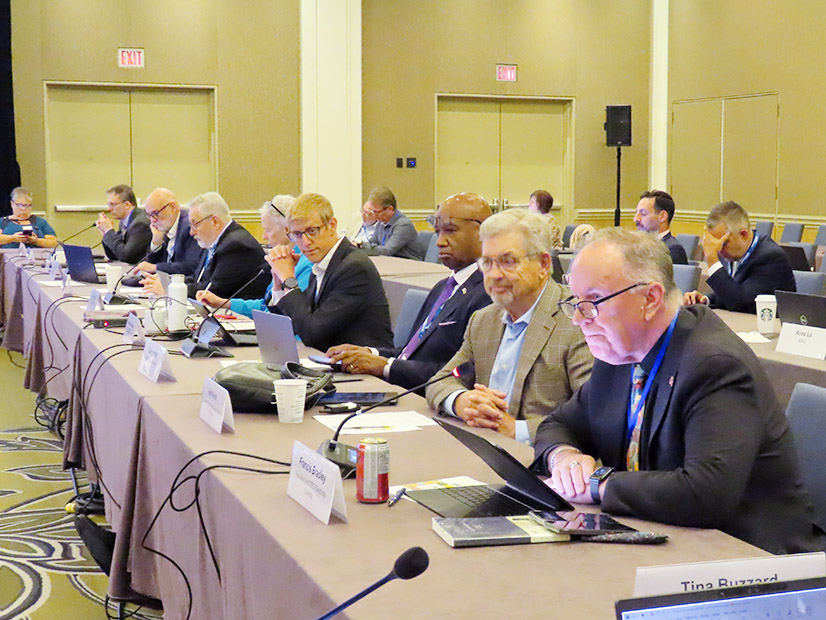
“I’m grateful that NERC exists. If it didn’t exist, we would have to create it,” Bradley said. “Electricity may be the example of what an effective cross-border relationship looks like; the stability amid the chaos. But let’s also make sure we don’t become complacent about that relationship and that we continue to look for ways to foster better and better collaboration.”
Board Approves 2026 ERO Budgets
Trustees voted to approve the proposed 2026 Business Plan and Budget for NERC, along with those of the regional entities and the Western Interconnection Regional Advisory Body (WIRAB), the day after their approval by the board’s Finance and Audit Committee (FAC). The budgets will be filed with FERC later this month.
When presenting the budgets to the FAC, CFO Andy Sharp reiterated that NERC is approaching 2026 as a “bridge year” between its current three-year plan, which concludes in 2025, and the next one, which will be developed during 2026 and begin in 2027. (See 2026 to be ‘Bridge Year’ for NERC Budget.) The ERO had planned to create another plan this year but decided to wait, considering the economic and regulatory uncertainty that has grown since Trump returned to the White House.
NERC’s 2026 budget is set to increase $5.3 million over the previous year to $128.3 million, while the assessment is to rise by the same amount to $113.7 million. The remaining budgeted expenses will be covered by NERC’s other funding sources, including fees from the Electricity Information Sharing and Analysis Center’s Cyber Risk Information Sharing Program and vendor affiliate program.
The total ERO budget — including NERC, the REs and WIRAB — is expected to grow $15.9 million to $320.5 million, with the total assessment climbing $18.7 million to $289.6 million. WIRAB plans the smallest increase, with $30,000 — for a total budget of $860,000 — while the Northeast Power Coordinating Council is expecting the largest increase at $2.7 million, for a total of $28.4 million.
Standards Modernization Update
Georgia System Operations CEO Greg Ford, chair of the MSPPTF, said the task force is “confident that we will deliver” recommendations for revamping the ERO’s standards development process by the February 2026 board meeting.
Updating trustees on the task force’s progress since its formation, Ford first noted the issuance of a white paper in July laying out several possible changes applicable to the standard initiation, development and balloting phases. (See NERC Task Force Members Share Standards Modernization Progress.) Proposals include a biannual review process for potential standards projects, centralizing all submissions through NERC’s Reliability and Security Technical Committee and using artificial intelligence for various amounts of work in the drafting process.
NERC is accepting comments on the white paper through Aug. 27. It held a series of webinars after its publication to explain the proposals in more detail and answer questions from industry stakeholders. Ford said nearly 3,200 attendees joined the webinars, showing the level of interest among the industry.
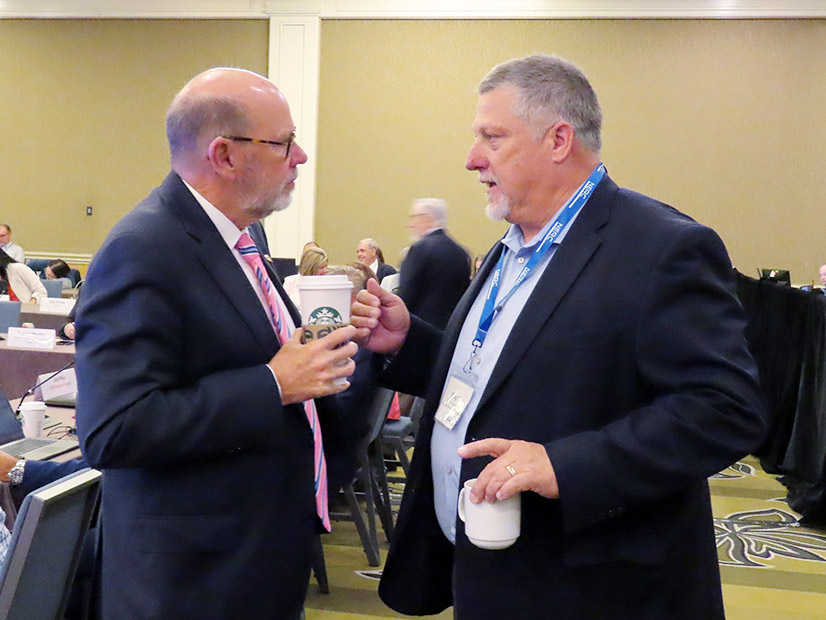
“That tells us a couple of things. It tells us we’re hitting on the right marks; they’re interested; and they’re willing to give us the comments to help us mold the actions that we’re going to bring to the board,” he said.
Ford also discussed the MSPPTF’s work during the Member Representatives Committee meeting prior to the board’s meeting. Asked by MRC Chair John Haarlow if the task force has identified any specific metrics to help measure efficiency improvements in the development process, Ford said that while it has not done so yet, he acknowledged that identifying such metrics would “make us a stronger ERO” and that the task force is working on it.
New Glossary Definitions Adopted
Trustees voted to adopt several new definitions for inclusion in NERC’s Glossary of Terms. They are related to FERC orders on IBRs.
Project 2024-01 (Rules of procedure definitions alignment — generator owner and generator operator) created new definitions for “generator owner” and “generator operator,” while Project 2020-06 (Verifications of models and data for generators) proposed to redefine “model validation” and “model verification.”
The GO and GOP definitions are intended to conform with NERC’s recent creation of new categories for owners of IBRs that previously were not required to register and follow the ERO’s standards. The other definitions arose from FERC Order 901 directing NERC to develop reliability requirements for IBRs and are meant to be used by other standards development teams working on those standards.