NERC RSTC Tackles Priority Projects in Quarterly Meeting

At the quarterly meeting of NERC’s Reliability and Security Technical Committee on June 10, NERC Chief Engineer Mark Lauby reminded members that the industry is facing “a busy time” dealing with the growing number of risks to grid reliability.

“Every meeting I come to, I always say this is the most important meeting we’ve had in a long time,” Lauby joked in his introductory remarks at CAISO’s headquarters in Folsom, Calif. “Of course, the RSTC is … the centerpiece of risk identification and risk mitigation, and clearly the work we have before us today is extremely important.”

The challenges “coming at [the ERO] like a head of steam” include the rapid growth of large loads like data centers and their impact on the grid, along with the reliability risks posed by inverter-based resources, which Lauby reminded attendees was the subject of several ongoing standards projects to meet FERC Order 901.

NERC Trustee Kristine Schmidt acknowledged the meeting — which kicked off three days of joint meetings among the RSTC, Reliability Issues Steering Committee and Standards Committee — represented a “heavy lift” for members and their companies. Echoing Lauby’s comments, she told attendees it was “critically important that we have your participation, leading the charge and creating such an important role for everything we do.”

The risks identified by Lauby and Schmidt ranked high on the meeting’s agenda, with Jack Gibfried of NERC’s Large Loads Task Force (LLTF) submitting for RSTC comment a white paper assessing the ability of existing engineering practices, requirements and reliability standards to address the reliability impacts of emerging large loads. Committee members will have 30 days to submit comments, starting June 13.

Gibfried said the white paper will feed into the LLTF’s next work plan item, a reliability guideline proposing best practices to address the gaps identified in the paper. He added that the task force hoped to submit the final edit of the white paper, addressing members’ comments, at the RSTC’s September meeting, hence the shortened comment period from the usual 45 days.

The LLTF white paper was the first of three accepted for comment by committee members. The next came from the Electric Vehicle Task Force (EVTF), with the goal to “identify, validate and prioritize the potential [grid] reliability risks related to motor vehicle electrification.”

EVTF members also requested a shortened comment period of 30 days for this white paper, in hopes of finishing their revisions by the September RSTC meeting. However, at the urging of Southern Company’s Todd Lucas, committee members approved a standard 45-day comment period for the paper.

NERC’s System Planning Impacts from DERs Working Group (SPIDERWG) asked for comment on a white paper analyzing the impact of DER aggregators on SPIDERWG’s model framework. The committee again approved extending the proposed 30-day comment period to 45 days.

Two more white papers, both from NERC’s EMT Modeling Working Group (EMTWG), were submitted for the committee’s approval, having completed their own comment periods and been revised according to the feedback received.

The first will help industry “enhance the understanding and utilization of EMT modeling in addressing the emerging challenges and opportunities associated with high penetration of [inverter-based resources] and changing resource mix,” according to the EMTWG. The second is meant to “highlight the typical life cycle for an IBR project and its model, use cases and challenges in the operations planning study space, typical practices and lessons learned.”

Members agreed to endorse three standard authorization requests (SARs) at the meeting as well, the first submitted by SPIDERWG. This SAR was prompted by observations of the impact on grid frequency of DER tripping from underfrequency load shedding programs.

Specifically, the SAR is aimed at establishing “consistent modeling practices as other stability depictions for the UFLS database” by clarifying terms and equations used in NERC’s standards. SPIDERWG said the clarity enhancements in the SAR are needed because “UFLS is a last measure before widespread frequency collapse.”

The other two SARs were developed to help NERC meet its obligations under Order 901, the fourth and final milestone of which — involving planning and operational studies requirements for all IBRs — is approaching next year. (See NERC Submits IBR Work Plan to FERC.) One of the SARs represents operating studies and the other planning studies.
EPA Proposes Repealing Limits on Power Plant Greenhouse Gas Emissions

EPA proposed repealing greenhouse gas emissions standards for power plants under Section 111 of the Clean Air Act and the 2024 amendments to the Mercury and Air Toxics Standards. 

The move was widely expected, as the agency’s attempts to regulate emissions in the power sector have gone through several 180-degree reversals over the past decade depending on the party occupying the White House. 

“Affordable, reliable electricity is key to the American dream and a natural byproduct of national energy dominance,” EPA Administrator Lee Zeldin said in a statement announcing the move June 11. “According to many, the primary purpose of these Biden-Harris administration regulations was to destroy industries that didn’t align with their narrow-minded climate change zealotry. Together, these rules have been criticized as being designed to regulate coal, oil and gas out of existence.” 

The proposal would repeal the 2015 emissions standards for new fossil fuel-fired power plants issued under President Barack Obama and the 2024 rule for new and existing fossil fuel-fired power plants under President Joe Biden. The 2024 rule was needed because the Supreme Court struck down the first Clean Power Plan in 2022 in West Virginia v. EPA, which introduced the “major questions doctrine” as a legal argument limiting regulatory power. 

Unlike other air pollutants that have a regional or local impact, the emissions targeted in the rules are global in nature. EPA is proposing that the Clean Air Act require the agency to make a finding that the targeted emissions from fossil fuel-fired power plants are significant in a global context. 

“The share of GHG emissions from the U.S. power sector, including CO2, to global concentrations of GHGs in the atmosphere is relatively minor and has been declining over time,” the proposed rule says. “In 2005, U.S. electric power sector GHG emissions comprised 5.5% of total global GHG emissions. This percentage has fallen steadily since then to 4.6% in 2010, to 3.7% in 2015, and comprising 3% of total global emissions by 2022.” 

Part of that decline is from the rise in GHGs in other countries, with the proposed rule saying that while domestic coal use has declined since its peak in 2007, more coal was burned globally than ever before in 2024. 

A major reason that EPA tried to regulate CO2 in the first place was the Supreme Court’s 2007 decision in Massachusetts v. EPA, which held it could if it made an endangerment finding on GHGs. EPA is not trying to overturn that endangerment finding, Zeldin said in a press conference unveiling the two proposed rules. 

“I don’t have anything to announce today as it relates to any proposed rulemaking that may be to come on that topic, and we will update the public as soon as we do have an announcement,” Zeldin said. 

2024 MATS Amendments

EPA also proposed eliminating the 2024 updates to the MATS for coal and oil-fired power plants, reverting back to 2012 standards that drove a sharp reduction in the covered pollutants.  

By 2021 mercury emissions from coal plants were already 90% below pre-MATS levels; acid gas hazardous air pollutant emissions have been cut by over 96%; and emissions of non-mercury metals like nickel, arsenic and lead are down 81%. 

EPA said repealing the rule would save $1.2 billion in regulatory costs over a decade, or about $120 million a year. 

Reactions to the EPA’s proposed repeals were mixed, with Democrats and environmentalists opposing them and Republicans and some industry supporting it. 

Electric Power Supply Association CEO Todd Snitchler said repealing the rule will help the power industry meet growing electricity demand, which requires policies that encourage the continued operation of existing power plants and attracting new investment. 

“EPA’s rulemaking requiring the use of carbon capture and sequestration technology for existing coal and new natural gas power plants nationwide was unrealistic, unachievable and poorly timed,” he said. “The United States is on the cusp of an increased level of demand for electricity, driven in part by the development of artificial intelligence, a resurgence of domestic manufacturing and electrification policies.” 

The National Rural Electric Cooperative Association said the carbon rule exceeded EPA’s authority and disregarded prior Supreme Court decisions, while the MATS updates were costly with minimal benefits that would prematurely retire coal plants. 

“Today’s announcements are a welcome course correction that will help electric co-ops reliably meet skyrocketing energy needs and keep the lights on at a cost local families and businesses can afford,” NRECA CEO Jim Matheson said. “These rules force power plants into premature retirement and handcuff how often new natural gas plants can run. Both of them are textbook examples of a bad energy policy that compounds today’s reliability challenges.” 

Natural Resources Defense Council CEO Manish Bapna said in a statement that EPA is waving the white flag to combating pollution that harms the climate. 

“Power plants are the largest industrial source of carbon emissions, spewing more than 1.5 billion tons of greenhouse gases annually,” Bapna said. “EPA claims this pollution is insignificant — but try telling that to the people who will experience more storms, heat waves, hospitalizations and asthma attacks because of this repeal. What’s more, … EPA is trying to repeal toxic air pollution standards for the nation’s dirtiest coal plants, allowing the worst actors to keep poisoning the air.” 

Analysts to Western Regulators: Wildfire Risk is Issue du Jour

PORTLAND, Ore. — Western states must deal with the high risk wildfires pose to the financial health of the region’s utility sector, investment analysts told regulators at the annual meeting of the Western Conference of Public Service Commissioners.

“That is the inextricable conversation du jour in the West — period. There is no bigger conversation we’re going to have,” Julien Dumoulin-Smith, managing director at investment banking company Jeffries, said during a June 2 panel to discuss electricity affordability issues.

For Dumoulin-Smith, the issue comes down to one key topic: “We have to talk about wildfire tort reform.”

Dumoulin-Smith, an equity analyst who covers the energy sector, focused on how wildfire risk could hamper Western utilities from raising capital to fund infrastructure projects. He said the West is “a fire or two away” from having a “truly unfinanceable outcome” for investing in the grid.

“The impact is actively being felt when you look at the cost of capital across the West,” he said. “It’s not in the ether; it’s actually dollars and cents to utility ratepayers today.”

Dumoulin-Smith finds it “striking” that the industry stakeholders seem to think there’s an “inevitable amount of money that we have to spend towards wildfires,” which is increasing the portion of ratepayer bills dedicated to mitigating wildfire risk.

And despite the thinking of some in the industry, he contended, California’s Assembly Bill 1054 — passed in 2019 to establish a fund for utilities to tap to cover wildfire damages claims — has not resolved the risk exposure issue for the state’s utilities. (See California Wildfire Fund Could be Model for US, Panelists Say.)

Dumoulin-Smith pointed to the Los Angeles fires in January as an example of California’s continued vulnerability to catastrophic fires, despite having the most advanced wildfire planning in the West.

“When you look at what happened in L.A., it’s not about who was at fault or what have you. It’s looking at wildfire mitigation plans in California [and] recognizing the clear ongoing deficits that exist in wildfire mitigation, period. It’s about recognizing that, ‘Wait, our state doesn’t even engage in wildfire mitigation that is as deep and as intense as in California, and that happened despite all the planning they did,’” he said.

Dumoulin-Smith told the regulators in the audience that if they’re not taking the risk issue seriously, it will work against their plans for investing in the grid.

“Because it is devastating to the ability to invest and the cost of capital. It’s extremely expensive to invest in a wildfire regime that is inhospitable,” he said.

He said different states “have vastly different” policies related to wildfire liability, and while seemingly “trivial,” they “are actually quite expensive differences.”

“So, I think start with that. I mean, who’s at the table, and how do we introduce a problem statement in general?” Dumoulin-Smith said.

‘All Perspectives’

During a separate panel discussion, Edna Mariñelarena, an assistant vice president at Moody’s Ratings, said investors want to understand the level of risk and return on their investments, and wildfire is “one of those high-risk questions” investors are asking on top of others related to utility infrastructure needs. They want to know what Western states are doing to mitigate those risks, she said.

“So ‘coordination’ is a word that we all say, but it’s one of those things that really needs to be taken very heavily, because it’s not just a utility problem, it’s an economic problem,” Mariñelarena said. “If you don’t have a healthy utility, you don’t have economic development that’s going to continue to feed the economy and jobs and regular people, right?”

Speaking on the panel with Dumoulin-Smith, former Idaho utility commissioner Paul Kjellander, now a senior adviser with Public Utilities Fortnightly, posed the question of how a utility can address any kind of investment “when the cost of capital is ridiculous,” or if it must adjust capital expenses “to recover from the liability associated with a wildfire.”

That diversion of funds prevents investments in new transmission and distribution, system hardening and resilience.

“Avoiding some of the catastrophic events — and reducing the financial impact of that — now has to go to something completely and totally different, and I’m not putting a single new kilowatt-hour into the system,” Kjellander said. “Somehow, we have to change that dynamic, and we need to do it with an idea of affordability at front and center.”

Nina Suetake, deputy director of policy at the National Association of State Utility Consumer Advocates, said that while tort reform might address one aspect of the wildfire issue, it could provoke another — namely, hindering the ability of people in wildfire-prone areas to obtain insurance against fires.

“While I understand from a financial perspective you can’t continually bankrupt a utility, the second you put liability caps on, you’re also going to impact the trust gap, and it’s going to widen even further,” she said.

Suetake advocated for a “holistic” approach to dealing with wildfire risk, examining it from “all perspectives.”

“You sort of have to bring all of those voices to the table and understand all the impacts if you don’t want to just exacerbate one of the problems,” she said. “In the end, the ratepayers are citizens of your state, so it’s all going to affect the same people; either it’s coming from tort liability or increased taxes or increased rates.”

Hail Remains Costliest Risk for Solar Farms

Hail remains the most expensive threat to photovoltaic solar panels but far from the most common, the 2025 edition of an insurer’s risk report indicates. 

Hailstones accounted for only 6% of incidents resulting in losses to solar panels, but those losses amounted to 73% of the total, kWh Analytics noted June 10 as it announced its seventh annual “Solar Risk Assessment.” 

Fires, hurricanes, inverter failures and damage from severe convective storms other than hail rounded out the top five sources of financial loss. Damages from those four types of incidents all were reported more frequently than hail, however. 

The report brings together academic, technology, financial and insurance insights on the solar energy and battery energy storage system (BESS) sectors. 

The threat picture is important to understand, kWh said, because solar and storage are an increasingly large part of the U.S. energy portfolio while facing increasing threat from climate change. 

“As renewable energy becomes the backbone of the electrical grid, ensuring system resilience is no longer optional — it’s imperative,” kWh Analytics CEO Jason Kaminsky said. “Keeping these assets operational requires unprecedented collaboration among asset owners, operators, financiers, insurers, brokers and manufacturers.” 

The Energy Information Administration in February reported a record 30 GW of utility-scale solar was added to the U.S. grid in 2024, accounting for 61% of capacity additions. It reported June 10 that it expects solar to rise from 5% of U.S. power generation in 2024 to 8% in 2026. 

The Solar Energy Industries Association reported June 9 that the total nameplate capacity of all classes of installed solar generation — utility, community, commercial, residential — stands at 248 GW nationwide. 

Takeaways from analyses by kWh and industry partners for the 2025 “Solar Risk Assessment” include: 

    • Thicker glass and better stow protocols can reduce the probability of hail damage. 
    • Cyber threats are increasing, and so must protection strategies — solar and BESS facilities offer multiple attack points, and the integration of their diverse systems only increases exposure. 
    • A significant factor in fire damage is overgrown vegetation. Better management of vegetation and wiring can mitigate risk of fire, which is second to inverter failure in frequency and second to hail in cost. 
    • New research shows wildfire smoke can reduce an affected solar facility’s annual revenue by as much as 6%, double the amount cited in kWh’s 2022 Solar Risk Assessment. 
    • The weather-adjusted performance index lags industry expectations by 8.6% nationwide, with the largest underperformance seen in winter and a gradual decline seen in the nine years analyzed; performance data is insufficient to pinpoint a root cause, but better understanding of the phenomenon would reduce financial risk and boost investor confidence. 
    • Performance-degrading hot spots on individual modules continue to be a concern, highlighting the importance of the compatibility of components within systems and suggesting the need for industrywide collaboration and early identification of systemic issues. 
    • Artificial intelligence can be a powerful tool for risk assessment but needs to be fine-tuned. In one analysis, out-of-the-box AI models miscalculated up to 20% of solar operational issues, struggling especially with weather-related and damage losses. 
    • Factory quality-control inspections are finding issues with 28% of BESS fire suppression systems and 15% of thermal management components. Non-conforming materials, poor workmanship and insufficient quality control were commonly cited causes. 
    • While a handful of BESS failures continue to occur each year, the massive buildout of these systems has dropped the number of failures per installed GWh of capacity 98% from 2018 to 2024. 
    • Much more common are state of charge estimation errors for lithium phosphate batteries — the error rate can exceed 15%. 
    • There is a disconnect between BESS technical performance and financial oversight: Operation and maintenance staff who were surveyed reported finding far more technical issues than asset managers reported. A strategy to collect, analyze and share the billions of datapoints generated is essential to maximizing the systems’ value.
    • This last point is not academic. The report cites one customer’s history of uneven cell discharging, which led to a performance loss of 18 MWh per day that grew to roughly $1 million in annual losses. 

Climate insurance provider kWh Analytics draws its insights from a database of more than 300,000 zero-carbon projects and $100 billion in loss data. 

For its 2025 report, kWh drew on its own analyses and those from Central Michigan University Assistant Meteorology Professor John Allen, Kiwa PI Berlin, 60Hertz Energy, VDE Americas, GroundWork Renewables, Radian Generation, Zeitview, Clean Power Research, Clean Energy Associates, EPRI, ACCURE Battery Intelligence and TWAICE. 

NYISO Monitor Proposes Changing Congestion Rent Assignments

The NYISO Market Monitoring Unit is proposing to revise the ISO’s net congestion rent assignment process by allocating residuals to transmission owners on an individual facility basis.

Congestion rent is collected by the ISO from load and paid out through transmission congestion contracts (TCCs). Residuals can arise when there is a difference in internal transfer capability between the day-ahead market and what was assumed in the TCC auctions. They represent the difference between the congestion rent required to fund payments to TCC holders and the amount of rent collected.

Currently residuals are assigned to TOs depending on the reason for the congestion, and some situations leading to residuals are socialized among TOs based on their respective shares of TCC auction revenues. Under the MMU’s proposal, however, “the TO that owns the ‘offending’ transmission facility would absorb or pay the shortfall associated with their facility,” it said.

The MMU says this would improve the incentives for transmission investment and operating grid-enhancing technologies, and reward efficient transmission operations, including line switching.

NYISO is on board with the change, but it needs to do a significant amount of modeling and simulating of the change’s impacts on the markets first. The ISO plans to propose a dedicated “Net Congestion Rent Assignment Evaluation” project as part of its 2026 prioritization process.

Talen, Amazon Enter PPA for 1.9 GW of Power from Susquehanna

Talen Energy and Amazon Web Services (AWS) have entered into a power purchase agreement for the Susquehanna nuclear generator to supply 1.9 GW to the tech company as its retail supplier. 

“Amazon is proud to help Pennsylvania advance AI innovation through investments in the commonwealth’s economic and energy future,” AWS Vice President of Global Data Centers Kevin Miller said in an announcement of the June 11 agreement. “That’s why we’re making the largest private-sector investment in state history — $20 billion — to bring 1,250 high-skilled jobs and economic benefits to the state, while also collaborating with Talen Energy to help power our infrastructure with carbon-free energy.” 

The agreement is effective through 2042 and will ramp up to the full 1,920 MW by 2032. The announcement states the two companies will explore possible uprates to the generator, as well as the installation of small modular reactor (SMR) resources within Pennsylvania. 

“This long-term transaction will significantly decrease Talen’s market risk and minimize its reliance on the federal nuclear production tax credit,” the announcement states. 

The deal ratchets up a partnership between the two companies that includes a data center co-located with Susquehanna, an arrangement Talen has sought to expand. FERC rejected an amendment to Susquehanna’s interconnection service agreement (ISA) that would have increased the amount of power serving the co-located load from 300 MW to 480 MW. (See FERC Rejects Expansion of Co-located Data Center at Susquehanna Nuclear Plant.) 

Following a configuration of the transmission around Susquehanna in spring 2026, the co-located data center would shift from being behind the generator’s meter to receiving full grid service. The change will occur at the same time as the generator’s scheduled refueling outage. 

“Our agreement with Amazon is designed to provide us with a long-term, steady source of revenue and greater balance sheet flexibility through contracted revenues. We remain a first mover in this space and intend to continue to execute on our data center strategy,” Talen CEO Mac McFarland said. “Talen is well positioned to support Amazon’s energy needs as it invests further in the Commonwealth of Pennsylvania.” 

Susquehanna would remain available for PJM dispatch under the PPA, with transmission and distribution service provided to the data centers by PPL. 

“PPL Electric Utilities is investing in the resiliency of its transmission system so we can better serve our customers, meet growing energy demands and ensure power is delivered reliably,” PPL Electric Utilities President Christine Martin said. “Connecting large load customers like data centers to our transmission system helps lower the transmission component of energy bills for all customers, as large load customers pay significant transmission charges on our network. We’re excited to be part of Amazon’s broader investment in Pennsylvania and look forward to the positive effects it can have for our customers and the local economy.” 

In an analysis of the transaction, financial firm Jefferies said it believes front-of-meter deals will become the norm going forward. The firm estimated that when the transaction fully ramps up, it will be worth between $82 and $88/MWh, higher than Jefferies’ earlier $75/MWh estimate and above other recent PPAs between nuclear operators and tech companies. 

“We believe this puts to bed the debate on BTM nuclear in PJM, consistent with our long-held view. We expect FTM involving hyperscaler companies paying full transmission charges or virtual (i.e. financial/carbon deals) in future transactions,” Jefferies wrote. 

Siting data centers behind generators’ meters has been a point of contention for state regulators and FERC. Proponents have pushed for clearer rules on the practice and argued it would increase the efficiency of the grid, reduce network upgrades and create flexibility for loads that don’t require all the characteristics that come with full network service. 

Opponents say co-location could allow the load to avoid paying for ancillary services, like regulation or black start, that they consume. PJM also has posed engineering challenges with behind-the-meter load, saying its rules are designed for small configurations and protective relay failures could cause reliability issues. 

Nuclear generators have been of particular interest to data centers looking for co-location opportunities or PPAs. Meta and Constellation energy announced a PPA on June 3 for the output of the 1,121-MW Clinton nuclear generator in Illinois, and another Constellation deal with Microsoft is set to revive the Three Mile Island Unit 1 as the Crane Clean Energy Center. (See Constellation, Meta Sign 20-year Nuclear PPA.) 

Pennsylvania Gov. Josh Shapiro (D), U.S. Sen. Dave McCormick (R) and U.S. Rep. Dan Meuser (R) threw their support behind the agreement in the announcement. 

“My administration is going to continue to bring people together to attract new investment to Pennsylvania, and we stand ready to work with Talen Energy and its partners to review permits for this project as efficiently as possible,” Shapiro said. 

MISO IMM Blasts NERC Long-term Assessment, Says RTO in Good RA Spot

MINNEAPOLIS — MISO Independent Market Monitor David Patton called NERC’s Long-Term Reliability Assessment inaccurate for labeling the RTO a high-risk area and said he believes it is in a good reliability position.

“We find that it is completely inaccurate. MISO should not be colored in red,” Patton said at a June 10 Markets Committee meeting of the MISO Board of Directors.

Patton faulted NERC for apparently conflating installed capacity with unforced capacity in the assessment’s totals. He said NERC tallied unforced capacity values for MISO when calculating a margin that it ultimately compared to an installed capacity requirement. He said the blunder lowered the footprint’s capacity sums on paper by more than 10 GW.

“I don’t frankly understand how they did this,” Patton said. “They basically presented an apples and oranges assessment.”

NERC’s Long-Term Reliability Assessment predicted MISO could be confronted with capacity shortfalls in 2025. It assumed the RTO would have 132.2 GW in generating capacity, or 124.4 GW after factoring in all retirement announcements. (See NERC Warns Challenges ‘Mounting’ in Coming Decade.)

Ahead of summer, MISO reported it has 143.1 GW in offered capacity available to it to meet a likely 123-GW annual peak. (See MISO Prepping for Likely 123-GW Summer 2025 Peak.) Altogether, the RTO has 203 GW of installed capacity.

Patton said NERC’s lapse is influencing national policy, evidenced by the Department of Energy’s directive to keep Consumers Energy’s 1.4-GW J.H. Campbell coal plant in Michigan operating over the summer. (See Consumers Energy Seeking Compensation for Keeping Campbell Open.) He said NERC’s projection could bleed into other rule changes.

“That sort of initiative can lead to FERC ordering market changes that are unnecessary,” Patton said.

Patton also said MISO overstated load predictions used in NERC’s assessment by submitting non-coincident peak forecasts instead of coincident peaks, raising its load requirements and lowering the calculated capacity margin.

Patton said of the four RTO markets he monitors, “I would say MISO is most reliable of the four.”

“It seems like a combination of errors that seems correctable here, but there isn’t a path for correction,” MISO Director Barbara Krumsiek said.

Patton said he hopes NERC will rectify its methods that inform the long-term assessment by the next December report. He said he has reached out to NERC and committed to working with the regulatory authority on its approach.

Michelle Bloodworth, CEO of coal lobby organization America’s Power, questioned whether it was appropriate for the MISO Market Monitor to question a “credible institution” such as NERC. She said she believed MISO’s “elevated risk” status under the assessment was apt.

Bloodworth praised DOE’s actions to keep J.H. Campbell available for a little while longer. She noted that Cleco’s 568-MW Big Cajun II Unit 1 shuttered March 31 due to a settlement decree; she said having the coal plant online at the time might have helped matters during MISO’s load shedding orders in the New Orleans area on May 25. (See NOLA City Council Puts Entergy, MISO in Hot Seat over Outages.)

At the same meeting, MISO said it likely will manage higher-than-normal temperatures paired with drought over the summer.

“If you’re dry and have a pervasive heatwave going on, it can compound challenges in the operating room,” MISO Executive Director of Market Operations JT Smith said.

Smith said a doubled-in-size solar fleet also likely will test MISO’s ramp and regulation capabilities in its ancillary market. He said MISO operators could be managing unavailable resources and higher-than-expected load throughout summer.

As part of a five-year update, Vice President of Operations Renuka Chatterjee said MISO finds itself in the most “dynamic and demanding” operating environment it ever has. She cited steeper evening ramps and mounting long-duration outages, forecasting challenges and stability risks.

MISO entered summer June 1 with a $666.50/MW-day capacity price, signifying the premium the RTO has put on new capacity. (See MISO Summer Capacity Prices Shoot to $666.50 in 2025/26 Auction.)

Carrie Milton, of the IMM staff, said if generation operators would have held off on powering down about 1.6 GW until September, it would have lowered capacity prices to $472/MW-day in the summer.

But Milton said the Campbell plant is not factored into MISO’s clearing prices and isn’t necessary for reliability during the season. She said MISO’s auction already returned a better than one-day-in-10-years standard without the large coal plant.

“We are more than adequate,” Patton said. He repeated that he has “no material concerns” over MISO’s resource adequacy for the upcoming summer.

Patton said factoring in imports and typical planned and forced outages, MISO has a comfortable, 12.2% reserve margin.

MISO Reapplies for Generator Interconnection Fast Lane with FERC

MINNEAPOLIS — MISO has put a second proposal for a fast-tracked interconnection queue lane in front of FERC, a mere three weeks after the commission rejected the RTO’s initial proposal.  

This time, MISO said it will hold to a 68-project limit before retiring the express lane and require regulators to verify in writing that a proposed project will either address a resource adequacy risk or accommodate previously unaddressed load growth in the footprint (ER25-2454).  

FERC rejected MISO’s first try to establish the fast track; the commission said MISO failed to limit the number of projects that could apply and failed to predicate expedited treatment on resource adequacy needs. (See MISO Going for 2nd Attempt to Fast Track Power Plants in Queue; FERC Rejects MISO’s Interconnection Queue Fast Lane.) 

During a June 10 System Planning Committee of the MISO Board of Directors, MISO’s Aubrey Johnson said RTO staff knew when drafting the first proposal that changing how certain megawatts “flow” through the queue was going to be an uphill battle.

Johnson said this time around, MISO made the proposal less open-ended by introducing the 68-count limit on projects that get expedited treatment.  

MISO committed to processing 10 fast-track applications per quarter for five quarters. Additionally, it added placeholders for 10 projects from independent power producers who have power purchase agreements with non-utility entities and an additional eight projects that can be submitted only by retail states for resource adequacy deficiencies.  

Johnson said MISO edited language to make it clearer that Illinois’ retail choice setup and Michigan’s partial retail choice construct are welcome.  

The fresh filing also stipulates that projects must reach commercial operation within three years of developers filing an application.  

MISO said it will shelve use of the express lane either by Aug. 31, 2027, or when it satisfies the 68-project limit, whichever comes first.  

MISO’s interconnection queue count as of mid-2025 | MISO

Johnson said MISO is aware that it moved fast to refile the proposal within three weeks of MISO’s original rejection.  

“When we think about the changes we made … we feel they’re appropriate because they’re narrow,” Johnson said. He said MISO spent several months refining its original proposal, and the limited revisions and cap keep the original intent of the express lane intact.  

MISO Director Barbara Krumsiek said she noticed that there was still no “grading” of projects by their resource adequacy contributions.  

Johnson said the states, not MISO, decide what’s appropriate to maintain resource adequacy.  

Sustainable FERC Project’s Natalie McIntire complained that MISO’s rapid refile cut short stakeholder review and discussion of the revisions. She reminded board members that FERC expects MISO to allow its stakeholders meaningful input on proposed rule changes before the RTO submits them for approval.   

As MISO reattempts an interconnection express lane, it’s poised to have a banner year for new generator interconnections.  

Johnson said MISO estimates that over 2025, it can usher a record-breaking 10.9 GW in nameplate capacity through its queue that would boil down to 6.2 GW in accredited capacity. So far this year, MISO has processed 2.2 GW worth 1.2 GW after applying accreditation.  

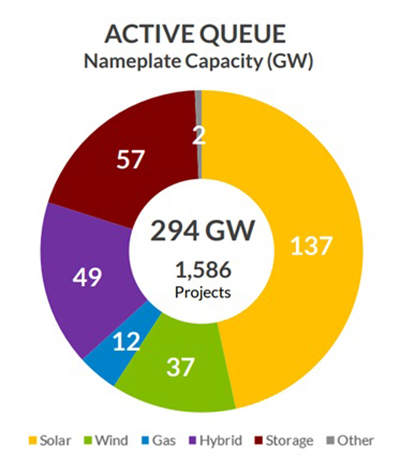
MISO’s traditional queue contains 294 GW across 1,568 projects.  

Johnson added that MISO still has 56 GW in generation projects that are cleared to interconnect to the system but remain unfinished. Just five companies are responsible for 40% of those incomplete projects, Johnson said.  

Expanded EDAM Would Reduce Curtailment, Costs, Study Finds

California Energy Commission staff presented a study on the size of CAISO’s Extended Day-Ahead Market (EDAM), finding more benefits as the market’s footprint increases.

The study, completed by The Brattle Group, is an update to one originally published in January, intended to provide a better picture of the benefits of day-ahead markets in California and the West. The original did not include the Western Energy Imbalance Market (WEIM), which is used as the “Status Quo” scenario in the new version.

Including this scenario helps “show the full impact of a West-Wide EDAM footprint, including how it might affect today’s WEIM as participants leave to join SPP Markets+,” staff said in a fact sheet on the subject. The updated study also includes an analysis of lower natural gas prices in EDAM and an analysis of the change in market revenues for California solar resources from EDAM expansion.

The new study comes as utilities decide whether to join EDAM, which will open in 2026 with its first members, PacifiCorp and Portland General Electric. More participants plan to join in 2027 and future years.

“Generally speaking, day-ahead markets are advantageous because they can deliver cost savings to customers through efficiency gains,” Kai Van Horn, senior consultant with Brattle, said at a CEC public workshop June 5. “They can deliver environmental benefits through lower emissions, generally through better utilization of renewables.”

Brattle’s study looked at four market scenarios alongside the status quo:

    • “Baseline,” which includes the entities EDAM is expected to launch with in 2026;
    • “Baseline+,” which also includes likely market participants;
    • “Expanded EDAM,” which includes the maximum number of entities that could participate; and
    • “Split Market,” which shows entities operating under both EDAM and Markets+.

The Expanded EDAM scenario estimates more than $1 billion per year in economic benefits to California compared to the status quo. A larger EDAM also could increase investments in renewables in the area, thereby accelerating emission reductions in WECC, the study says. Greenhouse gas emissions, for example, would decline 58% in California and 39% in the West, respectively, compared to 2024. Revenues for solar increase by about $14/MWh in California in the expanded scenario compared to the status quo.

Annual curtailment would drop from about 26,000 GWh yearly in the status quo to about 8,000 GWh in the Expanded EDAM scenario. Lower curtailments may allow fewer resources to be built to meet renewables targets in the state, the study says.

Even with the initial formation of EDAM, curtailment in California will decrease significantly: a 64% reduction in solar curtailments and 61% reduction in wind, the study found.

In the Split Market scenario, costs and emissions also decrease. For example, emissions drop by 24 MMT/year. In the Expanded EDAM scenario, GHGs drop 25 MMT/year. Similarly for curtailment, the Split Market case shows about 10,000 GWh yearly, compared to 8,000 GWh in the Expanded scenario.

For large solar plants, the market value in California increases from about $-3/MWh in the status quo to $11/MWh in the Expanded EDAM, “largely due to the ability to export otherwise unused solar in midday hours when solar is abundant,” according to the fact sheet. The increased market revenues for solar transfer to customers through lower power purchase agreement costs, the study says.

CAISO is working on key initiatives related to EDAM as the day-ahead market nears operation. In June the ISO plans to decide on a key initiative in EDAM: how congestion revenues are allocated.

Calif. Bill Seeks to Control Electric Bills, Create Transmission Authority

A California bill that would take aim at soaring electric bills and create a transmission infrastructure authority has cleared the state Senate and now is being considered in the Assembly. 

Senate Bill 254 by Sen. Josh Becker (D) was passed by the Senate 29-10 on June 4. It’s now in the Assembly, where it had its first reading. The bill is an “urgency” measure that would take effect immediately upon adoption. 

SB 254 is a sweeping bill with nine major provisions, which Becker said would save ratepayers “tens of billions of dollars” over the next several years. He called it “the legislature’s most ambitious effort ever to rein in rising energy costs.” 

“This is not a set of modest tweaks that will make minor improvements at the edges of a problem without offending anyone,” Becker said. “This is a big deal.” 

What’s in it?

SB 254 would exclude from electric utilities’ equity rate base a collective $5 billion spent on fire risk mitigation capital projects starting Jan. 1, 2025. Similarly, $10 billion collectively spent on energization capital projects would be excluded from the rate base.

The bill would create a Power Fund, to be funded by the legislature and used to reimburse utilities for “expenditures driven by public policy goals that provide a benefit to the general public.” Those could include transportation or building electrification programs or wildfire mitigation, among others. 

The California Energy Commission would decide how money from the Power Fund is spent. Utility spending that’s reimbursed from the Power Fund would be excluded from the rate base, and infrastructure paid for through the fund would not be eligible for return on equity. 

SB 254 would require utilities to include in their rate case filings a scenario in which spending would not go up more than the projected amount of the Social Security cost of living adjustment (COLA). The CPUC still could approve spending greater than the COLA if it’s deemed necessary for safe and reliable operation. 

Transmission Authorities

SB 254 proposes the creation of the Clean Energy Infrastructure Authority (CEIA) for transmission projects. The authority would identify transmission corridors; plan, finance, acquire and own transmission lines; serve as lead agency under the California Environmental Quality Act; and exercise eminent domain powers. 

The authority would enter into agreements with utilities to build, operate and maintain the transmission infrastructure. 

The California CEIA would be similar to two transmission authorities now operating in the West: the New Mexico Renewable Energy Transmission Authority (RETA) and the Colorado Electric Transmission Authority (CETA). 

“Establishing transmission authorities continues to be a critical policy lever for states, especially those without [an RTO], to consolidate and formalize transmission planning processes,” the National Caucus of Environmental Legislators said in a policy update in April. 

The group said lawmakers in Washington, Oregon and Montana had introduced bills this year to establish new transmission authorities.  

Affordability Issues

SB 254 is part of a three-bill package, intended to address affordability issues in California, that Senate president pro tem Mike McGuire worked on with the Democratic caucus. The other two bills address housing production and workforce development. 

“Skyrocketing housing costs and utility bills are stretching budgets, and folks are struggling to achieve a job that pays a family-sustaining wage,” McGuire said in a statement announcing the bill package in April. 

But opinions differed on whether SB 254 is part of the solution. 

Sen. Kelly Seyarto (R) pointed to “unrealistic mandates” as the cause of rising electric bills. 

“[Utility companies] are going back to the CPUC time and time again,” Seyarto said. “Because we are mandating that we attain unrealistic goals for all electric vehicles, for everything being electric in California. And they’re trying madly to try and get the infrastructure, which means wires everywhere.” 

Sen. Steven Choi (R) said creating a new transmission authority would increase costs. 

“Who knows how much money this agency will be using to establish and implement the programs and create the policies and employ the employees to run that authority?” Choi said. 

Other Provisions

Among other provisions in SB 254, the bill aims to provide near-term relief to electric utility customers by increasing the amount of the “climate credit” they see on their bills each April and October. The credit is part of the state’s cap-and-trade program.  

Low-income customers would get a greater share of the climate credit under SB 254, and it would be paid out in late summer when many residents are hit with their highest electric bills. 

In a permit streamlining measure, the bill would direct CEC to develop a program environmental impact report for energy storage systems of 200 MW or more. Agencies then could build on that more generic EIR when developers propose specific projects, reducing the time needed to prepare an environmental report. 

SB 254 also would lower the project-size threshold for a project to be eligible for the CEC’s opt-in certification program, from $250 million to $100 million. It would extend the life of the program by five years, through June 2034. 

The opt-in program is for renewable energy projects such as solar, onshore wind and energy storage systems. Under the voluntary opt-in process, the CEC becomes the lead agency for permitting and state environmental review. The CEC certificate is in lieu of any permit that normally would be required through the local land-use review process and most state permits. (See 2 Huge Solar-plus-storage Projects Planned in California.) 

SB 254 also would require the CEC to try out permitting management software to further streamline project review.