Ontario’s nodal market is showing promise one month after its launch, with improved price certainty, increased day-ahead trading and LMPs reflecting expected congestion patterns, IESO officials say.
IESO’s Market Renewal Program (MRP) is designed to improve the way the grid operator supplies, schedules and prices power by creating a financially binding day-ahead market (DAM) and adding about 1,000 LMP nodes. The ISO says the nodal market, which launched May 1, should save Ontario $700 million over the next decade through reduced out-of-market payments and increased efficiency. (See IESO Nodal Market Launch Successful.)
In a briefing June 4, IESO said the initial month of operations were “consistent” with the MRP’s goals. The only glitches to date were a day-ahead market failure May 22 and a delayed opening to the new virtual market.
While day-ahead prices were not financially binding in the prior market — meaning all settlements were against real-time prices — about 95% of energy volume is now clearing in the DAM. Most non-quick-start generator commitments are being made in the day-ahead rather than in real time, and pre-dispatch reviews are selecting least-cost resources.
‘Encouraging’ Results
“The results that we’re seeing from the first couple of weeks are actually really encouraging,” said Darren Matsugu, director of markets. “Our locational prices really have aligned with the expectations that we’ve seen historically based upon congestion across different parts of the province.
Darren Matsugu, IESO | IESO
“With the introduction of the day-ahead market … we are seeing improved real-time certainty, both from participants and importantly for the ISO.”
Most export transactions now are being scheduled day-ahead, up from virtually none in the old market. The shift “really gives the ISO a much more complete picture about the next day’s operation than we used to see,” Matsugu said.
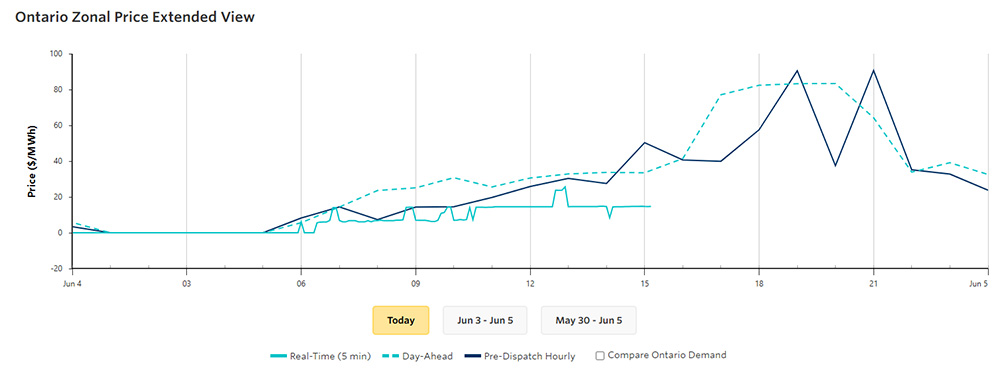
While the real-time market has shown more volatility than day-ahead prices because of unanticipated outages and supply/demand changes, those spikes are muted in consumer prices because only 5% of energy volume is settled in real time.
“We’re seeing really complete participation and competitive participation [in the day-ahead market], which has given us good confidence in those day-ahead market results,” Matsugu said. “And of course, if there’s any additional scheduling needed in between day-ahead and real-time, we are seeing that this vastly improved pre-dispatch sequence is doing a good job of selecting the least-cost resources.”
A Small Snapshot
Officials cautioned that their ability to draw conclusions is limited because of the short time the market has been operating. Participants still are learning about the market and developing their trading strategies, they said.
“A full year, covering all four seasons, will provide more complete information,” IESO said.
IESO day-ahead, real-time and pre-dispatch prices | IESO
“Market performance really does need to be considered under a wide variety … of system conditions,” Matsugu said. “Every season, every month, presents itself with very material differences in terms of demand, supply conditions, transmission [and] outages. All those things are very different, and the market needs to perform very different optimization through the year. So, for example, performance during the summer and winter peak days, there’s quite significant differences in system peaks and that kind of transition from overnight periods. And those really are kind of our best test of the market’s ability to be able to efficiently maintain reliability.”
‘Defects’ Corrected
The transition to the new market “went very smoothly thanks in no small part [to] the efforts of many of you out there,” said Candice Trickey, director of MRP readiness.
Candice Trickey, IESO | IESO
She singled out the MRP Implementation Working Group, composed of representatives from different market sectors that helped the ISO design training and testing of the new market.
The first run of the DAM calculation engine was successful on May 2, and the first market settlement statements were issued May 15.
“Since the transition, the settlement statements have been issued on time, and there have only been a small number of disagreements that we’ve seen by a limited number of participants,” she added. “To date, anyway, we haven’t seen any widespread calculation or settlement errors.”
Although the ISO’s support teams saw a large jump in the number of contacts and tickets in the first week, “those have fairly quickly petered out to more normal volumes,” she said.
IESO identified some “defects” during and after the launch. “Not a surprise, once you put everything into production; new things pop up, and we did identify some defects,” Trickey said. “Those have all been quite quickly addressed through either workarounds or permanent fixes. Most of those things were fixed before any of you saw them.
“This was a very complex project [involving] more than 10 different systems that we had to integrate together,” she added. “They all ran 24/7, providing a continuous stream of results and instructions and reports. So, it’s no surprise that we experienced a few hiccups.”
Timothée Denis of Air Liquide said his company’s day-ahead trading limit — 50 MW before the transition — initially was limited to 25 MW at the new market’s launch. “So we had to bid on half of our capacity and liquidate the rest of that on the real-time market,” he said, adding that the problem was resolved May 22.
Virtual Market Delayed
Trickey also said there were some problems completing authorizations for virtual traders, which delayed the launch of the virtual market from May 8 to May 13.
The new system allows market participants to submit hourly bids and offers in any of nine virtual transaction zones.
A defect related to virtual trades caused IESO to declare a day-ahead market failure for the May 22 trade date, causing it to use real-time prices.
The ISO halted virtual trading to avoid further DAM failures until a fix was implemented, with virtual trading resuming May 24.
“Since then, we haven’t experienced any other issues, but it is early days, and we still remain on high alert, monitoring and watching to see if anything else should arise,” Trickey said.
Speakers and attendees of the ISO-NE Consumer Liaison Group’s quarterly meeting June 4 advocated for governance changes at the RTO after the grid operator received a failing grade on a recent report card on RTO transparency.
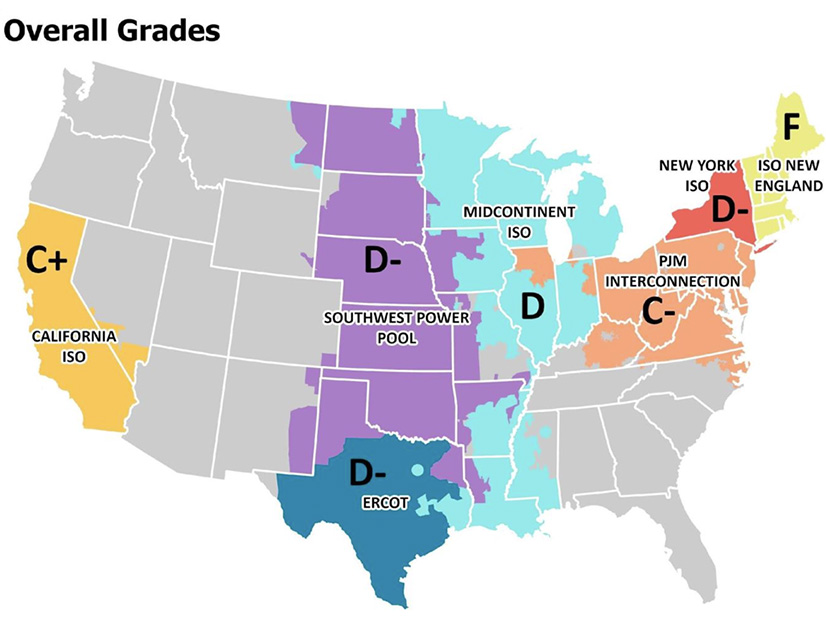
The report, commissioned by New England-based environmental justice nonprofit Slingshot, graded each RTO and ISO on public accountability, transparency and accessibility. ISO-NE was the only grid operator to receive a failing grade, which the report attributed to the RTO’s “exclusive stakeholder process and inaccessible, opaque board proceedings.”
The report also detailed concerns about the limited voting power of end-user organizations in the NEPOOL voting process, language barriers, the lack of a “streamlined public comment process” and the entrenchment of existing leadership.
None of the grid operators, however, received higher than a “C+.”
Governance issues have been a major topic at the CLG since a coalition of environmental and consumer advocates took control of the CLG Coordinating Committee in late 2022. (See Climate Activists Take Over Small Piece of ISO-NE.)
Activists have argued frequently that the nonpublic nature of NEPOOL proceedings and meetings of the ISO-NE Board of Directors prevents meaningful public engagement, while the RTO has pointed to recent steps taken to increase engagement, including annual public board meetings and the addition of an environmental and community affairs policy adviser. (See In Conversation with ISO-NE’s First Community Affairs Policy Adviser.)
Anne George, chief external affairs officer at ISO-NE, called the Slingshot report inaccurate and said it overlooked data and information the RTO has made available to the public.
“Obviously we’re not happy receiving an ‘F’; we disagree with a lot of what’s in that report, and we think it would have been helpful to talk with the researchers,” George said. “I don’t think we’re planning any major changes in what we’re doing based on that report.”
Bryndís Woods, principal analyst at the Applied Economics Clinic and one of the report’s authors, defended its methodology, stressing that the researchers were able to consider only publicly available inputs. Woods noted ISO-NE has made recent steps toward translating some materials into Spanish that were not captured in the report.
RTO transparency, accessibility and accountability grades | Applied Economics Clinic
Charles Hua, executive director of PowerLines, an affordability-focused nonprofit, said cost pressures have caused increased consumer interest in engaging with energy policy issues.
“The vast majority of Americans feel powerless to do anything about their utility bills,” Hua said, adding that limited public education and opportunities to engage with public utility commissions and RTOs create “significant risk for all stakeholders in the system.”
“It’s critical we create opportunities and processes for consumers to participate,” he said.
Joshua Macey, associate professor of law at Yale Law School, made the case that RTOs and ISOs across the country, including ISO-NE, structurally favor the interests of incumbent transmission and generation owners.
“What you see across all [RTOs and ISOs] is that the voting empowers entities that owned facilities in the 1990s,” Macey said, adding that utilities — and transmission owners in particular — played a major role in establishing the existing governance structures.
NEPOOL voting rules give each of the six sectors an equal share of the voting power and require an approval threshold of 60% for market tariff changes, 66% for non-market changes and 70% for endorsing candidate slates for the ISO-NE board. The high thresholds create a requirement for broad support for rule changes and board endorsements.
While ISO-NE is an independent organization, the transmission and generation sectors, which have a “a significant financial interest in the assets that are already on the system,” would have the power to block any slate of candidates for the board, Macey said.
So far, no slate of candidates for the board has ever been rejected. Slates are chosen by the Joint Nominating Committee, which typically consists of members of the ISO-NE board, representatives from each sector and a state representative.
Macey said the power of incumbent interests has contributed to resource adequacy rules that typically “favor incumbent resources” and provide inadequate incentives for resource entry. He also added that the TOs’ retention of filing rights over local projects likely has contributed to the high costs of asset-condition projects. (See ISO-NE Open to Asset Condition Review Role amid Rising Costs.)
Macey said the RTO has made progress in recent years in changing its rules to enable the addition of new renewables and said electricity restructuring has driven “meaningful cost reductions” and lowered barriers to decarbonization.
“As many challenges as we have here in New England … we should thank our lucky stars that we are not in a vertically integrated market,” Macey said.
Voting will begin soon on NERC’s latest proposed reliability standard to address FERC’s directive to improve the reliability of inverter-based resources, the oldest of the ERO’s high-priority standards projects.
NERC’s Standards Committee approved posting MOD-026-2 (Verification and validation of dynamic models and data) for a 26-day comment period at its latest meeting May 21. (See NERC Standards Committee Rejects IBR Definitions Request.) The comment period began May 22; voting will begin June 9 and end the same day as the comment period on June 18.
Formation of ballot pools began May 22 and concluded at 8 p.m. ET on June 4. The implementation plan for MOD-026-2 will be up for a vote along with the standard.
According to the technical rationale provided by the standard development team, the project originally was suggested by NERC’s Inverter-based Resource Performance Task Force (IRPTF) in 2020. The IRPTF said MOD-026-1 and MOD-027-1 — which “require generator owners to provide verified dynamic models to their transmission [planners] for … power system planning studies” — needed updates to “clarify requirements related to IBRs and to require sufficient model verification to ensure accurate generator representation in dynamic simulations.”
When FERC issued Order 901 in 2023 directing NERC to develop standards to improve the reliability of IBRs, NERC tapped Project 2020-06 — begun in response to the IRPTF’s report — to address the third milestone in the order, along with two other ongoing projects. The standards for Milestone 3 must be filed with FERC by Nov. 4, with full implementation by Jan. 1, 2030.
To satisfy FERC’s directive, MOD-026-2 combines MOD-026-1 and MOD-027-1, with changes that include expanding requirement R1 of MOD-026-1 to cover electromagnetic transient models. These were not mentioned in the previous version because they are required only of IBRs, flexible AC transmission system devices and HVDC facilities. It adds requirements that transmission planners and planning coordinators develop processes for generator and transmission owners to submit documents on model verification.
A new requirement concerns verification of models’ relationship to in-service equipment at IBR facilities. The SDT said “transmission planners and planning coordinators are faced with challenges relying solely on positive sequence dynamic models to ensure reliable operation” of the grid.
For example, simulation platforms currently in use “are generally not suitable for capturing the dynamic response of” IBRs, meaning that some protection systems or controls cannot be accurately modeled and ride-through performance cannot be assessed. The models also do not include IBRs’ real code behavior, instead relying on “engineering judgment based on controller block diagrams.”
The implementation plan for MOD-026-2 envisions requirement R1 becoming effective on the first day of the first calendar quarter that is 12 months after the date of FERC’s approval, with MOD-026-1 and MOD-027-1 to be retired immediately prior. All other requirements of the new standard would become effective 24 months after the overall standard.
Called to the podium by the New Orleans City Council, MISO and Entergy leadership agreed that a perfect storm of factors merged to cause the Memorial Day weekend power outages in the metro area.
The council convened a special Utility Committee on June 3 to grill MISO and Entergy leadership. MISO delivered 600 MW in load-shed orders May 25 in a last-ditch effort to maintain the system before something more catastrophic could befall the grid. The RTO ordered 500 MW offline in the Entergy territory and 100 MW offline in the Cleco territory. (See MISO: New Orleans Area Outages Owed to Scant Gen, Congestion, Heat.)
Senior Vice President and Chief Customer Officer Todd Hillman said with a “short amount of customer impact,” MISO was able to avert a “larger, more far-reaching” outage event.
Hillman said it’s “frustrating” that MISO cannot single out a source of the outages. Rather, he said it was a “culmination of factors.”
“It wasn’t one thing that happened. It wasn’t one thing you can point to and say, ‘oh OK, it was that transmission line’ or ‘oh OK, it was that unit,’” Hillman said. He said while MISO’s earlier modeling showed Louisiana would come through May 25 without issue, in the literal heat of the day, conditions changed.
In all, about 4.5 GW of generation was out in the area at the time, including Entergy’s Waterford and River Bend nuclear stations, the latter of which unexpectedly flickered off days before due to a cooling leak. The limited generation availability coincided with offline and overloaded transmission facilities. At the time, Entergy’s 500-kV transmission path near Jennings, La., remained out of service from a March tornado.
“We had a number of units that were [on] unplanned outages during that week. The good news is most of those are back on. So, they were working through that to get back on. In fact, that major transmission line to the west was back on two days after the event. So, they’re working feverishly to get ready for the peak season; it was just that all of these things sort of came together for that one, single moment,” Hillman said of MISO South utilities following the event.
Hillman assured the council that MISO works with its members to expand transmission and generation plans to make sure MISO South is reliable. He said MISO studied and approved the planned generation outages months before the event.
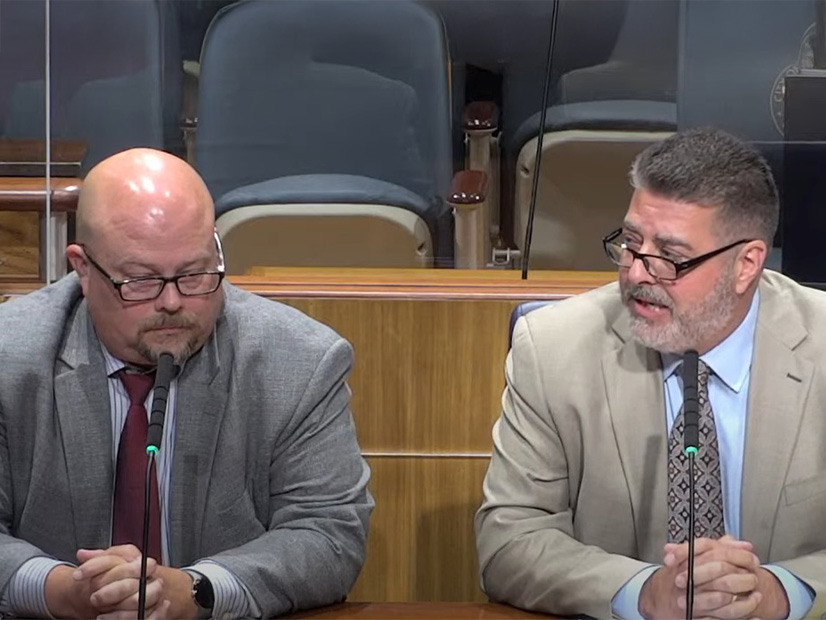
JT Smith (left) and Todd Hillman of MISO attend the special June 3 New Orleans City Council Utility Committee meeting. | New Orleans City Council
But he also said south Louisiana lacks import ability and can be affected when local generation is sparse.
Executive Director of Market Operations JT Smith said MISO is delving into why it experienced so many outages that week. He said the biggest change from days leading up to the outage to May 25 was an uptick in load due to hotter temperatures.
‘Plane Crash’
Council member Oliver Thomas questioned MISO’s deftness that day as the “air traffic controller” of the power grid. MISO leadership often makes the analogy.
“The plane didn’t land. It crashed,” Thomas said.
“We prevented a crash by making sure that plane never took off,” Hillman responded.
Thomas asked how many customers lost power that day. Hillman and Smith confirmed it was about 100,000.
“Tell them it was a landing,” Thomas retorted.
Hillman said he wasn’t trying to suggest there wasn’t a problem but stressed that MISO managed to avoid rampant, unchecked blackouts.
Council member Jean-Paul “JP” Morrell said a more suitable analogy might be likening the blackouts to the city’s periodic flooding when its pumping system is overwhelmed and decisions are made to release water in one neighborhood to save the larger city.
“Though the rest of the city celebrates not being flooded, the one neighborhood that is flooded is rightfully pretty upset about it and pretty pissed,” Morrell said.
MISO identified the risk of an interconnection reliability operating limit (IROL) violation at 4 p.m. CT on a transmission constraint on the north shore of Lake Pontchartrain. After 20 minutes where it conducted an analysis of available options, MISO called upon Entergy to commence load shed in the New Orleans and Slidell areas. MISO directed Cleco to shed load about 10 minutes after it delivered instructions to Entergy.
“We want to make sure double, triply, quadruply sure that’s the only course of action that we have at that point,” Hillman said of the 20 minutes of review time.
MISO, Entergy Vow to Improve Notification Time
Council member Eugene Green said residents needed more time to prepare and questioned why an alert was not sent out through NOLA Ready, the city’s emergency preparedness texting system.
Hillman said MISO is considering introducing more notifications to give the public “fair warning” about its risk posture.
Hillman and Smith emphasized throughout the hearing that NERC allots grid operators 30 minutes to get load off the system to prevent larger blackouts once it’s clear that an IROL issue is a possibility.
“We should have been communicating much greater externally that we were on that precipice,” Smith said. He added that even though MISO was “on the cutting edge” from Thursday onward managing congestion, MISO believed it would navigate the event without resorting to drastic measures.
Smith said prior to the event, MISO and Entergy had compared notes and had a mitigation plan at the ready. However, he said in the moment, for reasons that MISO has yet to understand, the agreed-upon transmission reconfiguration solution wasn’t viable.
“So yes, it would have surprised everyone participating in it,” Smith said.
Hillman said MISO hoped to avoid an IROL situation by talking through mitigation plans ahead of time.
“Those solved until they didn’t solve when we got to the real-time conditions,” Hillman said. Hillman said MISO conducted a “tremendous” amount of analysis on system conditions over the weekend leading into Sunday.
MISO ultimately was able to use the reconfiguration plan a few hours after it instructed the utilities to shed load as it restored power.
Though Entergy maintained a day after the outages that it had not seen a reason to shed load, company officials who appeared at the meeting said it was necessary.
Entergy New Orleans CEO Deanna Rodriguez said MISO’s load-shed orders served to avoid a “potentially catastrophic outage such as occurred recently in Portugal and Spain.” She said the circumstances were beyond Entergy’s “immediate control” and apologized to council members.
Entergy New Orleans CEO Deanna Rodriguez | New Orleans City Council
“We are working closely with MISO to better understand this highly unusual event and what can be done to prevent this from ever happening again,” she told council members. She said Entergy New Orleans would take pains to be “more aligned with MISO” in order to give ratepayers more notice.
Fielding questioning over the comprehensiveness of Entergy’s risk modeling, Rodriguez said while Entergy and MISO plan workarounds for maintenance outages, unplanned outages, hot weather and transmission outages, those variables never have all lined up at the same time. She also said Entergy didn’t know its reconfiguration plan would not have worked until MISO informed the utility in real time. Rodriguez said that failure will inform Entergy’s training and planning going forward.
Hillman said it’s not surprising MISO’s wider view of system vulnerabilities contradicted Entergy’s risk estimations up to the load shed.
Smith said load shedding to avoid potential collapse from IROL violations is an extremely rare event in MISO. He said a load-shed event during Winter Storm Uri in 2021 and an incident around 2014 in Baton Rouge when generation and transmission went down suddenly were the only other instances he could think of in his 20 years at MISO.
Entergy Senior Vice President Power Delivery Charles Long said Entergy, like MISO, believed it wouldn’t find itself in a load-shed situation over the holiday weekend.
Long said no significant transmission or generation outages occurred on May 25, with the unplanned generation outages all starting before the weekend.
“We knew that Memorial Day weekend was going to be a challenge. We knew that it was tight,” Long said.
Long said Entergy now understands the reconfiguration plan MISO and Entergy worked out would have failed, per MISO’s broader modeling. He said while catastrophic outages tend to develop slowly, “this one was rare and evolved very quickly.”
Council members repeatedly asked who decided which neighborhoods should go without electricity.
Long said Entergy operators choose to interrupt substations based on maximum relief on constrained transmission, without worsening system conditions, with fewest customers impacted. He said there was no time to be “surgical” and shed load according to its usual prioritization of critical loads. Long said Entergy didn’t have time to single out its interruptible industrial customers and instead cast off load closest to the problem area.
Morrell said he learned of the load shedding only when the power was cut. He said he didn’t know “what the hell was going on,” undermining his ability to regulate Entergy. He said from his perspective, Entergy could have notified regulators sooner of the grid stress and could have made public appeals ahead of the weekend for customers to lower usage.
“There’s always going to be that jerk that keeps his AC on 60,” Morrell added.
Entergy officials confirmed the New Orleans Power Station, a controversial, 128-MW gas generator built in 2020 and touted for its black start capability, was running at the time and helped to avoid further outages of about 25,000 customers. (See Entergy Touts Restoration; NOLA Leaders Question Lack of Blackstart Service.)
Council member Helena Moreno said it might be time for Entergy to weigh adding a battery storage facility to the New Orleans Power Station.
Attention Turns to MISO South Tx Planning
“Let’s talk about the bigger issue. The bigger issue here is we have not had the level of transmission development in our area that we should have,” Moreno said, adding that she remembered writing a letter urging MISO South transmission planning in the aftermath of Hurricane Ida in 2021.
Louisiana Public Service Commissioner Davante Lewis, who was a guest at the invitation of the city, said southeastern Louisiana not being able to access otherwise plentiful electricity to the north is evidence the region needs transmission planning.
Moreno asked MISO when it would focus its long-range transmission planning on MISO South. MISO long-term planning so far has focused solely on MISO Midwest; the RTO has planned to draft a third portfolio for the Midwest region before it focuses on the South.
Hillman said between 2017 and 2023, MISO South utilities independently planned about $13 billion in local transmission projects that MISO has approved.
“While they may not be doing it in that same, grandiose way as the North and Central [regions], there’s actually a lot of transmission planning happening in this region along with generation planning,” he said.
But Hillman acknowledged MISO South was “owed” a long-range transmission plan. He said MISO could begin a MISO South long-range transmission portfolio as soon as sometime in 2026.
In response to council members’ questions over Entergy’s receptiveness to transmission planning, Long said Entergy has transmission planned that might have helped the May 25 situation: a 230-kV Adams Creek-to-Robert line and 230-kV and 500-kV reliability projects around the Amite South load pocket.
However, Lewis said those planned projects appear tailored to serve growing industrial load and aren’t “necessarily combatting the transmission lock hold” that exists in the South.
Long likened the upgrades to a “tide that raises all ships,” meaning they will serve new load while strengthening MISO South’s system.
Lewis asked if Entergy believes FERC’s Order 1920 is a positive development. Long said he would have to read Order 1920 first to answer the question.
Long added that Entergy got to work as quickly as it could to rebuild the 19 damaged structures of the Jennings 500-kV line before summer. However, he said the company encountered some supply chain issues getting steel to finish repairs.
Consumer Advocate Faults Regulator Inaction
Consumer and environmental advocate Alliance for Affordable Energy held a June 2 virtual town hall meeting where they asked the public to pressure regulators to demand meaningful planning from Entergy.
Yvonne Cappel-Vickery, an organizer with the alliance, said this “won’t be the last load-shed event unless we deploy solutions.” She said Louisianans need demand response programs and renewables paired with battery storage in the short term and more transmission capacity in the long term.
Alliance for Affordable Energy’s Logan Burke displays MISO’s May 25 pricing at the special Utility Committee meeting June 3. | New Orleans City Council
“We need more lanes, and we need more highways to move power,” Cappel-Vickery said. She said despite “finger-pointing” over blackouts, elected officials in the New Orleans City Council and the Louisiana Public Service Commission deserve much of the blame.
Cappel-Vickery said it’s the elected officials’ responsibility to push utilities to incorporate assets like battery storage and plan long-term transmission. She said they’ve been derelict in their duties to guide utilities and need to be “held accountable for the situation they have created.”
The Alliance for Affordable Energy denounced Entergy for suggesting MISO alone was the originator of the curtailments.
“While MISO ordered the load shed to limit larger outages, inaction by Entergy, Cleco and their elected regulators created the conditions requiring those blackouts,” the Alliance wrote in a June 2 letter to the New Orleans City Council. “This blackout could have potentially been avoided if regulators had been consistently pushing our regulated utilities to begin regional transmission planning and investment years ago. Instead of encouraging utilities to begin transmission planning, Louisiana regulators have allowed costly consultants to quibble over cost allocation methodologies without finding a solution.”
“It was a perfect storm with this one. It was a lot of unplanned outages,” Southern Renewable Energy Association Transmission Director Andy Kowalczyk summed up during the webinar. He said MISO acted swiftly to dodge a more serious outage that could have taken several days to resolve.
Kowalczyk appeared at the council meeting to request MISO South get similar planning treatment as MISO Midwest. He also said grid operators are time and again “caught off guard” with unplanned outages of thermal generation and said utility-scale renewable energy and storage could assist the region.
Meanwhile, Louisiana Public Service Commissioner Eric Skrmetta did not address the southeastern Louisiana blackouts when he appeared during The Hill’s “Securing the Grid: Powering the Gulf South Region” June 2 conference and webinar sponsored by Entergy.
Louisiana Public Service Commissioner Eric Skrmetta | The Hill
Skrmetta focused instead on outages in the aftermath of hurricanes. He said while post-storm outages years ago lasted “18-20 days,” outages now last one to two days. He said outages in the Gulf South are inevitable while the Louisiana PSC works with utilities and urged public patience.
Skrmetta also touted Louisiana’s low electricity rates and said they’re the product of the commission being tough on utilities.
“We put strong demands on our utilities to achieve these goals. … We don’t actually knuckle under to our utilities. We work this out,” Skrmetta said. “We’ve trimmed off things that we don’t think the ratepayers should be paying for.”
Skrmetta said he wanted more industrial load and power plants to come to Louisiana and said he’s “agnostic” about the types of industry attracted to the region or the types of electricity that ultimately serve them.
“Whatever the cocktail of megawatts that they’re searching for, Louisiana is going to provide that,” he said.
The Louisiana PSC will hold its own hearing over the blackout on June 18.
PORTLAND, Ore. — Bonneville Power Administration CEO John Hairston’s keynote at the annual meeting of the Western Conference of Public Service Commissioners spotlighted a theme that would dominate discussion at the event: the looming prospect of overwhelming growth in electricity demand in the West and across the U.S.
Hairston’s core message: Utility planning practices must change to deal with what’s on the horizon.
“Current grid practices were designed for low growth that was more predictable and gradual, but I think you all understand that those days are over today,” he told the audience of Western regulators and power industry stakeholders.
Hairston said transmission providers have been “flooded” with interconnection requests that would require developing new infrastructure to serve “power-hungry” data centers or connect new generators to the grid.
Requests for new service in BPA’s territory exceed the entire Northwest’s current peak load, he said.
“In BPA’s experience, our processes have been overwhelmed by transmission service requests or duplicative and speculative projects,” he said. “The reality is, it is not easy to plan for transmission grid advancement around prospective data centers or generators that may never come to fruition, and the volumes that we’re seeing is just simply too big for our models to handle.”
Hairston said the agency sees the need for a “new planning paradigm” and is “rethinking” its transmission planning processes and working with its utility customers to identify new approaches by the end of the year.
“BPA understands that time is of the essence. We have an ambitious timeline for establishing transmission planning reforms. It’s my expectation that by November, we will have developed a solution that will allow us to move ahead with studying requests in our current transmission service queue. That’s all 65,000 MW of that,” he said.
Hairston also pointed to a key challenge the agency — and the industry in general — faces in addressing interconnection queues: a shortage of staff to do the work.
In BPA’s case, staffing issues were exacerbated by the Trump administration’s actions earlier in 2025 to reduce the size of the federal workforce, which resulted in many agency employees taking “deferred resignation” buyout packages. (See BPA to Restore 89 ‘Probationary’ Staff, Agency Confirms.)
“At Bonneville, our critical functions are being met, and the lights will continue to stay on, but with fewer resources, there will be impacts, and workforce needs could potentially slow our progress toward greater expansion,” Hairston said.
The issue has been compounded by a federal hiring freeze, but Hairston said he’s “hopeful” about the agency’s “prospect of regaining our hiring authorities.”
“The Department of Energy recognizes the vital role that BPA plays in supporting our nation’s grid and is committed to ensuring that we have the staffing that we need to execute on our mission,” he said.
‘Collaboration was Key’
Hairston’s speech notably omitted mention of a subject that’s consumed the attention of many Western stakeholders for the past two years: BPA’s much-awaited decision in May to join SPP’s Markets+ rather than CAISO’s Extended Day-Ahead Market. (See BPA Chooses Markets+ over EDAM.)
Critics of that decision contend it will prevent the Western Interconnection from developing the kind of single electricity market necessary to take full advantage of the region’s resource and load diversity, thereby maximizing the use of non-emitting renewable resources. The “seams” between Markets+ and EDAM will impede the coordination required to do that, they argue. (See Debate Lingers After BPA Day-ahead Market Decision.)
Throughout BPA’s day-ahead decision-making process, BPA staff have expressed confidence in the ability of the agency — and SPP — to manage energy transfers across seams based on its own history of doing so within the Northwest.
Hairston’s speech appeared to pick up on that line of thinking, if obliquely.
“On paper,” he said, the Western Interconnection might look fragmented to many, divided into multiple balancing areas “that operate and plan for the future of the grid independently.”
“But that doesn’t mean that we work in silos,” he said. “We understand that reliability and efficient operations require a lot of coordination. In fact, if you look back over the history of the Western Interconnection, it’s safe to say that collaboration was key to almost every major advancement that we’ve had.”
Hairston also pointed to historical efforts to share resources across the West, including development of what now is known as the Western Power Pool, which in recent years has led development of the Western Resource Adequacy Program (WRAP), which will provide a mandatory RA framework for participants in Markets+.
“Essentially, the program addresses the segmentation in the region where multiple utilities could be counting on the same power during the same time, which may not be available in the market,” he said. “Now, with all members using the same resource planning methods, WRAP provides greater assurance of maintaining region-wide reliability.”
Without naming the market, Hairston’s speech appeared to refer to one of the key challenges facing Markets+: the lack of transmission connecting its non-contiguous footprint, spread across discrete pockets in the Northwest, Desert Southwest and Colorado.
In speaking about BPA’s proposed interregional transmission projects, he called out plans for a possible line that would run from Central Oregon to the Nevada-Oregon border, “opening an opportunity for a southern partner to take it from that point, enabling energy transfers between the Pacific Northwest and the Desert Southwest.”
“And while I’m encouraged and hopeful about our prospects, I’m clear-eyed about the obstacles that we face. Among them is the challenge of making significant infrastructure investments while preserving affordability,” he said.
Stakeholders are mostly supportive of CAISO’s proposed new method for allocating congestion revenues in its Extended Day-Ahead Market (EDAM) after months of workshops and multiple proposals on the topic, according to comments filed with the ISO ahead of a June 2 deadline.
The congestion revenue issue is a top priority for CAISO this year. The “expedited” initiative began in March after Powerex published a paper contending that EDAM contains a “design flaw.” (See Fast-paced Effort will Address EDAM Congestion Revenue Issue.)
The primary question is whether certain congestion revenues should be allocated to the balancing authority area in which the costs accrued or to the neighboring area where the transmission constraint is located, specifically in cases in which parallel — or loop — flows occur.
Under EDAM’s existing rules, congestion revenues will be allocated to the BAA containing the constraint. The new method would allocate a portion of congestion revenue, such as network integration transmission service (NITS) rights, to the BAA where the energy is scheduled.
CAISO committed to making the new method temporary to allow the ISO to maintain its go-live target for the FERC-approved market in 2026. “This narrowly tailored design change appropriately addresses congestion revenues allocated associated with parallel flows to ensure a just and reasonable congestion revenue allocation for EDAM go-live,” the proposal says.
The ISO noted that stakeholders “were divided on the temporal aspect of the design.” Several argued it should establish a concrete timeline for consideration of a long-term solution, though without a hard sunset date for the temporary method.
The Balancing Authority of Northern California said it generally supports the draft final proposal, published May 19. It is “a workable interim solution while … CAISO and stakeholders take the necessary time to develop a more durable approach that addresses the identified issues surrounding incentives for self-scheduling,” BANC General Counsel Tony Braun wrote.
CAISO’s Department of Market Monitoring said it believes the new method is an acceptable transitional measure. While the department said it might create increased incentives to self-schedule that could reduce market benefits relative to the approved EDAM design, the implementation with the new allocation method “will still create market benefits relative to the current pre-EDAM market.”
The Bonneville Power Administration also said it supported the proposal, although it, too, is concerned the method potentially incentivizes increased self-scheduling.
Other stakeholders said the proposal is headed in the right direction but needs a few tweaks. San Diego Gas & Electric, for example, said that without additional analysis, it is challenging to evaluate with “any level of certainty whether this design supports market efficiency or minimizes cost shifts between the EDAM balancing authority areas.”
“Although the flow patterns and market results from market simulation and parallel operations are likely to evolve significantly following go-live and as participants gain actual market experience, any reporting regarding the potential impact of the transitional methodology that CAISO can provide to participants would ground the working group efforts planned in 2026,” SDG&E staff said in their comments. “SDG&E recommends CAISO prioritize providing this information to the extent it is possible.”
CAISO plans to publish the final proposal June 6. It then would be reviewed by the CAISO Board of Governors and Western Energy Markets Governing Body during a special meeting June 19.
GLEN, N.Y. — Roadside signs sprinkled through this rural town indicate someone nearby is “Saying NO! to MEGA SOLAR.”
But signs sprinkled through state law and reams of case records suggest these residents are shouting into the wind — the state will override local restrictions and objections to allow nearly 2 square miles of photovoltaic panels to be installed on what now is farm fields and woodlands.
Local input will shape the details of the approval, but local opposition will not block it.
The 250-MW Mill Point Solar 1 project Repsol Renewables wants to build in Glen is a microcosm of many of the issues that have put New York behind schedule in its drive to decarbonize its grid.
Building one of those large-scale renewable projects in New York is a long, expensive and fraught process with a lot of strong opinions on all sides. Many things can delay or kill a proposal, but local opposition of the kind seen in Glen is less of a threat than it once was.
With New York’s strong home-rule tradition, its 900-plus towns traditionally have the power to limit or block such development.
So when the state Legislature voted a clean-energy vision into law in 2019, it also created a mechanism to override local opposition, lest the vision die of a thousand cuts at the hands of opponents and elected leaders like those in Glen.
Which is not to say everyone in Glen is opposed.
More than 700 small solar arrays already exist in town, and some residents support Mill Point, which would be one of the largest arrays ever built in New York state.
Speakers at a May 28 public comment session were split between support and opposition. But many of those who spoke in favor would stand to benefit financially, and many of those opposed stood to lose — whether from the aesthetics of so many solar panels or from the feared impacts on the land and community where they and their families have lived for decades, or sometimes generations.
Compounding the resistance is that there is not just one of these huge solar arrays on the table. Multiple utility-scale proposals have been floated in the county, where land is gently sloped and relatively cheap, and where there are multiple major transmission lines.
In response to an even larger solar proposal just west of Glen, the Montgomery County Legislature passed a local law in October 2024 requiring developers to avoid or mitigate the cumulative impacts of the multiple “industrial solar arrays” proposed.
These same issues are playing out in numerous states, as state leaders either expand or limit local governments’ ability to thwart renewable energy development.
Role of ORES
ORES was created in 2020 to smooth the path to the statutory goals of New York’s landmark 2019 climate law, which include 70% renewable electricity by 2030 and 100% emissions-free electricity by 2040.
ORES is intended to streamline and standardize the environmental review and permitting of renewable energy facility proposals with a nameplate capacity of 25 MW or greater; projects rated at 20 to 25 MW also can opt in.
To accomplish this, ORES can waive compliance with local laws that would limit or block a proposal. Glen’s 18-page Solar Energy Facilities Law is a textbook example. It contains such requirements as a 500-foot setback on all sides in areas zoned rural residential, a ban on clear-cutting more than nine acres of trees and a requirement that substations not be visible.
In the draft permit, ORES provides relief or limited relief from nine separate aspects of the town law (Matter 23-02972).
Separately, it found that the 2024 Montgomery County law was not in effect at the time Mill Point was proposed and found that the county’s 2021 scenic byways law also was not applicable.
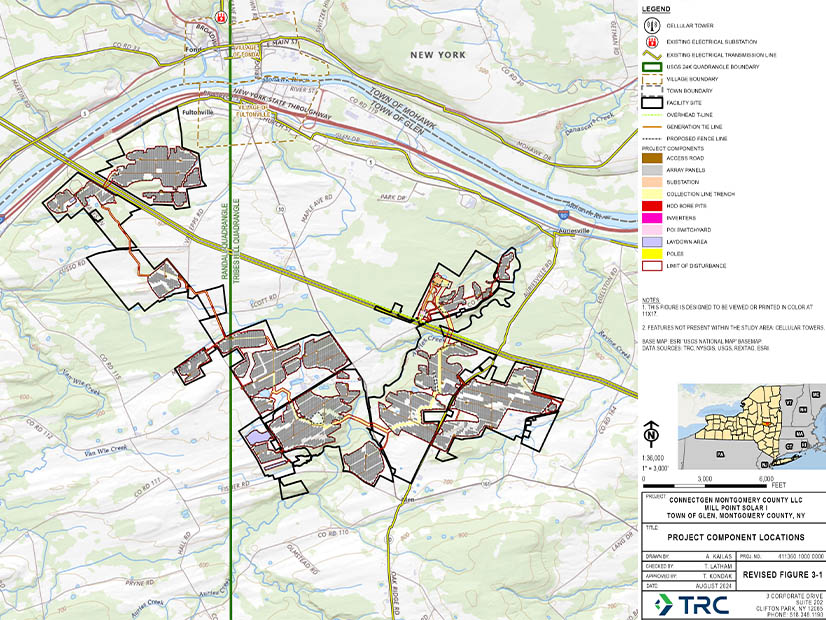
A map shows the configuration of the Mill Point Solar 1 project Repsol is proposing in the town of Glen. The diagonal yellow stripes are National Grid’s 345-kV lines. | Repsol Renewables
ORES does encourage public opinion and offers multiple opportunities to submit it.
Straight-up NIMBY statements and opposition to renewables seem unlikely to sway ORES, as it was created to promote renewables and blunt NIMBYism.
Twenty-three of the 39 applications listed on the ORES database have been approved, and all likely faced at least some local objections. But only one application has been denied, and that was because the developer had lost property rights, not because of opposition voiced in the 1,003 written comments submitted in the matter.
Nonetheless, local input is foundational to shaping ORES’ decisions. A spokesperson told NetZero Insider:
“The statements made at the public comment hearing, along with statements submitted in writing, may be used by the [administrative law judge overseeing the case] to determine if there is a sufficient doubt about the applicant’s ability to meet statutory or regulatory criteria applicable to the permit to warrant adjudicatory hearings on the application and draft permit.”
On a more granular level, the spokesperson said, local input is important to identifying impacts of a project and identifying the priorities or concerns of its neighbors.
This can shape ORES’ decision, so that these impacts are minimized while renewable energy development is advanced.
The public comment period on Mill Point Solar 1’s draft permit closed two days after the public comment session.
Project Details
Lead project development manager Andrew Barrett told NetZero Insider the Mill Point Solar 1 team first put feet on the ground in Glen in 2020. They hope to make a final investment decision in mid-to-late 2026, start construction soon after and begin commercial operation by the end of 2027.
This is not an uncommonly long timeline.
Along the way, ORES twice returned the application as incomplete, and Repsol had to put $250,000 in an intervenor fund so that opponents can pay for research and legal challenges.
The process, Barrett said, is “thorough with a capital T.”
The draft permit issued by ORES contains dozens and dozens of stipulations that fill 56 pages (with no appendices, footnotes or punchy graphics to take up space).
New York’s goal is to not damage the environment while trying to save it, Barrett added, which is important to the company and foundational to renewable energy.
And it is a draft permit that Repsol finds workable.
“Other than taking a lot of time and a lot of money, it is good because it does what we would do anyway, which is, forces us to be up there, forces us to be open and transparent with maps and schedules.”
Money has been a problem and may be again. Mill Point was among the huge tranche of renewable projects whose developers canceled their renewable energy certificate contracts with the state in late 2023 when the terms became financially untenable.
Just recently, it won a new contract from the New York State Energy Research and Development Authority — presumably at much higher cost, though NYSERDA is not saying and Repsol holds the information as confidential.
But great financial uncertainty still hangs over the proposal in the potential loss of the federal tax credits created by the Inflation Reduction Act. They are vital to Mill Point, Barrett said, though losing them would not necessarily kill the project. There also is the threat of tariffs.
“There are a lot of moving pieces in this,” he added. “The uncertainty the Trump administration has added recently is not helpful.”
As planned, Mill Point Solar 1 would have a nameplate capacity of 250 MW, operate at a 22% capacity factor and cover about 1,124 acres. Fencing and infrastructure on the patchwork of parcels would push the total footprint above 2 square miles.
Distributed solar already has a foothold in town, where 730 arrays ranging from 0.7 to 6,900 kW were connected to the grid as of March 31.
Utility-scale solar development is not nearly so quick and nimble. But just one completed large project could far outstrip the 83.8-MW DC combined output of those 730 little solar arrays.
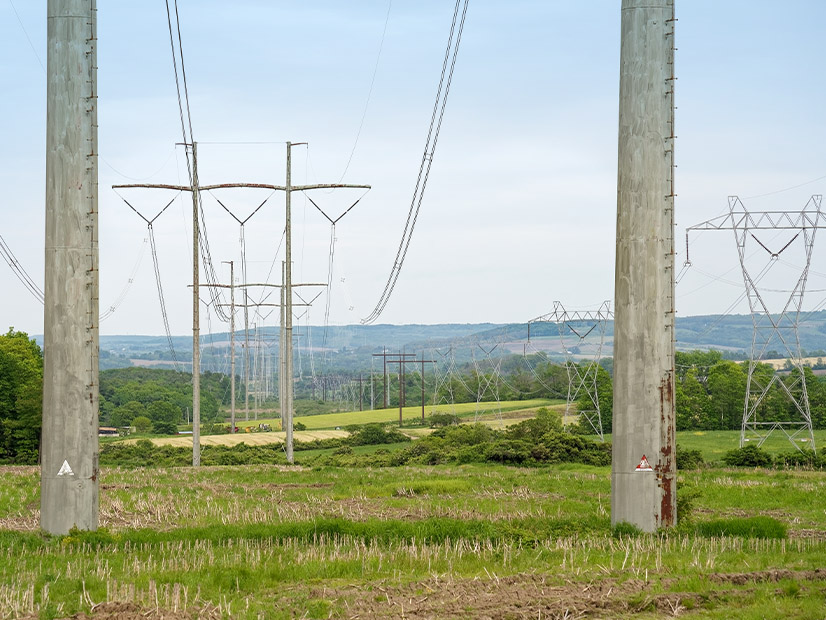
Large-scale solar is interested in the county because of its topography and its transmission lines — dual 345-kV circuits operated by National Grid cross right over Mill Point’s proposed footprint. To the south, LS Power and NYPA have 345-kV circuits that recently were enhanced to carry more upstate renewable energy to the downstate market. Additional smaller lines cross the area.
NYISO’s 2025 system map shows that this concentration of transmission is uncommon in upstate New York.
NYSERDA and the Department of Public Service looked specifically for areas that contain this combination of relatively flat land near transmission as part of the effort to accelerate large-scale solar development in New York.
“Montgomery County was identified by NYSERDA and DPS as having strong potential for such project sites,” a spokesperson said.
Other projects in the county include the 300-MW Flat Creek Solar, now under review by ORES. NextEra has the 90-MW High River Energy Center. Repsol also plans the 100-MW Mill Point Solar 2. Avangrid proposed the 90.5-MW Mohawk Solar. Greenbacker won a NYSERDA contract for the 20-MW Tayandenega Solar. SunEast Development won an 80-MW contract. And that is only a partial list.
Some of these proposals have been canceled or shelved, and others may never break ground. But the steady flow of proposals has dismayed a vocal segment of the county.
Push and Pull
The May 28 meeting showed the depth of local division, seldom more clearly than when the top elected official in Glen and his predecessor took the mic for their allotted three minutes.
“Small, rural towns with large agricultural open land holdings, limited budgets, like the town of Glen, are the target of these energy companies,” Town Supervisor Timothy Reilly said, “because in the context of New York state, we have insufficient funds and other resources to sustain a legitimate fight of these projects on a level playing field.”
Former Town Supervisor John Thomas countered: “There are far too many falsehoods being bandied about regarding the supposed evils of solar energy — I’m sure you will hear some of these tonight. The amount of energy from the sun hitting the Earth in one hour could power the world for an entire year. Solar energy is essential to combating climate change.”
In the following two hours, the comments volleyed back and forth with a rhythm of opposition and support.
This will destroy prime farmland.
Anyone who calls this prime farmland has never farmed it.
This will affect our Amish neighbors terribly.
A lot of the Amish are craftsmen more than farmers.
We’re trading in our agricultural heritage and future for a temporary source of electricity … and to benefit a corporation … and for little financial benefit to the community.
I can’t afford to farm … or farming is hard work that I’m getting old to do … or I don’t want my son to follow me into farming.
We’re being asked to trade our dreams for someone else’s vision of progress.
Would you rather see another warehouse there?
All this solar electricity is going downstate.
I have a right to do what I want with my land.
Not if it contaminates my land.
Construction will provide work for my union members.
This solar farm will create almost no permanent jobs.
Not Keeping up
There is much to unpack in those comments.
Montgomery County is like most of upstate New York: farmland and wooded former farmland dotted with villages and hamlets that date to the 1700s and 1800s. Commercial and industrial operations large and small survive and even thrive but occupy only a tiny fraction of the landscape. Its only city bears the scars of industrial decline and 1970s urban renewal.
Montgomery County’s population dropped more than 11% from 1970 to 2020 while the nation’s grew more than 62%. The percentages of county residents older than 65 and younger than 18 are both higher than the national average.
In other words, some young people look elsewhere for opportunity, and some never come back.
Farmland has been going out of production for a century, but a local statistic stands out in the ag census the USDA publishes every five years: There are many more small farms in Montgomery County now than in the 1990s, even as the amount of land in active production has continued to shrink.
The number of farms statewide decreased 20% from 1997 to 2022 but only 3.6% in Montgomery County.
This trend at least partly is due to a large influx of Amish attracted by one of the things that solar developers appreciate: affordable land suited for their purposes.
A large contingent of Amish men attended the May 28 comment session. But in keeping with their Old Order ways, they sat in a cluster and listened to their “English” neighbors speak, rather than offer comment themselves.
It was a bit ironic, given that some of them may not even use electricity. But the land-use debate does bear directly on the Amish.
The state in 2024 authorized eminent domain for transmission siting, but there is no such provision for solar power — if a photovoltaic array is placed in a pasture, it is with the landowner’s permission.
So the Amish need not lose the land they have. The concern may be more for the future and the options Amish children will have if farmland is scarce by the time they grow up.
Common Ground
At the May 28 public session, a third-generation town resident went in a different direction than other speakers and wondered why state policies did not offer more support for agriculture, so that farmers were not forced to make these hard choices about their land.
“I hate to see our community divided like this. It really breaks my heart,” she said.
It certainly is divided, but the tone throughout the evening was civil, not hostile.
“I think that the civility of the meeting, I think that comes with time,” Reilly told NetZero Insider later. “I think we have really come from becoming adversarial to each other and [those] kind of comments to a more participatory type of meeting where, ‘Look, I just want to get my point across.’”
Town Board meetings and community meetings hosted by the developer helped smooth that out, he said.
“It was a tribute to both sides for that,” Reilly said.
Unprompted, he added: “Andrew [Barrett] has been nothing but a gentleman since day one. You know, he comes in here and we sit, and we visit. We could almost go fishing together, but we’re on opposite sides.”
Barrett said this is the nature of his role and the job of others like him around the state and nation as they look for enough land and enough of a consensus to put together viable projects.
After the company identified Glen as a potential large-scale solar site, the development team was on the ground introducing themselves and explaining what they wanted to do as they looked for potential leases.
“Honesty and transparency is important, and we think it makes a difference,” he said.
And it is important not just to listen but to process what is said. After dialogue with the community, for example, Repsol moved the project footprint away from a cemetery and away from the historic hamlet at the center of the town. That soothed some feelings, but far from all.
“Twenty-five hundred people are never going to agree perfectly on any topic, certainly a large project like this,” Barrett said. “You’re always going to have someone who thinks this is a good idea because we need it for the environment, someone who would like to participate because it helps them save their farm. And then you will get people that are across the street and don’t like the look of panels, even if they’re going to be well screened.
“You’re not going to win over everybody.”
Reilly said the problem for him is not just the state usurping home rule but doing it to push through something that will start depreciating soon after it is installed.
“Much of the resistance, I think, in the town is not necessarily for renewable energy. It is the consumption, the vast consumption, of these huge swathes of land for something that’s going to be outdated in 30 years.”
But Reilly said the town is not ready to concede.
“I don’t think people think it’s a done deal by any stretch of the imagination,” he said. “You know, there are some that think, ‘We’re it’s the ninth inning, and we’re down a lot of runs.’ But as Yogi Berra would say, ‘It’s not over till it’s over.’”
Meta has signed a 20-year power purchase agreement for the output of Constellation Energy’s 1,121-MW Clinton nuclear plant in Central Illinois, the companies announced June 3.
The deal will begin in June 2027, upon expiration of the state’s zero-emission credit program that has been subsidizing operation of the plant. The PPA in effect will replace the ratepayer-funded ZECs.
In their announcements, Constellation and Meta hailed the deal as a landmark market-based solution to keep older nuclear facilities online, producing high-capacity-factor baseload power without carbon emissions.
With 38 years in service, Clinton is among the youngest U.S. commercial reactors. It was operating at a continuing loss in the mid-2010s and was slated for early retirement, but Illinois created the ZEC subsidy in 2017, returning it to profitability.
The facility’s license extends through April 2027. Constellation in 2024 filed an application with the Nuclear Regulatory Commission for a 20-year renewal, with the caveat that how long it actually operated the reactor would depend on the economics and on policy support.
As part of the agreement with Meta, Constellation will perform uprates that will add 30 MW to the existing 1,092-MW nameplate capacity of the facility.
Constellation now is considering seeking an extension of Clinton’s existing early site permit or seeking a construction permit for an advanced reactor or small modular reactor to be co-located with the existing facility, located in Zone 4 of MISO’s capacity market.
In September 2024, the company announced a PPA with Microsoft for output from the Crane Clean Energy Center — the former Three Mile Island Unit 1, which it retired in 2019 for economic reasons. The company had begun the decommissioning process but is working to restart the reactor.
In Constellation’s news release, CEO Joe Dominguez asked rhetorically why Three Mile Island had shut down in the first place, and said Meta had asked a similar question about the future of Clinton.
“They figured out that supporting the relicensing and expansion of existing plants is just as impactful as finding new sources of energy,” Dominguez said. “Sometimes the most important part of our journey forward is to stop taking steps backwards.”
“Securing clean, reliable energy is necessary to continue advancing our AI ambitions,” said Urvi Parekh, Meta’s head of global energy.
Meta also provided an update June 3 on its advanced energy ambitions, as it seeks to match the electricity used in its data centers with 100% clean and renewable energy. It said that as it considers emergent technologies, it recognizes the value of the firm, reliable capacity offered by nuclear fission.
The tech giant said it has received more than 50 qualified submissions in response to its nuclear request for proposals and is in final discussions with shortlisted developers for potential projects.
Meta is focusing on sites where nuclear development can be advanced with speed and certainty as it tries to assemble a 1- to 4-GW portfolio of projects. It hopes to finalize the process this year.
All of this, and the Constellation PPA, are intended to send signals of support and demand to the nuclear sector, Meta said: “Our investments in nuclear energy ensure that we will have the robust energy infrastructure needed to power the AI innovations that are set to spark economic growth and prepare our communities for the future.”
New Jersey legislators have backed clean energy bills that include efforts to promote the development of small modular nuclear reactors and enable the state to better deal with data centers.
The Senate Environment and Energy Committee approved S4423, which would enable the Board of Public Utilities (BPU) to authorize site approval for a small modular reactor (SMR) in a municipality where a nuclear facility previously was located. The agency could supersede municipal and county decisions to authorize reactors able to generate 300 MW of power or less. The reactors would be licensed by the Nuclear Regulatory Commission, and nuclear fuel would be stored on-site.
In a separate vote, the full Senate on June 2 voted 38-0 in support of a third data center bill, A5466, which would direct the BPU to study the “effect of electricity usage by data centers on electricity rates in the state.”
The bill, which goes to the governor’s desk, would require the study to look at:
Cost allocation, to determine if other electricity customers “unreasonably subsidize” the costs of data centers.
Whether other customers incur “unreasonable rate increases” to support new transmission, distribution or generation facilities that serve data centers.
Policy alternatives such as “the use of a special tariff to be applied to data centers, that could be used to mitigate or avoid rate increases caused by increased electricity demand by data centers.”
Fixing an Energy Shortfall
The votes come as New Jersey, an importer of energy, searches for ways to boost its generating capacity. Demand for electricity is expected to rise dramatically over the next decade, fueled in part by the growth in electric vehicle use and the needs of data centers. PJM says its region, which includes New Jersey, faces an energy crunch because new generating sources aren’t coming online as quickly as old, fossil-fueled sources are closing.
The nuclear and data center bills were among a slew of bills — including initiatives focused on storage, solar and geothermal energy — aimed at boosting the state’s clean energy resources and curbing energy use.
Two bills moved by the Senate committee address the expected arrival of data centers, including those supporting artificial intelligence capability. The committee backed S4293, which would require the owner or operator of a data center to prepare an annual report to the BPU of the facility’s water and electricity use.
The report also should include “basic information” on the facility and “performance calculations and indicators for the data center, including the energy reuse factor, power usage effectiveness, renewable energy factor and water usage effectiveness.”
Opposing the bill, Ray Cantor, a lobbyist for the New Jersey Business and Industry Association, said the bill would needlessly add a burden to data centers that might consider coming to the state. State requirements already ensure water permits are not issued unless there is sufficient water, he said.
“From an energy perspective, these data centers are either bringing their own energy, or they’re using energy off the grid, and that’s all being accounted for,” he said.
“On the one hand, we have policies in the state, and the governor has mentioned this as well, where we want business to come and locate here in New Jersey,” he said. “And then [on] the other hand, we pass legislation like this, which, while it’s not the end of the world from a regulatory perspective — it’s just another thing that’s being required. And it’s another thing that’s being required that doesn’t need to be required.”
Erecting Roadblocks
Cantor said he had similar concerns about another bill later backed by the committee, S4307. It aims to protect ratepayers from shouldering the burden of the development of generation systems that support data centers.
The bill is designed to incentivize data centers to increase energy efficiency, including through the use of technologies that use the heat produced by the data center. In addition, it would require that the BPU review each application to ensure the data center creates and submits a tariff that demonstrates the facility’s compliance with the law.
Cantor said enticing data centers to move into the state would be difficult if “we’re continually putting roadblocks in the way or making it more expensive or problematic to develop here in New Jersey.”
“We recognize that data centers are large energy users,” he said. “But they’re not the only large energy users. We have large manufacturing plants that use as much or more energy than data centers. Even hospitals could use more energy than a data center. And yet we don’t single them out for special treatment.”
Senate Environment and Energy Committee Chair Bob Smith said the bill “is absolutely a response” to a $20 hike in the average electricity bill that took effect June 1. State officials say the increase, set by the state’s Basic Generation Services auction, was triggered in large part by PJM’s capacity auction in July 2024, which included a massive jump in prices compared to the previous auction. PJM officials attributed the jump in part to high-demand data centers.
Doug O’Malley, director of Environment New Jersey, disputed Cantor’s claim, saying data centers can be far larger than community institutions, using as much as 1 million gallons a day for cooling and electricity generation.
“We can’t just rely on what we have right now. That’s why this bill is so important,” he said. “This is a reminder that we cannot have water hogs, (or) an energy hog, that literally spikes electricity rates (for) everybody.”
The committee passed the bill with a 3-2 vote. The bill will go to the Senate Budget and Appropriations Committee.
Fixing an Energy Shortfall
In a separate vote, the Environment and Energy Committee voted 5-0 to back a bill, S4100, designed to simplify and speed up the process by which solar projects are permitted.
State officials say developing more solar is one of the quickest ways to address the pending electricity shortfall. But the bill says “New Jersey has the fifth-slowest-known solar permitting timelines of any state.”
“Vestiges of outdated, overly bureaucratic permitting requirements” cause residents to “significantly delay installation efforts and significantly increase costs incurred in installing residential solar energy storage,” the bill states.
Elowyn Corby, mid-Atlantic director for Vote Solar, in supporting the bill, told committee members that “local solar benefits our entire grid and society.”
“While large-scale solar projects are important, they are often facing multiyear delays in the PJM interconnection queue,” she said. “Local solar, on the other hand, can be rapidly deployed without these delays, addressing our immediate energy needs while giving us breathing room to bring large-scale renewables online.”
To speed up the process, the bill calls for a State Smart Solar Permitting Platform that would automate permitting. It would enhance the ability of a local agency to review permit applications and permit revisions for safety and code compliance. The platform also would enable permitting agencies to release permits and permit revisions for residential solar energy systems, residential energy storage systems and main electric panel upgrades.
The state assembly backed a version of the bill, which goes to the Senate Budget and Appropriations Committee for consideration.
Storage and Geothermal
The Senate committee also backed a bill, S4289, that would authorize the BPU to procure and incentivize transmission-scale energy storage projects capable of storing at least 5 MW and connected with PJM.
Under the bill, the BPU would create an incentive program and then solicit applications for a tranche of projects. At its conclusion, the BPU would evaluate the impact on the sector, and, if needed, launch one or more tranches. The board’s 3-2 vote sent the bill to the Senate Budget and Appropriations Committee.
Bob Gordon, a former BPU commissioner now representing a renewable energy company, argued that storage can save ratepayers money by providing energy to the grid at peak times. With the law in place, he said, New Jersey would have saved $100 million to $200 million in the coming year if the state had 500 MW to 1000 MW of transmission-connected battery storage.
“A state-led competitive-procurement program such as this will put New Jersey on the path to getting resources online and be able to provide the immediate benefits and cost relief for wholesale power costs to New Jersey,” he said.
The committee backed by a 5-0 vote a bill, S4424, that would establish a three-year pilot program to replace aging or leaking natural gas pipelines with geothermal energy infrastructure.
The bill would enable gas utilities to submit plans to the BPU for review of the project size, scope and scale, and the expected benefits. The agency would assess the ratepayer impact and whether the benefits justify the cost.
FERC Chair Mark Christie’s tenure running the commission is coming to an end, as President Donald Trump on June 2 nominated Laura Swett of Vinson & Elkins to replace him.
“I learned this evening from a media inquiry that President Trump has appointed Laura Swett to replace me when my term expires,” Christie posted on X. “I congratulate Laura and wish her the best. I will remain in office for a few weeks after June 30 to help get key orders out.”
Christie’s term ends June 30; if confirmed, and depending on when she is sworn in, Swett would be able to serve a full five-year term. Another seat remains open since former Chair Willie Phillips stepped down earlier this year, but that term would extend only into 2026. Any new commissioner in that seat effectively would need to be nominated and confirmed twice to serve longer.
Swett’s nomination has been referred to the Senate Energy and Natural Resources Committee. She has previous experience at FERC serving on the staff of Chair Kevin McIntyre and former Commissioner Bernard McNamee, both Trump nominees in his first term. She also worked at the Office of Enforcement, according to her LinkedIn page.
Former FERC Chair Neil Chatterjee, who overlapped with both Swett and Christie on the commission, called the news bittersweet on X.
“I adore Laura Swett and believe she will be an excellent FERC chair (if given the chance by OIRA and OMB),” Chatterjee said, referencing the White House’s Office of Information and Regulatory Affairs and Office of Management and Budget. “But Christie is a patriot; all he did was run the agency well. He’s a veteran who has dedicated his life to serving America. He deserved better.”
The Trump administration has been skeptical of independent agencies generally, reportedly telling Phillips it would fire him if he did not step down, leading to his resignation. Trump issued an executive order in February trying to bring FERC and other similar agencies more under its control. (See Trump Claims Authority over Independent Agencies in Executive Order.)
Christie spent his first press conference as chair addressing that executive order and has repeatedly answered questions on it since. While he put some of it in the context of normal relations between a president and FERC, he also made it clear he had to follow the laws that govern FERC. (See FERC’s Christie Says Existing Policies Can Align with Trump’s Order.)
One area Christie made clear then that FERC could not tolerate was ex parte communications on cases pending before it.
“We do not allow ex parte communications; that would violate the [Government in the] Sunshine Act,” Christie said at the press conference in February. “It would also violate everything I know about due process in contested proceedings going back to being a state regulator. We didn’t allow it in Virginia, so we’re not going to start allowing ex parte communications.”
Reactions
“I think it’s great that Laura has been nominated by the president,” McNamee said in an interview. “I think she’ll do a fantastic job as a commissioner, and I knew that because she provided great and sound advice to me when she was my attorney adviser, when I was a commissioner.”
Swett advised McNamee on pipeline issues when she was his staffer, and much of her work at Vinson was in that area.
The issue of environmental assessment in pipeline permitting has caused some partisan splits among commissioners in the past decade, especially around how much attention FERC must pay to the downstream greenhouse gas emissions.
Former Chair Richard Glick’s efforts to update the pipeline approval process after some losses in the courts wound up sinking his renomination in 2022, but a recent Supreme Court decision means those debates likely are coming to an end regardless of FERC’s composition.
In Seven County Infrastructure Coalition v. Eagle County, issued May 29, the majority found that the U.S. Surface Transportation Board was right to not consider upstream and downstream effects from approving oil shipments over rail. In a post on X, Christie called the decision “the most important permitting reform in decades.”
Trade associations and other groups active before FERC released statements on June 3 congratulating Swett for the nomination.
Americans for a Clean Energy Grid Executive Director Christina Hayes offered congratulations in a statement and argued for continued action on transmission.
“In her previous stints as a senior leader at FERC, she worked on policies that emphasized grid reliability,” Hayes said. “At a time when American energy demand is set to skyrocket, no policy area is as essential to our energy dominance as transmission planning reform. ACEG’s coalition of transmission policy advocates across the political spectrum looks forward to working with Swett in her new role and urges continued FERC leadership in implementing the bipartisan consensus behind Order No. 1920. America’s energy dominance depends on it.”
In addition to congratulating Swett, Electricity Customer Alliance Executive Director Jeff Dennis thanked Christie for his service and for keeping reliability at the top of FERC’s priorities.
“We look forward to working with her and the rest of the commission to advance customer-centric solutions that support the power system expansion our nation needs to meet the demands of a growing digital economy while keeping energy affordable for all customers,” Dennis said.