PORTLAND, Ore. — Panelists at the annual meeting of the Western Conference of Public Service Commissioners emphasized the need for innovative regulatory frameworks to keep up with new technology.
Jay Griffin, senior adviser at the Regulatory Assistance Project and former chair of the Hawaii Public Utilities Commission, said electric industry participants in the U.S. should look to their counterparts in the United Kingdom.
After having visited the U.K., Griffin said, “one of the striking things there was how much quicker the pace of interconnection is for large loads and generation resources.”
Griffin made the comments at a panel discussion on technology adoption rates and regulatory reform during the WCPSC session June 2.
Griffin noted the U.K. has leveled the playing field of interconnection in part by having an open-source map that updates real-time capacity throughout the entire network and by making the pre-application connection assessment easier through a publicly available web app.
“They’re bringing resources online much faster,” Griffin said. “The tradeoff there is some level of curtailment over time, but that’s in exchange for bringing projects online years faster.”
Another key to the puzzle is that the U.K. uses performance-based regulation (PBR), according to Griffin.
PBR is a way to align utility incentives with the interests of customers and society. Traditional regulation pays utilities for what they build, while PBR focuses on what they achieve, according to a report issued last year by RMI.
PBR still is in the “nascent phases” in the U.S. — and in the Pacific Northwest, said Lauren McCloy, policy director at the Northwest Energy Coalition.
Still, the fact that PBR is being discussed as a way to address public needs and bring new technologies online is encouraging, McCloy said.
To implement PBR in the U.S., regulators should start “with a broad-based conversation about what are the policy goals that we’re trying to achieve,” according to McCloy.
“What are the technologies that are available to try to achieve that? And then, what are the incentive structures within cost of service-based regulation and maybe, you know, other frameworks that we could adopt to make that technology both more accessible, more transparent and deliver more benefits to customers.”
However, Elliott Nethercutt, senior director of state regulatory affairs at the Edison Electric Institute, urged caution.
Nethercutt said the existing regulatory framework is designed for reliability and affordability.
“I think that we got to move faster, but we don’t want to throw out the baby with the bathwater,” Nethercutt said. “We just need to see how we can make things … work and move a little more efficiently.”
Pilot programs, future test years, cost trackers and multiyear plans, among other alternative approaches to regulation, “can really move things faster and really meet the needs of electric companies and their customers in an era of rapid load growth,” according to Nethercutt.
Risks of Inaction
In a separate panel, Michele Beck, executive director of the Utah Office of Consumer Services, similarly stated that the industry must take a cautious approach when implementing new technology and updating planning processes.
“I understand there’s new times, and we need new solutions, but … the solution is not to put risk on customers,” Beck said.
Beck also noted “maybe we need a pilot program” to temporarily step outside the current “least-cost, least-risk paradigm.” This would allow regulators to look at cost allocations and augmentations to planning processes “to make sure that we’re treating all the resource types fair,” Beck added.
Meanwhile, Mark Thompson, a former Oregon utility commissioner who now is Form Energy’s senior director of state affairs, said while it’s a fair question to ask about the risk to ratepayers, regulators also should ask “what are the risk of not doing a new technology?”
“If the future is very different from the past, and we see all these constraints, and we have new challenges, and we have a new need for resources, there’s significant risk for ratepayers of never figuring out the new technology,” Thompson said. “These new technologies need a pull from the market. They need a pull from utilities who are willing to be partners, and they need a pull from regulators saying, ‘we’re willing to try something with you. Let’s figure out what it is.’”
California is setting records for the amount of battery energy storage operating on its grid, but in one Southern California beach county, residents have come out in large numbers opposing a proposed battery facility because of fire safety concerns.
The proposed Compass Energy Storage Project would operate as a 250-MW facility in San Juan Capistrano, near Laguna Niguel and Laguna Beach. California now has more than 12,000 MW of battery storage operating on its grid.
The project is under review with the California Energy Commission, specifically the CEC’s Opt-In Certification program, which began in 2022 as part of Assembly Bill 205. The program’s permitting process offers “developers an optional pathway to submit project applications, facilitating faster deployment of renewable technologies,” the CEC said.
Most residents and government officials in opposition are worried about a fire at the facility and the release of toxic chemicals. Laguna Niguel, for example, is located directly downwind of the project site during offshore winds, which not only occur during Santa Ana wind events but also on most nights, especially during the winter months when the inland valleys cool more than the ocean, the city said in comments filed with the CEC.
Laguna Niguel officials pointed to the Moss Landing battery storage facility that caught fire in January 2025 and required the evacuation of approximately 1,200 people within an eight-mile radius. A fire at the proposed Compass Energy Storage facility would require the evacuation of more than 37,000 people in a two-mile radius alone, the city said. An eight-mile radius could require 100,000 or more people to move out, the city said.
In response to safety concerns, Brett Fooks, CEC manager of safety and reliability, said the Moss Landing facility has two different safety characteristics compared with the proposed Compass Energy Storage project. First, the Moss Landing batteries are nickel magnesium cobalt lithium-ion batteries. This type of battery is more prone to thermal runaway than is the Compass battery, which would use a lithium-ion phosphate chemistry, Fokes said.
Second, the Moss Landing batteries are located indoors, whereas the Compass project’s batteries would be located outdoors. Indoor battery facilities are less fire-safe, Fooks said.
Objective Review
Not all local parties oppose the project. The Orange County Hispanic Chamber of Commerce offered support in comments to the CEC. The permanent shutdown of the San Onofre Nuclear Generating Station, combined with San Diego Gas & Electric’s forecast of a doubling in energy demand by 2045, underscores the importance of this initiative, the chamber said.
“The Compass facility will play a critical role in storing renewable energy and ensuring its availability during periods of high usage,” the chamber said. “In addition to its environmental contributions, the project is expected to provide over $50 million in local tax revenues, directly benefiting public schools, infrastructure development and community safety.”
The CEC currently has three projects with completed applications in its Opt-In Certification program, CEC staff told RTO Insider. The first project, Darden Clean Energy, has been recommended by staff for approval and will be considered by the commissioners at a business meeting June 11.
The second project, the Fountain Wind project, has been delayed beyond the 270-day timeline in alignment because of significant changes to the project discovered during development of the environmental impact report. CEC staff have recommended against the Fountain Wind project, which is anticipated to go before the commission at a business meeting in August or September, CEC staff said.
The CEC plans to vote on the Compass Energy Storage Project near January 2026.
If approved, the facility would interconnect into the existing SDG&E Trabuco-to-Capistrano 138-kV transmission line, which is about 500 feet from the project site. The project would connect to the transmission system through a “loop-in” transmission line. No downstream upgrades or off-site transmission upgrades are required for the proposed project, CEC staff said.
The CEC does not decide on the location of energy projects in California, leaving that to developers, CEC Executive Director Drew Bohan said at a May 29 public meeting.
“We evaluate projects when the [developer] applies,” Bohan said. “We then make recommendations as CEC staff to the CEC … about how they should dispense with the proposal.”
“I want to make clear that the CEC does not advocate for or against any proposal. Instead, we review each application objectively … on safety, environmental standards and community feedback,” Bohan said.
FALMOUTH, Mass. — Knee-jerk reactions to backlash over high winter costs could create long-term consequences for customers, utility regulators warned at the New England Energy Conference and Exposition on June 5.
The spike in energy costs across the region last winter, largely driven by cold weather and high supply prices, has caused significant public pressure targeted at state utility regulators, spurring debates about programs that increase costs in the near term but are intended to provide long-term savings and decarbonization. (See Regulators Focus on Energy Affordability at NECPUC Symposium.)
“Balancing the short term and long term is going to become increasingly difficult for PUCs,” said Marissa Gillett, chair of the Connecticut Public Utilities Regulatory Authority, adding that it is important not to “throw out the baby with the bathwater in the search for the silver bullet in the short term.”
On June 3, the Connecticut Legislature passed a compromise energy bill intended to lower bills over the next few years, reducing some incentives for clean energy and authorizing the use of rate-reduction bonds to cover storm costs and the installation of advanced metering infrastructure (AMI). While Republicans fought for deeper cuts, the final legislation received bipartisan support in both the House of Representatives and Senate, and Gov. Ned Lamont has said he plans to sign the bill.
Gillett said PURA has worked to increase education and transparency regarding the different components of customer bills, which have brought additional public scrutiny and criticism for regulators.
“PUCs are increasingly faced with a public that’s looking at the total bill, including transmission costs that have really grown precipitously for this region over the past decade,” Gillett said. “There’s always going to be a group of customers that don’t want to know more — they just want their bills to be lower — and we have to understand that and meet them where they are.”
Regulators throughout the region have faced similar pressure from consumers and legislators. In Rhode Island, when the Public Utilities Commission held a public hearing in March, “people came in, and for about four hours were just screaming at us, after the winter had passed and the rates were about to go down,” Chair Ron Gerwatowski said.
Electricity rates typically increase in the winter in Rhode Island because of elevated supply costs. While average rates during the past winter were slightly lower than the previous two winters, cold weather increased usage and total bill costs for many consumers.
“Our role as a commission is to kind of take the heat and then work with the legislators in ways that are kind of difficult, but you can make progress,” Gerwatowski said. He added that it is important to actively communicate with legislators during price-spike periods to prevent short-sighted responses with “knock-on effects.”
In Massachusetts, high supply costs over the past winter coincided with an increased distribution rate, causing bills to increase by about 18% on average relative to the previous winter, according to data from the state Department of Public Utilities.
DPU Chair Jamie Van Nostrand said cost increases in the state’s Mass Save program, an energy-efficiency initiative that has been used to promote heat pump installations in recent years, were the biggest driver of high distribution rates, followed by costs associated with the state’s Gas System Enhancement Plan (GSEP) program, which enables expedited recovery for utility investments to replace leaky gas pipes.
The DPU has taken steps to rein in spending from both programs in recent months, directing a $500 million cut in the three-year Mass Save budget and ordering the utilities to put a greater focus on pipe repair and non-pipeline alternatives in the GSEP. (See Mass. DPU Aims to Align Gas Leak Program with Climate Strategy.)
Van Nostrand echoed the need to carefully balance short-term costs and long-term benefits, highlighting the state’s push to deploy AMI, which utilities expect to complete by the end of the decade. Despite the high upfront costs, AMI will enable time-varying rates, which should reduce the need for transmission and distribution infrastructure in the coming decades, Van Nostrand said.
Maine Public Utilities Commission Chair Philip Bartlett also expressed optimism about retail demand response and said time-varying rates should lower bills for most customers — even if the customers do not change their usage patterns — and reduce systemwide infrastructure costs.
Bartlett also emphasized the importance of continuing to prepare the grid for new offshore and onshore wind resources, despite the current federal administration’s antagonism toward clean energy.
“We need to continue to get ourselves ready so we can bring those resources online as soon as we get the support from the federal government,” Bartlett said.
In general, the grid needs to see fewer retirements and more new resources with the right characteristics to maintain reliability, said Todd Snitchler, CEO of the Electric Power Supply Association.
“That’s not to suggest that … if plant ‘X’ retires, it needs to be replaced with exactly the same type of unit [or] type of fuel source,” Snitchler said. “But the performance characteristics of the things that are coming on the system have to ensure reliability and do so cost effectively.”
The whole system needs new resources, whether it’s the power plants or new transmission and distribution, and Snitchler sees that need in three phases. The next five years are seeing load growth, but most of the new generation that will come online already is well down the development path. The five years after that are long enough that new capacity can help, while anything further out is too far ahead to forecast accurately.
“If we can meet the objectives for the first block and the second block, I think the third block becomes far less concerning,” Snitchler said. “And, so, as we look at these numbers and how we’re going to meet this short- and medium-term obligation to get resources on the system, I think that’s where the focus needs to be from all parts of the value chain.”
FERC Chair Mark Christie asked what needs to be done in light of the issues, which Snitchler answered by noting it’s been about 18 months since data center-led demand growth became thetopic in the industry. Now it’s important to get the interconnection queues, siting and permitting right.
“At the end of the day, if we want to solve the problem, you’ve got to accelerate the projects that are ready to go in order to make sure that they can deliver the electrons that are needed to power the country,” Snitchler said.
Recent changes to the RTO’s capacity market, such as replacing the vertical demand curve with a sloped curve, have made MISO Independent Market Monitor David Patton, president of Potomac Economics, confident it will maintain reliability going forward. The old market design contributed to 6 GW of merchant power plants retiring in MISO, he said.
“The merchants retired,” Patton said. “It caused a one-year shortage in the Midwest, and then everybody figured out: ‘Hey, this is a real problem; our market isn’t facilitating investment.’ And they finally, after 15 years, adopted the reliability-based demand curve.”
The first auction cleared about 85 to 90% of the cost of new entry (CONE) when the old model would have cleared at 10%, Patton said. Now the market works for merchants, and rather than interfering with state integrated resource plans, it facilitates them, he said.
One other rule that should be universal is the marginal accreditation of resources, Patton argued, because that provides IRP planners and merchant developers with the right information on the grid’s needs.
“Once you implement the marginal accreditation, I think you can have a high degree of confidence that both the markets and the planning processes in regulated states will adjust to conform to the reliability attributes that drive what we need and facilitate the investment that we need,” Patton said.
“Correctly aligned” market rules would be good for development because it would offer more certainty, American Municipal Power Vice President Steven Lieberman said. But none of the organized markets offers enough certainty, he argued.
“These capacity constructs provide at most a one-year price signal,” Lieberman said. “Nobody’s building generation for a one-year price signal. And if it’s a seasonal design, you’re not building it because the price in the summer was high. Here, you’re building because you have a long-term view.”
Patton disagreed with that assessment, pointing to the one domestic market FERC does not regulate: ERCOT, with its energy-only market.
“They don’t provide anything beyond the day-ahead market, right?” Patton said. “And yet, people are still investing. They’re investing because they understand the market design and they can forecast market revenues of different types of units going out 20 to 30 years in the future. And that’s why it’s important for the capacity constructs to be efficient.”
The prices in capacity markets can be forecast decades into the future, but investors discount those prices heavily because of regulatory uncertainty. They might not be here in another decade or two, Patton said.
“But if we get to the point where we have well-structured capacity markets that that are robust and durable, where we’re not creating the concern that maybe they’ll go away, or maybe they’ll fundamentally change, then I think investors can rely on their expectations, and those expectations will fuel bilateral contracts,” he added.
One resource that ERCOT has been able to attract — as has California — is energy storage, American Clean Power Association Vice President Carrie Zalewski said.
“I think we just need to pause for a second and recognize the powerhouse, the Swiss Army knife, that storage is,” she added. “It’s fast; it’s flexible; it’s dispatchable. It allows for frequency regulation, grid stability, virtual inertia [and] black start. The technology continues to get better; it gets more efficient.”
Zalewski also argued FERC should not disregard many of the projects in the queues that will be ready to go and help over the next critical period.
“Those projects are in a much better place than starting over from scratch and building something new,” she added.
ISO-NE and NYISO
The two organized markets operating in the Northeast are not hotbeds of data center development, but they are facing their own resource adequacy issues.
NYISO is expecting a combination of large loads, increasing electrification and constraints on the supply side to lead to narrowing reserve margins, COO Emilie Nelson said.
“We’re also seeing a shift in what we must solve to continue to provide that reliable electric grid,” Nelson said. “One of the significant changes we’re preparing for in New York is to move from a summer-peaking to a winter-peaking system.”
NYISO expects its winter peak to go up by 14 GW by 2040, which will put more pressure on a natural gas system already strained to meet demand from power plants and heating during cold snaps.
ISO-NE faces the same problem. Recent analyses give the RTO into the early 2030s before its winter resource adequacy leads to reliability problems, noted Connecticut Department of Energy and Environmental Protection Commissioner Katie Dykes. There is enough time to avoid those problems, she said, but the region’s preferred answer on the supply side has some major issues of its own.
“We’ve had some very disappointing and challenging news on the offshore wind front, not just in terms of interest rates and general inflationary pressures, but now a federal executive order and tariffs and uncertainty around tax credits that’s making the path for that resource, which is very valuable for addressing winter reliability, have a more uncertain path,” Dykes said.
On the positive side, the states in New England have been cooperating on ensuring a reliable, affordable grid that meets their policy goals.
“I think one of the most important things will be to continue to have a clear path here at FERC,” Dykes said. “In terms of ensuring that we don’t see new barriers like a resumption of MOPR [the minimum offer price rule] or something like that, that would challenge the abilities for states and the ISO to work together on these solutions that we urgently need to deploy.”
It’s harder to build in New England, and it would be very difficult to get new pipelines in place to deal with the winter reliability issues in the next five years, said Philip Bartlett, chair of the Maine Public Utilities Commission.
“The states have come together and decided we want to build some transmission up into northern Maine to unlock resources that are there,” Bartlett said. “That’s a great benefit, particularly given the delay in offshore wind. But the earliest that’s likely to come online is 2035. So that is a long-time horizon when you’re dealing with resource adequacy challenges.”
Ideally, the states and the RTO will work together to develop a process that will evaluate resource adequacy and explore the tools the region has to address it, Bartlett said.
“If the states decide we want to go all-in on a particular resource or particular transmission approach, we need to figure out how to fast-track them to get it moving faster through the ISO process,” he added. “I think states need to think about, as we’re doing some of our state procurements, how does that fit in with resource adequacy? Should we be bumping up, for example, investments in storage or in certain kinds of other resources or demand response or other tools that could help us buy some time to deal with the problem?”
Michelle Gardner, NextEra Energy Resources’ executive director for the Northeast, agreed the region needed to think broadly when it comes to resource adequacy. Unlocking northern Maine, with its cheaper land and renewable resources, will help, she said.
“I think we need to take advantage of every tool in our toolbox,” Gardner said. “I think we need to take advantage of every effort to move forward.”
MISO has drafted a joint transmission planning agreement with neighbor Associated Electric Cooperative Inc. (AECI) that is premised on how the two coordinate today.
The RTO and Springfield, Mo.-based AECI work together when they have generator interconnection requests at their seams. The two use an affected system study process to coordinate on system upgrades necessary for interconnecting generation.
At a June 3 Interconnection Process Working Group meeting, MISO’s Liang Qi said the agreement largely memorializes what the RTO and AECI already have been doing.
The agreement details MISO’s and AECI’s data exchange for studies, cost recovery for studies, requirements for facility construction agreements and how the two will honor relative queue positions in studies. It will provide for the analysis of generation interconnection as well as merchant HVDC transmission connection requests.
When one of the two encounters a generation project that strains the system, AECI or MISO would draft a description of the required network upgrade and provide planning-level cost estimates and an estimated construction timeline. The two decided that interconnection requests assigned an affected system upgrade would have only “limited operation” until the upgrades are in service.
Under the agreement, MISO would get 120 calendar days for its initial affected study and another 60 days to complete a restudy, if necessary. AECI, on the other hand, would work on 90-day limits for its two study phases with a 60-day restudy provision for late-stage withdrawals.
Qi said MISO will present the agreement for review in July to the Planning Advisory Committee. He said the RTO is targeting a September filing for FERC approval.
AECI, a member-owned nonprofit cooperative, is not FERC-jurisdictional. Its territory includes rural Missouri, northeast Oklahoma and southeast Iowa.
ERCOT has told Texas regulators it’s completed its contractual work with LifeCycle Power, CenterPoint Energy and CPS Energy, clearing the way for 15 mobile generators to be moved from Houston to San Antonio and to provide more capacity in the area.
ERCOT General Counsel Chad Seely said at the Public Utility Commission’s June 5 open meeting that the first wave of generators is expected to arrive in the San Antonio area in July.
The mobile units, each capable of providing about 30 MW of power in about 10 minutes, will be interconnected to CPS substations in the city. Eight of the nine substations that will house the units are ready for delivery.
“I know LifeCycle has committed to move as quickly as possible,” Seely said. “A tremendous amount of work by everyone to get this across the finish line.”
ERCOT says the generators are necessary to mitigate emergency load-shed that may be necessary to avoid overloads of a generic transmission constraint. Staff have been working on the agreement since February 2025, when it became apparent they would not be able to extend reliability-must-run agreements to two aging CPS gas-fired units. (See ERCOT Board OKs Mobile Generators in San Antonio.)
The grid operator earlier entered into an RMR contract with CPS for V.H. Braunig Unit 3, its first. The San Antonio municipality said in 2024 that it was planning to retire all three Braunig units in March 2025. ERCOT said the plant’s retirement would lead to reliability issues until the transmission constraint is resolved. (See ERCOT Evaluating RMR, MRA Options for CPS Plant.)
Under the agreement, ERCOT will be able to dispatch the units only during actual or expected emergency conditions. The costs (an estimated $51 million) will be uplifted to qualified scheduling entities representing load on an hourly load-ratio share basis.
The units are leased from LifeCycle by CenterPoint. The Houston utility made them available to ERCOT, without compensation, through March 2027.
ISO Gets Good-cause Exception
The PUC granted ERCOT a good-cause exception for the 2025 Regional Transmission Plan, allowing the grid operator to adjust load forecasts outside the protocols’ requirements.
Recent state legislation requires the grid operator to include any load in its projections that doesn’t yet have a signed interconnection agreement. The ISO’s staff have proposed a 49.8% reduction in data center loads and a 55.4% cut in these “substantiated loads,” which are support by an executed interconnection agreement, a credible third-party forecast, or attestation by a transmission and distribution service provider (55999).
The reductions bring the forecasts more in line with historical performance, ERCOT said.
approved CenterPoint’s request to securitize $396 million of system restoration costs from two storms in May 2024. The commissioners agreed with Chair Thomas Gleeson’s proposal to adopt a standard of negligence instead of gross negligence (57559).
adopted a rule that sets reporting requirements for transmission providers and establishes monitoring responsibilities as part of the plan to build 765-kV import paths into the petroleum-rich Permian Basin. The monitor will identify the schedule and cost components that may affect the project’s timely development and approval of necessary service requirements, while also shedding transparency of expenses. The transmission providers will bear the monitor’s costs (57602). (See Texas PUC Approves 765-kV Transmission Option for Permian Basin.)
The Organization of MISO States and MISO are confident the footprint will be resource-sufficient in the 2026/27 planning year but said anything from an 11.4-GW surplus to a 14.1-GW deficit could be in store by the 2030/31 planning year depending on how swiftly capacity can be added.
The two drew on more generous capacity construction assumptions than in years past to come up with the 2025 OMS-MISO Resource Adequacy Survey results. MISO said it likely would have a surplus anywhere from 1.4 GW to 6.1 GW for summer 2026 based on survey totals.
For summer 2027, the five-year resource adequacy projection showed the potential for a 5-GW deficit or a 6.4-GW surplus. From there, the possibilities for excesses or shortfalls widen further.
MISO Senior Resource Adequacy Engineer David Kapostasy said OMS and MISO used a range of build rates for this year’s survey, including a more promising replacement trend for retiring generation.
The two used a 3.5-GW/year assumption for capacity builds, based on a three-year historical average of new capacity constructed 2022 through 2024. Factoring in MISO’s historical, 1.2-GW rate of generation replacement projects brought the baseline average to 4.7 GW/year. MISO and OMS also used a more optimistic, 6.2-GW/year alternative projection based on MISO members’ responses to the survey regarding generation plans. Furthermore, MISO said high-end value could grow to 8.6 GW/year using a more generous, 2.4-GW/year replacement rate that reflects an emerging trend of utilities more reliably choosing to build replacement capacity or, better, using surplus interconnection service at existing sites.
Using the 3.5-GW/year build rate alone, MISO could experience a 12-GW shortage by summer 2028. At the 8.6-GW/year rate, however, the deficit dissolves into a 6.7-GW overage. While the 3.5-GW rate returns 12.2- and 14.1-GW shortages in planning years 2029/30 and 2030/31, respectively, the 8.6-GW/year rate could deliver 10.5 and 11.4 GW in extra capacity over summertime needs.
It’s not until MISO applies the 8.6-GW/year average that the possibility of any capacity shortfall is eradicated from the 2027/28 planning year onward.
MISO compared capacity estimates against 2.2% compound annual load growth, instead of last year’s 1.6%.
This year’s survey results are the first time in a few years that MISO and OMS are entertaining the possibility of double-digit gigawatt reserves in summer. The 2024 survey’s best-case scenario showed a 4.6-GW surplus by the 2029/30 planning year. Capacity deficits, according to the 2024 survey, also could top out around 14 GW.
At a June 6 teleconference to review survey results, Kapostasy said MISO reflected an acceleration in construction turnaround times among its membership when preparing survey totals.
“There’s a question of: Is this the queue starting to unclog itself, or is this a return to normal,” pre-COVID construction tempos, Kapostasy said.
Kapostasy said this is the first year MISO projected replacement capacity and new capacity that may result from surplus interconnection service, recognizing that many existing interconnection customers already replace generation or explore using their existing interconnection service to the fullest.
Replacement and surplus interconnection projects should account for 25% of new capacity additions over the next five years and blunt the impact of retirements, Kapostasy said. He also said retirement deferrals in MISO are providing a “short-term buffer” against seasonal capacity deficits.
MISO this year attempted to quantify in survey totals what it calls “stranded GIAs,” or projects with signed generation interconnection agreements that nevertheless won’t become part of MISO’s capacity expansion due to difficulties getting them built.
Kapostasy reminded stakeholders that MISO has about 54 GW worth of planned generation that has signed interconnection agreements but are not yet online. He added that MISO’s recent queue process alterations (read: an annual megawatt cap on project entrants, higher dropout fees and an automated study process) should attract generation projects that are more of a sure thing in the future, minimizing dropouts.
MISO said 91% of existing generation participated in the 2025 OMS-MISO Survey, representing 97.4% of MISO load.
Vice President of System Planning Aubrey Johnson said the bottom line is MISO appears to have sufficient resources for the next planning year.
“Beyond that, we have challenges that need to be met,” he said.
Joe Sullivan, president of the Organization of MISO States and vice chair of the Minnesota Public Utilities Commission, said past surveys seemed to help move the needle on improving MISO’s resource adequacy picture.
“Capacity margins have improved since last year,” he said.
Sullivan said the goal of the survey is to guide planning decisions, “not deliver definitive” projections. He said many variables, including load growth, electrification and fleet turnover, remain in flux.
“As the survey shows, we are continuing to meet the moment,” Sullivan said.
SPP and Hitachi have announced a strategic partnership to produce an integrated AI-based solution they say will reduce study-analysis times by 80% in the generator interconnection process, potentially resolving one of the key issues that has slowed the grid’s ability to meet escalating demand.
The companies said in a June 5 press release that end-to-end use of industrial AI and advanced computing infrastructure will help significantly speed up safe integration and use of additional resources supporting the central U.S. grid.
The U.S. Energy Information Administration said in January that the nation’s electricity consumption grew by 2% in 2024 and will continue to grow at that rate in 2025 and 2026. It will be the first three years of consecutive growth since 2005 to 2007, with much of the demand coming from battery manufacturing operations and data center consumption.
“Our nation’s demand for electricity has risen sharply in recent years following a long period of slow growth. Our industry has struggled to keep up with this sudden and significant shift,” SPP CEO Lanny Nickell said.
“There are a lot of would-be power producers out there waiting to connect to the grid, but yesterday’s systems and technology haven’t been sufficient to enable us to bring incremental capacity online fast enough. It’s time to fix that,” he added.
The grid operator’s GI queue currently includes 679 projects, 380 of which are active, and more than 161 GW of capacity. It still is working on study clusters that date back to 2018.
The integrated solution comprises multiple Hitachi capabilities that include an AI-based power simulation algorithm, accelerated calculations, augmented simulation modeling, predictive analytics, and design and engineering services.
Hitachi said the partnership intends to “reimagine” the electric sectors production and distribution process through “the lens of modern AI technology.” SPP then can make “significantly quicker, better-informed decisions,” said Frank Antonysamy, Hitachi Digital’s chief growth officer.
“Real-time data access is needed to create truly realistic scenarios caused by new generator introductions. The AI solution we’re all developing will provide that data, among other advantages,” Antonysamy said.
Along with NVIDIA, another AI provider, Hitachi and SPP will draw on Hitachi’s various competencies, including an integrated storage and computing platform built on NVIDIA accelerated computing, networking and AI software. The AI-driven technologies will be applied to process automation, predictive analysis, communication systems integration and other study areas.
The project’s first phase is expected to be completed by December 2025. The phase includes initial systems acceleration, data-management processes optimization and introducing AI-augmented simulation modeling.
SPP says as an RTO, it will guide the integration of technical solutions and services and ensure the project outcomes align with industry requirements and regulations. Later objectives will address alternative energy integration challenges and transmission constraints.
For most organized markets across most of their history, resource adequacy was relatively easy to handle, with supply long and demand growing slowly.
That has changed rapidly in just the past few years, with a spike in demand growth led by new data centers. FERC spent June 4-5 looking into the issue across the markets it regulates.
FERC Chair Mark Christie has been talking about a reliability crisis for years, as dispatchable generation has retired with replacements that at best do not offer the same characteristics.
“So now the crisis is really right on our doorstep,” Christie said. “But let’s not forget, while this conference is about the impending crisis of reliability from resource shortfalls, it really has another crisis connected to it, and that is the crisis of rising consumer power bills, because consumers have to pay for capacity, as we all know. And I know that in at least two states in PJM — Maryland and New Jersey — this very week consumers are seeing big jumps in their power bills because of rising capacity costs.”
The technical conference, along with pre-filed comments and another round after the conference, will build a record that FERC could use in future proceedings on the issues, he said.
The industry is facing a lot of uncertainty, including extreme weather, supply chain constraints, rising costs for equipment and how much it can really count on demand forecasts, Commissioner Judy Chang said.
“The compounded complexities around the regulatory and commercial structures deployed in various regions across the country make all of our jobs difficult, and that’s why we’re having this conversation today, to add to the record, but also to add an opportunity to discuss these questions,” she added.
NERC has been monitoring resource adequacy for decades, and, outside a few regions, it mostly was boring until 2018, CEO Jim Robb said.
“For the first time, in 2018, our long-term resource adequacy assessment showed a material expectation of long-term unserved energy, and 18 months later, that expectation, unfortunately, was realized with a significant load-shed event in California in August of 2020,” Robb said. “And since then, our analyses have shown growing risk of unserved energy across the continent.”
The theory around resource adequacy in wholesale markets was simple, with trading in spot markets producing price signals that would lead to bilateral deals that can support new entry of generation, ISO-NE CEO Gordon van Welie said.
“The construct assumed that society would be tolerant of occasional shortages and high prices to allow market incentives to work,” van Welie said. “In practice, we have learned that the theoretical construct made assumptions that were inaccurate. Specifically, it assumed the proper price formation in the energy market, which has been stymied by price caps and externalities that have not been priced. This has led to the need to replace the missing money.”
It also ignored the need for a reserve margin, and in that gap came the capacity markets. Both ISO-NE and PJM have used three-year forward markets, but van Welie said his RTO is working on a prompt, seasonal design that is better equipped to deal with the realities the system is facing.
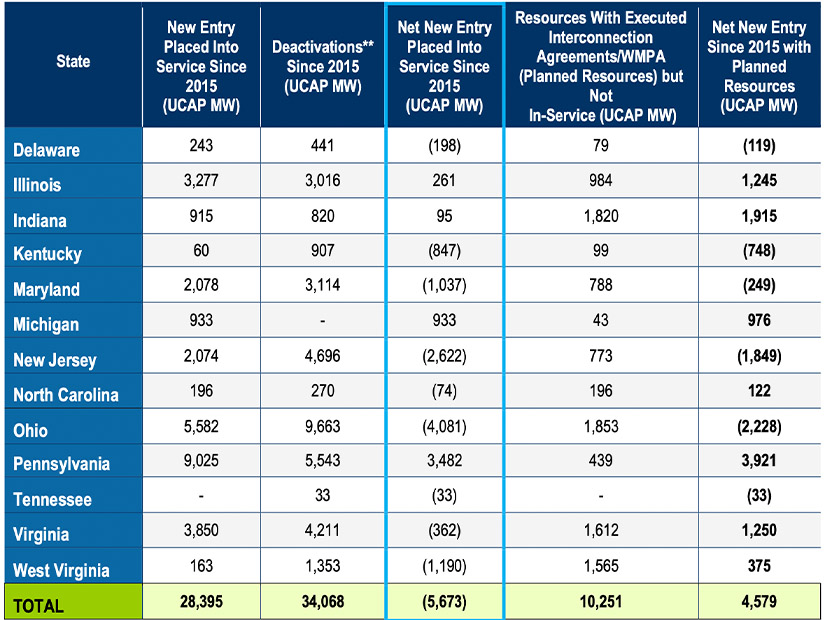
A chart PJM filed for the FERC technical conference laying out changes in capacity by state over the previous decade. | PJM
“The seasonal pricing will reflect the dynamic changes and constraints in the regional power system, provide the economic stimulus to drive bilateral trading and discipline wholesale buyers who have not covered their share of the resource adequacy objective,” van Welie said.
The new construct would require support from the states, reduced barriers to entry and substantial bilateral trading to manage volatility and support investment, he added.
PJM’s markets generally have worked well in the past, with its capacity market helping to bring online 50 GW of new resources that includes significant renewables and 8 GW of demand response since it launched in 2007, CEO Manu Asthana said.
“So, it’s not something very lightly that we would want to move away from,” Asthana said. “I think they have worked, but — and there’s a ‘but’ — as you know, we’ve been expressing resource adequacy concerns for some years now, and they’re driven by generator retirements, slow new entry and accelerating demand growth.”
Artificial intelligence is effectively just a “toddler” at this point, with ChatGPT launching less than three years ago, Asthana said. The technology is only to grow, and Asthana said he believes it will change the world — and in the process lead to much higher demand for power.
Other regions have seen their once large reserve margins shrink down to their minimum targets, and that is likely to remain the case.
“We hit minimum planning reserve margins in 2022; we’ve been treading water to maintain that level ever since,” MISO Senior Vice President Todd Ramey said. “I think that’s the new normal for our region. All of the incentives do not point to excessive planning reserve margins.”
A key way MISO keeps track of resource adequacy is surveys it conducts with the Organization of MISO States, which represents states that largely are vertically integrated. The latest survey June 6 will show the industry in the region has work to do to maintain its reserve margin target next year and for the rest of the decade, Ramey said.
A longer-term 20-year assessment from a couple years ago showed only renewables coming online, which would have left the grid short of key reliability services. But Ramey said that has changed for the next long-term assessments as states have added more dispatchable resources to their plans.
For states that have ceded more control to FERC, the options to ensure reliability are more limited, with van Welie suggesting some kind of financial hit is needed, such as a penalty baked into the market, or just letting scarcity pricing occur in the spot market.
While restructured states have given FERC more control over resource adequacy, none of them under its regulation has gone as far as Texas, where the standard utility has been eliminated, leaving large parts of their customers still on utility service. Asthana suggested states could change the rules set for utilities to procure supplies for those customers to boost bilateral trading and supplement the wholesale market.
“Because a lot of the load clears through state-run auctions, I think our states have the ability to try to hedge their consumers through those auctions for capacity,” Asthana said. “And I think those hedges and those bilaterals will also incentivize new generation, and those are conversations we’re having with our states.”
State of PJM’s Markets
After an initial panel of ISO/RTO CEOs, the technical conference started focusing on regions, and PJM got the most attention, with three panels taking up more than half a day.
Commissioner Chang noted PJM has seen some of the largest concerns, but paradoxically, it has seen some of the lightest renewable power development, with 93% of its generation still conventional.
Given that PJM is going through more retirements of conventional generation, and most of the new developments are renewables, the mismatch in retirements and replacements is a concern for the near future, and the RTO already has to start planning for it, said Vice President of Market Design and Economics Adam Keech. On top of that, PJM has several hot markets for data centers, with the resulting demand growth acting as an accelerant to every other issue it faces.
Data centers are looking for highly reliable, 24/7 power, but a recent study from Duke University showed they can be flexible if they use on-site resources such as batteries to participate as demand response, said LS Power Senior Vice President of Wholesale Market Policy Marji Philips. (See US Grid has Flexible Headroom for Data Center Demand Growth.)
“It’s really only the times the system is stressed that you need the thermal generation,” Philips said. “The problem is when it’s stressed, you need it all. And PJM, as Adam said, is seeing a retirement of those resources.”
Renewables are dominating the queue, and the most economical of those are going to be built and will benefit the grid and consumers, PJM Independent Market Monitor Joe Bowring said.
“All I’m saying is that there’s a baseline level of dispatchable resources you need for reliability to meet the demand during the high expected unserved energy hours,” Bowring said. “So, I mean … low-marginal-cost energy is great for customers, but it doesn’t meet that same reliability.”
But PJM Power Providers President Glen Thomas doubted Pennsylvania will change course and said Ohio just reaffirmed its market-centric policy with a recent change in law. Illinois, Maryland and New Jersey all restructured, and they have moved to a middle path, relying on the markets while being more active in picking resources, which he argued led to the retirements of others.
“They’ve largely been able to do that because of the tremendous surplus that Pennsylvania has built up,” Thomas said. “And I would also add that Pennsylvania would never have been able to build that surplus under a vertically integrated [integrated resource plan] regime. There’s no way state regulators would allow the system to be that overbuilt.”
Now that excess capacity is bailing out even Virginia, which is a vertically integrated state that is dealing with massive demand growth from its world-leading data center market, he said.
Chair Christie, who was a regulator on Virginia’s State Corporation Commission for years before joining FERC and is a strong proponent of its regulatory setup, said traditional regulation worked for years there and only ran into the same issue around unexpected demand growth that is causing issues around the country.
“That was a decision driven by policies adopted by our legislature to give tax subsidies to data centers and other attractions, which the utility commission had nothing to do with,” Christie said. “So, the IRP system is not the reason, as Glen said, Virginia is now a big importer.”
The prices are getting too high even for Pennsylvania, PPL Chief Legal Officer Wendy Stark said. The capacity market cleared at $270/MW-day last time, which was enough for Gov. Josh Shapiro (D) to file a complaint. That led to a settlement capping the next two auctions at $325.
“That also is not enough to incent new generation, so customers will be paying even more than they are now,” Stark said, adding that prices need to be at $500 to $600/MW-day. “That’s a problem, and as a utility with that obligation to serve, we at this point are really dependent upon the PJM capacity market. I will tell you at this point that feels like a single point of failure for us.”
Pennsylvania and other states restructured because cost-of-service regulation proved inefficient, which meant high costs as well, Bowring said.
“The idea that a regulated generator, because it’s subject to a regulatory process, is going to do things more efficiently is questionable,” Bowring said. “The markets have demonstrated the reverse for quite some time. So, I didn’t think I’d be here jumping up to defend the PJM capacity market.”
Bowring also doubted that the mandatory market ever will be meaningfully substituted with bilateral deals because it effectively forces much of that activity into the capacity auctions.
“Cost-of-service regulation worked to provide reliability for 100 years,” Bowring said. “It could certainly do that. I think it did it at a higher cost than markets.”
Capacity is a political construct, and states should be given more say in how it is managed, said Jacob Finkel, deputy secretary of policy in Shapiro’s office. The 14 states that are in PJM are swamped by the sheer number of stakeholders in a process that does not give them major formal input, he said.
“Most of our ability right now revolves around whatever goodwill we can build with PJM around working with the board and working with management, and it should be more than that,” Finkel said.
With the disconnect between price signals and new supply as the balance is getting tighter, Finkel suggested PJM needs to embrace resources such as virtual power plants (VPPs) and grid-enhancing technologies (GETs) that can be added to the grid quickly.
“All the acronyms should be deployed,” Finkel said.
Getting such resources will help, but after the quip, Finkel said ultimately if the issues around the market cannot be resolved in a way that is fair for ratepayers, Pennsylvania could move back to its own planning.
IESO politely said “no” to many of the stakeholder-requested changes to the design of its proposed Local Generation Program, but noted it will include the raised concerns in its report to the Ontario government in July and signaled it was open to further discussing others before then.
The program is intended to maintain existing distributed energy resources whose contracts are expiring in the next five years and procure new facilities. However, several groups of stakeholders asked the ISO to consider changes to elements of the program before it submits its official recommendations to the minister of energy and electrification. (See Suppliers Call for Changes to IESO Local Generation Proposal.)
In a webinar June 5, IESO programs strategist Greg Bonser explained the ISO’s rationale for the program’s contract length, project size cap and competitive pricing.
Cooperatives and generators, among others, had requested a longer contract term than IESO’s five years for facilities renewing their contracts. While new facilities would be offered longer contracts, and the ISO is considering different terms for resources that need upgrades, “we have found that under our Medium-Term RFP, we recently offered a term for re-contracting for five years, and it worked quite well to re-contract larger, existing facilities that are connected to the transmission system, so we’re going to replicate that,” Bonser said.
Some stakeholders also had asked for generators over the proposed maximum of 10 MW to be included in the program; others asked for those under the minimum of 100 kW.
Bonser said IESO is firmly against raising the size cap.
“Under the current practices and regulations and whatnot, once you go over 10 MW, there’s a whole new set of rules that need to be followed around connection assessments and around the way in which our control room tries to manage those facilities,” he said. He noted there were other ways for participating in the ISO’s markets — a note he made several times throughout his presentation when talking about facilities not eligible for the program.
The ISO, however, is considering lowering the threshold for program participation.
“We’re open to having a discussion about what kind of value those facilities can bring and whether or not they’re a good fit for this program,” Bonser said. “We heard a lot of small facilities say they felt they might not be cost competitive, so we need to have a conversation with” them.
Not up for consideration is including facilities under 10 kW, he said. “We also do have to draw a line somewhere.”
That goes for standard offer pricing as well. Bonser called it “quite a costly and difficult thing to figure out, frankly. It’s hard to keep everybody happy, and it ends up being costly to the ratepayer. We take the position that the facility owners are best positioned to review their own systems, figure out the costs and tell us what you need to keep the facility running, or what you need to build a new facility.”
‘Spirit of Simplicity’
About 220 people attended the webinar. There were several questions seeking clarification about the re-contracting and new-build “streams,” specifically about how different fuel types will be treated in each.
IESO said existing facilities of the same type would be grouped together in the bidding process, which prompted some attendees to question whether the ISO was going against its fuel-agonistic policy. Bonser said the reason for this was to “provide continuity, and they can continue to generate after their contracts expire.”
When asked if this was “definitive,” Jonathan Scratch, IESO senior manager of market and system adequacy, chimed in to say the ISO was presenting only what it will recommend to the minister. He also emphasized that the fuel type grouping would apply only to the re-contracting process; new resources would all bid against each other, regardless of fuel type.
The new-build stream would begin six months after the re-contracting process began, but IESO officials declined to comment on when that would be. The program is expected to begin in 2026.
IESO is requesting more information from stakeholders or will seek guidance from the government on several requests, including:
how to integrate DER aggregations into the program in an “administratively simple” way;
how to allow behind-the-meter facilities to participate in the program;
whether municipal council resolutions or indigenous support should be required for participation;
how cooperative or indigenous ownership should be considered; and
how refurbishments, upgrades, expansions or repowering should be accommodated.
Officials repeatedly stressed that “simplicity” in the program is a high priority for the ISO. Eric Muller, the Canadian Renewable Energy Association’s director for Ontario, noted that the Medium-Term RFP “did not include rated criteria points and other policy considerations or land-use considerations or partnership factors. … It was a simple, straightforward competition on price. … I would just put forward that, in the spirit of simplicity, something similar be considered for re-contracting under this program.”