SERC Says Most Subregions Prepared for Summer Heat

SERC Reliability expects above-average temperatures to drive higher demand this summer, and registered entities should have the resources to meet demand under normal operating conditions, the regional entity said in its 2025 Summer Reliability Assessment. 

However, SERC also warned that some areas do face a risk of shortfalls should weather conditions become more extreme. 

SERC published the SRA on May 29 as a supplement to NERC’s 2025 summer assessment, in which the ERO warned that multiple subregions across North America showed a potential for insufficient operating reserves in above-normal conditions. (See NERC Warns Summer Shortfalls Possible in Multiple Regions.) NERC identified rising demand and the retirement of traditional generation resources as primary contributors to the risk in the summer season, which for both assessments runs from June to September. 

SERC’s assessment noted that extreme weather continues to be a major concern for the region, which “contains those areas of the U.S. most likely to be in the path of a hurricane, as well as many of the states that are prone to high summer temperatures.” The RE included data from EPA showing that the frequency, intensity and duration of heat waves in major U.S. cities have all steadily increased since 1961, while the average length of heat wave seasons has lengthened from just over 20 days in the 1960s to 70 days in the 2020s. 

“Hotter summer temperatures cause increased demand due to heightened use of commercial and residential air conditioning,” SERC said. “Simultaneously, hotter temperatures can reduce the generation capacity and efficiency of thermal generation units and reduce air density, which decreases the capability of wind turbines. … Extreme heat along with high demand can overwhelm the transmission lines and cause them to sag and touch trees or other objects, which can potentially lead to outages.” 

Despite the growing threat of extreme heat, SERC said all of its subregions have enough resources to meet NERC’s recommended 15% reserve margin target under the 50/50 load forecast, which represents a 50% chance that the actual peak load will be higher or lower than the prediction. This prediction held for most areas even under the 90/10 forecast, in which there is a 10% chance that peak load will be higher than expected. 
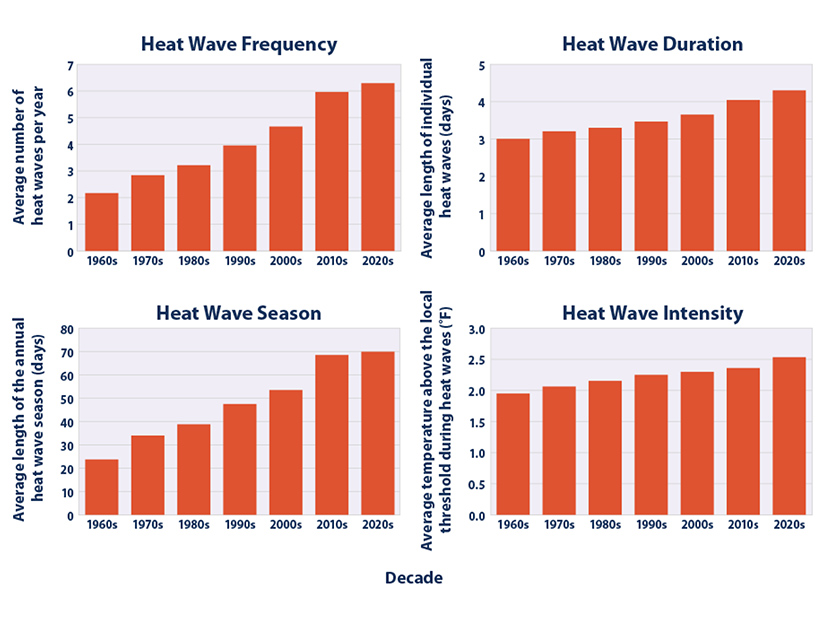
Charts included in SERC’s SRA, based on EPA data, on the frequency, duration and intensity of heat waves in major U.S. cities, along with the length of heat wave season, since the 1960s. | SERC

The one exception was the Central subregion, covering all or parts of Alabama, Georgia, Iowa, Kentucky, Mississippi, Missouri, North Carolina, Oklahoma, Tennessee and Virginia. Its predicted reserve margin was 19% under the 50/50 forecast, but 9% under the 90/10, putting it into the “elevated risk” category. 

Natural gas generation constituted the largest share of SERC Central’s summer on-peak generation mix, with 19.7 GW, or 41% of the total generation fleet; coal was next at 12.7 GW (27%); followed by nuclear at 8.2 GW (17%). For comparison, in SERC’s overall footprint, gas accounted for 49% of the nearly 324 GW on-peak generation capacity, with coal at 18% and nuclear at 13%. 

The report observed solar generation still is increasing across the SERC region, with 30 GW of on-peak solar capacity expected to be online by this summer, up 7 GW from summer 2024. This growth has driven operators to rely on natural gas to balance the weather dependence of solar generation. 

However, SERC noted that “while [gas] generators are capable of quickly ramping up and down to provide ‘load following’ service as necessary, this is only possible if they have access to the full amount of natural gas commodity needed for the periods for which they are dispatched.”  

The RE mentioned that one registered entity said, “If operational flow orders (OFO) were issued on the pipelines serving its generating units, the OFOs would require the units to maintain the day-ahead planned fuel usage.” This could prevent operators from redispatching the affected gas units to handle transmission line loading issues. 

SERC recommended that reliability coordinators, balancing authorities and transmission operators review their seasonal operating plans with a focus on communication and resolution of potential supply shortfalls during periods of extreme demand. The RE also said utilities should ensure resource availability through conservative generation and transmission outage coordination procedures, and state and provincial regulators should prepare to implement demand-side management mechanisms. 
Palisades Nuclear Restart Clears Environmental Review

The Nuclear Regulatory Commission has determined there would be no significant environmental impact from restarting the Palisades Nuclear Plant in Michigan. 

The NRC decision issued May 30 reaches the same conclusion as its draft decision Jan. 31. 

The 800-MW facility in Covert Township formerly operated by Entergy went offline in May 2022 in preparation for decommissioning, but barely a year later, new owner Holtec International began to float the idea of bringing it back into service.

No commercial reactor in the United States has been restarted in such a scenario, although Constellation is working toward that goal with the former Three Mile Island Unit 1, which shut down in 2019, and NextEra has filed notice with the NRC about potentially restarting the Duane Arnold Energy Center, which ceased operations in 2020. 

The NRC issued the environmental assessment of the Palisades proposal in cooperation with the U.S. Department of Energy’s Loan Programs Office, which in September 2024 extended a $1.52 billion loan guarantee to Holtec to help financed the effort. 

More recently, in March, DOE approved disbursement of $56.8 million for that purpose — a relatively small sum, but notable amid the wholesale slashing under way at the time as the new Trump administration took aim at the clean energy priorities of the Biden administration. 

While the two presidents have little common ground on wind and solar generation, both have supported nuclear power with words and deeds. (See Trump Orders Nuclear Regulatory Acceleration, Streamlining.) 

In the determination issued May 30, NRC said restarting Palisades would provide baseload power to meet current system needs. Holtec also noted it would help Michigan reach its targets of at least 80% clean energy by 2035 and 100% by 2040. 

NRC said it considered 11 potential direct or indirect environmental impacts from a restart and determined none would be significant. It also determined there are no environmentally preferable alternatives to restarting Palisades. 

In an April update, Holtec said the project remains on schedule and on budget. As it refurbishes the physical plant, it is rebuilding its workforce: Staffing has rebounded from a low of 220 to 570, 26 plant operators have requalified, and the first initial operator class was on track to complete their license exams this month. 

Also, FERC approved Holtec’s waiver request to maintain the grid interconnection, which was suspended after the plant shut down and otherwise would have been sunsetted. 

MMU, FTI Argue for Maintaining Uniform Pricing in NYISO Capacity Market

NYISO and its stakeholders continue to consider different designs as part of their Capacity Market Structure Review, but one idea should be dismissed, according to the Market Monitoring Unit and FTI Consulting: bifurcated pricing.

Though all RTOs with capacity markets may be concerned with their effectiveness in maintaining resource adequacy, NYISO is perhaps more unique in that, according to the MMU, new investment in generation primarily is driven by New York state procurements. In a market based on the net cost of new entry, stakeholders are concerned this could lead to keeping older, more inefficient resources longer than necessary and at a higher cost to consumers. (See NYISO Stakeholders Debate Purpose of Capacity Market.)

A bifurcated — or “discriminatory” — market would have two separate demand prices: one for existing resources and one for new entries to the market. According to NYISO consultant FTI, such markets can result in short-term reductions in costs to consumers, but “in the longer run, as more existing capacity inefficiently exits as a result of the artificially low capacity price and is replaced with high-cost new capacity, the short-run consumer savings will tend to turn into higher costs for future consumers.”

“From a social welfare standpoint, all of this is inefficient,” FTI’s Scott Harvey said in the middle of his presentation to the Installed Capacity Market Working Group on May 22. “It’s going to reduce social welfare because unless we do the price discrimination perfectly, we’re going to shut down some existing capacity that’s got lower cost than new capacity, and that reduces social welfare.”

Biasing the market toward new capacity also incentivizes the construction of short-lived assets because they will make less money as they age, even if initially they are higher cost, he said.

Balancing the market such that it retains enough units to meet reliability needs while incentivizing new entry and economic exit is tricky, Harvey acknowledged, especially amid low reserve margins.

FTI offered several approaches to a bifurcated market: holding a two-stage auction with separate supply curves but a single demand curve, with a lower price cap for existing capacity; a single-stage auction with a single supply curve but separate demand curves; and a two-stage auction with both supply and demand curves completely separated. Each construct, however, had its own drawbacks under certain circumstances, according to FTI’s presentation.

“If you are close to the edge already on reliability, then shutting down existing capacity will have a larger impact,” Harvey said. “Anything that drives up the cost of new capacity and less [generation] comes in than you expected is going to have an impact. If some of the existing capacity is already shut down by the time you realize the new capacity isn’t going to show up, you’re going to have problems.”

FTI noted that the natural gas market was bifurcated by the Natural Gas Policy Act of 1978, but this ultimately resulted in inflated, high prices, and by 1989, the law was repealed.

Potomac Economics’ Joe Coscia presented the MMU’s quantitative model using multiple scenarios showing that price discrimination between new and old units would lead to both “inefficient behavior” and higher investment costs.

Capacity prices also rise relative to status quo, and capacity surpluses decrease.

“That’s a result of the early retirement of existing resources or inability to attract imports and firm gas instead of replacing it with more expensive new capacity,” Coscia said.

He said the MMU’s results pointed toward the advantages of uniform clearing prices based on cost of new entry, even when there isn’t much investment in the peaking technology.

Panel Approves SPP Markets+ Phase 2 Governance Transition

The panel of SPP board members overseeing the development of Markets+ has approved the governance transition plan for the construction phase of the day-ahead market. 

The Interim Markets+ Independent Panel (IMIP) also signed off on Phase 2 sector representation for stakeholder groups, a meeting attendance and proxy policy, and the budget for the Markets+ State Committee (MSC) during its May 27 virtual meeting. 

The IMIP unanimously endorsed the Markets+ Participant Executive Committee’s (MPEC) recommendation to keep the Phase 1 stakeholder groups’ rosters until the committee’s Aug. 12-13 meeting, which serves as the Phase 2 effective date. Potential Markets+ participants must sign one of three agreements — funding, participation or stakeholder — by July 23 to retain seats for their representatives. 

MPEC will vote on stakeholder group nominations during the August meeting in Portland, Ore. (See SPP Readies Participants for Next Phase of Markets+.) 

IMIP Chair Steve Wright praised MPEC’s suggestion for meeting attendance and use of proxies. A stakeholder task force worked to meet the demands of public interest groups and nonprofits, many of which are stretched to cover the various working groups and subgroups. 

“This is a good example of how the process works well. I thought there were some legitimate concerns raised with respect to small organizations’ ability to participate in the process, and some good compromises were made from the initial proposal,” Wright said. “I feel like this is a really strong proposal that aligns with the culture of governance that we want to have as part of the development of Markets+.” 

The MSC budgeted $389,680 for 2025 expenses. That covers the cost of a full-time equivalent dedicated to the committee and two in-person meetings during the year, and compares favorably with SPP’s Regional State Committee in the Eastern Interconnection. 

The costs are allocated to Markets+ participants. The Western Interstate Energy Board provides independent staffing for the MSC, which is composed of state regulators from the West. 

Xcel Defends Markets+ Decision

Joe Taylor, who represents Xcel Energy operating subsidiary Public Service Company of Colorado (PSCo) on MPEC, explained the utility’s decision to join Markets+ rather than an RTO during testimony May 27 before the state’s Public Utilities Commission. 

Taylor said the company is concerned about long delays in grid operators’ interconnection queues. 

“It gives us pause to turn over those activities to an RTO,” he said. “The ability to plan and build are important considerations.” 

A 2021 state law requires transmission-owning utilities to join an organized market by 2030. Tri-State Generation and Transmission Association, Colorado Springs Utilities and the Platte River Power Authority have chosen to become full RTO members of SPP’s Western expansion. 

PSCo estimates it will be assessed $20 million in implementation costs for Markets+. 

MMU Releases 2024 Market Report

SPP’s Market Monitoring Unit has released its annual State of the Market report for 2024 and continues to find the Integrated Marketplace to be competitive.  

The Monitor shared a draft with stakeholders during the quarterly Joint Stakeholder Briefing in May. (See “MMU’s Draft Market Report,” 2025 ‘Challenging’ Year for SPP, Exec Says.) 

The MMU said many of the themes identified in previous years — resource adequacy challenges and increasing renewable generation — persisted in 2024. The market continues to see escalating load growth with a “high likelihood” that it will continue in future years. 

Intermittent resources continue to play an ever-growing role in the SPP markets, with increasing variability and uncertainty of supply, out-of-market actions to ensure system reliability, higher make-whole payments and negative prices, according to the report. 

The MMU will host a webinar June 12 to discuss the report. 

PJM Files Waiver Seeking Additional Time to Select Board Candidates

PJM has asked FERC to grant it more time to find candidates to fill two Board of Managers positions vacated when the Members Committee (MC) voted against reelecting two incumbents May 12. (See PJM Stakeholders Reaffirm Board Election Results.) 

The May 30 filing states that the RTO’s Nominating Committee (NC) needs more than the one-month period permitted by its Operating Agreement (OA) to select new candidates after the MC fails to elect a full board. It seeks instead to impose a Sept. 25 deadline for the NC to bring new candidates for members to vote on. The committee is composed of one member from each of the five member sectors and three from the Board of Managers. 

“While the Nominating Committee has already been reconvened and met, this waiver request is necessary to ensure sufficient time to identify potential board members and to complete appropriate due diligence, including background checks, prior to announcing the proposed nominees to be considered and voted on by the Members Committee,” the filing states. 

The MC voted against re-electing then-Chair Mark Takahashi and board member Terry Blackwell during PJM’s Annual Meeting on May 12. When stakeholders sought to reconsider the vote the following day, Takahashi removed his name from the running; a subsequent motion to reconsider Blackwell’s election failed. (See PJM Stakeholders Vote Out 2 Board Members.) 

PJM wrote that the current board meets OA requirements for the “size, the expertise and experience, and the composition of the board” and can continue operations until the membership votes on new members. 

PJM Board of Managers member David Mills speaks during the May 14 Public Interest and Environmental Organization User Group meeting. | © RTO Insider 

In a May 29 notification, PJM announced the NC had decided to continue working with Korn Ferry International in the search for the two new candidates. The firm was brought on to aid in finding candidates to replace outgoing board member Dean Oskvig, who retired from the board and was replaced by Matthew “Matt” Nelson, principal of regulatory strategy at Apex Analytics in May. 

Those interested in applying can submit resumes to Korn Ferry at PJMBoard@KornKerry.com. The announcement states the firm will not reach out to state commission members or government employees without their consent “to avoid the appearance of impropriety.” Officers and employees of PJM members or their affiliates are prohibited from serving on the board, as are those with financial interests in PJM members. Prospective candidates are encouraged to submit applications by June 30. 

“The Nominating Committee seeks to consider a broad and diverse field of candidates who possess the appropriate expertise and experience to oversee PJM as it fulfills its public service responsibilities in a complex and changing industry and regulatory environment,” PJM said in the notification. 

FERC Approves Implementation Delay for ISO-NE Order 881 Compliance

FERC has accepted a 17-month delay to ISO-NE and the New England transmission owners’ (TOs’) implementation of Order 881 and Order 881-A compliance, pushing back the rollout of ambient-adjusted line ratings (AARs) in the region. The RTO and the TOs said the delay is needed to accommodate vendor and software development challenges (ER22-2357, ER25-410). 

FERC Order 881, issued in December 2021, requires transmission providers to adopt AARs, which provide more accurate real-time temperature information on transmission lines, for near-term transmission requests. The order is intended to free up transmission capacity, as existing static rates are based on worst-case temperature conditions. The order also requires operators to use seasonal line ratings for long-term transmission service. (See FERC Orders End to Static Transmission Line Ratings.) 

ISO-NE and the TO’s compliance with the order was to take effect in July 2025 but has been pushed to December 2026.  

“Considering the vendor delay in delivery of the software that is needed for ISO-NE and the [participating transmission owners] to implement Order No. 881, and the time to test and train after delivery of the software, it is highly unlikely that the filing parties will be able to implement the tariff rules as of July 12, 2025,” the groups wrote in their request to FERC.  

The organizations wrote that ISO-NE plans to complete “all initial integrated software testing by January 2026,” which would be followed by trainings, TO testing and procedure development prior to the rollout of AARs in “all required day-ahead and real-time processes.” 

No protests of the request were filed in the docket. FERC accepted the request in a brief order May 30, writing that “good cause exists to defer the effective dates to implement the requirements of Order Nos. 881 and 881-A in order to provide additional time to complete the development and deployment of necessary software updates.” 

Energy Department Staff Cuts Just Getting Started

The U.S. Department of Energy is poised to lose thousands of employees this year through early buyouts and other mechanisms, but the cuts are heavier in certain offices. 

Cutting down the size of government is a major policy goal of President Donald Trump, as stated in a memo from the White House’s Office of Management and Budget and the U.S. Office of Personnel Management issued about a month after he took office. 

“The federal government is costly, inefficient and deeply in debt. At the same time, it is not producing results for the American public,” the memo said. “Instead, tax dollars are being siphoned off to fund unproductive and unnecessary programs that benefit radical interest groups while hurting hard-working American citizens.” 

The memo called on federal agencies to submit “agency [reduction in force] and reorganization plans that include a “significant reduction” in full-time employees, lower budgets and “better service for the American people.” 

The full effects of that process still are being played out, with the deferred resignation program that many employees have signed up for not being final until the end of September. The law firm Mintz said that up to 5,000 employees at DOE alone could leave, which is out of a total workforce of around 16,000, according to the Equal Employment Opportunity Commission. 

In testimony before the Senate Appropriations Committee on May 21, Energy Secretary Chris Wright said only a small percentage of employees had left the department. 

“We are looking at larger reductions and … we have offered voluntary plans and programs for people to be compensated by the government as they transition to another career,” Wright said. “We’ve done this slowly, carefully, with a lot of engagement with people and while looking at how to restructure our department. So, the ultimate reduction in workforce will be larger than it’s been today.” 

The Federal Reserve Bank of St. Louis estimates that total federal employment has fallen from 3.015 million in January to 2.989 million at the end of April, which still is above January 2024 federal employment levels. 

Speaking during a webinar in May put on by the World Resources Institute, where he is a senior fellow, former DOE Loans Program Officer Director Jigar Shah said some of the smartest people at DOE “were forcibly told to resign” over the previous couple of months. 

“So that expertise is gone,” the former Biden administration official said. “Even if they wanted to figure out a nuclear renaissance, those people decided to take the early retirement program; the same with geothermal; the same with advanced battery storage. So they’re not there to do that planning.” 

Shah listed his old office along with the Office of Clean Energy Demonstrations, the Grid Deployment Office, and the Office of Manufacturing and Energy Supply Chains as being particularly hard hit by staff cuts. 

“If you have a new technology right now, and you go to the Department of Energy … I don’t think there’s actually anyone to talk to over there to help you with commercialization of your technologies,” Shah said. 

Lasting Impact

While administrations and their policies come and go, the staff losses will be difficult to unwind if in four years a new president wants a more active DOE. 

“It is possible, but it’s going to be very difficult,” another former DOE official said in an interview. “You’re going to need to have some kind of authority, from either the administration or Congress, that allows you to hire much more quickly than the normal civil service hiring rules have allowed you to do.” 

Even if hiring can be sped up, many of the employees let go or who left because of new requirements, such as return-to-office, were young and doing their first stint in public service, the official added. Their trust in the system will need to be rebuilt, they said. 

The National Energy Technology Laboratory in Pittsburgh has not been hit as hard as some of the offices that were implementing key Biden-era policies, but about 100 employees have taken the deferred resignation program, said American Federation of Government Employees Local 1916 President Lilas Soukup. 

“Obviously it’s excruciating to lose about 15 to 20% of your workforce and not [be] able to replace them,” she said. 

A hiring freeze is in place until July 15, and it could be extended. Additionally, new rules allow departments to hire only one employee for every four who leave, Soukup said. 

NETL has different focuses, and those dealing with solar energy are being reduced by the Trump administration. But it also works on fossil fuels, so Soukup said hopefully some of the staff losses could be offset by having her members switch to other programs. 

While NETL — as well as the Department of Health and Human Services, whose Pittsburgh-area employees Soukup also represents — have not faced the same cutbacks as other parts of DOE, she worried about the long-term impacts of the staff cuts on public service. 

“Who’s going to want to take and work for the government after all of this fiasco is over with?” she asked. 

DOE Reorganization Goes Beyond Staffing

DOE did not respond to requests for comment on its staff cuts, but on May 30, it put out a press release highlighting the shift in its direction under President Trump and Secretary Wright.  

While the press was bombarded with releases on funding authorized by DOE under President Joe Biden, the department trumpeted $3.7 billion in savings from 24 canceled projects. 

“While the previous administration failed to conduct a thorough financial review before signing away billions of taxpayer dollars, the Trump administration is doing our due diligence to ensure we are utilizing taxpayer dollars to strengthen our national security, bolster affordable, reliable energy sources and advance projects that generate the highest possible return on investment,” Wright said in a statement. “Today, we are acting in the best interest of the American people by canceling these 24 awards.” 

Of the canceled projects, 16 were approved between Election Day in November and Trump’s inauguration Jan. 20, and they primarily were for carbon capture and storage projects. 

The cuts came under criticism from the American Council for an Energy Efficient Economy, which argued they go against the goal of reshoring manufacturing. 

“This program could have been a centerpiece of achieving the administration’s goal to bring manufacturing back to the United States,” ACEEE Executive Director Steven Nadel said. “Choosing to cancel these awards is shortsighted, and I think we’re going to look back at this moment with regret. Locking domestic plants into outdated technology is not a recipe for future competitiveness or bringing manufacturing jobs back to American communities.” 

Pathways Initiative Seeks $7.1M to Fund RO

The West-Wide Governance Pathways Initiative’s Launch Committee estimates it will cost about $7.1 million to launch the independent regional organization (RO) that eventually will oversee energy markets in the West, staff said during a May 30 presentation, while noting federal funding for the effort is uncertain.

The budget is divided into three categories: preparation, formation and implementation. The estimated total cost for all three phases is about $7.1 million, including a 10% contingency cost, said launch committee member Jim Shetler, general manager of the Balancing Authority of Northern California.

The draft budget runs from Jan.1, 2025, to Dec. 31, 2027, when tariff funding takes effect for the RO. It includes costs for activities like project management, legal services, hiring an executive director and general counsel, and finalizing a draft tariff and service agreements.

However, the committee has yet to receive confirmation on whether the U.S. Department of Energy plans to issue nearly $1 million in funding. Pathways received a commitment under former President Joe Biden’s administration to underwrite the committee’s efforts to establish the RO to oversee CAISO’s Western Energy Imbalance Market (WEIM) and Extended Day-Ahead Market (EDAM). (See Feds Pause $1M Pathways Initiative Funding, Group Leader Says.)

The award was issued through the Pathways Initiative’s philanthropy adviser, Global Impact, which the group’s Launch Committee partnered with earlier in 2024 to secure outside funding for its operations, which so far have been supported by donations — and volunteered staff — from its participants.

President Donald Trump’s administration on Jan. 27 paused all federal grants and loans, according to a memo issued by the White House’s Office of Management and Budget.

“We are still looking to try to engage to see if we can get a DOE grant, but we’re not assuming that that will be the case,” Shetler said.

Instead, the committee seeks donations from stakeholders to support the effort, Shetler added.

“I’ll just let you know I’ve been starting some initial dialog with the utilities that have indicated support for EDAM, and I’m not suggesting the utilities would support all of the $7.2 million, but at least we have started dialog around how we might support that,” Shetler said.

Kathleen Staks, executive director of Western Freedom and the Launch Committee’s co-chair, also provided an update on the RO’s board members, stating that the committee hopes to seat a board by July 2026 and no later than January 2027. (See Pathways Inches Closer to Seating RO Board.)

Per the committee’s draft proposal, the board will have five members, with two additional seats added after FERC approves the tariff changes and RO funding is secured.

The initial board will consist of independent members that will negotiate with CAISO, Staks said. She noted the board “would not yet have any authority over the markets because that authority change does not happen until FERC approves the tariff change.”

The five initial members would serve until the RO tariff goes into effect, and service during this period would not count toward the members’ term limits, according to the committee’s proposal.

The committee has proposed that when the RO is fully implemented and has a seven-member board, two of the seats would be one-year terms; two seats would be two-year terms; and three of the seats would be full, three-year terms.

Staks noted that seating the five-member board in July, as opposed to a smaller board or seating at a later date, “will create a pretty significant increase in our budget.”

But the committee did not want the budget to be a “limiting factor for the important role that this independent body will play as we move forward,” Staks said.

“We decided that we would prioritize having some of these independent board members in place earlier, so that there really is that separation and independence for the negotiations with the CAISO,” Staks said.

FERC Resource Adequacy Conference Comes with Markets at a Crossroads

FERC will hold a two-day technical conference June 4-5, where it will look at resource adequacy issues in the ISO/RTO markets, with most of the focus on those with capacity markets. 

Capacity auctions in PJM and MISO have generated headlines recently as both markets face narrowing supply-and-demand balances that have led to spiking prices and yet another round of changes, which have been nearly constant since the capacity markets were created. 

“The problem with the capacity market and the reason there’s all this tinkering is there’s literally hundreds of parameters that make a big impact on the prices and the quantities,” Forward Market Design founder Peter Cramton said in an interview. “And people care enormously about those prices and quantities, and so they argue about them endlessly. So, in essence, capacity market has been troubled by this constant stakeholder debate about this effectively moving money from one side of the market to the other.” 

Cramton previously was an independent director on ERCOT’s Board of Directors. Forward Market Design filed comments in the tech conference’s docket (AD25-7) outlining a major overhaul to organized markets that would scrap the capacity auctions and replace them with “forward energy markets.” 

The concept could be readily implemented by ISO/RTOs because it does not require changing their core systems for the day-ahead and real-time markets, the company said. 

“Unique prices and quantities that maximize total welfare are calculated hourly for all forward products,” it added. “This lets market participants trade gradually over tens of thousands of auctions to establish desired positions in forward energy and energy options before day-ahead is reached. Their positions can be adjusted based on the latest information and the consensus views of market participants with intuitive trade-to-target strategies.” 

When the capacity markets first were developed, the trading technology was not as effective as it is today, Cramton said. 

“This new approach is really focusing on the fundamental problem that the natural sellers and natural buyers have to deal with, and that is to establish positions to best manage needs and risks,” he added. “And the way this happens in the forward energy market is the system operator conducts an hourly auction for highly granular energy and energy option products. This is done with this new trading technology, flow trading, which is effectively what we already do today in the day-ahead and the real-time market.” 

Instead of trading once or twice a year in capacity auctions, market participants can trade much more frequently and make constant adjustments to their positions over time, Cramton said. Forward hedges can be locked in gradually over time, helping participants manage risk and limit trading costs. 

Capacity prices are high because of tightening supply and demand balances, which makes sense, but the overall cost is very high because there is a huge quantity of megawatt-days trading at that high price, Cramton said. 

“That’s what the forward energy market avoids by trading every hour rather than trading once a year,” Cramton said. “So, when you’re trading every hour, you may have this disequilibrium, and the prices are very high momentarily, but very small quantities are transacting many orders of magnitude smaller.” 

That still produces the all-important price signals to guide investment, but because of the smaller amounts being traded, the actual money involved will not lead to price spikes for consumers once the capacity year starts. 

“Prices are changing gradually, and to the extent that the actions are taken to address the shortfall that’s leading to the high prices, then the prices will fall over time as supply responds,” Cramton said. 

Replacing capacity markets with forward energy markets would represent a major change in organized markets, and Cramton’s endorsement makes it an option worth considering, Copper Monarch’s Vincent Duane, a longtime former PJM executive, said in an interview. But that is only one of the long-term options on the table. 

“The commission is trying to explore what types of alternatives might sort of break the logjam of increased costs of supply versus the sort of affordability crisis,” Duane said. The market design can continue to be tinkered around the edges; it could be knocked down and rebuilt; or it could be replaced with something entirely different. 

The recent return to demand growth has come at a time when the cost of building power plants has gone up, with combined cycle rising from $1,000/kW about five years to $2,500/kW today, Duane said. 

“The capacity market printed a price of about $280.60/MW-day the last time around,” Duane said. “But that doesn’t translate into what it’s going to cost to incent new investment, which, of course, is desperately needed.” 

FERC Chair Mark Christie is not tied to the organized markets in the way many of his predecessors were, having published an article suggesting it was time to move on from the single clearing price model that is fundamental in ISO/RTOs. (See FERC’s Christie Calls for Reassessment of Single Clearing Price.) 

“Does it make sense in this day and age with the very different technologies that we now have, not to mention the ages of these technologies, to treat them all, from a capacity market perspective, as just another megawatt, as another megawatt, as another megawatt,” Duane said. “And I think he’s got a serious question in mind as to whether that makes sense.” 

Paying some supply more than others might be a way to get around the fact that the current systems’ prices are politically unviable, but still not high enough to attract the needed wave of investment in new power plants, Duane said. 

A key input to capacity prices is the load forecast. The markets need to clear enough capacity to meet future demand, plus a reserve margin, and forecasters face new uncertainty from the growth in large loads. The Electricity Customer Alliance and other customer groups wrote a letter May 30 to all four FERC commissioners ahead of the technical conference, saying FERC should ensure that best practices in load forecasting are being used. 

The alliance includes some of those new large loads along with everyday mass market customers, and the letter’s co-signers included the Electricity Consumers Resource Council and the National Association of State Utility Consumer Advocates. 

“We cannot meet these national security imperatives … without more confidence in load growth forecasts, greater transparency and standardization in how forecasts are constructed, and clearer lines of communication among state and federal regulators, transmission operators, generators, load-serving entities and customers as forecasts are adjusted,” the letter says. “Customers face significant reliability and cost risks when load growth forecasts and projections are uncertain and not transparent.” 

Looking into where current practices are incomplete or inaccurate and identifying best practices are important steps to protecting customers from reliability risks if forecasts are too low, or paying for stranded costs if they are too high, the letter says. “The commission is uniquely positioned to convene the states, industry and customers to examine load forecasting practices, given the impact of these practices on matters in the jurisdiction of both the commission and the states.” 

Around the Corner: The Solar Duck Has Run Amuck, But that May Change Soon

Peter Kelly-Detwiler

If you follow power markets, then you are familiar with the duck. The solar “duck curve” received its moniker 13 years ago in sun-drenched California, with its emerging multitude of rooftop solar arrays and thousands of megawatts of utility-scale arrays. In that market, the electricity demand net of solar — in other words, the load that must be met with imports and dispatchable resources — frequently drops to zero these days.  

Solar also has exerted a significant impact on California’s electricity market, with prices typically falling significantly by mid-day, and then firming up — often tripling — by early evening, before softening again at night and the wee hours of the morning. The fourth quarter of 2024 was a typical example of this dynamic. For the last three months of the year, hourly load-weighted day-ahead prices sat in the high $20/MWh range in the early afternoon, before soaring past $65 around 7 p.m.  

A Tale of Two Price Regimes

In California, the duck generally sets the rules, and the other resources — whether imports, batteries or gas generation — respond accordingly. The funny thing about ducks is they have offspring, a fact that is becoming clear in a number of other power markets, with some effects more pronounced than others. 

duck

| ISO-NE

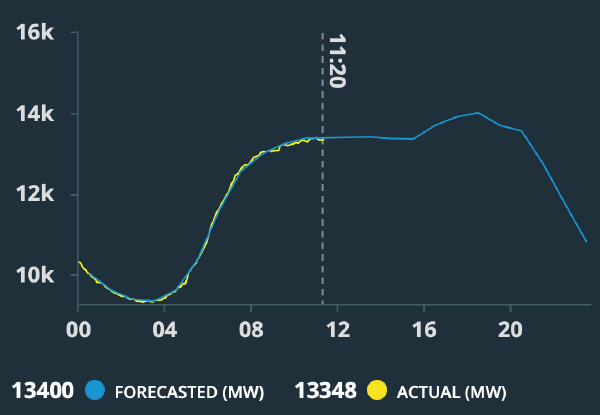
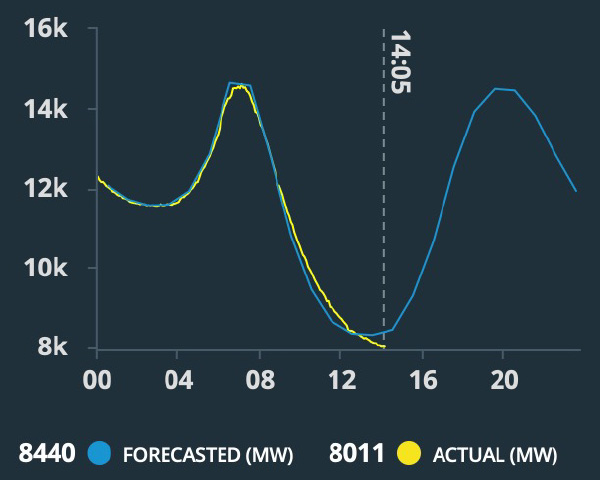
New England, not the sunniest of places, is an instructive example. The first duckling landed there April 21, 2018. On that day, for the first time, net load in the early hours of the morning exceeded mid-day demand. Almost all of the solar creating this change was subsidy-driven rooftop solar. In New England, utility-scale solar typically has lagged behind because there’s simply not a lot of unforested open space to build on.  

New England’s duck found suitable rooftop habitat and subsidy-related forage and began to quickly fatten up its belly. By 2022, the region saw 45 “duck days,” with that number vaulting to 73 days the following year and 106 in 2024 

The duck phenomenon is most prevalent in spring, when demand for air conditioning is relatively low, the position of the sun is optimal and there are fewer leaves to block out potential sunlight. Panels also are relatively cool in the spring and operate at higher efficiency. 

Though spring is ideal, duck days now occur in every month of the year, and the sag of the duck’s belly grows ever deeper. In fact, Easter 2025 saw ISO-NE record a record all-time low of just 5,250 MW, 1,000 MW below the 2024 record. That dynamic is likely to continue to strengthen. An April 2025 ISO-NE overview forecasts the contribution of solar growing significantly in coming years, from 6,500 MW at the end of 2023 to nearly 13,500 MW by 2033. 

duck

| ISO-NE

With recent tariff increases affecting the cost of imported solar panels, combined with significant looming cuts to federal tax subsidies, these forecasts now appear less likely. However, additional solar capacity still is likely to be installed for some time, even if added somewhat more slowly. Thus, we will see both frequent and precipitous declines in New England electricity demand daily whenever there’s sun. Prices also will fall increasingly into negative territory at times — that’s already happening. Sunny spring days will look like April 9, shown below, but the roller coaster dips and rises will be much steeper unless we add enormous amounts of storage and distributed resources to the mix. 

Sunny days likely will see an increasingly bifurcated world of pricing: one pricing regime on sunny days when the solar resource is active and another when it’s not. Then there will be entire days — like during May’s unusual spring nor’easter — where solar energy barely contributes to the system at all. All of this means that ISO-NE has had to become more sophisticated in its forecasting in this dynamic environment, particularly as it relates to anticipated irradiance, to ensure sufficient resources in the system for those cloudy days.  

Where Else the Duck is Nesting

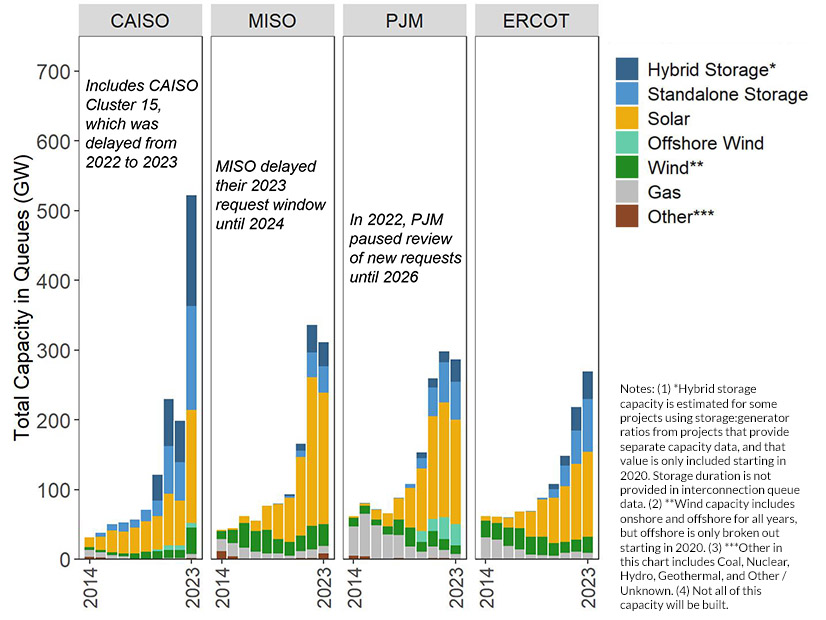
New England certainly has the most pronounced situation in terms of behind-the-meter resources, but it and California are by no means the only grids that are — or will be — greatly affected. A brief look at the interconnection queues (historically, only 19% of what’s in the queue eventually flows power, but it’s still a useful indicator) suggests significant levels of solar energy are on tap for various regions, with some much more affected than others. 

Storage also increasingly enters the picture, both in the form of hybrid solar-battery projects and stand-alone ventures. A 2024 review of interconnection queues by region illustrates the sheer magnitude of the solar resource knocking at the door of other grid operators, such as MISO, PJM and ERCOT. 

| Lawrence Berkeley National Laboratory

MISO and PJM are only beginning to be affected, as not much solar has been built out yet, but ERCOT already is an entirely different story. In Texas, almost 31,000 MW of solar capacity and nearly 40,000 MW of installed wind generation populate the system, up from 14,000 MW of solar and 36,000 MW of wind just two-and-a-half years ago.  

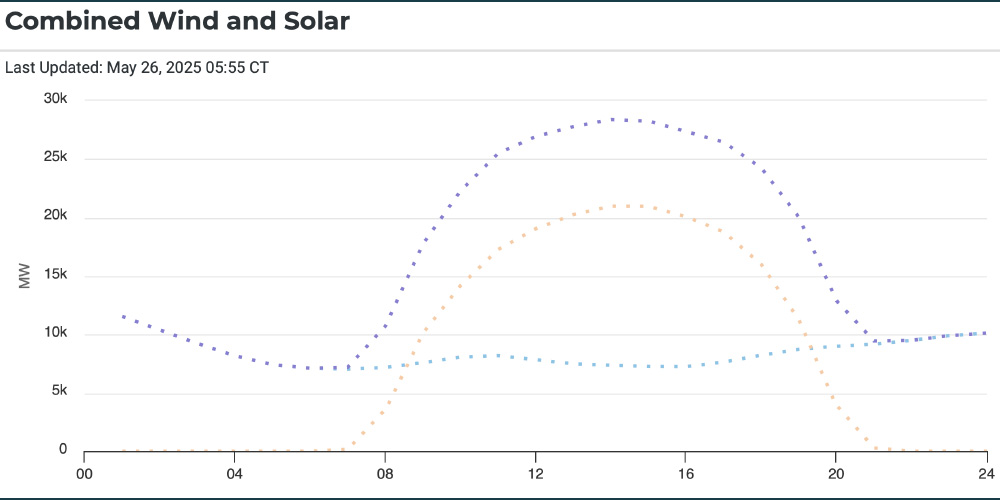
Renewables are so meaningful there that ERCOT daily forecasts the combined output of wind and solar. Some days, the tandem output resembles a cowboy hat, while other days it looks more like a derby.  

| ERCOT

Here, too, prices tend to soften increasingly by mid-day as Apollo’s chariot ascends higher into the sky. A classic example of that effect would be May 14, when record demand occurred and yet prices did not soar into the stratosphere. 

What Subsidies and Policies Give, They Also Can Remove

In recent years, solar energy has benefited from a flood of low-cost panels imported from Asian countries with minimal tariff barriers. This dynamic, combined with fairly generous federal tax policies, was topped off in some areas by generous state policies as well. That landscape has shifted recently. Steep tariff barriers have been erected on imports coming from the four countries from which the U.S. recently imported about 80% of its solar modules, and those tariffs range from 41% to over 350% on some of the larger Chinese-based companies that export most of the panels. 

Perhaps even more critically, the U.S. House just narrowly voted to strip the investment tax credits from renewables nearly immediately. That legislation now goes to the Senate, where it is expected to be modified to some degree, though nobody knows quite how this will play out. 

Meanwhile, at the state level, California has retreated recently from some of its most generous supports for rooftop solar, significantly reducing economic prospects for investors in on-site solar, with perhaps even more changes to come. Massachusetts — the key supporter of the New England duck — also has rolled back its most generous subsidies in recent years. And Texas just narrowly avoided a major legislative shift that would have dramatically eroded the future potential of solar. 

This rapidly evolving political landscape invites the obvious question: “In the absence of significant subsidies, what would a future state look like?” At this point, with so much uncertainty in the air, nobody can say for sure. But the duck certainly is feeling its feathers ruffled. 

Around the Corner columnist Peter Kelly-Detwiler of NorthBridge Energy Partners is an industry expert in the complex interaction between power markets and evolving technologies on both sides of the meter.