PJM MRC Briefs: May 21, 2025

Stakeholders Endorse Proposal to Add Transparency to ELCC

VALLEY FORGE, Pa. — The PJM Markets and Reliability Committee endorsed by acclamation a proposal intended to add transparency to the RTO’s effective load-carrying capability (ELCC) process and how the ratings it produces contribute to resources’ capacity accreditation. (See “PJM Presents Proposal to Add Transparency to ELCC,” PJM MRC/MC Briefs: April 23, 2025.)

Providing more information to generation owners about the amount of capacity their units can provide is one of several areas where stakeholders have sought to make changes through the ELCC Senior Task Force. The MRC endorsed a proposal in March to add two resource categories and limit the Capacity Performance deficiency penalty rate for units whose accreditation falls between a Base Residual Auction and Incremental Auction. (See PJM Stakeholders Endorse Proposals to Rework ELCC Accreditation.)

The transparency proposal would create an exception to PJM’s confidentiality requirements to allow market sellers to request data showing the historic performance of the resource through June 2012, even if that extends prior to the owner’s acquisition of the asset. Proponents argued those data are integral to understanding how PJM determines the inputs driving the unit’s ELCC rating.

Before rounds of ELCC analysis are initiated, pre-study stakeholder sessions would be held to review the assumptions and updates to data inputs PJM is considering. Additional sessions would be held once the analysis is complete to discuss the results. PJM also would publish an annual report outlining the assumptions, methodology and results of the ELCC analysis, including any sensitivities.

More sensitivities could be conducted after the analysis, such as developments in the load forecast, weather data or resource performance.

Independent Market Monitor Joe Bowring asked PJM to produce a legal opinion outlining its perspective that it can share confidential information from a prior resource owner to a new owner without permission from the former. PJM legal staff said their client is the RTO, not the Monitor, after which a member also requested more information on PJM’s legal reasoning.

Discussion of CETL Deferred

The MRC voted to delay consideration of an issue charge focused on a “disconnect” between PJM’s winter-skewed risk modeling and the use of summer peaks to calculate capacity emergency transfer limits for locational deliverability areas. (See “LS Power Seeks Issue Charge to Align CETL Calculation with Winter Risk,” PJM PC/TEAC Briefs: Oct. 8, 2024.)

LS Power Director of Project Development Tom Hoatson, who made the motion to defer, said he believes the issue is intertwined with the concept of a seasonal capacity market and suggested the two should be discussed together. He also said the stakeholders and PJM engineers who would lead the work are the same employees engaged with discussions on other areas of the ELCC paradigm, presenting workload challenges.

Greg Poulos, executive director of the Consumer Advocates of the PJM States (CAPS), said the issue charge, which was sponsored by LS Power, was well developed and broached an issue of importance to consumer advocates. He said they could support a delay of a few months, but not longer.

The motion to defer until “stakeholders undertake work on a seasonal capacity construct” was endorsed with the support of all sectors except end-use customers.

Stakeholders Torn on Further SATA Education

Stakeholders held mixed perspectives on whether to recommence work on an issue charge seeking to establish rules for storage acting as a transmission asset (SATA), with some feeling more education is warranted and others arguing it’s time to move on to proposal development.

PJM Director of Stakeholder Affairs Dave Anders said that, after a series of presentations at the Operating Committee in recent months, he believes the education component of the work has run its course and said the issue charge is slated for an endorsement vote at the MRC’s June 18 meeting. He added that approving the issue charge does not mean further education and stakeholder discussion cannot happen.

The committee voted in October 2024 to delay acting on the issue charge until PJM had completed education sessions at the OC, both to allow stakeholders to focus on several capacity market proposals being considered at the time and to bring them up to speed on a SATA proposal last considered in 2021. The OC’s sessions focused on the 2021 proposal, how SATA could impact operations and FERC’s regulatory authority. The issue of developing rules for SATA was brought by PJM in September 2024, nearly four years after members voted to delay further activities on the subject until market rules for storage had been established. (See “Vote on Issue Charge to Establish SATA Rules Deferred,” PJM MRC Briefs: Oct. 30, 2024.)

Constellation Energy’s Juliet Anderson said there are unanswered questions around where SATA would fall into the federal and state jurisdictions over transmission and distribution networks. She noted that the October 2024 deferral delayed action on the issue charge until education at the OC had been completed.

Bowring asked whether PJM believes it’s appropriate to proceed without a more complete understanding of how SATA could impact market operations. Anders responded that market impacts fall under the issue charge’s key work activity 6.

Poulos said most issue charges have a significant educational component, so it’s surprising to him there’s opposition to continuing that work here. He said SATA is a priority for advocates who see it as a valuable tool for resolving reliability issues, and they’re frustrated that barriers are being put up to having the subject discussed further.

Exelon Director of RTO Relations and Strategy Alex Stern said there have been several discussions over the past five years to determine whether storage can act as transmission. In that time FERC has issued policy statements, and other RTOs have developed their own rules, while PJM has been blocked artificially from advancing the discussion by stakeholders using pre-education as a pretext for delay, he said. Whether or not stakeholders want to proceed with establishing a SATA framework, he said, their position should be made clear and communicated to the states, which have been pushing for increased storage deployment.

“I’d just as soon like to know whether this is something we can have in the toolkit or not,” he said.

PPL’s Robin Lafayette said SATA has been discussed at more than 30 meetings and is clearly a tool PJM believes it needs to have available.

“Other ISOs and RTOs have found ways forward on this issue, and I do acknowledge some of the issues raised by some of my colleagues on interactions with the markets,” he said. “PPL strongly supports trying to find a way forward on this issue; even if it is a targeted, limited tool, it could be a valuable one.”

1st Read on Uplift Formula Proposal

PJM Senior Director of Market Settlements Lisa Morelli presented a first read on a proposal to rework how balancing operating reserve (BOR) credits are calculated, including a new metric to determine whether a resource is following dispatch signals. (See “Stakeholders Narrowly Endorse Uplift Changes,” PJM MIC Briefs: April 2, 2025.)

The proposal would replace the three desired megawatt metrics used to determine deviation charges with a new tracking ramp-limited desired (TRLD) metric, which would compare actual output to how a resource should be operating if it had followed dispatch instructions. Morelli said the existing metrics are limited to how dispatch instructions and resource output change over five-minute intervals, which can mask when a resource is deviating from instructions by small amounts over a long period, particularly because there is a 10% margin before a resource is found to be deviating.

The BOR credit formula also would be revised to take the lesser of real-time output or the TRLD, adjusted for a unit’s ramping parameters. The period for which a resource is eligible for uplift also would be realigned to when its commitment began and continue through either the minimum run time parameter or the end of the commitment.

Depending on how a unit operates, the proposal either could lead to increased uplift payments or higher deviation charges, Morelli said, adding that PJM and the Monitor, which jointly sponsored the proposal at the Market Implementation Committee, aimed to take a balanced approach to how uplift would be affected by the proposal, rather than just reducing the amount of uplift paid.

If endorsed, a soft launch would be rolled out at the end of 2025 or early 2026, starting with calculating how the TRLD would affect settlements and communicating that to market sellers through their Market Settlements Reporting System reports. Changes to actual settlements would not come for another year once the full implementation begins.

Gregory Pakela, manager of regulatory affairs for DTE Energy Trading, said the proposal could have significant impacts during periods of high system stress and asked if PJM could conduct backcasts on how it would have changed settlements during the two winter storms in early 2025, when conservative operations were initiated.

Morelli said PJM has conducted limited backcasting, but there’s a balance between the number of staff hours that fully recalculating results would take versus the benefits. She said PJM is comfortable that the proposal is worth moving forward with.

Vistra’s Erik Heinle said the phased implementation process allows market participants to have more understanding of how their resources would fare under the proposed paradigm. Having the opportunity to spend a year understanding how TRLD would determine when a unit is following dispatch and the ability to update the unit’s parameters based on that information is crucial, he said.

EBA Event Examines History of Electricity Demand Growth as Industry Tackles New Wave

WASHINGTON — The return of rapid load growth still is a relatively new phenomenon for the power industry, but demand has seen such cycles several times before, speakers said at the annual half-day meeting of the Energy Bar Association’s Electricity Steering Committee.

Electricity started off as a niche product, with fully distributed power generators serving mansions and some industrial customers in the late 19th and early 20th centuries, recalled Hannah Wiseman, professor of law at Penn State University.

Appleton, Wis., was home to the first grid in the country, with a hydropower dam serving multiple homes and the lights dimming as water flow slowed.

At first, industry preferred distributed power, and residential customers used electricity only for lights, but that expanded to new products like electric clocks. It was not until World War I that industrial use took off and the grid as we know it started to be patched together, Wiseman said.

“We start to see more centralization, and we start to see more federal involvement, which means we also start to see more public involvement in power,” Wiseman said. “So the War Department in World War I became directly involved in determining where the electricity needed to be generated most.”

The department helped to wring efficiency out of the grid by determining when coal power needed to be dispatched due to hydropower not producing enough to meet demand, she said.

Under the New Deal, electricity service started expanding to more rural areas, such as through the Tennessee Valley Authority. Then World War II and its demands on industry made the backbone transmission system developed in the 1930s a valuable investment. Demand surged during the war as industry built massive fleets of airplanes that needed aluminum, she said.

“Historians say that that previous buildout that was in the 1930s was viewed as an overbuild,” Wiseman said. “Private industry said: ‘Will the rural customers … use this much power? Do we need all this transmission?’ It turned out to be quite important.”

After the war came the golden age of the investor-owned utility, when demand grew by 416% between 1949 and 1969, with residential demand growing even faster at 540%, Harvard Law School’s Ari Peskoe said.

There was a massive housing boom after the war, and the electric industry tried to maximize their individual power demand.

“If you get what was called ‘a total electric home’ at the time, where it’s using electricity for heat, hot water for cooking; that’s a massive increase in the amount of electricity that house is going to consume,” Peskoe said.

From 1970 to 1990, demand grew by 100%. A survey by the Department of Energy in 1979 found homes that only had electricity used three times the amount of power as homes that had another fuel such as gas or oil, Peskoe said. The industry tried to maximize those total electric homes with direct financial incentives and via advertising in the early days of television.

“There’s some great commercials there,” Peskoe said. “You can see Ronald and Nancy Reagan promoting all sorts of electricity use in the home.”

The rapidly growing demand coupled with efficiencies from new, larger power plants meant that adding capacity to the grid lowered costs for everyone, Peskoe said. That led to similarly rapid growth in power demand, which had to be managed either by taking turns building new plants or working together on joint projects.

“Consistent with Section 202(a) of the Federal Power Act, the Federal Power Commission was focused on encouraging utility coordination at the bulk power system,” Peskoe said. “So, for instance, in 1964, it publishes a two-volume national power survey, and the theme of that is basically the benefits of coordinated growth. That is, utilities ought to be interconnecting more. They ought to be trading more. There ought to be more joint planning, even potentially joint dispatch.”

That all should sound familiar to anyone who knows the FPC by its newer name, FERC, and while the commission, states and industry are grappling with demand growth and the need to meet it now, the days of power too cheap to meter are over.

Former FERC Commissioner Philip Moeller, who recently left the Edison Electric Institute, started at the commission in 2006 when the economy was booming, but then the 2008 financial crisis hit. That contributed to low demand growth, but it also led central bankers to cut interest rates to zero in advanced economies.

“We had a period of extraordinary monetary policy where interest rates were basically zero for almost 10 years,” Moeller said. “I mean, that’s an exaggeration, but not too far off.”

In a capital-intensive industry where investments last for decades, the cost of borrowing money is important, Moeller said. Those zero interest rates are a thing of the past. But when it comes to the electric industry, the regulatory framework also is vitally important, said Moody’s Ratings Vice President Jairo Chung. About 50% of the credit risk in Moody’s analyses comes from the regulatory side of things.

“We look at the judicial underpinning of the regulatory framework where the authorities operate,” Chung said. “So, this could be state regulation, but also federal-level regulation, and we also look at the consistency and predictability of the law.”

Other ratings agencies assign utility credit scores to states, but Moody’s instead is more granularly focused on how specific utilities work within their state frameworks because that can vary across firms under the same jurisdiction, she said.

Maryland People’s Counsel David Lapp criticized agencies that rank states because he has found the rankings to be arbitrary, with different agencies scoring his state very differently.

“My primary concern as the customer advocate is regulators overusing or being oversensitive to how a rating agency may categorize the state as a whole,” Lapp said. State rankings can change, with no impact on a utility’s credit rating, which is more important to investors than ratepayers, he said.

Clean Energy Facing Grim Financial Environment in N.J.

MONTCLAIR, N.J. — The double whammy of federal funding disruption and predictions of a dramatic surge in electricity demand will require state government to implement resource adequacy and financial support policies for new energy sources, speakers at a recent energy conference said.

The loss of federal support as the Trump administration redirects federal efforts toward fossil fuels, coupled with declining interest from private funders, has thrown clean energy financing into turmoil, said Abhay Pande, managing director of Princeton Capital Advisors, at the Clean and Sustainable Energy Summit 2025 on May 14.

Assessing the financial environment now facing clean energy developers, he said, “two words jump out — chaos and unprecedented, maybe unprecedented chaos.”

Historically, projects have been funded by private capital and corporate venture capital, he said. Government funding has supported “early-stage project development around the country, construction and actually building out and scaling,” he said.

“Almost all of these have changed in the last year, and almost none of them for the better,” Pande said. “So for everything that’s going to happen going forward, the solution is going to be the state.”

Investors Looking Elsewhere

The funding problem was one of several challenges addressed in what conference organizers called “A Resilient Future” in the face of expected demand from EVs, data centers and other energy uses. (See N.J.’s Power Future Clouded by Data Center Uncertainty.)

The conference came a few days before the House of Representatives on May 22 approved the Trump administration’s budget bill, which would repeal or phase out many clean energy tax credits. The budget now will be considered by the Senate. (See House Passes Reconciliation Package that Would End Energy Tax Credits.)

The Inflation Reduction Act’s investment tax credits and production tax credits, which are a target for reduction in the budget talks, have played a significant role in keeping down energy production costs, Pande said. The credits have helped reduce solar costs “potentially on a per megawatt hour basis by 50%, reducing wind by 30%, even reducing nuclear by about 20%,” he said. Nuclear power, however, got a big boost from Trump on May 23. (See Trump Orders Nuclear Regulatory Acceleration, Streamlining.)

The elimination or reductions under discussion for other sources could have a “huge impact in the resource adequacy, as far as money goes in, in terms of investments,” Pande said.

Staff cuts at the Department of Energy also likely will hamper project development, he said. That has included downsizing at the federal Loan Programs Office, which provided funding for clean energy projects under President Joe Biden.

Meanwhile, private sector funders have their own challenges, he said.

“The private equity community continues to have a ton of money that they raised from pension funds and endowments and sovereign wealth funds over the last five years,” Pande said. “But they’re having a hard time finding a way to make attractive returns — the 15-ish percent that they need per year.”

In the search for attractive investments, “there’s some re-shifting of private equity and investing, which over the last 10 years has overwhelmingly shifted to renewable, and is now in transition back to fossil fuels,” he said. Some investors have left energy altogether to invest in artificial intelligence and biotechnology, he said.

“We’re certainly facing headwinds,” Pande said. “But it creates an important role for states and state governments to fill some of the gaps that at least allow early-stage developers and new technology [to start projects], at which point the private sector will jump in.”

Headwinds, but Sustained Interest

There are some bright spots outside the United States. “The global commitment towards investing in energy transition really hasn’t changed,” Pande said. “The sovereign wealth funds in the Middle East and Asia and Europe are as committed, possibly even more, to investing in renewable energy than they ever were.”

There is a “lot of appetite” in Middle Eastern sovereign and European sovereign wealth funds to invest in the U.S. energy transition, Pande said. And there still is interest from some U.S.-based investors as well, he said.

“The interest in ensuring long-term sustainable investing continues,” he said. “People talk about it less, because there was some backlash from a number of state pensions and so forth in the past. But in talking to — certainly the U.S., major endowments and pension funds — that commitment hasn’t changed at all. They just don’t mention it as much because they don’t want to pick a fight with anybody right now.”

Studying Resource Adequacy

Coinciding with the conference, New Jersey Gov. Phil Murphy (D) took steps to address the pending 20% increase in electricity for the average ratepayer set to begin June 1.

The hike stemmed from the New Jersey Basic Generation Service auction in February, which state officials say was in turn shaped by the PJM capacity auction in July 2024. The auction concluded with prices — $270/MW-day — about nine times higher than the previous auction.

PJM officials say the rising prices are due to the unforeseeable spike in demand and state policies that are shutting down old, mostly fossil-fuel sources of energy at a faster rate than replacement sources — mostly clean energy — are coming online.

Murphy directed the New Jersey Board of Public Utilities (BPU) to “open a new proceeding on resource adequacy” that would evaluate proposals to bring more generation online quickly. He directed the agency to “continue to determine how New Jersey can best achieve its reliability, equity and clean energy objectives while keeping costs to consumers as low as possible.”

The proceeding also will look at “whether New Jersey is best served [by] the regional capacity market administered by PJM” and directs the BPU to “identify policy opportunities to mitigate increased ratepayer costs due to demand growth driven by data center proliferation.”

Preethy Thangaraj, deputy director of Murphy’s Office of Climate Action and the Green Economy, said at the conference that the governor’s directive is his response to the state facing steep load growth.

“We have volatile energy markets. Things are very complex, and how we deal with resource adequacy is also evolving,” she said. “The state has been very focused on ensuring that we really leverage every tool in the toolbox to make sure we are responding to the market conditions.”

That will include the state having an “important role to play in funding the incremental cost between what we consider to be the status quo, traditional technologies to new technologies,” she said.

Changing Demand Patterns

Creating more generation will require a range of solutions, said Larry Barth, director of corporate strategy at New Jersey Resources, which operates solar and gas generation facilities.

“There are tradeoffs in every one of these generation resources. Solar is great for decarbonization, but it’s not necessarily great for resource adequacy,” he said. “Gas is something you can fire up at a moment’s notice, but it’s not necessarily going to help us with emissions.”

A further complication is that demand peaks are changing, said Jason Lemme, managing director at Hartree Partners, an energy and commodity trading company. PJM now sees its highest peaks in the winter, with a recent, near-record peak in the early morning of Jan. 20, he said. That is different from past peaks, which occurred in the summer in early evenings, driven by demand for air conditioning use, he said.

Summer peaks, occurring when the sun is out, can be met with solar generation. But a recent 7 a.m. winter peak occurred in the dark, when solar was inactive, he said.

The state also should consider greater use of excess capacity in its gas-fueled generators, he said. Due in large part to the impact of emissions restrictions under the Regional Greenhouse Gas Initiative, these plants are much more efficient than those in Pennsylvania, Ohio and elsewhere, using less gas to produce the same amount of electricity.

“Why don’t we increase the utilization of assets that we already have in the state that are incredibly efficient to begin with?” Lemme asked. “And that, I think, goes a long way to solving part of the problem that we have, at least in the state in the near term.”

NYISO Outlines Storage as Transmission Proposal

NYISO on May 20 presented an outline of how it plans to implement storage-as-transmission assets (SATAs), drawing critiques from stakeholders representing end-use customers and generators.

The ISO has been working on storage as transmission since 2023. It would allow energy storage systems to act as regulated transmission, making them eligible for cost-of-service rate recovery and to be considered as solutions for transmission needs in the ISO’s planning processes. This would mean that SATAs would not be dispatched via the wholesale market beyond what would be necessary for them to remain ready to withdraw or inject into the grid.

Katherine Zoellmer, a market design specialist for NYISO, explained to the Installed Capacity Working Group that SATAs would only be considered as transmission solutions for needs arising from N-1-1 contingency events. The ISO would dispatch all SATAs for direct charging and discharging manually. Zoellmer said NYISO wants to limit SATAs to 20 MW per substation and to 200 MW across the New York grid. The ISO wants these rules in place to reduce the impact of SATAs on the wholesale market, she said.

That prompted questions from stakeholders. Kevin Lang, representing New York City, said it seemed strange to focus on market impacts when anything, including adding generation, has a market impact.

“I understand your concern about the impacts on the market, but are you looking at the benefits of storage as transmission? That it could be a lower-cost option for consumers?” Lang asked. “It just seems like you’re focused on one small piece.”

Zoellmer responded that the ISO was committed to evaluating SATAs “consistent with other transmission solutions.”

Other stakeholders said the N-1-1 contingency was restrictive in terms of which problems SATAs could solve. Another stakeholder said it seemed like restricting SATAs from market-based compensation might discourage investment by developers in other market-based storage in the same area.

When the discussion turned to megawatt limits, Lang voiced his disappointment.

“These are ridiculously low numbers for a storage resource that could take the place of a multibillion-dollar transmission line,” Lang said. “It’s really troubling here that your focus is, again, not on the benefits, but how we need to avoid impact.”

Multiple Intervenors — an association of large industrial, commercial and institutional energy consumers — asked whether the ISO could share the reasoning behind its approach. Zoellmer said the ISO would “take that back” for consideration.

In a post-meeting interview, Zoellmer clarified that the megawatt limits on SATAs were intended to make it easier for operators to manage their dispatch. When asked if there was a software solution to dispatch, Zoellmer explained that programming software to restrict SATA resources so they aren’t being dispatched constantly was a challenge, which is why manual operation was being considered only for now.

Winter Reliability Capacity Enhancements

Michael Swider, senior market and technologies strategist for NYISO, presented questions the ISO was considering as it moved forward with the Winter Reliability Capacity Enhancements project, its effort to make the capacity market reflect the shift of New York’s peak demand from summer to winter.

NYISO is evaluating whether the methods for determining the seasonal ICAP demand curves and reference points for capacity prices are working. Beginning with the 2025/26 capability year, the ISO is using reference points adjusted by the relative risk in each season.

Swider cited the “winter-to-summer ratio,” defined as the average amount of available capacity in winter relative to summer over a historical three-year period. As the resource mix changes, the ratio may no longer represent which resources are available. The ISO and the New York State Reliability Council have brought this up in other contexts, specifically the winter gas constraints white paper. (See Winter Fuel Constraints Concerning for NYISO.)

Swider also discussed adjusting the “zero crossing point” of the demand curve to retain price stability and a stakeholder proposal to amplify price signals in the capacity market during peak months.

California’s ‘Pathways’ Bill Heading to Senate Floor

A California bill to implement the West Wide Governance Pathways Initiative’s Step 2 proposal is headed to the floor of the state Senate after being approved by the body’s Appropriations Committee May 23. 

The committee voted 4-1 to move Senate Bill 540 — known as the “Pathways” bill — out of the “suspense” process, part of a normal procedure in which bills are examined for their fiscal impact before being advanced to the floor for a second reading and debate. 

But questions remain about the exact content in the bill, especially related to amendments. 

SB 540 authorizes CAISO to 1) transfer its state-backed governance authority over its Western Energy Imbalance Market (WEIM) and Extended Day-Ahead Market (EDAM) to the new, independent “regional organization” (RO) being developed by the Pathways Initiative; and then 2) join the RO as a participating member. (See Pathways ‘Step 2’ Bill Sets Conditions for EDAM Governance.) 

In late April, the Senate’s Judiciary Committee amended the bill to include several provisions intended to shield California’s environmental and energy policies from interference by the Trump administration through any potential backdoors opened by CAISO’s participation in the RO. (See California Lawmakers Seek to Trump-proof Pathways Initiative Bill.) 

Key among those amendments is a provision allowing the California Public Utilities Commission to direct the state’s investor-owned utilities to exit the RO if the new body’s market rules — or other public policies — become  “detrimental to California consumers;” the state’s renewable portfolio standards are “held invalid by [a] reviewing court on claims of impermissible discrimination;” or Trump or future presidents use emergency powers to require California to subsidize fossil fuels. 

Another amendment would prevent the RO from establishing capacity markets, which California consumer advocates worry would be used to support coal-fired generation the Trump administration is seeking to incentivize. 

According to one source not authorized to speak for their organization, the amendments have rankled some Pathways supporters, who are concerned the changes needlessly complicate the bill’s original intent.  

During a May 9 press briefing after the Bonneville Power Administration released its long-awaited day-ahead market decision in favor of Markets+, BPA Vice President of Bulk Marketing Rachel Dibble said the amendments “continue to erode the independence that was even in the initial bill, which we did not find to be superior to Markets+.” (See Debate Lingers After BPA Day-ahead Market Decision.)  

But the precise language of the bill emerging from the Appropriations Committee still is unclear.  

While the bill tracker on the California Legislature’s website indicates the committee voted with the recommendation of “do pass as amended,” multiple sources familiar with the legislative process said the bill could have been further altered in committee, with the previous amendments revised or potentially stripped out — although Appropriations amendments typically deal with fiscal matters. 

“Any bill that costs money or would bring in more than a certain amount of money is automatically moved to the suspense file in Appropriations. It can definitely be amended there,” according to a source familiar with California’s legislative process.  

That issue will become clearer when the Legislature prints and posts the next version of the bill, likely May 27, according to one source. 

NYISO Seeking Info on Dispatchable Generation not in Queue

NYISO on May 21 asked developers to tell the ISO about any dispatchable generation projects that have not yet been submitted to the interconnection queue by June 13. 

Ross Altman, senior manager of reliability planning for NYISO, told the Transmission Planning Advisory Subcommittee that any responses would support the ISO’s Comprehensive Reliability Plan. 

“We are very concerned about the shrinking margins,” Altman said. “Just knowing that there’s anything else out there that’s early in the pipeline that could potentially be in service by the time we run into narrowing margins could be helpful for us in coming up with the Comprehensive Reliability Plan.” 

Altman said any projects submitted in response would be nonbinding and the ISO would respect all confidentiality requests from stakeholders. He said any information obtained through this request would be used “on an aggregated basis” and that the ISO would not identify any specific developers or locations. 

NYISO sent its request out to all stakeholders earlier in the week. The ISO is requesting the following information from developers: 

    • nameplate capacity (MW), or if a storage resource, energy capacity (MWh); 
    • fuel type and technology; 
    • location; 
    • anticipated project schedule and commercial operation date; 
    • ownership or development partners; and 
    • status of site control. 

Independent Power Producers of New York spokesperson Jordan Lomaestro told RTO Insider that IPPNY’s membership still was “digesting” the request and deciding whether to submit anything to NYISO. 

Lomaestro said IPPNY favored an all-of-the-above approach to new resources on the grid and noted its comments submitted to the Public Service Commission in support of any and all new technologies to support the state’s climate goals. 

Alliance for Clean Energy New York spokesperson Barry Wygel said the group did not have an official position on the request but noted that it “isn’t typical for NYISO.” 

“There’s some interest in seeing how the submitted information will be aggregated and what insights NYISO will share,” Wygel told RTO Insider. 

SPP Readies Participants for Next Phase of Markets+

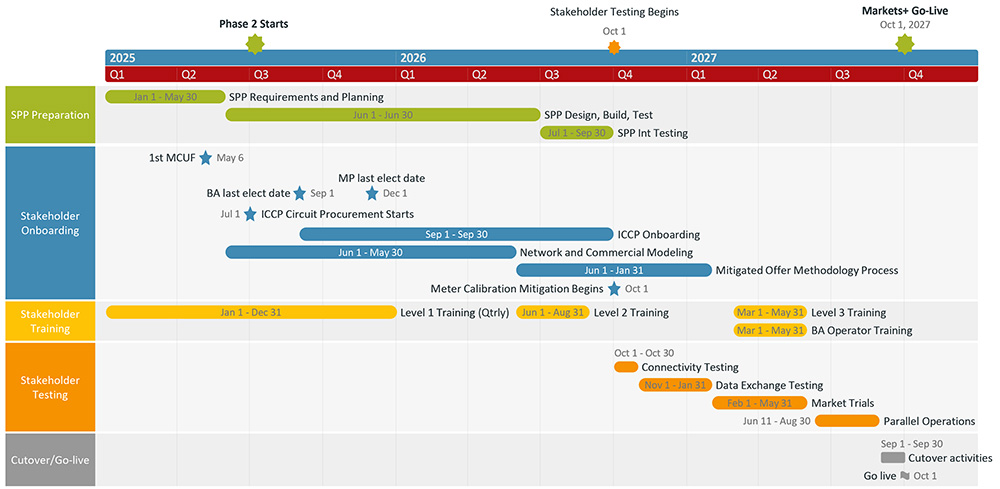
With FERC having fully blessed the Markets+ tariff, SPP has begun the day-ahead market’s transition to Phase 2 with the first of two webinars designed to educate potential participants on what lies ahead. 

“We’re really moving forward into … actually building out Markets+ and the systems, processes and procedures necessary to implement the tariff,” said Jim Gonzalez during the May 21 webinar. (A second webinar is scheduled for June 30.)  

“We’re ramping up that pre-planning work in order to hit the ground running full steam ahead when Phase 2 starts in earnest,” Gonzalez added. SPP’s senior director of seams and Western services since May 1, he said staff is gathering a list of potential market participants to understand who will participate in building system requirements and developing a readiness program to help work through the implementation effort. 

The RTO expects 13 entities initially to help fund Phase 2, most notably the Bonneville Power Administration, the Pacific Northwest’s 800-pound gorilla. (See BPA Chooses Markets+ over EDAM.)  

Those entities and other interested stakeholders must sign and submit one of three agreements through SPP’s Request Management System to continue engaging and voting as rostered members in the various Markets+ stakeholder groups: 

    • Funding agreements, for balancing authorities and their embedded entities. Under that agreement, they will provide collateral in the form of a letter of credit or cash that allows SPP to use debt to build the systems. 
    • Stakeholder agreements, for non-governmental organizations and others that don’t expect to be active market participants. 
    • Participation agreements, for entities in a BA without a funding agreement and that register the utility’s load. 

The stakeholder and participation agreements both come with $5,000 one-time fees, similar to SPP’s RTO participation model. The grid operator will waive the fee for nonprofit NGOs that can prove their status. 

SPP has set a soft deadline of July 23 for submitting the agreements and retaining seats on stakeholder groups. The Markets+ stakeholder groups must submit their roster nominations on that date. The rosters will be posted for the stakeholder-led Markets+ Participant Executive Committee’s approval and then confirmed by the MPEC during its Aug. 12-13 meeting in Portland, Ore. 

The Interim Markets+ Independent Panel, composed of three SPP board members that are overseeing the market’s development, then will confirm the chairs. 

“If you intend to participate with Phase 2 governance, we will need an executed agreement in any one of these three [categories],” SPP’s Kelli Schermerhorn said. 

Markets+ Phase 2 timeline | SPP

She warned attendees that participants who don’t sign one of the agreements will lose their seat on working groups or task forces.  

“Those Phase 1 agreements are going to cease to be effective,” Schermerhorn said. “Independent governance is a cornerstone of all SPP offerings. Our Markets+ design has been largely accomplished by these task forces and working groups.” 

Three other decision dates have been set as deadlines for balancing authorities, transmission providers or market participants if they want to be part of the initial market launch: Sept. 1 (BAs), Oct. 1 (transmission providers) and Dec. 1 (MPs). 

FERC in April approved the Markets+ $150 million funding agreement and its recovery mechanism. The commission also granted SPP’s request to issue debt securities to cover the agreement and fund the market’s implementation over three years until its scheduled Oct. 1, 2027, go-live date. (See SPP MPEC Members Celebrate Markets+ Funding Order.) 

The funding agreement requires the entities to provide the collateral backstop to SPP’s lender in supporting the RTO’s financing. The collateral is equal to the amount of the entities’ Phase 2 obligations.  

SPP says the cost to repay the financing will be incorporated into Markets+ rates and will relieve participants from the burden of providing “large sums of money to directly fund Phase 2.” SPP is splitting the phase into two stages, with participants required at first to provide collateral equal to two-thirds of their Phase 2 obligation. The first stage expires six months after the initial funding threshold has been met, at which point participants must provide collateral equal to their full Phase 2 obligation.

Funding participants withdrawing from the agreement must pay their Phase 2 obligation to SPP, protecting the remaining participants from the withdrawal. 

Florida, Mississippi Utilities to Pay SERC $140K in Penalties

SERC has levied $140,000 in penalties against utilities in Mississippi and Florida for violations of NERC’s reliability standards, in two separate settlements recently approved by FERC. 

The settlements, submitted in April in NERC’s monthly spreadsheet notice of penalty, are with Florida Power and Light (FPL) for $120,000 and Mississippi’s Cooperative Energy for $20,000 (NP25-11). FERC said in a filing May 23 that it would not further review the settlements, leaving the penalties intact. 

Both settlements concern the standard FAC-008-5 (Facility ratings), which requires that transmission owners and generation owners have facility ratings for [their] solely and jointly owned facilities that are consistent with the associated … methodology or documentation for determining [their] facility ratings.” FPL’s noncompliance was discovered through a compliance audit; Cooperative self-reported its infringement. 

SERC conducted its onsite audit of FPL from June 20 to 24, 2022. The regional entity’s audit team walked down four transmission substations and found a 138-kV, 230-kV and 500-kV substation with incorrect facility ratings. 

Following this finding, SERC required FPL to walk down eight transmission facilities and eight generation facilities to look for more misratings. The utility found one incorrect rating among the transmission facilities, a 230-kV line that needed a 25% derate; at the generation facilities, FPL found one station with incorrect facility ratings, two more stations with incorrect or missing equipment ratings, and one where the walkdown could not be completed because the current transformers could not be verified without an outage. 

FPL then did an extent of condition assessment requiring walkdowns of all 1,822 transmission facilities and 180 generation facilities. It found 153 incorrect transmission facility ratings, including one facility that experienced an exceedance of the correct rating. The biggest derate required was 93% on a 115-kV line. For the generation facilities, 12 derates were required and three uprates. 

SERC determined the violation began June 18, 2007, when FAC-009-1 — the predecessor of FAC-008-5 — was in effect. The root cause was ineffective controls, specifically training management controls, validation controls and controls to ensure the utility’s management of change process was carried out successfully. The RE assessed the risk posed by the noncompliance as moderate. 

FPL’s mitigating actions include adding a training course on the FAC-008 worksheet to its learning management system, standardizing the procedure for walking down transmission and substation facilities, and improving the implementation of controls and ensuring they’re working as designed. 

Cooperative Discovered Repeat Issue

Cooperative notified SERC of its noncompliance Jan. 30, 2024. As with FPL, SERC determined the violation spanned both FAC-009-1 and FAC-008-5. 

The utility discovered during a substation facility walkdown that the current transformer (CT) rating factor for a gas circuit breaker was not on the CT’s nameplate. This GCB was older than the others in the same facility, which were installed on the same date.  

Upon reviewing the nameplate and electronic documentation, Cooperative could not find a correct CT rating factor. As a result, the utility had to change to a more conservative rating factor than the one that was in its database, requiring a derate on the affected line. 

Cooperative found no further CT rating factor issues on other substations. It went on to verify elements at five substations that had been walked down but later had field work done requiring another in-person examination. 

In the SNOP, SERC noted the violation began June 18, 2007, and ended Nov. 8, 2023, when Cooperative changed the CT tap setting to account for the CT rerating. The total duration of the infringement was more than 16 years. The RE said the cause of the violation was “an ineffective training program” that did not equip staff to recognize that the breaker was an older model that required a different CT rating factor. 

SERC observed that Cooperative has a history with this specific type of misrating. Cooperative and SERC settled in 2023 for a similar infringement, when the utility failed to consider CTs when determining facility ratings for its solely and jointly owned facilities. (See FERC Approves SERC Settlement with Mississippi Co-op.)  

Although that settlement did not result in a monetary penalty, the RE said it considered the utility’s history as an aggravating factor in determining the penalty for this case because the changes put in place after the earlier infringement should have detected this one. 

Stakeholder Forum: The Facts About FERC Order 1920 and Why It’s Essential

By Gretchen Kershaw

As the tides of “deregulation” swell, I write to set the record straight on FERC Order 1920. As Mark Twain said, “Get your facts first, then you can distort them as you please.” Here are the facts. 

Gretchen Kershaw

We need a significant amount of transmission in this country. Study after study shows a pressing need today as well as in the future, and that need is driven by threats to the reliability and resilience of the grid, high energy costs, and congestion and constraints on the existing system. 

At the same time, demand is surging, driven by electrification, increases in domestic manufacturing, and, of course, new load from artificial intelligence (AI) data centers and other large customers. 

So, everyone is asking: How do we meet potentially exponential demand growth reliably and affordably? Generation will be needed, but it cannot meet this demand alone; transmission is essential. So is FERC’s Order No. 1920. Here are a few key facts. 

Fact 1: The status quo incremental and reactive approach to building the grid we need is the most expensive option and will contribute to rising electricity bills. FERC aimed to fix the broken paradigm with Order 1920, establishing a baseline across the country that reflects best practices, such as planning on a 20-year forward-looking basis. Well-planned transmission, as envisioned by Order 1920, benefits all users of our electric system. 

Fact 2: Well-planned transmission improves reliability and resilience. The reality is that all generators have outages, whether “behind the meter” or grid-connected. A more networked system, connecting areas that have peak loads and generation outages at different times, always has been the way to ensure steady power supply. 

Looking at extreme weather events, transmission consistently allows more resources to be shared across regions and move energy from where it is available to where it is needed. Witness Winter Storms Uri and Elliott, where regions that could import power avoided prolonged outages that plagued regions that were more islanded. 

As my colleague Michael Goggin says: We need a grid bigger than the weather. Building this insurance policy against future extreme events requires planning that is proactive and that accounts for a wide range of drivers and addresses uncertainty by identifying projects that are beneficial under multiple scenarios. 

Fact 3: Well-planned transmission saves consumers money. Electricity rates are increasing for several reasons, one of which is transmission. But despite transmission spending hitting an all-time high in recent years, the miles of new high-voltage transmission that is being built has dropped year-over-year. 

So, transmission owners are investing — not surprising, given our aging electric grid — but not adding new large-scale transmission capacity nearly fast enough. The National Transmission Planning Study, released by DOE last year, found the lowest-cost electricity system to meet future demand and reliability needs includes substantial transmission expansion — and that accelerated and coordinated expansion could save upward of $490 billion through 2050. We cannot afford to abandon Order No. 1920; instead, we should implement it faster to significantly benefit sooner. 

Fact 4: Order 1920 benefits all kinds of generation, and our country needs more transmission no matter the generation type. Abundant American energy supply is within reach. But we cannot access it reliably and affordably without transmission. 

Let’s be clear: Utilities are investing more than ever in upgrading a rapidly aging grid. Order 1920 provides a collaborative road map for more efficient and cost-effective grid upgrades. Grid hardening is critical, as is squeezing more from our existing system by deploying grid enhancing technologies and high performance conductors. 

Congress knew this when it acted, on a bipartisan basis, to establish federal funding programs in the Infrastructure Investment and Jobs Act in 2021 for just this type of investment. Regrettably, delays in these critical enhancements may indeed happen, but not from Order 1920; instead, delays may happen from blocking use of federal funds specifically for these needs. 

Those are the facts. How impactful Order 1920 will be is yet to be seen, but to cut it off at the pass is to threaten grid reliability and resilience, impose higher costs on consumers, and threaten America’s ability to compete in the global AI race. 

Gretchen Kershaw is chief operating officer and vice president of strategy at Grid Strategies LLC. 

CAISO Approves $4.8B Transmission Plan to Support 76 GW of New Capacity

CAISO’s Board of Governors has approved the ISO’s 2024/25 transmission plan to build out 31 new projects in the region over the next eight to 10 years. 

Of the 31 approved projects valued at $4.8 billion, 28 are for reliability purposes for $4.6 billion. By 2039, California will need 76 GW of additional capacity to meet increasing building electrification and electric vehicle loads, CAISO wrote in the plan. 

The plan’s most expensive project is the North Oakland Reinforcement Project, estimated at $1.1 billion and with an online date by 2032. The project includes the Port of Oakland, which is experiencing rapid load increase due to industrial and commercial growth, EV charging and electrification loads.  

The project is meant to meet increasing demand without relying on local Oakland thermal generation units, CAISO wrote in the plan. Demand is forecast to increase from 377 MW in 2024 to 458 MW by 2039 in the region. CAISO and Pacific Gas and Electric should attempt to accelerate the completion of the project prior to 2032, Teri Dean Alderson, assistant general manager at Alameda Municipal Power (AMP), said in comments to CAISO. 

The second-most expensive project in the plan is the $700 million Greater Bay Area 500-kV Transmission Reinforcement project, which has an online date of 2034. The area could have a deficiency of about 5,000 MW by 2039, which significantly surpasses the available transmission resources and internal generation capacity, CAISO said in the plan. The forecast supply shortage is caused by the potential loss of two of the three 500/230-kV transformer banks at Metcalf or loss of the two 500-kV sources to Metcalf and Moss Landing substations, CAISO said. 

About $290 million of the remaining funding is allocated for three policy-driven transmission projects. Policy-driven transmission projects enable the grid to support local, state and federal directives, with most of these projects focused on meeting California’s renewable energy goals, CAISO said. 

From a systemwide resource assessment, CAISO is going into a period of greater uncertainty as load growth continues to accelerate, Neil Millar, CAISO vice president of transmission planning and infrastructure development, said at the May 22 Board of Governors general session meeting. 

“Not only are the peak loads growing, but our load factor and winter peak loads are growing, which is a success of building and transportation electrification,” Millar said. “Those are creating additional challenges that the state agencies are taking into account.” 

Having more transmission project options is important because “we don’t know what things are going to look like four years from now [at the federal level],” Millar said. However, CAISO also must follow state policies and cannot afford to let transmission projects be a barrier to achieving state policy goals, he said. 

At the same time, CAISO should consider the risk of policy changes affecting expensive transmission projects, such as two transmission projects in the North Coast region, which are to support future offshore wind power in Humboldt County, Millar said. CAISO has selected Viridon to build these future OSW transmission projects for up to $4.1 billion over the next eight to 10 years. (See CAISO Chooses Viridon to Develop Humboldt OSW Transmission Projects.) 

The projects were designed to be the right first step, but CAISO recognizes that the resource requirements for the lines can grow beyond their initial design, Millar said.  

“We were also very clear in bidding those projects that there is inherent uncertainty in those resource types and as a result those projects have a higher risk of potential cancellation,” Millar added. 

The transmission plan also emphasizes non-transmission alternatives, such as energy efficiency and demand response programs, renewable resources and energy storage systems. Battery energy storage has made up the vast majority of new resources in CAISO’s region in recent years. As of April, more than 12,000 MW of battery storage capacity is online in CAISO’s region, with an additional 15,000 MW planned to be available by 2028. 

Stakeholders Applaud, Question Plan

In comments to CAISO, Caitlin Liotiris, principal at Energy Strategies, said one notable enhancement to this year’s transmission plan is the additional transparency regarding CAISO’s process for reserving deliverability for long lead-time resources.  

“The [plan] specifies the long lead-time resources in the base portfolio and the amount of deliverability that is being reserved for them,” Liotiris wrote. 

However, staff with California Wind Energy Association (CalWEA) said CAISO’s transmission plan “does not fulfill … CPUC’s request to plan transmission for the 5.2 GW of in-state wind energy.”  

“CalWEA is primarily concerned with the Southern California Edison Northern and San Diego Gas & Electric study areas where wind development interest is currently the strongest,” CalWEA staff said.  

In the SCE Northern area, CPUC requested that CAISO plan for 564 MW of full capacity deliverability status. Of this 564 MW, only 100 MW has been awarded that status. CAISO therefore must plan for 464 MW, CalWEA staff wrote.  

In next year’s transmission plan, there likely will be a fairly heavy emphasis on load-growth related reliability projects as CAISO transitions to a higher long-term expectation of growth, Millar said.