A new study commissioned by the Environmental Defense Fund (EDF) finds Public Service Company of Colorado (PSCo) would earn millions of dollars more in annual benefits from participating in CAISO’s Extended Day-Ahead Market (EDAM) than SPP’s Markets+.
The study, conducted by Aurora Energy Research, found EDAM could provide the Denver-based utility $11.2 million more in average annual savings from 2028 to 2040 compared with Markets+, rising to $13.2 million through 2060.
The analysis comes three months after PSCo, a subsidiary of Xcel Energy, asked the Colorado Public Utilities Commission (CPUC) for permission to join Markets+ and fund its share of the Phase 2 implementation stage of the market. (See PSCo Seeks to Join SPP’s Markets+.)
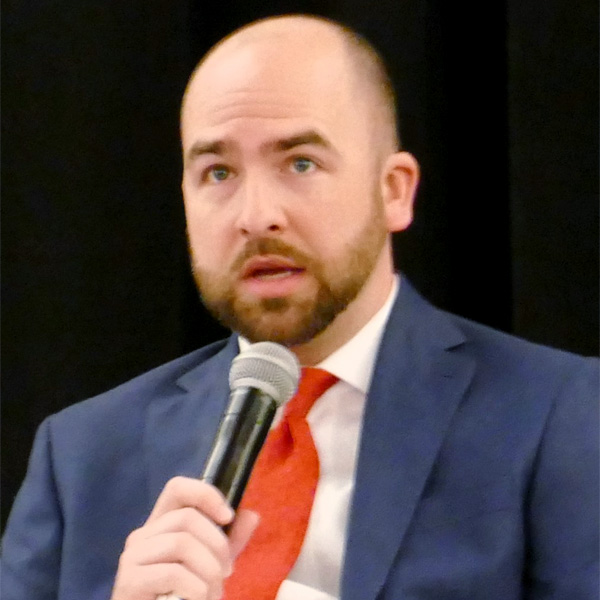
“It’s important to recognize that not all markets are created equal,” Alex DeGolia, director of state legislative and regulatory affairs at EDF, said in a May 27 statement accompanying the release of the study.
Like other prominent environmental organizations, EDF has advocated strongly for a single Western electricity market that pointedly includes California and rests on the existing framework of CAISO’s Western Energy Imbalance Market.
“Coloradans deserve for this decision — which could have decadeslong implications for their utility bills, as well as the state’s ability to meet its climate targets — to be informed by thorough, robust analysis. Recent analysis suggests that the Extended Day-Ahead Market is a clear winner among currently available options in terms of delivering both lower costs and more reliability to our state,” DeGolia said.
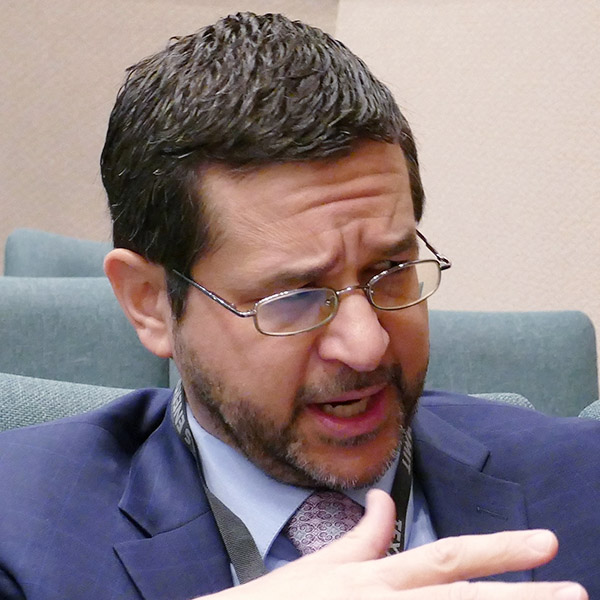
In an email to RTO Insider, Joe Taylor, senior director of Western markets for Xcel Energy-Colorado, said the Aurora study “was very recently submitted in public comments in our application to join the Markets+ market.”
“We are taking part in that proceeding at the Public Utilities Commission and have not had the opportunity yet to review this document,” Taylor wrote.
Breakdown of Benefits
In its February filing with the CPUC seeking to join Markets+, PSCo said it was swayed by the SPP market’s independent governance, greenhouse gas emissions tracking and accounting system, and benefits “overall and in relation to costs relative to the other markets studied, including EDAM.”
It’s unclear what impact the Aurora study might have on the PUC’s response, but it could raise questions about PSCo’s cost-benefit claim based on its examination of four metrics, including estimated production costs, bilateral trading costs, congestion revenues and wheeling revenues under both markets.
The study found that under EDAM, PSCo’s average annual productions costs would be $4.9 million lower than in Markets+, in large part because the CAISO market would allow the utility to more significantly increase its use of wind generation and reduce its reliance on gas-fired generation.
Aurora also found that PSCo’s participation in EDAM would bring increased use of its transmission system to facilitate energy transfers between EDAM members PacifiCorp and PNM, whose balancing areas border PSCo. Those transfers would translate into $12.8 million more in congestion revenues compared with Markets+, along with $0.4 million more in wheeling revenues.
The study does show Markets+ outperforming in one area: PSCo’s bilateral trading costs in EDAM are expected to exceed those in the SPP market by $4.9 million, something largely attributed to “friction charges” for imports from the Western Area Power Administration’s neighboring Rocky Mountain Region balancing area, which plans to join SPP’s full RTO.
Aurora noted that, in modeling the Western Interconnection, the study considered transfer limits between BAs, basing its transfer capacity assumptions on both the historical record and assumptions about planned upgrades to interstate transmission capacity affecting Colorado, including three lines expected to begin service in 2032.
But even in excluding those planned interstate projects in the modeling, EDAM’s benefits would exceed those of Markets+ by $4.2 million a year, the study found, while the EDAM benefits advantage would continue to increase with the additional inclusion of each project.
The study also found PSCo would be able to comply with Colorado’s ambitious emissions targets under either market. State law requires utilities to reduce their emissions from retail sales by 80% by 2030 compared with a 2005 baseline and move to 100% clean energy by 2050.
“Emissions are similar between the two modeled scenarios for PSCo participation in EDAM and Markets+, given the capacity mix was held constant. Marginal differences in emissions are driven by variation in carbon intensity of imports and exports,” the study says.
Aurora’s study modeled the makeup of each market based on confirmed and likely commitments by participants.
The Bureau of Land Management has proposed changes to three of its Northern Nevada resource management plans to accommodate NV Energy’s 235-mile Greenlink North transmission project.
The proposed amendments would loosen restrictions for building near greater sage-grouse habitat and courtship areas known as leks.
The amendments were released along with BLM’s final environmental impact statement for Greenlink North on May 27, opening a 45-day objection period. BLM expects to issue a record of decision for the project this year.
Greenlink North would be a 525-kV line connecting the Robinson Summit substation in northeastern Nevada to the Fort Churchill substation in the northwestern part of the state. The line would run parallel to U.S. Highway 50 and an existing 230-kV transmission line for most of its length.
Greenlink North will connect with NV Energy’s existing One Nevada Line, a north-south line along the eastern side of the state, and Greenlink West, a 525-kV, 350-mile line under construction on the west side of the state, to form a transmission triangle around Nevada.
The project is aimed at increasing transmission redundancy, reliability and resiliency. It will facilitate access to state-designated renewable energy zones to help meet greenhouse gas reduction targets.
The project also will “increase northern Nevada’s transmission import capacity required to meet the region’s electric demand, grid reliability and [FERC] requests for service,” according to the BLM document.
Greenlink West is expected to be in service by May 2027, and Greenlink North’s expected in-service date is December 2028.
Plan Amendments
BLM’s proposed resource management plan (RMP) amendments would designate a new utility corridor up to 3,500 feet wide on land where the Greenlink North project would be built. That would provide enough space to avoid electrical interference with the existing 230-kV line, the bureau said.
Under the amendment, the utility corridor would be exempt from requirements to stay a certain distance from sage-grouse leks. Roughly 100 miles of Greenlink North would be within a 3.1-mile buffer zone for ground disturbances around leks. The buffer requirement would impact geotechnical investigations, construction work, and operation and maintenance activities, BLM said.
“The transmission line’s proximity to leks would be unavoidable,” the BLM document said. “Exempting the BLM utility corridor from the lek avoidance buffers would ensure the viability of the utility corridor if future applications for energy transmission projects were submitted to the BLM.”
The utility corridor also would be exempt from a seasonal restriction for activities in greater sage-grouse winter range, under the proposed amendment.
With seasonal restrictions in place for breeding, brood-rearing and winter habitats, 190 miles of the Greenlink North project would have only 45 days a year remaining for construction, from Sept. 16 to Oct. 31.
With the winter-range seasonal restriction removed, the construction season would run from Sept. 16 to Feb. 28.
Work has started at both ends of Greenlink West, NV Energy said in a March project update. In April, construction crews drilled the first holes for the project’s transmission poles. Material yards have been established in strategic locations to reduce distance to construction sites.
NV Energy said it’s been taking delivery of lattice and tubular transmission structures, conductor and shield wire for the transmission line, high-voltage circuit breakers and steel support structures for the substation equipment.
ERCOT breezed through its first heat wave of the season recently using the same valuable resources that helped it survive last year’s record-breaking summer in Texas: wind, solar and batteries.
The most extreme bills targeting those same renewables appear to have died in the Texas State Legislature.
Thanks to a heat dome settling into position and sending temperatures into triple digits from Dallas to Austin, ERCOT projected demand to threaten its all-time peak of 85.5 GW on May 14. The forecast was off. Demand averaged 77.8 GW during the hour ending at 5 p.m., still a record — for the fourth straight month — for May.
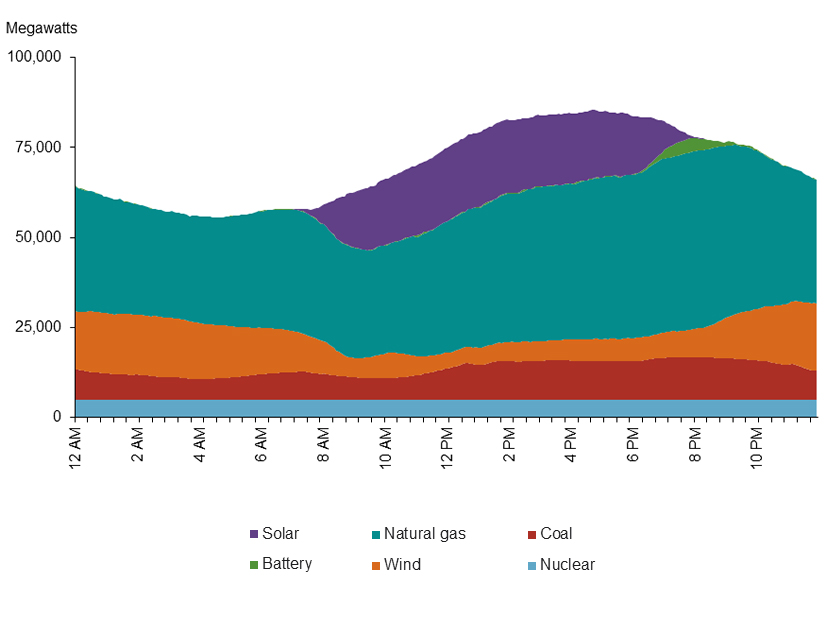
Wind and solar accounted for 47% of the demand during that time, when total available capacity was nearly 108 GW. As was the case last summer, batteries began discharging as the sun set on solar resources. Storage provided less than 1 GW in May 2024. A year later, storage can provide nearly 6 GW of energy.
According to the Federal Reserve Bank of Dallas, solar output averaged nearly 17 GW between 11 a.m. and 2 p.m. during the summer of 2024, compared to 12 GW during the same hours in 2023. Between 6 and 9 p.m., storage facilities’ discharge averaged 714 MW in 2024 after averaging 238 MW for those hours in 2023.
ERCOT CEO Pablo Vegas has not been shy about praising renewables’ contribution to the Texas grid, especially that of solar and batteries.
“We’re really continuing to see the benefit of increased resources from the solar and battery perspective,” he told reporters during ERCOT’s Innovation Summit in early May. “That made a very significant difference last summer. I think that we’ll see the benefit of that this summer.”
Thomas Gleeson, chair of the Texas Public Utility Commission, agrees. He said in November 2024 that solar and storage “saved” ERCOT during the summer and prevented emergency conditions like those in 2022. (See ERCOT Continues to Feel the Heat.)
“Solar and storage are key for reliability in this state. … We need them to be successful,” he said during an industry conference.
Texas leads the 49 other states in wind energy and trails only California in solar and batteries. The latter two resources dominate ERCOT’s interconnection queue.
How battery resources began discharging as solar energy dropped off the grid | Grid Status
Yet, lawmakers have stuffed the state legislature’s 89th session with bills that would place firming obligations and new interconnection requirements on renewable resources. Other legislation excludes batteries as a dispatchable energy source, contrary to ERCOT’s own contention that storage is dispatchable and is valuable in providing ancillary services and energy arbitrage. Still another law would prevent offshore wind power from gaining a foothold in the Gulf of Mexico.
If cheap renewable energy is so important in helping ERCOT meet ever-increasing demand, why are state lawmakers — framed by The Hill as a “red-on-red” civil war — doing all they can to essentially stifle an industry that helps keep prices around the national median?
“It’s often said, ‘No one’s life, liberty or property are safe when the legislature is in session.’ And this time around, it’s no different with energy,” said Chris Reeder, a partner with Husch Blackwell leading its Texas energy regulatory practice.
“There used to be a time when they just didn’t do much on energy,” he added during an April webinar. “Those days are past us.”
Judd Messer, Texas vice president of the Advanced Power Alliance, told RTO Insider that some lawmakers’ opposition to renewables stems from a “fear of competition and allegiance to a narrow set” of political allies that benefit from limiting clean energy’s growth.
“As technology advances and renewables continue to deliver when the grid is strained, their value becomes increasingly undeniable and opponents find it harder to justify their stances,” he said. “What’s more troubling is that many of their proposals this session directly contradicted long-held conservative values — private property rights, limited government and free markets — suggesting that clean energy has become such a political flashpoint that this small band of lawmakers are willing to abandon the very principles they typically champion.”
Stoic Energy principal Doug Lewin, who has kept close tabs on this year’s legislative session, allows that while politics may play a role with the idealogues capturing the headlines, many elected officials have embraced an “all-of-the-above” approach to Texas’ power needs.
“I think what we have really seen emerge this session is … kind of pragmatism over ideology, really led by the business community,” he said in an interview. “Sure, renewables have some challenges, but we’re going to work to integrate them and overcome those challenges. … Otherwise, all of our electric bills are going to go significantly higher without it.”
Case in point: Three Senate bills (SB715, SB388 and SB819) never made it to the House of Representatives’ calendar in time to get a vote before the session ends June 2, effectively killing them.
SB715 would require existing wind and solar facilities in the ERCOT region to back up their energy production with gas generation or be subject to fines. SB388 would update the Texas Utilities Code to reflect the legislature’s intent that 50% of generating capacity installed in ERCOT after Jan. 1, 2026, “be sourced from dispatchable generation other than battery energy storage.”
Both bills would dampen further investment in clean energy — renewable companies have made plans for $64 billion in new projects in Texas since 2022, mostly for solar and battery storage — and cause existing sites to shut down, industry insiders said. Aurora Energy Research said in a May report that about 25 GW of capacity would require contracts for backup generation, leading to a 14% increase in wholesale prices over the next 10 years and cause capacity shortfalls that could result in more than 3 GW of load shed during an extreme weather event.
“If you rely on gas as your sole fuel, your sole source of power, it would be hard to overstate how incredibly stupid that would be,” Lewin said. “That just absolutely makes no sense. You absolutely need a diverse set of resources.”
As for SB819, it would have placed some of the most onerous permitting conditions for wind and solar resources. Clean energy advocates called the bill “an industry killer.”
“We need policies that support an all-of-the-above approach to meet the expected surge in power demand,” said Olivier Beaufils, Aurora’s head of USA Central. “Embracing renewables alongside flexible generation sources will help maintain grid stability, lower costs, and sustain Texas’ economic momentum.”
Mark Stover, executive director of the Texas Solar + Storage Association, memorably said earlier in the session that he couldn’t recall “legislation as damaging to our industry and to the energy market” as SB715 and its companion House bill (HB3356).
Stover declined comment about the clean energy sector possibly dodging a bullet, as it did during the 2023 session, until after June 2. (See Clean Energy Escapes Texas Legislature’s Wrath.)
Perhaps that’s because of the danger of “zombie bills” and “frankenbills.” Zombie bills refer to legislation that is reintroduced or revived in subsequent sessions after failing to pass in a previous session. Frankenbills are those measures attached to another living bill either through a committee substitute or a final-hour compromise in a conference committee where members meet to resolve their differences.
Lewin said the final days of the session can be an “eternity in legislative time.”
“Strange things happen,” he said. “There are still some pretty big bills in play … what we do know is that the worst of the anti-energy bills as standalone bills are dead.”
“For two consecutive sessions, cooler heads have prevailed in blocking some of the most extreme anti-energy proposals,” Messer said. “Without a competitive, diverse energy mix, Texas risks not only missing out on significant economic development but also struggling to keep the lights on. These legislators recognize renewables for what they are: a vital part of the Texas economy, particularly in rural communities.”
The attention now turns to SB6. Its low number denoting it as one of the Senate’s top priorities, the measure addresses the potential wave of large-load additions. ERCOT has more than 150 GW of new standalone and co-located projects in its large-load queue, adding nearly 20 GW in its most recent month alone.
SB6 requires developers to put down a $100,000 fee for a screening study and to notify ERCOT whether they’re considering multiple sites in Texas, giving the grid operator a more accurate read on load growth. It also gives ERCOT and utilities the ability to reject the co-location of data centers with existing generation and hands the grid operator a “kill switch” to shut off large loads if needed.
The measure was preliminarily approved by the House on May 26. It was returned to the Senate with an amendment that allows water utilities to use their rates to fund power infrastructure that can participate in the market and also stripping out HB3970, a load-flexibility bill. The two versions must be reconciled.
Several other power-related bills are still in various phases of the legislative process:
HB14 would use up to $2 billion in taxpayer money to help build advanced nuclear reactors, provide grants and fund development research. It also would create an office under the governor to “lead the transition to a balanced energy future by advancing innovative nuclear energy generation technologies.” The measure has cleared both houses, but the Senate has asked the House to return the bill.
HB3556 still is alive in the Senate. The bill was amended to give the Texas Parks & Wildlife Department the ability to review coastal wind projects and removed its ability to stop projects.
SB383 has been approved by the Senate and passed out of a House committee, but it did not get a vote by the full membership. It would prohibit offshore wind turbines in the Gulf of Mexico from interconnecting with ERCOT through state waters (extending 9 nautical miles from the coastline), effectively killing Texas offshore wind.
Two bills related to utility ratemaking have passed the House but have not advanced in the Senate. HB3157 would allow utilities to use interim rate hikes before a proposed increase is approved by the PUC. HB2868 would require the commission to assume a utility’s debt-to-equity ratio is reasonable if calculated using certain metrics as recorded in the books and records for the most recent available financial quarter before the applicable rate proceeding begins.
The Bonneville Power Administration predicts even steeper energy deficits among its network of dams under firm conditions compared to predictions last year, according to the agency’s annual “White Book” study.
BPA’s Pacific Northwest Loads and Resources Study, or the White Book, was issued May 29. It covers a 10-year period and provides predictions for the federal power marketer’s loads and resources, as well as the entire region’s retail loads, power supply obligations and resources.
The 2025 White Book finds that under firm conditions, the federal system would have annual energy deficits between 2026 and 2035, ranging from deficits of 426 aMW to a high of 1,012 aMW.
“Overall, these annual energy deficit projections are more than those projected in the 2024 White Book,” according to the study. In 2024, the White Book projected deficits ranging from 79 aMW to 303 aMW.
The 2025 study also found that under median water conditions, the federal system could have a surplus ranging from 911 aMW and 364 aMW. The Northwest relies heavily on hydropower generation, which is notoriously difficult to predict and can fluctuate dramatically from year to year.
“The federal system surplus/deficit forecasts generally have a positive relationship with water conditions,” the report stated. “Better water conditions generally yield more surplus overall. For example, the annual energy surplus can increase by over 4,000 aMW under better water conditions, while monthly surplus or deficit position can vary by over 5,500 aMW within the same year.”
Meanwhile, the entire Pacific Northwest could have an energy surplus of 960 aMW in 2026 under firm water conditions, but this could drop rapidly to a deficit of 3,026 aMW by 2034. Under median water conditions, however, the region could have surpluses until 2032, according to the report.
“This result was mainly driven by the increasing retail loads,” the report stated. “Overall, the annual energy surplus/deficit position projections are more surplus than forecasts from the 2024 White Book until the out years of the study period. Under median water conditions, the PNW region would begin to see energy deficits in the out years.”
Energy consumption in the region has hovered around 20,000 to 22,000 aMW since 2010, according to NWPCC. But energy demand could skyrocket and reach between 31,000 and 44,000 aMW by 2046, with the largest growth expected from electric vehicles and data centers, NWPCC found.
BPA noted in the White Book that: “Many factors contribute to the uncertainty of the longer-term resources outlook for the region, such as resource retirements and development, resource adequacy and the efforts surrounding it, and other federal and state policy mandates. As with resources, there is also much uncertainty with loads including the potential for electrification and data centers coming online.”
“While regional analysis shows surpluses in the first two years of the 10-year study period with rapidly rising deficits in certain parts of the years following that period, BPA analysis shows periodic deficits for the entire study period,” BPA spokesperson Doug Johnson told RTO Insider. “Rapidly growing load forecasts and subtle changes in water volume and runoff over the period account for the growing deficits.”
Johnson pointed out that forecast certainty declines “the deeper you get into the 10-year period.”
“However, it looks like at some point during the study period BPA will likely need to secure the output of additional resources to meet its firm power obligations,” he said.
Facing a dramatic electricity rate hike driven in part by a shortage of generation sources, the New Jersey Board of Public Utilities has approved new grid modernization rules that the agency says will make the process of launching new distributed sources easier and faster.
The board voted 4-0 on May 21 for rule changes the agency said will streamline the process by which distribution grid interconnection applications are handled. Among the changes are the enactment of more frequent updates to hosting capacity maps and a revised dispute resolution process, according to a statement from the board.
The new rules also include a “pre-application and verification process to provide applicants with an early indication of project feasibility and costs, and a requirement for utilities to have a web portal for a more consistent interconnection application process regardless of service territory,” the board said.
The approval came as state ratepayers on June 1 will see a 20% increase in the average electricity bill, which has stoked anger among lawmakers, ratepayer advocates and BPU officials. The increase, based on the prices in the state Basic Generation Service auction held in February, was affected by the dramatic price rise in the PJM capacity auction held in July 2024.
PJM officials say the increase stems in part from old fossil fuel power sources shutting down at a faster pace than new generation sources, mainly clean energy, are coming online. Both New Jersey and PJM forecast a major increase in electricity demand due to the proliferation of data centers, greater electric vehicle use, building electrification and other factors.
BPU President Christine Guhl-Sadovy said the new rules mark a “pivotal step toward … making the interconnection process more efficient,”
“Increasing the number of distributed energy resources, including new solar projects, as quickly as possible is a key component of our comprehensive effort to drive down energy costs for ratepayers, and we are delivering on that effort,” she said in a statement.
The BPU says the rules will make it easier to get solar and storage facilities online, which the agency said in a statement are “some of the cheapest and fastest resources to come online” and will “reduce the peak energy forecasts for New Jersey.”
Doing so “decreases the amount of capacity New Jersey needs to buy, which in turn puts downward pressure on capacity prices for all ratepayers, helping save money via avoided costs,” the agency statement said. New Jersey is an importer of electricity because it does not generate enough in-state.
CAISO is moving ahead with a key initiative to resolve how battery storage resources function on the grid as the battery boom continues in the Golden State.
The ISO is prioritizing battery outage management enhancements, battery nonlinearity guidance and state of charge (SOC) clarifications in its storage design and modeling initiative that began earlier this year.
CAISO held a stakeholder meeting May 28 to address technical challenges associated with the increase in battery storage capacity on its grid, which has grown from 500 MW in 2020 to more than 11,000 MW in 2025.
CAISO’s current outage management system has served conventional resources effectively but does not easily convey a battery’s SOC limitations, CAISO said in an issue paper. Storage resources face limitations and outage types not covered in the outage management system that are unique to storage resources, such as negative minimum energy outputs.
There is a lack of clarity around how battery resources can accurately represent their availability to CAISO using the existing outage management system, CalCCA said in comments to CAISO. Another stakeholder in the initiative, Vistra, asked CAISO to clarify reporting thresholds for a battery’s SOC, specifically recommending the ISO add reporting requirements for changes that exceed 10 MW or 40 MWh, or 5% of registered values lasting 15 minutes or longer and within 60 minutes of discovery.
CAISO agreed with stakeholders about the need to align its outage management system with storage-specific outage types and characteristics. To do so, the ISO is considering implementing an outage card that can adjust a battery’s availability, maximum load, maximum energy and minimum energy values on one card.
Nonlinearity Options
Another key concern addressed by the initiative is battery storage nonlinearity, meaning the concept that batteries charge and discharge energy at a nonlinear rate. Nonlinearity complicates the modeling and control of battery storage resources, which in turn reduces a battery’s responsiveness and dispatch capability, CAISO said in the issue paper. Nonlinearity is comparable to gas generators that may take time to ramp up to reach their maximum dispatch, CAISO said at the meeting.
As a battery approaches its SOC limits, its maximum and minimum energy output are “greatly affected, potentially hindering its ability to respond to grid demands,” CAISO said. For example, a 100-MW battery storage facility might be able to charge or discharge only 50 MW at the extremes of its SOC.
“Nonlinearity is the area we got the most diverse comments,” said Sergio Dueñas, CAISO storage sector manager, at the working group meeting. “Everyone is getting more and more comfortable with the idea of, ‘Let’s pursue a [solution] in the near term and then move to a more doable solution in the long term.’”
CAISO is considering four ideas to account for nonlinearity, one of which is to use outage cards that indicate the effects of nonlinearity on ramp rates and maximum energy outputs. Currently, some market participants might be communicating the impacts of nonlinearity through outage cards that do not include all of these characteristics, since nonlinearity is not explicitly called out in the outage management system, CAISO said.
As a near-term solution, CAISO favors participants including a comment noting that an outage is related to nonlinearity. This near-term guidance will allow for resources shown as resource adequacy (RA) resources to be evaluated in the context of the RA availability incentive mechanism (RAAIM), the ISO said. The RAAIM provides incentives or disincentives for resources to help ensure they’re available for CAISO to meet reliability needs. If a battery resource is shown as RA and evaluated as RAAIM, then the battery would be accounted for according to its actual dispatch availability under instances of nonlinearity, CAISO said.
CAISO plans to publish a revised issue paper and hold another stakeholder meeting June 30.
FERC has approved MISO’s new generation replacement provision that allows replacements to reconnect at more preferred points on the grid over clean energy groups’ concern that it plays favorites.
The commission said replacement generation in MISO should be able to link up at different points of interconnection (ER25-1802). MISO proposed that it would allow the interconnection point substitutions when they’re “electrically equivalent to the original point of interconnection” and when they don’t cause material adverse impact to MISO’s transmission system.
Clean energy groups, including American Clean Power Association, the Solar Energy Industries Association, Advanced Energy United and Clean Grid Alliance, had argued MISO’s proposal should be rejected because it’s unfair to other planned generating facilities. The groups said the plan would discriminate between similarly situated projects.
However, a group of utilities, including Alliant, Lansing Board of Water and Light, Consumers Energy, DTE, ITC, Michigan Public Power Agency, MidAmerican Energy, Muscatine Power and Water, Wolverine Power Supply Cooperative and WPPI Energy, said the proposal would allow replacement generation to connect at more favorable interconnection points that have similar impacts on the grid.
FERC decided the plan would allow “more cost-effective and timely replacement of existing generating facilities, which will help address regional resource adequacy needs and allow interconnection customers to avoid investing in redundant infrastructure.” The commission further said the replacement facilities would dodge duplicative contracts, deeds and site control costs that might come with both a new site for a replacement facility and “a path to connect that site to the original point of interconnection.”
The commission said it agreed with the Organization of MISO States that MISO’s plan would remain in keeping with MISO’s current methods for discovering and minimizing adverse impacts on the transmission system. FERC said it would pair “offering increased flexibility to interconnect new generation resources in a more efficient manner” with “supporting state resource planning and ratepayer affordability.”
FERC said the new prerequisites MISO placed on moving an interconnection point in addition to its usual replacement study process — interconnecting at the same voltage level, not introducing new constraints and not forcing a distribution factor change of more than 5% — “will ensure that an alternate point of interconnection is electrically equivalent to the existing point of interconnection.”
The commission disagreed with arguments that by allowing replacement facilities to move their points of interconnection, MISO was creating a process that more closely resembled a new interconnection request with the added bonus of skipping the queue.
“We do not believe that providing this limited flexibility to replacement generating facilities to interconnect at a different, but electrically equivalent, point of interconnection results in an unduly discriminatory interconnection process,” FERC wrote in the May 27 order.
FERC said MISO’s commitment to preventing a replacement generator from adversely affecting the grid should take care of clean energy groups’ concern that permission to move a point of interconnection would drive up network upgrade costs by replacements claiming spots on the grid that other interconnection customers had “reasonably expected” to use.
MISO has said its generator replacement process has been instrumental in limiting the impacts of power plant retirements. Since it began the process in 2019, MISO said it has accepted about 5.9 GW in replacement requests and is studying 4.9 GW of replacement requests.
The RTO expects 25 GW of coal retirements through 2030, up 5% from its 2024 forecast. In the same time frame, MISO’s membership plans to add about 10 GW of solar generation and significantly more gas generation.
Clean energy and transportation project cancellations continue as 2025 rolls on, with analysis of public announcements showing investments of $4.5 billion abandoned in April alone.
Business advocacy group E2 on May 29 blamed uncertainties about finances and policy under the new Republican leadership in Washington. It tallied the impact so far this year at $14 billion in investments and 10,000 potential new jobs.
The two manufacturing and two generation projects that E2 counted as canceled in April far eclipsed the seven newly announced manufacturing projects announced in April, which carried a combined investment of only about $500 million. But the disparity was not as wide as it seems: The largest announcement — by the electric vehicle startup Slate — did not carry a price tag.
E2 Communications Director Michael Timberlake said in the news release that pending policy changes may add to the reductions.
“Now is not the time to raise taxes on clean energy and compound the business uncertainty that is clearly taking a greater and greater toll on U.S. manufacturing and jobs,” he said. “If the tax plan passed by the House last week becomes law, expect to see construction and investments stopping in states across the country as more projects and jobs are canceled.”
E2 and the Clean Economy Tracker have been following public announcements of job-creating green projects since passage of the Inflation Reduction Act in August 2022. They have tallied 390 major proposals across 42 states and Puerto Rico that carry planned investment of $132 billion and the hiring of 123,000 permanent workers.
From January 2023 through April 2025, 45 projects have been canceled, closed or downsized, accounting for commitments of $16.7 billion in investments and nearly 20,000 jobs.
Twenty-seven of the 45 announcements came after the election in November 2024 of President Donald Trump, who had pledged a strong reversal of President Joe Biden’s support for clean energy and clean transportation. The Trump administration’s rapid-fire policy changes have complicated efforts, and the current version of the budget bill would provide further costs and hindrance.
E2 noted the irony contained within the geography for the proposed and canceled investments: More than 61% of all clean energy/transportation announcements have been in Republican congressional districts, and they account for 72% of planned job creation and 82% of planned spending. More than $12 billion of the $16.7 billion in canceled investments were to have been made in Republican districts.
FERC is resolute in its support of MISO’s annual megawatt cap in its generator interconnection queue.
The commission rejected rehearing requests that framed the queue cap as discriminatory, preferential and riding roughshod over state authority (ER25-507).
FERC in late January gave MISO the go-ahead to impose an annual megawatt cap on the generation applications it accepts in its interconnection queue. The cap limits megawatt values of queue cycles to 50% of MISO’s non-coincident peak among its five study regions. (See FERC Approves Annual Megawatt Cap for MISO Interconnection Queue.)
Two study regions — East and Central — already have exceeded their megawatt caps for the 2025 cycle. Across all regions, MISO has a 77.82-GW cap for the 2025 cycle. As of mid-May, it has fielded 50.13 GW across 176 submissions.
MISO South regulators in early March asked FERC to reconsider its approval of MISO’s queue cap. Led by the Mississippi Public Service Commission, regulators argued the cap needs an exemption for state-designated necessary resources. They asked FERC to backtrack and either reject MISO’s plan or condition it on MISO including an exemption for the states, saying the MISO plan tested the very limits of cooperative federalism.
In its May 27 order, FERC decided it didn’t transcend its statutory authority and infringe on state jurisdiction by allowing the queue cap, even though the cap will have “incidental effects” on state jurisdiction. It said the Supreme Court already decided those inadvertent encroachments are of no legal consequence. FERC also said that despite Southern regulators’ prerogatives, the commission is allowed to consider “resource adequacy concerns in exercising its jurisdiction.”
FERC also said it judged the queue cap plan as fair and reasonable without the state exception and would not order MISO to include one.
Clean energy groups also argued against FERC’s acceptance of the cap. They said FERC should reconsider because MISO didn’t have a strong rationale for the cap and said the cap itself will introduce undue discrimination and preference among developers vying for a spot on the MISO grid.
FERC disagreed with the groups, who said that in accepting the cap, the commission abandoned standardized generator interconnection processes established under FERC Order 2003. FERC said the clean energy groups should have raised the argument sooner in proceedings but said “in any event,” the queue cap followed Order 2003’s “recognition of independent entity variations for RTOs/ISOs.”
FERC also said it found nothing amiss with MISO’s first-come, first served aspect of the cap to determine cutoff points. The commission disagreed with the groups that argued prioritization could create an unfair environment by incentivizing projects to line up for exploratory or speculative positions. Instead, MISO ultimately would study submitted interconnection requests as part of a cluster. FERC said projects that entered too late to beat the cap simply would be subjected to a later cluster of projects.
MISO has shed light on the reasons behind the Memorial Day weekend load-shed event in southeast Louisiana, describing a system taxed by early summer heat and rife with congestion and unavailable generation.
Executive Director of Market Operations JT Smith said there were “a number of” planned and unplanned generation outages coupled with higher-than-normal temperatures that paved the way for challenges headed into the weekend.
“We approached some pretty warm days for the season down there,” Smith said during a Reliability Subcommittee meeting May 29. He added that evening peaks with “early summer heat” can be a hazardous time.
During the first hour of the load-shed event, electricity prices were in the negative — as low as ‑$400/MWh around the Mississippi Delta — while prices in southern Louisiana soared past $2,000/MWh. Electricity appeared undeliverable into the greater New Orleans area because of a lack of transmission.
Smith said MISO operators began noticing congestion problems on Wednesday, May 21. By the weekend, operators were “battling congestion all over the place” in Louisiana, Smith said. He said MISO was keenly aware that it was “important for the transmission system to hold up” with reduced generation and warm weather.
Generation was available outside Louisiana, “but you could just not get it in” because of the congestion on May 25, Smith said. Smith said MISO’s pricing map showed “a lot of red” in southeast Louisiana and “a lot of blue and purple sitting out” north, indicating high prices butting up against negative-cost, trapped generation supply.
Smith said there were a lot of “infrastructure availability” issues May 25. He said operators contended with unusual flow patterns and “import limits not usually seen.”
Leading up to the event, MISO was identifying post-contingent positions on transmission lines. Smith said the RTO conducted several on-the-spot analyses to see if any potential congestion problems could rise from localized system operating limit issues to the more serious and widespread interconnection reliability operating limit (IROL) issues.
Smith said that “unfortunately on the 25th,” MISO identified a constraint north of Lake Pontchartrain that presented as 125% over its limit.
“It was identified to have cascading potential, putting at least 1,000 MW of load at risk,” said Smith, calling it a “very significant” issue that necessitated MISO’s call for Entergy and Cleco Power to shed load.
Members of the Louisiana Public Service Commission and the New Orleans City Council have expressed concern over the short notice on the power deficit and have vowed to get answers. Smith said that unfortunately when an IROL is identified, MISO has precious little time to correct it. Nevertheless, he said the RTO would review its communication protocols and see if it can improve notification time. It will have more information to share at its Board Week meetings in June, he said.
“We’ll be looking to improve that posture overall,” Smith said. “Since then, it has been a whirlwind of data collection. It’s an unfortunate situation, but one that can come up from time to time.”
Reliability Subcommittee Chair Ray McCausland, of Ameren, told stakeholders that information still is scarce because the meeting was a mere four days after the event and “there’s a lot to discover.” From his experience in control rooms, he said he was surprised that MISO wasn’t forced to “sacrifice” more megawatts given the situation.
Michigan Public Power Agency’s Tom Weeks asked if an earlier order of conservative operations may have helped the situation.
Smith said MISO had very few options in the moment, and a conservative operations declaration would not have returned enough equipment to service to make a difference.
Entergy: Nuclear Gen Offline Days Before Event
Meanwhile, Entergy has challenged Louisiana regulators’ narrative that its two offline nuclear plants played a major role in the blackouts.
In a statement to RTO Insider, Entergy said its own models did not indicate load-shed conditions, but “MISO uses a different model and has a broader view of system conditions, which MISO is able to see due to its status as the regional transmission coordinator.”
“Entergy had been monitoring load conditions due to warmer-than-typical weather, but as noted, its models did not show the need for load shed,” Entergy spokesperson Brandon Scardigli said in a statement.
Entergy also said the implication that the nearby, offline River Bend nuclear plant exacerbated circumstances might not stand up to scrutiny.
“While the River Bend generating unit was offline during the event, it had been out for several days before the event, and its outage was accounted for in the generation that Entergy Louisiana and Entergy New Orleans made available to MISO and in MISO’s own modeling,” Scardigli said.
River Bend reportedly shut down unexpectedly on May 21 because of a leak in its cooling system. The Union of Concerned Scientists released a May 27 report in which it singled out River Bend for being one of the most problematic nuclear plants in the U.S. in terms of regulatory violations.
Entergy added that its refueling outage at the nearby Waterford 3 plant was within the norm, as it routinely plans maintenance in the spring and fall. Entergy said the outage was scheduled months in advance.
“The timing of the planned outage was to ensure that this important unit is up and running during the summer months when customer usage is high,” Scardigli said.
Episode Spurs Calls for MISO South Tx Planning
The rolling blackouts have revived debate around MISO South’s lack of regional transmission projects and webwork of load pockets.
The Louisiana-based Alliance for Affordable Energy circulated a one-pager after the load-shed event that said the longer MISO South waits on transmission planning, “the longer consumers remain vulnerable to load-shed events.” It said the RTO needs expanded transmission capacity between its Midwest and South regions to alleviate the South’s load pockets.
“Corporations like Entergy have long fought efforts to do this because it could negatively affect their bottom line by forcing them to compete with other electricity producers, and the [Louisiana PSC] and New Orleans City Council have often had their backs in doing so. It’s time we put the people of Louisiana and New Orleans first — increasing transmission means we will be better protected from grid failures and will also help to bring down costs,” the group wrote.
However, Southern Renewable Energy Association Transmission Director Andy Kowalczyk cast doubt on the notion that more Midwest-South transmission could have helped the load pocket in this situation. He pointed out at the subcommittee meeting there was plenty of available generation below MISO Midwest that could not reach Louisiana.
The alliance also said earlier investments in locally available renewable energy and battery storage could have offset the need to shed load.
Finally, the organization said the Louisiana PSC and New Orleans City Council should demand information from Entergy and Cleco. It faulted the PSC for dismantling a statewide energy efficiency program weeks before that could have dampened demand. (See Louisiana PSC Scraps Statewide Energy Efficiency Program.) The PSC has reverted to utility-led programs for energy efficiency.