House Committees Mark up Budget Bill that Guts Energy Tax Credits

Efforts by U.S. House committees to mark up the “One, Big Beautiful Bill” that includes most of President Donald Trump’s legislative goals could so complicate energy tax credit provisions as to make those instruments difficult to use at all.  

Under proposed changes, the production tax credit and investment tax credit not only would be rolled back sooner than set out in current law, but restrictions on foreign ownership and a requirement that projects be completed to qualify for credits (rather than just be under construction) would make them much less useful for developers. (See Budget Bills Would End Energy Tax Credits Early, Claw Back Other Funding.) 

“With all the unpredictability of Trump’s up-and-down tariff-taxes, the supply chain difficulties and the natural disasters that are made worse by climate change — all this chaos, no project developer worth his salt can actually guarantee when their facility will be placed in service, can they?” House Ways and Means Committee Ranking Member Lloyd Doggett (D-Texas) said at a markup hearing May 13. 

Uncertainty always is bad for a capital-intensive industry and the end of the tax credits would mean ratepayers would pay more for electricity, JC Sandberg, chief of policy at the American Clean Power Association, said during a May 13 webinar hosted by the World Resources Institute (WRI). 

“I think what came out of the House is hard,” Sandberg said. “It starts to look a lot like repeal.” 

But it’s still early in the process, and Sandberg and others on the webinar said the language around key tax credits could change before the bill winds up on the president’s desk. 

A group of four GOP senators, which is enough to erase the party’s majority in that chamber, issued a letter in April urging their colleagues against fully repealing the energy tax credits. The senators are Lisa Murkowski (R-Alaska), John Curtis (R-Utah), Thom Tillis (R-N.C.) and Jerry Moran (R-Kan.). 

“Many American companies have made substantial investments in domestic energy production and infrastructure based on the current energy tax framework,” they wrote. “A wholesale repeal, or the termination of certain individual credits, would create uncertainty, jeopardizing capital allocation, long-term project planning and job creation in the energy sector and across our broader economy.” 

There is pressure from another side of the GOP caucus to go further than the House’s proposal, with Energy and Natural Resources Committee Chair Mike Lee (R-Utah) introducing a bill called the Energy Freedom Act to completely repeal more than 20 “green energy subsidies” passed or expanded by the Inflation Reduction Act. 

“America’s energy policy should be about keeping the lights on and costs low — not lining the pockets of special interests,” Lee said in a statement. ”The Biden administration’s green energy subsidies have rigged the market, driven up costs, and left our grid more vulnerable.” 

‘Incredibly Complicated’

The new uncertainty around tax cuts comes as load growth continues apace and the other main option for addressing the growth — natural gas-fired generation — is seeing rising costs with no plans to expand the supply chain for power plant components, WRI Senior Fellow Jigar Shah said. 

“I think we’re in a situation right now where there’s a lot of legislating by Twitter and not enough actual planning that’s being done through physics, right?” Shah said on the webinar. “We will end up getting to the other side. It is very obvious that clean energy technologies are now the most cost-effective way to meet all of our load growth.” 

GE Vernova has no plans to expand its production of turbines and instead is producing as many as it can with its existing facilities and is happy to sell them at three times the old price, the former Biden administration official said. 

Shah added that new natural gas is roughly $95-$100/MWh, with solar and storage coming in below that even at their “wildest” costs. 

Developers also could have difficulty complying with another aspect of the tax bills: how to comply with language around “foreign entities of concern,” which would include using components manufactured in China. While the U.S. clean energy industry is working to reshore its manufacturing base, sourcing every nut and bolt domestically never will make sense, ACP’s Sandberg said. 

“I think there are ways to do that that don’t completely destroy what’s already being built and what’s already happening in a transition,” Sandberg said. “I think what’s currently in front of us from House Ways and Means is incredibly complicated. It’s very cumbersome. It’s not entirely clear on a lot of areas.” 

As written, the bill could disqualify projects from the tax credits if “any part” of their supply chain comes from China, Sandberg added. As the legislation works its way through Congress, all that could change, he said. 

Even without the uncertainty from changes to tax credits, the industry already was facing a hard push to expand infrastructure, former FERC Commissioner Allison Clements said on the WRI webinar. 

“The tax legislation is the latest kind of thunderstorm/lightning storm in the challenges that this administration has thrown forward relative to the development of new infrastructure in this country. But behind that, you still have a kind of constant drizzle of the regulatory lag and challenges to facilitate infrastructure development,” Clements said. 

Clements was on the commission when it passed orders 2023 and 1920 to speed up generation interconnection queues and expand the grid. But she noted Order 2023 will not really start to make an impact for another year and Order 1920 will not lead to any actual new transmission plans until the end of the decade. 

“How do you hook more stuff onto the grid we’ve already paid for?” Clements asked. “We have to operate the existing system more efficiently.” 

Construction Begins on Utah Portion of TransWest Express Line

Construction work began this month on the Utah terminal of the 732-mile TransWest Express transmission line, a project designed to carry Wyoming wind energy to the Southwest. 

Civil construction work on the project’s Wyoming terminus started in 2023 and is largely completed, project developers said in a progress report. 

Preparation work is under way on the 100-acre project terminal site in Millard County, Utah, where TransWest Express will connect with the Intermountain Power Agency system. Construction work also is planned this year along the transmission route in Juab and Wasatch counties, Utah; Moffat County, Colo.; and Carbon County, Wyo. 

TransWest Express will consist of a 3,000-MW direct current (DC) segment running from Sinclair, Wyo., to Delta, Utah, where it will be extended with a 1,500-MW alternating current (AC) segment that will run to southern Nevada. Construction is expected to be completed in 2029, according to the TransWest website. 

CAISO Connection

Last month, the Public Utilities Commission of Nevada (PUCN) approved a construction permit for an approximately 1.55-mile, 500-kV transmission line and related facilities to connect TransWest Express to the existing Harry Allen-to-Eldorado (HAE) transmission line, also known as DesertLink. 

LS Power’s DesertLink line, energized in 2020, links NV Energy’s Harry Allen substation with Southern California Edison’s Eldorado substation to the south, which is part of the CAISO system. 

The TransWest to DesertLink interconnection will allow “delivery of wind energy to [CAISO] on the existing HAE transmission line, while enhancing the reliability of the Western Interconnection power grid,” TransWest Express representatives said in a filing with the PUCN. 

Although PUCN approved the TransWest to HAE construction permit, that work will not start in 2025, TransWest Express spokesperson Kara Choquette told RTO Insider. 

In addition to TransWest interconnections with Intermountain Power and CAISO, interconnections are planned with the PacifiCorp system in Wyoming and the NV Energy system in Nevada. 

TransWest Express is a wholly owned subsidiary of Wyoming Renewable Resources, which is a wholly owned subsidiary of The Anschutz Corp., a privately held company, according to TransWest’s filing with the PUCN. 

TransWest Express will transmit wind energy generated by its affiliate, Power Company of Wyoming, to utilities and other wholesale purchasers serving the Desert Southwest, the filing said. TransWest Express said those areas include Arizona, Nevada and Southern California. 

About two-thirds of the project is on federal land, mainly areas administered by the Bureau of Land Management. Federal agencies have issued the needed right-of-way grants and notices to proceed, TransWest said. 

TransWest Express may be among the first transmission facilities to join CAISO under the ISO’s subscriber participating transmission owner (PTO) program, which is open to developers of certain transmission projects not chosen in CAISO’s transmission planning process. (See CAISO Wins FERC Approval for Subscriber-funded Tx Plan.) 

Under the program, the developer can solicit generation-owning customers to subscribe to service on a line designed to deliver energy into California. The project owner then can turn operational authority of the line over to CAISO but won’t be eligible to recover costs through the ISO’s transmission access charge. 

Ontario Greenlights OPG to Build Small Modular Reactor

Site preparation is underway in southern Ontario for what is expected to be the first small modular reactor to come online in North America, a 300-MW unit projected to cost $7.7 billion CAD.

Much hope has been attached to SMR technology as a solution to large load power demand. But early movers are expected to pay more, as they will not benefit from the speed and cost savings that are the value prospect of serial production and construction.

Ontario Power Generation (OPG) led its first-quarter earnings report May 13 with an update on its Darlington New Nuclear Project, which five days earlier received provincial approval for start of construction.

Three subsequent SMR units are planned on the site, bringing the combined capacity to 1,200 MW. The total cost including interest, potential cost escalation and contingencies is projected at $20.9 billion CAD, or $15 billion USD at the present exchange rate. It will be borne by ratepayers.

The project has drawn opposition in part because of that price tag. By contrast, the most prominent recent example of expensive nuclear power — construction of Plant Vogtle Units 3 and 4 in Georgia — added a bit more than 2,200 MW at a cost of more than $30 billion USD.

On May 8, the same day the Ontario government approved construction of the first Darlington SMR, the Ontario Clean Air Alliance released a report stating the levelized cost of Darlington’s nuclear electricity would be up to eight times higher than onshore wind and nearly six times higher than solar.

On May 9, the Alliance blasted the construction approval, saying Ontario is rolling the dice on untested first-of-a-kind technology for a project that may cost as much as $27 billion CAD and would rely on uranium imported from the country that elected Donald Trump president.

OPG did not return a request for comment for this story.

In announcements from OPG and the Ontario Ministry of Energy and Mines, the Darlington SMR project is hailed as a groundbreaking initiative that is the first of its kind among the G7 nations, an economic boon to the region’s workforce and a project that is expected to contribute $38.5 billion CAD to the nation’s economy over 65 years.

The construction site is on the Lake Ontario shoreline 35 miles northeast of Toronto. It is adjacent to OPG’s Darlington Nuclear Generating Station, whose four units provide over 20% of Ontario’s electricity needs and are undergoing a $9.2 billion USD refurbishment expected to extend their operational lives 30 years.

OPG said construction of the first Darlington SMR would incorporate more than 7,000 lessons learned so far from the Darlington refurbishment.

This points to the promise and peril of the SMR revolution envisioned by some U.S. policymakers and energy industry leaders: SMRs could standardize and modularize the process of permitting and building nuclear stations so much that the timeline and costs are significantly reduced.

But until that standardization comes, costs will be high.

Vogtle 3 and 4 had a number of setbacks, not least of which was the bankruptcy of its contractor. But despite relying on widely used and proven technology, Vogtle had a disadvantage common to first-of-a-kind ventures: Nobody had successfully built a full-scale commercial reactor in the United States in a generation.

Some analysts maintain that if a Vogtle 5 or similar project began construction soon after Vogtle 4 was completed — while the lessons learned at such high cost were front-of-mind and still relevant — it would not see anywhere near the degree of budget and timeline overruns that Vogtle 3 and 4 suffered.

Many are skeptical that SMRs will make the leap anytime soon from first of a kind to “nth of a kind,” that subjective point when a new concept stops being new and is an accepted technology operating with economies of scale.

NextEra Energy CEO John Ketchum, for example, said during an October 2024 earnings call that he does not foresee any meaningful amount of new nuclear capacity coming online in the U.S. in the next decade.

The nearly one dozen companies pursuing SMR development are insufficiently capitalized for the most part, he said, and those SMR designs that do reach the deployment stage will be very expensive and risky at first.

SMR developers themselves seem a much more optimistic lot, recently announcing multiple rollout plans and agreements with tech giants to provide emissions-free baseload power to the data centers some expect to be built in large numbers.

Industry analyst Dean Murphy, a principal at Brattle Group, told RTO Insider that while the 10 design teams developing SMR will not all be successful — and should not be, because that would limit standardization — there can be shared learnings across the different design concepts, such as how to build a pump to withstand extreme temperatures.

So there is value in these competing efforts underway now, he said, and value in winnowing them down.

But building an SMR never will be like erecting a wind turbine or solar array, he added. There is too much complexity, even with the lightened regulatory regime the Trump administration is reported to be considering.

“So, we’re going to have to build this first one in Darlington,” Murphy said. “And there are a couple of other projects that are sort of their first of a kind, but they’re going to have to get designed and built and constructed and operate for at least a little while before people say, ‘OK, that one looks like it’s going to work.’ And then we’re going to go through the next round with light revisions to the design, which likely means you’ve got to redo the licensing.”

And then there is the siting.

Americans and their elected officials are said to be more supportive of nuclear energy than they were a generation ago, when the Three Mile Island accident was fresher in the collective mind.

But they have not been faced with the prospect of hundreds of small reactors dotting the landscape with lightened safety protocols.

This is why the regulatory process should not become superficial even if it can be expedited, Murphy said: It risks a bad reaction from the American public and a bad result from a botched project.

An SMR buildout can be pursued successfully but not quickly, he said.

“Nuclear is a really promising technology, including SMRs, really for the second half of this century. I think that’s how long it’s going to take to get a couple of times through this technology cycle before you can start building them in volumes that are enough to make a difference.”

Deadline Approaching for ERO Cold Weather Reports

Utilities have only a few days left to submit a required report on the winterization of their generating units, NERC said in its Standards, Compliance and Enforcement Bulletin issued May 12. 

May 15 is the deadline for the first annual submission of information ordered under Section 1600 of the ERO’s Rules of Procedure, which allows NERC and the regional entities to request information from registered entities “necessary to meet their obligations under … the Federal Power Act,” as authorized by the Board of Trustees. 

NERC developed the data request after filing a work plan with FERC in February 2024 detailing its intent to collect and analyze cold weather data, as ordered by the commission a year earlier (RD23-1). (See FERC Orders New Reliability Standards in Response to Uri.) The board approved the data request at its quarterly meeting Dec. 10, 2024. (See “Organizational Items Endorsed,” NERC Board of Trustees Briefs: Dec. 10, 2024.) 

According to the data request page, generator owners must provide minimum and maximum ambient operating temperatures, extreme cold weather temperatures (ECWTs) and constraints for each generating unit, along with corrective action plans for generator cold weather reliability events. Canadian entities are not required to comply with the request, but NERC said registered GOs based in Canada “are welcome to” respond. Information from Canadian entities will not be submitted to FERC. 

ECWT refers to “the temperature equal to the lowest 0.2 percentile of the hourly temperatures measured in December, January and February from [Jan. 1, 2000,] through the date the temperature is calculated.” A cold weather constraint is defined as any condition that prevents a GO from implementing freeze protection measures on at least one cold-weather critical component, according to criteria from NERC’s Frequently Asked Questions document. 

Generator cold weather reliability events are one or more of the following events when apparently caused by the freezing of equipment or freezing precipitation on equipment within the GO’s control, when the air temperature was at or above the ECWT: 

    • a forced derate of more than 10% of the unit’s total capacity, not less than 20 MW for longer than four hours; 
    • a startup failure and failure to synchronize within a specified time; or 
    • a forced outage. 
  • Entities will be able to amend submitted information until June 15, a provision NERC said is intended for utilities that are still determining whether corrective action plans are needed for cold weather events in the most recent winter. If entities still have not determined this information by June 15, they can include it in the following year’s filing. 

For this first informational filing, entities must submit the required information by uploading a Microsoft Excel spreadsheet through the ERO Portal, which opened April 1. NERC said GOs should include all generating facilities that they own in their spreadsheets. Access will be limited to primary compliance contacts and entity administrators of registered GOs for the initial reports. An automated submission process will be implemented in time for the 2026 data request. 

New Jersey Opts to Explore Nuclear Options

The New Jersey Board of Public Utilities is looking into the feasibility of building a new nuclear electricity generator as a way to meet the expected chronic energy shortfall over the next decade. 

A May 6 request for information says the state is looking to “explore the role and opportunity to develop new nuclear energy resources to advance the state’s affordability, resource adequacy and clean energy goals.” 

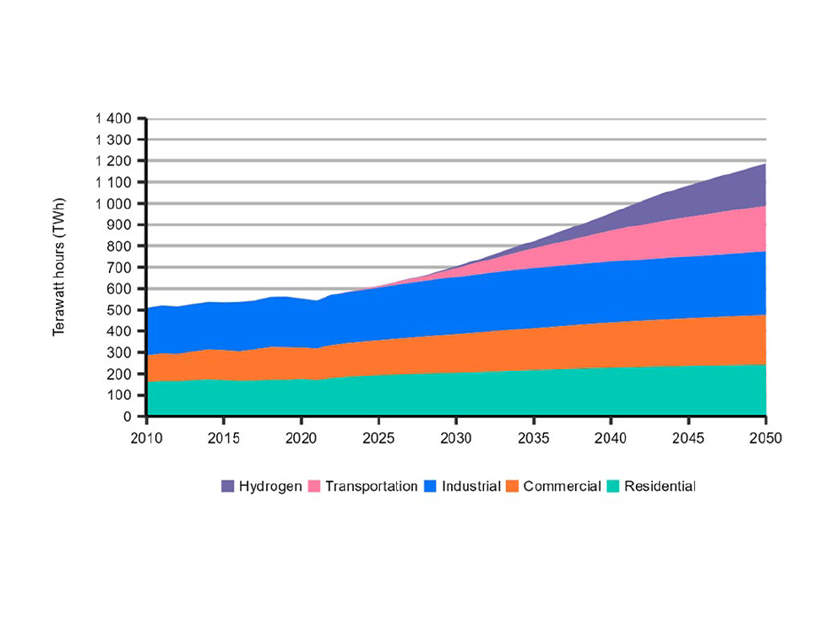
The state’s draft Energy Master Plan, released March 13, predicts a 66% increase in electricity demand by 2050 if the state pursues current policies and a far greater increase if the state uses a more aggressive strategy of electrification. 

Public reaction has been intensified by a 20% increase in the average electricity bill starting June 1, stemming from the state’s basic generation services (BGS) auction in February. State officials say the auction outcome largely was shaped by the PJM capacity auction in July 2024, which concluded with prices in some cases 10 times higher than in the previous auction. 

New Jersey officials, and those in other states, have blamed PJM for failing to ensure the pipeline of new generating plants is sufficient to meet growing demand. PJM argues the expected shortfall stems from a sudden surge in demand — due to the needs of artificial intelligence data centers, EVs and other uses — that the RTO could not have foreseen. In addition, state decisions have closed fossil fuel plants at a faster rate than new, mainly clean energy plants have opened. 

Christine Guhl-Sadovy, president of the New Jersey Board of Public Utilities (BPU), in a statement announcing the request for information plan, said “New Jersey, and the region, need more electricity, and since Day 1 of the Murphy administration, our commitment to supporting our existing nuclear fleet has never waned.” 

“As we work to push PJM to improve [its] interconnection queue to allow more resources like solar and storage to be built in the short term, expanding our nuclear fleet offers the Garden State an opportunity to add new generation to our resource mix, improving reliability and affordability for ratepayers in the long-term,” she said. 

Exploring New Sources

The PJM 2025 Long-term Load Forecast predicts electricity demand in the region will grow by nearly 40% in the next 14 years.  

Gov. Phil Murphy (D), said in a press release that “as part of my administration’s all-of-the-above energy strategy, we continue to explore ways to bring online new sources of electricity generation and improve and expand our nuclear fleet to grow the supply of resources as the U.S. faces increasing demand.” 

Nuclear-generated electricity accounts for about 40% of the state’s power and 85% of the state’s emission-free power. The state has three existing nuclear generators — Hope Creek, Salem 1 and Salem 2 — in South Jersey. The state has paid $100 million a year since 2019 under the zero-emission certificate (ZEC) program to ensure they remain open. Hope Creek is operated by Public Service Enterprise Group (PSEG), which operates the other two with Exelon. (See NJ Legislators Consider $300M for Grid Upgrades.) 

The state closed the ZEC program in February 2024 after PSEG and Exelon, the only nuclear plant operators in the state, opted to apply for more lucrative subsidies under the federal Inflation Reduction Act. (See NJ Closes Nuclear Subsidy Process as PSEG Looks to Feds.) 

Questions on Location, Size, State Role

The RFI asks respondents to answer questions in six categories, ranging from “the role of nuclear in New Jersey’s electricity production” to “nuclear safety and nuclear waste” to “the role of state government.” 

Among the questions posted in the RFI are these: 

    • What roles should various scales of nuclear power play in New Jersey? 
      • Large-scale nuclear facilities (>300 MW)
      • Small modular reactors (51 to-300 MW) 
      • Microreactors (1-50 MW) 
    • How could thermal energy from such facilities (fission-based or fusion-based reactors) be beneficially used? 
    • What areas, regions, categories of sites or specific sites in New Jersey might be suitable (or unsuitable) for siting new small-scale or microreactor nuclear facilities? 
    • What actions, if any, should the state take to facilitate the development of new nuclear electric generating capacity in New Jersey?
    • What stakeholder processes are needed to support the responsible development of nuclear electric generating capacity in New Jersey? 

Questions on Location, Size, State Role

The possibility of New Jersey expanding its nuclear fleet has been much discussed. While Republicans have floated the idea frequently, analysts say the time needed to build a new generating plant is several years longer than for other electricity-generating facilities. Cost overruns and delays are common. Supporters say small modular reactors can be built more quickly.  

The state draft energy master plan anticipates nuclear energy production increasing under the three electrification policies modeled in the plan, with a rise of 50% over the current level by 2050. At least two of the five Republicans seeking the party’s nomination in the state gubernatorial race have backed greater use of nuclear plants to generate power. 

At a legislative hearing in March, Guhl-Sadovy said she asked the U.S. Department of Energy if the Oyster Creek Nuclear Generating Station, a 1,930-MW reactor in South Jersey that is being decommissioned after closure in 2018, “could be repowered.” 

“Unfortunately, the decommissioning is too far along,” she said. 

The Assembly Telecommunications and Utilities Committee on May 5 unanimously backed a bill, A5517, that directs the BPU to work with the New Jersey Department of Environmental Protection and New Jersey Economic Development Authority to study the possibility of developing small modular reactors in the state. The bill appropriates $5 million from the state general fund and authorizes the BPU to obtain additional funding. 

“Small modular reactors offer a carbon-free, safe and scalable energy solution that compliments the state’s energy and environmental goals,” the bill states. 

Texas PUC Drafting Reliability Exemption Rule for ERCOT

Texas Public Utility Commission staff are drafting a rule to codify a process for exemption requests from ERCOT reliability requirements and allow owners of generation, load or energy storage resources to appeal the grid operator’s decisions to the PUC (57374).

Allison Fink, a staff attorney, told commissioners at their open meeting May 8 that ERCOT does not have a process for market participants to request exemptions. She said the proposed rule would not affect any existing exemptions or future provisions in ERCOT’s protocols, operating guides or other binding documents unrelated to reliability.

Staff are drafting the rule after ERCOT’s Board of Directors and stakeholders and the PUC approved a change to the grid operator’s Nodal Operating Guide (NOGRR245) that imposes voltage ride-through requirements on inverter-based resources. The revision was bifurcated so a subsequent rule change could address more details around the exemption process, a sticking point during the stakeholder process. (See “Bifurcated NOGRR245 Approved; 2nd Change to Add Details,” ERCOT Board of Directors Briefs: Aug. 19-20, 2024.)

Resource entities had until April 1 to request exemptions if they can’t meet the new requirements.

ERCOT General Counsel Chad Seely told the PUC that staff are processing more than 90 exemption requests. “I think we’re going to have quality issues with the data that’s going to take some time to work out with the individual resource entities,” he said.

Seely and PUC Chair Thomas Gleeson agreed cost should not come before reliability when evaluating the requests. “Costs can have a role in how we evaluate the overall risk,” Seely said. “What we don’t want is to be required to consider costs when there’s an unacceptable reliability risk.”

“I think [cost is] useful information to [entities] if they’re trying to figure out how to mitigate these risks,” Gleeson said. “But under no circumstance do I want ERCOT making the tradeoff between the value propositions on cost and reliability. Their focus should be on reliability.”

Staff Working on EOP Compliance

Staff from the PUC’s Division of Compliance and Enforcement (DICE) told commissioners they are handling about 130 violation findings for entities that have not filed either an initial emergency operations plan (EOP) and executive summary, or annual updates (53385).

The commissioners directed staff in September 2024 to investigate about 300 entities that were not compliant with filing their EOPs. The directive came following a report on the power sector’s weatherization preparedness and companies’ EOPs after a review of 691 electric entities. (See “PUC Adopts EOP Report,” EHV Tx Lines Coming into Focus for ERCOT.)

DICE opened investigations into 262 entities but were able to identify 76 that had met an April 2022 deadline or filed at least one of the annual reports due in March every year. Using a “corrective action plan” — essentially deferred adjudication, staff said — DICE closed out all but three of the cases.

Mass. DPU Aims to Align Gas Leak Program with Climate Strategy

In Massachusetts’ latest step to transitioning away from natural gas, the state’s Department of Public Utilities (DPU) has ordered major changes to the state’s program for addressing pipe leaks, aiming to better align the program with its long-term decarbonization strategy. 

Massachusetts’ gas system enhancement planning (GSEP) process was created by the legislature in 2014 to reduce methane leaks from the state’s gas network. The program has come under fire in recent years from climate and consumer advocates, who argue it encourages the utilities to invest in replacement pipes that risk becoming stranded assets as the state moves away from gas. 

Massachusetts has taken an ambitious approach to transitioning away from gas following the election of Gov. Maura Healey (D) in 2022 and the appointment of DPU Chair Jamie Van Nostrand. In late 2023, the DPU ruled that decarbonization of the state’s gas network should center around electrification, citing concerns about the overall viability of replacing natural gas with renewable natural gas and hydrogen. (See Massachusetts Moves to Limit New Gas Infrastructure.) 

In the 2023 order, DPU singled out networked geothermal as the emerging technology with “the most potential to reduce GHG emissions.” 

In recent years, lawmakers and regulators have made several changes to the GSEP process to account for the state’s climate strategy. In 2022, the legislature directed the utilities to consider using advanced repair technology in GSEP investments, and in 2024 the DPU required the utilities to consider the use of non-pipeline alternatives (NPAs). In late 2024, lawmakers amended the GSEP statute to put a greater focus on decarbonization and avoiding stranded assets. (See Mass. Clean Energy Permitting, Gas Reform Bill Back on Track, Mass. Gas Working Group Finalizes Recommendations to Legislature.) 

Building on these efforts, the DPU on April 30 ordered a series of significant changes to the program, requiring the utilities to more rigorously document their analyses of pipe repairs and NPAs, lowering the annual GSEP spending cap and prohibiting the collection of carrying charges when utilities defer cost recovery on GSEP investments that exceed the annual cap.  

“The GSEP program as currently implemented is not striking a good balance between safety and affordability, given the escalating costs and limited progress in addressing leak-prone pipe,” the department wrote in the order, adding that the utilities’ focus on pipe replacement is at odds with affordability and the state’s decarbonization laws.  

The department estimated the utilities spent about $4.7 billion on GSEP projects between 2015 and 2024 and projected that addressing the 4,000 miles of remaining leak-prone pipe in the state would cost an additional $13.7 billion if the gas distribution companies “continue down the current path of relying primarily on pipe replacement and failing to control costs in any meaningful manner.” 

“The replacement strategy followed by the LDCs [local distribution companies] is the most expensive path for customers, and the one most profitable for the LDCs given the earnings benefits of making a capital investment in new pipe having a useful life of 50 to 60 years,” the DPU wrote.  

The DPU noted that its $13.7 billion cost estimate may be “relatively conservative,” as it assumes just 2% inflation, compared to the nearly 12% annual increase in GSEP costs seen in recent years. Prior to the DPU’s order, Dorie Seavey, senior research scientist at Groundwork Data, estimated the cumulative cost to ratepayers of the GSEP program was on track to reach $42 billion by the end of the century. 

“The fundamental issue is the lack of any meaningful incentive for cost containment,” the DPU wrote, noting that GSEP’s accelerated rate recovery mechanism bypasses the typical regulatory lag between when investments are made and when utilities recover the costs, which typically “provides an effective incentive for the LDCs to minimize costs.”  

The reforms were praised by the Massachusetts Attorney General’s Office (AGO) and climate advocacy groups, who recommended similar changes prior to the April orders.  

“We applaud the DPU for adopting nearly all of our office’s recommendations to rein in the gas companies’ unrestrained and costly spending under the GSEP program,” Attorney General Andrea Campbell said in a statement. “It is fundamentally unfair to charge ratepayers billions of dollars to prop up the gas system as the commonwealth works to decarbonize.” 

Both the AGO and the DPU framed the changes as an important step to reduce gas costs in the state, which skyrocketed this past winter due to increased delivery fees and high gas supply prices induced by cold weather. The DPU noted that GSEP costs are the second-largest component of gas delivery charges. 

The GSEP cap reduction cuts the amount the utilities can spend through GSEP from 3 to 2.5% of the companies’ total firm service revenues. The DPU also wrote that it likely will cut the cap to 2% in 2026 and 1.5% in 2027.  

However, the department still will allow the companies to spend up to the 3% cap on NPAs, which should create increased incentives for the utilities to pursue these alternatives. 

In the proceedings prior to the order, the state’s gas utilities opposed cutting the spending cap, arguing it would make it difficult for them to meet their DPU-approved GSEP timelines, and would be “inconsistent with the Commonwealth’s climate goals and injurious to customers, from both a risk and financial perspective.” 

However, the DPU rejected this argument, writing that “reforms in the risk prioritization process and increased integration of NPAs and advanced leak repair technology into the GSEP process” should enable the companies to meet their existing timelines while also reducing costs. 

The department also stressed that the updates to GSEP cost recovery mechanisms should have no effect on reliability, as the gas companies “are obligated to spend whatever it takes to maintain and operate a safe gas distribution system, in compliance with all federal safety requirements.” 

Also in the order, the DPU directed the companies to improve their frameworks for analyzing NPAs, writing that “it appears that the LDCs are continuing with business as usual for the 2025 GSEPs.” 

The department emphasized the importance of NPAs for meeting the state’s decarbonization requirements and said the gas companies must fully incorporate NPAs into their planning processes to ensure full recovery of GSEP investments in the future.  

The DPU also ordered the creation of a GSEP Risk Assessment Working Group to “improve the transparency and consistency of risk prioritization within GSEP filings,” which will begin meeting in the coming months.  

National Grid and Eversource Energy, the two largest gas utilities in the state, said they are reviewing the orders. National Grid said it “is dedicated to exploring viable alternatives to gas infrastructure for heating, including targeted electrification and networked geothermal.” 

Eversource wrote that its “work will continue on behalf of our customers to safely, efficiently, and cost-effectively address aging, leak-prone pipe across the state.” 

PJM PC/TEAC Briefs: May 6, 2025

Planning Committee

PJM Presents Additional Details on RRI Selections

PJM Director of Interconnection Planning Donnie Bielak presented additional details about the projects selected for expedited interconnection studies through the Reliability Resource Initiative (RRI) to the Planning Committee on May 6.

The one-time program is designed to allow a limited number of resources to enter the next study cycle based on the amount of capacity they would provide, as well as their locations and expected in-service dates. (See PJM Selects 51 Projects for Expedited Interconnection Studies.)

In a May 2 announcement of the results, PJM said 51 projects totaling 11,793 MW of nameplate capacity were awarded positions in Transition Cycle 2 through the initiative, 39 of which are uprates of existing resources while 12 are “new construction” projects.

The RRI projects are expected to start coming online this year, with four to be completed in 2025, six in 2026 and 10 in 2027. One existing project receiving additional capacity interconnection rights (CIRs) was listed as being completed in 2023 in Bielak’s presentation. Each project, whether it was selected or not, has been added to PJM’s Cycle Service Request Status webpage with queue numbers AH1-674 and above; Bielak said there are no projects outside of RRI intertwined with those queue numbers.

Bielak said the initiative is considered complete by PJM, and any projects not selected will have their deposits refunded. Even if some of the projects with RRI positions withdraw from the queue, he said PJM does not plan to allow others to take their place.

Because RRI was meant to address localized resource adequacy shortfalls that PJM is projecting in 2029, stakeholders questioned why some new projects with longer construction timelines were selected over uprates that could be completed more quickly. Bielak said some new developments had characteristics that outweighed the in-service date. The ranking process awarded 35 points for unforced capacity (UCAP); 20 for effective load-carrying capability (ELCC) rating; 10 for projects sited in Dominion or BGE; 10 for being able to enter commercial operation between 2028 and 2031; 10 points for providing evidence of permits, siting or equipment procurement to support the in-service date; and 5 points for using existing transmission headroom.

Several stakeholders asked if PJM could provide more information about how specific projects were scored to the public or the applicants, but Bielak said those results “cannot be discussed in any capacity” for data confidentiality reasons.

The Natural Resources Defense Council’s Claire Lang-Ree told RTO Insider that the weighting used to rank projects led to many being selected that are unlikely to be online in time to address PJM’s projected capacity shortfall, which she also sees as a significant reliability risk the region faces. Of the 51 projects selected, 21 are expected to come online between 2029 and 2031, amounting to more than 8 GW of the expected capacity. She said that creates a risk that construction delays could result in projects being pushed beyond the time frame that RRI is targeting.

“The vast majority of that capacity in UCAP terms is coming online at the last minute or too late to help with the capacity crisis PJM is anticipating,” she said.

Lang-Ree argued PJM should have prioritized the in-service date rather than “double counting” the output of a project by having separate ELCC and UCAP values in the ranking. With shorter development schedules, she argued a design that selected more storage resources would have provided more certainty around the ability for the projects to start providing capacity in time for the start of the capacity shortfall. Of the 46 rejected RRI applications, 12 storage and hybrid resources had in-service dates prior to 2029, 17 were aimed to come online that year, and one had an in-service date in 2030.

She credited the RTO for reworking its interconnection queue to process applications more expeditiously and noted that it recently announced a partnership with Alphabet and Tapestry to use next-generation software to process interconnection requests. The next area she said PJM should focus on is creating a process for replacing retiring generation with new resources on the same day the deactivation occurs. The siloed nature of the existing CIR transfer and deactivation processes creates roadblocks for developers to take advantage of the interconnection facilities left behind after a resource goes offline, Lang-Ree said.

PJM has filed a package of changes to its CIR transfer rules with FERC, which would eliminate categorical restrictions on which resources can participate and allow applications that may consume transmission headroom. The commission has yet to issue an order on the proposal (ER25-1128). (See PJM Stakeholders Endorse Coalition Proposal on CIR Transfers.)

Transmission Expansion Advisory Committee

PJM Recommending Changes to Independence Energy Connection

PJM staff plan to recommend the Board of Managers revise the scope of the Transource Independence Energy Connection market efficiency project to abandon its eastern segment because of challenges with getting it approved.

The project includes two 230-kV lines, the western route running from the Ringgold substation in Washington County, Md., to the Rice substation in Franklin County, Pa., and the eastern route between the Conastone substation in Harford County, Md., and the Furnace Run substation in York County, Pa. While the Maryland portions of the project have been approved by the state’s Public Service Commission, the Pennsylvania Public Utility Commission rejected the certificate of public convenience for Transource to proceed with construction in the commonwealth. A federal court invalidated the rejection in 2023, ruling that it was based on economic protectionism rather than siting issues. Construction has not commenced on either of the lines. (See Christie Blasts PJM Pursuit of Transource Market Efficiency Project.)

Presenting an update on the project to the Transmission Expansion Advisory Committee, PJM’s Tim Horger said there are regulatory and constructability challenges with the eastern portion, leading staff to determine it no longer is worth pursuing. He said the most recent cost-benefit analysis found the original route, an alternate route modifying the eastern leg to use existing right of way and the western component alone each passed the 1.25-to-1 ratio threshold. The original had a 3.74 ratio, the alternate a 3.42 and the western-only route 3.85.

Carl Johnson, representing the PJM Public Power Coalition, said the RTO’s membership needs more information about how it conducted the analysis such that the cost-benefit ratio significantly increased for the 2025 project reevaluation. Horger said PJM can present more information about the topology and load forecast used.

Supplemental Projects

Dayton Power and Light presented a $480 million project to serve three new customers located near Jeffersonville and Wilmington, Ohio, by expanding several 345-kV substations and linking the Clinton, Fayette and Atlanta facilities with new 345-kV lines.

The Fayette and Atlanta substations would be expanded to breaker-and-a-half configurations to accommodate a 25-mile double circuit between the two sites, as well as two customer feeds from Fayette. The Clinton facility would be expanded with equipment for a new 27-mile line to Fayette and two 345-kV customer feeds. The project is in the conceptual phase with a projected in-service date in January 2031. The two Jeffersonville customers are expected to come online in September 2026 and ramp up to 1.5 GW of load by 2031, while the Wilmington customer is expected to come online in 2028 and grow to 500 MW.

The East Kentucky Power Cooperative presented a $566 million project to serve a new customer in Mason County expected to grow from 110 MW in 2026 to 2.2 GW by 2031. The customer has agreed to pay for all the interconnection costs.

The first phase of the project would construct two 1.5-mile temporary tap lines, one each on the 138-kV Spurlock-Goddard and Spurlock-Plumville lines. Next, a 345/138-kV switching station, to be named Mason County 1, would be constructed and tied into the 345-kV Spurlock-North Clark line with 1.5 miles of new lines. It would be outfitted with six 345-kV breakers, 15 138-kV breakers and two 345/138-kV transformers.

The next phase would expand the new substation with three more 345-kV breakers, 11 138-kV breakers and another 345/138-kV transformer. Another 345/138-kV switching station, named Mason County 2, would be constructed with eight 345-kV breakers, six 138-kV breakers and two 345-kV transformers. The second substation would tap into the 345-kV line between Mason County 1 and North Clark, and a new line would be constructed to Spurlock.

The final phase would expand Mason County 2 with three 345-kV breakers, 14 138-kV breakers and an additional 345/138-kV transformer. A third substation, Mason County 3, would be built and cut into lines between Spurlock and the two other Mason County facilities. A new 11-mile 345-kV line would be built to the existing Stuart substation. The temporary taps from the first phase would be removed when the rest of the work is complete.

PPL presented a $19.4 million project to rework portions of the Susquehanna switchyard to serve a 1,440-MW customer in Berwick, Pa. The customer is set to come in service in 2026 with 120 MW, growing to the full load in 2030. The transmission solution is in the development phase with a projected in-service date of May 30, 2028.

Dominion presented a $145 million project to address several violations in the Meadowville Load Area in Chesterfield County, Va. The work would rebuild the 230-kV Carson-Clubhouse line with new double-circuit structures and an additional 230-kV conductor. An additional 5.5 miles of 230-kV lines between Hopewell and the planned Sycamore Springs substation would be reconductored. The project is in the conceptual phase and is envisioned to be completed in the fourth quarter of 2030.

The company also presented a $135 million project to address thermal violations in the White Oak area of Henrico County, Va., through the 2025 Do No Harm analysis. Segments of the 230-kV Techpark Place-Darbytown, Chickahominy-Elmont, Chickahominy-Elko and Chickahominy-Bermuda Hundred lines would be reconductored, totaling around 40 miles. The project is in the conceptual phase and projected to go in service on Dec. 1, 2030.

PJM MIC Briefs: May 7, 2025

Stakeholders Discuss DR Participation in Regulation Market

PJM’s Market Implementation Committee discussed a proposal to revise its governing documents to allow demand response (DR) resources to participate in the regulation market when there may be energy injected at the customer’s point of interconnection (POI). 

Curtailment service providers (CSPs) would be required to have a net energy metering (NEM) agreement with the relevant electric distribution company (EDC) and explicit approval from that EDC to allow participation alongside injections. The same change also is part of PJM’s larger proposal to comply with FERC Order 2222, but some members have expressed a wish to have the capability implemented before 2028, when the Order 2222 implementation is set to go live. 

PJM’s Pete Langbein said allowing DR participation at POIs with injection would require some software redesign. 

Intelligent Generation CEO Jay Marhoefer said the company supported the proposal at the Distributed Resources Subcommittee (DISRS) because DR aggregators can get injection rights only when they have a wholesale market participation agreement (WMPA) or similar arrangement with PJM. When a DR resource provides regulation service, injection is allowed under an NEM tariff, but there no longer is uncounted energy and thus a WMPA no longer applies. 

Representing DR providers, Bruce Campbell of Campbell Energy Advisors said it is arguable that a customer with a NEM agreement that includes the capability to inject energy cannot participate in the markets as DR. He said such configurations could be operated as DR when the injections are not wholesale energy. 

1st Read on 3rd Phase of Hybrid Resource Rules

PJM’s Maria Belenky presented a set of proposed manual revisions to codify the third phase of PJM’s rules for hybrid resources, which would expand the rules to configurations in which non-inverter generation is paired with storage. (See “Third Phase of Hybrid Resource Rules Endorsed,” PJM MRC/MC Briefs: Nov. 21, 2024.) 

For generation paired with storage, participation in the energy and ancillary service markets is based on PJM’s Energy Storage Resource Participation Model. For hybrids composed entirely of non-inverter resources, rules for participation are similar to those for wind and solar generation 

The changes would allow the resource owner to decide whether the storage component of a hybrid should enter PJM’s market as open-loop capable, meaning it can charge from the grid, or closed-loop capable, limiting it to charging only from the generation components of the hybrid. Belenky said current practice dictates that if a storage resource is considered open-loop if it is physically capable of receiving energy from the grid, even if that does not reflect how the storage is operated. 

Hybrids with a capacity obligation and composed entirely of inverter generation must meet their requirement to offer into the energy market by providing their economic maximum equal to or greater than the hourly forecast for each component of the hybrid. If there is a battery component, the offer should reflect the expected intermittent and storage output, including the “roundtrip efficiency of the battery.” The resource owner can use either PJM’s forecast or supply its own. 

The changes also include adding a description of the formula used to determine lost opportunity cost (LOC) credits for hybrid resources that are instructed by PJM to charge to maintain reactive reliability. Resources are eligible for credits when locational marginal pricing (LMP) is lower than its offer. 

The changes rewrite portions of Manual 11: Energy & Ancillary Services Market Operations, Manual 27: Open Access Transmission Tariff Accounting and Manual 28: Operating Agreement Accounting. 

Stakeholders Endorse Market Suspension Rules

The MIC endorsed a slate of revisions to Manuals 6, 11, 28 and 29 to conform with a 2023 FERC order approving a PJM proposal to define how it proceeds with settlements under a market suspension. (See “First Reads on Manual Revisions,” PJM MIC Briefs: April 2, 2025.) 

The filing established three sets of rules for determining real-time prices when suspensions last less than six hours, between six and 24 hours, or for longer periods. Shorter suspensions would average real-time prices for each hour before and after the outage; moderate-length outages would use day-ahead prices if available or an average of real-time prices for the intervals before and after the suspension began; and suspensions longer than a day would use an aggregate supply curve (ER23-1431).   

For the day-ahead market, prices would be set to $0/MWh and real-time output and prices would be used to determine settlement. 

Regulation compensation would be based on a market-clearing price calculated by PJM based on the average prices in the hour before and after a suspension lasting less than one day. For longer suspensions, the highest-cost resource in each hour would set the clearing price. 

The price for synchronized, non-synchronized and secondary reserves would be based on the average price in the hour before and after a suspension for events shorter than six hours. If a suspension lasts between six hours and a full day, the day-ahead market-clearing prices would be used, and for events longer than a day, prices would be set to $0/MWh and LOC would be paid to resources. 

PJM Presents on April 8 Reserve Shortage

PJM’s Brian Chmielewski presented information on a reserve shortage April 8 that caused shortage conditions to be declared in the RTO and Mid-Atlantic Dominion (MAD) subzone between 7 and 7:15 a.m. Colder-than-expected weather during the morning caused load to ramp up more quickly than forecast, limited ramping capability was available at the time and imports were scheduled to reduce by around 900 MW. 

The event drove LMPs to $3,586.99/MWh at 7 a.m., with an RTO synchronized reserve deficit of 199.4 MW, a 792.6-MW primary reserve shortfall and 379.7 MW deficit in MAD, all of which was at the $850/MW penalty factor. Prices increased in the following 5-minute interval to $3,700/MWh before falling to $2,786.10/MWh at 7:10 a.m. 

PJM Stakeholders Vote Out 2 Board Members

LANSDOWNE, Va. — PJM’s Members Committee voted not to reelect two incumbent members of the RTO’s Board of Managers: Chair Mark Takahashi and Terry Blackwell.

Committee Chair Lynn Horning, of American Municipal Power (AMP), called the body into recess, following Exelon’s motion to reconsider, to allow members time to prepare to cast votes on the motion and potentially a second ballot on the two board members. The committee will return to session on May 13 at 11 a.m. ET.

Takahashi received 30.8% sector-weighted support in the vote, shy of the 50% required to be elected, while Blackwell received 43.5% support. The committee did vote to elect Matthew “Matt” Nelson, principal of regulatory strategy at Apex Analytics, to fill the seat vacated by outgoing board member Dean Oskvig, who is retiring. Prior to his position at Apex, Nelson served as chair of the Massachusetts Department of Public Utilities and worked on Eversource’s regulatory policy team for four years.

PJM CEO Manu Asthana expressed disappointment with the results of the vote but said he respects the will of the RTO’s members. Asthana noted the board is in the process of searching for his own replacement and also will be seeking a new board member when Charles Robinson steps away next year. (See PJM CEO Manu Asthana Announces Year-end Resignation.)

“As the outgoing CEO, I will say there is a lot of change happening at PJM with Dean leaving, with Charlie leaving next year … my experience with both Terry and Mark has been exceptional. I could not ask for more hard-working, dedicated board members,” he said.

In an emailed statement, PJM spokesperson Jeff Shields told RTO Insider, “PJM members, via our governing documents, decide who will serve on the independent Board of Managers.”

Introducing the motion to reconsider, Exelon’s Alex Stern said losing two experienced board members, the sitting chair especially, could cause expertise to drain from PJM at a particularly sensitive time, with looming resource adequacy concerns and an ongoing CEO search.

“We are in the beginning of a historic time, complete with an executive order declaring a national energy emergency,” Stern said, pointing to a series of “challenges” facing the RTO, including resource adequacy issues, large load additions and the transition to a new CEO.

“I’d like to ask for a revote. I’m hopeful that some of the folks that voted against may now, given the result, may appreciate the opportunity to consider … the destabilizing influence of what just happened with this vote,” he said.

That motion was seconded by Vistra’s Erik Heinle, who said he understands the frustration many members feel with PJM’s direction over the past year but contended this is a critical time for the RTO. He said both Takahashi and Blackwell have been excellent board members and that he appreciates their openness and willingness to reach out to RTO members. He said the results of the vote sent a message to the board that the membership wants to see a change in direction, but there is no reason to continue down the path of removing two experienced leaders.

Transparency Concerns

LS Power’s Marji Philips said PJM members have been extremely disappointed with the direction the board has taken. Without further statements from board members about how they would act differently, she argued there is no reason for members to change their votes on whether to reelect Takahashi and Blackwell.

“It’s not just a sign; it’s a sign that we want change … so what is the change we could see if we revote this?” she said.

Paul Sotkiewicz, president of E-Cubed Policy Associates, pushed back on the idea that removing two board members would be destabilizing, saying PJM is on a perilous course and a change in leadership is needed to avert a crisis down the road.

“This was clearly a vote of no confidence and to say that this would be destabilizing … I don’t think there’s been anything more destabilizing than the last few years at PJM,” he said.

Members also voiced concern about how a vote to reconsider could be administered. A third-party vendor conducts the vote to elect board members in a portal that provides PJM staff no access to see how individual members have voted. However, PJM Director of Stakeholder Affairs Dave Anders said the vendor cannot change voting on the fly. Therefore, the vote to reconsider would have to be done through PJM software. If the members give the directive, Anders said staff is willing to commit to ensuring that sector and member votes remain private and that the internal audit team can ensure the data is deleted without having been viewed.

Greg Poulos, executive director of the Consumer Advocates of the PJM States (CAPS), told RTO Insider that many advocates feel there has been little improvement since the 2024 Annual Meeting, when the sector voted against reelecting board members Paula Conboy, David Mills and Vickie VanZandt out of frustration with the design of the capacity market and a proposal to shift filing rights over regional planning from PJM’s membership to the board. (See Stakeholders Re-elect 3 PJM Board Members Over Consumer Dissent.)

Poulos said consumer advocates have supported several major board decisions — such as renewing the Independent Market Monitor’s contract and modeling the output of resources operating on reliability-must-run (RMR) agreements as capacity. But even in many of  those instances, he said, the board acted with little transparency and rushed through the stakeholder process, leaving advocates feeling their perspectives were not sought.

Poulos stressed that the advocates who voted against reelecting Takahashi and Blackwell did not do so out of opposition to them as individual candidates, but because there’s no other way to hold the board accountable, given that it meets in private and acts as a body. He noted that board member David Mills told the committee on April 12 that the board is planning to add a standing agenda item to the end of future MC meetings where attending board members will speak with stakeholders with the hope of providing more transparency.