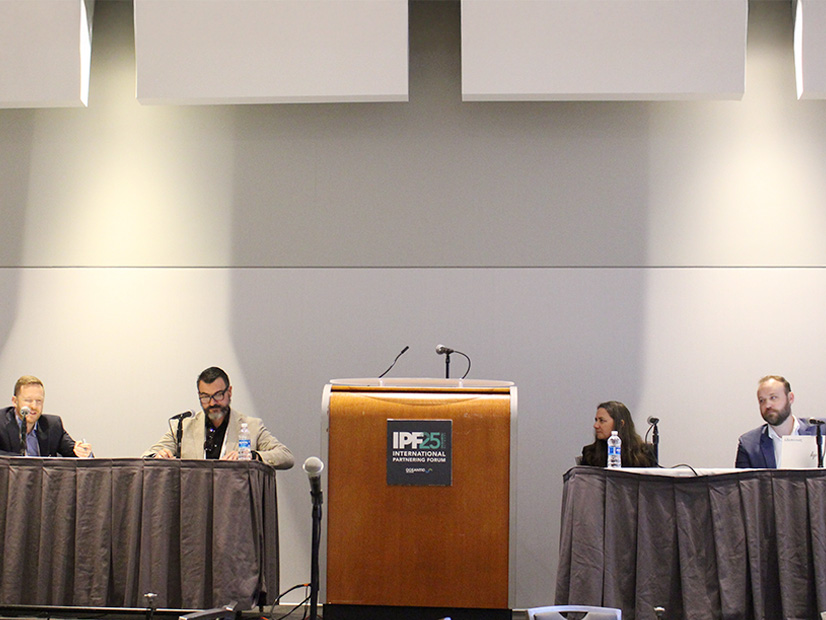
Following the Bonneville Power Administration’s pause on certain transmission planning processes, the agency’s customers say it might be time to consider creating a regional transmission organization or imposing stricter requirements to tackle the “exponential growth” of transmission service requests.
BPA heard from several customers and industry stakeholders during a May 6 workshop, including Seattle City Light, NewSun Energy, Portland General Electric (PGE), Northwest & Intermountain Power Producers Coalition (NIPPC), Renewable Northwest, Northwest Requirements Utilities and Western Public Agencies Group.
The agency hosted the workshop after it issued a pause in February to consider new “reforms” in light of “exponential growth” of transmission service requests (TSRs). BPA’s 2025 transmission cluster study includes over 65 GW of TSRs, compared with 5.9 GW in the 2021 study. The requests exceed the total regional load projected for the Pacific Northwest in 2034, according to the agency. (See BPA Halts Some Tx Planning Processes Amid Service Requests.)
After it issued the pause, BPA started soliciting stakeholder comments on how the agency can improve the transmission queue and deliver on its goal to go from transmission customer request to service in five to six years.
To meet that goal, BPA and power entities in the West must explore a range of possible approaches, even some controversial ones like creating an RTO, Michael Watkins, policy adviser at Seattle City Light, said during the workshop.
“Is it time for the West to finally wrap their hands around and accept that maybe we should form a regional transmission organization to bring us all together under one umbrella and actually serve our transmission needs?” Watkins said. “And it might be time to do that, and maybe it’s not, but we should talk about it as part of this process. That’s what we’re suggesting. I know that’s contentious, but I think that ought to be part of the discussion.”
Watkins also said it might be time for the West to consider solutions implemented in the East, like power transfer distribution factor scheduling and compensation change.
Speaking on behalf of NIPPC, Henry Tilghman said he agrees the West should consider an RTO.
“We should also consider moving to a congestion rights or a financial transmission rights model for transmission service,” Tilghman added.
Given BPA’s upcoming decision on whether to join a day-ahead market, “I think considering how we can move to a congestion rights model might be something we want to put into the hopper,” Tilghman said.
Other NIPPC recommendations include identifying reforms that don’t need a tariff change, ensuring interconnection and transmission service requirements are consistent and prioritizing the transition process.
Meanwhile, Laura Green of PGE said the utility supports imposing stricter data exhibit requirements to ensure only feasible TSRs move forward and clear the queue of requests that aren’t ready.
“You need to identify your [point of receipt] and your [point of delivery] and upstream generation resources, which I think we already do today. I think that’s part of the requirements,” Green said. “So it will be interesting to see what additional requirements might be put on customers.”
Jake Stephens, CEO at NewSun Energy, said BPA should think about interim solutions and study “the lower hanging fruit” like already planned upgrades or “simple redirects.”
While BPA’s efforts to address the growth of TSRs are good, the pause has impacted the market and companies that invested in resources in the belief their transmission requests would be studied, Stephens noted.
“Bonneville coming up with an interim way to keep working through that queue, I think is important,” Stephens said. “I think it’s necessary one way or another, because at the end of the day, if everything is studied, the results from all of that are going to be so staggering as to almost be undigestible.”
The cyber and physical threat landscape facing electric utilities remains “as dynamic and complex as ever,” especially in light of recent “geopolitical and economic developments,” officials from the Electricity Information Sharing and Analysis Center (E-ISAC) told members of NERC’s Board of Trustees.
Speaking at the quarterly open meeting of the board’s Technology and Security Committee on May 7, E-ISAC Vice President of Security Operations and Intelligence Matt Duncan cited recent threat assessments from the U.S. and Canadian governments that found “a growing cast of malicious and unpredictable actors” posing potential dangers to electric reliability. China, Russia, Iran and North Korea continue to represent major cyber threats, with more concern arising from criminals, political activist groups and other non-state actors.
China’s cyber warfare group “remains the dominant threat,” Duncan said, pointing to an assessment from security vendor CrowdStrike that espionage and reconnaissance activities against U.S. financial services, media, manufacturing and industrial organizations by Chinese actors increased 300% in 2024 from the previous year. This indicates that “all of the naming and shaming that has gone on with … U.S. foreign policy has not deterred the adversary from continuing to scan and … preposition in [U.S.] networks.”
Recent years also have seen a rise in malicious cyber activity by “hacktivists,” which Duncan described as a catch-all term for activity by groups not officially affiliated with state actors but associated with various causes, including conflicts between Russia and Ukraine, Israel and Palestine, and India and Pakistan. The last of these conflicts erupted the same week as the TSC meeting and already has seen Pakistani cyber criminals claim to have breached Indian defense systems.
“While they are not as sophisticated or as capable as a nation-state actor or even a criminal gang, they employ a lot of the same tactics and can impact folks’ reputation and cause disturbances to business operations,” Duncan said. “No electric outages have been caused by these groups, but they certainly have caused some website outages and some other, higher-profile events related to websites facing the electricity industry.”
Duncan devoted a significant part of his presentation to reviewing physical threats and the E-ISAC’s response to them. He noted that information sharing across the industry improved significantly in 2024, with utilities voluntarily sharing 45% more physical security incident data with the E-ISAC than in the previous year.
Despite the greater information volume, Duncan emphasized that the number of incidents that affected the grid remained low in 2024. The E-ISAC uses a four-level system for assessing security threat levels: level 0 indicates non-criminal activity; level 1 is criminal activity resulting in no outages; level 2 is criminal activity that results in outages for fewer than 10,000 customers; and level 3 is criminal activity resulting in at least outages for at least 10,000 customers.
The last two categories comprised around 3% of the physical incidents recorded for the entire year, around the average for the past five years. Of these incidents, the four most common types were theft, vandalism, ballistic damage and intrusion, representing 35, 27, 25 and 12%, respectively.
While theft of copper wire is a longstanding problem for electrical facilities, Duncan said the E-ISAC has also seen significant reports of optical fiber being cut. He called this phenomenon “a very concerning development” for both the energy and the telecommunication sectors, because it could lead to loss of communication with control centers.
He added that perpetrators may be motivated not by sabotage but simple greed, because “the coating [on the fiber optic cables] looks very similar to the untrained eye” to that on copper cables. Nevertheless, the E-ISAC continues “to ring the bell with government and our telecommunications partners.”
Duncan also pointed out the significant number of incidents in which the apparent motive was to cause damage, noting that “those are the types of attacks you want to focus a little bit more on, because … somebody was actually trying to cause an impact, and it wasn’t an accident.” He noted that a large amount of violent rhetoric online discusses sabotaging the grid to achieve political gains.
Bluma Sussman, the E-ISAC’s vice president of stakeholder engagement, hinted at the “challenging times” facing U.S.-Canada relations while promising that nothing would change the organization’s engagement with its Canadian partners.
“Our ISAC is not just here for U.S. utilities, but for all of the North American electricity industry, and our partnership with Canadian utility members and government partners is a critical one,” Sussman said. “Our shared commitment to the reliability and security of the North American power grid is paramount, and its foundation lies in these strong relationships.”
Duke Energy is seeing demand growth at a level its new CEO, Harry Sideris, has not seen in his 30-year career, and that is leading to massive investments across its utilities over the next decade.
“We are ready to meet the moment with a renewed focus on speed and agility and supported by the same spirit of innovation that has been at the heart of this company for over a century,” Sideris said during a first-quarter earnings call May 6. “As I assume the CEO role during this pivotal point for our company and industry, Duke Energy’s mission remains unchanged: delivering long-term value for shareholders and superior service to our customers and communities by building a smarter energy future.”
To support that new demand, Duke plans to invest $83 billion through 2029 and up to $200 billion cumulatively through 2034.
That spending includes new generation and transmission and increased spending on its existing generation. The utility recently won 20-year license extensions from the Nuclear Regulatory Commission to keep its Oconee Nuclear Station in South Carolina running until midcentury. Sideris said Duke plans to do the same for the rest of its nuclear fleet.
The firm also is investing in uprates at its other generators, which are small at the individual level but add up to 1 GW of new supply across its utilities, Sideris said.
That 1 GW of new supply across its fleet is equal to the amount of load to be served under new contracts it signed with just two large users in April, Sideris said.
The company plans to merge its Duke Energy Carolinas and Duke Energy Progress utilities, which have maintained some corporate separation since it bought Progress Energy in 2012. The firm plans to file applications with North Carolina and South Carolina regulators and FERC in 2025 and hopes to complete the merger by January 2027.
“The proposed merger would create significant customer savings, simplify operations and regulatory processes, and add operational flexibility to our system,” Sideris said.
Duke is seeing growth now, especially in its Southeast utilities and Indiana, but it expects the rate will pick up this decade, CFO Brian Savoy said.
“We continue to expect load growth to accelerate, beginning in 2027 as economic development projects come online. Our economic development pipeline continues to grow and includes advanced manufacturing projects across multiple sectors, as well as data centers,” Savoy said on the earnings call. “We’re streamlining processes across the organization to accelerate projects through the pipeline, which is yielding results.”
Duke is trying to figure out how its plans will be impacted by President Donald Trump’s tariffs, Savoy said.
“It’s important to remember that tariffs primarily affect capital, and the majority of our capital spend is American labor, which is not subject to tariffs,” Savoy said. “We currently estimate the impact of tariffs to be about 1 to 3% of our five-year capital plan, and we are confident in our ability to further minimize the impact, leveraging our size and scale to work with suppliers across our diverse supply chain.”
Energy Secretary Chris Wright testified on the Trump administration’s budget request for his department before a House Appropriations subcommittee hearing in which many of the questions were focused on funds already authorized by Congress that his department has delayed.
“This budget will return DOE to its core mission of advancing energy innovation and global competitiveness through research and development,” Wright told the Subcommittee on Energy and Water Development on May 7. “We will invest DOE’s resources in sources and technologies that support affordable, reliable and secure energy and provide a return on investment for the American taxpayers.”
The hearing was scheduled at the same time as other Appropriations subcommittees were reviewing budgets for the departments of Agriculture, the Army, the Treasury and Homeland Security. That schedule led to complaints from Ranking Member Marcy Kaptur (D-Ohio).
“We’re being squished into this tourniquet, and it’s not fair to you, and it’s not fair to the American people, and it’s not fair to members,” Kaptur said. “And I know this chairman didn’t do it, but I don’t like it because we can’t get into the level of detail that we need to do. And it’s all part of this squeeze by the new administration.”
In addition to complaining about the Republican majority’s review of the budget, she also criticized the proposed $20 billion in cuts to DOE’s budget, including 74% of the funding for energy efficiency and renewable energy.
“Since January, the Department of Energy has suspended critical energy programs, canceled executed awards and contracts authorized by this Congress, severely reduced staffing — including removal of the inspector general who tries to go after the crooks — and changed contracting policies,” Kaptur said. “The resulting confusion has disrupted communities, businesses and project developers across our country.”
At her time for questioning, Kaptur asked Wright why he had not responded to letters she and colleagues have sent to him this year asking about reports on paused congressionally approved funding.
“I receive dozens of letters accusing me of things that are reported in headlines, in blog posts and media all over the place, almost all of which are false,” Wright said. “Everyone who’s reached directly out to me, I’ve jumped on the phone with.”
Wright said his department has not paused funding because any project that already was underway has not seen its funding impacted. But it is reviewing other projects that were not underway. Part of that review includes $100 billion in loan commitments the Biden administration pushed out between the 2024 presidential election and President Donald Trump’s inauguration, Wright said.
Rep. Rosa DeLauro (D-Conn.), the ranking member of the Appropriations Committee, said Congress was supposed to receive a detailed spending plan for this fiscal year by the end of April, which did not happen.
“I’ve got a fear that we’re going to lawlessly, illegally try to move these funds and move them elsewhere,” DeLauro said. “But the law of the land is the 2024 enacted budget applied to 2025, so, really we’re going to press on getting that.”
She added that the department has refused to release $67 billion in funding. Wright took issue with her characterization of the issue and, in response to a later question, explained what is going on with that money.
“I’m very cautious about giving answers when I don’t really have an answer,” Wright said. “I’ve assembled a team and a process that’s not political, that’s not focused on buzzwords. It’s just a technology, business and end-market overview of projects. If we invest a lot of money, we want something at the other end that’s going to go forward, that’s going to have customers and off-takers and move on with it.”
The government spends $1.25 for every dollar in taxes it collects, Wright said, so he is on board with Trump’s policies that are meant to bring that spending under control. DOE grew 20% under the Biden administration, and the request would cut its budget to the lowest level since 2017.
Rep. Dan Newhouse (R-Wash.) told Wright he was on board with the administration’s goals to rein in government spending, but he pressed the secretary on staffing cuts at the Bonneville Power Administration that gets no funding from taxpayers. About 200 employees have taken buyouts offered by the Trump administration, and Newhouse worried that low staffing levels could impact the power marketing agency’s operations.
Wright said he and DOE leadership are concerned about BPA and other federal power marketers’ staffing levels as well, saying those 200 employees took an initial offer for early retirement and that staffing already was below target when Trump took office.
“We did a second round that’s been much bigger, but we’ve been specific at saying we can’t have people leave from Bonneville Power and the other power marketing agencies, because I don’t think we have room to reduce head count there anymore,” Wright said.
American Electric Power told analysts during its quarterly earnings call that load growth, driven by commercial customers in its service territory, presents opportunities to invest in “critically needed” infrastructure.
CEO Bill Fehrman said during the May 6 call that commercial load increased 12.3% in the first quarter compared with the same period a year ago. The company has forecast “historic” total retail load growth of 8 to 9% over the next three years, driven by large-load demand in Indiana, Ohio, Oklahoma and Texas.
“This growth is not a show-me story. It is happening,” he said. “As we look ahead, AEP is extremely well-positioned to participate in future growth across our footprint … to support increasing electric demand.”
AEP’s capital plan includes customer commitments for over 20 GW of incremental load by 2030 because of data center demand, reshoring, manufacturing and continued economic development. Fehrman said the company’s investment in its 40,000-mile transmission system, which includes the nation’s largest network of 765- and 345-kV lines, has been a driver behind the growth.
“These ultra high-voltage lines position us exceedingly well in attracting hyperscalers [large data centers] to our system. We need consistent, large-load power,” he said. “New infrastructure will allow us to handle this increased demand.”
AEP said it has secured funding this year through two separate transactions that complete its expected equity needs for its five-year, $54 billion capital growth plan. The company said it could invest an additional $10 billion over the next five years.
Fehrman said the company has determined the capital plan has about 0.3% direct tariff exposure.
The Columbus, Ohio-based company reported first-quarter earnings of $800 million ($1.50/share), compared with just over $1 billion ($1.91/share) from the same period in 2024. It also reaffirmed its operating earnings guidance of $5.75-$5.95/share and maintained its long-term growth rate target of 6 to 8%.
AEP’s share price closed May 7 at $107.48, up four cents since the earnings release.
The NYISO Market Monitoring Unit on May 5 told stakeholders it is independently analyzing the capacity market in parallel with the ISO’s ongoing Capacity Market Structure Review project.
“We want to help with a bit of quantitative modeling to help reason through some of the alternative structure proposals that have come out as part of this process,” said Joe Coscia of Potomac Economics. He said that his presentation to the Installed Capacity Working Group was intended to show his thinking and get feedback on possibilities. “We’ll follow up with a future presentation of results, so no numbers today.”
Coscia said the MMU is attempting to address the specific concerns of stakeholders with the current market. The analysis will address several questions:
Is there still value in a market designed to attract new entry in an environment where new generation development is driven by state contracts?
Do uniform net cost of new entry (CONE) demand curves result in “excessive rents” to existing resources?
Do bifurcated or “retention-driven” capacity markets improve efficiency or reduce costs?
Coscia said the study includes looking at the implications of using marginal capacity accreditation factors (CAFs) rather than average CAFs. This involves studying the calculation of effective load-carrying capacity for resources on the grid. Currently NYISO uses marginal CAFs, which can diminish the value of energy storage as more storage enters the market, according to a Brattle Group analysis.
Stakeholders asked whether the MMU’s analysis would try to account for state reimbursement programs for renewable energy. Coscia said the study will include an assumption that a portion of renewable energy entry into the market would not be driven by capacity prices.
Coscia gave a brief rundown of the MMU’s assumptions:
state-contracted renewables could meet 70% of load by 2033 and 100% of load by 2040;
6 GW of battery storage and 9 GW of offshore wind would be satisfied by state contracts;
load growth based on the 2025 Gold Book’s forecasts; and
imperfect market participant foresight in investment and retirement decisions.
These assumptions would underlie different market designs, which would be tested under different “technology scenarios” (i.e., all fossil units retired by 2040, dispatchable renewable energy peakers available, etc.). The goal is to examine how alternative market designs might perform under different future economic and technological conditions, Coscia said.
“What we’re interested in doing is trying to simulate out the implications of what could happen if changes are made to the way that prices and settlements are being determined,” Coscia said. “We have no ability to predict the future about all these market conditions that could be taking place.”
He said this would be a helpful tool for looking at the tradeoffs and benefits of different market structures under different conditions.
Stakeholders also asked whether there would be sensitivities included in the analysis. Coscia said the MMU intended to look at different variations within the assumptions.
NYISO Presents Results of Transmission Congestion Contract Survey
NYISO conducted a poll of current transmission congestion contract market participants to see what the demand for TCCs of various durations in future auctions might be, as well as their preferred structure for this fall’s centralized auction.
Ten market participants responded to the survey. On average, they wanted roughly 22% of system capacity to be available at a one-year duration. The desired capacity for a six-month duration was roughly 44%. Multiple market participants said that they wanted a percentage of the available system capacity to be reserved from the centralized TCC auctions for release in the “balance of period” auctions.
In response to the survey, NYISO proposed an eight-round auction structure. The ISO would offer 20% of system capacity as one-year TCCs across three rounds and 45% of system capacity as six-month TCCs across four rounds. Both of these would be effective Nov 1.
Effective May 1, 2026, NYISO proposes 5% of system capacity be available as one-year TCCs in one auction round. The remaining 35% of the system capacity for the winter 2025/26 capability period was already sold in 2024.
Market participants and transmission owners are encouraged to provide feedback to the ISO.
After a hiatus on gas-electric coordination discussions, MISO’s Advisory Committee touched on lingering frustrations in 2025 and potential solutions.
This time, MISO members pointed out that new electric storage could mitigate risk at times when high demand causes the natural gas supply to falter. The Advisory Committee’s roundtable May 7 was one of its periodic “current issues” discussions, with more topics planned in June.
John Wolfram, representing MISO transmission owners, said he expected it would continue to be a challenge to supply gas plants in high demand using a pipeline system that was designed to support heating only. Wolfram said TOs would like to see 24/7 gas operations, especially since scarcity occurs in extreme weather that strikes indiscriminately.
“It always seems like these emergencies occur on a four-day holiday weekend,” Wolfram said.
The Union of Concerned Scientists’ Sam Gomberg said battery storage waiting to interconnect in MISO’s queue could help it navigate gas shortfalls during punishing weather. The queue contains about 60 GW of energy storage.
Gomberg also said more regional and interregional transmission lines could lessen the pressure to perform for MISO’s key natural gas generation and make forced outages during system stress less noticeable.
“These aren’t one-off events anymore,” Gomberg said of extreme weather episodes. “I think MISO should be incorporating these into their long-term planning.”
Xcel Energy’s Susan Rossi, also representing MISO TOs, said a multiday commitment model from MISO could help natural gas resources better prepare.
MISO in 2024 said it wouldn’t entertain a member request to create a multiday fuel purchase requirement for market participants during extreme cold weather. However, the RTO said it likely would create a financial guarantee by the 2025/26 winter for resources that are committed days in advance and have those commitments canceled by MISO. (See MISO Proposes Alternative to Multiday Gas Purchase Requirements.)
Clean Grid Alliance’s David Sapper said while firm fuel procurements and dual-fuel conversions on plants could alleviate some risk, a “less expensive” option could be better unit commitments from the RTO.
Sapper also said battery storage, which could be charged with natural gas generation ahead of time, could help MISO ride out long, stormy weekends when gas becomes scarce.
Sapper said the lack of weekend service “in times of incredibly high need does not square with competitive markets and outcomes.” He said it remains “puzzling” to him that gas trading shuts down without regard to need.
Committee members agreed MISO has been handling fierce winter conditions better than ever. (See MISO: Better Preparations Clinched Winter Storm Operations.) However, some said it’s difficult to separate how much of the improved operations are due to MISO’s better forecasting and data or improved gas-electric coordination.
More Topics in June
The Advisory Committee will discuss emergency preparedness and power restoration procedures when it meets in June with the MISO Board of Directors in the audience.
Clean Grid Alliance’s Beth Soholt asked that MISO sectors be allowed more input when selecting topics to discuss in front of the board rather than its C-suite determining themes.
Advisory Committee Chair and Indiana regulator Sarah Freeman agreed there’s still “a degree of opacity” in how MISO leadership chooses the subject matter for Advisory Committee sessions during quarterly Board Week meetups.
For its separate, “current issue” discussion format in June that is not held in front of MISO board members and handpicked by the committee itself, the Advisory Committee decided to discuss MISO’s most recent capacity auction and how the new sloped demand curve influenced results. (See MISO Summer Capacity Prices Shoot to $666.50 in 2025/26 Auction.)
The committee maintains an ongoing list of future topics. Potential upcoming discussions could feature a possible minimum transfer capability between RTOs and how to best prevent future episodes of market manipulation à la Ketchup Caddy. (See In a Pickle: FERC Issues $27M in Fines over Ketchup Caddy DR Deceit.)
VIRGINIA BEACH, Va. — The sudden halt of the offshore wind sector has left states holding high-investment wind ports that won’t be needed for a while, raising questions about how states can use the pricey assets without hampering future OSW needs.
That approach, while understandable to try to recoup on the investment, could leave OSW developers high and dry if the industry rebounds, said speakers at the International Partnering Forum (IPF), which ran from April 28 to May 1.
“It scares us,” Brendan Crowe, port procurement manager for developer Invenergy, said in a panel called “Preserving Offshore Wind Port Development Momentum Amid Market Uncertainty.”
“We completely understand that that port is sitting fallow right now,” said Crowe, whose employer is developing OSW projects in New Jersey, New York and California. “We do understand that it needs to be a revenue-generating asset, and the state needs to start paying back the taxpayers for their investments.”
But, at the same time, “We don’t want that port to go to another alternative and we are not … able to claw back that use for our projects. Hopefully those alternative uses are short term prior to our project construction periods.”
Crowe urged states to stay the course.
“If the states are serious about their offshore wind goals, to put it frankly, they’ve got to put their money where their mouth is,” he said. “These port facilities are the industry enablers, and we’re not going to be able to construct anything without these ports. I always say ports are one of the first dominoes that needs to fall.”
Thinking Long Term
The panel was part of an ongoing discussion at the conference about the uncertain future. The sector requires massive investments and a complex, interlocking system of permitting, financing, supply chain and assembly elements. Planning is tough when the future is unclear.
Even before President Trump’s decisions to temporarily freeze all OSW projects in the permitting process, and to halt New York’s Empire Wind project mid-construction, the sector suffered a series of abandoned projects due to supply chain and financing problems, and rising costs.
That raised questions about the level of risk taken to support logistics and supply chain projects, and what’s the price — and reason — for taking it on.
Bon-Kyu Koo, CEO of cable manufacturer LS Cable & System, gave a decisively positive answer to a question by moderator Liz Burdock, CEO of Oceantic Network, the conference organizer, as to how he weighed the risks against the market opportunities in the United States.
The previous day, the manufacturer broke ground on a $700 million, 750,000-square-foot subsea cable factory in Chesapeake, Va., in a ceremony attended by Gov. Glenn Youngkin (R). The plans include a vertical vulcanization tower and a dedicated pier.
“The most important thing for all of us here in the offshore wind industry is if you look at this as a timeline of only one, two, three, four, five years, it’s difficult to make a decision,” Bon-Kyu Koo told Burdock. “But what we did is, we’re looking at this as an industry that will last over 20, to 30, to 40 years.
“Of course we’re going to have our ups and downs. But if you look at the long-term curve, this will be a curve that will be now going up.”
Port Capacity Shortfall
For stakeholders involved in building or using a port, the question is how to weather the near-term turbulence, said Jonathan Kennedy, chief development officer for port developer Clean Energy Terminals, who moderated the panel and was heavily involved in developing New Jersey’s port.
The OSW sector has achieved much in the past five years, developing the N.Y. and N.J. ports, as well as building ports in New Bedford, Mass., Tisbury, Mass., Providence, R.I., and New London, Conn., he said. The challenge stems from the large scale of the projects and the need to build them well in advance of when they’re needed to handle turbine materials and preparation, he said.
“We all know the U.S. lacks the port capacity it needs to achieve long term offshore wind targets,” he said. “Given the current market uncertainty, how do we preserve that momentum so that we can be port-ready when that offshore wind pendulum swings back — and it will swing back.”
John Schneidawin, director of strategic initiatives for the Port of Albany, said the agency recently put out a request for “expressions of interest” for alternative uses of the port, given the dramatic slowdown in offshore wind business. (See Fate of Wind Tower Manufacturing Site in Albany Uncertain.)
The port, located 126 miles from New York up the Hudson River, has 85 acres and will be shovel ready in two years, he said. The initial goal was to use it for a Tier 1 tower manufacturing site, taking advantage of the cheaper costs of doing business in Upstate New York while moving materials, equipment and finished towers down the Hudson River to the South Brooklyn Marine Terminal, he said.
“We’re trying to identify, do we subdivide those 85 acres,” said Schneidawin, who attended the ports panel but was not a panelist. “Do we maybe leave half of it kind of dedicated toward the needs of the industry now in offshore wind, whether that’s just storage and assembly and marshaling? Or maybe go with a different use for the other set of the acres.”
Future Income Uncertain
Suzanne Plezia, senior director/chief harbor engineer for the Port of Long Beach, said the port is confident the project on 400 acres to assemble floating wind turbines will not go to waste, based on the experience of the main port. The Port of Long Beach, which handles imports and exports in shipping containers, is the busiest in the U.S.
“From a near term, (for) all of our infrastructure, we have to think 20, 30 years down the road. So we do cargo forecasts. That’s how we look at, ‘Do we need to expand our infrastructure?’” she said. “It’s a similar approach here with pure wind. We believe in the long-term horizon and the need for offshore wind. And you know, whatever happens in the next four years will sort of be a blip on that horizon.”
The port also is protected by the heavy demand for land in the port area for non-wind uses, she said.
“From a risk profile, we know that should offshore wind not move forward, there will absolutely be a demand for that land,” she said. Still, she added, the nature of offshore wind makes it tough to get private investors interested in the wind port compared to backing cargo ports, for which the future cargo flow and income is more predictable.
“When it comes to pure wind, we need that same environment where there’s predictability on that source of revenue,” she said, and cited the typical “offtake” or contract for output delivered in the future. “The offshore wind model in particular is very challenging in that regard because offshore wind offtake happens in the future in increments over time. And that is really a core foundation for investors: Is that revenue secure?”
“So you have to think about, ‘How do we move forward during this period of time so that when (the developer) is ready my infrastructure is ready?’” she said. “And that risk is really high right now.”
Maturation Period
Crowe, of Invenergy, said the industry needs to draw on its OSW solicitation experience to create “offtake mechanisms,” that “share and mitigate that risk between developers and the ratepayers.”
“We are still in the early stages of this industry,” he said. “We have to allow the industry to mature before we start tacking on these kind of supply chain development targets on these early projects, and allow the industry to mature and bring those manufacturing (elements) domestic over time.”
Crowe agreed with the suggestion from audience member Molly Croll, director of Pacific Coast Offshore wind for the American Clean Power Association, that the current enforced pause may help the OSW sector by giving more time to develop the supply chain and decide which equipment is needed so ports can design around that plan.
Invenergy, which expects to use the Port of Long Beach to develop its floating foundation types, is “continuing to select what that component of foundation is going to look like, and that is really going to help (the port) build a more efficient, effective port for our use,” Crowe said.
“The challenge,” he said, “is I’m not the only customer,” and other developers will be placing their own demands too.
Ørsted is pushing ahead with two U.S. offshore wind projects amid potential policy threats but halting development of a much larger U.K. proposal due to rising costs.
The Danish renewable energy developer shared the news May 7 with the release of its latest financials. The company has struggled amid global headwinds facing renewables but managed to post higher first-quarter earnings in 2025 than in the same period of 2024.
Ørsted does expect halting the Hornsea 4 project to have a potential negative impact of as much as $530 million (U.S.) in the second quarter, however. And it projects a roughly $180 million impact on its Revolution Wind and Sunrise Wind projects due to new U.S. tariffs on steel and aluminum. Additional U.S. tariff impacts are possible but not expected to be as large.
Ørsted, which claims the title of largest offshore wind developer by capacity, surpassed 10 GW of installed offshore generation and reached 99% renewable generation in the first quarter of 2025.
During a conference call with financial analysts, CEO Rasmus Errboe reaffirmed the company’s commitment to offshore wind, saying “despite the significant challenges across certain geographies, the long-term fundamentals for offshore wind are strong.”
But the headwinds that emerged in the early 2020s still exist and led Ørsted to tighten its investment decision making process earlier this year.
Ørsted has suffered heavy losses on its investments in the struggling U.S. market, and the first question in the Q&A portion of the call honed right in on the latest threat: President Donald Trump.
How will Revolution and Sunrise be able to avoid stop-work orders like the one federal regulators in April slapped on Empire Wind 1, a New York project under construction by fellow Scandinavian developer Equinor?
Errboe said he would not speculate on the U.S. regulatory process.
The same analyst asked if Ørsted has discussed this risk with the Department of the Interior or its Bureau of Ocean Energy Management.
Ørsted always maintains an ongoing dialogue with regulators about its projects, Errboe said, but he described the current conversations only as “constructive.”
He told another analyst the company remains 100% committed to finishing both projects.
Revolution is far along in its offshore construction, with 100% of the export cable, 80% of monopiles and 50% of turbines installed. The delaying factor that has emerged is construction of the onshore substation. Revolution is not expected to reach commercial operation until the second half of 2026.
Offshore work began earlier this work on Sunrise, which is targeted for commercial operation in the second half of 2027.
Revolution will feed 704 MW into Connecticut and Rhode Island. Sunrise has a 924-MW offtake contract with New York.
Unlike some recent earnings calls, however, the U.S. market was not the main topic of discussion on May 7.
The decision to shelve Hornsea 4 — which at 2.4 GW would be one of the largest offshore wind arrays — overshadowed the other developments.
Errboe said increases in interest rates and supply chain costs as well as other adverse developments have raised risks and decreased anticipated rate of return well below the more-stringent thresholds for investment the company announced earlier this year.
Ørsted already has commissioned Hornsea 1 and 2 and now is building Hornsea 3. The problem that arose with Hornsea 4 is that cost factors changed after it was awarded its Contract for Difference — a mechanism by which the U.K. government subsidizes low-carbon generation.
A similar fate befell most early projects advanced by Ørsted and other developers off the Northeast U.S. coast, which locked in compensation long before costs.
Multiple contracts subsequently were canceled, and multiple proposed offshore wind projects were put on hiatus. Ørsted so far is the only developer to fully cancel a project — Ocean Wind 1 and 2, off the New Jersey coast.
Ironically, one of the ways Ørsted was going to reduce the financial blow of canceling Ocean Wind 1 was to use the export cables procured for that project instead on Hornsea 4.
Errboe emphasized that while the execution plan for Hornsea 4 is discarded, the concept of the wind farm itself is not.
The pause comes early enough that the financial impact is not as bad as it could be, he said, adding: “Also worth noting that we still have the lease rights, we still have the development consent order, we still have the grid connection agreement, and we will now work toward bringing the project forward again in a new configuration. We basically take it back to development, if you will.”
Ørsted reported a first-quarter 2025 EBITDA 18.7% higher than in the same period of 2024. Offshore wind earnings were 10% higher year over year, with weaker 2025 wind speeds offset by increased capacity and availability of generation.
Constellation Energy said it is closing in on new power purchase agreements and is in a good position to help serve projected data center load — whether in front of the meter or behind.
During the company’s first-quarter earnings call with financial analysts on May 6, CEO Joe Dominguez also gave optimistic updates on its acquisition of natural gas generation company Calpine and its planned restart of the former Three Mile Island nuclear plant.
Data centers were a recurring focus of the presentation, however, and Dominguez said Constellation feels the sky-high projections of the power demands posed by the artificial intelligence revolution are exaggerated — in some cases by stakeholders trying to build a business case for new wires or generation.
“I think the load is being overstated. We need to pump the brakes here,” he said.
He cited as an example projections by ERCOT, MISO and PJM of a combined 140 GW of new large-load demand by 2030 and contrasted that with forecasts by third-party analysts that average out to only 74 GW of new data center demand in that period in the entire country.
“Large-load demand” is more than just data centers, but a significant portion of those new large loads are expected to be data centers.
The problem is a familiar one: developers shopping around in multiple locations with a single early-stage plan that may not even get built but which gets added to the tally of potential growth in each jurisdiction.
“We know from conversations from our customers and the end users that the same data center need is being considered in multiple jurisdictions across the United States at the same time,” Dominguez said.
He added that renewable energy developers do the same thing, cramming interconnection queues with projects that have only a fractional likelihood of ever being built.
“It’s hard not to conclude that the headlines are inflated,” Dominguez said. “In fact, we’ve done the math, and if Nvidia were able to double its output and every single chip went to ERCOT, it still wouldn’t be enough chips to support some of the load forecasts. In ERCOT, there’s been a history of over-forecasting.”
A recent RMI analysis based on FERC data concluded that over the past decade, utilities’ long-term demand forecasts were 23% higher than what actually came to pass, he added.
But Constellation does expect load growth and for that growth to present the company with a strong market position. It hopes to absorb Calpine’s fleet and finish the year with more than 50 GW of operating generation in place; the cost and time frame to build a comparable new fleet would be daunting.
Constellation’s Wolf Hollow and Colorado Bend combined cycle gas turbine plants, for example, would cost about 300% more today than they did when built less than a decade ago.
Crane Clean Energy Center — Unit 1 of the former Three Mile Island — is aiming for a 2028 restart. It was among the 51 projects PJM selected for expedited interconnection studies; more than half of the 600 employees needed to run the plant have been hired; the first reactor operator class is underway; and the second operator class is on deck for this autumn.
In late April, Constellation answered FERC’s deficiency letter on its proposed acquisition of Calpine, and the company expects the deal to be approved and to close later this year. For its $29 billion outlay, Constellation will gain generation capacity that would cost $65 billion to build new.
“The short story here is that we’re seeing a very, very favorable environment,” Dominguez said. “We believe our offerings for clean and reliable generation are far more attractive from a time and pricing standpoint than any competing option, whether that’s used to support on grid data center development or behind the meter development.”
Possible headwinds facing Constellation include tariffs, a recession and hotly debated regulations on generation being co-located with load.
Past recessions historically resulted in a 1 to 4% decrease in demand, with weather patterns complicating any attempt to generalize the relationship between the economy and demand. This time around, the demand growth that is occurring would offset a temporary economic slowdown, Dominguez said. Also, the production tax credit for Constellation’s nuclear fleet gives the company downside protection from falling power prices during a recession.
The final shape of tariffs remains to be seen, Dominguez said, but Constellation’s preliminary estimate is for a 1 to 2% impact on 2025/26 capital expenditures, excluding fuel, but a negligible impact on operations and maintenance.
The outcome of the co-location debate is not clear, Dominguez said, and the industry desperately needs clarity. One byproduct of the controversy, he added, is that utilities have sped up the interconnection process. He applauded them for that and urged FERC to allow for some latitude in its rulemaking.
“It’s important that FERC not constrain innovation for co-generation and co-location,” he said.
Constellation reported unadjusted GAAP income of $118 million ($0.38/share) in the first quarter of 2025, down from $883 million ($2.78/share) in the same period in 2024.
It reported adjusted non-GAAP earnings of $673 million ($2.14/share) in the first quarter of 2025, up from $579 million ($1.82/share) in the same period in 2024.
The company’s stock price soared May 6 after the release of the financials, closing 10.3% higher as the three major U.S. stock market indexes all closed lower.