OSW Advocates Monitor, Lobby Congress for IRA Support

VIRGINIA BEACH, Va. — Offshore wind advocates are closely monitoring and vigorously lobbying Congress to assess and shape potential changes to the Inflation Reduction Act and its budget, speakers said at the International Partnering Forum 2025.

Key among the issues outlined at the IPF — which ran from April 28 to May 1 — is the fate of investment tax credits, as Congress seeks to pass a budget that will extend President Donald Trump’s 2017 tax cuts, speakers said.

Trump’s dislike of offshore wind has resulted in a freeze in permitting of projects and a halt placed on the Empire Wind project in New York mid-construction. Those actions suggest an uncertain fate for the IRA. But many benefits from the act have gone to Republican states, and wind advocates hope to sway legislators in key districts to keep the credits in the president’s proposed $4.5 trillion budget.

“It’s fair to say that defense of the tax credits is the first, second and third priority for ACP federal affairs team,” said Anne Reynolds, vice president of offshore wind for the American Clean Power Association (ACP), in an April 29 panel.

On the same panel was Shawn Daray, a tax attorney for Jones Walker, who specializes in renewable energy tax credits. He said one of Trump’s first executive orders — known as Unleashing American Energy — “is attempting to pause the disbursement of funds for the Inflation Reduction Act, that includes grants, loans, contracts and any other financial disbursements,” by declaring a national emergency.

“It’s important for all of us to just keep a close eye on the inner workings of Congress and see what comes out of these coming months,” he said.

Driving Economic Development

The IRA discussion emerged from a conference focused on efforts to reenergize the OSW sector amid a host of economic and political challenges. (See IPF25 Attendees Plan Future OSW Resurgence.)

The energy investment tax credit can be used to pay 6% of the cost of a project starting construction before Jan. 1, 2026, rising to 30% if the project pays prevailing wage levels and meets apprenticeship requirements. A project can earn another credit of 10% if it meets requirements for domestic content, such as the iron and steel used and certain other components. Domestic manufacturers of wind components — such as blades, nacelles, towers, and offshore wind platforms — can get a 10% tax credit.

Anne Reynolds, ACP (left), and Abby Watson, The Groundwire Group | © RTO Insider 

In recent weeks, 21 Republican Congressmen signed a letter supporting the tax credits. Four senators have publicly expressed support too, speakers at the conference said. OSW advocates are working hard to solidify that support and make sure it is reflected in the budget talks.

“Our message in Congress is that these tax credits are driving economic development, job creation and increases in household incomes all across the country,” said Reynolds, whose organization represents wind, solar, storage and other clean energy companies. “They’re doing that disproportionately in Republican states and Republican districts, and they’re doing it in a way that will address the surging demand for electricity across the country. So that’s the message that we’re trying to say six different ways.”

ACP’s campaign includes “television ads and online ads and events in strategically selected congressional districts across the country,” she said. “It includes grassroots activation, patch calls, email alerts, text alerts, and it includes direct meetings with Congress,” Reynolds said. On April 30, ACP organized 400 people to conduct congressional visits, including “front line workers, so real people whose jobs are depending on these tax credits continuing” could present their position, she said.

The challenge is to try to make sure the Republicans expressing support for the credits maintain that view through budget negotiations, said Catherine Belmán Goggins, the policy director of Turn Forward, a nonprofit organization that supports OSW. She said the first deadlines for passage, Memorial Day and then July 4, may change again.

“Time is of the essence,” she told the audience of about 100 people. She urged them to stress not only the local benefits of offshore wind but “the broader priorities” held by federal legislators, such as “domestic energy security, energy resilience, domestic manufacturing.”

“These are common interests across both sides of the aisle,” she said.

Persuading Opponents

That strategy of looking for common ground with opponents is key, said speakers at a panel called “Bridging the Divide: Engaging Republican Lawmakers on Offshore Wind and Renewable Energy.”

In general, OSW has strong support, said Hillary Bright, executive director of Turn Forward. Surveys conducted by the organization show that 73% of voters overall approve incorporating renewable energy into the state’s mix, including 53% of Republicans and 90% of Democrats, she said.

Those figures rise when the people surveyed are told “offshore wind can support good paying jobs, but don’t all require four-year degrees” and when the survey takes place in states like Texas or Virginia, where the benefits of wind energy development are in evidence, she said.

To persuade skeptics, advocates need to talk about OSW “in a more inclusive way that really brings everyone to the table,” she said.

A key strategy is to remove climate change from the discussion, said Jennifer Mundt, assistant secretary of clean energy economic development for the North Carolina Department of Commerce, which helps develop offshore wind energy resources in the state. They don’t mention the “other environmental co-benefits, like improved air quality because we’re replacing fossil fuel generation and all the emissions — we don’t touch any of that,” Mundt said.

But they will emphasize “the opportunities that come with growing, really a nascent industrial supply chain,” she said. “What we found to be the most successful strategy in communication has just really been to depict innovative and sustainable energy solutions like offshore wind as a part of a portfolio, as the drivers of economic growth, as the drivers of good jobs creation, and as the driver of energy security that North Carolina needs.”

Confronting New Regulatory Terrain

For other speakers, the key challenge facing the industry is how to adjust to the fact that “regulatory certainty has been turned on its head,” as Josh Kaplowitz, senior counsel for Troutman Pepper Locke, put it.

The changes triggered by Trump’s executive orders, and their potential impact on OSW projects, the supply chain, states and the industry, have been dramatic, according to speakers on a panel called “Unpacking the New Presidential Directives on Offshore Wind.”

Key among the initiatives highlighted was the Unleashing American Energy order, which declared the nation under an energy emergency and enabled the White House to take action to create more energy. That was followed by a separate — and contrasting — order that effectively froze all OSW federal permitting and leasing pending a review of existing leases, for which no timeline has been set, speakers said.

The administration’s decision to halt New York’s Empire Wind project mid-construction, with all permits in place, was close to unprecedented, said Kaplowitz, who moderated the “Unpacking” panel. The decision, enshrined in a presidential memorandum, did not cite any “particular legal authority” to justify the move, and it potentially could deter investors from backing any major energy project, he said.

“You have a situation where a project that has been fully financed, all the contracts are not just signed, but being executed,” he said. “It does beg the question about what message it sends to any industry, when receiving a final federal permit doesn’t mean anything, because it can be pulled away at any time, literally, including in mid-construction.”

Brian Krevor, senior director for offshore environmental and permitting at ACP, said Empire Wind was one of nine projects in various stages of construction that all had permits.
Brian Krevor, ACP | © RTO Insider

The Trump administration has set up a “dichotomy” of dramatic contrasts between its treatment of renewable energy projects versus other types of energy, Krevor said. To say that there is a national energy emergency and then exclude renewable energy as a source to meet it “doesn’t quite make sense,” he said. Nor does the fact that the U.S. Department of the Interior on April 23 said it would review non-renewable energy projects in 28 days if they require an environmental impact statement, and 14 days if they simply need an environmental assessment, he said.

“So on one hand, they’re making a critique of reviews that have taken two plus years each for these offshore wind projects, and even longer, to get there and do planning,” he said. “But for all other energy resources, they’re saying 28 days or 14 days is sufficient.”

On the same panel, Janice Schneider, an attorney at Latham & Watkins who specializes in environmental, energy and infrastructure, said she expects the administration’s moves to create “create some market chill.”

“In a perfect world, a lender would prefer to not lend until there are final and non-appealable permits on projects,” she said. The new environment is likely to mean “folks are sort of asking themselves, can we be confident that this shovel-ready project is actually going to be buildable and we get a return on investment?”

PJM Selects 51 Projects for Expedited Interconnection Studies

PJM has selected 51 projects to receive expedited interconnection studies through its Reliability Resource Initiative (RRI), adding 11,793 MW of nameplate capacity to the next study cycle. 

The RTO’s May 2 announcement said 39 of the projects are uprates of existing units, amounting to 2,488 MW, while the bulk of the capacity comes from 12 “new construction” projects, which would bring 9,305 MW to market. That translates to 9,361 MW of unforced capacity (UCAP) split between 2,108 MW of uprates and 7,253 MW of new construction. 

The majority of the additional nameplate comes from six new combined cycle gas generators and 20 uprates, which together would provide 7,756 MW if completed. An additional 2,275 MW of battery storage was selected, coming from five new projects. Four uprates to nuclear units would add 496 MW, while one new unit would carry 887 MW.  

Thirteen combustion turbine uprates would provide 365 MW, and 14 MW would come from an uprate to a coal generator. One onshore wind project was selected to increase its capacity interconnection rights (CIRs) by about 20 MW. 

FERC approved the initiative Feb. 11 to address a potential capacity deficiency PJM has identified in the 2029/30 delivery year. By ranking and selecting RRI applications according to their expected capacity contribution, in-service date and location, PJM argued that the one-time program would allow projects that could bring additional capacity online quickly to be added to Transition Cycle 2 (TC2).  

By limiting the number of projects selected to 50, it said there would be no impact to other queue positions in the cycle; ultimately, 94 applications were received, amounting to 26.6 GW of nameplate. The May 2 announcement said 51 were selected due to a tie in the ranking. (See PJM Receives 94 Applications for Expedited Interconnection Process.) 

PJM’s announcement said 90% of the selected projects should begin service before 2030 and all should come online by 2031. 

‘Thinly Veiled Effort’

Renewable developers and environmental organizations have objected to the RRI, characterizing it as allowing fossil fuel generation to jump a queue made up mostly of wind and solar projects. 

“If PJM were serious about addressing reliability concerns, they would be complying with FERC’s order to reform their interconnection process and speeding up their interconnection queue to get projects online that have been waiting for years. Instead, PJM has decided to let gas plants cut in line,” Sierra Club Staff Attorney Megan Wachspress told RTO Insider 

Wachspress called RRI a “thinly veiled effort to move gas plants ahead of renewable resources” and said it is “beyond disappointing that more than 75% of the projects selected are methane gas projects when study after study [has] shown that renewable energy is more reliable, affordable and better for the environment.”  

She also said winter storms Elliott and Uri showed that “gas plants underperform when families need electricity the most. Rather than follow FERC’s direction to improve interconnection and transmission, PJM’s short-sighted favoritism will put customers at risk and threaten our environment.”   

PJM highlighted several changes it’s making to its interconnection study process, including the cluster-based study process, of which RRI is a part. Since being approved by FERC in 2022, PJM said, the process has completed studies on about 18 GW of projects, and studies on an additional 62 GW should be completed by the end of 2026. 

The announcement also notes the commission recently approved changes to PJM’s surplus interconnection service (SIS), which allows expedited studies for new projects sharing a point of interconnection (POI) with an existing or planned resource not fully using its injection capability (ER25-778).  

Another proposal before the commission would revise the process for transferring CIRs from a retiring generator to a replacement resource by allowing all resource classes to participate, most notably storage (ER25-1128). (See PJM Stakeholders Approve SIS Manual Language.) 

Increased automation of studies could reduce the queue backlog by 60%, PJM said, pointing to a collaboration with Google announced April 10 to use AI tools to streamline the process. (See PJM, Alphabet Partnering on AI Tools to Speed Interconnection.) 

In a statement, Constellation Energy said the Crane Clean Energy Center, formerly Three Mile Island, was among the projects selected. The company said the RRI allows high-reliability projects to respond to rising load forecasts fueled by burgeoning AI and manufacturing demand. 

“In addition to Crane, PJM selected three Constellation ‘uprate’ projects that will increase output at three other nuclear plants in our fleet, bringing the total increase from the four projects to 1,150 MW of clean, firm electricity. We look forward to bringing these projects online to help support grid reliability and economic development throughout the region,” the statement reads. 

American Clean Power focused on the ability of storage developers to quickly install their selected projects, which improve grid reliability and reduce costs, ACP spokesperson Phil Sgro said in an email.  

“The representation of energy storage in PJM’s selection highlights these benefits, including favorable capacity accreditation and shorter development timelines,” Sgro wrote. “To balance the strengths and weaknesses of all generation resources, a diversified grid that includes clean energy is the best way to achieve the most reliable and affordable grid. PJM has [forecast] annual demand growth of nearly 5% over the next 10 years. Renewable resources are quick to deploy and provide additional capacity for the grid, helping boost overall reliability and meet rising demand.” 

IESO Opens Day-ahead Market in Nodal Rollout

IESO continued a smooth rollout of its nodal market, opening day-ahead trading for Ontario on Friday, May 2.   

IESO’s Market Renewal Program is intended to improve the way IESO supplies, schedules and prices power by creating a financially binding day-ahead market (DAM) and adding about 1,000 locational marginal pricing (LMP) nodes. The previous day-ahead commitment process was not financially binding, resulting in uncertainty for generators. 

“The market transition has succeeded,” the ISO declared Friday, calling an end to the market suspension it had issued during the transition to the new market. “The IESO confirms that there will be no rollback to the legacy market.” 

Day-ahead zonal prices for Ontario ranged from zero to $14.35 on Saturday, May 3, the first day of DA trading, rising only as high as $6.54/MWh on Sunday, May 4. With the return of the work week, DA prices topped out at $51.20 for 8 p.m. Monday and $58.61 for 7 p.m. Tuesday. 

DA LMPs since May 3 have ranged from $0/MWh to $85.60 — at hour ending 21:00 May 6 from an intertie in the Northwest zone. 

Real-time prices for the Ontario zone have ranged from near zero to a high of $389/MWh at 3:25 p.m. May 5. 

Peak demand for the first five days of the nodal market ranged from less than 15.1 GW (May 3) to almost 16.3 GW (May 1) with a projected peak of 16.4 GW for May 6.  

On May 5, RT prices in the West electrical zone north of Lake Erie hit the $2,000/MWh price ceiling for intervals ending 7:40 a.m. EPT to 7:55 a.m. EPT. 

The cause of the spike is unclear, partly because Ontario publishes much of its constraint data on a six-day lag.  

On Saturday, the ISO announced its Commercial Reconciliation System had been updated and was fully operational, meaning the ISO’s rules for settlement of the renewed market were in effect. 

The ISO experienced a couple technical glitches, reporting on Saturday that its day-ahead market phone line was not working and referring urgent issues to its real-time operations. 

On Sunday, it reported that an “unplanned tool outage” had made its Energy Market Interface (EMI) and Energy Market Administration Tool (EMAT) inaccessible. 

As of late Monday, May 5, IESO had not posted any subsequent notices saying the problems had been corrected. IESO did not respond to a request for comment. [Note: After initial publication of this story IESO spokesman Andrew Dow said the EMI/EMAT access problem had been resolved on Sunday May 4 . “The other issue is related to the day-ahead market phone lines not working on the weekends, and we are working to resolve it before this upcoming weekend,” he said.]

The nodal market launched May 1 should save Ontario $700 million over the next decade through reduced out-of-market payments and increased efficiency, according to IESO. 

State Officials in the Northeast Discuss Interregional Transmission Plan

Officials from members of the Northeast States Collaborative on Interregional Transmission expounded on the group’s strategic action plan, released in April.

“There are certain basic truths that apply to transmission planning and development today,” Katie Dykes, commissioner of the Connecticut Department of Energy and Environmental Protection, said to an audience of 300 people during a teleconference April 29.

She said the collaborative’s nine states — Connecticut, Delaware, Maine, Maryland, Massachusetts, New Jersey, New York, Rhode Island and Vermont — saw a benefit to working together to ease the complications of transmission development as much as possible. “It’s imperative that we do so, and we’ve certainly made a lot of progress over the past two years.”

Dykes said numerous studies found that interregional transmission connections could help stabilize the grid and drive down energy costs. With tariffs and long-term supply chain uncertainties looming, it’s important that states work together to ease the barriers to interregional transmission development.

“To achieve this, we need to agree on common standards for transmission technologies so that investments across the system are compatible and consistent,” said Dykes, citing the example of an HVDC multi-terminal platform for offshore wind. “Such standardization could lead to more certainty in the supply chain and reduce costs for ratepayers.”

The plan, released by the Brattle Group, recommended the states work with the three grid operators in the Northeast to find interregional “low-hanging fruit” that could be developed. (See Plan Lays out Steps for State-led Interregional Transmission in Northeast.)

PJM continues to support working with our neighbors on interregional planning,” PJM spokesperson Jeff Shields said in response to RTO Insider.

officials

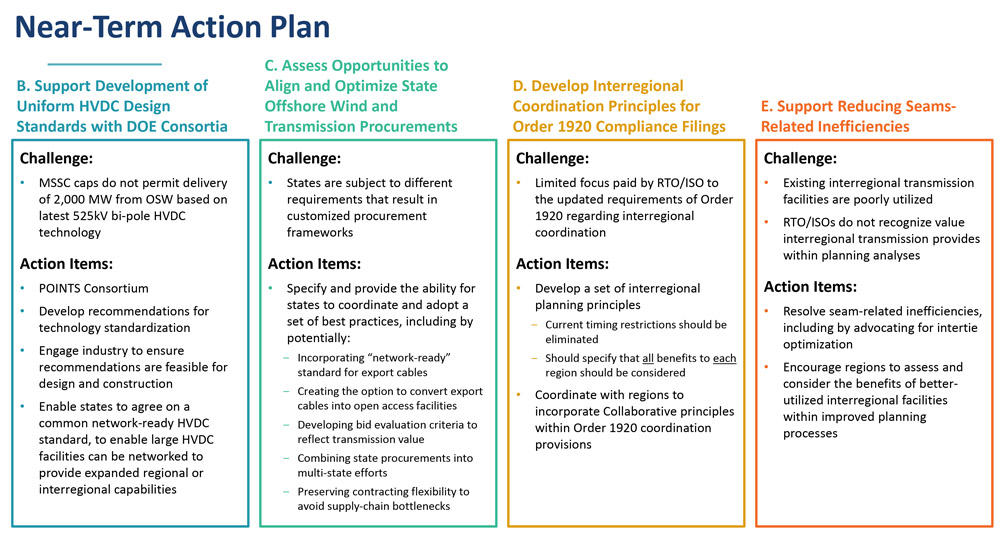
Objectives for the Northeast States Collaborative on Interregional Transmission in the next year | The Brattle Group

“Transmission planning is an integral part of planning the future power system, as is working collaboratively with the New England states and neighboring regions,” ISO-NE spokesperson Randy Burlingame said. He cited ISO-NE’s Interregional Planning Stakeholder Advisory Committee and a recent request for proposals on interregional transmission. “We look forward to continued collaboration with the states and our counterparts to ensure a reliable grid today and in the future.” (See ISO-NE Releases Longer-term Transmission Planning RFP.)

NYISO declined to comment.

“No process currently exists for a group of states spanning different transmission planning regions to take the steps necessary to identify, evaluate and ultimately agree to share the cost of beneficial interregional transmission projects,” said Joe DeLosa III, a manager and consultant for Brattle.

He presented more specifics on the action items outlined by the plan. In the near term, these include working to standardize transmission technology to permit the delivery of 2,000 MW from offshore wind on 525-kV lines, harmonizing state regulations and procurements, and directing the grid operators to implement interregional planning principals in line with FERC Order 1920. They also include reevaluating the benefits that could be provided by the extant interregional connections.

Over the next few years, the states would expand their efforts via mid-term action items, including reevaluating whether tariffs need updating for interregional transmission and exploring the formation of a buying pool for transmission equipment.

A panel of state officials including John Bernecker, director of the Transmission Center of Excellence at the New York State Energy Research and Development Authority; Kira Lawrence, senior policy adviser for the New Jersey Board of Public Utilities; and Jason Marshall, deputy secretary and special counsel in the Massachusetts Executive Office of Energy and Environmental Affairs, addressed questions from the audience. The panel was moderated by Suzanne Glatz, a consultant and former director of interregional planning for PJM.

“One of the critical activities is breaking down silos that have existed within transmission planning, both across the regions but really, across the ways that the benefits of transmission have been assessed,” Bernecker said. He said transmission typically has been assessed for market efficiency, reliability or for public policy. “In reality, a given transmission project will have benefits across different areas.”

The panel was asked why the plan seemed to have a specific focus on offshore wind given the opposition from the Trump administration.

“While wind power is mentioned, that’s more from the perspective of specific technical barriers that need to be addressed in order to fully integrate those resources in the long term,” Bernecker said. “But that’s not the focus of the plan in its entirety.”

State Attorneys General Sue Trump for Executive Order Halting Wind Approvals

A group of 18 Democratic state attorneys general filed suit May 5 against President Donald Trump’s executive order that halted wind energy projects’ federal approvals. 

The lawsuit, filed in the U.S. District Court for Massachusetts, seeks an injunction against the order so federal agencies can resume working on projects as the litigation is pending. The complainants include states that were banking on major offshore wind projects that have been interrupted, like New Jersey and New York, as well as many that were impacted by the order’s impact on onshore wind, such as California and New Mexico. 

“This administration is devastating one of our nation’s fastest-growing sources of clean, reliable and affordable energy,” New York Attorney General Letitia James said in a statement. “This arbitrary and unnecessary directive threatens the loss of thousands of good-paying jobs and billions in investments, and it is delaying our transition away from the fossil fuels that harm our health and our planet.” 

The order, which Trump issued on the first day of his new term, categorically halted all federal approvals needed for offshore and onshore wind energy, pending an “amorphous” and “extra-statutory” multiagency review of unknown duration. The order cited past, unspecified legal deficiencies and directed relevant federal agencies to stop issuing new or renewed approvals, rights of way, permits, leases or loans for onshore and offshore wind pending the review. (See Critics Slam Trump’s Freeze on New OSW Leases.) 

Agencies have implemented the executive order, with the Department of the Interior even issuing a stop-work order on Empire Wind 1 off New York, which had begun early construction activities. (See Feds Move to Halt Construction of Empire Wind 1.) 

The federal stoppage has harmed states’ efforts to secure reliable, diversified and affordable sources of energy to meet increasing demand, preventing the economic benefits associated with development and the environmental benefits of more clean energy. 

“The various actions taken by agency defendants to implement the wind directive are arbitrary and capricious under the Administrative Procedure Act,” the lawsuit says. “First, the wind directive was issued with no reasoned explanation for its categorical and indefinite halt of wind energy development. Second, neither the wind directive nor agency defendants have offered any detailed justification to explain the abrupt change in longstanding federal policy supporting the development of wind energy.” 

Numerous laws require federal agencies to consider and issue decisions on applications for wind energy projects, including the Outer Continental Shelf Lands Act, the Clean Water Act, the Clean Air Act, the National Environmental Policy Act and the Endangered Species Act. 

“Under these authorities, agency defendants must comprehensively, but promptly, review, approve, deny or otherwise act on applications to construct and operate wind energy facilities, following specific procedures and standards,” the lawsuit says. 

Previous presidential administrations, including Trump’s first, implemented those laws faithfully and often celebrated the growth in wind energy that resulted. In Trump’s first term, seven offshore wind lease auctions were conducted, multiple leases to offshore wind energy developers were issued, and the administration processed environmental reviews of many projects. 

Agencies already have looked into wind projects’ impact on fisheries, tourism and the environment and found their effects were at least acceptable for projects to move forward. Courts have reviewed some of those projects and come down on the side of the agencies. 

“The wind directive reverses the robust federal support for wind energy that had spanned decades and multiple administrations, does not account for agency defendants’ extensive past federal review of wind development, and conflicts with President Trump and agency defendants’ concurrent promotion of domestic energy production, both as a general matter and specifically in several of our states,” the lawsuit says. 

The order calls on the secretary of the Interior to run the review in consultation with secretaries of the Treasury, Agriculture, Commerce and Energy, and the EPA administrator. 

“Despite the extensive past reviews of wind energy projects by agency defendants — indeed, ignoring the existence of these reviews — the directive orders that the assessment consider anew ‘the environmental impact of onshore and offshore wind projects upon wildlife’ and the ‘economic costs associated with the intermittent generation of electricity,’” the complaint says. 

The directive was one of several Trump issued on his first day in office this January, which also included one addressing an “energy emergency.” (See Trump Will Need More than Executive Orders for US to Meet Rising Power Demand.) 

Other executive actions since then have emphasized the need for more energy, but the wind order goes against all of them, the lawsuit says. 

The order takes a low-cost, clean and abundant energy option off the table at a time when Americans need more affordable electricity, said Environmental Defense Fund Lead Counsel for U.S. Clean Energy Ted Kelly. 

“Instead of tapping into America’s vast wind resources and growing this industry, the administration is blocking energy progress,” Kelly said in a statement. “These attorneys general are right to challenge the Trump administration’s illegal attempts to obstruct wind energy.” 

SPP Addresses 3rd Load Shed Since March 31

OMAHA, Neb. — SPP staff have told its state regulators and board members that it will do better after three local load sheds since March 31.

The outages affected a combined 54,000 customers in northwestern Louisiana and mostly oil and gas facilities in southeastern New Mexico.

“They’re concerning, and we are committed to analyzing what went wrong and what we need to do to get better,” SPP CEO Lanny Nickell said May 5 during the Regional State Committee’s quarterly meeting.

The most recent, and largest, load shed since Nickell became CEO came April 26 near Shreveport, La., in Southwestern Electric Power Co.’s (SWEPCO) service territory. SPP said it identified grid instability in the area and directed SWEPCO to immediately reduce its electricity use by 140 MW, resulting in a six-hour outage for about 30,000 residential customers in Caddo and Bossier Parish.

Bruce Rew, SPP’s senior vice president of operations, told the RSC and stakeholders that temperatures came in higher than forecasted, increasing load. With several generators and transmission lines out for planned maintenance, the grid operator didn’t have enough generation to respond to voltage instability in the area.

Coming as it did three weeks after a similar event, the outage generated numerous headlines in the region:

Foster Campbell, the outspoken Louisiana commissioner who serves northern Louisiana and once ripped SPP for its “Taj Mahal” of a headquarters building, held a press conference in his office April 29. (See Louisiana’s Campbell Expands Beef with SPP.)

Campbell called Nickell and SWEPCO President Brett Mattison and sat them alongside him, where they held court before the regional media for about an hour. One image from the press conference showed Nickell, his head bowed, listening to Campbell as the commissioner looked at the CEO and pointed to a document.

Nickell noted to the RSC that the event occurred during a pleasant spring afternoon.

“What I found is there’s never a good time to take an outage. There’s never a good time to interrupt service,” he said. “It’s important that we never take for granted what we do to keep the lights on.”

Campbell has asked SPP and SWEPCO staff to attend the Public Service Commission’s next meeting and discuss compensation for the outage’s damage. SPP has said it will have representatives at the meeting.

“Let’s see about how we can get together and how much money would be reasonable or fair,” Campbell said during the press conference. “We’re going to work this out and come up with a solution. We gotta figure out how you give these people their money back that lost its revenues while the power was down.”

The RTO has said it will work with SWEPCO to conduct a comprehensive analysis of the event to understand what happened and determine future actions.

“We will consider all possible solutions to issues that threaten real-time and long-term reliability across the region we serve,” SPP said in a statement.

The Shreveport area also went through an emergency outage April 2 after a dangerous storm system swept across the Midwest. More than 24,000 customers were without power for several hours. SWEPCO said it was required by SPP to implement “emergency grid protection outages” to prevent “potentially catastrophic damage” to the grid.

A SWEPCO representative told one of the regional media outlets that emergency outages like the April 2 event are “incredibly rare” and not something that happens regularly.

The third load shed took place March 31 in Southwestern Public Service Co.’s (SPS) eastern New Mexico service territory, which has dealt with slim generation margins recently, Rew said. Several generators were out of service for planned maintenance or forced outages, and when there was a steep drop in wind production during the early morning, the reliability coordinator ordered SPS to drop 122 MW of load.

The outage affected primarily large industrial consumers and lasted less than three hours before offline generation could be deployed.

FERC Approves $110K Penalties in RF

Two entities managed by Cogentrix Energy will have to pay a collective $110,000 to ReliabilityFirst for violating NERC’s reliability standards, according to a settlement between the regional entity and the utilities approved by FERC (NP25-9). 

NERC filed the settlement with the commission in a notice of penalty March 31, along with a separate spreadsheet notice of penalty containing a settlement between SERC Reliability and Georgia Transmission (GTC), and another settlement between SERC and the Municipal Electric Authority of Georgia (MEAG), both for failing to maintain consistent facility ratings (NP25-10).  

FERC said in a filing April 30 that it would not further review any of the settlements, meaning the penalties for the RF violations will remain intact. Neither of the SERC settlements carried a monetary penalty. 

Communication Issues Between Cogentrix, PJM

RF’s filing involved two gas generating facilities: the 870-MW Hamilton Liberty station in Towanda, Pa., and the 773-MW Essential Power Rock Springs (EPRS) station in Rising Sun, Md. Liberty is registered with NERC as a generator owner and generator operator, while EPRS is registered as a GO, GOP and transmission owner. 

Liberty and EPRS were accused of infringing IRO-001-4 (Reliability coordination — responsibilities) and TOP-001-5 (Transmission operations), respectively. RF said both violations stemmed from “the same manager’s miscommunication [when] both entities were experiencing a phone outage,” and both were self-reported to the RE on Nov. 15, 2021.  

According to the NOP, on Sept. 16, 2021, Liberty was preparing to perform reactive testing for a 453.5-MW unit as required by MOD-025-2 (Verification and data reporting of generator real and reactive power capability and synchronous condenser reactive power capability). The test was approved by Liberty’s reliability coordinator, PJM, except for one portion.  

In its self-report, Liberty explained that Cogentrix’s Energy Management Group (EMG) “was experiencing a [voice-over-IP] phone outage that created additional confusion in the EMG to PJM communications” at the time, requiring the use of multiple cell phones that “were not utilized by PJM as intended by EMG.”  

PJM told the manager of the EMG that because of an ongoing transmission outage, the leading reactive test could not be performed at the maximum MW output. The RTO told the manager that “a lengthier stability study was required prior to performing that portion of the test.”  

However, the EMG told Liberty’s control room operator to start the test without passing along the information about PJM’s lack of approval for one portion. As a result, the operator conducted the test in full. This constituted a violation of IRO-001-4 requirement R2, which requires transmission operators, balancing authorities, distribution providers and GOPs to “comply with [their RCs’] operating instructions unless compliance … cannot be physically implemented or …such actions would violate safety, equipment, regulatory or statutory requirements.” 

Also on Sept. 16, 2021, PJM requested through the EMG that EPRS run Units 3 and 4 for economics. The EMG manager relayed this instruction to the EPRS lead operator, but the operator did not hear the request clearly. Although the operator repeated it back as an instruction to use Unit 4 only, the manager did not correct this misunderstanding.  

As a result, the EPRS operator did not start Unit 3 until called back by the EMG’s real-time desk operator to ask why the unit was not running. At this point, the EPRS operator listened to the recordings and realized he had missed the request for Unit 3 to be started. EPRS contacted PJM to notify the RTO that it had failed to bring Unit 3 online, and PJM canceled the request. 

The failure to convey PJM’s directive violated requirement R5 of TOP-001-5, which, like IRO-001-4, requires TOPs, GOPs and DPs to “comply with each operating instruction issued by” their BAs. RF assessed the TOP-001-5 infringement as a minimal risk to grid reliability. However, the RE assessed the other issue as a serious risk because performing the reactive test without a stability study could have caused the unit to trip, damaging station equipment and further jeopardizing grid reliability. 

To mitigate the miscommunications that led to the lapses, both Liberty and EPRS conducted an extent of condition review of their communications with Cogentrix’s EMG from October 2021 to January 2022 and found no further instances of failure to follow operating instructions. They also developed plans to manage communication with PJM and other plants during future phone outages by the EMG. 

RF assigned a penalty of $85,000 for the IRO-001-4 infringement, and $25,000 for the TOP-001-5 violation. 

Georgia Entities Settle Over Ratings Issues

SERC’s settlement with GTC started with a self-report filed Oct. 12, 2022. The utility indicated it was in violation of FAC-008-5 (Facility ratings). 

While reviewing drawings and equipment logs for its Bolingbroke substation, GTC found that a line elements database maintained by another registered entity did not list the correct jumpers or bus, likely the result of improper record keeping during a conversion from 68 kV to 115 kV in 1999. The utility derated the relevant line, restoring the previous rating several months later when the bus and jumpers were replaced. 

GTC then conducted a walkdown of 699 additional stations, finding 10 incorrect facility ratings that resulted in derates of up to 32%. SERC later conducted an audit in 2023 that found no additional instances of noncompliance. 

The RE assessed the root cause of the infringement as ineffective controls, primarily because of outdated procedures for communicating facility ratings that were not updated to incorporate new technologies. GTC’s mitigation activities — which are expected to be completed Dec. 31, 2025 — include updating its project review checklist to require verifying the actual transmission line ratings, completing an extent of condition review and committing to correct its internal records as necessary. 

SERC discovered MEAG’s violations — also of FAC-008-5 — through a compliance audit. The RE conducted a walkdown of MEAG’s facilities and found that some of the installed equipment was not included in the ratings table provided by the entity for one of its substations. Among the omissions were all the jumpers, along with a conductor and the name plate size of a switch at the facility. 

After the audit, SERC required MEAG to conduct a walkdown assessment of eight additional transmission stations. The utility identified one incorrectly rated element that led to a 10% derate on a 115-kV line. 

In this case, SERC attributed the misratings to a failure to follow internal controls, which meant that all applicable elements were not included in the facility rating database. MEAG committed to update its ratings database and participate in training on proper facility rating change management procedure. The utility also promised to perform walkdowns of all elements applicable to FAC-008, starting in the third quarter of 2024 and with an expected completion date of Dec. 31, 2025. 

NEPOOL Supports Timeline Revisions for ISO-NE Order 2023 Compliance

The NEPOOL Participants Committee on May 1 voted to support an expedited filing adjusting several key dates in ISO-NE’s compliance proposal for FERC Order 2023.

The commission approved ISO-NE’s compliance filing on April 4, but several dates included in the filing no longer are viable (ER24-2009, ER24-2007). (See FERC Approves ISO-NE Order 2023 Interconnection Proposal.)

To preserve the general timeline of its proposal, ISO-NE intends to push back most dates and deadlines in its original filing by about a year. This would enable the RTO to run a group study for late-stage interconnection requests that lack capacity interconnection rights. The group study would precede the main transitional cluster study, which is likely to begin in October.

A proposed revision by RENEW Northeast failed to gain enough support to pass despite support from the NEPOOL Transmission Committee. RENEW proposed to let customers with late-stage interconnection studies continue their system impact studies (SISs) until Aug. 30, arguing this could help these developers avoid restarting their studies. ISO-NE stopped working on all in-progress SISs after FERC approved its compliance proposal. (See ISO-NE Prepares Expedited Filing After Ruling on Order 2023 Compliance.)

Prior to the meeting, NEPOOL Counsel Pat Gerity told members that the Participating Transmission Owners Administrative Committee did not support filing the changes with RENEW’s revision. He wrote that, “because of the shared filing rights that are implicated, the ISO does not believe it will be in a position to file the TC-recommended Section II revisions.”

The revision fell short of the two-thirds threshold required for PC support, with 59% of the committee voting in favor at the meeting on May 1.

The PC also voted to support changes to a pair of definitions in the ISO-NE Financial Assurance Policy and approved minor changes to the operating procedures for transmission outage scheduling and metering and telemetering criteria.

Operations Report

Energy market revenues significantly increased in April compared to the same month last year, ISO-NE COO Vamsi Chadalavada told the PC.

Average day-ahead and real-time hub LMPs increased by more than 65% year-over-year. The revenue increase largely was driven by more-than-doubled natural gas costs.

ISO-NE’s day-ahead ancillary services (DAAS) market, which the RTO launched at the beginning of March, had an average daily total value of about $15 million. Following a significant price spike after the market launch in early March, DAAS prices have remained relatively stable, but they did experience a smaller spike during a period of cold weather and elevated demand in early April.

The system did not experience any emergency conditions but did experience the lowest minimum load in ISO-NE history. (See Growth of BTM Solar Drives Record-low Demand in ISO-NE.)

Around the Corner: Nobody Does Capacity Quite Like Ontario

Twenty-two years after it went live, Ontario’s independent electric system operator, IESO, has launched its Market Renewal Program (MRP), instituting a nodal day-ahead market that covers more than 900 locations. 

The revision appears to have gone smoothly, with the grid operator now joining the seven U.S. ISOs and RTOs that have day-ahead structures. Given that fact, it’s an opportune time to look at the bigger picture of Ontario’s structure and competitive electricity markets in general. 

DA markets typically are where the largest volumes of electricity are transacted on a location-specific nodal basis, with varying levels of nodal granularity. Under its earlier approach, IESO had operated only a real-time market with a single price, irrespective of location or transmission constraints. 

Generators could schedule their output the day prior, but commitments were not financially binding. Any inefficiencies or price discrepancies, including congestion, were settled through compensatory out-of-market payments, and discrepancies between expected generation and actual real time operations were not subject to penalty.  

Under the new MRP, day-ahead market offers — which create financial obligations to deliver energy the following day — will be scheduled to match forecast demands. Prices will be bound by a floor of -$100/MWh and a ceiling of $2,000/MWh.  

In some ways, it’s surprising the move took so long. Locational day-ahead markets create more market efficiency while also offering grid operators and market participants better foresight into what will happen the following day. They are more deliberately proactive and less reactive to real-time events.  

The move was a big step for IESO and one of the biggest tweaks to its market design in years. And while it increases the overlap in the Venn diagram with other market operators, IESO’s action and market redesign highlights a very curious fact about North America’s restructured markets: Each “deregulated” market embraces the overriding concept of competition but then spikes the drink with its own highly local flavors. 

ontario

Peter Kelly-Detwiler

Editorial pet peeve: It’s not clear why people insist on calling this “deregulation.” With highly complex competitive markets superimposed on regulatory supervision for distribution at the state or provincial level, there are far more — and more complex — rules than ever existed before the advent of competition. And operators keep tweaking them to respond to the latest perceived market shortcoming. 

These market flavors also defy any attempt by generators, battery operators or demand response aggregators to achieve economies of scale — no, we have created a true Tower of Babel here.  

To illustrate the nature of this multifaceted hydra, let’s take the issue of capacity in a number of markets. Texas has no capacity market, letting energy scarcity prices offer the signals, although operating reserves are in the mix as well. Meanwhile, ISO-NE and PJM hold formal capacity market (FCM) auctions three years in advance — unless the regulatory conversation gets so muddled that they get delayed for years, as has been the case for PJM. 

New York long ago decided the FCM approach was too potentially inefficient and risky, and opted for monthly options with the possibility of transacting seasonal strips. Meanwhile, on the West Coast, California’s ISO tasks the utilities with procuring capacity resources. 

In many markets, capacity represents a noticeable element on the wholesale power bill. Exhibit A is PJM, with its recent eye-watering 2025/26 auction results at just under $270/MW-day, and the just-formalized floor and ceiling prices of $175 to $325/MW-day for the coming two auctions. Exhibit B is MISO’s just released auction results for this summer, coming in devilishly high at just over $666/MW-day and annually between $212 and $217/MW-day. They make PJM look tame by comparison.  

But nobody does capacity quite like Ontario, and that hasn’t changed with its Market Renewal.  

Capacity and the Global Adjustment Charge (GAC)

As in other markets with capacity prices, the GAC — established in 2006 — is intended to cover the cost of building and maintaining supply infrastructure to ensure system resource adequacy. The initial MRP proposal intended to do away with the GAC and replace it with a formal capacity auction. However, pushback from various stakeholders resulted in this plan being abandoned.  

Unlike the role of capacity pricing in other markets, though, the GAC specifically addresses the difference between the total compensation made to certain contracted generators and any offsetting market revenues. As such, there typically has been a strong inverse relationship between wholesale electric energy prices and the GAC. When wholesale energy prices are lower, the GAC is higher, and vice versa. And energy prices historically have been very low, with the result that the GAC typically is the largest single element on the average consumer’s total wholesale power bill, often representing up to 65% or more of the monthly costs 

Ontario’s GAC will continue under the new program, but its impact and interaction will change slightly. The greatest impact may simply be that it will reflect greater location-specific volatility resulting from a nodal pricing program that specifically integrates the impact of congestion. 

Lower hourly energy prices will result in higher compensatory GACs, and higher prices will result in the opposite. Only time will tell whether capacity costs will decline as a total percentage of the entire wholesale bill. But if the history of many other grid operators is any guide, the rules-tweaking is far from over. Call it whatever you want, but don’t call it “deregulated.” 

Around the Corner columnist Peter Kelly-Detwiler of NorthBridge Energy Partners is an industry expert in the complex interaction between power markets and evolving technologies on both sides of the meter. 

MISO Petitions 8th Circuit in Dispute with SPP over Data Center-strained Flowgate

MISO is seeking judicial review of two related FERC decisions preventing the RTO from recouping costs or revising a joint procedure with SPP over a shared North Dakota transmission line that has become congested by a new cryptocurrency mining facility.   

The RTO on May 1 filed a petition for review with the 8th U.S. Circuit Court of Appeals over the commission’s previous orders declining a request that SPP refund MISO members or change procedures around the overworked 230-kV Charlie Creek flowgate (ER24-1586, et al).  

The flowgate ran up tens of millions of dollars in congestion costs after the Atlas Power Data Center in Williston, N.D., activated on the SPP side of the line in 2023. MISO and its member Montana-Dakota Utilities maintain that associated market-to-market (M2M) settlements unfairly involved MISO in SPP’s localized issue brought on by 200 MW of poorly planned data center growth.  

FERC in March denied requests by both MISO and Montana-Dakota Utilities for rehearing to obtain refunds from SPP or cancel eligibility for the flowgate’s ongoing M2M coordination. The commission said the Charlie Creek Flowgate passed the RTOs’ flowgate eligibility studies for such coordination. (See FERC Again Declines Changes, Refunds on Crypto-burdened MISO-SPP Flowgate.)  

According to the agreement between the RTOs, MISO must secure SPP’s permission to remove M2M coordination from the flowgate. 

MISO also unsuccessfully sought for FERC to alter the MISO-SPP interregional coordination process — which manages flowgates — to make it easier for one RTO to revoke M2M status on a line if it doesn’t think the designation can assist with relieving a constraint. FERC decided that while a section of the two RTOs’ interregional coordination process says M2M coordination should be reserved for issues that are regional — rather than local — that requirement is not an explicit prerequisite for a flowgate to hold an M2M designation.  

MISO has claimed that unwarranted M2M coordination has cost its members $38 million in charges to manage congestion on the flowgate, even as its members can offer only less than 1 MW of relief. However, FERC said SPP’s evidence shows that revoking Charlie Creek’s M2M flowgate status might risk the RTO needing to resort to transmission loading relief or load shedding.  

MISO did not return RTO Insider’s request for comment on how much the RTO estimates its members are owed in refunds or whether it believes growing data center load would produce more flowgate issues at its seam with SPP.