MISO Summer Capacity Prices Shoot to $666.50 in 2025/26 Auction

MISO’s 2025/26 capacity auction returned $666.50/MW-day prices across all zones in the summer, reinforcing the need for members to build new generation fast, the grid operator said.

While none of MISO’s resource zones experienced a capacity deficit, MISO said it’s inching closer to pervasive shortfalls. The summer’s capacity prices represent a 22-fold increase over summer capacity prices in 2024.

Beyond summer, MISO zones cleared uniformly at $69.88/MW-day in spring and $33.20/MW-day in winter. For fall, MISO Midwest cleared at $91.60 while MISO South cleared at $74.09/MW-day. MISO said the split in fall pricing occurred due to its transfer limits between its Midwest and South regions.

Annualized, MISO’s capacity prices are $217/MW-day for MISO Midwest and $212/MW-day for MISO South.

Prices go into effect June 1, when the planning year begins.

In the 2024/25 capacity auction, Missouri’s Zone 5 cleared at the $719.81/MW-day cost of new entry for generation in spring and fall. All other MISO zones cleared at $30/MW-day in the summer, $15/MW-day in the fall, $0.75/MW-day in the winter and $34.10/MW-day in the spring. (See Missouri Zone Comes up Short in MISO’s 2nd Seasonal Capacity Auction, Prices Surpass $700/MW-day.)

The 2025/26 auction was MISO’s first to feature sloped demand curves by season. The grid operator hoped the curves would function as a safety net to have more capacity on hand than strictly necessary to meet planning reserve margin requirements. FERC in 2024 allowed MISO to use them in place of the vertical demand curve it had been using since 2011. (See FERC Approves Sloped Demand Curve in MISO Capacity Market.)

MISO said the sloped curves placed an expected higher price on capacity, “reflecting the increased value of accredited capacity beyond the seasonal planning reserve margin target.” The grid operator said the auction cleared 1.9% above its 7.9% summer planning reserve margin (PRM). MISO said, effectively, it’s heading into summer with a 10.1% summer margin at 101.8 GW in MISO Midwest and an 8.7% margin at 35.7 GW in MISO South.

Ahead of the auction, MISO anticipated a 122.66-GW summer coincident peak and required a 7.9% PRM at 135.3 GW for the auction.

In other seasons, MISO cleared a 17.50% PRM in fall compared to its initial 14.90%; a 24.50% PRM in winter compared to the original 18.40%; and a 26.80% PRM in spring compared to the initial 25.30%.

During an April 29 conference call to review results with stakeholders, MISO’s resource adequacy manager Andy Taylor said all offered capacity in MISO Midwest ended up clearing while about 300 MW of capacity in MISO South priced above the summer clearing price was left on the table.

MISO said as with previous auctions, most of its load-serving entities “self-supplied or secured capacity in advance” outside of the voluntary auction and thus are shielded from this year’s pricing. Taylor said more than 90% of load in MISO hedged against “direct exposure to these prices.”

The RTO said while its sloped curves cleared extra capacity, it noticed the footprint’s spare capacity beyond planning reserve margins dwindled 43% this year compared to summer 2024. MISO said the drop occurred despite a slightly lower planning reserve margin aim than summer 2024’s 9% target. The RTO said it oversaw 140.7 GW in summer 2024 offers and 137.8 GW in summer 2025 offers. MISO reported surplus capacity in the summertime has regressed from about 6.5 GW in 2023, to 4.6 GW in 2024, to 2.6 GW in 2025

The 5.1 GW in new capacity, made up mostly of solar generation, and 1.2 GW in capacity accreditation increases added over the last planning year were no match for 4.9 GW in accreditation decreases, 3.3 GW in retirements and suspensions, and a nearly 1-GW loss in external suppliers in the same timeframe, MISO reported.

“New capacity additions did not keep pace with reduced accreditation, suspensions/retirements and slightly reduced imports. The results reinforce the need to increase capacity, as demand is expected to grow with new large load additions,” MISO said in a presentation accompanying auction results.

MISO Vice President of System Planning Aubrey Johnson said clearing prices more accurately reflected the growing value of accredited capacity as MISO’s supply drops closer to its resource adequacy requirements.

During the teleconference, Johnson said the auction “reinforces the challenges of preserving online resources and bringing more resources online as soon as possible.”

Taylor said prices better represent the value of reliability given the “relative risk in each season.” In summer, MISO neared but didn’t hit its preset, approximately $850/MW-day cost of new entry (CONE) for summer. Taylor said although MISO achieved its RA requirements and then some without experiencing any capacity shortages, MISO’s total surplus capacity continues to shrink.

“This has been a trend for many years,” Taylor told stakeholders.

MISO Executive Director of Markets Innovation and Strategy Zak Joundi said prices are “way more reflective of the risk profile we’re operating under.”

But stakeholders questioned whether the surplus is worth the expense.

Sustainable FERC Project’s Natalie McIntire asked how members are supposed to determine how much supplemental capacity MISO might deem appropriate in upcoming years.

“It seems like the PRM is no longer a really firm target,” McIntire said. She asked MISO to be mindful when deciding what volumes are sufficient beyond MISO’s one-year-in-10-years standard, because the surplus comes at a cost to consumers. McIntire requested MISO to balance affordability with reliability.

“It makes everyone feel very comfortable to have large margins, but there is a cost to large margins,” she said.

Taylor responded that MISO’s overall margins are “extremely thin” and acknowledged that MISO would exceed its baseline reliability targets moving forward under the sloped design curve. He MISO’s annual “static” sloped curves — which are calculated annually and use a blend of seasonal, systemwide curves and subregional sloped curves — would determine cleared capacity excesses in upcoming years.

Other stakeholders agreed the added reliability reassurance came at a high cost. Some also questioned whether MISO relied on the correct curves to lock in summertime prices.

Taylor said if not for the sloped curves and additional cleared supply, auction prices could have risen even higher and topped out at CONE under the old vertical curve paradigm. He also said MISO plans to host a more in-depth presentation on auction results at its May 21 Resource Adequacy Subcommittee.

Constellation Energy’s John Orr asked MISO to analyze and share what prices would have been had MISO used its vertical curve. WPPI Energy’s Steve Leovy seconded the request.

Over 2024, MISO and the Organization of MISO States through their joint resource adequacy survey showed that anywhere from a 1.1-GW surplus to a 2.7-GW shortfall could be possible by summer 2025. MISO leadership has been cautioning its stakeholders for more than a year that faster generation additions are a must.

Plan Lays out Steps for State-led Interregional Transmission in Northeast

The Northeast States Collaborative on Interregional Transmission released a strategic action plan April 28 for creating an interstate planning process for transmission projects that span the seams of their grid operators.

The collaborative comprises nine states — Connecticut, Delaware, Maine, Maryland, Massachusetts, New Jersey, New York, Rhode Island and Vermont — and was formed with the goal of exploring “opportunities for increased interconnectivity” between ISO-NE, NYISO and PJM. (See 10 Northeastern States Sign MOU on Interregional Transmission Planning.) New Hampshire signed the initial memorandum of understanding creating the group but did not sign onto the plan.

The plan, prepared by The Brattle Group, goes further than exploration and into concrete steps for soliciting projects and proposing them to the grid operators. It implicitly criticizes FERC’s planning rules, including the recent Order 1920, for creating barriers to interregional projects.

“No process currently exists for groups of states spanning different transmission planning regions to take the various steps necessary to identify, evaluate, select and agree to share the cost of beneficial interregional transmission projects so they can be developed,” the plan says. “Members of the collaborative have referred to the absence of such a process as ‘the missing middle.’”

Brattle focused on what states can do in the short term — including over the next year — to identify beneficial interregional projects and “make them actionable through existing regional planning processes.” Such projects would help states reach not just their long-term emission-reduction goals but also address their looming resource adequacy concerns.

“New York is pleased to be a part of this strategic partnership so that together with our fellow Northeast states, we can find more effective and affordable solutions to maximizing transmission opportunities that can both provide increased reliability as well as deliver additional clean energy to our grid,” New York State Energy Research and Development Authority President Doreen Harris said in a statement.

Over the next year, the states will attempt to identify “low-hanging fruit” projects through a request for information. Brattle recommends the states ask the three grid operators to take on advisory roles in the process, as any project will need to be integrated into each of their transmission plans. It also suggests including NERC, “given its recent identification of interregional transmission solutions as necessary to ensure a reliable electric grid.” (See NERC Responds to Interregional Transfer Capability Study Comments.)

Simultaneously, Brattle says, the states should consult with the grid operators and FERC on what, if any, tariff changes would be necessary to facilitate the interstate process.

The plan also includes goals for the end of 2027, including the development of HVDC design standards to facilitate an offshore transmission network and joint offshore wind procurements.

“Not having to build new power plants saves Marylanders money,” Maryland Energy Administration Director Paul Pinsky said. “Increased regional transmission capacity can reduce the need for power plants that solely exist to meet peak demand, which are typically fossil fueled. … This collaboration illustrates why state-led climate action is so important to achieving our energy, environmental and economic goals.”

“States across the Northeast share a common priority to ensure an affordable, reliable and sustainable electric grid,” Vermont Department of Public Service Commissioner Kerrick Johnson said. “Transmission is at the heart of securing that energy future.”

Oxbow Incident: FERC Denies Solar Farm’s Waiver

FERC has denied Oxbow Solar’s waiver request for a 24-month extension of its commercial operation deadline for a planned generating facility in Southwestern Electric Power Co.’s northwestern Louisiana service territory.

In its April 23 order (ER25-1274), the commission said Oxbow Solar had failed to meet FERC’s criteria for waivers of tariff provisions: that the applicant acted in good faith; the waiver is of limited scope; it addresses a concrete problem; and the waiver does not harm third parties or have any other “undesirable consequences.”

FERC found Oxbow Solar failed to show it acted in good faith to diligently advance the solar facility and said it appears “Oxbow Solar’s need for the instant waiver may have been caused, in part, by its own inaction.” The developers did not dispute they failed to meet an amended generator interconnection agreement’s milestone to notify SWEPCO to begin construction or that they met the milestone almost two and a half years late, the commission said.

The planned 73.5-MW generating facility had an initial operating date of Dec. 1, 2023.

FERC also said Oxbow Solar failed to demonstrate that granting the requested waiver would have addressed a concrete problem. It said Oxbow Solar’s only justification is that “the market has corrected for increased project costs.”

“Given the absence of a detailed explanation in the record of how the 24-month extension will allow Oxbow Solar to secure financing and achieve commercial operation, we find that Oxbow Solar has failed to sufficiently demonstrate that its waiver request will remedy a concrete problem,” the commission wrote.

Oxbow Solar had requested the extension, from Nov. 30, 2026, to Nov. 30, 2028, back in February. It said rapid increases in insurance, engineering, procurement, and construction costs and difficulties in securing solar components had hampered its ability to negotiate offtake agreements in time to meet the commercial operation deadline.

Ontario Introducing Nodal Market May 1

After nine years of development and dozens of stakeholder meetings, the Independent Electricity System Operator (IESO) is poised to launch its new nodal market May 1, a change it says will save Ontario $700 million over the next decade through reduced out-of-market payments and increased efficiency.

The Market Renewal Program (MPR) is intended to improve the way IESO supplies, schedules and prices power by creating a financially binding day-ahead market (DAM) and creating almost 1,000 locational marginal pricing (LMP) nodes.

The IESO says nodal pricing — which is used in all seven U.S. RTOs and ISOs — is crucial to efficiently dispatching and providing market signals to renewables and new resource types such as distributed energy resources, storage and hybrids.

The current day-ahead commitment process is not financially binding, resulting in uncertainty for generators. The addition of a financially binding day-ahead market gives resources “much more certainty over what they will be paid, and it gives us much more certainty over what’s available and how we can schedule and commit those resources,” said Candice Trickey, director of the MRP, at an April 16 webinar attended by almost 600 people. “So, it gives much, much more clarity, transparency and certainty for both sides.”

Under Ontario’s current two-schedule market design, the initial schedule ignores system constraints and transmission losses to calculate the Hourly Ontario Energy Price. The second schedule incorporates transmission constraints to determine system dispatch, with uplift payments used to address differences between the two schedules.

Candice Trickey, director of IESO’s Market Renewal Program, explains the changes coming with the new nodal market at an April 16 webinar. | IESO

The new market will use a single schedule to dispatch the system and calculate LMPs at more than 970 generation, load and intertie nodes in the day-ahead and real-time markets, a number IESO says may increase as its system grows. The day-ahead market will have hourly pricing while the real-time market will continue to price in five-minute increments.

IESO says the improved price transparency should increase efficiency and lower costs.

The pricing granularity is “really important to sort of underpinning all of the changes that we’re making and giving us the ability to make those cost decisions, and it will also provide longer term signals for resources across the province in terms of where it makes the most sense to locate if you’re looking for future opportunities,” Trickey said. “It will also help better inform consumption decisions for loads that want to be responsive to price.”

Work Began in 2016

Work on the new design began in 2016, when IESO held a series of consultations with stakeholders. “Stakeholders have been a big part of this all along the way [with] literally hundreds of meetings covering all kinds of topics — committees, groups, working groups, you name it,” Trickey said.

The goal? “Making sure that we make the most of Ontario’s electricity supply resources — those that we have today and those that we know are coming in the future,” Trickey said. “It’s really about improving how we schedule the resources and ensuring that we make the most cost-effective scheduling decisions in all hours of the day.”

The IESO’s MRP business case predicted total 10-year benefits of $975 million, including $525 million in market efficiency improvements and $450 million from eliminating unnecessary congestion management settlement credit payments. After implementation costs, the IESO expects $700 million in net financial benefits for Ontario electricity consumers over the first decade.

Accounting for congestion in LMPs will reduce uplift payments. “That’s where a good chunk of the cost reduction comes from,” Trickey said.

Changes for Non-Quick Start Generators

A new Enhanced Real-Time Unit Commitment process will seek to optimize the scheduling of non-quick start gas generators over multiple hours versus the current system, in which dispatch is determined for individual hours.

Most non-quick start (NQS) generators need one to six hours to start up and synchronize with the grid and have limited flexibility because of minimum loading points, maximum daily starts and minimum runtimes.

The IESO will be “looking up to 27 hours ahead to schedule the least cost solution and make sure that we schedule all of the pieces together,” Trickey said.

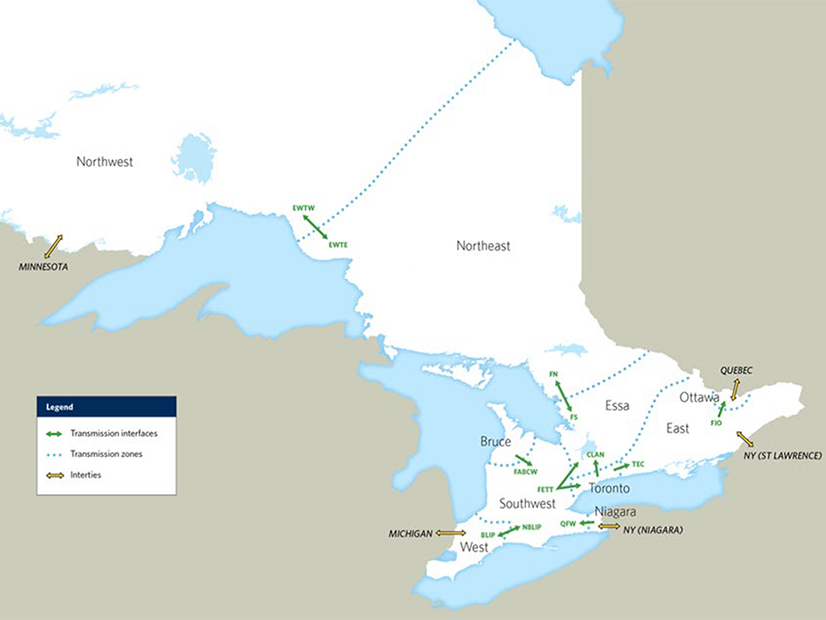
Ontario’s major transmission interfaces, electrical zones and interties | IESO

IESO also will replace its Real-Time Generator Cost Guarantee (RT-GCG) program with a Generator Offer Guarantee program. The former program provided financial and operational guarantees to NQS generators on days when they may not be able to recover their costs through energy prices. But that allowed them to claim reimbursement for start-up costs greater than what they incurred, the Ontario Energy Board (OEB) concluded in a March 6 ruling dismissing the generators’ challenge to the MRP.

Under the new rules, NQS generators must provide a three-part offer, including energy costs, start-up costs and the cost of remaining connected to the grid while generating net-zero active power.

“The non-competitive nature of the RT-GCG leads to productive inefficiencies in the short run when demand is not met using the lowest cost resources, as offers do not accurately reflect generation costs,” the OEB wrote. “The RT-GCG program also suppresses market prices below efficient levels by removing the incentives for these generators, who are frequently market price-setters, to incorporate fixed start-up costs into their offer prices. The result is a weakened price signal and a reduction of incentives for other market participants to be available at these times.”

An analysis by the generators’ consultant, Power Advisory, found a 600-MW gas generator with a heat rate of 7.5 MMBtu/MWh would have had a net margin of $75.5 million from 2018 to 2023 under the new rules, a reduction of $21 million from the current rules. The analysis also found gas generators set prices in 41% of day-ahead hours and 62% of real-time hours in summer 2021.

Impact on Loads, Resources

Nodal pricing will be applied to dispatchable loads, price-responsive loads and generation, including dispatchable resources, self-scheduling and intermittent suppliers (wind and solar). Non-dispatchable loads will settle on one of 10 hourly zonal prices. Large industrial consumers can continue to pay an hourly Ontario-wide price or choose the LMP for their location.

Dispatchable loads — “a very, very small percentage” of loads, according to Trickey — must be able to respond to IESO instructions and reduce their consumption within five minutes.

2023 energy input (TWh) | IESO

Pricing for non-dispatchable loads will remain uniform across Ontario, but the new Ontario Electricity Market Price will be based on the hourly load-weighted average of all non-dispatchable load DAM LMPs plus a price adjustment to account for the cost of the differences between day-ahead and real-time schedules.

Although the calculations behind them will change, consumer bills will look the same, with an hourly province-wide price for electricity added to the Global Adjustment, which covers the cost of building and maintaining the electric system.

Intertie Transactions

The market will use dynamic settlement pricing on its interties with Quebec, MISO, NYISO and PJM.

IESO imported 4.1 TWh to meet its 137.1 TWh of demand in 2023, while exporting 16.5 TWh.

The real-time intertie border price will be used if there is no congestion in the final pre-dispatch run. For export-congested interties, the sum of the five-minute real-time intertie border prices and the pre-dispatch intertie congestion price will be used. For import-congested interties, the lesser of the pre-dispatch intertie LMP (which includes the intertie border price plus the intertie congestion price) or the five-minute real-time intertie border prices will prevail.

The current day-ahead commitment evaluates import and export legs of wheel-through transactions as linked transactions while pre-dispatch assesses both as separate transactions. In the new market, both the DAM and pre-dispatch will assess import and export legs as linked transactions.

No Virtuals or FTR Markets

With a system-wide price and the lack of a binding day-ahead market, IESO’s current system has no virtuals market for arbitraging between day-ahead and real-time prices.

And while there is a financial transmission rights market for hedging import and export risks, there is no FTR market for hedging internal congestion.

The MRP will create a virtuals market at the zonal level, like those in NYISO and ISO-NE. Market participants will be able to submit hourly bids and offers in any of nine virtual transaction zones in the day-ahead market. The Bruce zone has a low load relative to supply, so it was combined with the Southwest to create a more balanced zone, according to IESO.

MISO and PJM began their virtuals market at the zonal level until they became more established, and SPP’s Markets+ virtuals market also will begin on a zonal basis when it launches, noted Emily Merchant, a director of product at Yes Energy.

Merchant said nodal virtual markets require significant trading activity to ensure prices accurately reflect market conditions. “Given all the changes rolling out with the MRP, the market operator may have wanted to de-risk this new virtuals market by starting off zonal,” Merchant wrote in a Yes Energy blog post on preparing for the nodal market.

The introduction of LMPs also creates the “framework to support FTRs,” said Merchant, although IESO says it has no current plans for such an expansion.

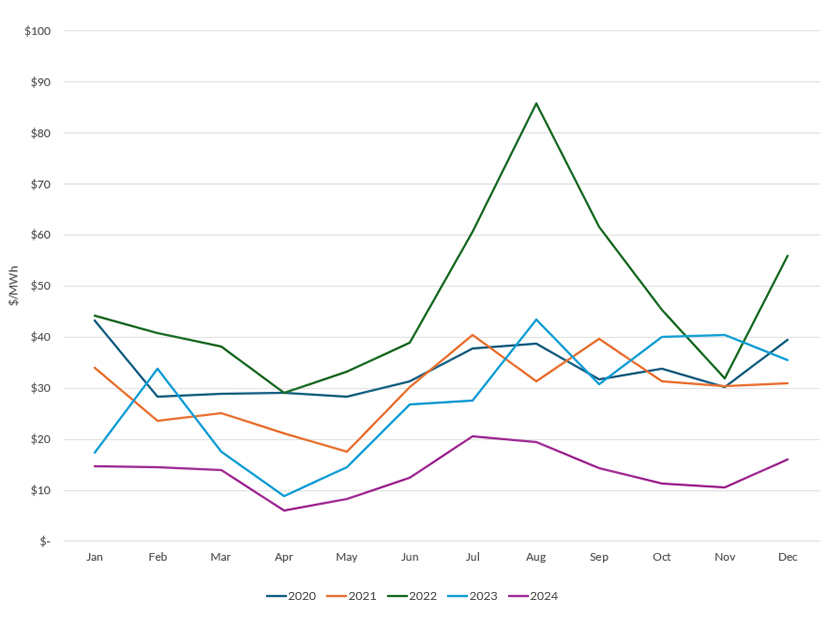
Average weighted hourly Ontario energy price | IESO

“There are no internal nodal transmission rights like there are in some other markets,” said Warren Hill, a senior adviser for market development at IESO. “We are not going in that direction.” (See IESO’s Introduction to Virtual Traders.)

Yes Energy power market analyst Tim Hough said the zonal virtual market may be most attractive to asset operators looking to hedge against volatility.

“Since there’s only nine different nodes you can virtually transact on, there is just a lot less opportunity for traders to find a couple little nodes and a special little weather pattern to make a lot of money on,” he said.

Market Power Mitigation

IESO will change from an ex-post to an ex-ante approach to market monitoring, employing a “conduct and impact” test to mitigate market power before prices and schedules are determined.

If a market participant fails the conduct test — or is found to have made an offer significantly above that expected under competitive conditions — IESO will apply an impact test to determine the difference in market outcome between the higher offer and the reference level offer. If the MP fails both tests, its offer will be replaced with reference levels.

Implementation Plan; Potential for Delays

The MRP will result in about 36 new public reports from IESO and updates to more than a dozen others, while more than 20 will be retired. The MRP also will include a new four-zone demand forecast, “so you’ll be able to see demand in different areas with a more accurate view than what we would provide today,” Trickey said.

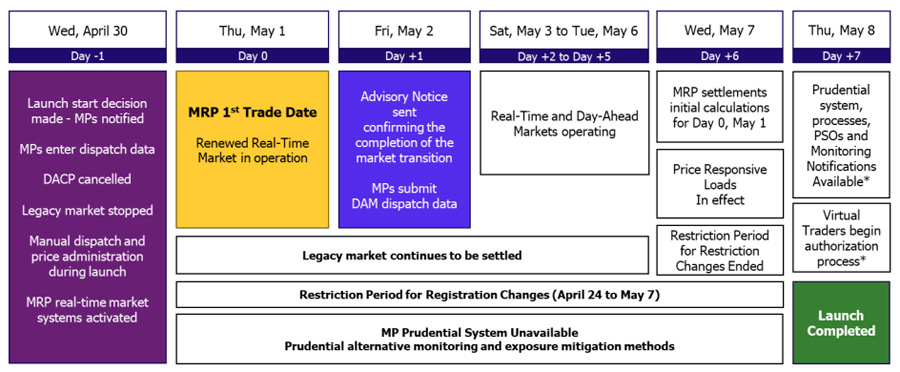
IESO will provide updates on the status of the launch beginning the morning of April 30 and continuing through completion of the launch, expected May 2.

“There is always a small chance that something could happen in between now and then that would impact that — likely to be something in terms of system conditions,” Trickey said. “If there was some sort of reliability event — you know, weather event, or something that impacted us — we may need to change that.”

If the launch is delayed, IESO will not go forward until the first of a subsequent month, Trickey said, ruling out a launch on July 1 or Aug. 1 because of holidays. “[We] may not want to necessarily launch in the heat of the summer as well, when system conditions can be more challenging.”

Market participants will need to submit dispatch data into both the legacy and renewed market systems on April 30 because existing bids and offers will not be moved to the new system. There will be no day-ahead market for the May 1 and 2 trade dates as IESO establishes the new real-time market and monitors dispatch results.

“There will be bumps along the way as we transition, because it is a very large and complex change, and one that depends on people from across the sector,” said Trickey. “I know there’s going to be bumps coming, but we’re in a good position to weather through those.”

Although IESO is making the changes to improve operational certainty and reduce system costs, initial market results may not show immediate improvements, said Yes Energy’s Hough. “It’ll be a very big change for a lot of people. So, I would expect some volatility there. If you’re a battery asset operator — which there isn’t much of in Ontario — you will probably be raking it in early on.”

For More Information:

Editor’s note: RTO Insider is a wholly owned subsidiary of Yes Energy.

CPUC, Others Question Details of EDAM Congestion Revenue Proposal

Stakeholders and state energy officials continue to raise concerns about a CAISO draft proposal that would adjust how congestion revenues are allocated in its Extended Day-Ahead Market, with the ISO aiming for a vote on the final proposal in the coming weeks. 

The draft proposal, released last week, addresses how the EDAM will allocate congestion revenues when a transmission constraint in one EDAM balancing authority area causes parallel flows in a neighboring BAA.  

CAISO has said the draft proposal will be “transitional” over the next three years, after which time it plans to implement a more permanent design. 

The proposal is a product of the past two months of focused work on the subject. In March, CAISO launched an expedited initiative to address stakeholder concerns, and this week, the agency held an all-day meeting to review the proposal with the more than 150 participants who joined the call. 

At the April 24 meeting, California Public Utilities Commission regulatory analyst Michele Kito asked if the ISO had a sense of where the major parallel flows currently take place on the system. 

“I would imagine that we can look at historical system data,” Kito said. “Do we have any sense of what those [parallel flows] are and what the effects each of these proposals have in terms of revenue allocation?” 

“We haven’t looked at specific parallel flow impacts,” George Angelidis, CAISO executive principal, said at the meeting. “There are well-known transmission bottlenecks in the ISO system, like Path 36 and Path 15, but in general, any kind of flow in the system will experience what we define as parallel flow.”  

Parallel flow is the impact on the flow gauge of transactions that are external to that BAA, Angelidis said. They can be infinite: Any path will have parallel flows, so CAISO has not looked at potential parallel flow results on specific flow gauges, he said. 

Cathleen Colbert, senior director of Western markets policy at Vistra, added, “I will give a little extra support to Michele’s questions. Do we not have any sense of how these parallel flows work on internal constraints? I do think there’s a case for you guys to provide some additional kind of forward-looking information. 

CAISO will study these parallel flow effects over the three-year period of the new design, said Milos Bosanac, ISO regional markets sector manager. 

“As entities join the EDAM, we will be modeling transmission constraints on their system that may not necessarily be reflective today,” Bosanac said. “I think it’s difficult to surmise the effects at this point in time of constraints that might not yet be modeled. [However], we will be modeling the new design on PacifiCorp’s system, and as other entities join, we will model those effects [too].” 

Middle Approach

Under current EDAM market rules, Open Access Transmission Tariff (OATT) customers in one BAA will end up paying costs for congestion for parallel flows caused by binding transmission constraints in neighboring BAAs. However, under the draft final proposal, parallel flow congestion revenues collected in a BAA that result from a binding constraint in a neighboring area will be allocated first to the BAA in which the overflow congestion occurs and the revenues are collected.  

In an example reviewed at the meeting, $135,800 in congestion revenue was collected and distributed to three balancing areas: BAA A, BAA B and BAA C. Under the current design, all $135,800 would be distributed to BAA A. However, under the draft proposal, BAA A would receive $132,800 in revenue, BAA B would receive $1,000, and BAA C would receive $2,000.  

The final draft proposal supports EDAM entities’ capacity to provide congestion cost protection for transmission customers exercising firm OATT rights, Bosanac said. The draft also addresses stakeholder concerns about a balancing area being exposed to congestion costs when providing counterflow effects in relation to constraints, he said. 

The draft would apply only to the day-ahead market, not to the real-time market. The real-time market retains the congestion revenue allocation in effect today in the WEIM “in order to minimize the impact on the WEIM participants,” Bosanac said. 

If approved, CAISO will implement the draft final proposal by collecting data and monitoring the congestion effects over the first one to two years of the transitional approach. CAISO then will prepare a permanent design after the three-year period. 

Consumers Defend Local Transmission Planning Complaint from Protests

Consumer groups defended their complaint with FERC alleging utilities spend too much on lightly regulated local transmission projects against arguments that such spending is justified (EL25-44).

In a joint answer to protests filed April 24, the 22 groups — including the Industrial Energy Consumers of America, American Forest & Paper Association and R Street Institute — argued that the December 2024 complaint against all FERC-jurisdictional transmission planners should be granted so the commission can address what they called widespread unjust and unreasonable planning practices. (See Utilities Ask FERC to Toss Local Tx Planning Complaint, Others Support It.)

While the transmission lines can be called “local,” those at issue in the complaint are located in the Eastern and Western Interconnections and are part of interstate commerce. That has long been recognized by the courts, the groups said.

“Respondents nevertheless insist that planning of interstate transmission at the individual level remains appropriate because such transmission is ‘local’ and that existing transmission owners have a ‘right’ to plan the interconnected grid of the future simply because they built the grid of yesterday,” they said. “Respondents make no electrical distinction between local and regional transmission.”

The actual difference between “local” and “regional” projects can be arbitrary, the groups argued, noting as an example that American Transmission Co. independently started planning a 345-kV line, which then was selected by MISO for its regional transmission plan, with its costs spread across the footprint.

“ATC argues that ‘the project directly contradicts the “piecemeal planning” allegations contained within the complaint,’ but the project actually proves the point of the complaint, as MISO recognized that the project impacted the entire region, although it was initially individually planned,” the consumer groups said. “The electrical nature of the project did not change through the regional review, and the complaint identified hundreds of similar projects that were individually planned with no substantive regional review.”

A common rebuttal to the complaint was that utilities had to retain their planning role to effectively meet state retail obligations, which leaves it outside of FERC jurisdiction.

“The complaint is based on the simple electrical premise that there is no FERC-jurisdictional ‘local’ transmission and thus there are no ‘local’ transmission planning needs,” the groups responded. “There are localized inputs to determining the holistic needs of the interconnected grid, but electrical facilities at 100 kV and above are not local, except those excluded by the complaint.”

Local projects that solely serve intrastate needs are outside of FERC jurisdiction, and the complaint does not ask FERC to try to regulate them.

Many protesters argued the complaint is too broad, and the commission should take regional differences into account if it decides to grant it.

“Individual or even regional ‘planning challenges’ or differences are irrelevant to the fundamental question under the complaint as to whether it is appropriate to allow individual transmission owners to plan 100-kV and above transmission in interstate commerce based on the ongoing false premise that such transmission planning relates to ‘local transmission,’” the groups answered. “Planning challenges, to the extent they exist, can be incorporated into the required regional planning, just as regional differences are incorporated today in regional planning.” FERC can grant the complaint and facilitate implementation of any necessary region-specific reforms through compliance filings, they argued.

Another common rebuttal was that the complaint had to prove that local planning leads to unjust and unreasonable rates on specific projects. But the groups argued it was aimed at local planning practices and that Section 206 of the Federal Power Act can address broad industry practices.

“Critically, acceptance of respondents’ arguments would also mean that FERC, under a rulemaking pursuant to Section 206, wouldn’t be able to dictate nationwide standards, like in Orders Nos. 890, 1000 [and] 1920,” they said.

Opponents also argued the complaint was a collateral attack on Order 1920, or even earlier transmission planning rules. But the groups said they had put new evidence in front of FERC that it did not have during the proceedings that led to its most recent transmission planning rule.

“The new evidence and changed circumstances consist of new analytical reports and evidence of both individual projects and cumulative regional transmission plans and portfolios across every planning region over several years,” they said.

Other Parties Defend the Complaint

American Municipal Power also filed an answer April 24, arguing FERC should grant the complaint despite a request from PJM and its transmission owners to dismiss it.

The complaint made the case that spending on local projects in PJM has become unjust and unreasonable and should be dealt with in a subsequent show-cause proceeding, AMP said.

Transmission rates in PJM are up 237% from 2011, mainly from local projects with limited oversight, AMP said.

“Forcing local transmission customers to bear the cost of projects that should have been supplanted by more cost-effective regional projects could unduly discriminate against those local customers by unfairly shifting the cost of transmission projects in a manner inconsistent with cost-causation principles,” AMP said. “The harmful effect of these failures would only multiply going forward, as PJM’s load is expected to grow by 70 GW or more in the foreseeable future.”

The Maine Public Utilities Commission similarly rebutted claims about local planning in New England. It said FERC should open another Section 206 show-cause proceeding so it can address the issues around local planning and its lack of oversight in New England.

Projects above $5 million are presented to ISO-NE’s Planning Advisory Committee, but the process has proven inadequate, and the TOs retain all control over asset-condition projects in the region.

The PUC “completely agrees that the ISO-NE tariff and related documents do not provide ISO-NE with a role in local transmission planning sufficient to effectuate all of the remedies sought by complainants, but [it] submits that a Section 206 investigation will allow parties to build a record upon which remedies consistent with Order No. 890 and FERC precedent may be developed specifically for the New England region,” it said.

What to Know About IESO

RTO Insider is beginning regular coverage of Ontario’s Independent Electricity System Operator (IESO) in conjunction with the region’s transition to a nodal market May 1. (See related story, Ontario Introducing Nodal Market May 1.) 

Here’s an introduction: 

How does it compare with organized markets in the U.S.?

IESO has 37.2 GW of installed capacity and 18,640 miles of transmission, both ranked seventh among the nine organized markets in the U.S. and Canada. It hit its peak demand, 27,005 MW, in August 2006. Its record winter peak, 24,979 MW, was set in December 2004. 

How is power demand expected to change in the future?

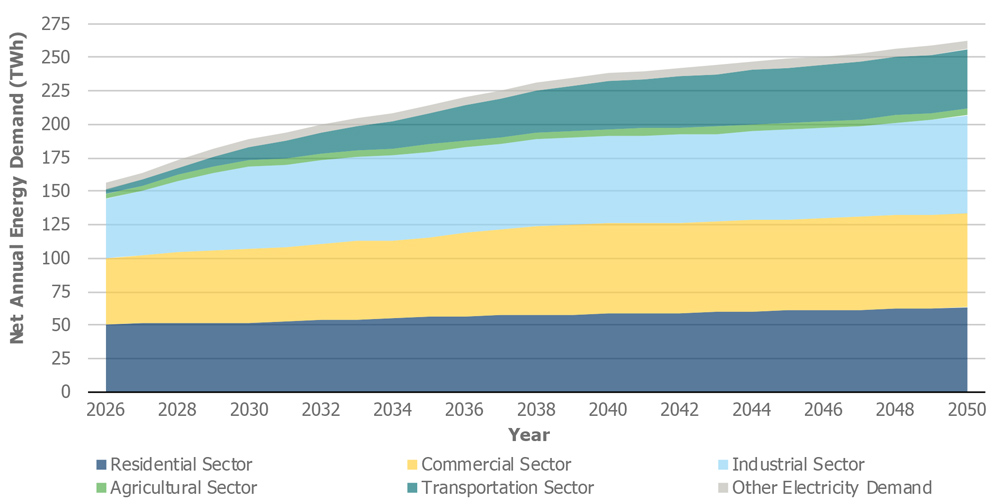
The 2025 Annual Planning Outlook demand forecast predicts a 75% increase in electric demand by 2050 — up from the 60% increase forecast a year earlier — driven by industrial and data center growth in addition to commercial sector growth, increasing population and electrification. Annual consumption is seen rising from 151 TWh in 2025 to 263 TWh in 2050. 

Annual energy demand | IESO

Who owns and controls IESO?

IESO is a “Crown corporation,” a government organization with a mixture of commercial and public-policy goals, owned by the government of Ontario. 

It is governed by a board whose directors are appointed by the provincial government. 

Before 1998, Ontario Hydro and municipal utilities provided power to Ontario, with electricity prices set by the provincial government. 

The Ontario Electricity Act of 1998 split Ontario Hydro into IESO’s predecessor and four other companies, including:  

      • the Electrical Safety Authority (ESA), which regulates and promotes electrical safety;
      • the Ontario Electricity Financial Corp. (OEFC), which is responsible for managing Ontario Hydro’s debt and contracts with non-utility generators;
      • Ontario Power Generation (OPG), which took over Ontario Hydro’s generation and now owns 66 hydropower stations, two nuclear stations and a handful of solar and gas generators in Ontario;
      • and Hydro One, which assumed Ontario Hydro’s transmission and distribution assets and now serves 1.5 million predominantly rural customers. 

IESO, originally called the Independent Electricity Market Operator (IMO), was created to prepare for deregulation of the province’s electrical system. It assumed the grid management functions of Ontario Hydro and was charged with developing a new electricity market. 

The wholesale electricity market opened in May 2002, and the IMO was renamed IESO in January 2005.  

How is IESO regulated?

The Ontario Energy Board regulates electric companies and sets residential electricity rates; it also approves IESO’s budget and fees. The OEB reports to the Ministry of Energy and Mines, which sets overall policies for the electricity sector.  

In an October 2024 report, Minister of Energy and Electrification Stephen Lecce signaled a shift from the previous Liberal government, which Lecce’s Progressive Conservative Party ousted in 2018, criticizing its “failed and ideologically driven energy experiments” and “sweetheart deals that paid several times the going rate for power,” a reference to 33,000 renewable energy contracts signed between 2004 and 2016 at up to 10 times the prevailing power prices. 

Lecce called for “an all-of-the-above approach to energy planning, including nuclear, hydroelectricity, energy storage, natural gas, hydrogen and renewables, and other fuels, rather than ideological dogma that offers false choices and burdens hardworking people and businesses with a costly and unnecessary carbon tax.” 

He touted “the largest expansion of nuclear energy on the continent with the first small modular reactor in the G7. The province is upgrading and refurbishing existing reactors at Darlington, Pickering and Bruce Power to extend their lifespan and building four 300-MW SMRs at Darlington.  

What is its fuel mix?

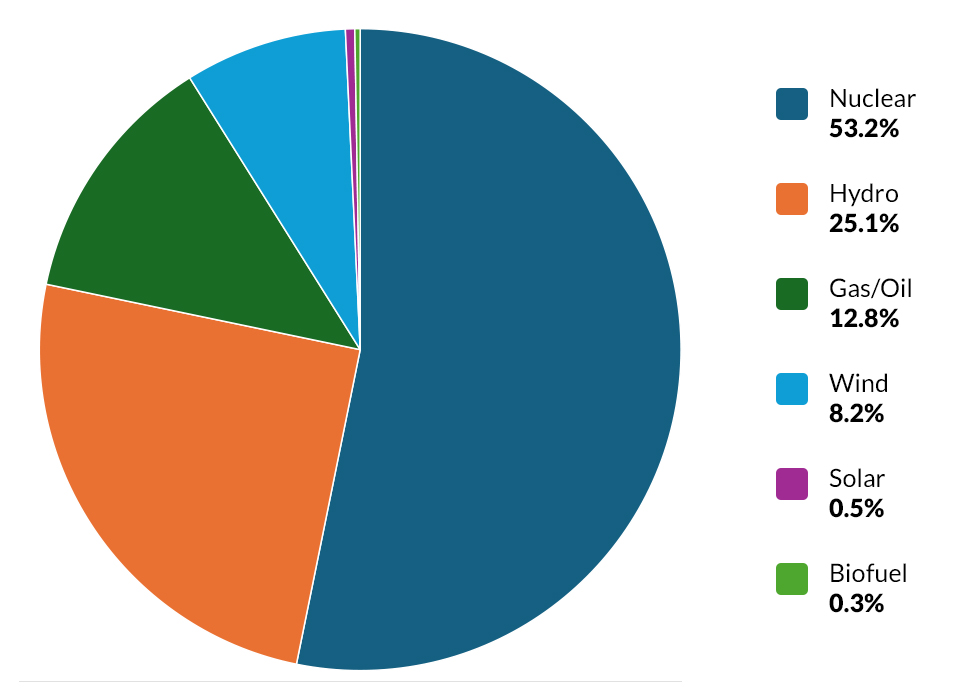
Nuclear (53%) and hydropower (25%) constitute more than three-quarters of IESO’s fuel mix, up from 66% in 2003. Wind (8%), solar (0.5%) and biofuel (0.4%) have increased their shares from a combined 1% in 2003. Gas and oil represent 13% (up from 11% in 2003). 

Coal, which represented one-quarter of generation in 2003 — and most of the system’s flexibility, according to IESO — was eliminated in 2014. 

Where is it expanding transmission?

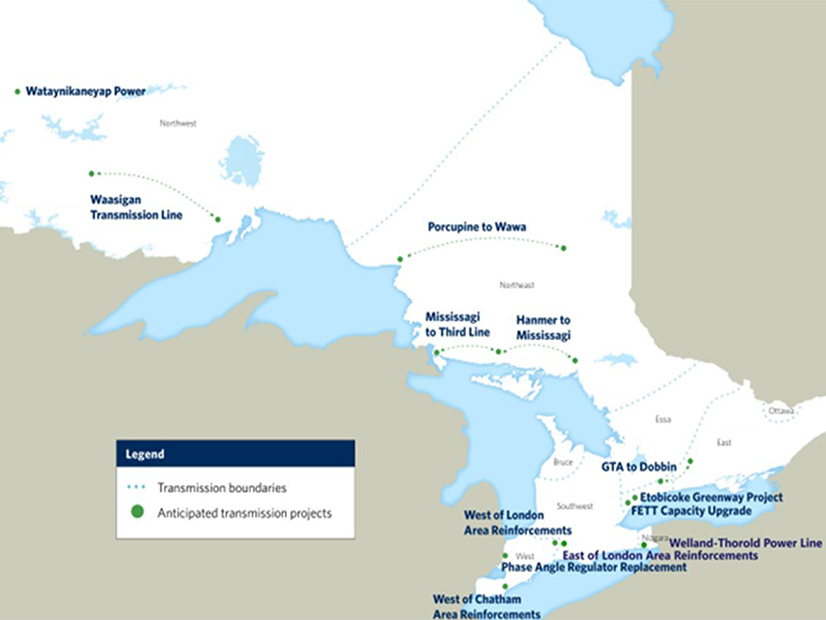
IESO is developing five new transmission lines in southwestern Ontario to serve auto manufacturers and agriculture, two new lines in northeastern Ontario to support a steel mill’s planned conversion to electricity and mines, and one line in eastern Ontario to serve the Peterborough and Ottawa regions. 

How does it incorporate stakeholders in new market rules?

IESO says it dedicates one to three days each month for stakeholder engagement meetings. Current engagement issues include local generation, demand side management, the annual planning outlook and capacity auction enhancements. 

Planned transmission projects | IESO

In addition, the Strategic Advisory Committee provides feedback to IESO’s Board of Directors and executive leadership team. Current members represent generators, transmission and distribution companies, communities, consumers, and energy-related businesses and services. The committee held three public meetings in 2024. 

The Technical Panel reviews proposed changes to market rules. Its current members include representatives of generators, renewable generators, energy-related businesses and services, importers and exporters, transmission and distribution companies, market participant consumers, residential consumers and demand response providers. It has scheduled seven meetings through the end of 2025. 

FAQs: Ontario’s Shift to a Nodal Market

To modernize and deliver more efficient markets and ensure customers have reliable electricity at the lowest cost, IESO’s Market Renewal Program (MRP) will transform Ontario’s energy markets by shifting to a nodal market with a formal day-ahead market as well as a virtual market for the first time.  

The market design changes summarized below will introduce more transparency into the price formation through the reporting of nodal LMPs that account for the congestion costs, instead of reporting a system-wide price and handling congestion costs through out-of-market payments. The MRP also will introduce more competition and certainty for market participants through the introduction of a formal day-ahead market as well as a new virtuals market.  

Read on for some frequently asked questions on the key changes happening in IESO in May with the introduction of the Market Renewal Program. IESO is: 

    • Shifting to a single schedule market, establishing one schedule for both pricing and dispatch.  
    • Shifting from a voluntary day-ahead clearing process to a formal day-ahead market (DAM) that is financially binding.  
    • Moving away from out-of-market congestion payments to locational cost of congestion handled in nodal LMPs. 
    • Adopting nodal pricing for all generation resources and dispatchable load customers in the real-time and day-ahead markets, replacing the single price system. There will be about 970 generator and load nodes when the MRP goes live. 
    • Introducing price-responsive loads, a new participation type for load customers. The pricing for non-dispatchable loads will remain uniform across Ontario but will better reflect the congestion costs of delivering energy across the grid. 
    • Introducing a new zonal-based virtuals market that will be financially binding. 
    • Creating the framework to support financial transmission rights (FTRs). While this feature won’t be available at the May 1 launch, the introduction of nodal LMPs and location-based congestion prices sets the stage for future FTR support. 
    • Providing 35 new public reports.  

Key Dates

This section includes key dates and go-live details for the Market Renewal Program. 

When does the IESO MRP go live? 

    • On the morning of April 30, IESO will announce whether the MRP will launch on May 1. 
    • Real-time and pre-dispatch data will be published. 
    • Pre-dispatch data will be published at about 2:36 a.m. EST. 
    • On the morning of May 1, IESO will announce whether the day-ahead market will operate on May 2 for the market day May 3.
    • On May 2, day-ahead market data will be published. 
    • On May 7, price responsive loads (PRLs) will come into effect (registered loads can begin participating as PRLs). 
    • On May 8, virtual trading begins. 

Market Participation Information

This section includes information on market participation requirements.  

Do you have information on minimum market participation requirements, e.g. cash/collateral requirements?  

For this information, see the Guide on Prudentials. A prudential support obligation will be determined separately for physical transactions and virtual transactions, informed by all activity in the day-ahead and real-time time frames. A market participant authorized for both types of transactions will have two separate prudential support obligations. 

Data Publication Information

This section includes information on data publication nuances (e.g., time zones) and data accessibility in the IESO sandbox/test environment. 

How can I access data in the IESO sandbox environment to familiarize myself with the data before market go-live? 

Public site: https://reports-public-sandbox.ieso.ca/public/ 

Gateway sandbox: https://gateway-sbx.ieso.ca/  

How to access the data: https://www.ieso.ca/-/media/Files/IESO/Document-Library/market-renewal/Market-Participant-Testing/Connectivity-Testing-IESO-Gateway.pdf 

Will IESO keep publishing data in EST and not EDT when the clock moves forward? 

IESO will keep publishing data in EST, but the DAM process timelines will follow Eastern Prevailing Time (EPT). 

Pricing Data

This section includes information related to the reporting format of LMPs, reference nodes and maximum/minimum price limits in the real-time market.  

Will IESO publish nodal day-ahead prices ahead of the nodes going live? 

Nodal day-ahead prices are available in the IESO sandbox environment before go-live. Yes Energy already has this data flowing into its products. Note: This is just test data that is meant for market participants to familiarize themselves before the MRP go-live.  

Timing of newly created or updated data IESO reports: 

    • May 1 is the first day of real-time market operation and the first day of real-time report publication. 
    • On May 2, market participants will submit day-ahead market dispatch data. The first day of day-ahead report publication for the trade date is May 3. 

Will the pricing data be reported by locational marginal price components (LMP, congestion, loss) for both nodal and zonal prices? 

The day-ahead and real-time LMP price reports will include the LMP, loss and congestion components for the more than 900 generator and load nodes. The zonal price reports also include the LMP, loss and congestion components. See more information. 

How is the Hourly Ontario Energy Price (HOEP) going to be calculated after MRP? 

After the MRP implementation, HOEP will be replaced by LMPs, and contracts will be settled based on those LMP prices. HOEP’s global adjustment (GA) charge will continue to exist following the implementation for Ontario. 

What’s now the reference node in IESO? 

By default, the reference bus will be the Richview Transformer Station. If the reference bus is out of service, then an alternate station will be chosen as per the prevailing system conditions. 

Is there a maximum or a minimum price in real time in Ontario post-MRP? 

The settlement floor price is -$100/MWh. The maximum settlement will remain at $2,000/MWh. Resources still can offer as low as -$2,000/MWh, however. 

Two-settlement example | IESO

Transmission Congestion Data

This section provides information regarding the availability of transmission constraint data, whether FTRs will be tradable in IESO post-MRP and transmission rights (TR) products. 

Will IESO post binding constraint data? 

Yes, after MRP, IESO will publish real-time, day-ahead and predispatch binding constraint files. Unfortunately, the data will be published on a six-day lag on its public site. Read more about the day-ahead binding constraint shadow price report, the real-time binding constraint shadow price file and the predispatch binding constraint file. IESO will publish day-ahead and predispatch security constraint files on a more real-time cadence, but this provides visibility into the constraints assumed in the day-ahead clearing engine and predispatch engine. Read more about the day-ahead security constraint report and predispatch security constraint report. 

Will shift factors be posted?  

Not directly. IESO used to publish an annual loss penalty factor report. Per IESO, “Loss penalty factors are used to account for the incremental change in transmission losses as a result of the change in output from a resource — including generators, loads and intertie connections.” While they sound similar to a shift factor, the range of 2024 loss penalty factors is 0.91-1.22. IESO says the dynamic loss penalty factors, which will be calculated in each pricing pass of the calculation engine, can be determined using the LMP reports (IESO Publishing and Reporting Market Information (Final), p. 37). 

Will there be an FTR product? 

No, there will not be a financial transmission rights (FTR) product. IESO offers and will continue to offer a transmission rights product that market participants can use to hedge risk (e.g., for unpredictable congestion costs). Transmission rights are traded at the zonal level, not the nodal level. 

Will financial transmission rights still settle on the real-time price, or will they settle on the day-ahead price? 

Under MRP, financial transmission rights will be settled based on the day-ahead congestion prices instead of the real-time price. 

Virtuals Market

This section provides more information on the new virtuals market in IESO, including the number of tradable nodes, price formation and data availability. 

How many zones will be tradable in the virtual market?  

Ontario has 10 electrical zones, but only nine virtual trading zones. The Bruce and Southwest are combined into one Southwest virtual trading zone. See IESO’s Introduction to Virtual Traders Report for more information. 

How is the virtual zonal price calculated? 

Virtual transactions will be settled with the virtual zone prices, which is calculated as the load-weighted average of the LMPs at all load points within the zone. Load distribution factors (LDFs) will be used to determine the weight of each LMP in the virtual trading zone. Like with other prices, day-ahead market and real-time virtual zonal prices will be calculated and used for settlement. Pre-dispatch zonal prices will be provided for information purposes only. 

How far back will the virtual price data be available? 

IESO is launching a virtual market for the first time on May 8. Test data for the new virtuals market is available in the IESO sandbox site 

Launch plan overview | IESO

Will there be uplifts on virtuals similar to other ISOs in the U.S.? Will there be monthly or weekly settlements for virtuals? 

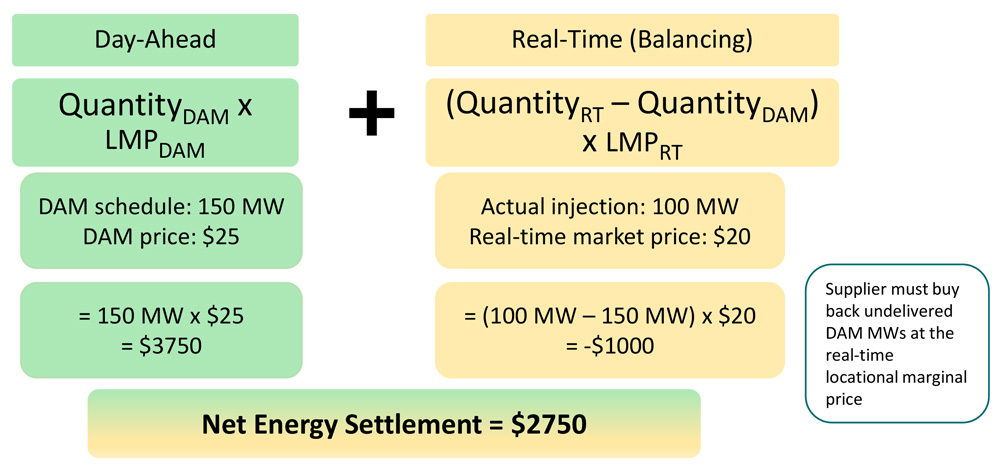
There will be uplifts on virtuals. Due to the DAM reliability scheduling uplift, virtual transactions can be allocated a portion of the cost of DAM-MWP and DAM-GOG generated in Pass 2: reliability scheduling and commitment of the DAM calculation engine for every MW cleared in the DAM. 

Virtuals will be settled hourly and invoiced monthly. IESO will continue using monthly billing periods for settlement of the physical market (this includes both physical and virtual transactions), so virtual transactions will appear on the monthly invoice. Invoices will be issued 10 business days after the end of the billing period. The market participant payment date is the second business day following the issuance of the invoice. The weekly invoice will continue to contain only settlement amounts for the transmission rights auction. 

Emily Merchant is a director of product at Yes Energy in charge of setting the vision and strategy for Yes Energy’s PowerSignals, QuickSignals and Trading Regions (public data) products. Emily has over 14 years of experience working in the energy industry. Prior to Yes Energy, Emily worked at Navigant Consulting (now Guidehouse), E Source, Energy Trust of Oregon and GDS Associates. 

RTO Insider is a wholly owned subsidiary of Yes Energy. 

RWE Sets Conditions for Further U.S. Renewables Investment

RWE, which put a two-year pause on its U.S. offshore wind development efforts when President Donald Trump was re-elected, now is setting a higher bar for building renewables in the United States.

The German power company is looking for greater certainty and less risk before it makes any new decision to invest in a U.S. project.

All federal permits must be in place, tax credits must be safe harbored, all tariff risks must be mitigated and — for solar and onshore wind projects — offtake agreements must be secured.

“Only if these conditions are met will further investments be possible, given the political environment,” the company said.

The update came in remarks prepared for delivery by CEO Markus Krebber to shareholders at the company’s April 30 annual general meeting.

The remarks were released publicly April 25 and cover the range of challenges facing the company and how it is meeting them as it operates in more than 20 countries.

RWE surpassed 10 GW of U.S. installed capacity at the start of 2025 and plans the construction of 4 GW more.

Demand for electricity is higher in the United States than almost anywhere else, the company said, and renewables and storage are able to meet this demand relatively quickly, so the market environment is positive.

But uncertainties have expanded in the U.S. as in the rest of the world: Political tensions are palpable, tariffs are straining trade, supply chains are more fragile, and inflation and interest rates have risen.

So the company is being more cautious, raising its required return on investment from 8% to 8.5% and projecting lower earnings in 2025 than in 2024. Net investment will be reduced from 45 billion to 35 billion euros from 2025 to 2030; RWE invested a net 10 billion euros in 2024 alone.

Renewables are by far the largest source of electricity for RWE, and the CO2 emissions it creates while generating power continue to fall as it pursues net-zero status by 2040.

Nearly 150 generation projects with a combined 12.5 GW of capacity are under construction globally, and the majority of its newest assets are in the United States.

But the world’s No. 2 offshore wind developer appears unlikely to be erecting any of the giant wind turbines in U.S. waters anytime soon.

The U.S. offshore wind sector, which had enjoyed four years of strong support from President Joe Biden, was cast into doubt by the Nov. 5 election of Trump, who had said on the campaign trail he would halt wind turbine development.

RWE announced the two-year pause Nov. 13, citing the risk and uncertainty raised by his election, and other companies have made similar decisions. (See RWE Pauses Investments in US Offshore Wind.)

Just hours into his presidency, Trump followed through on his threat Jan. 20, directing a halt to future offshore wind leasing and a review of existing permits. The chilling effect this had on the industry was ratcheted up three months later with a stop-work order slapped on Equinor’s fully permitted Empire Wind 1 project.

RWE has a greater breadth of exposure to the U.S. offshore wind market than most companies, holding lease areas on the East, Gulf and West coasts — areas that have distinctly different technical challenges and political environments.

RWE’s most mature concept sits off the New York-New Jersey coast, where it and National Grid Ventures jointly hold a lease area and repeatedly have bid their Community Offshore Wind proposal into the two states’ various solicitations.

The latest iteration of Community — with a nameplate capacity of up to 2.8 GW and an early 2030s commercial operation date — was one of four proposals submitted for New York’s 2024 solicitation. (See NY Receives Largest OSW Proposal Yet.)

The proposed Attentive Energy was soon withdrawn, but the other three — Long Island Wind, Excelsior Wind and Community — still are listed as live proposals.

The state has limited its publicity about in-progress solicitations and plans to release no updates before completion of contract negotiations, which it had targeted for the first quarter of 2025.

California Lawmakers to Discuss Amendment Requests to Pathways Bill

The Utility Reform Network (TURN) is finding some success in getting California state lawmakers to address the group’s concerns about what the Trump administration might do if the Golden State moves forward with plans to hand over control of CAISO’s energy markets to an independent regional organization.

Democratic Sen. Josh Becker, who introduced the Pathways bill, has said he will convene a group to address the consumer advocacy organization TURN’s concerns with the proposed legislation. In its public comments on the bill, TURN submitted a position of opposition that stands unless the bill is amended.

Kathleen Staks, executive director of Western Freedom and the co-chair of the West-Wide Governance Pathways Initiative’s Launch Committee, provided the update during the committee’s monthly meeting April 25.

Staks said there has been no commitment to addressing all of TURN’s requests for amendments.

“I think we have to figure out as a group, how do we continue to honor the recommendation that … came out of the Launch Committee, ensure that whatever recommended amendments are something that our coalition can continue to live with,” Staks said.

Senate Bill 540, or the Pathways bill, is the product of the work of the Pathways Initiative, the nearly two-year effort to support the expansion of CAISO’s Western Energy Imbalance Market (WEIM) and soon-to-be-implemented Extended Day-Ahead Market (EDAM) to entities outside California by shifting governance of the markets from the ISO to a proposed independent RO.

Writing in opposition to the bill, Matthew Freedman, staff attorney for TURN, wrote that handing power over CAISO’s wholesale energy markets to an independent RO while opening the door to other market actors in the West “may expose California customers to new risks that could prove difficult to mitigate.”

In an email to RTO Insider, Freedman said: “Our goal is to ensure that the scope and role of Regional Organization is clearly defined in state law and that California has the right to withdraw under a variety of circumstances. We are extremely concerned about the potential for the federal government to make changes to the regional energy markets that would undermine California’s clean energy and decarbonization goals.”

The group asked for amendments to address the following points:

    • Ensure the RO’s tariffs permit California to withdraw utilities from the regional market without penalties or need for approval by FERC.
    • Clarify that the RO cannot set “any requirements relating to resource adequacy, reserve margins or reliability.” Additionally, the RO should not be allowed to rely on a centralized capacity market or separate markets for dispatchable, firm and intermittent resources. This is to prevent the federal government from intervening in wholesale markets to provide incentives for coal and gas generation.
    • Give the California Public Utilities Commission power to direct investor-owned utilities to withdraw from the RO if it violates any of the obligations under SB 540 or implements changes that could harm consumers.
    • Require utilities to withdraw from the RO if a court rules that California resource planning policies discriminate against out-of-state resources.
    • Similarly, utilities must withdraw if the federal government takes action that would lead to California consumers subsidizing fossil fuels.
    • Require utilities to withdraw “if a Joint Concurrent resolution is passed by the State Assembly and State Senate.”
    • Clarify that the Renewables Portfolio Standard “requirements relating to energy delivery from resources outside of a California Balancing Authority must satisfy strict standards including the use of dynamic scheduling, pseudo ties or firm transmission rights.”

Staks noted during the April 25 meeting that participation in the market is voluntary, and participants can withdraw “if something does not work for them.”

The Pathways bill passed California’s Senate Energy, Utilities and Communications Committee unanimously April 21. Though the committee voted in favor of the legislation, some lawmakers referenced TURN’s letter, saying they are concerned about whether the bill contains sufficient consumer protections. (See Calif. Senate Committee Backs Pathways Initiative Bill.)

The bill will go to the Senate Judiciary Committee for a hearing April 29. But TURN’s request for amendments will not be completed before then, according to Randy Howard, general manager of the Northern California Power Agency and Launch Committee member.

“We’re still working on dates to try to get the group together face to face,” Howard said during the meeting.