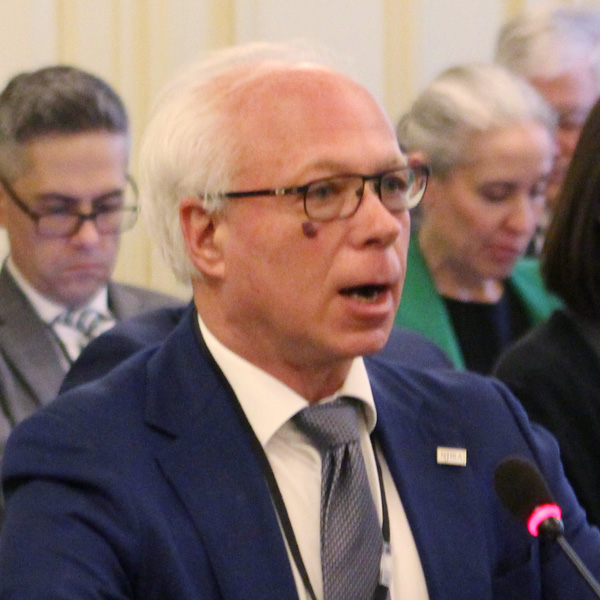
NYISO Business Issues Committee OKs Firm Fuel Accreditation Concept

The NYISO Business Issues Committee has approved, in concept, implementation of the ISO’s new firm fuel election process and requirements as part of its changes to capacity accreditation. 

The March 18 vote passed unanimously, with only the Market Monitoring Unit and Natural Resources Defense Council abstaining. The Installed Capacity Working Group will vote on revised tariff language before the Management Committee’s March 26 meeting. The ISO aims for a FERC filing in mid-April. 

For several weeks and across multiple working group meetings, NYISO stakeholders have been hammering out the details of the ISO’s firm fuel accreditation improvement project. The project aims to ensure generators that say they have guaranteed (firm) sources of fuel deliver on their promises during winter months. 

The ISO and the New York State Reliability Council are concerned about future fuel supply constraints in the winter. As New York transitions to a winter-peaking system, the downstate gas turbine fleet will find itself competing with home heating for fuel during peak periods. 

FERC accepted NYISO’s capacity accreditation changes in July 2024, but it delayed implementation until 2026 after generators complained of the limited amount of time to make their firm fuel elections: The changes required them to tell the ISO by Aug. 1 prior to each capability year how much of their capacity was covered by firm fuel supply. (See FERC Accepts NYISO Capacity Accreditation Changes, with 1-Year Delay.) 

Other requirements include that resources with firm fuel have supply, transportation and replenishment strategies in place by Dec. 1 of the capability year through the end of winter, and have fuel available to run 56 hours over any consecutive seven-day period in December through February. 

Firm suppliers would not have to submit additional attestation that they have secured fuel, and those downstate and in Long Island would get their own capacity accreditation factor. Failure to meet firm fuel performance obligations by being unavailable because of fuel supply issues on the day-ahead or real-time markets could result in audit and financial sanction. The MMU also may examine suppliers if it identifies concerns with bidding or operational behavior. 

Generators would be sanctioned based on the reason that the firm supply was unavailable, with a 1.5 multiplier added to violators who otherwise could have prevented it; NYISO would use NERC’s guidance for “outside management control” events for the base “1.0” sanction. 

During the ICAP Working Group’s meeting the day before the BIC’s vote, stakeholders wondered whether firm generators could be subject to sanctions if they were told by the ISO they were not being scheduled on the day-ahead market, sold their fuel and then were called on as part of the supplemental resource evaluation program but were unable to respond.  

Responding to this concern during the BIC meeting, Zach Smith, senior manager of capacity and new resource integration for NYISO, clarified that gas-only firm units called in for SREs that don’t respond would be evaluated only to see if fuel was available or if they made efforts to procure fuel.  

“If there was no fuel available and they made those efforts to try and find it, they will not be subject to any penalty for the firm fuel,” Smith said. “If our investigation finds that the fuel was procurable at a price and the entity did not try to get it, they will be subject to the 1.5 penalty.” 

Other stakeholders brought up the 16-month period between the firm fuel election (Aug. 1 prior to the capability year) and the deadline for having supply arrangements in place (Dec. 1 of the capability year). They argued this could lead to situations where a generator elects as firm but its fuel supplier “goes bankrupt” or experiences some other disruption and no longer can meet a firm fuel obligation. Stakeholders asked whether the eventual tariff revisions would include making generators tell the ISO if this occurred by the Dec. 1 deadline. 

Nikolai Tubbs, a market design specialist for NYISO, said the ISO was going include that provision in the procedures manual, not the tariff. 

Doreen Saia, chair of Greenburg Traurig’s energy and natural resources practice, asked whether every financial penalty should be called a sanction. She said the effect of the 1.0 modifier was to put the generator in the position of not having the financial benefit of being a firm supplier, which wasn’t really a sanction.  

“That’s not a sanction to me; that’s an adjustment,” Saia said. “I think we have to step back from calling it a sanction because [issues outside of a generator’s control are treated] no different than the EFORd [equivalent forced outage rate on demand] rules we have today. I don’t get an EFORd hit if the transmission line to my facility goes down.” 

Saia said she agreed with penalizing poor performers but that clarifying the punitive sanction from the non-punitive was necessary so future tariff revisions would be legible. “I guarantee you, six months from now when someone else is looking at this who has not been part of these conversations, they’re not going to get it.” 

Smith said NYISO still was considering whether to use the word “adjustment” or something else. He said the ISO understood her concern and was working on it. 

Market Monitor Proposes Future Firm Fuel Election Changes

Dovetailing off the firm fuel discussion at the ICAP Working Group meeting, MMU Potomac Economics proposed changes it said would better coordinate the capacity market with firm fuel elections. 

The Monitor argued there were several issues with the current structure of firm fuel elections and how they interact with the Installed Reserve Margin study and fuel constraints. At the heart of its concerns is that generators make firm fuel elections roughly 15 months before the winter performance period they are electing for and that these elections cannot be changed. This pushes into a system where the IRM, capacity accreditation factors (CAFs) and unforced capacity prices are interrelated.  

“What we are saying is that there’s a lack of market responsiveness,” Potomac’s Joe Coscia said. “We’re setting the same price regardless of whether there’s more or less fuel relative to the IRM requirement.” 

Coscia said the current system caused problems whether or not firm fuel elections were used in future IRM studies. If they were, generators could over-elect and incur financial losses or under-elect and artificially boost prices. This could increase the volatility of prices and CAFs. If they weren’t used in the IRM, then the market and IRM might not be reflective of actual fuel arrangements.  

“The resource adequacy modeling component should consider how to coordinate these fuel elections in a way that makes sense,” Coscia said. “If you meet the requirements, consumers benefit from it.” 

Potomac proposed moving the firm election deadline to after the final CAFs are published and setting the winter UCAP requirements to satisfy the reliability criteria of the IRM study. This would mean that generators’ firm fuel elections affect the amount of UCAP supplied relative to the reliability requirements, and they would be closer to when generators are sure of having contracts in place, knowing the price of fuel and the price of CAFs. 

The Monitor said that while these changes will not be in place for the 2026/27 capability year, NYISO should discuss implementing them in the long term. 

ISO-NE Scales Back Vehicle, Heating Electrification Forecasts

As part of a major overhaul of its annual load forecasting process, ISO-NE has significantly scaled back its electrification forecast for electric vehicles and heat pumps.

Prior forecasts relied heavily on state EV targets to estimate load growth due to a lack of data on EV adoption. ISO-NE has compiled data over the past few years, enabling it to better estimate the actual adoption rates in the region, said Victoria Rojo, supervisor of load forecasting and system planning at ISO-NE.

“Comprehensive vehicle registration data has indicated that prior forecasts have exceeded actual EV registrations,” Rojo told the Planning Advisory Committee on March 19.

ISO-NE has indicated its 2024 Capacity, Energy, Loads and Transmission (CELT) report overestimated the adoption of personal light-duty vehicles by more than 70%. As a result, the RTO is reducing its adoption forecasts for all classes of electric vehicles.

To a lesser extent, the RTO also has reined in its forecast for heat pump adoption in the region, reducing its 2025 adoption expectation for Connecticut by 30% and for Massachusetts by 15%. The changes aim to account for “state policies, goals and [the] best available historical installation data.”

While ISO-NE still expects heating and transportation electrification to increase substantially long-term, the updated adoption numbers significantly decrease the energy forecast for the upcoming decade. In its draft CELT forecast, ISO-NE reduced its annual net energy projection for 2033 by 8.2%, from 140,001 GWh to 128,460 GWh.

The RTO also cut its summer peak load projection for 2033 to 26,663 MW, a 1.4% reduction, and dropped its winter peak projection to 24,440 MW, an 8.7% reduction.

This is the second straight year ISO-NE has scaled back its demand forecasts. In 2024 it reduced its 10-year summer peak load forecast by 1.8% and its winter peak by 2.5%. (See ISO-NE Decreases Its 10-year Peak Load Forecast.)

An ISO-NE study looking at 2032 — which relied on the elevated 2023 CELT forecast — found limited risk of shortfall on the New England grid, with the greatest risks coming during extreme winter weather scenarios. (See ISO-NE Sees Little Shortfall Risk for 2032.)

The electrification adoption changes are one component of a revamped forecasting methodology ISO-NE has rolled out for its 2025 CELT report. The new modeling capabilities will enable the RTO to estimate hourly power demand in each load zone more than 20 years into the future. The modeling will rely on zonal, county-level forecasts of electric vehicles, heat pumps and behind-the-meter solar.

“Each forecast component (base load, EV, HP and BTM PV) reflects coincident weather over a 70-year simulation period and are combined into forecasts of net and gross load for each zone and the region,” Rojo noted.

The new methodology also introduces “climate-adjusted weather data reflecting 70 weather years,” Rojo said. ISO-NE previously had not included the effects of climate change in its CELT forecasts.

The modeling also uses energy efficiency as an input to the model, eliminating the need for a separate energy efficiency forecast.

The RTO plans to publish its final CELT forecast in May.

PUC Adds 2 More Projects to Texas Energy Fund

The Texas Public Utility Commission has advanced two generation projects for due diligence review as part of the Texas Energy Fund’s In-ERCOT loan program, filling a hole left by two proposals that dropped out earlier this year.

The PUC accepted staff’s recommendation during its open meeting March 13 to add NRG Energy and Vistra projects to the TEF portfolio. The companies are seeking $548 million in TEF funds for their 895 MW of potential new generation (56896).

NRG plans to add a 455-MW, quick-start natural gas peaker at its Greens Bayou facility outside Houston. Vistra has proposed a second Permian Power 440-MW natural gas peaker in the Permian Basin. Permian Power I, one of the first projects selected, would be built next to Vistra’s existing 325-MW gas unit near Monahans in West Texas.

PUC attorney Laurie Hobbs said staff prioritized applicants that meet the commission’s priorities, including speed to market, ability to relieve transmission constraints and diversity of dispatchable resource types.

“We’re really trying to still balance as many of the [commission’s] original policy priorities … but we must present you with applicants that can begin timely construction of their projects,” she told the commissioners.

ENGIE Flexible Generation NA withdrew a 930-MW peaking facility from consideration in February, and Howard Energy Partners pulled back a co-generation facility in January. Both companies said supply chain issues would delay the projects and keep them from meeting a December 2025 deadline for initial loan disbursements. (See 2 Companies Withdraw Texas Energy Fund Projects from Consideration.)

“We need to make sure as best as we can that any project we approve going forward can meet these deadlines and be online,” PUC Chair Thomas Gleeson said.

The In-ERCOT portfolio has 19 applications, totaling 9,774 MW of new gas generation, for $5.37 billion in loaned TEF funds.

Deputy Executive Director Barksdale English told the commission that Vistra generator Luminant, NRG, Constellation Energy and Calpine account for 35% of the TEF projects. He said adding more participants would increase competition.

Constellation said in January it plans to acquire Calpine, the nation’s largest operator of geothermal and natural gas power generation. (See Constellation to Acquire Calpine for $29.1B.)

The TEF was created by the Texas Legislature in 2023 to add more dispatchable generation to the grid and was approved by voters later that year. Managed by the PUC, it is designed to provide grants and loans to finance construction, maintenance, modernization and operation of electric facilities in the state.

The fund is composed of four programs: In-ERCOT Generation Loans; In-ERCOT Completion Bonus Grants; Outside-ERCOT Grants; and Texas Backup Power Package.

Maryland Crossover Day Update: Bills Passed, Amended, Waiting

The Utility Transparency and Accountability Act was one of the dozens of bills the Maryland House of Delegates passed March 17, sending it to the Senate as part of the legislature’s “crossover day,” which begins a three-week countdown to the close of the 2025 session on April 7. 

Otherwise known as HB 121, the bill would require the state’s electric utilities to file a yearly report on all their votes at PJM, or any other RTO, including votes taken at “any committee, user group, task force or other part of the regional transmission organization in which votes are taken.”  

Votes are to be reported whether or not they are final votes or made by a person with decision-making authority, the bill says. HB 121 passed the House 128-8, while the Senate version, SB 37, passed with 45-0, on Feb. 27. 

With energy a top priority for the Assembly’s Democratic leadership, the bills that crossed over, and the amendments needed for passage, were significant. 

For example, SB 116 originally called for the state’s Department of the Environment and Energy Administration to work with the University of Maryland School of Business to produce a report analyzing the environmental, economic and energy impacts of data center development in the state. 

But to gain Republican support — and a 46-0 vote — the language requiring the report to look at the energy impacts of data centers was stripped out of the bill. 

The House version, HB 270, crossed over Feb. 17 on a 125-8 vote, with no amendments, which means final passage could depend on either the House accepting the Senate amendment or the Senate backtracking.  

Amendments could take the teeth out of another bill, SB 149, and its House version, HB 128, a Democratic-sponsored proposal to create a Climate Change Adaptation and Mitigation Program that would require fossil fuel producers doing business in the state to pay fees that would be used to mitigate the impacts of climate change in Maryland.  

A flurry of amendments on March 14 essentially rewrote the Senate version, which now would only require the state’s comptroller and Environment and Commerce departments “to conduct a study to assess the total cost of greenhouse gas emissions in the state.” The same amendments were adopted in the House, and both bills passed March 17. 

Hoping to Cross Over

Not all state legislatures have crossover days, but among those that do, failure to pass one house by the specified date typically means a bill essentially is dead for the session. In Maryland, however, bills that do not cross over still can move forward with a special vote in the rules committee of either house. 

Leaders in both houses appear to be relying on that strategy for the passage of three major energy bills, often referred to as “the leadership package.” The bills cover a range of issues critical for the state to meet its growing energy demand while ensuring affordability and reliability and cutting dependence on imported power, primarily from PJM. (See Ahead of Crossover Day, Energy Bills Stalled in Md. General Assembly.) 

    • The Energy Resource Adequacy and Planning Act (SB 909) would require the Maryland Public Service Commission to establish an Integrated Resource Planning Office, which would conduct a 25-year comprehensive energy forecast aimed at meeting state clean energy and emission reduction goals. 
    • The Renewable Energy Certainty Act (SB 931) would set rigorous standards for solar and storage projects seeking a certificate of public necessity and convenience from the PSC, to ensure careful siting and community engagement. The bill also would prohibit city or county governments from passing zoning or other laws blocking solar and storage projects. 
    • The Next Generation Energy Act (SB 937) would promote the development of nuclear energy, and the extension of the licenses of existing reactors, as a matter of state policy, while also encouraging regional collaboration between states to share costs on the development of new reactors. The bill also calls for the procurement of 3,100 MW of “dispatchable energy generation capacity” and a temporary expedited permitting process for these projects.  

None of the bills crossed over on March 17, but energy advocates and lawmakers like Del. Lorig Charkoudian (D) have said negotiations over possible amendments are ongoing. Speaking with NetZero Insider on March 13, Charkoudian said, “I think what you’re going to see, when they kind of come out or start going through the process in committee, is just a lot of amendments to add, to improve, take the best ideas and move them on.” 

She is sponsoring another bill, the Abundant, Affordable Clean Energy (AACE) Act (HB 398, SB 316) which calls for major new procurements of energy storage and solar in the state, as well as better transmission planning for offshore wind and license extensions for existing nuclear plants. Charkoudian said she is working on proposing some of the bill’s provisions as amendments to SB 937. 

Distribution and Transmission Planning

Katie Mettle, policy principal for Maryland at Advanced Energy United, is promoting another non-crossover, SB 908 and HB 1225, which would require the state’s utilities to submit detailed distribution system plans to the PSC every three years. The bill calls for these plans to include demand-side management options such as virtual power plants, as well as non-wires solutions for improving reliability.  

Mettle remains “cautiously optimistic” it still could move forward. “We love it because it has the potential to save rate payers a lot of money on their electricity delivery costs over time,” she said. “Just building out infrastructure in the most cost-effective way possible … will also lower demand on the grid and really make the grid a lot more reliable.” 

Other bills crossing over included: 

    • HB 155, which would allow the state’s Community Development Administration to provide loans for energy efficiency and clean energy upgrades for multifamily, low- and moderate-income buildings. The loans could be 0% interest, with deferred repayment plans lasting 15 to 40 years. The Senate version, SB 247, still is in committee. 
    • HB 49, which provides exclusions to the state’s building performance standards in special cases, such as not counting emissions related to the production of steam used for sterilizing medical instruments or from backup generation at a health care facility. The bill also gives building owners the option of paying a compliance fee if they cannot meet the state’s performance standards. 
    • HB 829, another Charkoudian bill, would require transmission developers seeking approval for a new line to provide the PSC with evidence they had considered alternatives, such as grid-enhancing technologies or distribution system upgrades that would defer the need for a new line. The bill does not have a Senate version.  

ACEEE State Efficiency Scorecard Gives California Top Marks

California earned the top score in the American Council for an Energy Efficient Economy’s 2025 State Energy Efficiency Scorecard, released March 18. 

The scorecard showed state spending on efficiency rebounded last year to set a record of $8.8 billion, with 90% of the increase coming from five states: Massachusetts, Missouri, New Jersey, New York and Pennsylvania. California scored 93.5 out of 100 points in ACEEE’s rankings, followed by Massachusetts at 80.5 and New York at 79.5, with Maryland and Vermont tied for fourth place at 77. 

“Leading states are reducing costs and cutting pollution through energy savings measures, but many other states are stagnating,” Mark Kresowik, ACEEE senior policy director and lead author of the scorecard, said in a statement. “American families have endured years of rising costs and need relief. Energy efficiency upgrades lower utility bills, and now is the time for state policymakers and regulators to help more families see those savings.” 

Louisiana was the most improved state, jumping nine places to No. 37 after it adopted a strong building code, which was primarily motivated by skyrocketing insurance costs for homes due to extreme weather, ACEEE said. 

Wyoming was at the bottom of the list at just 5.5 points, with Alabama (6 points) and Mississippi (6.5 points) coming in just ahead of it. 

Colorado reached the top 10 for the first time, jumping six spots to reach No. 7 after it adopted policies for clean vehicles and a new efficiency standard to cut energy consumption in large buildings and enacted a range of efficiency standards. 

“The top states are consistently advancing efficiency across every category, typically receiving at least half of the available points in each sector,” the report said. “The second tier is making considerable progress, but more inconsistently across sectors.” 

ACEEE has been releasing the scorecard for 16 years, and it sees a new focus on efficiency due to rising energy bills, with a bigger focus on helping low-income consumers. Efficiency programs invested more than $2 billion last year to make efficiency upgrades that cut their monthly bills, but more than 75% of that was from just four states: California, Massachusetts, Michigan and New York. 

“In the wake of rapidly rising energy prices and electricity bills, several states are recognizing energy efficiency’s important role in keeping energy affordable by helping homeowners and businesses reduce costs, by improving living conditions, and by creating jobs, all while supporting increasingly ambitious state and local goals to reduce carbon emissions,” the report said. 

States are ranked in six primary policy areas: utility and public benefits programs, transportation policies, building efficiency policies, state government-led policies, industrial energy efficiency and appliance and equipment standards. 

Points used to be allocated solely to policies that saved the most energy, but since 2022, the scorecard has started including carbon benefits, which means that policies such as vehicle electrification and building decarbonization generate more points.

States can get 100 points, with 29 from utility programs, 26 from transportation programs, 24 relating to building efficiency policies, nine points to state-led initiatives, six points for industrial programs and six points for state appliance and equipment standards. 

Most states have room for improvement on the building energy code because only six have adopted the latest model. Nine states have no code at all, though among them, Colorado requires localities to adopt building codes. 

The codes apply to new buildings and can require existing buildings to save energy. Four states and the District of Columbia have adopted standards requiring large buildings to cut energy consumption and climate pollution over time. 

A dozen states have adopted clean vehicle standards first developed by California, requiring automakers to sell more zero-emissions cars. An additional 15 states have signed deals to start moving medium- and heavy-duty vehicles to zero-emissions. 

DC Circuit Reverses Course on Vacating FERC Approvals of 2 LNG Sites

The D.C. Circuit Court of Appeals on March 18 reversed its vacatur of FERC’s approvals of two LNG export facilities in Texas, having been convinced on appeal that the commission’s procedural errors were not as serious as it initially judged.

The court had vacated FERC’s 2019 approvals of the Brownsville Shipping Channel and Rio Grande LNG in Cameron County, Texas, and remanded them for additional proceedings in 2024. (See DC Circuit Vacates FERC Approval of Two LNG Facilities in Texas.) The court’s vacatur, along with another decision, led then-Chair Willie Phillips to consider changes to how FERC was reviewing natural gas infrastructure. (See DC Circuit Orders Could Lead FERC to Rethink its Natural Gas Policies.)

The three-judge panel’s initial decision held that while the vacatur might cause significant disruptions to the projects, that did not outweigh the seriousness of the commission’s procedural defects in the case. Among them was that, having its approvals already remanded in 2021, FERC did not conduct new environmental impact statements for the projects.

The court followed a precedent that vacatur is warranted when an agency commits a “fundamental” procedural error, such as skipping an environmental review altogether.

“The procedural steps the commission skipped here were important, but they were not ‘fundamental’ in the same sense,” the same panel said. “The commission has already issued extensive final environmental impact statements reflecting more than three years of review and public comment.”

While the decision reversed the vacaturs, FERC must undertake some additional environmental reviews of specific subjects, like Rio Grande’s proposal to add carbon capture and storage to its facility.

“Against that backdrop, the seriousness of the reauthorization orders’ deficiencies does not outweigh the disruptive effects of vacatur,” the court said. “This court never doubted that vacatur would impose significant disruptive consequences … and respondent-intervenors have provided more details about those consequences in their rehearing petitions.”

The complex, large-scale projects have been in development for more than eight years. The court agreed that vacatur would upend their construction schedules, prevent developers from meeting contractual obligations, and stall their ability to get financing and finalize labor contracts — impacting thousands of jobs.

President Donald Trump’s executive orders on energy also have changed some of the legal questions, but the court declined to resolve new issues they brought up because doing so would not have changed its decision that vacatur was not warranted, it said.

7th Circuit Lifts Injunction on Indiana ROFR, Remands LS Power’s Case

The 7th U.S. Circuit Court of Appeals has tossed a temporary injunction against Indiana’s right of first refusal law and sent the case back to a lower court, leaving plaintiff LS Power with more work ahead of it to increase competitively bid transmission projects in MISO.   

The court decided LS Power’s arguments were directed at the wrong party and said the company should have named MISO, not the Indiana Utility Regulatory Commission (IURC), as the source depriving it of the chance to bid on long-range transmission projects. The appeals court remanded the case to the district court that issued a preliminary injunction against the right of first refusal (ROFR) law and vacated the injunction (25-1024). The controversy again awaits proceedings from the U.S. District Court for the Southern District of Indiana. 

The higher court concluded in its March 13 order that LS Power lacked standing to request the injunction because MISO is the entity responsible for assigning projects from its long-range transmission portfolios to developers. The court also said that because the preliminary injunction was meant for Indiana regulators alone, MISO isn’t beholden to the ban.  

The case has raised questions about who administers Indiana’s ROFR law.  

LS Power, a competitive transmission developer in MISO, has claimed for months that Indiana’s ROFR is unconstitutional and violates the dormant commerce clause by treating in-state developers differently from out-of-state developers. The company won a preliminary injunction barring Indiana regulators from enforcing the law in December 2024, days before MISO approved a $21.8 billion long range transmission plan for MISO Midwest, raising doubts on who could build projects in the state. (See “Indiana ROFR Reversal Complicates Project Assignment,” MISO Board Endorses $21.8B Long-range Transmission Plan.) 

‘An Unusual Situation’

The 7th Circuit acknowledged the case presented “an unusual situation,” with gray area over whether IURC has the authority to enforce the state’s ROFR. It eventually sided with counsel for the Indiana commissioners, who said commissioners are powerless to designate or reassign developers to the regional transmission projects MISO plans and approves.  

“Even the subsections of the statute that mention the IURC make clear that the IURC functions only as a notice repository, not as an enforcer of the rights of first refusal,” the court said of the IURC’s role in the ROFR. It said a “genuine redress would have to operate against” MISO.  

However, the district court reasoned months before that because IURC enforces the ROFR, MISO would “no longer be permitted to recognize an incumbent’s right of first refusal” and would treat the law as void.  

But the 7th Circuit said incumbents taking advantage of their right to first dibs on construction only file notices of intent and descriptions of construction with the state regulatory body, noting that they don’t ask permission.  

Furthermore, the court said a preliminary injunction of a state law “does not change the applicability of the law in question to non-parties.”  

MISO, meanwhile, has no intention of competitively bidding the Indiana share of its long-range transmission projects.  

In an amicus brief in the case, MISO said it did not view itself as bound by the injunction, even though its tariff requires it to follow all applicable state laws. The RTO said the district court’s preliminary injunction “does not direct MISO to take any action, nor does it prohibit MISO from taking any action.”  

The court agreed and said because LS Power named Indiana commissioners as defendants and failed to mention MISO in its request for injunctive relief, the company ensured the lower court “could not operate against MISO directly.”  

LS Power has attempted to close that gap through FERC. The company in February filed a complaint against MISO, arguing the grid operator should be forced to obey preliminary injunctions of state laws and should open about $1 billion in new long-range transmission projects in Indiana for competitive solicitation. (See LS Power Files Complaint Against MISO over Indiana ROFR.)  

The apparent uncertainty over the IURC’s authority drew a dissenting opinion from Circuit Judge Michael Scudder, who argued that ROFR enforcement can be traced to Indiana regulators. Scudder said Indiana law provides “every indication” that IURC has the power to prevent an incumbent transmission owner from building and operating a transmission project in the state.  

“Everyone agrees that the commission is the regulatory agency with authority over public utilities in Indiana,” he wrote. “Everyone agrees that HEA 1420 is a law ‘relating to public utilities.’ … It defies belief that the Indiana General Assembly vested the commission with broad enforcement authority, but the commissioners are nevertheless powerless to impose any limitation on a utility company’s ability to construct, own, operate or maintain electric transmission facilities within the state. To adopt that view is to conclude that Indiana law does not mean what it says.” 

Scudder said he would have affirmed the district court’s preliminary injunction.  

But the 7th Circuit’s majority judges agreed that ordering the IURC to block construction of interstate, MISO-approved transmission lines “would force the IURC into a power struggle with FERC over whether legitimately assigned and important projects” could be built.  

“The dissenting opinion would in effect conscript the IURC to enforce the dormant commerce clause rather than carry out its more general duties to enforce Indiana public utility laws,” the court said.  

NJ Legislators Seek AI Data Center Energy Rules

A key New Jersey Senate committee has backed two measures seeking to limit the energy that artificial intelligence data centers can take out of the transmission and distribution system. 

Forecasts predict the state will struggle to meet a dramatic surge in electricity demand in the next two decades. 

The Senate Environment and Energy Committee backed S4143, which would require power for data centers to be from clean energy sources or nuclear power plants, or a combination of both. It also requires “no net decrease of verifiable … renewable energy and energy from nuclear power plants supplied to the transmission and distribution system.” 

The bill, which passed March 17 on a 3-2 party line vote, also would require that AI data centers seeking local permits submit an energy use plan to the New Jersey Board of Public Utilities (BPU) for approval. 

Sen. Bob Smith (D), chair of Senate Environment and Energy Committee | © RTO Insider

In a separate 3-2 vote, the committee also backed a nonbinding resolution, SR125, that urges all states within the PJM region to “enact policies that will require data centers to obtain their electricity from new zero- or low-emission sources of energy.” 

The two measures highlighted the state’s growing concern over handling the expected increase in data centers and AI facilities, as well as the conflicting desire to reap the economic benefits of the high-investment facilities. 

Chairman Sen. Bob Smith (D), who co-sponsored the bill and the resolution, said after the hearing that data and AI centers consume 10 to 20 times as much energy as other facilities. While the state “would love to have them,” the centers need to pay their way, he said. 

“These bills are designed to put some logic and sanity into future development in AI data,” he said. “My contention is that we, the ratepayers of New Jersey, shouldn’t be paying for them. We should require that they bring their own energy, not consume the energy we’re already using and the energy storage that we already paid for, the transmission lines that we already paid for. They need a bigger financial responsibility.” 

He said he expects to promote the resolution to other states in the PJM region to pass similar resolutions and pressure PJM to comply. 

Supply Shortfall

The committee’s vote followed the March 13 release of the first draft of the next state Energy Master Plan, which predicts a 66% increase in electricity demand by 2050 if the state pursues the same strategy outlined in the 2019 master plan. The new plan predicts much greater increases if the state follows one of the three suggested paths detailed in the plan, which advocates for greater electrification.  

State and PJM officials say the dramatic future power imbalance stems from the slow pace of new energy sources coming online and the faster rate fossil fuel generators are closing. The expected development of data centers and AI facilities, with their heavy use of electricity, is another key driver of the demand surge. (See NJ Releases Electrification-focused Energy Master Plan.) 

New Jersey officials say the supply shortfall is a key reason behind a 20% hike in residential electricity rates set to take effect in June as a result of a Basic Generation Service (BGS) auction in February. (See NJ Conference Confronts Electricity Demand Squeeze.) 

Environmental group members who spoke at the nearly three-hour hearing in Trenton welcomed the two measures, with some saying that without the protection of S4143, the state could end up using carbon-emitting generation sources. 

“This data center growth could derail New Jersey’s progress toward clean energy goals and lead to increased fossil fuels,” said Taylor McFarland, conservation manager for the Sierra Club’s New Jersey chapter. “It’s critical for New Jersey to be ahead of the curve and already have regulations and restrictions in place for these data centers so that our environment and our wallets are protected. 

“The only way to best tackle the challenge is by requiring data centers to operate through additionality of power instead of (it) being extracted” from existing sources. “Most importantly, this additional power must come from clean energy sources so that we avoid the addition of extracted and polluting fossil fuel driven power.” 

Deterrent Effect

Business groups, however, expressed concern the requirements of the bill would deter AI and data center developers from coming to the state. 

Ray Cantor, a lobbyist for New Jersey Business & Industry Association (NJBIA), one of the state’s largest business groups, said he agreed with the sentiment of the bill but said the requirements would be excessive and prompt developers to look to other states. 

“AI centers coming to New Jersey need to have their own source of power,” he said. “They are enormous drains or energy users, and we are a net importer of energy. We don’t have enough power generated in New Jersey … to supply these AI data centers.” 

Ray Cantor, New Jersey Business & Industry Association | © RTO Insider

But he worried that the bill put “certain impediments in place.” 

“It requires an energy usage plan. That energy usage plan is not just saying you have to use have your own energy. It’s talking about how you construct your building. It’s talking about the water systems you must use, and other facets of that building,” he said. “It’s just another regulatory process, another regulatory approval that is really not needed … for these facilities to be located. I think they know how to build their own facilities well enough without us telling them.” 

Michael Egenton, a lobbyist for the New Jersey State Chamber of Commerce, suggested the state consider offering incentives to companies that want to put AI and data centers in the state if they use renewable energy. 

“We should be encouraging them to open up operations in our state, and not placing hurdles, impediments, mandates and fines for compliance,” he said. 

Reporting Emissions

The committee also backed S4117, the Climate Corporate Data Accountability Act, which would require companies with annual revenues of $1 billion or more to report their annual greenhouse emissions to the New Jersey Department of Environmental Protection (DEP) and nonprofits selected by the DEP. 

The bill requires the companies to report for four years their “Scope 1” emissions, or the direct emissions by the company, and their “Scope 2” emissions, those that stem from the company’s electricity, heat and cooling systems. The companies after five years would have to report their “Scope 3” emissions, which includes those from purchased goods and services, business travel, employee commutes, and the processing and use of sold products. 

The bill also enables the DEP to set a fee on the companies to recover administration costs. 

Doug O’Malley, executive director of Environment NJ, said the $1 billion threshold ensures only large companies would be affected, and the emissions reporting requirements would force them to calculate how much pollution they generate. 

Doug O’Malley, Environment NJ | © RTO Insider

That will “ensure that the largest companies know what their emissions are, with the idea that obviously knowledge is power, sunlight is the best disinfectant,” he said. “And then with that knowledge, we can ultimately look to reductions from the largest emitters in this country.” 

Business groups expressed concern at the burden reporting would place on companies, especially small and medium-sized business and especially if they had to report in other states with similar requirements, such as California, as well. 

Cantor, of the NJBIA, which opposes the bill, said reporting emission on “Scope 3 is extremely difficult.” 

“It’s costly, it’s expensive, it’s confusing, and I don’t believe that this sort of gets us to where we want to go,” he said. “It’s going to require those customers and suppliers to do their own investigation, and they may not be sophisticated enough to do that, to report back to you. It’s going to impact a lot of New Jersey businesses.” 

NEPOOL Reliability Committee Briefs: March 18, 2025

Load Power Factor Audits

Dean LaForest of ISO-NE presented the results of the RTO’s 2023/24 load power factor (LPF) audit, which found most regional LPF areas to be noncompliant with the standards for low-load, high-voltage conditions.

The system generally graded out better on the standards applying to high-load, low-voltage conditions. However, within regional areas found to be compliant with the standards, regional entities frequently were out of compliance with the standards, ISO-NE found.

LaForest said ISO-NE found “no significant improvement year-over-year in LPF zone compliance.” He said gaining more insight into transmission and distribution operators’ systems “should help focus efforts on where compliance improvements within a zone are needed the most.”

He noted that ISO-NE will share more specific details of the audit directly with the region’s transmission and distribution operators.

Transmission Cost Allocations

Also at the NEPOOL Reliability Committee (RC), stakeholders approved transmission cost allocations for a pair of Eversource infrastructure replacement projects.

The projects, located in Connecticut, include relay replacements on a substation and replacements of aging and deteriorating transmission structures. The projects combined have an estimated $15 million in pool transmission facility costs.

Transmission Outage Scheduling

Anthony Stevens of ISO-NE discussed a series of minor changes to the RTO’s operating procedures governing transmission outage scheduling. The changes will explicitly allow the RTO to approve long-term transmission outages without first having to issue an interim approval of the outages. The changes also clarify the definitions of outage statuses and add language about “alternate dates” used for repositioning outages.

Stevens also presented changes to the RTO’s operating procedures for metering and telemetering criteria. ISO-NE proposes to expand the equipment temperature range to allow for “additional conditions in which data center type HVAC redundancy is in place,” Stevens said.

ISO-NE plans to seek a vote on the operating procedure changes at the RC in April.

Also at the meeting, stakeholders voted to support changes to ISO-NE operating procedures regarding protection outages, settings and coordination. ISO-NE proposes to “add language clarifying that automatic sectionalizing schemes do not require OP-24 Appendix D forms.”

EPA Puts Hold on Atlantic Shores OSW Permit

After receiving final approval in October 2024, Atlantic Shores, New Jersey’s sole remaining offshore wind project, has suffered a new setback and is on hold pending an EPA review and reevaluation of federal offshore wind leasing and permitting practices. 

On March 14, EPA’s Environmental Appeals Board granted the agency’s motion for a “voluntary remand” on the air quality permit for the project, essentially returning it to EPA for re-evaluation in light of President Donald Trump’s Jan. 20 executive order on offshore wind. 

The order withdrew all areas in the U.S. Outer Continental Shelf from offshore wind leasing and ordered a “temporary cessation and review of federal leasing and permitting practices.” However, the order states that “nothing in this withdrawal affects rights under existing leases in the withdrawn areas. With respect to such existing leases, the secretary of the Interior, in consultation with the attorney general as needed, shall conduct a comprehensive review of the ecological, economic and environmental necessity of terminating or amending any existing wind energy leases.” 

EPA’s motion for remand claims Atlantic Shores had not received a final permit and therefore was subject to review and re-evaluation.  

In its rebuttal to EPA’s motion, Atlantic Shores argued the voluntary remand should not be granted solely on the basis of Trump’s broadly worded executive order. The project had, in fact, received a final permit, and the agency “has not provided good cause for its motion, failing to identify any permit condition it seeks to substantively change or any element of the permit decision it wishes to reconsider,” the rebuttal said. 

EPA also has not identified any provisions of the Clean Air Act or OCS air permitting regulations “that would justify a remand,” Atlantic Shores said. 

However, the board’s panel of three judges rejected Atlantic Shores’ argument, saying EPA need not cite specific provisions in a permit it wants to review.  

“The board treats requests for voluntary remand liberally and is not limited to circumstances where [EPA] provides specific substantive changes to the final permit or specific elements of the permit decision it seeks to reconsider. …  

“The board has generally exercised its broad discretion to grant a permit issuer’s voluntary remand request where the permitting authority is reevaluating its permit decision, because in this situation ‘it would be highly inefficient for the board to issue a final ruling on a permit.’” 

The ruling also stated that the board would not accept any appeals of the final permit decision resulting from the remand. 

EDF Renewables North America, the developer behind Atlantic Shores, has said it remains committed to the project.  

“In a time where the demand for electricity is surging, it is imperative that all forms of power production contribute to deliver all-of-the-above solutions,” said Ryan Pfaff, executive vice president for grid-scale power at EDF. “The Atlantic Shores offshore wind project stands as a frontrunner in advanced energy initiatives, poised to supply substantial megawatt-hours to the grid and bolster American energy dominance,”  

“Unfortunately, the recent EPA decision has resulted in a significant setback, erasing years of progress and investment in a complex permitting process,” Pfaff said in an email to NetZero Insider. 

EPA has yet to provide details on its process for reviewing and reevaluating the Atlantic Shores permit, whether the process will include opportunities for public and stakeholder input and how long the review might take.  

State Support Lags

Atlantic Shores has faced multiple challenges over the past decade. The original federal auction for the Atlantic Shores lease sites was held Nov. 9, 2015, and the sale agreement was finalized in March 2016, according to the Bureau of Ocean Energy Management’s web pages on the project.  

The project actually includes two lease sites, Atlantic Shores 1 and 2, to include 197 locations where turbines, undersea substations and a meteorological tower would be built. At its closest point, the project would be 8.7 miles from the New Jersey coastline.  

Atlantic Shores 1 was approved by the New Jersey Board of Public Utilities for 1,510 WM. The capacity for the second project still is being determined, but BOEM said the two projects together could provide 2,800 MW. 

Transmission lines for the project would come ashore in Atlantic City and Sea Girt, N.J. Local opposition to Atlantic Shores has been ongoing since it was announced, with concerns raised by the fishing and tourism industries and shoreline communities concerned about the project’s impact on “viewsheds” and local economies. 

BOEM issued its notice of intent to conduct an environmental review of the project in September 2021. The draft environmental impact statement was issued in May 2023, followed by a series of in-person and virtual public hearings. The final EIS was issued in May 2024, and the permit for construction and operation in October. (See BOEM Approves NJ’s Atlantic Shores OSW Project.) 

The 560-page FEIS found that the project would impact the commercial and recreational fishing sector through a range of activities, including anchoring, cable emplacement, noise, port use and structure presence. Beyond its closest point, the project would be about 10 miles offshore. 

But the FEIS also concludes the area would suffer major environmental impacts even if the project were not built. Those impacts would stem from factors including fishery management measures taken to ensure the volume of fish caught is sustainable; the impact of climate change from ocean warming, sea level rise and ocean acidification; and non-OSW construction on land.  

Likewise, the study found that though the project would have a major scenic impact on the area — on the open ocean, seascape, and landscape character and views — the coast would suffer strong scenic impacts regardless due to onshore development and construction activities, offshore vessel traffic and the effects of other OSW projects.  

However, market conditions and uncertainty have presented steeper challenges. In January, Atlantic Shores lost a key partner when Shell New Energies U.S. withdrew from the project. (See Shell Quits Atlantic Shores Offshore Wind Project in NJ.) 

The New Jersey Board of Public Utilities withdrew its fourth offshore wind solicitation in February, citing the Shell withdrawal and general uncertainty triggered by Trump’s executive order reflecting his well-known antipathy to offshore wind. 

While Gov. Phil Murphy (D) said he supported the BPU’s decision, he still called offshore wind a “once-in-a-generation opportunity” to build a new industry and create jobs. “The offshore wind industry is currently facing significant challenges, and now is the time for patience and prudence,” he said.