VALLEY FORGE, PA. — The electric industry’s historic shift to natural gas will aid its compliance with federal regulators’ pending carbon emission rules and provide a boon for gas producers. But the shift won’t be accomplished, speakers said at the PJM Grid 20/20 symposium last week, without an answer to a difficult question: Who will bear the cost of building new pipelines to relieve constraints, and how will they be incented to take on the expense?
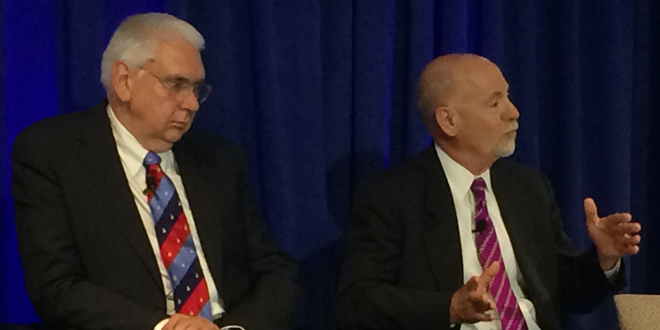
Outgoing PJM CEO Terry Boston expressed confidence in the future, saying, “This is the first time in my career I can say that energy independence for the United States of America is attainable.”
The gas and electric industries, he said “are connected at the hip.” There’s not a lot of room for error, he said, “between just-in-time and too-dang-late.” ISO-NE CEO Gordon van Welie who keynoted the conference, shared the challenges faced by New England, where natural gas’ share of electric production has ballooned from 15% in 2000 to 44% in 2014. The region adopted a Winter Reliability Program and Pay-for-Performance incentives to encourage upgrades and improvements to fuel reliability.
“Natural gas infrastructure has not kept pace with the tremendous growth in gas-fired generation,” van Welie said. “We don’t think response to Pay-for-Performance alone is going to result in investments in natural gas pipelines.”
Meanwhile, he said, “It’s not that our situation is getting better — it is getting worse.”
Speakers said the Federal Energy Regulatory Commission’s April order moving the timely nomination cycle deadline for scheduling gas transportation to 1 p.m. CT from 11:30 a.m. CT and adding a third intraday nomination cycle should improve coordination between the two industries. (See FERC Approves Final Rule on Gas-Electric Coordination.)
“The idea of adding more cycles, it can’t hurt,” said Joseph Kienle, director of Dominion Transmission. But, he said, “At the end of the day, if I’m in a winter situation and I’m fully subscribed, it doesn’t matter how many cycles you add.”
Andy Ott, who will become PJM’s CEO upon Boston’s retirement, said operational awareness of the natural gas industry has expanded from being a winter concern. PJM in May reconvened its gas “war room” to stay abreast of issues. “This is going to become a normal course of business,” he said. “It’s becoming an annual, year-round phenomenon for us.”
Outgoing FERC Commissioner Philip Moeller encouraged attendees to be proactive in recommending solutions to the commission and its new chairman Norman Bay. “He’s got a bigger, steeper learning curve to tackle,” he said. “Keep that in mind because he’s the person who will lead the commission at least for the next one and a half years.”
Moeller said he has been impressed so far with Bay, who he said is trying to bring the commissioners into decision-making conversations earlier. He declined to comment on Bay’s lone dissent on PJM’s Capacity Performance proposal, citing a “99.99% chance of rehearing that order.”
“My main message to you is: Creative ideas are welcome. We need desperately to keep the momentum going on this issue,” he said.
FERC is good at dealing with singular issues, he said, but, “Sometimes being able to see out a little farther is a challenge the commission has.”
MILWAUKEE — MISO Independent Market Monitor David Patton on Wednesday called for tighter rules on wayward generators, more precise real-time pricing and a fix for Financial Transmission Rights funding shortfalls. He also engaged in a spirited debate with board members over his longstanding complaints about the RTO’s voluntary capacity market.
Patton outlined the proposals, contained in the Monitor’s 2014 State of the Market Report, during a presentation at the Markets Committee of the Board of Directors at MISO’s Annual Meeting in Milwaukee.
Board members’ repeated interjections ate up the clock and forced Patton to defer further discussion about some recommendations to a future Markets Committee meeting.
Five-Minute Pricing
One of Patton’s “high-priority” recommendations is to implement five-minute settlements for generators in the real-time market, something he raised three years ago.
“This is one area where we’re not leading, and it has real consequences,” Patton said after rattling off a list of positive metrics for MISO during 2014.
MISO dispatches the real-time market in five-minute intervals but settles based on hourly average prices. Patton said the inconsistency reduces the incentive for generators to follow dispatch signals and results in increased uplift.
“The response to our dispatch signal by a lot of our suppliers is pretty ragged and it affects us from a reliability standpoint and it affects us from an economic standpoint.”
Patton noted that SPP and NYISO both use five-minute settlements. MISO won’t be able to do so until it installs a new settlement system.
Todd Ramey, vice president of system operations and market services, said the system is expected to be installed next year, but it would be 2017 before members’ systems would be ready to accommodate the shorter pricing intervals. “The question mark is ultimately whether the membership says ‘please proceed with five-minute settlements.’”
He said the $28.6 million in increased generator revenue that the Monitor estimates would result from the change is “way less” than 1% of their overall revenues.
“From the market participant perspective, they’re trying to weigh … the changes they would need to make to accommodate five-minute settlements versus the additional revenue,” Ramey said.
Patton replied that a better comparison is the impact after accounting for fuel costs. “If you compare it against net revenue, it’s actually way more significant,” he said.
FTR Funding
Patton also offered a new recommendation for the longstanding problem of underfunding FTRs.
Shortfalls, but none of the surpluses, are allocated to FTR holders. MISO funded 96% of FTRs in 2014.
“We’ve created a financial instrument and created an unnecessary uncertainty about what that instrument is actually worth,” Patton said. “It lowers the prices of our FTRs, so we collect less revenue when we sell the FTRs, which hurts our transmission customers.”
Patton said shortfalls caused by transmission outages or derating should be allocated to those responsible for the diminished transmission capacity, as is done in NYISO. The current approach has provided incentives for some “relatively unseemly outages,” including some during the polar vortex last year that generated hundreds of millions of dollars in congestion, Patton said.
“You would wonder why [outages] were being scheduled at that time of the year in the northern part of our system.”
30-Minute Local Reserve Product
The Monitor also recommends that MISO introduce a 30-minute local reserve product, saying the RTO incurs high uplift costs in some areas to satisfy voltage and local reliability requirements beyond first contingencies.
The reliability requirements would be best addressed by quick-start gas turbines, which are in very short supply in MISO South, Patton said. As a result, slower-responding units are paid to be online even though they’re not economic.
Patton said the new product would provide incentive to invest in quick-start units. “When [the cost is] embedded in uplift, you’re not providing an investment signal,” he said.
Tighten Thresholds
Another recommendation, first made by the Monitor in 2012, is to tighten thresholds for uninstructed deviations by generators. Patton said MISO is “substantially more lenient” than other RTOs in setting the bandwidth for measuring compliance, using a tolerance band of 8% and four consecutive intervals.
Patton said generators not following dispatch are nonetheless receiving a “significant amount” of ancillary services and price volatility make-whole payments.
In addition, he said, the RTO is losing as much as 400 MW due to derates during peak conditions, “a meaningful portion of the headroom that we have to operate the system. This has some reliability implications and it has economic implications.
“We think it’s very important and there’s almost nothing that’s been accomplished in terms of moving this forward,” he said. He said referrals to the Federal Energy Regulatory Commission’s Office of Enforcement have improved performance somewhat.
Interface Pricing
Patton repeated his call for removing external congestion from interface prices, saying the current rules are resulting in inefficient imports and exports. Patton has previously called for a FERC technical conference to resolve MISO’s differences with its neighboring RTOs. (See Patton Asks FERC to Set Deadline on PJM-MISO Interface Pricing Dispute.)
“We’re seeing virtually no progress toward any consensus solution” with PJM, he said. “SPP is a little closer to understanding the issue than PJM.”
“We think it’s extremely important that MISO move forward unilaterally,” he added later.
Capacity Market
Patton drew pushback from some board members when he displayed a slide showing that generators’ net revenue in MISO is far below the estimated annual cost of a new combustion turbine or combined-cycle plant.
Left to right: Todd Ramey and Richard Doying, MISO; David Patton, Potomac Economics
“We’re not very close to motivating anybody to build anything in MISO,” he said. “For RTOs with functioning capacity markets, they would be meeting or exceeding the cost of new entry.”
Patton said that could be fixed by making several changes to the Planning Resource Auction for capacity, including adding seasonal capacity requirements and replacing the vertical demand curve with a sloped curve similar to that used in PJM.
Committee Chairman Michael Curran was unconvinced by Patton’s analysis. “As I’m struck by this chart, I’m thinking we still manage to get things built.
“One’s led to believe if you’re vertically integrated you have a monopolistic power, therefore you’re going to be able to exploit the poor state regulators and get really high prices … but in our market, MISO came through as the lowest cost market,” he said, citing an analysis from the ISO/RTO Council.
Patton responded that MISO has a “tremendous cost advantage” because of low-cost fuel.
“All of our [independent power producers] want to get out of MISO and … that causes our vertically integrated utilities to have to build resources that are more expensive than maintaining the existing resources that we have. And it also puts all that investment risk on the backs of regulated ratepayers instead of investors.
“MISO has been enjoying a capacity surplus for a long time,” he added. “When states have to build new generation … that’s when you’re going to see the costs appear.”
Board Chairman Judy Walsh also waded into the debate, saying Patton needed to provide more data regarding other regions’ costs. “This chart doesn’t do it,” she said.
Director Paul Feldman said the board had authorized Patton to share his proposed changes with state officials, who have been opposed to anything resembling PJM’s mandatory capacity market. “So you didn’t do a good [sales] job,” he said, prompting laughter.
Director Paul Bonavia was a bit more conciliatory. He said if Patton could convince the stakeholders that MISO could have a more robust capacity market without increasing overall costs, “that would change the dialog a lot.”
At the end of the meeting Curran thanked Patton for his independent analysis but couldn’t resist a little jab.
“You’re going to have a sloped demand curve on your tombstone.”
“Cause somebody’s going to kill me?” Patton responded, laughing nervously.
“No,” Curran said. “This is the Midwest. These are nice people.”
MILWAUKEE — Dynegy CEO Robert Flexon last week defended his company’s bidding strategy in MISO’s April capacity auction and said the controversy over the results signals the need for a regulatory change in Illinois.
On May 28, Public Citizen Inc. and the Illinois Attorney General asked the Federal Energy Regulatory Commission to investigate whether Dynegy illegally manipulated MISO’s Planning Resource Auction, resulting in a nine-fold price increase in Zone 4. Public Citizen also alleged that MISO rejected recommendations by its staff that Zones 4 and 5 be merged due to their concerns about Dynegy’s growing share of capacity in Zone 4 after the company acquired four generators in the zone from Ameren. (See Public Citizen: Investigate Dynegy Role in MISO Auction.)
Zone 4, comprising much of Illinois, cleared at $150/MW-day, compared with just $16.75 a year earlier. Clearing prices in the rest of MISO were less than $3.50/MW-day.
In an interview before his appearance in a panel discussion at the MISO Annual Meeting last week, Flexon said that the company had properly offered all of its generating units into the auction based on their operating costs. “Nothing was withheld,” he said.
Flexon said the auction results pointed to the disconnect between Illinois, which has retail choice, and the other14 states in MISO, which operate under cost-of-service rate regulation. Southern and Central Illinois are in MISO, while the Chicago area is part of PJM, where most states have retail choice.
“If you do the math, we’re getting about $50/MW-day where all of the [utilities in the] regulated states are getting about $300 to $350 per MW-day via rates,” he said — the $50 an average including units that did not clear.
“You have a market where it’s designed where all of the other 14 states will take all of their capacity and [price] them at zero … and then people compare our [prices] to theirs and they’re actually getting 10 times what we’re getting. But we’re getting all the [criticism] because we only have two ways of compensation.”
Flexon said the company bid its units in at “basically a marginal cost.”
“We look at each unit and we look at the economics and the cash flow and we bid it in at the cost. We balance the energy market with the capacity market. So some units are cheaper to run than others. So we had some units that cleared and some units that don’t. … It does us no good to offer it in at $3/MW-day like the [regulated utilities do].”
Move to PJM?
Flexon reiterated his desire to move his generation into PJM. He said the company is trying to convince Illinois officials to support a change in their regulatory construct.
“The message I’ve really got to take to Illinois is that Central and Southern Illinois — being a part of MISO in the deregulated state — there’s no future for [merchant] generation in Central and Southern Illinois if you don’t change the construct. We’re going to continue to get every megawatt we can into a market that’s designed with like competitors.
“I think Illinois needs to look at that and say this construct doesn’t work. And that’s why [Exelon’s] Clinton [nuclear] plant can’t survive.
“Whether you do that within the parameters of MISO; whether we make Zone 4 designed a little different; whether you reregulate or whether you try … to push the whole state into PJM — I don’t know what the answer [is] there. Those are possible solutions.”
MISO Response
In a question-and-answer session with MISO’s Board of Directors afterward, Chairman Judy Walsh thanked Flexon for his candor. “I don’t think this is a problem that we didn’t know about,” she said.
Brett Kruse of Calpine said the aberrant prices weren’t in Zone 4 but in MISO’s other regions, where prices were much lower. “It is not the correct price signal. I think most economists would probably agree with that. So given all the challenges MISO’s had over the years … maybe it’s time for MISO and the board to say, ‘Maybe there’s another way to do it,’” he said.
MISO CEO John Bear said the RTO has been talking with Illinois officials about developing “a separate mechanism for that state — which I think is a way for us to address that problem without having to do anything different across our vertically integrated states, who are quite happy with the resource requirements that we have now.”
“I think that’s something that we ought to try to get some traction on … pretty quickly,” Bear added.
The Federal Energy Regulatory Commission again rejected Consolidated Edison of New York’s request that it force PJM to recalculate the cost allocation for two transmission upgrades in northern New Jersey, raising questions about whether the company will seek alternatives to the so-called “PSEG wheel” for delivering power to New York City.
PSEG short circuit solution (Source: PJM Interconnection LLC)
The commission last week rejected Con Ed’s November 2014 challenge (EL15-18) and a rehearing request by Con Ed, the New York Public Service Commission and Linden VFT on an earlier order in the dispute (ER14-972).
PJM assigned Con Ed $629 million of the costs of a $1.2 billion transmission upgrade to address a short-circuit problem in the Public Service Electric and Gas transmission zone outside New York City. PSE&G was allocated $52 million of the cost.
Con Ed was also assigned $51 million of PSE&G’s $100 million Sewaren storm-hardening project. The company says it should be assigned only $29 million for the two New Jersey projects.
PJM said Con Ed’s responsibility resulted from its use of the “Con Ed-PSEG wheel,” in which Public Service Enterprise Group, PSE&G’s parent company, takes 1,000 MW from Con Ed at the New York border and delivers it to Con Ed load in New York City.
In April 2014, FERC rejected Con Ed’s attempt to avoid paying for the short-circuit project but said it wanted more information on how PJM performed the distribution factor (FERC Rejects Con Ed Challenge on Tx Upgrade.) In last week’s order, the commission accepted PJM’s compliance filing, saying it was satisfied that the RTO had conducted the DFAX analysis correctly.
In filing the second complaint, Con Ed had sought a broader consideration of the cost allocation than the rate filing that prompted FERC’s earlier order.
‘Objectively Unreasonable’
Con Ed said PJM’s Tariff requires a review of instances where its cost allocations will produce “objectively unreasonable” results. The commission, however, sided with PJM, saying that “that the provision limits the discretion in reviewing the results of the solution-based DFAX method analysis to its engineering judgment of the flows over the subject facility.”
It agreed with PJM that, based on its Tariff and Order 1000, the RTO can use a “substitute proxy” only “when the solution-based DFAX method analysis cannot be performed for the facility in question and the resulting flows are not consistent with the normal expected flow results that an engineer would expect to see.”
FERC said PJM was able to properly conduct the analysis.
“Because Con Edison has provided no evidence the flows were not properly measured, there was no basis upon which to disregard those results,” the commission said, adding that the Tariff did not permit PJM the discretion to use a substitute proxy based on whether the resulting cost allocation appears unreasonable.
“Such an interpretation would require PJM to ignore the cost allocation procedures of its Tariff and examine every cost allocation to determine whether it is objectively unreasonable. We also find that such an interpretation would provide PJM with too much discretion and is at odds with the requirement in Order No. 1000 for determining ex ante cost allocation procedures, so all parties will know in advance how project costs will be allocated.”
Con Ed also protested the way PJM nets transmission usage, saying it discriminates against point-to-point customers and makes incorrect assumptions about the source of the generation serving its New York load.
PJM nets a customer’s positive energy flows with its negative flows, modeling the transmission zone as a whole and not bus-by-bus. PJM said that wouldn’t apply to Con Ed because its energy flows in only one direction over the Bergen-Linden Corridor.
Planning Transparency
FERC also rejected the complaints of Con Ed and Linden — which owns a 315-MW merchant transmission facility that interconnects both PJM and NYISO — about the transparency of PJM’s transmission planning process. FERC repeated its observation from the April 2014 order that the RTO had discussed the project during numerous Transmission Expansion Advisory Committee meetings in 2013. “Con Edison could have, but did not [raise] cost allocation issues at the TEAC meetings,” FERC said.
Con Ed’s contract for the wheel expires April 30, 2017, unless the company chooses to roll over the service. Con Ed spokesman Mike Clendenin said the company has not decided on whether it will appeal the ruling or renew the contract for the wheel.
“We are concerned about the unfair costs to our customers and will be reviewing our options,” he said.
“We’ve got some time,” he added, noting that the company would have to give notice of its intention regarding the contract in 2016.
Con Ed’s peak load in New York’s five boroughs and Westchester County is more than 13,000 MW.
PJM acted properly in its solicitation of bids to fix a stability issue at the Artificial Island nuclear complex, the Federal Energy Regulatory Commission has ruled, denying a request by losing bidder Public Service Electric and Gas seeking to have the project reposted.
While the commission found that PJM was not required to use its Order 1000 solicitation rules because the call for bids predated that measure, Commissioner Cheryl LaFleur said the case presented an opportunity to consider the order’s competitive solicitation procedures more generally.
“One of Order No. 1000’s key goals was to harness the benefits of competition in transmission development for customers, and it is important that, as regions implement their Order No. 1000 procedures, we do not lose sight of that goal: facilitating the identification, development and ultimately the construction of more efficient or cost-effective transmission projects that are better for customers,” she wrote in a separate note included with the ruling (EL 15-40).
PSE&G had accused PJM of failing to follow its own rules by unilaterally modifying finalists’ proposals and allowing LS Power – the winning bidder – to modify its proposal more than a year after the proposal window closed. (See PSE&G: PJM Broke the Rules in Artificial Island Solicitation.)
If PJM did not believe that any one proposal represented the most efficient or cost-effective solution, PSE&G said, it should be required to repost the solicitation.
PJM countered that such an interpretation of the rules “would result in PJM engaging in interminable, never-ending solicitations until the perfect project was proposed, with the inevitable result that PJM would have to default to assigning many projects to incumbents due to time constraints.” (See PJM: PSE&G’s Remedy for Artificial Island Bid Process ‘Draconian,’ ‘Self-Serving.’)
In addition, it said, that type of thinking “would turn the Order No. 1000 solicitation process into a strict bidding process of the type that would govern homogenous products such as the purchase of paper clips.”
PJM also noted that without the authority to combine and modify proposals, “it would be left with accepting a proposal four times as expensive as the combination it is considering.”
FERC concluded, “PJM followed its commitment to evaluate Artificial Island proposals using its then-effective transmission planning process and to incorporate its new Order No. 1000 proposal window into that process ‘to the extent feasible and practicable.’”
PJM planners announced April 28 that they would recommend to the Board of Managers that LS Power build a new 230-kV transmission line from New Jersey’s Artificial Island to Delaware at a cost of $146 million. (See PJM Staff Picks LS Power for Artificial Island Stability Fix; Dominion Loses Out.) PSE&G and Transource Energy were chosen for necessary connection facilities.
PSE&G initially was picked for the job last summer, but the Board of Managers reopened the bidding following an outcry from losing bidders, New Jersey officials and environmentalists.
The Board of Managers once again will be asked to decide the issue at their meeting July 29. Prior to that, PJM planners will present their recommendation to the board’s four-member Reliability Committee.
New York regulators approved Central Hudson Gas & Electric’s three-year rate plan in an order that also says one demonstration project the company filed in the state’s program to revamp the utility industry shows promise.
The New York Public Service Commission on Wednesday approved a joint proposal by the company, PSC staff and stakeholders that will increase electric rates by $43.4 million through 2017 (14-E-0318). The company had initially proposed a one-year plan with a $40.1 million increase.
Much of the commission’s discussion Wednesday focused on the state’s Reforming the Energy Vision. Utilities have been ordered to file demonstration projects by July 1, but Central Hudson jump-started the process by proposing six projects in a proceeding that ran parallel to its rate case that started last July. The proceedings are on separate regulatory tracks, however. (See Central Hudson Case Provides Early Test of NY REV.)
‘Non-Wires’ DR Plan
PSC staff said a “non-wires alternative” proposed by Central Hudson and its stakeholders in a status report filed in May met the criteria to move forward. The alternative is a demand response proposal in three congested areas of the service territory. The company was given 30 days to file additional details on proposed cost recovery and incentive mechanisms.
The PSC said a net customer benefit would have to be shown for approval, including “forgoing the capital investment associated with a traditional [transmission and distribution] solution.” To expedite implementation, the order defers cost recovery until Central Hudson’s next rate case — no sooner than June 2018.
That prompted concerns from Commissioner Diane Burman. “Is the rate case driving the policy, or is policy’s generic proceeding driving the rate case?” she asked.
Burman also complained that commission staff were driving the demonstration project approvals. “I really think that it’s an inappropriate delegation of authority for me to give up the review of that,” she said.
Chairman Audrey Zibelman said she understood the concern. But after “long conversations … I know staff ended up feeling this is the right process and I’m comfortable with it,” she said.
Rate Case
Distribution rates for Central Hudson have not changed since 2012. Its last rate case was approved in 2010, and the PSC’s 2013 approval of its acquisition by Canadian holding company Fortis included a two-year rate freeze that expires on July 1.
The rate order calls for graduated increases over the next three years beginning July 1:
In 2015, electric rates will increase $2.3 million, or 38 cents/month, for the average residential customer, a 0.3% increase based on the total bill.
In 2016, rates will increase $17 million, up 3.4% or $3.86/month.
In 2017, rates will go up $24.1 million, up 4.8% or $5.58/month.
The impact is softened over the three years by the use of $27 million in customer credits that Fortis provided during the 2013 takeover.
Other provisions include the shift from bimonthly to monthly billing and the creation of a “major storm reserve” — Central Hudson is the only New York utility without one. The fixed monthly service charge of $24 will not change. The company had sought a $5 increase.
Central Hudson is also allowed a 9% return on equity.
The Federal Energy Regulatory Commission last week denied wind generators’ rehearing request on its June 2014 order concerning SPP’s revisions to the RTO’s generator interconnection procedures.
FERC also conditionally accepted SPP’s compliance filing as a result of the June 2014 order, subject to a further compliance filing (ER14-781).
2009, 2013 Changes
SPP first revised its interconnection process in 2009, shifting it from a “first-come, first-served” approach to a “first-ready, first-served” approach. The changes streamlined the study process by including a fast-track approach for customers that met specific milestones and reduced the impact of suspended projects on other projects. They also sought to steer speculative projects into a preliminary interconnection queue and discourage them from entering the final queue by increasing deposits and requiring project readiness milestones.
In December 2013, the RTO proposed changing the way the interconnection queue priority was determined and revising milestones to execute a generator interconnection agreement (GIA). SPP also proposed requiring an interconnection customer to provide a deposit, upon execution of an interconnection agreement, of 20% of the interconnection facilities and network upgrade costs, or convert the previously provided financial milestone of $4,000/MW, whichever was greater.
FERC initially ruled the filing deficient but conditionally accepted SPP’s subsequent compliance filing response in the June 2014 order.
SPP not Unclear
The American Wind Energy Association (AWEA), the Wind Coalition and E.ON asked FERC for clarification or rehearing of the order, arguing SPP did not make it clear as to what constituted harm to interconnection customers when a higher-queued customer withdrew from the queue and had its deposit refunded.
FERC rejected their assertion, saying the complainants had misconstrued the interconnection process and took SPP’s statements out of context.
FERC also denied rehearing over revisions allowing SPP to withhold refunds. The commission said the “costs would not have been incurred without the higher-queued interconnection customer’s request for the interconnection capacity.”
FERC also rejected rehearing regarding transmission network upgrades funded by interconnection customers whose interconnection agreements are subsequently terminated by SPP. FERC said its June 2014 order found that “[i]nterconnection customers who execute a GIA and provide an initial payment for construction are undertaking a significant business risk” should they not meet their obligations.
“We find that their request would defeat the purpose of protecting lower-queued customers from increased costs,” FERC said.
FERC denied E.ON’s separate rehearing requests regarding SPP’s establishment of queue priority at the interconnection facilities study queue stage, and payment of interest on deposits, saying they were beyond the scope of the proceeding.
MILWAUKEE — MISO will reevaluate the metrics used in evaluating market efficiency transmission projects because of concerns they are unduly conservative and preventing viable solutions to congestion, officials said last week.
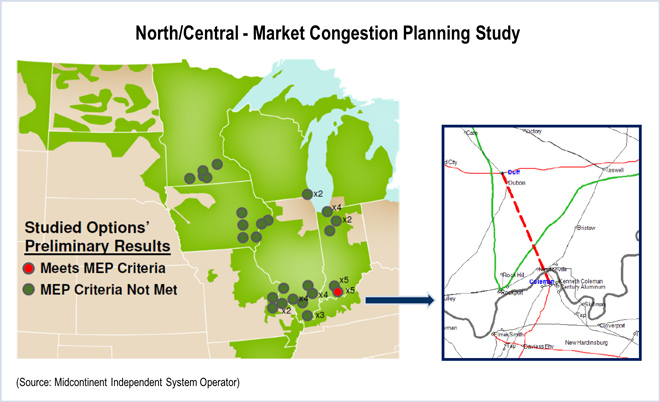
The Duff-Coleman 345-kV upgrade (right) is the only proposed market efficiency project that cleared MISO’s conservative 1.25-1 benefit-cost ratio in the North/Central region. Each dot represents a proposed project; some projects were the subject of as many as five proposals.
MISO requires economic projects to clear a 1.25-1 benefit-cost ratio, based on an assumed 20-year lifespan rather than the actual life of 40 years or longer. In addition, projects are discounted based on transmission owners’ cost of capital (currently about 8%) rather than a “societal” discount rate of about 3%.
“So essentially we have three layers of conservatism,” Clair Moeller, executive vice president of transmission and technology, told the Board of Director’s System Planning Committee meeting.
The issue came up during a briefing on MISO’s North/Central market congestion planning study, which analyzed 48 proposed projects, only one of which — the Duff-Coleman 345-kV project to reduce congestion in southern Indiana — cleared the 1.25 threshold.
“It appears to me there’s clearly congestion in three or four key zones,” said Director Thomas Rainwater, noting the number of rejected projects clustered together on MISO’s North/Central map. “Something looks to be broken when one out of 48 projects gets approved. It just strikes me by looking at it visually: Is the criteria right?”
Cost Concerns
Moeller said the difficult hurdle was the result of stakeholders’ cost concerns. “When we first had the notion of cost allocation, the constituency was very interested in us being very conservative. So there are several things inside the business case parameters that we’re required to follow inside the Tariff that causes … the economics of the projects to be fairly modest.”
Moeller said it was time “to take a look at those business case parameters and see what the appetite is for relaxing some of those now that we’ve had a better track record and a better understanding of how to model these things.”
“We will be doing the reevaluation because it’s a good idea,” he added. “Whether we end up changing the business case is an open question.”
In an interview after the meeting, Moeller said the review of the metrics will likely begin this fall at the stakeholders’ Planning Advisory Committee.
General Counsel Steve Kozey noted that states could authorize any transmission that would reduce their constituents’ costs “as long as it doesn’t hurt” MISO reliability. The question is whether load wants to pay for the upgrades, he said.
The fact that congestion remains on the system “doesn’t mean that there are a lot of super obvious projects,” he said.
Committee Chairman Michael Evans — who was surprised at the end of the meeting with a carrot cake to celebrate his 70th birthday — asked staff to provide a list of projects that would clear the threshold using a more realistic 40-year lifespan.
Competitive Solicitations Coming
The Duff-Coleman project, which has a benefit-cost ratio of 3.6 to 12.9 depending on assumptions used, is expected to be one of the first tests of the competitive solicitation process for nonincumbent transmission developers under the Federal Energy Regulatory Commission’s Order 1000.
John Lawhorn, director of regional and economic studies, told the board there is also a “50-50” chance that staff will recommend opening a competitive window under Order 1000 for a project in MISO South. He did not identify the project.
Board Chairman Judy Walsh said she feared MISO’s role in evaluating competing proposals was a “slippery slope.”
Rainwater and Evans also expressed misgivings. “We have a common concern about wading into this river,” Evans said.
Moeller said MISO has had difficulty attracting top-tier engineering firms to conduct evaluations because they prefer to pursue more lucrative work with the developers themselves.
Joint Study with ERCOT
Moeller also said MISO and ERCOT expect to begin a joint study in about six months to evaluate the potential for HVDC facilities to address seams issues in the Houston area.
Participants in evidentiary hearings will no longer have to provide paper copies of all exhibits introduced as evidence, under an order approved by the Federal Energy Regulatory Commission last week (RM15-5).
The commission said its administrative law judges recently adopted a practice requiring participants to file exhibits electronically. “Thus, it is no longer necessary or efficient to require all participants to provide the presiding judge and court reporter with paper copies of each exhibit introduced at the hearing,” the commission said. The order amends Rule 508 of the commission’s Rules of Practice and Procedure, which previously required participants provide one paper copy of each exhibit to the presiding officer and two paper copies to the court reporter.