PJM Markets and Reliability Committee Members Committee Briefs

The Markets and Reliability Committee approved Tariff and manual revisions regarding PJM’s use of sampling to measure and verify residential demand response.

The new measurement method was originally endorsed at the Jan. 22 Members Committee meeting. Thursday’s vote approved the inclusion of an additional transition year because of delays in filing the new method with the Federal Energy Regulatory Commission.

PJM now expects to make the filing in late April. (See “Sampling to be used for Measuring Residential DR” in MRC/MC Briefs, Nov. 25, 2014.)

Tariff Harmonization Senior Task Force Charter Approved

The MRC approved the draft charter of the Tariff Harmonization Senior Task Force, formed to address inconsistencies and discrepancies in PJM’s governing documents. There was one abstention and one vote against the measure. (See Task Force Proposed to Resolve Inconsistencies in PJM Governing Documents.)

Regional Planning Process Senior Task Force Placed on Hiatus

On first reading, MRC members approved the Regional Planning Process Senior Task Force’s recommendation directing the Planning Committee to develop guidelines for considering generation interconnection projects as drivers under the multi-driver transmission project approach.

The MRC also agreed to place the task force on hiatus, available to be returned to operation if needed based on future rulings by FERC.

Manual Change Endorsed

The MRC approved changes in Manual 14D: Generator Operational Requirements to reflect a recent advisory from the North American Electric Reliability Corp. on generator frequency response requirements. PJM sent Generator Operators a survey regarding governor dead band settings, droop setting and mode of operation on April 3. PJM will compile the responses, due June 3, and share the data with NERC.

FTR Auction Clearing Deadlines, Trading Periods Approved

The Members Committee approved minor “non-substantial” provisions regarding financial transmission rights’ auction clearing deadlines and trading periods.

Quebec-NYC Tx Line Clears Final Regulatory Hurdle

By William Opalka

A 1000-MW merchant transmission line that would deliver Canadian hydropower to New York City has completed its federal environmental review, clearing the way for construction.

The U.S. Army Corps of Engineers on Tuesday issued a permit to Transmission Developers Inc. that allows the Champlain Hudson Power Express project to be placed in U.S. waters along the proposed route. The entire 333 miles from the Quebec border to the Astoria neighborhood in Queens will be underground or underwater, including sections beneath Lake Champlain and the Hudson River.

TDI said the project has secured all of the federal and state siting permits necessary to proceed with construction, which could start next year. The permit authorizes TDI to construct the project under Section 10 of the Rivers and Harbors Act and Section 404 of the Clean Water Act.

champlain hudson power express

The estimated $2.2 billion project would boost Canada’s interest in exporting electricity to New York and New England. (See Hydro-Quebec Seeks to Boost Exports to Northeast.)

“The terms of the permit reaffirm that our project will take appropriate steps to protect New York’s environmental and commercial resources, and we are excited to have moved substantially closer to the moment when we will begin to deliver cleaner, lower-cost power to New York’s residents and businesses,” TDI CEO Donald Jessome said in a statement.

The project has been under development since 2008. Its proponents claim it could reduce energy costs for consumers and businesses by $650 million a year.

The Independent Power Producers of New York, a trade association whose members would be in direct competition with imported energy sources, opposed the project. IPPNY insists the project is not financially viable without subsidies from Canadian power producers and an above-market-rate contract with New York utilities transmitting the energy.

The New York Public Service Commission has rejected those claims.

TDI plans to finance the project through private equity and support from shippers and contractors. TDI’s lead investor is the Blackstone Group.

PJM Staff Picks LS Power for Artificial Island Stability Fix; Dominion Loses Out

By Suzanne Herel

VALLEY FORGE, Pa. — PJM planners will recommend to the Board of Managers that LS Power build a new 230-kV transmission line from New Jersey’s Artificial Island to Delaware to address stability issues at the nuclear complex, they announced Tuesday at a special meeting of the Transmission Expansion Advisory Committee.

LS Power’s commitment to limit construction costs to $146 million was a driving factor of the decision, said Paul McGlynn, general manager of system planning. PJM also felt the proposal has the best chance of being able to secure permits.

“It is our opinion that the LS Power proposal provides greater flexibility and can mitigate some of the permitting risk involved in siting,” he said. “It is staff’s intent to recommend installing a 230-kV line under the Delaware River using horizontal directional drilling technology and designate that to LS Power.”

Public Service Electric & Gas and Pepco Holdings Inc. were chosen for necessary connection facilities. Dominion Resources and Transource Energy, which were among the finalists, were not included in PJM’s recommendation. PJM will make the recommendation to the Board of Managers after May 29, the deadline for stakeholders to submit comments.

artificial island
PJM planners recommended the selection of LS Power to build a new 230kV circuit from Salem to a new substation near the 230kV corridor in Delaware, using horizontal directional drilling the bury the line under the Delaware River. The new line would tap the Red Lion-Cartanza and Red Lion-Cedar Creek 230 kV lines. (Source: PJM Interconnection LLC)

Sharon Segner, vice president for LS Power, said in an interview that she appreciated PJM recognizing the value of being able to choose from an overhead or submarine crossing.

“It’s going to be a difficult river crossing. We go into it with our eyes wide open,” she said. Yet, she said she was confident the company would be able to complete the four-year project within the cost cap. “We’ve assessed the situation, assessed the risks and feel very comfortable in the commercial feasibility of our project.”

Roles for PSE&G, Transource

PSE&G would be responsible for expanding the Salem substation and building a static VAR compensator (SVC) upgrade at New Freedom. Pepco Holdings Inc., Transource’s partner, would oversee interconnecting the new substation to the existing Red Lion-Cartanza and Red Lion-Cedar Creek 230-kV lines.

PSE&G and PHI together would be responsible for optical ground wire (OPGW) upgrades.

The SVC upgrade project is estimated at $31 million to $38 million, and the OPGW work at $25 million.

Home to the Salem and Hope Creek nuclear reactors, Artificial Island is the second largest nuclear complex in the country. Special operating procedures that historically have been used to maintain stability in the area have become increasingly difficult to implement while respecting the system’s other operational limits.

First Order 1000 Solicitation

The call for proposals for a fix, which went out two years ago, signaled PJM’s first competitive transmission project under the Federal Energy Regulatory Commission’s Order 1000.

Last summer, PJM planners recommended PSE&G for the job, but the Board of Managers reopened the bidding following an outcry from losing bidders, environmentalists and New Jersey officials.

PSE&G was a finalist in the new round of bidding, along with LS Power, Transource and Dominion.

“We’re disappointed with the outcome,” Jorge L. Cardenas, PSE&G vice president for Asset Management & Centralized Services, said after the meeting. “We will put our comments together in the next 30 days.”

All of the projects include new transmission lines connecting the nuclear complex to Delaware. LS Power and Transource offered a southern, submarine crossing of the Delaware River, with LS Power also including an overhead option. Dominion and PSE&G proposed a northern, overhead crossing. (See Artificial Island Finalists Face Off in Tense Meeting.)

All are expected to be met with permitting obstacles.

Planners had expected to make a recommendation in January but held off so consultants could look into concerns that Dominion’s proposed use of thyristor controlled series compensation (TCSC) could threaten reliability.

At the last TEAC meeting, PJM said that Siemens Power Technology International had completed a sub-synchronous resonance analysis of Dominion’s proposal and found it could result in “negative damping” for several resonant frequencies.

Exponent, an engineering and science consulting firm hired by PJM to review the Siemens study, expressed its own concerns with the Dominion plan, which proposes a 90% post-contingency TCSC compensation — well above the usual 70 to 80% compensation used in the industry.

PSE&G Challenge

Still outstanding is a complaint PSE&G submitted to FERC accusing PJM of breaking its own rules in the bid solicitation process (EL-15-40). PJM in March asked FERC to defer ruling on the matter until it had chosen a bidder for the project. (See PJM: PSE&G’s Remedy for Artificial Island Bid Process ‘Draconian,’ ‘Self-Serving’.)

“We still have our complaint in to FERC, and we will pursue that and hope for the best,” Cardenas said.

FERC OKs PJM Request to Delay Capacity Auction

By Rich Heidorn Jr.

The Federal Energy Regulatory Commission Friday granted PJM’s request to delay May’s Base Residual Auction, allowing the RTO more time to seek FERC approval for its Capacity Performance proposal.

“PJM’s request for waiver will allow the commission to consider the additional information submitted by PJM in support of its Capacity Performance proposal, as well as comments and protests regarding that additional information, while also providing clarity regarding the timing under which PJM will conduct its auction following commission action on that proposal,” the commission said.

PJM filed the request on April 7, after FERC issued a deficiency letter over the Capacity Performance plan (ER15-623). It sought a waiver from the Tariff requirement that the auction be held in May. It said it would hold the auction 30 to 75 days after a commission order on the merits of the proposal, but no later than the week of Aug. 10-14.

The proposed delay drew more than two dozen comments, mostly from supportive stakeholders, but also from critics who said a postponement would create more market uncertainty than it is seeking to quell. (See PJM Bid to Delay Capacity Auction Draws Flurry of Support, Criticism.)

In granting the delay, the commission ruled that PJM’s request was of limited scope, remedied a concrete problem and would not harm third parties (ER15-1470). (The commission later issued an errata to fix its incorrect reference to the in paragraphs 1 and 2, which should have referred to the 2018/19 delivery year.)

FERC acknowledged the delay would result in “some uncertainty.”

“We recognize that some protestors argue that delaying the auction will harm them by increasing their costs to participate in the auction. We acknowledge these concerns, but agree with PJM that it is important that the commission have the opportunity to consider the full record in the Capacity Performance proceeding prior to PJM running this year’s auction.”

The commission said PJM’s commitment to conduct the auction no later than mid-August mitigates the potential impacts on market participants, and noted that “any additional costs incurred by participating resources may be included in their capacity sell offers, to the extent permitted by the rules in place for the auction.”


Entergy Out-of-Cycle Requests Win MISO Board OK

By Chris O’Malley

CARMEL, Ind. — Over the objections of transmission developers and independent power producers, MISO’s Board of Directors voted unanimously Thursday to approve Entergy’s request for $217 million in out-of-cycle transmission projects.

There was no discussion by the board nor comments from stakeholders on the topic.

The outcome seemed all but certain following a unanimous vote Tuesday by MISO’s Board of Directors System Planning Committee to recommend that the full board approve Entergy’s requests.

Most of the opposition centered on the largest of the Entergy projects, a $187 million project to serve additional load in the Lake Charles, La. industrial zone in the midst of an economic revival.

Opposing stakeholders have alleged the increased load is speculative, that the project is beyond what is needed for a base reliability upgrade and that there was inadequate stakeholder review.

They also wanted a shot at competing for the project.

On Tuesday MISO staff outlined a checklist of steps taken that they say conforms with tariff and business practice manual procedures.

The bulk of the controversial Lake Charles project involves adding a 500 kV tap line that will extend seven miles to a new substation in Lake Charles, where Entergy said numerous industrial customers have committed to adding facilities.

MISO studied alternatives, including upgrading a 230 kV line and providing supply from more distant sources, but concluded they were less effective, said MISO Director of Planning Jeff Webb. “This is a straightforward, and I think ideal, solution,” Webb told the committee last week.

The committee pointed to an April 2 letter from Louisiana Public Service Commissioner Eric Skrmetta that expressed dissatisfaction with the review of the projects at MISO, calling on MISO to streamline the out-of-cycle approval process.

“Nothing should be permitted to interfere with the location of significant new load in southwest Louisiana and the economic benefits it will bring to the people of this state,” wrote Skrmetta. “…The consideration of these projects has gone on long enough. Second, numerous stakeholders have expressed dissatisfaction with MISO’s out-of-cycle consideration and approval process.”

Webb told the committee that MISO had 16 OOC projects last year and seven in 2013. Director Baljit “Bal” Dail, who is not a member of the committee but sat in on Tuesday’s meeting, asked Webb why Lake Charles was so controversial.

Webb cited the size of the project and said he recalled only one other controversial project over the years — also one of substantial size.

Clearly, large projects would be more lucrative for transmission developers hoping for a competitive project. MISO staff have maintained that Lake Charles is a reliability project, which would be ineligible for competition.

Board Chairman Judy Walsh — who substituted as chair of the meeting due to a medical issue involving chair Mike Evans — said the OOC process is designed to prevent MISO from becoming a “stumbling block” to needed reliability upgrades.

“In order for this process to work it has to be fast. It has to be efficient,” she said.

Earlier this month, in response to the controversy over Entergy’s request, MISO launched discussions that could lead to refinements in its procedures for handling out-of-cycle requests. (See MISO Seeks Stakeholder Input on Out-of-Cycle Process amid Entergy Controversy.)

MISO to Consumer Sector: No Money for You

By Chris O’Malley

CARMEL, Ind. — MISO has declined a request by the Public Consumer Advocates sector for $200,000 to help cover its legal costs in a fight over MISO transmission owners’ return on equity.

The decision was announced Wednesday at the MISO Advisory Committee.

“We don’t have a mechanism to send them money,” said MISO General Counsel Stephen Kozey, adding there was no show of stakeholder support for such funding.

The Public Consumer Advocates sector consists of both non-profit groups and government agencies that represent consumers in utility cases before state regulators.

MISOIt decided to enter the ROE battle after settlement talks ordered by the Federal Energy Regulatory Commission between industrial customers and TOs broke down last year. It is the consumer sector’s first-ever litigation in a FERC case.

The consumer sector made the request at the Advisory Committee in February, saying it lacks the deep pockets for legal costs.

Robert Mork, deputy consumer counselor for the Indiana Office of Utility Consumer Counselor, said the Consumer Advocates sector has been supportive of MISO over the years. “We have to say we’re surprised and disappointed by MISO’s decision on this,” Mork said.

He reminded the committee that FERC Order 719 was created in part to improve the responsiveness of RTOs to electric consumers.

Mork didn’t elaborate on the group’s response to the funding denial but said that the consumer sector would have further discussions with MISO, the Organization of MISO States and with FERC.

MISO industrial customers initiated the ROE dispute last year, contending that transmission operators’ current base ROE — 12.38% except for American Transmission Co., at 12.2% — is too high (EL14-12). On April 3, the consumer advocates asked FERC for approval to amend the group’s intervention by adding allies from Arkansas, Kentucky, Louisiana, Montana and Illinois. (See MISO TOs Seek Base ROE of 11.39%.)

Federal Energy Review Calls for Billions of Dollars in Spending on Infrastructure

By Suzanne Herel

The Obama administration’s first Quadrennial Energy Review presents a roadmap for returning the U.S. to a post-World War II level of investment in infrastructure, creating 1.5 million jobs while transforming the nation’s electric grid and oil and gas pipelines, Vice President Joe Biden said Tuesday from PECO Energy headquarters in Philadelphia.

“The U.S. is in the midst of an energy transformation that will allow us to remain the energy epicenter of the world,” Biden said. “To maintain that position, we need a 21st-century infrastructure.”

President Obama ordered the review — similar to the Pentagon’s Quadrennial Defense Review, a widely followed assessment of the nation’s defense — to provide a comprehensive “multi-year roadmap” for U.S. energy policy, with an assessment of current policies and recommendations for additional executive and legislative actions, including priorities for research, development and demonstration programs to support innovation. A White House task force, headed by the president’s top science, technology and climate change advisors and including more than 20 federal agencies, took part in the project, which included public meetings with stakeholders around the country. (See Looking to Build Infrastructure, Moniz Comes to Wall Street.)

The effort is intended “to provide policymakers, industry, investors and other stakeholders with unbiased data and analysis on energy challenges, needs, requirements and barriers that will inform a range of policy options, including legislation.” Each installment of the report will focus on one part of the energy “value chain.”

The 348-page report released Tuesday focuses on the energy transmission, storage and distribution system, which is facing new challenges from climate change, environmental policies and innovations in oil and natural gas production.

[metaslider id=”102305″]

New Sources

Since 2008, solar electricity generation has increased 20-fold, Biden said, and wind energy has more than tripled. In that time, the U.S. has become the world’s No. 1 producer of natural gas, and the nation has reduced its dependency on foreign oil.

Meanwhile, new challenges have emerged regarding national security, increasingly strict clean energy standards and an aging transmission system that isn’t geographically aligned with the needs of renewable generation.

“Changes in the geography of domestic energy production stress the ability of existing infrastructures to move both liquid fuels and electricity from supply regions to demand centers,” the White House said in a fact sheet. “Congestion in the nation’s ports, waterways and rail systems affect the timing and cost of moving not just energy products, but all commodities.”

Aging Infrastructure, Need for Resiliency

Biden noted that half of the nation’s 2.6 million miles of gas pipelines were constructed in the 1950s and 60s, and it would cost about $270 billion to repair them all.

The solution, he said, includes permitting new pipelines more quickly and finding ways for companies to recover their investment without burdening ratepayers.

The system also needs to gird for events such as 2012’s Superstorm Sandy, said Biden, citing it as evidence of climate change.

Between 2003 and 2012, an estimated 679 widespread power outages occurred, he said, costing from $18 billion to $33 billion per year, depending on the nature of the event, he said.

“The threat’s real,” he said. “We’re expecting sea levels to rise by 2030.” In some places, he said, “we will need to literally raise the substation.”

The report cites estimates of billions of dollars to achieve its recommendations. Grid modernization alone is expected to run $3.5 billion annually over 10 years.

Workforce Impacts

Biden stressed the positive effect the investments will have on the workforce.

About 1 million people were employed in energy transmission, storage and distribution jobs in 2013 and over the next five years, about 15% of them will be eligible to retire. The administration says infrastructure spending could add 1.5 million additional energy sector jobs.

“These are middle-class jobs,” he said. “These are the jobs that used to exist at the turn of the 20th century.

“Investing in our infrastructure creates of a virtuous cycle of creating good-paying jobs and attracting companies.”

Accompanying the announcement were two related executive actions.

The U.S. Department of Energy has created the Partnership for Energy Sector Climate Resilience, aimed at strengthening the system against extreme weather and climate change impacts. It will kick off with an April 30 meeting with the CEOs of 17 member companies, including Exelon, Dominion Virginia Power, Pepco Holdings Inc., Public Service Electric & Gas, the New York Power Authority, the Tennessee Valley Authority, National Grid and Entergy.

In addition, the U.S. Department of Agriculture introduced a plan to spend $72 million to support six new rural electric infrastructure projects.

Entergy Out-of-Cycle Request Wins Committee OK; Full Board Approval Likely

By Chris O’Malley

CARMEL, Ind. — MISO’s Board of Directors System Planning Committee voted unanimously Tuesday to approve Entergy’s request for $217 million in out-of-cycle transmission projects, setting up a likely approval by the full board Thursday.

The competitive transmission developer and independent power producer segments have steadfastly opposed the largest of the Entergy projects, a $187 million project to serve additional load in the Lake Charles, La. industrial zone in the midst of an economic revival.

They’ve alleged the increased load is speculative, that the project is beyond what is needed for a base reliability upgrade and that there was inadequate stakeholder review. They also would like a shot at competing for the project.

But once again, MISO staff outlined a checklist of steps taken that they say conforms with tariff and business practice manual procedures.

The bulk of the controversial Lake Charles project involves adding a 500 kV tap line that will extend seven miles to a new substation in Lake Charles, where Entergy said numerous industrial customers have committed to adding facilities.

entergy

MISO studied alternatives, including upgrading a 230 kV line and providing supply from more distant sources, but concluded they were less effective, said MISO Director of Planning Jeff Webb. “This is a straightforward, and I think ideal, solution,” Webb told the committee.

No stakeholders spoke in opposition.

The committee pointed to an April 2 letter from Louisiana Public Service Commissioner Eric Skrmetta that expressed dissatisfaction with the review of the projects at MISO, calling on MISO to streamline the out-of-cycle approval process.

“Nothing should be permitted to interfere with the location of significant new load in southwest Louisiana and the economic benefits it will bring to the people of this state,” wrote Skrmetta. “…The consideration of these projects has gone on long enough. Second, numerous stakeholders have expressed dissatisfaction with MISO’s out-of-cycle consideration and approval process.”

Webb told the committee that MISO had 16 OOC projects last year and seven in 2013. Director Baljit “Bal” Dail, who is not a member of the committee but sat in on Tuesday’s meeting, asked Webb why Lake Charles was so controversial.

Webb cited the size of the project and said he recalled only one other controversial project over the years — also one of substantial size.

Clearly, large projects would be more lucrative for transmission developers hoping for a competitive project. MISO staff have maintained that Lake Charles is a reliability project, which would be ineligible for competition.

Board Chairman Judy Walsh — who substituted as chair of the meeting due to a medical issue involving chair Mike Evans — said the OOC process is designed to prevent MISO from becoming a “stumbling block” to needed reliability upgrades.

“In order for this process to work it has to be fast. It has to be efficient,” she said.

Last week, in response to the controversy over Entergy’s request, MISO launched discussions that could lead to refinements in its procedures for handling out-of-cycle requests. (See MISO Seeks Stakeholder Input on Out-of-Cycle Process amid Entergy Controversy.)

FERC Rejects Rehearing Request on SPP Order 1000 Filing

By Rich Heidorn Jr.

The Federal Energy Regulatory Commission last week rejected LS Power’s request for rehearing on SPP’s Order 1000 procedures and accepted the RTO’s December compliance filing (ER13-366).

The transmission developer had challenged the commission’s October 2014 order allowing SPP to retain tariff provisions requiring consideration of state law and rights-of-way in the early stages of its competitive bidding process. The commission had made a similar finding in a ruling on PJM last May, reversing the directive it had originally given. (See Order 1000 Reversal: Reality Check or Surrender to Incumbents?)

FERC said LS Power’s challenge “seeks to expand the reach of Order No. 1000’s reforms by prohibiting SPP from recognizing state or local laws or regulations when deciding whether SPP will hold a competitive solicitation.”

The commission noted that while Order 1000 barred any federal right of first refusal for incumbent transmission owners in commission-jurisdictional tariffs, it did not require removal of references to state or local preferences.

While recognizing that FERC lacks jurisdiction to overrule state laws, Chairman Norman Bay issued a concurring statement that seemed to invite a constitutional challenge to state laws that prohibit nonincumbent developers from winning the right to build a transmission project.

“The Constitution limits the ability of states to erect barriers to interstate commerce. State laws that discriminate against interstate commerce — that protect or favor in-state enterprise at the expense of out-of-state competition — may run afoul of the dormant commerce clause,” wrote Bay, a former law school professor. “The commission’s order today does not determine the constitutionality of any particular state right-of-first-refusal law. That determination, if it is made, lies with a different forum, whether state or federal court.”

The commission also rejected LS Power’s challenge to SPP’s process for evaluating competitive bids, saying the RTO “has sufficiently demonstrated that the proposed weighting of its evaluation criteria is not unduly discriminatory and will result in a regional transmission planning process that selects more efficient or cost-effective transmission solutions.”

While it rejected LS Power’s rehearing bid, the commission said SPP’s rights-of-way provision is vague. It ordered the RTO to revise tariff language “that refers to ‘rights-of-way where facilities exist’ to make it consistent with the commission’s finding that retention, modification or transfer of rights-of-way remain subject to relevant law or regulation granting the rights-of-way.”

The commission said the revision would address a protest by South Central MCN, a competitive transmission company that plans to partner with electric cooperatives and municipal utilities in SPP. It denied South Central’s request to schedule a technical conference on RTO competitive bidding processes under Order 1000 as outside the scope of the SPP proceeding.

ITP10 to Include 3 Scenarios for Clean Power Plan

By Rich Heidorn Jr.

TULSA, Okla. — SPP’s next 10-year transmission plan will consider three future scenarios to assess the potential impact of the Environmental Protection Agency’s Clean Power Plan, members agreed after a lengthy debate last week.

The Markets & Operations Policy Committee decided the 2017 Integrated Transmission Planning 10-Year Assessment will include one scenario assuming regional compliance with the EPA rule and one assuming state-by-state compliance. The third scenario will be a business-as-usual case that assumes the EPA rule is abandoned — due, for example, to a legal challenge or a change in leadership at EPA after the 2016 presidential election.

clean power plan
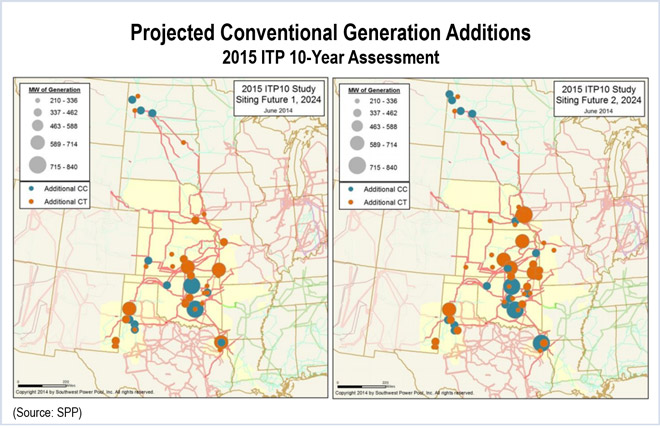
SPP’s 2015 10-year plan compared a business-as-usual case, which projected the need for 15.3 GW of new conventional generation at 60 sites, with a decreased baseload scenario, which projected a need for 21 GW of new conventional generation at 82 sites. The latter scenario assumed the retirement of all coal units less than 200 MW and a 20% reduction in hydropower capacity due to drought.

EPA plans to issue the final rule this summer. It is intended to reduce power generation CO2 emissions by 30% from 2005 levels.

SPP this month released a study estimating the RTO could comply with the rule through a regional approach that includes a $45/ton carbon adder and 7.8 GW of additional generation, most of it wind. The study estimated an annual cost of $2.9 billion in increased energy costs and capital spending for new gas and wind generation. It did not evaluate additional transmission that may be needed, an element ITP10 will seek to quantify. (See SPP: $45/ton Adder, Wind, Gas Meets EPA Carbon Rule.)

The Economic Studies Working Group had recommended use of three futures, including one that assumed increased load growth as a result of the elimination of the Clean Power Plan. MOPC members amended that to assume normal load growth — creating a business-as-usual scenario as a comparison with the regional and state-by-state compliance schemes.

Members first rejected a proposal to include a fourth future that included an “extreme” EPA final proposal. It won only 41% support. A second vote limiting the study to the regional and state compliance scenarios but allowing the working group to seek approval of a third future, also fell short at 57%.

Fundamental Questions

The debate over the study revealed fundamental questions over the RTO’s planning strategy.

“Once again we are doing the absolute minimum and not looking at the long-term future,” said Kristine Schmidt, vice president of regulated grid development for ITC Holdings.

Board of Directors Vice Chairman Harry Skilton said the 18-month timeline for completion of the study is too long. “This is unbelievably ridiculous that it takes this long,” he said.

Lanny Nickell, vice president for engineering, said the length of the study process reflects the incorporation of stakeholder input. “We have a very open and transparent stakeholder process,” he said. “That is very valuable, but it takes time.”

The debate continued during Wednesday’s meeting of the Strategic Planning Committee, as Skilton, Board Chairman Jim Eckelberger and member Phyllis Bernard called for changes.

Eckelberger said MOPC’s debate over whether it should spend $270,000 in planning staff salaries for a fourth future was shortsighted considering the at least $8 billion the RTO expects to spend on new transmission.

“We’ve got this all backwards,” he said. We’re “trying to put the right lines in the right place. We don’t want to misspend money. We don’t want to get it wrong. We want to have as much foresight as possible. We have not built the robust capability within SPP to get this right — and it’s one of our primary responsibilities.”

Steve Gaw, representing The Wind Alliance, said SPP needs information on a variety of generation sources it may call on under the EPA plan. “You can’t get there with two futures — or with three if one of them is a business-as-usual case.”

Skilton and Bernard also called for a broader range of scenarios.

“I’m not in favor of planning too far out, but I’m in favor of planning much more broadly — casting a really wide net,” she said. “But don’t necessarily try to project it too far forward because we don’t know what’s coming.”

Skilton said the RTO also should seek a shorter planning cycle — ideally six months instead of a two years.

“People have told me six months is impossible,” he acknowledged. “We may not get to six months but we won’t be at 24.”

Nickell said he would relay the board’s thoughts to the newly formed Transmission Planning Improvement Task Force, which has been charged with producing “more progressive, forward-thinking, regional planning processes that are more responsive” to the continued growth of SPP’s transmission system and markets in response to federal and state environmental regulations and reliability rules.

“If I could boil it down,” said Nickell, “you all said you want it bigger, better, quicker… more agile.”