How Should We Do Affordability?

According to the Business Council for Sustainable Energy’s 2026 Factbook, U.S. consumers spent “slightly less” on electricity in 2025 than they did in 2024.

The extent of that “slightly less” is not calibrated in dollars and cents, but you can see in the charts above ─ from BloombergNEF, which compiles the annual report ─ that total energy costs, which include gasoline, and electricity costs are wiggling down, though not by much.

Other charts in the factbook show that while wholesale and retail electricity prices have gone up and down over the past 15 years, they are not appreciably higher today than they were in 2010 ─ with some notable exceptions. After 2021’s dramatic winter storm spike, wholesale prices dropped in Texas, while retail prices are up in New England and California (though BNEF sees a 2025 rate plateau in California).
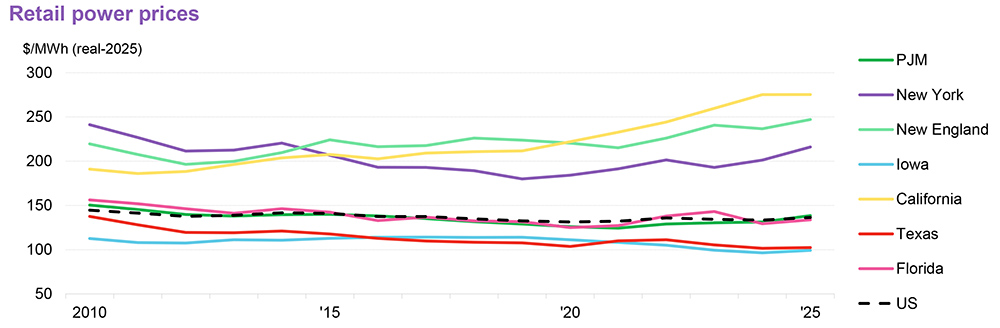
Retail power prices: How high or low can they go? | BloombergNEF

The factbook and its charts provide the kind of widely quoted data points often used to try to persuade consumers the U.S. electric power industry is working hard to keep their utility bills affordable.

But when I first saw these charts at an advance press briefing for the factbook Feb. 17, what quickly came to mind were the panel discussions I had heard on affordability and transparency at the National Association of Regulatory Utility Commissioners’ Winter Policy Summit in D.C. the week before.

Affordability can be defined in many ways, depending on context. Affordability in the abstract ─ what a utility or regulator thinks of as affordable ─ may have little if any relationship to affordability as experienced day to day by consumers looking at electric bills that keep going up.

David Springe, executive director of the National Association of State Utility Consumer Advocates, talked about his 86-year-old mother, who had upgraded her HVAC system to improve efficiency at the home she has lived in for decades but was still seeing higher electric bills.

“There’s a level of frustration going on out there right now with customers not feeling like they can control their budget and control their usage, and no matter what it is that they do, their bill keeps going up,” Springe said during the panel on affordability that closed the conference. “This is a conversation we seem to have every year at NARUC. … This interaction with customers and giving customers tools and power and ownership is something we always struggle with.”

The pressing issue of demand growth ─ primarily from data centers ─ has only heightened consumers’ and consumer advocates’ anxieties, he said.

“The scary part to me [is that] the answer seems to be that … we’re going to build our way out — spend a lot of money building our way out of this problem — and I’ll tell you that does not give the consumer advocate community the warm and fuzzies.”

Springe pointed to the October 2025 forecast from the Edison Electric Institute, the trade association for investor-owned utilities, that its members will spend $1.1 trillion in capital investments over the next five years ─ a figure that could already be out of date.

For example, in its most recent earnings call Feb. 10, Duke Energy raised its projected five-year capital expense plan 18.4%, from $87 billion for 2025-2029 to $103 billion for 2026-2030.

“Those costs are going to end up in rates,” he said.

‘Growth Must Pay for Growth’

Energy efficiency and better customer communication are the perennial low-hanging fruit ─ and as Springe noted, ongoing pain points ─ of the industry’s efforts to bridge the gap between different definitions and experiences of affordability.

According to the BCSE factbook, utility spending on efficiency programs ─ for electric and natural gas companies ─ has never exceeded $8.4 billion per year over the past decade, or less than 1% of the $1.1 trillion or more the IOUs will invest in new generation and the grid over the next five years.
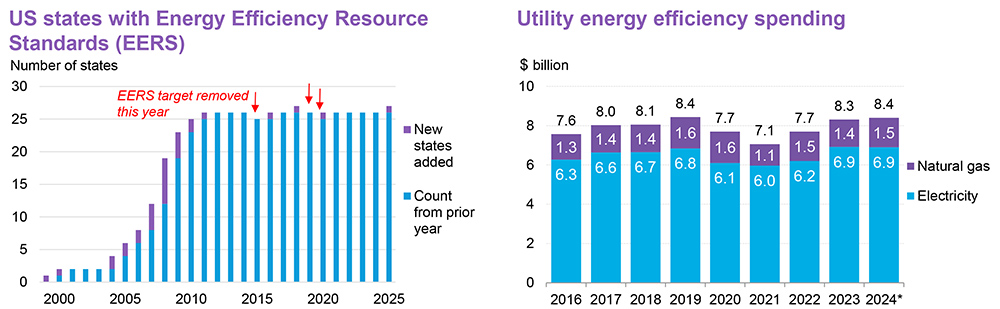
Efficiency: The low-hanging but underfunded fruit of affordability. | BloombergNEF

Policy signals also are mixed. Currently, 27 states and D.C. have some kind of energy efficiency standard, setting targets for utilities to reduce electricity consumption with efficiency measures. Arizona is expected to repeal and revise its efficiency rules, despite broad public opposition.

Springe cautioned that communication promoting efficiency must be ongoing but balanced. If bombarded with messages about energy conservation, customers could tune out and not react to cut consumption in real emergencies, he said.

Matthew Ketschke, president of Con Edison of New York, agreed that while “it’s very important to constantly [engage] our customers on the value of energy efficiency, I do have concerns about going out right before either a high-load day for heat or cold and sending [an appeal to conserve]. … It gives the impression that we, collectively as the people responsible for their energy delivery systems, did not do our jobs in making sure that we have enough capacity for safe, reliable delivery of energy. … You kind of want to save that messaging for when … there’s no room for failure.”

If efficiency can be a hard sell, the challenge is even greater for convincing consumers of the potential benefits of building new generation and power lines to meet demand growth from data centers, calling for levels of transparency that are not exactly utilities’ or regulators’ strong suit.

The new mantra at the state and federal level is that “growth needs to pay for growth,” according to speakers at a separate panel on demand growth and large loads.

“Whether it’s a regulated or a deregulated area, you need to be trying to develop policies where new large loads are accompanied by new large generation, and you grow the system in a balanced way,” said Nick Elliot, senior policy adviser for the White House’s National Energy Dominance Council.

Several reports have provided case studies in which adding new generation for large loads has helped mitigate rate increases by spreading the fixed system costs of utility bills to a larger customer base. The caveat is that “there are obviously a lot of different models for connecting these loads … [which] may not be replicable and scalable in every scenario,” said Lakin Garth, director of emerging technologies for the Smart Electric Power Alliance.

Trump’s Election Year Ploy

How these ideas play out at the state level is very much a moving target. A map and database compiled by SEPA and the NC Clean Energy Technology Center show that individual states, their regulators, utilities and high-tech customers are trying out different approaches.

According to Christopher Ayers, executive director of public staff and consumer advocate for the North Carolina Utilities Commission, it is too early to say if the various rate structures or contracts being proposed will consistently or substantially lower rates.

Transparency is critical, so the public can understand any proposed rate structures or other regulations on large loads, Ayers said.

Jose Esparza, senior vice president for public policy at Arizona Public Service, pitched for his company’s model, which uses a formula to allocate costs to large load customers so they pay 45% of the utility’s requested rate increase, compared to 14% for residential customers. APS is also providing “special contracts” for data centers looking for fast-track interconnection and service.

“What we’re offering is what we’re calling a subscription rate, where you’ll take a portfolio of resources,” he said. “The customer will have to put up a certain amount of collateral, agree to pay a 20-year or 15-year agreement, to pay down and appreciate those costs as much as possible.”

APS is facing opposition to its special contracts from Arizona Attorney General Kris Mayes, a former utility commissioner who argues they lack transparency and public oversight.

Such calls for transparency could open a new front in industry and regulatory debates, where definitions are again varied and subjective. For example, APS customers might not see a 14% rate increase as particularly affordable.

“We can say growth pays for growth, [but consumers] are not really understanding that because there is a national narrative going around on both sides of the aisle that’s convincing folks that that’s not really happening,” Esparza said. “Utilities and large load customers have to do a better job of partnering with their regulators and our customers to ensure them that we are taking this seriously.”

Briana Kobor, head of energy market innovation for Google, agreed that “transparency is key. We are screaming from the rooftops that we are here to pay our fair share of costs. Help us to show that to the public and to the regulatory ecosystem. … The math is different in every single jurisdiction. Maybe [the data center share] is 70%; maybe it’s 80%. Maybe it’s 12 years; maybe it’s 15 years. Behind that minimum revenue guarantee is a math problem, and it should be compared with what your rate is and what your marginal costs are, what you are going to be investing in, and it’s a conversation that we’re going to be having for years and years to come.”

All of which makes President Donald Trump’s State of the Union announcement of a “Ratepayer Protection Pledge,” committing the AI giants to providing their own data center power, little more than an election-year ploy aimed at co-opting and taking credit for the hard, innovative work being done on the ground.

Electricity Value vs. Cost

And, as the consumer advocates are saying, it is too early to gauge the impact of the state-level initiatives, let alone a vague federal effort.

“Once there is a large load tariff in place, the load projections kind of drop,” North Carolina’s Ayers said. “It’s because now you’re able to quantify impact; now you’re going to have to start putting money where your proposal is … and that has an inherent heightening effect in terms of our need to sharpen our pencils and get to that number. … There’s also a perception amongst the consumer advocate community that large load is still running around from jurisdiction to jurisdiction, trying to find the best deal.”

The bottom line is that, at least for the near term, electric bills are going up, and definitions and perceptions of affordability will have to evolve.
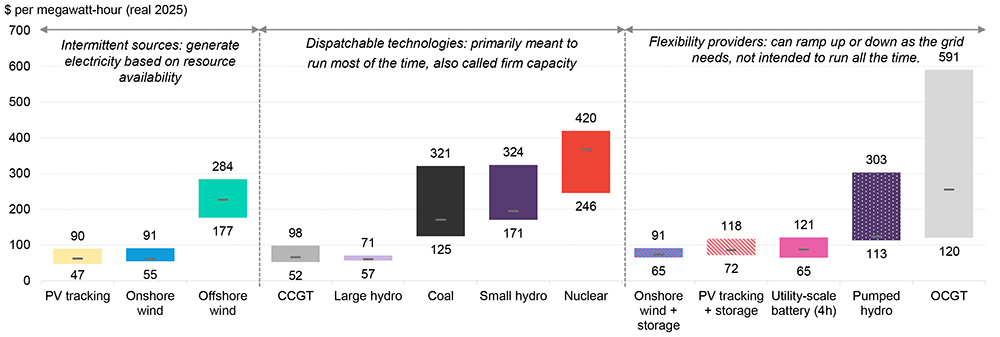
U.S. LCOEs: Again, what’s high and what’s low? | BloombergNEF

Morgan Scott, vice president of global partnerships and outreach at the Electric Power Research Institute, said that as the cost of electricity goes up, so does its value, which should be a key theme in industry messaging to customers.

The bring-your-own-power imperative for hyperscalers may be a first step, but it raises some tricky questions.

Ayers has a major concern about long-term risk and costs shifting back to consumers. If we’re building 40-year assets ─ like natural gas or nuclear plants ─ what happens after a data center’s 15- or 20-year contract runs out, he asked. Will consumers be left to pick up the tab for the remaining 20-plus years?

That’s a rabbit hole the industry has yet to go down, he said.
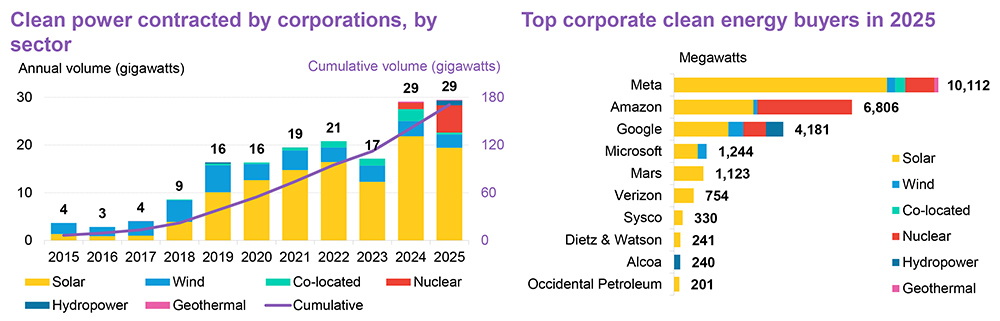
Look who’s buying clean energy | BloombergNEF

The way forward for both affordability and transparency will involve figuring out what combination of technologies ─ generation, transmission and flexible demand response ─ are going to deliver the highest value and reliability for consumers, while raising rates the least.

While it is by no means the only or most reliable measure of affordability, the levelized cost of electricity remains a useful marker. On that basis, the BCSE factbook shows that renewables remain the most affordable, which is likely at least one consideration for the corporations and investors still betting heavily on them.

Not surprisingly, Meta, Amazon, Google and Microsoft are leading the pack. Corporations are all about affordability.


Swett, Energy Company Officials Press for Permitting Reform

WASHINGTON — Congress needs to disallow states from vetoing Clean Water Act permits for interstate natural gas pipelines, FERC Chair Laura Swett said Feb. 24.

With natural gas production expected to shatter records this year, Swett joined oil and gas executives at the annual Energy Aspects Conference to urge Congress to advance permitting reform legislation that would ease the construction of natural gas pipelines.

“We can do everything to speed up the process,” Swett said. “But the court will overturn that pipeline if any state in the right of way of that pipeline does not grant the [Clean Water Act] permit.”

An attorney with Vinson & Elkins representing energy companies prior to her nomination, Swett said much of the regulatory expense and uncertainty stems from prolonged litigation over permits. “Congress has to not allow states to effectively veto federal projects.”

FERC Chair Laura Swett | Jason Dixon Photography

The Clean Water Act’s Section 401 authorizes states to certify that a proposed activity, be it construction of a pipeline or a hydroelectric dam, won’t harm water quality. States and environmental groups have used this provision and other laws to block pipeline construction, such as the 303-mile-long Mountain Valley Pipeline, which now transports natural gas from the shale production areas of northern West Virginia to Virginia. Its construction was allowed only after President Joe Biden signed the Fiscal Responsibility Act of 2023 into law.

FERC is once again considering Williams Companies’ 124-mile Constitution Pipeline, for which New York state declined to issue a water permit. On the day of the conference, the state argued in a filing that the commission must dismiss the petition and not force its Department of Environmental Conservation to “engage in yet another round of wasteful administrative review.”

Joining Swett on the panel was Toby Rice, CEO of EQT, the largest natural gas producer in the Appalachian Basin. He agreed that supply is not the problem; infrastructure is.

“Our biggest challenge in natural gas is the infrastructure that it takes to move this to market,” Rice said. “While we spend maybe 50 cents getting it out of the ground, I’ll spend $1 [to] $1.50 getting it to market.” It costs two to four times as much to ship natural gas to Boston as to extract it from the ground, he said.

Despite concerns about fracking, the shale boom has achieved record production. However, Rice said, “the pipeline cancellation movement is the only time environmentalists have been successful in shutting down development.”

Approximately 65% of total pipeline capacity built in 2025 consists of intrastate pipelines, continuing the trend of intrastate pipeline builds outpacing interstate capacity additions, the U.S. Energy Information Administration reported Feb. 25.

Congress has been debating permitting reform for years without success, but Mike Sommers, CEO of the American Petroleum Institute, is optimistic about its prospects under a Republican-controlled Congress.

“I am more optimistic today than I was three months ago that we actually could get something done this year with this Congress, because it is becoming a political imperative for politicians to do this because of affordability,” Sommers said.

Meeting Power Demand

While much of the conference was focused on the oil and gas production and celebrating the 10th anniversary of the first LNG cargo shipment from the Sabine Pass Terminal, panels also discussed rising power demand from data centers and potential solutions.

Speaking prior to Swett and Rice in an earlier panel on policy perspectives, Deputy Energy Secretary James Danly acknowledged that rising electricity demand is “undeniable.”

He said the Department of Energy is taking steps to ensure reliability while making sure rates remain affordable.

“We are doing everything we can to reconductor as many of the strategically important transmission lines to reduce congestion costs and to improve reliability,” Danly said.

Deputy Energy Secretary James Danly speaks to M2M Advisors CEO Majida Mourad. | Jason Dixon Photography

He also noted that DOE petitioned FERC in October to explore rules governing the co-location of large electricity loads, such as data centers, with on-site generation. The proposal would allow large users to supply their own power under certain conditions. (See Energy Secretary Asks FERC to Assert Jurisdiction over Large Load Interconnections.)

FERC is working its way through the voluminous comments on DOE’s proposal, with the department asking for action by April 30 (RM26-4).

President Donald Trump alluded to data centers bringing their own generation in his State of the Union address to Congress the same day as the conference, saying he had reached a “a new ratepayer protection pledge” with major tech companies to build their own power plants.

Calling it a “unique strategy never used in this country before,” Trump said this approach will ensure that “no one’s prices will go up, and in many cases, prices will go down for the community, substantially down.”

Trump did not disclose the names of the firms involved in the pledge, and it is still unclear what exactly it will involve. The president is planning to host officials from Amazon, Google, Meta, Microsoft, xAI, Oracle and OpenAI at the White House to sign the pledge March 4.

In the conference’s final panel, Invenergy CEO Michael Polsky said the U.S. grid must be improved before new generation sources are added.

“You build roads, and then you build houses,” Polsky said. “The same goes with electricity; you build up a grid first.”

PSEG Looks to Support N.J.’s Nuclear, Gas Generation Plans

PSEG is working to meet the energy needs expressed by New Jersey Gov. Mikie Sherrill (D) and is gearing up to help with the potential expansion of the state’s nuclear and gas generation fleet, the utility’s CEO said in its fourth-quarter earnings call.

CEO Ralph LaRossa, after presenting the company’s expectation of 6 to 8% compound annual growth through 2030, said it could be even higher given some of the initiatives drafted by the state to increase its energy generation capacity and curb rate increases.

“We have been cooperatively working with policymakers since last November,” LaRossa said on the Feb. 26 call. He also cited a bill introduced in recent days that would establish a new natural gas power plant procurement program at the Board of Public Utilities “and incentivize the development of new natural gas power plants in the state.”

“This gas bill pairs with an earlier bill that establishes a new nuclear procurement program, also within the BPU, that was introduced at the start of this legislative session,” he said. He added that the utility would “support legislation that would increase competition for generation supply, should New Jersey decide to pursue new in-state generation.”

The utility is “well positioned to help meet that need,” he said. “We have sites with grid connection capability and pipeline supplies, as well as the in-house expertise to build new supply here in New Jersey with prevailing wage labor.”

Sherrill, who took office Jan. 20, has prioritized tackling the energy problem. She released two executive orders on her first day that sought to freeze electricity rates and implement a range of policies designed to improve energy efficiency and stimulate the development of new generation. (See New N.J. Governor Rapidly Confronts Electricity Crisis.)

As part of that effort, the BPU issued a request for information to the state’s four utilities probing their response to issues such as how to speed up connection and how they are complying with new rules instituted in 2025 to modernize the grid. (See N.J. Looks to Utilities for Solar Expansion Answers.)

Asked about specific issues that may concern PSEG as it works with the governor’s administration, LaRossa said, “the way we’ve been thinking about it is trying to help policymakers think through and then enable the opportunities for gas or for new nuclear.”

Big Nuclear, Not SMR

Introduced on Feb. 24, bill A4491 would direct the BPU to launch a request for expressions of interest in developing new natural gas power plants that could generate at least 1,100 MW. The legislation sets out the conditions that would need to be met for the BPU to approve the plant and gives the agency authority to grant financial support in the form of a Natural Gas Development Charge and Natural Gas Energy Certificates (NGECs).

PSEG neither owns nor operates gas plants, having announced plans in July 2020 to sell all its fossil plants, a task the company completed in February 2022, said spokesperson Marijke Shugrue. The utility owns and operates three nuclear plants in South Jersey.

LaRossa did not specify what role the utility might play in the development of new gas or nuclear plants. Asked for clarification, the company referred RTO Insider to an article LaRossa released after the election. It outlined the state’s problems — including the predicted generation shortfall — and called for the state to “immediately open a process to procure in-state generation.” LaRossa added that “PSEG is ready to deliver new generation quickly and affordably.”

At present, however, New Jersey law prohibits regulated electric utilities from building or owning generation plants.

Asked on the earnings call about the company’s interest in hosting small nuclear reactors on its South Jersey site, LaRossa said “if we were advocating, we’re advocating for — on a nuclear front — big nuclear. We think that that makes the most sense based upon our property and our footprint.

“We have a site that makes a ton of sense, where we have pipes, wires running to it already. SMRs, from our standpoint, would not be the highest and best use of our property, but one that would be open to people if that was really what folks wanted us to enable. Remember, our early site permit is technology agnostic, so we could go in any direction on that.” The U.S. Nuclear Regulatory Commission issued an Early Site Permit for the site in 2016.

Q4 Results

PSEG reported 2025 net income of $2.11 billion ($4.22/share), compared to $1.77 billion ($3.54/share) for 2024. Net income for the fourth quarter was $315 million ($0.63/share), compared to $286 million ($0.57/share) a year earlier.

Black Hills, PowerWatch to Join WEIM in May

Black Hills Energy and PowerWatch are to join CAISO’s Western Energy Imbalance Market, extending the market’s geographical reach into South Dakota, the ISO announced.

Black Hills and PowerWatch, formerly known as BHE Montana, are to join the WEIM on May 6, five days after the scheduled launch of CAISO’s Extended Day-Ahead Market with PacifiCorp as the first participant, CAISO announced Feb. 25.

“We are honored to welcome Black Hills Energy and PowerWatch into the WEIM,” CAISO CEO Elliot Mainzer said in a statement. “The continued growth of our markets delivers real economic benefits to market participants and their customers and is a proven strategy for improved reliability and affordability throughout the region.”

Black Hills and PowerWatch are working with CAISO to complete readiness criteria by March. FERC must approve the readiness certification before they can join, according to the release.

With Black Hills joining the fold, the market’s footprint extends into South Dakota as WEIM’s 12th Western state, CAISO wrote in a news release.

Black Hills serves 1.35 million natural gas and electricity customers in eight states. In January, the utility announced it had completed construction on a 260-mile, $350 million transmission expansion project to interconnect electric systems in Wyoming and South Dakota. (See Black Hills Completes $350M Tx Project.)

In 2024, Black Hills Power and Cheyenne Light announced they would move from SPP’s Western Energy Imbalance Service to CAISO’s WEIM. (See CAISO’s WEIM Plucks Black Hills Utilities from SPP’s WEIS.)

Under the WEIM implementation agreement signed by Black Hills Power and Cheyenne Light, the utilities agreed to register a new balancing authority to facilitate participation in the market by 2026.

The newly energized 260-mile line is part of Cheyenne Light’s FERC tariff and will be within the WEIM when the utility begins participation in May, according to Black Hills.

PowerWatch is a subsidiary of Berkshire Hathaway Energy. It is the second generation-only balancing authority committed to participate in the WEIM, CAISO stated, with Avangrid in the Northwest being the first.

TerraPower Poised to Break Ground on Natrium Nuclear Plant in Wyoming

WASHINGTON — Bill Gates-backed nuclear power startup TerraPower expects to break ground on its planned Natrium power plant in Wyoming within weeks, the company’s top executive said Feb. 24.

“We’re probably just a few weeks from the [Nuclear Regulatory Commission] awarding the construction license for our plant,” TerraPower CEO Chris Levesque said at the annual Energy Aspects Conference at the Waldorf Astoria hotel in D.C.

Once the permit is in hand, TerraPower can begin building its 345-MW sodium-cooled, small modular reactor, which would be the first commercial venture of this nature to reach this stage. The company hopes to complete construction by 2031, after which it will seek a permit to begin operations.

“This will be really huge for us as a nation,” Levesque said, calling the project a key step forward in deploying the next generation of grid-scale nuclear reactors.

The U.S. needs these next-generation reactors to achieve parity with Russia and China, he argued.

At least 12 commercial reactors featuring state-of-the art small modular technologies are at various stages of development in the U.S., according to data from Yes Energy’s Infrastructure Insights.

Among them is an 80-MW small modular reactor being jointly developed by Dow Chemical and X-energy at Dow’s UCC Seadrift Operations along the Texas Gulf Coast. X-energy submitted a construction permit for it in March 2025.

The Trump administration has prioritized nuclear power to meet rising demand from data centers to power artificial intelligence applications and replace aging baseload generation. Just the day after the conference, the Department of Energy announced a $26.5 billion loan package for Southern Co. subsidiaries Alabama Power and Georgia Power that includes licensing and upgrades for about 6 GW of nuclear generation. (See related story, DOE Loans $26.5B to Southern Co. for Infrastructure Upgrades.)

Federal regulators also are moving to streamline licensing and regulations. DOE recently created a new categorical exclusion under the National Environmental Policy Act for certain advanced reactor projects, while the NRC is developing a new regulatory framework for advanced reactors under Parts 53 and 57. Those rules are expected to be finalized by the end of the year, NRC Commissioner David Wright said at the conference.

Still, challenges remain. “To say that nuclear power is not without its challenges would be ingenuous,” Deputy Energy Secretary James Danly said in an earlier panel.

Deploying first-of-a-kind technology, such as the kind Oklo and TerraPower are pioneering in the U.S., comes with its own challenges, including access to financing, reliable supply chain and a skilled workforce, as well as supportive government policies, NIA CEO Judi Greenwald said during a webinar Feb. 26 on the project tracker.

“And we are in that place now.”

CPUC Orders Massive 6 GW of New Capacity to Feed Data Centers, Other Loads

At a meeting about 260 miles away from its headquarters, the California Public Utilities Commission ordered 6 GW of new capacity to meet forecast data center and electric vehicle loads — among other new demand — in the state.

More than half of the 6 GW will come from Pacific Gas and Electric and Southern California Edison, according to the final decision approved by the CPUC on Feb. 26.

“Over 800 pages of comments on the proposed decision alone is a testament to how seriously stakeholders take this work,” Commissioner John Reynolds said at a voting meeting held in Santa Maria City Hall.

The original proposed decision, issued in January, said no more than half of the 6 GW could come from energy storage resources, but the revised final decision threw the requirement out.

“The imposition of a cap on the amount of storage to be procured would be unwise,” the decision says, “because we have no wish to discourage the development of longer-duration storage beyond four-hour lithium-ion batteries, which imposing a cap could do.”

Instead, the revised proposed decision mandates at least one-quarter of the new capacity must come from long-duration energy storage or clean, firm power.

“This change was partly driven by the fact that these resources have value that may not always be captured by our existing renewable portfolio standard and resource adequacy compliance,” Reynolds said.

However, Commissioner Matt Baker said he is “weary of any kind of carve out for specific technologies. The integrated resource planning process really is designed to say how do we get to zero carbon emissions at the lowest possible costs.”

Most of the stakeholders supported the 6 GW procurement order, except for Protect Our Communities Foundation (PCF), the final decision says.

The CPUC should analyze and report on the expected data center load in the utilities’ service areas before requiring costly utility-scale resources and corresponding transmission expenditures, PCF said in Feb. 6 comments. It also said the commission should determine how much of that load — as well as load from future adoption of EVs and building electrification — can be met by facilitating customer-sited generation instead of requiring ratepayers to foot the bill.

The CPUC acknowledged it lacked sufficient evidence regarding its asserted bases for requiring procurement of an additional 6 GW, PCF added.

“The commission should not burden ratepayers with the costs of additional procurement unless and until the commission has first established with reliable evidence that such a need exists in the first place,” PCF said.

Some stakeholders questioned other assumptions in the decision, such as VoteSolar, which said data centers could be built in lower-cost states such as Oregon and Arizona, thereby lowering the CPUC’s assumed future data center load. Drought conditions could lower the amount of hydropower available to California as well, the organization added.

“I find that, like many stakeholders, there is a lot of uncertainty surrounding the medium-term forecast,” Baker said. “I think it would be pragmatic to re-evaluate the medium-term forecast … in the next couple of years to make sure we are right-sizing things.”

In Feb. 11 comments, CAISO said if only 2 GW of procurement is required in 2030 and no more until 2032, then the electric system could be vulnerable to reliability risks in 2031.

“Issuing a procurement order well ahead of the identified need will provide LSEs and developers with the necessary lead time to complete procurement processes and navigate potentially long development timelines,” CAISO said. “This proactive approach is critical to avoid capacity shortfalls in 2029 to 2032.”

Commissioner Darcie Houck added it is “critical that we closely scrutinize procurement amounts and that we should all be concerned about any excess procurement that could needlessly add to ratepayer costs.”

SPP Secures 2 More Commitments for Markets+ in Washington

SPP has secured two new commitments for its day-ahead Markets+, as Grant County Public Utility District and Tacoma Power in Washington state announced their intent to join.

The utilities are to begin participating in Markets+ and SPP’s real-time market Oct. 1, 2028, joining at least seven other entities that have signed agreements, the RTO announced Feb. 27.

“The addition of Grant County PUD and Tacoma Power reflects the continued growth and momentum of Markets+ across the Pacific Northwest,” said Carrie Simpson, SPP vice president of markets. “These utilities recognize the value of a market built on strong governance, reliability and cost savings for their customers. We look forward to our continued partnerships building a market that works for the entire Western Interconnection.”

The two utilities are both parties to a $150 million funding agreement SPP signed in April 2025 with eight Western entities to develop Markets+. However, neither utility had announced when it would join, according to SPP’s announcement. (See SPP Launches Markets+ Phase 2 With $150M Secured.)

Arizona Public Service, Powerex, Public Service Company of Colorado, Salt River Project and Tucson Electric have said they will begin participating in Markets+ when it goes live in October 2027. Grant County PUD and Tacoma Power, with Puget Sound Energy and Chelan County PUD, are to join in 2028.

The Bonneville Power Administration announced in May 2025 it intends to pursue participation in Markets+ over CAISO’s Extended Day-Ahead Market, but a group of nonprofits has challenged BPA’s decision in the 9th U.S. Circuit Court of Appeals. (See related story, Nonprofits Tell 9th Circuit BPA’s DAM Decision Poses ‘Imminent’ Harm.)

Grant County PUD serves approximately 56,000 customer meters in Central Washington and operates more than 2,100 MW of hydroelectric generation, according to SPP’s announcement.

Tacoma Power, meanwhile, serves 186,975 customers in Pierce County.

“Grant PUD’s mission is to deliver reliable and affordable energy to our growing customer base,” John Mertlich, the utility’s CEO, said in a statement. “Joining SPP’s Markets+ is a strategic step that strengthens our ability to do so. Additionally, joining Markets+ aligns us with a growing coalition of utilities across the West who are working toward a more reliable, interconnected and economically integrated regional power grid.”

Energy Availability Tops MRO’s 2026 Risk List

Uncertain energy availability remains an “extreme priority risk” for the Midwest Reliability Organization for the third year in a row as generation growth fails to keep pace with rapidly rising demand, representing the highest level of risk classification in the regional entity’s 2026 Regional Risk Assessment.

Six other risks were classified as high priority in the assessment, released Feb. 23. Extreme and high risks are considered to require “immediate attention for regional awareness and mitigation efforts,” as opposed to medium and low risks, which can be “managed with routine procedures or less intensive monitoring.”

The six high priority risks are nation-state threats; generation outages during extreme cold weather; supply chain compromises; inadequate inverter performance and modeling; malicious insider threats; and material and equipment unavailability. All were a high risk in 2025 except material and equipment unavailability, which moved up from medium to high in the 2026 report. Another seven risks, including loss of essential reliability services, physical attacks, inaccurate facility ratings and various cybersecurity risks, were considered medium priority.

MRO produces the Regional Risk Assessment each year as a supplement to NERC’s Long-Term Reliability Assessment. Risks are identified throughout the previous year from various sources including risk assessments, government intelligence and stakeholder engagement, and ranked by a team comprising subject matter expert volunteers and MRO staff according to potential impact and likelihood of occurrence.

In NERC’s 2025 LTRA, released Jan. 29, the ERO warned that multiple assessment areas — including significant parts of MRO’s footprint — face a high risk of energy shortfalls over the next 10 years, largely because of projected demand growth outstripping planned generation additions. (See NERC Warns of ‘Worsening’ Resource Adequacy Through 2035.)

The regional assessment is consistent with this analysis, citing “accelerating retirements of dispatchable power plants before adequate replacement energy is available, limited transmission capacity and barriers to timely deployment of new infrastructure” in the MRO region to explain why uncertain energy availability earned the highest risk rating. Amplifying the risk is the increasing presence of weather-dependent, hard-to-forecast resources like wind and solar among projected new generation.

The report’s authors moved material and equipment unavailability up in the rankings because of “industry sentiment on lead time extensions and the loss of guaranteed production slots for major grid equipment [like] transformers and circuit breakers.” MRO pointed to reports of utilities “cannibalizing underutilized equipment” to prevent delays to urgent repairs and new construction in more heavily used parts of the grid.

Generation outages during extreme cold weather remain a high priority risk, MRO said, with winter demand growth continuing to outpace summer demand growth and “signaling a fundamental shift toward winter-peaking energy usage.”

However, the RE also assessed the risk as slightly less likely to occur, primarily because of the adoption of NERC’s new cold-weather reliability standards such as EOP-012-3 (Extreme cold weather preparedness and operations), which took effect Oct. 1, 2025. (See FERC Clarifies Cold Weather Standard Approval, Effective Date.)

“There are performance improvements as evidenced by no major events within the MRO region; discovering limits and managing those equipment limits have yielded tangible results,” MRO wrote. “There is a sense of ‘cautious optimism’ with this progress, as reliability concerns remain in the production and delivery of natural gas and whether recent extreme winter storms match conditions seen in benchmark storms.”

Judge Orders Spill at Northwest Dams to Aid Salmon, Despite Energy Concerns

A federal judge in Oregon ordered increased spill levels at eight dams on the Columbia and Snake rivers to protect endangered salmon species, rejecting claims that doing so would impede power generation.

U.S. District Judge Michael H. Simon on Feb. 25 granted a preliminary injunction sought by the states of Oregon and Washington, tribes and environmental groups. The order requires the U.S. Army Corps of Engineers and the Bureau of Reclamation to spill large amounts of water over the dams instead of running it through turbines to protect migrating salmon and steelhead in the Columbia and Snake rivers.

Simon said the salmon species have “dwindled to near extinction levels” as the issue has played out in courts over the decades.

“One of the foundational symbols of the West, a critical recreational, cultural, and economic driver for Western states, and the beating heart and guaranteed resource protected by treaties with several Native American tribes is disappearing from the landscape,” Simon wrote. “And yet the litigation continues in much the same way as it has for 30 years.”

The case, which began in 2001, now concerns an environmental impact statement and a biological opinion from 2020 that the court ordered the federal agencies to prepare for the Federal Columbia River Power System.

In challenging the analysis, the plaintiffs alleged the Army Corps of Engineers’ plan failed to adequately protect salmon.

The case was stayed after former President Joe Biden assumed office and allowed the parties to work out a deal. An agreement was reached in 2023, which included $1 billion toward salmon restoration.

The Biden administration was considering breaching four dams on the Snake River that produce more than 3,000 MW, but it did not make a final decision.

The parties resumed litigation after President Donald Trump upended the deal in June 2025. The Trump administration said the deal would have several negative impacts on energy production, shipping channels and water supply for local farmers. (See Trump Directs Feds to Withdraw from Deal on Snake River Dams and BPA Cuts Payments for Tribes, Salmon Restoration Under Revised Cost Projections.)

In resuming the case, the plaintiffs asked the judge for injunctive relief beginning March 1.

Specifically, they sought a preliminary injunction to address alleged violations of the Endangered Species Act.

They urged the court to order federal defendants to increase spill levels, lower reservoir levels and implement emergency conservation measures for the salmon.

In his Feb. 25 order, Simon granted the motion in part, writing he “declines to impose many of plaintiffs’ requests challenged by the federal defendants as outside of this court’s equitable authority to grant.”

Simon said the injunction includes a provision for the federal agencies to adjust spill for emergency power generation and transportation needs. However, he rejected arguments that increasing spill levels could impact power generation, saying the granted relief is “narrowly tailored and essentially maintains the status quo.”

“The court is unpersuaded by arguments that spill will create various catastrophic results,” Simon wrote. He added that defendants have presented similar concerns in the past “without them coming to fruition.”

“The majority of the spill has been implemented over the years without such negative repercussions, and the court does not anticipate such calamities will ensue from the current spill order,” Simon wrote.

PPC ‘Disappointed’

Though Simon ordered modifications to spill levels, he granted defendants’ request to keep reservoir levels at the 2025 operating levels and declined to implement a series of nonoperational conservation measures.

“Those limited acknowledgments, however, do not offset the broader impacts this decision could have on the region’s power supply, transmission operations, greenhouse gas emissions, and customer costs,” Public Power Council’s Scott Simms said in a statement.

PPC is the lead defendant-intervenor for public power in the case. The group represents Northwest publicly owned utilities that buy federal hydropower marketed by the Bonneville Power Administration.

“PPC is disappointed that the court adopted a sweeping operational injunction that will materially affect the region’s clean hydropower system and the millions of people who depend on it,” Simms said. “The Columbia River system already operates under some of the most protective fish measures in the nation, and public power utilities have invested billions of dollars over decades to support salmon recovery while producing reliable and affordable electricity.”

A spokesperson for the U.S. Department of Justice declined to comment.

Meanwhile, plaintiffs celebrated the ruling.

“We absolutely can have clean energy and restored salmon runs, and today’s ruling is an important step in the right direction,” Zachariah Baker, NW Energy Coalition’s regional and state policy director, said in a statement. “The ruling helps protect salmon, while the region continues to collaborate on the comprehensive, strategic solutions envisioned in the Resilient Columbia Basin Agreement the administration withdrew from, including how to ensure abundant, affordable and reliable clean energy across the Northwest.”

Simon denied the defendants’ request to stay the case pending appeal.

Municipal Utility Would Cost City of Tucson $4B, Study Finds

As Tucson, Ariz., weighs whether to take over part of Tucson Electric Power’s electric system to form a municipal utility, a new study said such a move would cost the city more than $4 billion.

The Brattle Group study, commissioned by TEP, found that the additional cost to city residents would average about $290 million per year for the next 20 years under a municipal utility compared to sticking with TEP.

“Municipalization can be lengthy, litigious and costly,” said the paper, by Brattle principals Toby Bishop and Ann Bulkley and associate Adam Wyonzek.

The authors noted that of 68 electric utility municipalizations attempted in the U.S. in the past 25 years, only seven succeeded. And in two of the seven cases, the utilities later were sold back to the original investor-owned utility.

In announcing the new study Feb. 24, TEP CEO Susan Gray said a city takeover of the utility’s system would be “an unrealistic, unaffordable and unnecessary distraction.”

“A forced takeover would jeopardize reliability, slow clean energy development and create roadblocks for economic development initiatives that depend on TEP’s proven ability to deliver power safely, reliably and sustainably,” Gray said in a statement.

TEP serves 457,000 customers in Tucson and surrounding areas. TEP and its parent company, UNS Energy, are subsidiaries of Canada-based Fortis.

The city has been exploring formation of a municipal utility as one potential way to rein in electric rates and meet climate goals. The 25-year franchise agreement between the city and TEP expires in April.

Residents in support of a Tucson municipal utility are upset by rising electric bills and TEP’s backing of new data centers in the area, according to a group called Tucson Democratic Socialists of America. The group said it has collected more than 4,000 signatures on a “public power for Tucson” petition.

“Let’s put it to a vote, TEP. Let Tucson decide on public power,” the group said in a release.

Conflicting Reports

The city commissioned its own study of forming a municipal utility. An April 2025 draft report found that a Tucson municipal utility would be financially feasible, and average residential customers would see their electric bills drop by $241 per year within the first five years. The report was prepared by engineering and consulting firm GDS Associates and law firm Best Best & Krieger.

The Brattle researchers noted several reasons their findings differed from those of GDS Associates. GDS assumed municipal service would start in 2028, which Brattle called unrealistic. Brattle went with a 2032 start date instead, noting that acquisition costs will increase over time as TEP invests more in its system.

GDS estimated it would cost between $1.4 billion and $3.6 billion to buy TEP’s electric system in Tucson; Brattle pegged acquisition-related costs at $4.05 billion. And TEP’s costs to serve Tucson customers would be lower than a municipal utility’s costs over the 20 years examined, Brattle projected.

In another difference between the two studies, GDS assumed TEP’s rates would increase 3.5% per year, based on an inflation rate “calculated during a period when inflation was at its highest in the past 40 years,” Brattle said. By contrast, Brattle estimated future rates through a breakdown of generation, transmission and distribution components.

Data Center Impacts

Brattle also looked at impacts of the Project Blue data center that has been proposed within TEP’s service area — but outside of Tucson. TEP expects the data center to bring in significant revenue that might create rate benefits for other customers.

“[The data center’s] exclusion from the area served by a municipal utility would make municipalization even more financially infeasible,” Brattle said.

A $3.6 billion Phase 1 of Project Blue would consist of 10 data center buildings that could begin operation as soon as 2027. A Phase 2 of data center development could follow.

The Arizona Corporation Commission voted 4-1 in December to approve a 286-MW energy supply agreement between TEP and the Project Blue developer. (See TEP Wins Approval for Data Center Energy Supply Agreement.)