BOEM Seeks to Vacate Maryland Offshore Wind Approval

BOEM is formally seeking to vacate approval of the US Wind project off the Maryland coast, saying it made errors in granting the approval. 

The move is the latest in the campaign against offshore wind power development that President Donald Trump initiated hours after the start of his second term in January. 

Along with erecting a series of new regulatory barriers to future projects, the Trump administration has moved to impede existing projects in advanced development or actual construction. 

It issued stop-work orders against Empire Wind and Revolution Wind, two projects in active construction; remanded the air quality permit for Atlantic Shores; and most recently indicated it would seek to remand Biden-era construction and operations plan (COP) approvals for New England Wind, SouthCoast Wind and US Wind. (See Interior Reconsidering Approval of Two OSW Projects and BOEM Plans to Vacate New England Wind Project Approval.) 

The three COP remands are sought as part of lawsuits that offshore wind opponents filed against federal agencies seeking to invalidate their approvals of the three projects. 

In the US Wind case in U.S. District Court in Maryland (1:24-cv-03111), elected leaders of Ocean City, Md., and others are trying to prevent construction of wind turbines with as much as 2.2 GW of nameplate capacity as close as 10 nautical miles from the popular vacation destination. 

On Sept. 12, the Bureau of Ocean Energy Management asked the court to remand and vacate its approval of the COP for the Maryland project. BOEM said its desire to reconsider the approval is by itself sufficient reason to grant remand, and BOEM’s identification of an error in the approval process justifies vacating the approval. 

BOEM also asks the court to dismiss the lawsuit if it grants the motion to vacate approval, as the lawsuit would be moot. If only remand is granted, BOEM asks the court to place the lawsuit on hold for the duration of the remand. 

There was no real suspense about the Sept. 12 filing: BOEM had indicated in an Aug. 25 filing that it would make such a motion no later than Sept. 12. 

US Wind struck back first. 

On Sept. 3, it countersued the Department of the Interior and other defendants in 1:24-cv-03111, saying the effort to vacate or otherwise undermine the federal agencies’ previous efforts is illegal, factually incorrect and a pretextual means to achieve policy goals. 

It wrote: “The federal defendants’ efforts to vacate and undermine the federal approvals are inextricably tied to a wider plan to hinder or kill outright offshore wind projects (and renewable energy projects more generally) for political purposes, as evidenced by numerous official acts and public statements by federal defendants, various members of the current presidential administration and others within the federal government acting in concert with federal defendants.” 

US Wind is asking the court to declare that federal approvals for its project were lawfully issued, to enjoin the federal defendants from taking any action to undermine any of the approvals, and to award legal fees and costs. 

In its Sept. 12 motion, BOEM faults its prior assessment of factors in Title 43 Section 1337(p)(4) of the U.S. Code, which pertains to commercial activity on the Outer Continental Shelf. 

As examples, BOEM said it now feels it underestimated the effect the offshore wind farm would have on helicopter search and rescue operations and said its impact on commercial fisheries may not be sufficiently mitigated under terms of the COP. 

BOEM brushed aside US Wind’s objections: “US Wind may be concerned that BOEM will make a different decision than its prior COP approval, but those concerns are speculative and unripe.” 

BOEM also said offshore construction still is months or years away, so it would not be disruptive for the court to vacate the COP approval. 

Later Sept. 12, the Oceantic Network criticized BOEM’s motion: “Today’s news is yet another targeted action against American energy. The unlawful actions by the Trump administration against fully permitted offshore wind projects up and down the East Coast represent one of the largest, economically devastating assaults on U.S. workers, businesses and energy in decades. Revoking a permit on an approved project after years of thorough agency review will raise electricity prices for families, jeopardize private investment, delay economic growth and weaken our power grid.” 

The Maryland Offshore Wind project dates to an Aug. 19, 2014, auction of what now is OCS-A 0490. BOEM issued a record of decision in favor of the project in September 2024 and approved the COP in December 2024. 

The first two phases of the project — the 300-MW MarWin and the 800-MW Momentum Wind — hold offshore renewable energy certificate agreements with Maryland. 
Texas PUC Approves Entergy Gas Plants, Caps Costs

Texas regulators have approved Entergy Texas’ request to build two natural gas-fired generating units in MISO’s portion of the state, but they limited the construction costs eligible for recovery to a combined $2.4 billion.

Thomas Gleeson, the Public Utility Commission’s chair, filed a memo Sept. 10 outlining his proposal to protect ratepayers from “bearing the burden of … potentially higher costs” during construction. In doing so, Gleeson rejected an administrative law judge’s recommendation to deny Entergy’s application (56693).

“I think the proper thing to do on the cost cap is to impose a hard cost cap of $2.4 billion,” he said during the PUC’s Sept. 11 open meeting.

The ALJ found in June that, while all parties agreed Entergy had shown a “significant near-term need” for additional capacity, it had not demonstrated the two gas units were a cost-effective alternative to meet that need. The judge recommended Entergy’s application be denied as it did not meet its burden of proof.

However, the judge said also that Entergy had demonstrated an “imminent” need for additional capacity as early as 2028, leaving little time to secure different resources. It said the PUC could approve Entergy’s Dispatchable Portfolio, as it has been labeled, but that it should impose certain conditions of cost recovery.

The PUC applied conditions in the order requiring weatherization and permit approval for future implementation of hydrogen operations and carbon capture and storage.

Entergy Texas filed an application for approval to build the two plants in June 2024, saying they were part of the company’s “urgent need” to add 40% more generation capacity in four years in the face of “extraordinary” economic and population growth in Southeast Texas.

“We’ve heard directly from our customers and communities about the need for more power to support our rapidly growing region, and these facilities will deliver just that,” Entergy Texas CEO Eliecer Viamontes said in a statement.

The plants will be capable of providing 1,207 MW of energy and will generate a combined $2.74 billion in regional economic activity during construction, Entergy said. The company said the units are expected to be in service by 2028.

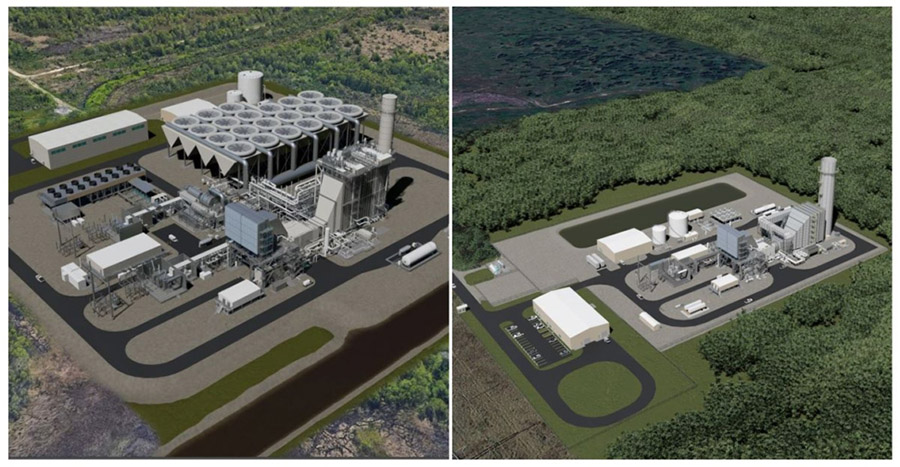
Rendering of Entergy’s proposed Legend Power Station and Lone Star Power Station | Entergy Corp.

Legend Power Station, near Port Arthur in southeast Texas, is a 754-MW combined cycle turbine facility. It will be carbon capture-enabled and feature a hydrogen-capable combustion turbine.

Lone Star Power Station is a 453-MW hydrogen-capable combustion turbine facility near Cleveland, northeast of Houston.

Under the terms of the PUC’s approval, Legend will be limited to $1.6 billion and Lone Star to $799 million in recoverable costs.

An Entergy Texas spokesperson said both projects have been accepted into MISO’s new Expedited Resource Addition Study process (ERAS). “We expect their generator interconnection agreements to be available next year,” she said.

However, the projects do not appear on the list of 10 finalists to enter the first ERAS cycle. MISO plans to accept another round of applications for a second cycle in early November and begin studies in December. (See MISO Selects 10 Gen Proposals at 5.3 GW in 1st Expedited Queue Class.)

Legend and Lone Star are part of Entergy Texas’ Southeast Texas Energy Plan, also known as STEP Ahead. The six-step plan aims to add 1,600 MW of capacity to the grid by 2028 along with transmission and grid-hardening projects.

Commissioner Kathleen Jackson agreed with Gleeson in the 2-0 decision. Commissioner Courtney Hjaltman recused herself from the discussion and vote.

Mobile Gens Synchronized

ERCOT legal staff told the commission that CPS Energy and LifeCycle Power have interconnected eight of the 15 mobile generators that have been moved from Houston to San Antonio to address a transmission constraint.

Nathan Bigbee said the remaining units are expected to be synchronized and available for ERCOT’s dispatch by mid-October, two months later than originally planned. All 15 30-MW units will be dispatched only during emergency conditions through March 2027.

The units originally were leased from LifeCycle Power by CenterPoint Energy in Houston. ERCOT says the generators are necessary to mitigate emergency load-shed that may be necessary to avoid overloads of a generic transmission constraint. It became apparent in February that the grid operator would not be able to extend reliability-must-run agreements to two aging CPS gas-fired units. (See ERCOT Board OKs Mobile Generators in San Antonio.)

ESRs as ‘Stand-alone’ Resources

Commission staff recommended that energy storage resources (ESRs) be included in the PUC’s first proposed rulemaking on net metering arrangements involving a large load co-located with an existing generation resource (58479).

Legislation passed during the 2025 biennial session requires ERCOT to study the system impacts of net metering arrangements involving “stand-alone” resources as of Sept. 1, 2025, and new large-load customers. On Sept. 2, staff posted a market notice that included an attachment listing the types of stand-alone resources.

Bigbee said he found “near-universal” support for including ESRs during a Sept. 2 workshop on net metering.

“We believe that’s a defensible approach as well,” he said. “So, if it’s the commission’s will, we’d be happy to include them on the list.”

The commission will discuss the proposed rulemaking at its Sept. 18 open meeting.

The PUC also:

    • Remanded back to docket management a revised order on CenterPoint’s system resiliency plan. In a memo, Hjaltman said the utility’s proposed transition from a five-year to a three-year vegetation management trimming cycle lacked key information supporting cost recovery. She requested supplemental evidence to justify the plan’s approval and a proposed cost-recovery mechanism. An ALJ filed the revised order in July (57579).
    • Delayed action on Entergy Texas’ proposed 500-kV single-circuit transmission line in Northeast Texas. The 150-mile line has drawn opposition from local landowners, who requested a rehearing of the State Office of Administrative Hearings’ decision to recommend a certificate of convenience and necessity for the line. The project’s various routes range from 131 to 160 miles and its costs are projected to be between $1.33 billion and $1.52 billion (57648).

E-ISAC Updates NERC Committee on GridEx VIII Scenario

GridEx VIII, a security exercise, will see changes both visible and behind the scenes that are designed to match real-world developments in the past two years, an official with the Electricity Information Sharing and Analysis Center (E-ISAC) told members of NERC’s Reliability and Security Technical Committee. 

Speaking at the RSTC’s quarterly meeting Sept. 11, GridEx Program Manager Jesse Sythe outlined some of the updates to the biennial training event scheduled for Nov. 18-19. These include new participation options for the distributed play portion: In addition to the traditional full-scale exercise, participants can choose a simplified “GridEx-in-a-box” option designed for smaller planning teams and organizations new to the exercise, or a streamlined “tabletop” scenario for entities unable to participate in a real-time program. 

All three participation options will be based on the same scenario, Sythe said, and will involve physical and cybersecurity threats to grid infrastructure inspired by real-world events. While he did not provide the full scenario, he said it will involve climate change impacts such as wildfires and heat domes, along with attacks coinciding with a major world sporting event. This element was added in light of the 2026 FIFA World Cup and 2028 Summer Olympic games, both of which will be held in the U.S. 

Planners also have incorporated new tools for the scenario, including a new social media and news simulation tool, ATSsim Media, to provide a smoother and more realistic experience for participants. The new tool incorporates social media bots to “create some noise and … background chatter” that might be heard during a real security event. 

Like GridEx VII, the scenario timeline comprises four separate “moves”: the first four hours of the event (move 1), hours 4-8 (move 2), hours 24-28 (move 3) and a week after the main action (move 4). This element debuted in GridEx VII, and planners decided to bring it back based on favorable participant reactions. 

“Folks seemed to really like that; [it] lets you look through recovery a little more in depth than we have in previous GridExes and shift to more of a discussion-based exercise for that final phase,” Sythe said. 

Committee to Post EV White Paper

Committee members unanimously voted to approve a paper submitted by the RSTC’s Electric Vehicle Task Force outlining “potential risks and benefits of integrating EVs with the grid.” 

As EVTF Vice Chair Syed Ali reminded attendees, the group submitted a draft of the paper at the committee’s June meeting for a 45-day comment period. (See NERC RSTC Tackles Priority Projects in Quarterly Meeting.) The final draft was updated to take the committee’s feedback into account and to address “policy impacts” on the EV industry. 

The highest-priority risks identified in the paper include difficulty in forecasting EV characteristics, a lack of available charging profiles, inability of current models to represent charging and discharging behavior, inadequate studies of the impact of EVs on the grid, and lack of information sharing among manufacturers, utilities and end-use customers. Ali said the EVTF’s next product will be mitigations for these and other risks. 

Members also approved a reliability guideline submitted by the System Planning Impacts from Distributed Energy Resources Working Group (SPIDERWG) addressing the impact of DERs on underfrequency load shedding program design. As part of its triennial review process, SPIDERWG determined the document remained applicable, effective and useful to registered entities in addressing risks. The new guideline includes “minimal revisions … based on SPIDERWG’s review and comments” from industry after a 45-day comment period earlier in 2025. 

Finally, members agreed to post another guideline relating to the commissioning of inverter-based resources for a 45-day comment period, and to accept for internal comment a paper on the ability of current standards and engineering practices to address emerging large loads. The paper will be ready for comment in late September or early October, NERC Engineer for Power Systems Modeling and Analysis Jack Gibfried said. 

Ameren Resolute in 1st Dibs on Long-range Transmission Projects in Illinois

Ameren Illinois remains adamant that it should have exclusive access to construct nearly $2 billion of MISO regional transmission projects in the state without competition.

In a Sept. 9 filing, the company called the Illinois Commerce Commission, MISO and consumer groups’ counter arguments “irrelevant, misleading and without merit” and continued to claim FERC should decide the matter (EL25-105).

Ameren argued in a late July petition that Illinois’ “first in the field” doctrine is the functional equivalent of a right-of-first-refusal law and gives it carte blanche to develop the Illinois portions of the lines in MISO’s second, $22 billion long-range transmission plan. (See Ameren Argues Exclusive Rights to MISO Illinois Competitive Tx Projects.)

Among others, the ICC has asked FERC to reject Ameren’s petition and let the state handle the matter.

“Ameren seeks to accomplish via the commission what it failed to achieve through its lobbying efforts in 2023: the establishment of an exclusive statutory right of first refusal,” the ICC said. It added that courts have never construed the doctrine as a ROFR law, and Illinois Gov. JB Pritzker vetoed a ROFR bill in 2023.

The ICC said Ameren is “forum shopping” with FERC to quash transmission competition. It argued that while the “field” doctrine protects incumbent utilities from competition for retail customers and is meant to discourage duplicative utility facilities and stranded assets, the Illinois Supreme Court has explicitly ruled that it is “not to be employed to totally prevent another from entering a contiguous area or, for that matter, even the same territory.”

MISO has disagreed with Ameren’s claim that it was wrong to put the projects up for solicitation.

“Without a binding determination from an Illinois court or other competent tribunal, it is not clear whether the ‘first in the field’ doctrine has any application in the specific context presented by this case,” the RTO told FERC in late August.

MISO has put two 765-kV projects in Illinois from the second long-rang portfolio up for bid: $717.6 million of the $984.6 million Woodford County-Illinois/Indiana State Line project, and the $940.1 million Sub T-Iowa/Illinois State Line-Woodford County project.

But Ameren insisted that protesters haven’t been able to prove that the doctrine is not “valid law.” It argued in its latest filing that its petition is “specifically limited to an interpretation of MISO’s tariff” as to whether the RTO should have put those projects out for bid. Ameren said a determination as to whether Illinois’ doctrine constitutes a ROFR is an “underlying” issue.

Ameren said it filed a separate “declaratory action in Illinois state court” to verify its rights to the projects over competitive developers. The utility said it understood that FERC doesn’t regulate state transmission siting and said it’s not seeking an interpretation of Illinois law, just the commission’s “confirmation” that the doctrine is an applicable law that MISO should recognize.

“No interpretation of Illinois law is required by the commission because it is clear that the ‘first in the field’ doctrine is existing law that applies to electric transmission,” Ameren argued. It argued that no ICC hearing is required and that the doctrine has already been “broadly” applied in bus service, telecommunications, moving companies, and water and sewer service.

The utility also noted that FERC “alone has the authority to issue a binding interpretation of MISO’s tariff.”

Invenergy Transmission and Exelon have agreed with the ICC that Ameren’s claim should be resolved by Illinois regulators and courts. The Industrial Energy Consumers of America, the Coalition of MISO Transmission Customers, Electricity Transmission Competition Coalition and the Illinois Industrial Energy Consumers have also urged FERC to dismiss the petition. The consumer groups argued that the doctrine is applied on a case-by-case basis in proceedings after evaluation by the ICC and is not an unmitigated shield from competition.

Utilities Back Some BPA Transmission Updates, Hesitate on Others

Utility representatives at a customer-led workshop voiced support for Bonneville Power Administration’s shift toward “proactive” transmission planning, though some expressed reservations about the agency’s proposed commercial readiness criteria. 

The Sept. 10 workshop was part of a series of public meetings the agency is hosting as part of its Grid Access Transformation Project (GAT). The agency has paused certain transmission planning processes to consider changes in how it will tackle 65 GW of transmission service requests. 

In July, BPA outlined its proposed plan to address the queue. The agency has developed a two-part approach: a transitional phase to get off the pause and a longer-term “future state” that will include more substantial reforms to BPA’s existing transmission processes. (See BPA Outlines Proposed Transmission Planning Reforms.)  

BPA’s proposed future state, which includes shifting toward proactive transmission planning (an approach that seeks to forecast transmission needs and prepare the system ahead of time rather than just reacting to customer requests), received support from Seattle City Light (SCL) during the Sept. 10 workshop.  

“We want to get to a future state where Bonneville is going through a planning process that’s proactive and not reactive, so that planning process can look ahead 10, 15, 20 years using probabilistic analysis and come to some great outcomes for us as customers,” said Michael Watkins, policy adviser at SCL. 

Watkins also discussed BPA Administrator John Hairston’s goal of reducing the time from transmission request to service to five to six years. (See Industry Sees Challenges as BPA Considers ‘Radical’ Updates to Tx Planning.) 

“If we can get to that point, think about that world for our customers, where our customers can get interim nonfirm service in a short amount of time, whether that’s to make a deal for a new resource, take advantage of a regional importer or exporter deal,” Watkins said. “And then, within five or six years, firm that up, so that our customers can make long-term investments and count on using that transmission to serve load or to reduce their cost for a long period of time.” 

“We support that vision of the future, and while there’s lots of details to work out on how we get there, we think that difficult discussion and working those details out is worth it,” Watkins added. 

BPA is also moving from a business practice process to a tariff proceeding process, or a Section 212 proceeding under the Federal Power Act.  

Chris Jones, director of transmission policy and power delivery at Northwest Requirements Utilities, said he agrees “strongly with the encouragement to continue moving toward the proactive planning element.” 

“To me, that’s the kind of crown jewel, the pot of gold at the end of this rainbow,” Jones added. “And I think what I would encourage BPA is to, as we move into this 212 proceeding, not subordinate that effort to the 212 effort to the extent possible. I would encourage BPA to continue supporting that in parallel.” 

‘Inherently Speculative’

BPA customers participating in the workshop, such as Portland General Electric, also requested that the agency clarify its proposed readiness criteria intended to weed out speculative projects. 

Some of the new proposed updates to planning processes include readiness criteria and a new Network Integration Transmission Service initiative where any new forecast increase of 13 MW or more during any year would require participation in commercial planning. (See BPA Transmission Pause Questioned During Workshop.) 

The Pacific Northwest Renewable Interconnection & Transmission Customer Advocates (PRITCA), a coalition whose members constitute more than 25% of the current BPA interconnection queue, voiced concern over BPA’s commercial readiness criteria. 

“Bonneville Transmission is excellent at what they do, but they’re not a commercial enterprise, and so shouldn’t be picking winners and losers on the basis of these kinds of rather arbitrary standards,” said Eric Christensen, an attorney with Beveridge & Diamond PC, which represents PRITCA. 

Christensen argued that commercial readiness criteria are anticompetitive and that all “projects are inherently speculative,” noting that several things can go wrong during the permitting process, such as financing or issues with the landowner. 

“At the end of this process, we should be promoting generation, market competition,” Christensen said. “That, of course, has been the policy for decades now in the electric utility industry. And the [Open Access Transmission Tariff] platform is a stable platform that should be promoting competition and promoting market liquidity.” 

“The end state that we would like to see, and I think Bonneville’s core customers would like to see, as well, is that there is a broad choice of developers of renewable projects that they can choose from when they have to fill their portfolios,” Christensen said. “And so anything that restricts that artificially impacts market liquidity and makes it more likely that consumers will be harmed.” 

Swett and LaCerte Nominations Clear Committee on Party Line Votes

The two nominees to open seats on FERC, Laura Swett and David LaCerte, both cleared the Senate Energy and Natural Resources Committee in largely party line votes of 12-8 in a hearing Sept. 11. 

Swett is widely considered to be named the chair of FERC assuming her nomination gets through a full Senate vote. With LaCerte, the two commissioners would give President Trump a majority on FERC for the first time this term. The committee votes came just a week after Swett and LaCerte testified in another hearing. (See: Senators Focus on FERC’s Independence at Swett, LaCerte Confirmation Hearing.) 

Committee Chair Mike Lee (R-Utah) said FERC has important authority that ensures a reliable and affordable energy system and that the two nominees would help get that work done. 

“It performs these and many other functions that in many cases not all of us think about every day. When it performs that duty with discipline within FERC, the country prospers. When it strays from its mission, the bill lands squarely on the kitchen tables of American families. That is the gravity of the task before Ms. Swett and Mr. LaCerte. Both nominees bring with them valuable experience that can serve the commission.” 

Swett has been a FERC attorney at the law firm Vinson & Elkins and has worked at the commission before, including as staff for former Chair Kevin McIntyre and former Commissioner Bernard McNamee. LaCerte lacks direct experience with FERC. 

While Lee said LaCerte is qualified for the job, Ranking Member Martin Heinrich (D-N.M.) noted that FERC nominees are, by statute, supposed to be experienced on the issues before the regulator. 

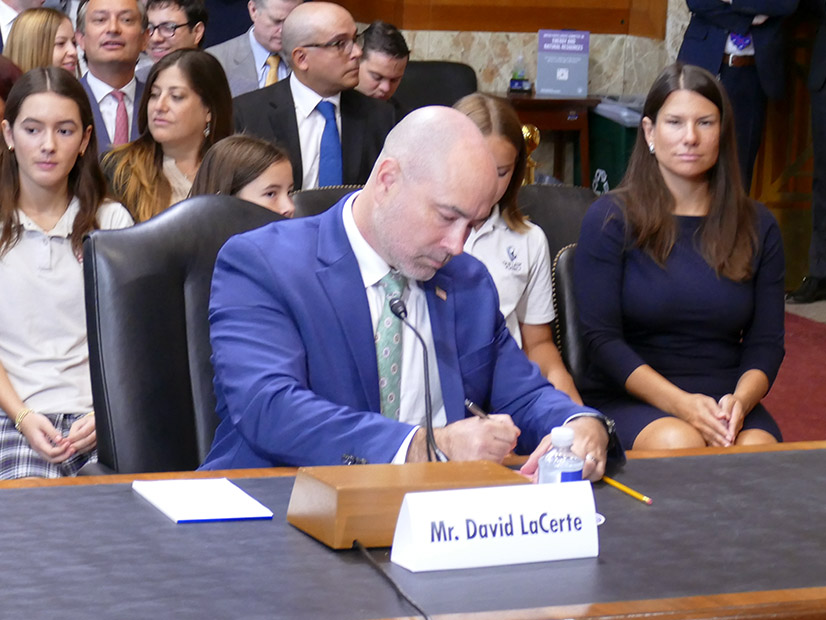
David LaCerte | © RTO Insider LLC

“The commission’s independence, its bipartisanship and its members’ expertise have always been part of its strength,” Heinrich said. “They have contributed to, rather than detracting from, the making of good energy policy, and I believe Ms. Swett has the necessary qualifications for this job.” 

Normally, Heinrich said, he would have voted in favor of Swett’s nomination. He added that LaCerte lacked the qualifications for the job, saying he “does not meet the basic statutory requirements.” However, neither of them got his vote and all but one Democrat on the committee voted against the pair. 

“These are not normal times,” Heinrich said. “This administration is issuing illegal stop work orders on fully permitted projects. They are creating a grid crisis. They are killing good union jobs, and they are raising electricity prices, and until they are willing to comply with the letter of the law, it will be difficult for me to support their nominations.” 

The two nominees need to get approved by the entire Senate in floor votes before they can move into offices at 888 First St. NE. Sen. Lisa Murkowski (R-Alaska) asked Lee to impress on leadership the imperative of getting FERC back to a full quorum. 

WEIM Prices Rise on Higher Gas Costs in Q2 2025

Western Energy Imbalance Market prices increased sharply in the second quarter of 2025 compared with the same period in 2024, mostly due to higher natural gas prices at Western hubs — with some seeing 80% gains.

That was a key finding in a report CAISO’s Department of Market Monitoring (DMM) delivered at the Western Energy Markets Governing Body’s general session Sept. 9.

The report showed 15-minute market prices across the WEIM averaged $26/MWh during the quarter, a 12% increase compared with 2024.

California experienced the highest electricity price in the market — about $28.40/MWh, marking a 22% increase. The Desert Southwest region saw the biggest gain at 40%, while Pacific Northwest prices were up 14%.

Rising gas costs and higher load drove the price gains, Eric Hildebrandt, DMM executive director, said in the report.

Natural gas prices at most major Western hubs were “up significantly compared to the second quarter of 2024,” with the average prices at Henry Hub, PG&E Citygate, SoCal Citygate, and NW Opal Wyoming increasing by 55%, 27%, 80% and 64%, respectively, compared with the second quarter of 2024, Hildebrandt said in the report.

Asked by RTO Insider to provide more insight into the causes of gas price increases, CAISO said it “doesn’t monitor these markets directly.”

“Our regulator, FERC, would be in a better position to answer this question,” the ISO said. “We generally treat gas prices as inputs.”

Demand increased in the WEIM, too, but not by much: Total system load averaged 74.7 GW, which was about 1.4% greater than the load in the second quarter of 2024. The Pacific Northwest region’s average load came in at about 21 GW, up 1% from the second quarter of 2024. CAISO’s average load was about 22 GW, up 1.9%.

Policy Project Updates

Speaking during the session, WEM Governing Body Chair Rebecca Wagner said the WEM’s policy projects are “back on track” after a “hiatus due to the work on the congestion revenue rights [initiative].”

Wagner said the WEM Governing Body was changing its approach to policy updates at its meetings.

“Rather than having a detailed policy initiative update, you can find that information in our informational reports … and so what we’re going to do instead is just policy hot topics,” Wagner said. “What are the key topical items that are rising to the top for ISO management and most importantly with stakeholders?”

Becky Robinson, CAISO director of market policy development, said the ISO plans to potentially bring certain policy initiative decisions to the next WEM board meeting in October.

Specifically, Robinson said CAISO could have a proposal ready for a decision associated with the ISO’s gas resource management initiative. That initiative has “set out to determine what parts of our market design may limit the ability of gas resources from participating in the WEIM or the EDAM when it’s up and running next year,” Robinson said.

The goal of the new proposal is to address what factors might be restricting gas resources’ ability to accurately reflect their gas cost and availability, she said.

The proposal could include three parts.

First, it could provide updates to day-ahead advisory market runs, so that “we are providing that information to market participants … potentially in advance of the day-ahead market,” Robinson said.

The second part could include providing more options for cost inputs and cost recovery for gas resources better accommodate variables such as extreme weather, she said.

The third part of the proposal could include more options for managing certain limits encountered by gas resources, Robinson said.

No Joint General Session

The WEM Governing Body general session was held a day before the body’s joint executive session with the ISO Board of Governors, but no joint public meeting between the boards will be convened in September — just as in July.

Asked about the reason, a CAISO spokesperson said: “General session meetings are held only when there are planned topics of discussion. Since there are no general session topics for the joint meeting or the Board of Governors meeting this month, those two general sessions were not scheduled.”

ISO-NE Kicks off Talks on Accreditation, Seasonal Capacity Changes

ISO-NE kicked off discussions on the second phase of its capacity auction reform (CAR) project at the NEPOOL Markets Committee on Sept. 10, beginning long-awaited talks on accreditation and seasonal capacity auction changes. 

Changes to capacity accreditation would directly affect the capacity market revenues available to resources in the region, which makes it a particularly hot topic for New England stakeholders. 

The second phase of the CAR project also includes a proposal to split ISO-NE’s annual capacity commitment period (CCP) into six-month summer and winter seasons with separately procured capacity. 

ISO-NE is aiming to finalize and file the CAR seasonal and accreditation (CAR-SA) changes by the end of 2026. The RTO is nearing the end of its work on the first phase of the CAR project (CAR-PD), which is focused on transitioning from a forward to a prompt capacity auction, along with resource retirement changes. (See Stakeholders Mixed on ISO-NE Prompt Capacity Market Proposal.) Both phases of the CAR project are intended to take effect for the 2028/2029 CCP. 

The RTO’s CAR effort began in 2022, but it paused the work for an extended period to expand the scope of the project to include changes to the auction format. 

The proposed accreditation reforms would base each resource’s capacity value on “how an increment of capacity from the resource would reduce the total amount of expected unserved energy.” 

Steven Otto, manager of economic analysis at ISO-NE, said this approach should better account for resources’ actual contributions to regional reliability, improving market efficiency and providing more accurate signals for resource entry and exit.  

“The [marginal reliability impact] framework, in conjunction with the other elements of the CAR proposal, will help the capacity market meet its core objectives of reliability, sustainability and cost effectiveness by accrediting resources based on their expected performance during simulated hours where additional available capacity would mitigate or prevent load shed,” Otto said. 

In the new format, each resource’s accreditation would be subject to change as the resource mix evolves, which could incentivize a more diverse resource mix. For example, as the proliferation of solar generation reduces reliability risks during early evening hours in the summer, incremental additions of solar capacity would reduce the accreditation of all solar resources. 

Under the existing rules, “resources’ [qualified capacity] values are largely static, which may cause disparities between resources’ capacity market compensation and their resource adequacy contributions as system conditions evolve,” Otto said. 

One key component of the accreditation reform proposal will be the calculation of the winter gas constraint, intended to reflect the region’s limited access to gas during cold periods. 

Otto noted that ISO-NE plans to develop a “market-based gas constraint for the winter season,” which would be based on separate demand curve for gas resources that lack firm fuel contracts. 

ISO-NE wrote in a 2024 memo that the approach “would decrease the amount of gas capacity procured in the winter… and would pay that capacity a lower price.” 

Though the details of this market constraint have yet to be developed, the mechanism will likely reduce accreditation values for gas resources that do not have firm fuel arrangements, creating incentives for generators to secure their fuel supply. 

Stakeholder Proposals

Also at the MC, stakeholders proposed several changes to ISO-NE’s CAR-PD proposal. 

Andrew Gillespie, director of governmental and regulatory affairs at Calpine, made the case for ISO-NE to change its formula for calculating the capacity offer price threshold (COPT) in the capacity market. Market participants that bid above this threshold are subject to market power review by the Internal Market Monitor and must submit a detailed cost workbook. 

For the 2028/2029 CCP, ISO-NE plans to base the threshold on the average of the clearing price from previous Forward Capacity Auction (FCA) and a clearing price forecast for the upcoming auction. 

Gillespie argued that relying on the clearing price from previous capacity auction, which would have been held about four years earlier, inadequately accounts for the recent spike in capacity scarcity hours. 

Elaborating on a proposal outlined at the MC in August, he said the RTO should instead rely on the opportunity costs, as defined by a formula multiplying the balancing ratio by the performance payment rate by the expected number of capacity scarcity hours. (See “Seller-side Market Power,” NEPOOL Nears Vote on 1st Phase of ISO-NE Capacity Auction Reforms.) 

Relying on this formula would significantly increase the threshold price, Gillespie said. He estimated that the threshold price for the past three auctions would have been more than double the auction clearing price for the past three FCAs. 

He said recent FCAs have underestimated the number of scarcity hours and added that, “without modification to the threshold price, suppliers that submit an offer based on ‘opportunity costs’ may be mitigated by IMM.” 

Ben Griffiths, vice president of wholesale market policy for LS Power, offered an alternative proposal for the threshold, proposing to rely on the most recent annual reconfiguration auction clearing price instead of the most recent FCA clearing price. 

He said this proposal should be applied solely to the 2028/2029 CCP and would serve as a “one-time, targeted fix that it preserves the broader tariff framework and leaves the general COPT formula unchanged for future auctions.” 

Griffiths added that the annual reconfiguration auction clearing price would be a “reasonable substitute” for the FCA clearing price, since annual reconfiguration auctions “are deliberately designed to mirror the FCA in many of their mechanics.” 

Also at the meeting, FirstLight Power’s Tom Kaslow proposed tariff changes to impose Pay-for-Performance charges on exports during capacity scarcity events. ISO-NE also advocated for this change in its annual report, published earlier in 2025. (See ISO-NE Monitor Discusses Market Trends, Energy Transition.) 

In response to the proposal, some stakeholders have advocated for explicit language exempting capacity-backed exports from performance charges. 

Report: Gas Powerful Tool for Energy Assurance

With electric utilities worldwide facing rapidly rising demand and an “unpredictable” planning environment, natural gas continues to hold a strong role “supporting long-term sustainability and energy security” in the global market, according to the International Gas Union’s 2025 Global Gas Report.

The report, released Sept. 10 and co-authored with European gas pipeline operator Snam, analyzed trends in the international gas market and compared them with developments in the electric landscape. Overall gas demand grew to 4,122 billion cubic meters in 2024, up 1.9% from the year before, while gas production grew by 65 Bcm, or 1.6%.

Demand growth was strongest in Asia, which consumed 36 Bcm (3.6%) more in 2024 than in 2023, followed by Russia, up 11.5 Bcm (2.5%), and North America, up 22.9 Bcm (2%). Consumption fell by 0.6% in South America and 1.5% in Africa. About 80% of the natural gas supplied in North America went to the U.S., IGU said, partly because of historically low Henry Hub prices making gas more cost-competitive with coal for electric utilities.

Power generation made up about one-third of gas consumption worldwide in 2024, more than any other application; industrial applications and residential and commercial uses came in second and third, continuing the pattern of the previous four years. Similar results were seen in North America, Asia and the Middle East.

Despite this steady demand growth, the report noted that “shifts in technology, climate and geopolitics” have introduced uncertainty into the market. Record high summer temperatures in 2024 contributed to peak power demands in multiple countries including the U.S. Import tariffs imposed by the Trump administration also have the potential to “weaken global liquified natural gas demand despite strong support for the oil and gas sector domestically … exacerbated by the unpredictable pace of the energy transition.”

The ongoing data center boom is expected to drive structural increases in electricity demand as well. IGU observed that about 73 GW of new data center capacity is under construction and planned in the next five years, on top of the close to 45 GW that existed in 2024, with most facilities concentrated in Georgia, Arizona, Texas and Virginia. “Favorable conditions such as low-cost energy, tax incentives and robust fiber infrastructure” are behind the anticipated growth, according to the report.

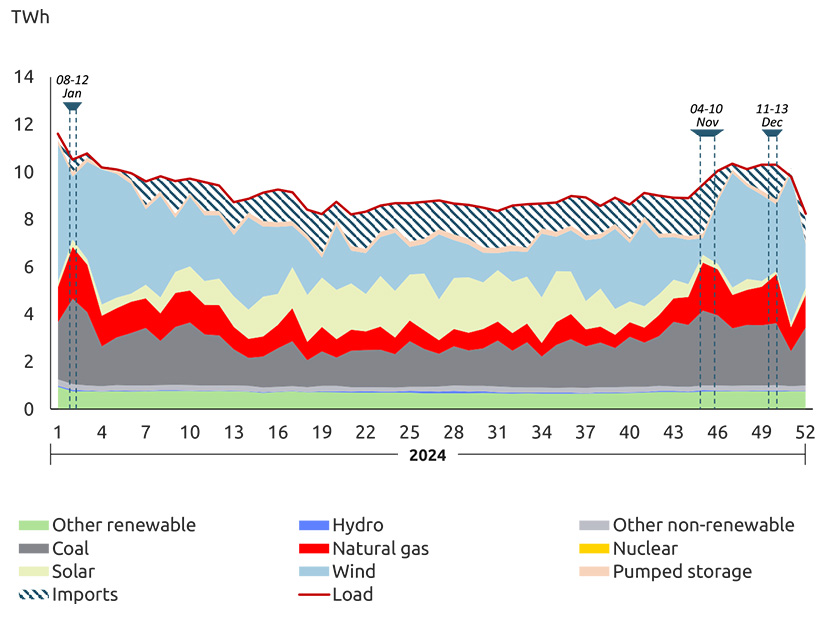
The weekly power balance in Germany for 2024 by energy source, showing the use of natural gas to meet demand during periods of low wind generation. | European Network of Transmission System Operators for Electricity

In light of these growing pressures, IGU argued that “gas is well positioned as a force of resilience [and] a lower-carbon alternative to coal.” The organization noted the use of gas as “insurance for power systems” that have seen growing penetration by intermittent resources like wind and solar, citing the “dunkelflaute” incidents in Germany in 2024 when wind activity, and thus wind power generation, fell off steeply, leaving the slack to be taken up by gas, coal and imports.

Gas also constitutes “a proven technology partner to batteries,” the report said, pointing to the experience of California in the first six months of 2025, when gas regularly ramped up to compensate for decreased output from solar and battery facilities. These global examples show the role of gas “as a flexible solution in balancing [renewable energy] variability,” IGU said.

Given the importance of gas, the report argued for the U.S. and other developed nations to pursue “targeted investment across the natural gas value chain, careful alignment of technology choices with system needs and reform of power market structures to ensure project viability.” Potential value chain investments include upstream supply, midstream infrastructure such as pipelines and storage, and increased gas generation capacity. Market reforms could include clarifying the role of gas plants as support for renewable energy rather than as baseload power.

“The future role of natural gas in power systems will vary widely depending on feasibility considerations, best practices and regional integration strategies,” the report said. “Existing infrastructure, current power mixes and policy environments will determine how extensively gas-to-power can contribute to system flexibility. Therefore, unlocking the full potential of natural gas as a dispatchable and balancing power source will require a set of targeted measures at both national and global levels.”

Permitting Hearing Shows Tricky Politics of Getting a Bill Passed

The House Natural Resources Committee held a hearing Sept. 10 on three pieces of permitting reform legislation that showed the political disputes that will have to be solved if any of them are going to pass. 

“It’s a bipartisan issue,” Chair Bruce Westerman (R-Ark.) said in opening remarks. “It’s not just people who vote Republican that are coming in my office to tell me that. We had a hearing on this topic in July, and in that hearing, many of my friends across the aisle were calling fouls on the current administration, saying they shouldn’t be doing this. But you know what? This time a year ago on our side of the aisle, we were calling fouls on the Biden administration, saying they shouldn’t be doing this.” 

Congress has an opportunity to enact permitting legislation that will improve the process regardless of who occupies the White House, he added. 

The committee is not the only one working on the issue, with the House Energy and Commerce Committee planning a hearing on other permitting legislation for Sept. 16. Senate committees have been crafting bills as well. (See related story, Permitting Legislation Effort Picks Up Steam, but Passage Remains Difficult.) 

Two of the bills before the committee, H.R. 573 and H.R. 4503, are focused on modernizing the permitting with new technologies and enhanced data, but Ranking Member Jared Huffman (D-Calif.) said Westerman’s bill — the SPEED Act (H.R. 4776) — “takes a sledgehammer” to the National Environmental Policy Act’s core provisions. 

“The SPEED Act treats public input like it is an annoyance, like a hurdle, rather than a resource that can guide better decisions,” Huffman said. “It restricts what major environmental impacts can even be considered for review. It eliminates the spotlight that NEPA provides for the public to help government get it right, and by shrinking analysis and compressing timelines without investing in greater agency permitting capacity, you’re really just inviting shoddy analysis, and ultimately that’s going to lead to more litigation and uncertainty.” 

The act is meant to cut red tape and relieve the “logjam” caused by onerous reviews under NEPA that have slowed down infrastructure projects, Westerman said. 

“NEPA must be further reformed to put definitive guardrails around what agencies are expected to review,” he added. “Much like the review documents themselves, the NEPA litigation has gotten out of control. NEPA is the most frequently litigated environmental statute.” 

The SPEED Act does have a Democrat as a co-sponsor: Rep. Jared Golden (Maine), whose district is among the most conservative in New England, with President Donald Trump winning it in the past three presidential elections. But beyond the opposition from the leading Democrat on the committee, other members of the rank and file questioned why they should work with an administration that is actively working against their states’ policies. 

“I want to get to ‘yes’ on this bill,” Rep. Seth Magaziner (D-R.I.) said. “I’m not there now, but I want to get there because I understand that … we need to build out our infrastructure, repair our highways and bridges, and achieve the clean energy transition and so much more. We need to make it easier to build in this country again.” 

The conversation about how to balance against the need for environmental protections and allowing impacted communities a voice in the NEPA process is something that normally Congress should be engaged in, he added. 

“But we are having this normal conversation in an abnormal time, a time when the Trump administration is unilaterally and most likely illegally canceling and stopping clean energy projects, including a very important project in my district, the Revolution Wind project that was set to deliver energy to the grid at a below-market rate for consumers and meet a third of my state’s electricity demand,” Magaziner said. 

The bills before the committee have their merits and deficiencies, but they also have to be considered in the context of the administration blocking clean energy, he added.